


Tantalum element (Ta): tantalum periodic table facts
Tantalum periodic table facts: tantalum (Ta) is element 73, a transition metal in group 5, period 6. Meet tantalum, the chemical element with symbol Ta that sits at position 73 on the periodic table: a dense, lustrous, ductile metal that hardly reacts with anything. Its name comes from Tantalus in Greek mythology, and if you want to know why the element tantalum ends up in your phone, in surgical tools and in chemical plants, the short answer is a self-healing surface skin that makes it almost immune to chemical attack. To read about argonium, clathrates and the first compound, argon fluorohydride, look up argon (ar) first for the basics.
Rotate the 3D Bohr model of tantalum
Drag to orbit, scroll to zoom.
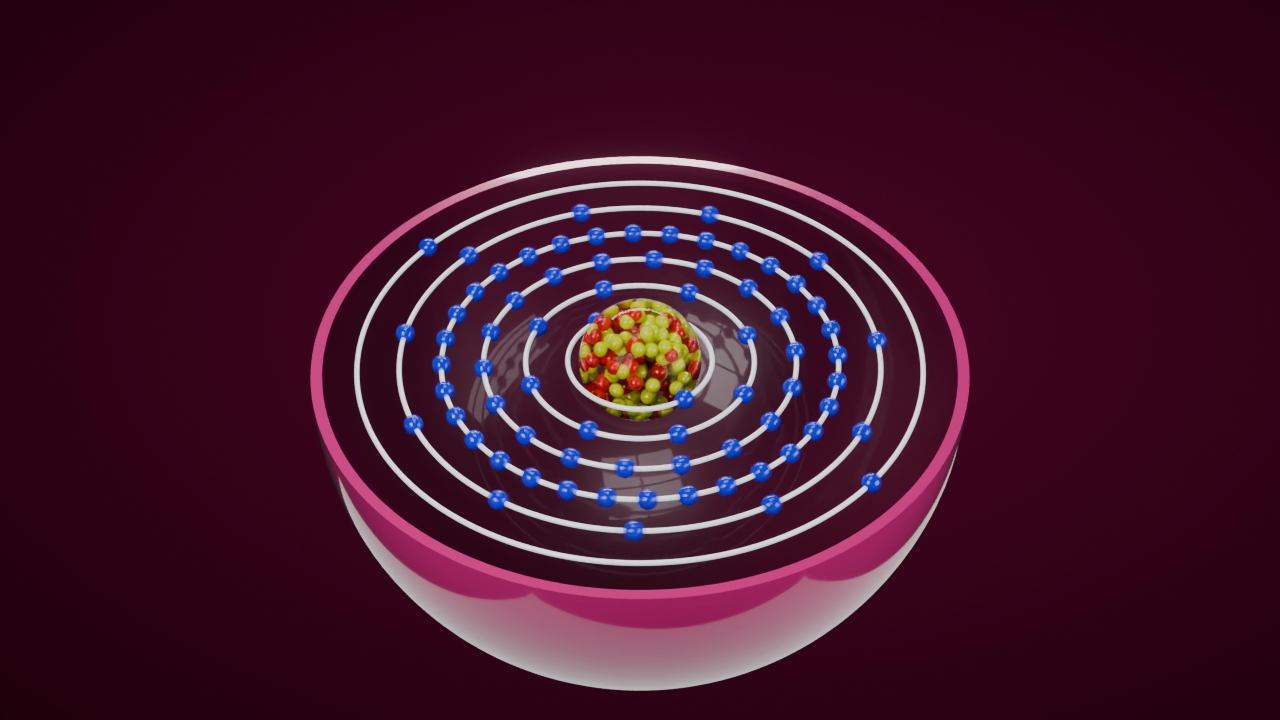
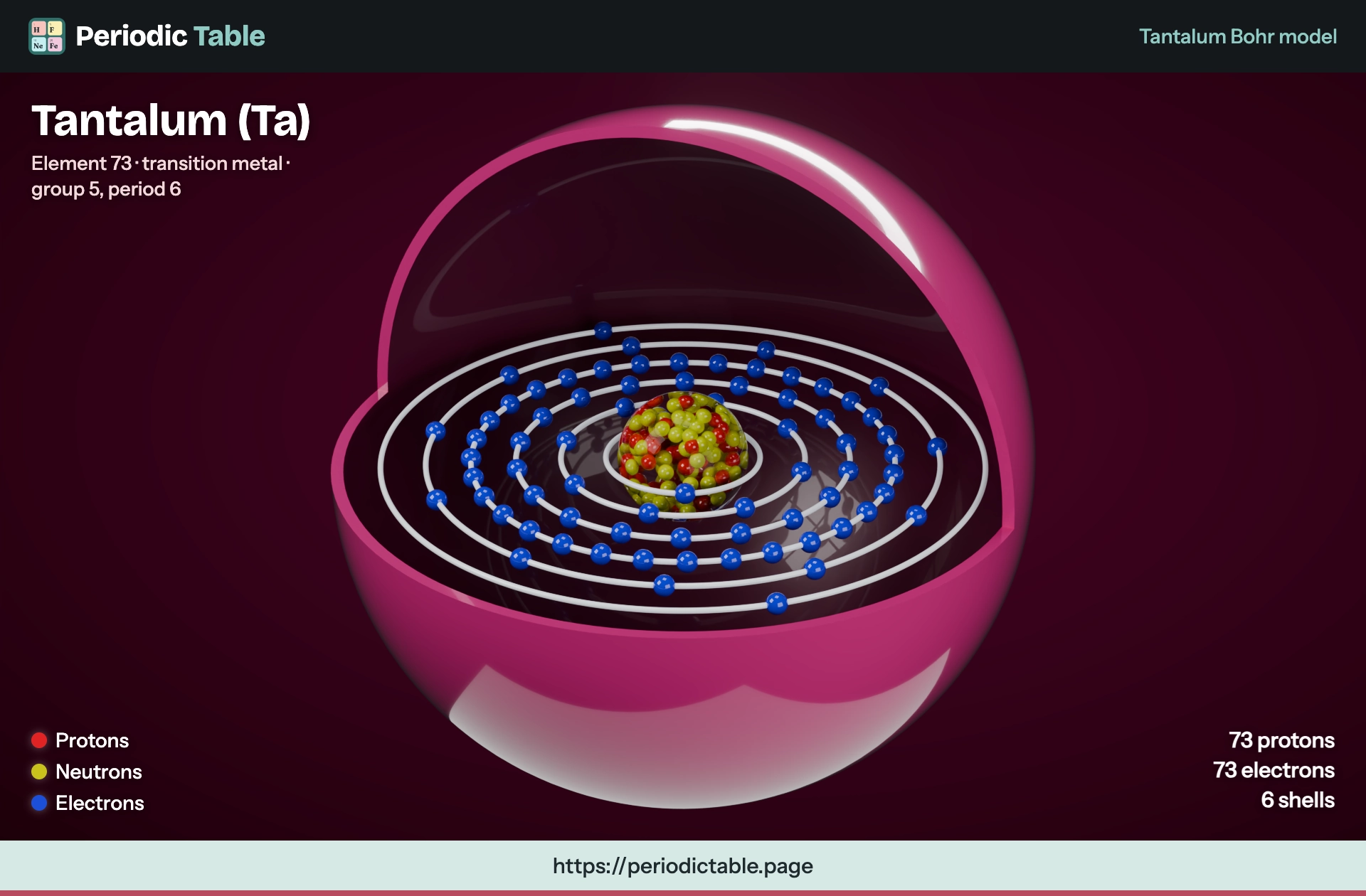
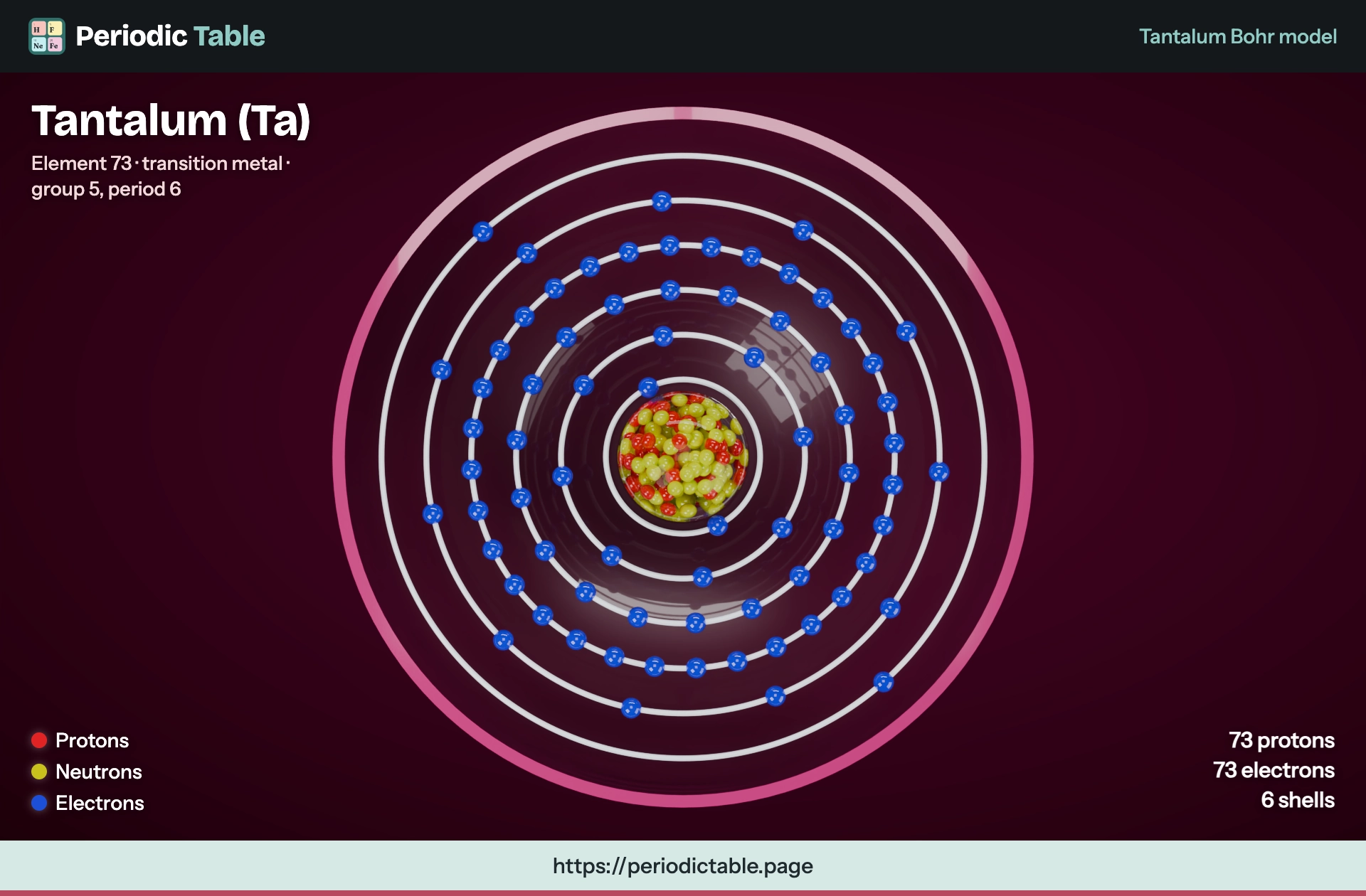
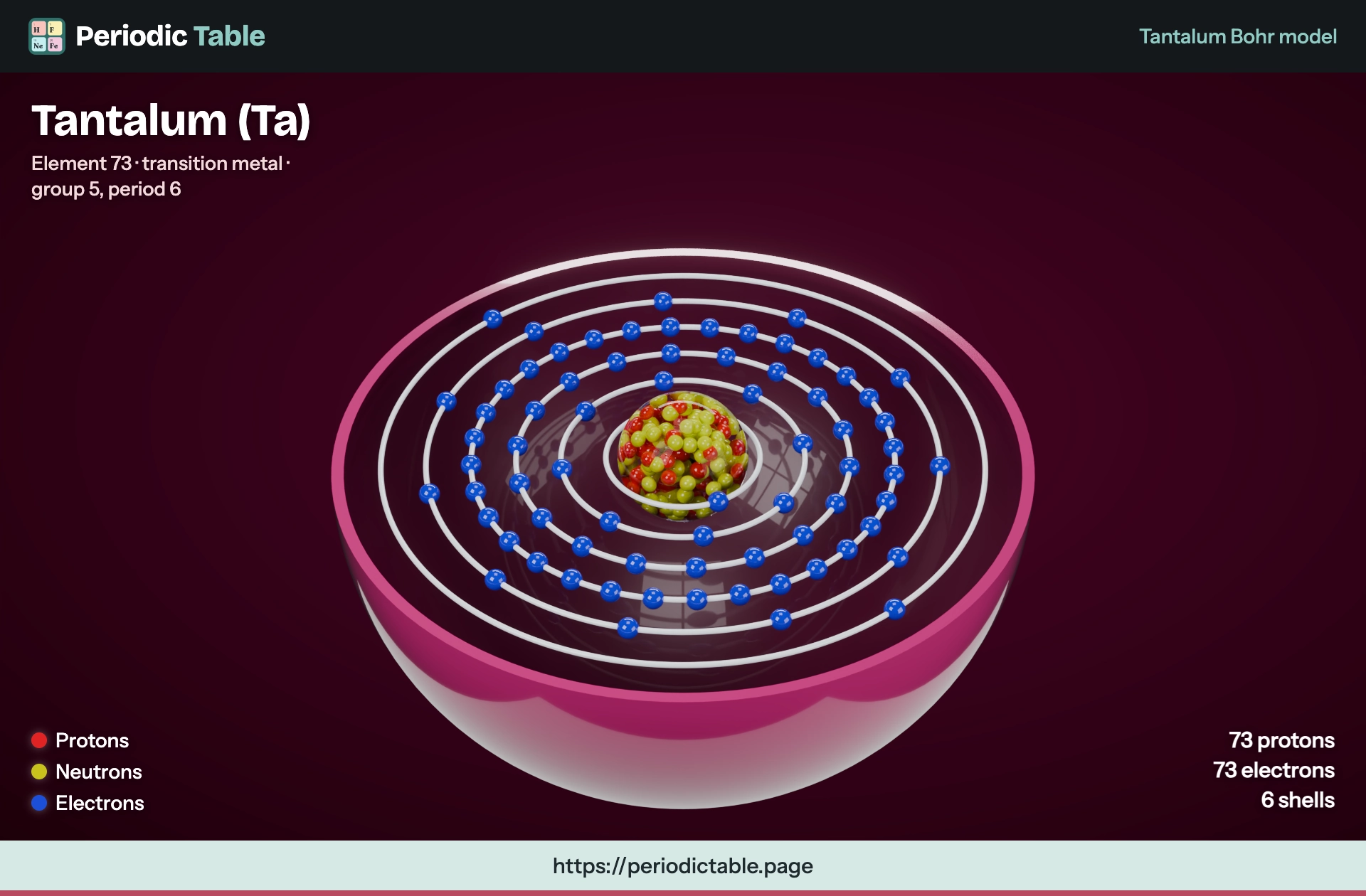
This is a Bohr model of tantalum (Ta), a simplified picture of a single tantalum atom. Its nucleus holds 73 protons, and a neutral tantalum atom has 73 electrons, arranged around it in 6 shells (2 in shell K, 8 in shell L, 18 in shell M, 32 in shell N, 11 in shell O and 2 in shell P).
Tantalum periodic table electron configuration
- Shorthand
- [Xe] 4f14 5d3 6s2
- Full
- 1s2 2s2 2p6 3s2 3p6 4s2 3d10 4p6 5s2 4d10 5p6 6s2 4f14 5d3
- Electrons per shell
- 2, 8, 18, 32, 11, 2
Tantalum element properties and atomic data
- Atomic number
- 73
- Atomic mass
- 180.9479 u
- Phase at STP
- Solid
- Melting point
- 3016.85°C (3290 K)
- Boiling point
- 5457.85°C (5731 K)
- Density
- 16.69 g/cm³
- Electronegativity (Pauling)
- 1.5
- Period
- 6
- Group
- 5
- Block
- d-block
- Appearance
- Gray blue
- Discovery date
- 1802
- Discovered by
- Anders Gustaf Ekeberg
- Named by
- —
Tantalum element facts at a glance
Tantalum is a transition metal in the d-block and a group 5 element, sharing its column with vanadium and niobium, with hafnium as its neighbour to the left. It is also counted as a refractory metal, one of the handful of elements that stay solid far above the temperatures that melt steel. The table below collects the reference values you will reach for most often. Haber-Bosch ammonia, nitrates and fertilizers are the farming story in the nitrogen element, linked to the nitrogen cycle.
| Property | Value |
|---|---|
| Symbol | Ta |
| Atomic number | atomic number 73 |
| Standard atomic weight | 180.948 |
| Group, period, block | Group 5, period 6, d-block |
| Electron configuration | [Xe] 4f14 5d3 6s2 |
| Melting point | 3,017 °C (3,290 K) |
| Boiling point | 5,458 °C (5,731 K) |
| Density at 20 °C | 16.69 g/cm3 |
| Crystal structure | bcc (alpha phase) |
| Electronegativity (Pauling scale) | 1.5 |
| Specific heat | 140 J/(kg·K) |
| Thermal expansion | 6.3 µm/(m·K) at 25 °C |
| Naturally occurring nuclides | Ta-181, Ta-180m |
| CAS number | 7440-25-7 |
Two numbers explain most of its uses: a density close to twice that of iron, and a melting temperature beaten by only three other metals. Nearly everything else in this article follows from those figures plus its resistance to chemical attack.
Physical properties of tantalum
In bulk form tantalum is a heavy, blue-gray solid that polishes to a silvery sheen. It is hard, yet you can roll it into foil or draw it into wire without cracking, and it carries both heat and electricity well. For cadmium telluride solar films and control rods, the cadmium electron configuration page gives a short technical summary.
Its thermal conductivity is about 57.5 W/(m·K) and its electrical resistivity about 131 nΩ·m at room temperature. Stiffness is high too: Young's modulus of roughly 186 GPa, a shear modulus near 69 GPa, and a Mohs hardness of 6.5.
Those figures place it firmly among the refractory metals, the small family that also includes niobium, molybdenum, tungsten and rhenium. What sets it apart from its relatives is that it combines that temperature tolerance with unusual formability.
Melting point and body-centered cubic crystal structure
Tantalum melts at 3,017 °C and boils near 5,458 °C. Among all the elements, only tungsten, rhenium, osmium and carbon hold their solid form longer.
Bulk tantalum is the alpha phase, a body-centered cubic lattice that stays soft and ductile even well below room temperature, which is unusual for a bcc metal. A second, metastable beta phase is tetragonal, much harder and brittle; it appears mostly in thin films deposited by sputtering or vapour deposition, and it converts back to alpha when heated to roughly 750 °C.
Corrosion resistance and the protective oxide film
The moment a freshly cut surface meets air, it grows a thin, self-healing oxide film. That skin is why tantalum shrugs off aqua regia below about 150 °C and ignores most acids at room temperature, a level of corrosion resistance that engineers compare with gold and platinum.
Its chemical inertness has limits, though. Hydrofluoric acid, hot concentrated sulfuric acid, fluoride-bearing solutions and molten alkali hydroxides will all dissolve it, so you should check those exposures before specifying it.
Atomic structure of element 73
Each tantalum atom holds 73 protons and 73 electrons arranged as [Xe] 4f14 5d3 6s2. That electron configuration leaves five outer electrons available for bonding, which is why +5 dominates among its oxidation states.
Lower states from −3 up to +4 exist in specialised compounds, but in water Ta shows only the +5 state. Its electronegativity is 1.5, its first two ionization energies are 761 and 1,500 kJ/mol, the empirical atomic radius is 146 pm, and the covalent radius is about 170 pm.
Isotopes and the rare tantalum-180m nuclear isomer
Natural tantalum is a blend of two stable isotopes: Ta-181 makes up 99.988 % and Ta-180m only 0.012 %. The second is a nuclear isomer, an excited nuclear state that ought to decay, yet nobody has ever caught it doing so; experiments only set a lower limit on its half-life of about 1017 years.
That makes it the rarest primordial nuclide known. By contrast, its ground state Ta-180 lasts about eight hours, and Ta-182, formed when the metal absorbs neutrons, is a strong gamma emitter.
Tantalum pentoxide, tantalum carbide and other Ta compounds
Nearly all tantalum chemistry runs through the +5 state. Tantalum pentoxide, Ta2O5, matters most commercially: it forms the insulating layer in capacitors, and it raises the refractive index of the special glass used in camera lenses. Tantalum carbide, TaC, is one of the hardest known ceramics and goes into cutting tools, while tantalum nitride films act as thin insulators in microchips.
Among the halides, tantalum pentafluoride (TaF5) is a white solid that melts at 97 °C, and the chloride TaCl5 is the usual starting reagent for making new compounds. Lithium tantalate, LiTaO3, is a piezoelectric crystal used in signal filters, and organometallic compounds such as pentamethyltantalum are studied in research labs.
History of tantalum from Anders Ekeberg to metallic tantalum
Swedish chemist Anders Ekeberg identified the element in 1802 in mineral samples from Sweden and Finland. In 1809 William Hyde Wollaston compared samples of it with columbium, found by Charles Hatchett a year before Ekeberg's work, and wrongly concluded they were the same element. The confusion lasted decades.
In 1846 Heinrich Rose argued the ores held two distinct elements, and in the 1860s Blomstrand, Sainte-Claire Deville and Troost proved him right. Jean Charles Galissard de Marignac confirmed in 1866 that there were exactly two, and that columbium was the element now called niobium.
De Marignac also made the first, impure metallic tantalum in 1864 by heating its chloride in hydrogen. Truly workable wire arrived in 1903, when Werner von Bolton produced it in Charlottenburg, and for a few years it served as light bulb filaments before a sturdier material displaced it.
The Greek mythology behind the name
Ekeberg borrowed the name from Tantalus, the king condemned to stand in water that drained away whenever he bent to drink, beneath fruit that drifted out of reach. He said it alluded to the new substance's refusal to soak up acid even when immersed in it. Rose kept the family theme when he named niobium after the king's daughter, Niobe.
Where tantalum minerals occur: tantalite, coltan and columbite
Tantalum makes up only about 1 ppm of Earth's crust, and it never occurs as a native metal. Instead it is locked inside minerals, nearly always together with niobium. Tantalite, (Fe,Mn)Ta2O6, is the main ore.
It shares its structure with columbite, and the name simply flips with the chemistry: when tantalum outweighs niobium the mineral is called tantalite, and when niobium wins it is columbite. Miners in Central Africa sell the mixed concentrate as coltan.
| Mineral | Formula | Role as a source |
|---|---|---|
| Tantalite | (Fe,Mn)Ta2O6 | Primary ore, highest tantalum share |
| Columbite | (Fe,Mn)(Nb,Ta)2O6 | Niobium-rich partner, still mined for tantalum |
| Microlite | (Na,Ca)2Ta2O6 | Pyrochlore-group mineral in pegmatite bodies |
| Wodginite | Mn(Sn,Ta)(Ta,Nb)2O8 | Tin-bearing source in lithium-rich deposits |
Production geography has swung sharply. Before 2007 Australia and Brazil led output; since then Rwanda and its neighbours in Central Africa have supplied much of the world, while China and Mozambique mine ores unusually rich in tantalum. Brazil still holds some of the largest reserves of these minerals.
Geology of tantalum ores in pegmatites and granites
Tantalum ores form late in the cooling of magma. The element does not fit easily into common rock-forming crystals, so it concentrates in the last fluids and ends up in rare-metal granites and in pegmatite dikes alongside lithium and tin minerals.
Weathering later frees the dense grains into river and beach placers, where they settle next to cassiterite. That is why tin mining in Thailand and Malaysia yields tantalum as a by-product: the smelter slag holds enough of it to leach out profitably.
Tantalum as a conflict resource and supply risk
Coltan from the eastern Democratic Republic of the Congo helped finance armed groups during the war that began there in 1998, and a 2003 United Nations report linked smuggling of the ore to the fighting. That conflict is why tantalum is listed as one of the 3TG minerals that companies in the US and EU must trace back to the smelter. If you buy a phone or laptop from a large manufacturer, its annual sourcing report covers this element by name.
Governments watch the supply side closely as well. The United States treats tantalum as a critical mineral, keeps a reserve in the National Defense Stockpile, and has had no domestic mining of it since 1959, relying entirely on imports.
Tantalum production and refining
Because tantalum and niobium behave almost identically in solution, separating them is one of the toughest jobs in metallurgy. Modern plants rely on hydrometallurgy: they dissolve the ore concentrate in hydrofluoric acid mixed with sulfuric acid, then pull the Ta fluoride complex into an organic solvent such as methyl isobutyl ketone.
This solvent extraction step replaced the older fractional crystallisation method of the 1860s. Lowering the acidity sends niobium back into the water layer and leaves purified tantalum in the organic phase.
Adding potassium fluoride then precipitates potassium heptafluorotantalate, which is reduced with sodium at about 800 °C:
$$\mathrm{K_2TaF_7 + 5\,Na \rightarrow Ta + 5\,NaF + 2\,KF}$$
The result is a fine tantalum powder that is pressed and sintered under vacuum, or melted into ingots by electron beam. A newer route skips the fluoride chemistry and reduces solid Ta2O5 directly by electrolysis in a molten salt bath near 1,000 °C. Once you have solid stock, all welding must happen in an inert atmosphere of argon or helium, since hot tantalum soaks up oxygen and nitrogen and turns brittle.
Uses of tantalum in electronics, industry and medicine
Three markets account for most demand, covered below. Beyond them, the same mix of high-temperature strength and chemical stability puts the element in a long list of niche jobs:
Other uses of tantalum
- Hot zones of vacuum furnaces and evaporation filaments
- Chemical reaction vessels, valve bodies and heat exchangers for hot hydrochloric acid
- Radiation shielding in aerospace hardware such as the Voyager probes
- Shaped charge liners, where its mass boosts penetration
- Cases of luxury watches and spherical powder for additive manufacturing
Tantalum capacitors in phones and computers
The largest single use is the tantalum electrolytic capacitor. A pellet of pressed powder forms one plate, its anodised surface skin becomes the dielectric, and a conductive electrolyte or polymer acts as the other plate.
Because that dielectric layer is extremely thin, the part packs high capacitance into a tiny case, which is why you find tantalum capacitors in cell phones, laptops, cameras and car electronics. In semiconductor fabs, sputtered tantalum and its nitride also serve as barrier layers that stop copper wiring from leaking into silicon.
Tantalum alloys for jet engines and reactors
A few percent of tantalum strengthens the nickel superalloys used in turbine blades, helping them keep their shape at glowing-hot temperatures. Tantalum alloys with small additions of other refractory elements are stronger than the pure element yet still formable, so they appear in nuclear reactors, rocket nozzles, missile parts and chemical plant piping. Each alloy trades a little ductility for a large gain in strength.
Medical implants and surgical uses
Tantalum is biocompatible: body fluids do not corrode it and living tissue tolerates it without irritation. Porous tantalum scaffolds let bone grow straight into hip and knee components, and the element is used in dental implants, pacemaker parts, vessel clips, monofilament sutures and surgical instruments. Because it is non-magnetic, patients with tantalum parts can usually still have an MRI, and thin tantalum coatings are added to titanium devices to improve how they bond with the skeleton.
Tantalum safety and environmental notes
The metal itself is low in toxicity, and its compounds are rarely met in everyday laboratory chemistry. Workplace exposure comes mainly from breathing fine powder.
In the US, the OSHA permissible exposure limit for tantalum dust is 5 mg/m3 over an 8-hour shift, and NIOSH recommends the same figure with a 10 mg/m3 short-term ceiling. Environmentally, tantalum is one of the least mobile elements: it sits mostly in soils and sediments as particles, dissolved levels in natural waters are below what most instruments can measure, and no pollution from human use has been detected.