


Lithium element (Li): lithium periodic table facts
Lithium periodic table facts: lithium (Li) is element 3, an alkali metal in group 1, period 2. Lithium (symbol Li, atomic number 3) is the least dense metal you will ever handle: a freshly cut piece floats on water and can be sliced with a kitchen knife. Cosmetics fans can read bismuth crystals for oxychloride pigments, while chemists find telluride and oxide data.
It leads the alkali metals, yet its biggest story today is energy storage, with a second life as a pharmaceutical salt that has treated mood disorders for more than 75 years. This guide walks you through its properties, isotopes, sources, history, production and uses, with the reasons behind each one.
Rotate the 3D Bohr model of lithium
Drag to orbit, scroll to zoom.
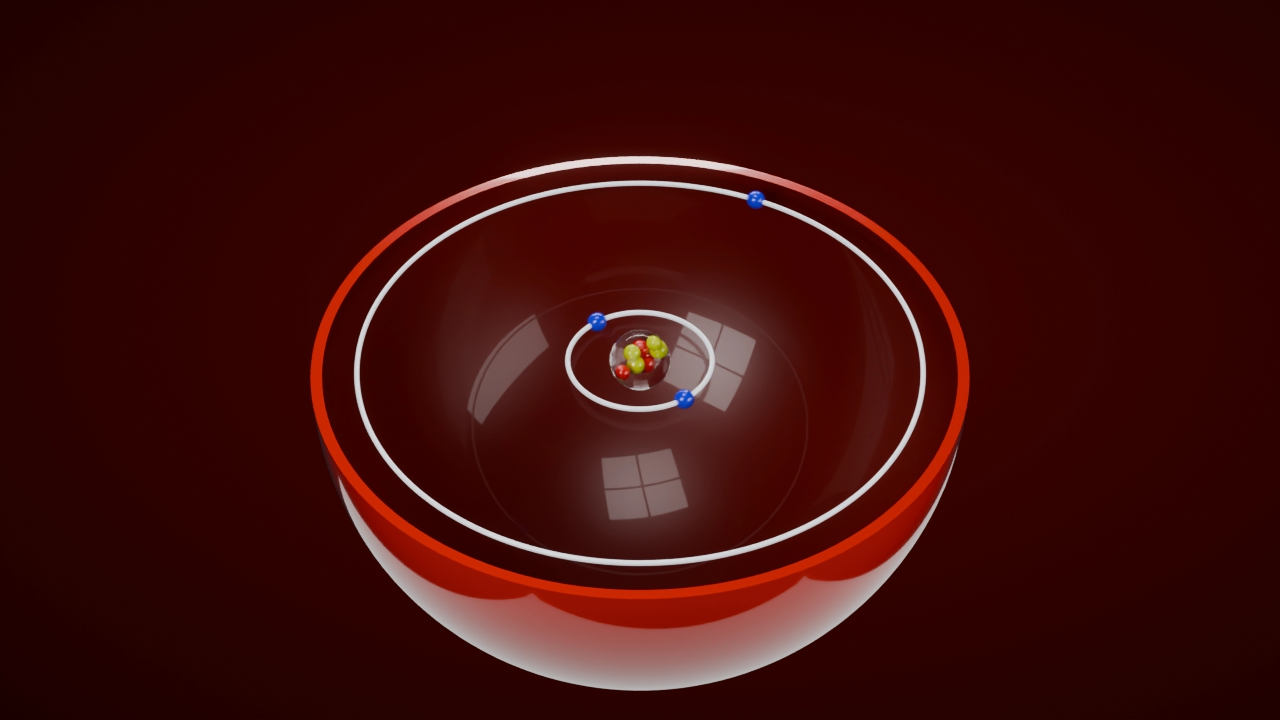
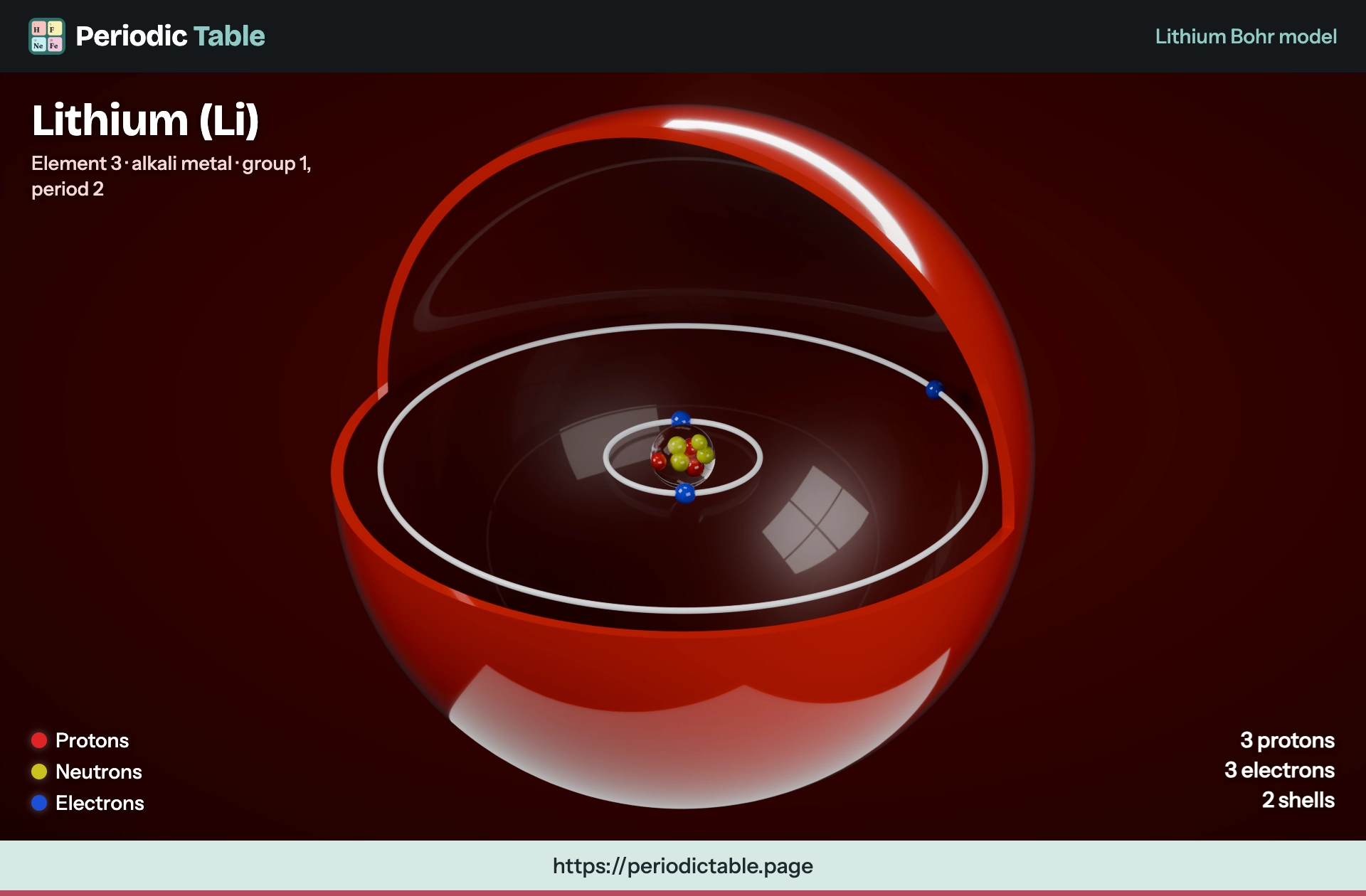
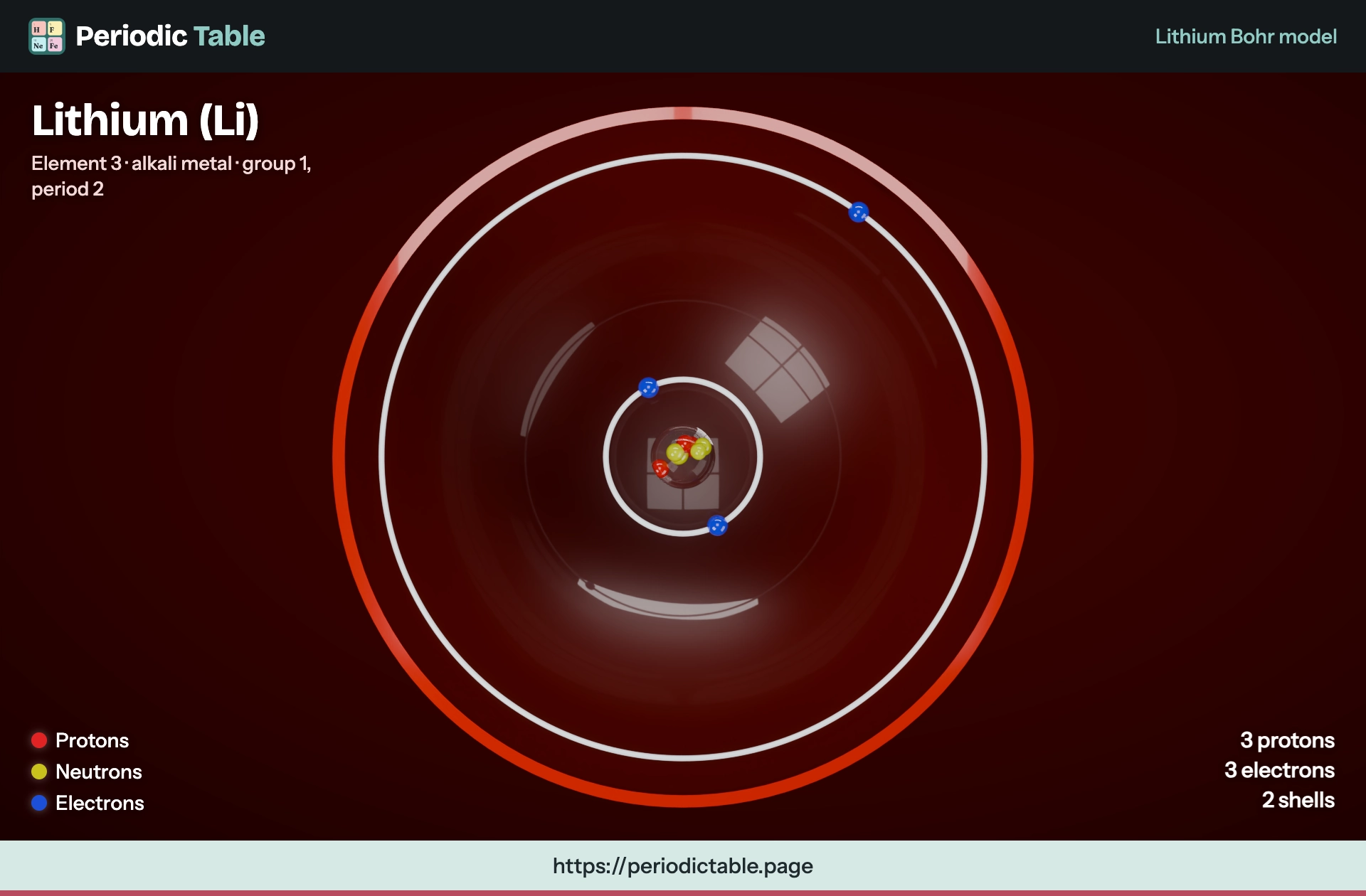
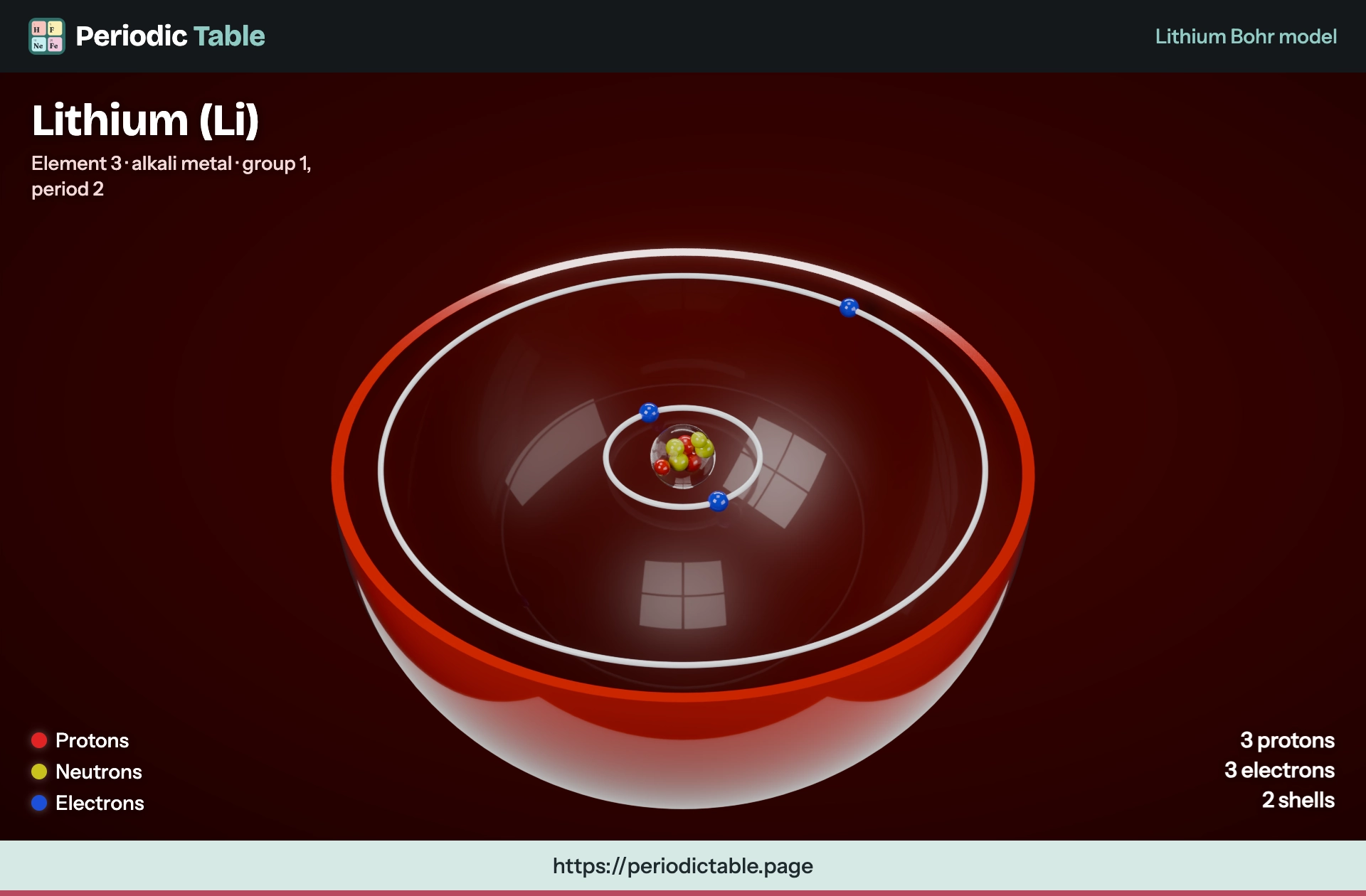
This is a Bohr model of lithium (Li), a simplified picture of a single lithium atom. Its nucleus holds 3 protons, and a neutral lithium atom has 3 electrons, arranged around it in 2 shells (2 in shell K and 1 in shell L).
Lithium periodic table electron configuration
- Shorthand
- [He] 2s1
- Full
- 1s2 2s1
- Electrons per shell
- 2, 1
Lithium element properties and atomic data
- Atomic number
- 3
- Atomic mass
- 6.94 u
- Phase at STP
- Solid
- Melting point
- 180.5°C (453.65 K)
- Boiling point
- 1329.85°C (1603 K)
- Density
- 0.534 g/cm³
- Electronegativity (Pauling)
- 0.98
- Period
- 2
- Group
- 1
- Block
- s-block
- Appearance
- Silvery-white
- Discovery date
- 1817
- Discovered by
- Johan August Arfwedson
- Named by
- —
Facts about lithium at a glance
Before you look at what lithium does, it helps to know the numbers chemists quote for it. The values below come from standard reference data (IUPAC and published thermophysical tables), so you can use them as a quick fact box when you compare lithium with its neighbours. Students checking long-lived isotopes can use technetium uses to find the 97 and 98 isotopes and how each decays.
| Property | Value for Li |
|---|---|
| Symbol | Li |
| Atomic number (Z) | 3 |
| Standard atomic weight | 6.94 |
| Position | Group 1, period 2, s-block |
| Electron configuration | [He] 2s1 (1s2 2s1) |
| Appearance | Soft, silvery-white solid |
| Melting point | 180.50 °C (453.65 K) |
| Boiling point | 1,342 °C (1,615 K) |
| Density at 20 °C | 0.534 g/cm3 |
| Crystal structure | Body-centered cubic |
| Electronegativity (Pauling scale) | 0.98 |
| First three ionization energies | 520.2, 7,298.1 and 11,815.0 kJ/mol |
| Atomic radius (empirical) | 152 pm |
| Covalent radius | 128 pm |
| Specific heat capacity | 3,582 J/(kg·K) |
| Bulk modulus | 11 GPa |
| CAS number | 7439-93-2 |
| Name origin | Greek lithos, "stone" |
Two rows explain most of Li's behaviour. The jump from the first to the second ionization energy is enormous, so the atom gives up exactly one electron and no more. And the low electronegativity of 0.98 means that electron leaves easily, which is why the element is always found bonded to something else.
Lithium electron configuration and group 1 position
A lithium atom holds 3 protons, 3 electrons and, in its common form, 4 neutrons. Two electrons fill the inner 1s shell, the same closed shell helium has, and the third sits alone in the 2s orbital. That single valence electron is what makes Li a member of the first column of the periodic table, directly below hydrogen and next to beryllium in period 2.
Because the outer electron is close to the nucleus, lithium holds it a little more tightly than sodium or potassium do. That makes Li the gentlest member of its group in reactions, but it is still a reactive chemical element that never turns up uncombined in nature, only locked inside compounds.
Physical properties of lithium among the alkali metals
Lithium metal is the lightest solid element at room temperature. Pure lithium has a bright, silvery shine only on a fresh cut; within minutes the surface dulls, so elemental lithium is rarely seen at its brightest. Compared with the other alkali metals, the element lithium has the highest melting and boiling temperatures, the hardest (though still soft) texture and the smallest atoms, so it often behaves like a bridge between its own group and magnesium. Marguerite Perey's discovery at the Curie Institute is told in the francium element, with its naming after France.
Why lithium is so light, soft and heat-hungry
Each Li atom is light (6.94 atomic mass units) and the body-centred lattice packs them loosely, which is why you get 0.534 grams per cubic centimetre, about half the mass of the same volume of water. If you cut a 250 cm3 bar, roughly the size of a stick of butter, it would weigh only about 133.5 g.
Lithium metal is also unusually good at soaking up heat. With a specific heat of about 3.58 kJ per kilogram per kelvin, the highest of any solid, warming 2 kg of lithium by 15 K takes about 107 kJ of energy, close to the 126 kJ the same mass of water needs.
That property is why molten lithium has been studied for coolants in heat-transfer loops and experimental reactor blankets. At extreme cold the element turns superconductive, below about 0.4 millikelvin at normal pressure.
Lithium chemistry: reactions with water, air and nitrogen
Like its relatives, lithium is highly reactive, but its reactivity is milder than you might expect. Lithium reacts with water steadily rather than violently, fizzing as it releases a flammable gas and forms lithium hydroxide:
$$2\,\text{Li} + 2\,\text{H}_2\text{O} \rightarrow 2\,\text{LiOH} + \text{H}_2$$
In moist conditions the surface oxidizes and picks up a dark tarnish. Unusually, it is the only alkali metal that reacts with nitrogen at room temperature, forming reddish-brown lithium nitride (Li3N).
With oxygen it burns to the oxide, and it is flammable enough that a lithium fire cannot be fought with water. Its salts colour a flame a deep crimson, a red flame test that chemistry students still use to identify the element.
Lithium isotopes and oxidation states
Natural lithium is a mixture of two stable isotopes, lithium-6 and lithium-7. The heavier isotope dominates, but the exact ratio varies between samples, which is why the standard atomic weight is published as a range (6.938 to 6.997) rather than a single number.
| Isotope | Nucleons (p + n) | Natural abundance | Main use |
|---|---|---|---|
| Li-6 | 3 + 3 | about 7.6% | Breeding tritium; neutron shielding |
| Li-7 | 3 + 4 | about 92.4% | Coolant chemistry in pressurised-water reactors |
Both Li-6 and Li-7 have unusually weak nuclear binding for such light nuclei, which is part of why lithium is scarcer in the cosmos than its tiny mass suggests. The radioactive forms are all short-lived; the longest lasting, Li-8, has a half-life under one second.
Chemically, the picture is simple. Lithium has one common oxidation state, +1, because removing the second electron would mean breaking into the closed 1s shell. Lithium compounds almost all contain the Li⁺ ion, and that ion is small enough (about 76 pm) to slip into crystal sites that larger ions cannot reach.
Where lithium is found in nature
Because it reacts so readily, lithium only exists in nature inside minerals, brines and living tissue. It is spread thinly through rocks and ores, and only a handful of deposits concentrate it enough to be worth mining.
Lithium from the big bang and the stars
Lithium is one of only three elements made in the first minutes of the universe. Big Bang nucleosynthesis produced mostly hydrogen isotopes and helium, plus a small amount of lithium-7. Since then, stars have mostly destroyed it: Li nuclei burn at a few million kelvin, far cooler than the core of the Sun.
Astronomers measure the lithium left in very old stellar atmospheres and find less than theory predicts, an open puzzle called the cosmological lithium problem. The same fragility gives a handy test, since small brown dwarfs keep their lithium while slightly heavier red dwarfs burn theirs.
Lithium minerals, brine and seawater
On Earth, lithium averages around 20 parts per million in the crust. The richest rock sources are granitic pegmatites carrying spodumene (LiAlSi2O6), petalite and lepidolite, the three minerals that supply most mined output.
The other big source is brine: salty groundwater under dry lake beds, where dissolved lithium salts have built up over thousands of years. Seawater also holds an enormous total of lithium, but at well under one part per million it is far too dilute for economic extraction with current methods.
Trace amounts of lithium in living things
Plants, plankton and animals all carry trace amounts of lithium picked up from soil and drinking water. Your own body holds a few milligrams at most, spread through blood and bone. No essential biological role has been proven, but because Li⁺ passes through the same channels as sodium, even these tiny quantities interact with cell chemistry.
History and discovery of lithium in petalite
The story starts with a mineral. Petalite was first described around 1800 from a mine on the Swedish island of Utö, and in 1817 Johan August Arfwedson, working in the Stockholm laboratory of Berzelius, found a new alkali hidden inside it, and soon in other lithium-bearing minerals. The discovery was notable because the element turned up in a rock, not in plant ash (potassium) or animal fluids (sodium), so Berzelius named it from lithos, the Greek word for stone.
Arfwedson could not isolate the free element. That fell to William Thomas Brande, who in 1821 obtained tiny amounts by electrolysis of lithium oxide. In 1855 Robert Bunsen and Augustus Matthiessen made larger quantities by electrolysis of molten lithium chloride, the method still used today, and commercial production began in Germany in 1923.
Lithium therapy has a parallel thread. In the 19th century doctors tried lithium salts against gout, hoping they would dissolve uric acid; they did not work as intended.
Early in the 20th century lithium even appeared in the original 7-Up soft drink formula until it was removed. In 1949 the Australian psychiatrist John Cade reported its calming effect in mania, which launched modern lithium therapy.
Industrial demand came in waves. World War II needed lithium-thickened lubricants for aircraft that had to keep working in extreme cold, and the Cold War turned the lighter isotope into a strategic material for thermonuclear weapons. Lithium-ion cells, commercialised in the early 1990s, became the dominant use by the late 2000s.
How lithium production works
Lithium production follows two main routes, mining ore from rock and brine extraction, and both end in compounds that refiners sell rather than in pure lithium. The industry quotes output in tonnes of carbonate equivalent, or LCE. Because Li makes up only 18.8% of the carbonate's mass, one tonne of contained lithium equals about 5.32 tonnes of LCE.
Hard-rock mining of spodumene into lithium carbonate
In hard-rock operations, spodumene ore is blasted, crushed and separated into a concentrate of around 6% oxide content. The concentrate is roasted above 1,000 °C to make it reactive, leached with sulfuric acid and converted into lithium carbonate or lithium hydroxide.
The hydroxide is often preferred for high-nickel battery cathodes. Australia is the largest producer by this route; the Greenbushes mine in Western Australia is the biggest lithium mine in the world, and the old Kings Mountain belt in North Carolina is being explored again for spodumene.
Brine extraction from salt flats
Under the salt flats of the "lithium triangle", where Chile, Argentina and Bolivia meet, brine is pumped into chains of shallow evaporation ponds. Over 12 to 18 months the sun concentrates it, other salts crystallise out, and the lithium-rich liquor is treated with soda ash to precipitate carbonate.
The Salar de Atacama in Chile is the richest operating brine field, with dry lake beds in Argentina and Bolivia close behind. To make lithium metal itself, producers run electrolysis on molten lithium chloride mixed with potassium chloride.
Direct lithium extraction
Newer direct lithium extraction methods use sorbents or membranes to pull Li⁺ out of brine in hours instead of months and return most of the water underground. They promise smaller footprints and access to lower-grade brines, but most plants are still at pilot or early commercial scale.
Lithium reserves, supply risk and recycling
Known lithium reserves are concentrated in a few countries. Chile holds the largest proven reserves, much of it beneath the Salar de Atacama, Australia leads mined output, Argentina's brine output is growing fast, and China dominates refining of concentrate into battery chemicals. That concentration, plus long lead times to open new mines, is what makes supply risk a recurring concern for battery makers.
Lithium prices have swung hard. A shortage around 2022 pushed carbonate prices to record highs, then new lithium supply and slower demand sent prices down sharply within two years. Lithium brine operations face scrutiny over water use in some of the driest places on Earth, while ore mining moves large volumes of rock and energy, and both raise questions about local communities.
Recycling is the long-term answer but still small. Most spent cells today are collected for cobalt and nickel, with lithium recovery rates historically low, though hydrometallurgical plants now recover battery-grade chemicals. As the first generation of electric cars retires, recycled lithium is expected to cover a growing share of demand alongside newly mined reserves.
Uses of lithium in batteries and industry
Most lithium compounds sold today end up in one of a few markets. The table shows the approximate share of world consumption by end use; batteries take the overwhelming majority.
| End use | Approximate share | Key compound |
|---|---|---|
| Batteries | about 85-90% | Carbonate, hydroxide |
| Ceramic glazes and glassware | about 4% | Carbonate, spodumene |
| Greases | about 2% | Hydroxide (stearate) |
| Gas treatment, casting flux, pharmaceuticals, other | remainder | Chloride, bromide, carbonate |
Lithium-ion batteries and energy storage
Lithium-ion batteries work because Li⁺ ions are small, light and shuttle easily between a graphite anode and an oxide cathode such as nickel-manganese-cobalt oxide. Lithium also has a very negative electrode potential, so each cell delivers a high voltage and a high energy density. That combination powers smartphones, laptops, electric vehicles and grid storage.
A typical electric car battery pack holds several kilograms of lithium, which is why electric cars drive most new demand. Older non-rechargeable lithium cells still run pacemakers, where a cell must last a decade, and newer rechargeable batteries such as lithium iron phosphate trade some range for safety and long cycle life. Every lithium-ion cell depends on the same light, mobile Li⁺ ion.
Glass, ceramics and lithium grease
In glass and ceramics, lithium oxide acts as a flux that lowers melting temperature and thermal expansion, giving heat-resistant glass cooktops and ovenware that survive sudden temperature changes. Heated with a fat, the hydroxide makes a soap, lithium stearate, that thickens petroleum lubricants into the lubricating greases used in cars, trucks and machinery. Lithium grease stays workable from deep cold to well above 100 °C, which is why most multipurpose greases use it.
Lithium alloys, air purification and pyrotechnics
Added in small amounts, lithium lowers the weight and raises the stiffness of light metals. Aluminium-lithium alloys cut weight in aircraft and rocket fuel tanks, and magnesium-lithium is among the lightest structural materials known. US aerospace suppliers market these as aluminum-lithium grades.
In air purification, lithium hydroxide scrubs carbon dioxide from the cabins of submarines and spacecraft, and it is favoured because it absorbs more CO2 per kilogram than heavier hydroxides. Lithium nitrate and carbonate give fireworks and signal flares their red colour, and crystals of lithium fluoride transmit ultraviolet light for specialist optics and radiation dosimeters.
Lithium in nuclear fusion and weapons
Lithium's light nuclei make it central to nuclear technology. When lithium-6 absorbs a neutron it splits into an alpha particle and tritium, the heavy hydrogen isotope that fusion needs.
This is why lithium deuteride, made with lithium-6, serves as the solid fuel in thermonuclear nuclear weapons; in a hydrogen bomb, neutrons from the fission trigger convert the fuel in place, and the resulting fusion releases the main yield. Lithium hydride also shields against neutron radiation.
The same reaction matters for peaceful fusion energy: planned reactor blankets would use lithium to breed their own tritium while carrying heat away. In ordinary nuclear power plants, lithium-7 hydroxide adjusts coolant chemistry, and its low neutron absorption is why reactor operators insist on highly enriched Li-7. In 1932 lithium was also the target in the first fully artificial nuclear reaction, splitting into two alpha particles.
Lithium compounds in medicine
Lithium's small ion and simple chemistry give it a surprising range of compounds, from the carbonate and hydroxide used in factories to organolithium compounds such as butyllithium in drug and plastics synthesis. In medicine, one compound stands out: lithium carbonate.
Lithium as a mood stabilizer for bipolar disorder
It remains a first-line mood stabilizer for bipolar disorder, the condition once called manic depression. It reduces the frequency of manic and depressive episodes and lowers suicide risk, an effect few other drugs match.
Its exact mechanism is still debated, but Li⁺ competes with sodium and magnesium inside cells and alters chemical messengers in the brain. Because it is a simple salt that cannot be patented, its use in mental illness was built largely by academic researchers rather than drug companies.
Why lithium doses are tightly controlled
The gap between a helpful dose and a toxic one is narrow. Doctors adjust doses to keep blood levels within a narrow therapeutic band, usually around 0.6 to 1.0 mmol/L, and check them regularly.
Dehydration, a low-salt diet or certain painkillers can push levels up, because the kidneys handle Li⁺ much like sodium. If you take lithium, regular blood tests and thyroid and kidney checks are part of safe treatment.
Lithium safety and disposing of lithium batteries
Bare lithium is corrosive: moisture on your skin turns it into a caustic hydroxide, and its dust irritates the nose and lungs. Laboratories store it under argon, in kerosene or mineral oil, or coated in petroleum jelly, because it is so light that it can float to the top of the oil and touch the air.
Lithium batteries carry their own risk. A damaged, crushed or overheated cell can short internally, heat up quickly and even explode or vent burning electrolyte.
Never put spent cells in household rubbish or shred electronics that still contain them; tape the terminals and take them to a battery drop-off point. And if you are wondering whether old cells are worth money as scrap, lithium is not a precious metal: recyclers pay for the cobalt, nickel or gold in the device, not the lithium.