


Technetium element (Tc): technetium periodic table facts
Technetium periodic table facts: technetium (Tc) is element 43, a transition metal in group 7, period 5. Look at the gap between molybdenum and ruthenium on the periodic table and you find technetium, symbol Tc, the element 43 that chemists hunted for more than sixty years. Before studying oxidation states, half-lives and the odd metallurgy of a metal that shrinks on heating, look up properties of plutonium for data on its radioactive isotopes and alloys.
It is the lightest radioactive element of all: every isotope of the element technetium decays, so almost none survives in nature. You will see below how this chemical element was predicted, made, measured and put to work, and why atomic number 43 matters to hospitals today.
Rotate the 3D Bohr model of technetium
Drag to orbit, scroll to zoom.
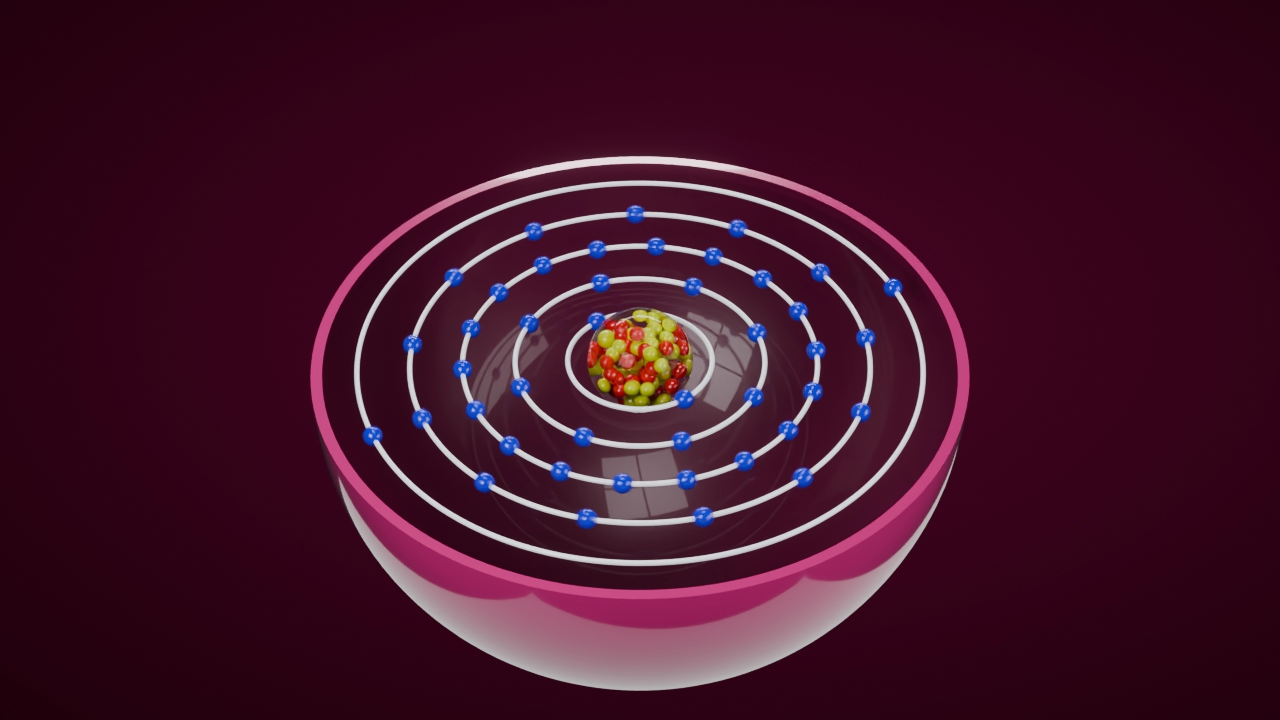
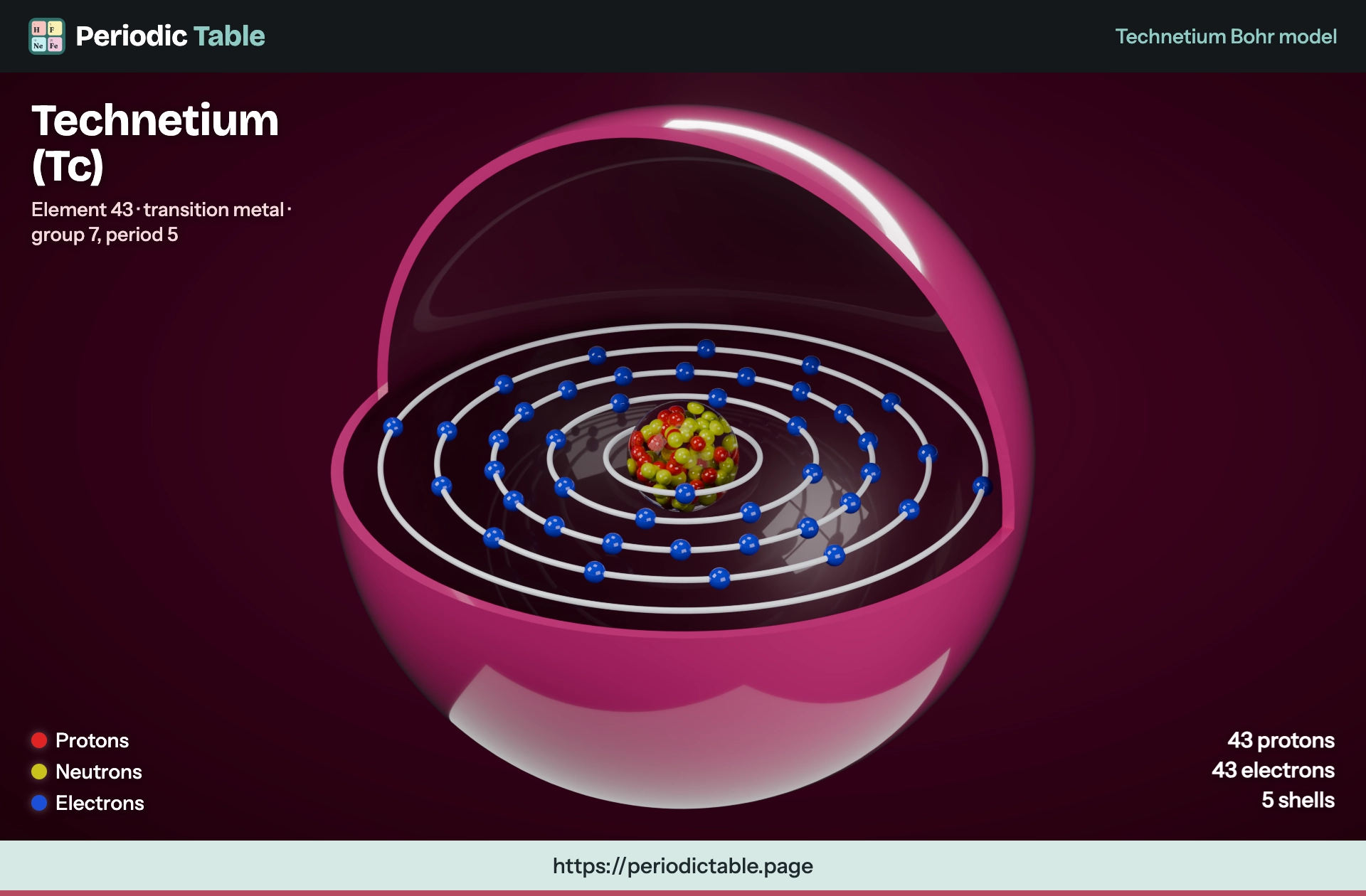
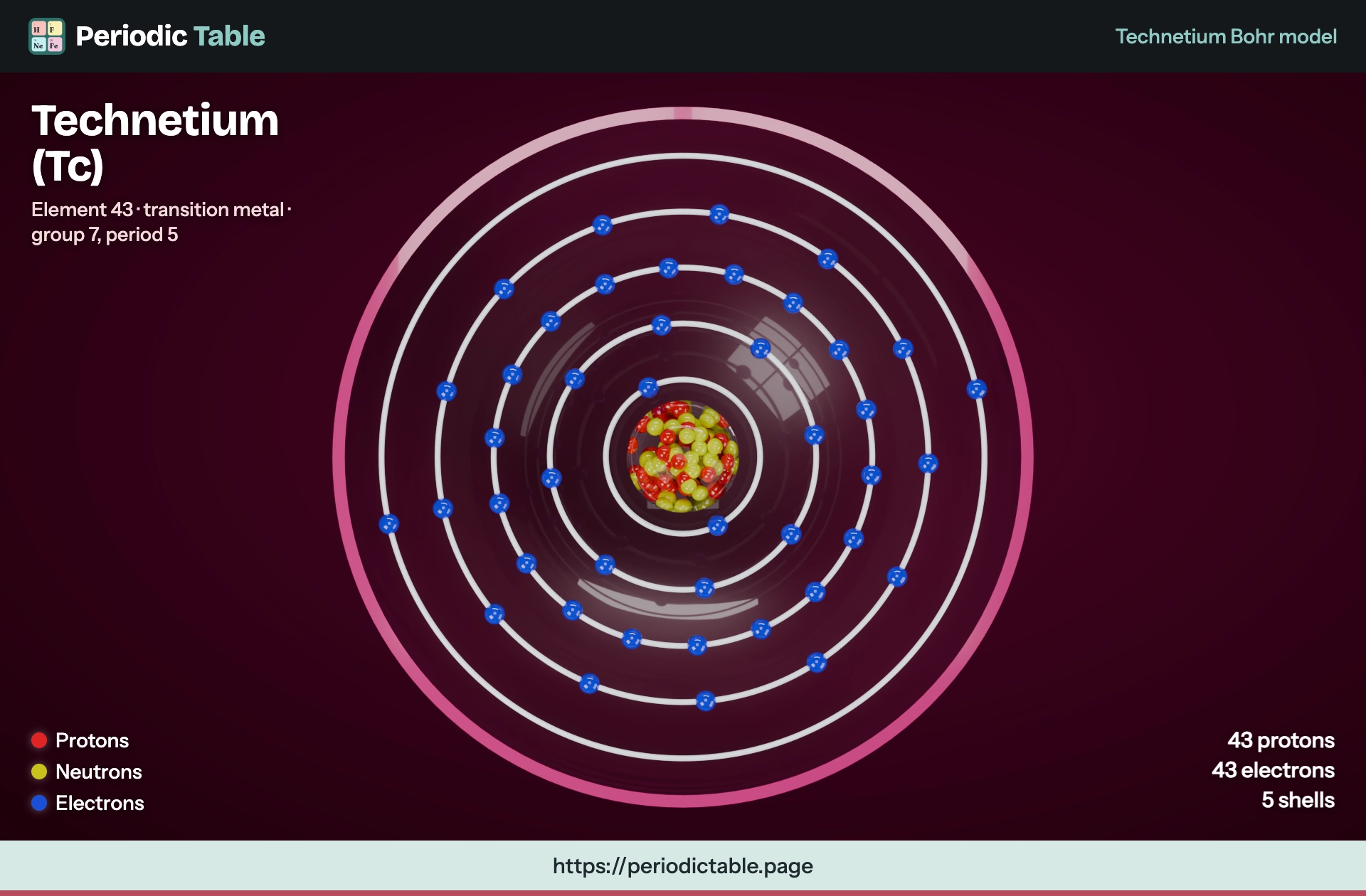
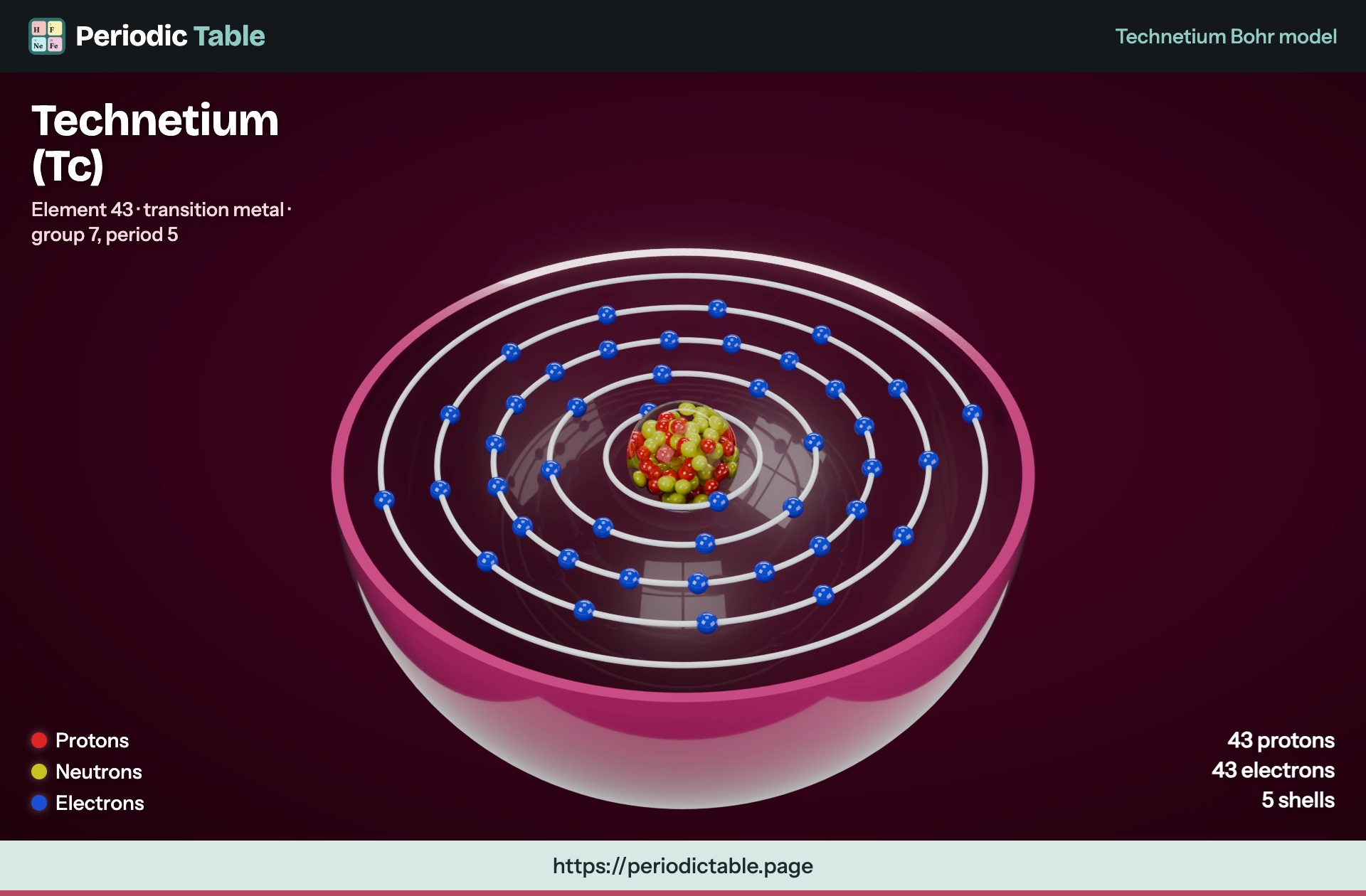
This is a Bohr model of technetium (Tc), a simplified picture of a single technetium atom. Its nucleus holds 43 protons, and a neutral technetium atom has 43 electrons, arranged around it in 5 shells (2 in shell K, 8 in shell L, 18 in shell M, 13 in shell N and 2 in shell O).
Technetium periodic table electron configuration
- Shorthand
- [Kr] 4d5 5s2
- Full
- 1s2 2s2 2p6 3s2 3p6 4s2 3d10 4p6 5s2 4d5
- Electrons per shell
- 2, 8, 18, 13, 2
Technetium element properties and atomic data
- Atomic number
- 43
- Atomic mass
- [98] u
- Phase at STP
- Solid
- Melting point
- 2156.85°C (2430 K)
- Boiling point
- 4264.85°C (4538 K)
- Density
- 11 g/cm³
- Electronegativity (Pauling)
- 1.9
- Period
- 5
- Group
- 7
- Block
- d-block
- Appearance
- Shiny gray metal
- Discovery date
- 1937
- Discovered by
- Emilio Segrè
- Named by
- —
Technetium facts: atomic mass, melting point and density of element 43
The table gathers the core data for technetium (Tc). Published values differ slightly between sources because so little pure material has ever been measured, and the bracketed value is the mass number of the longest-lived form rather than a weighted average. Its place on the periodic table, in the middle of the transition block, sets most of the rest. Technology and catalysis are two applications explained for properties of transition metals and their elements.
| Property | Value |
|---|---|
| Symbol and atomic number | Tc, 43 |
| Atomic mass | [98] |
| Group, period, block | Group 7, period 5, d-block |
| Electron configuration | [Kr] 4d5 5s2 |
| State at 20 °C | Solid |
| Melting point | 2157 °C (2430 K) |
| Boiling point | about 4265 °C (4538 K) |
| Density | about 11.5 g/cm3 |
| Electronegativity (Pauling scale) | 1.9 |
| First three ionization energies | 702, 1470 and 2850 kJ/mol |
| Atomic radius / covalent radius / Van der Waals radius | 136 pm / 147 pm / 205 pm |
| Crystal structure | Hexagonal close-packed |
Two numbers explain most of what follows. The 43 protons give an odd proton count, which makes stable nuclei harder to form, and the half-filled 4d shell explains why its chemistry sits between that of its group neighbours.
History of technetium, the first artificial element
The discovery of technetium took three generations, several false claims and, in the end, a piece of scrap from a physics lab. When you need electron configuration, density and the reason it is the lightest metal, look up element lithium in the reference.
Mendeleev's ekamanganese gap
When Mendeleev arranged the known elements by atomic weight in his first periodic table, he left an empty space below manganese. In 1871 he predicted that a missing element would fill it, with properties close to its upper neighbour, and gave it the provisional name ekamanganese (often written eka-manganese, from the Sanskrit for "one").
His other predicted gaps were filled by scandium, gallium and germanium within about 15 years, which made the last gap the obvious next target. It turned out to be the hardest, because no ore holds more than the faintest traces of it.
The 1925 masurium claim
In 1925 the German chemists Walter Noddack, Ida Tacke and Otto Berg announced elements 75 and 43, naming the second one masurium. They had bombarded a mineral with electrons and reported a weak X-ray line at the wavelength expected for the missing element.
Nobody could repeat the result, and later estimates of how much technetium their ore could have held put it far below what their method could detect. Element 75 (rhenium) stood; the second claim did not.
Perrier and Segrè isolate a synthetic element in 1937
The confirmed find came from the University of Palermo in Sicily. Emilio Segrè had visited Ernest Lawrence, inventor of the cyclotron, in Berkeley, and Lawrence later mailed him a radioactive molybdenum foil that had served as a deflector in that particle accelerator. Segrè and the mineralogist Carlo Perrier showed chemically that part of its activity came from a new element, and this time the discovery held up when others repeated it.
Since it was the first element to be artificially produced, it was named in 1947 from the Greek word technetos, meaning "artificial". Segrè later worked with Glenn Seaborg in Berkeley to isolate the short-lived form that hospitals now rely on. Because the element was made before anyone found it in nature, technetium is usually described as the first synthetic element, the first of many elements made in a lab before being found anywhere else.
Physical and chemical properties of technetium
Only small amounts of metallic technetium have ever been prepared, yet its physical properties and chemical properties are well mapped.
A group 7 transition metal with a hexagonal crystal structure
Technetium is a silvery-gray metal that looks much like platinum and is usually handled as a gray powder. As a transition metal it packs its atoms in a hexagonal close-packed lattice.
The bulk metal is weakly paramagnetic, and pure single crystals become a type-II superconductor below about 7.5 K. Heated vapour gives characteristic emission lines in the violet and blue part of the spectrum, the same lines astronomers later used to find it in space.
Oxidation states, electronegativity and reactivity
In its group, technetium sits between manganese above and rhenium below, and it behaves much more like rhenium: fairly inert, and inclined to form covalent bonds rather than simple cations. The reason is the lanthanide contraction, which makes period 5 and period 6 elements of the same group close in size. Technetium shows nine oxidation states, from −1 to +7, with +4, +5 and +7 the most common, and written forms such as Tc(VII) and Tc(IV) appear throughout its chemistry.
The metal dissolves in aqua regia, nitric acid and concentrated sulfuric acid, but not in hydrochloric acid. It tarnishes slowly in moist air, the powder burns in oxygen, and it forms a hydride with hydrogen under high pressure and a carbide with carbon. Being close to the noble metals, Tc corrodes very little.
Technetium compounds: pertechnetate, oxides and complexes
Most practical work with technetium starts from one ion, pertechnetate, TcO4−, and moves outward from there.
Sodium pertechnetate and technetium heptoxide
Sodium pertechnetate is the form hospitals and labs receive. The ion is a tetrahedron like permanganate, but it is only a weak oxidizing agent, so it stays put in water instead of attacking whatever it touches.
Burning technetium gives the pale yellow, volatile technetium heptoxide, Tc2O7, which dissolves in water to form a strongly acidic solution. Reduce the oxidation state and you get the dioxide, sulfides, and a family of halides from TcF6 down to Tc(II) chlorides, some built from clusters with direct Tc–Tc bonds.
Coordination and organometallic complexes
Technetium binds a wide range of organic ligands, and many coordination complexes were studied simply because medicine needed them. The organometallic side includes the white, volatile carbonyl Tc2(CO)10, in which two Tc atoms are joined directly.
The best known drug in this class is sestamibi, a heart imaging agent built around a Tc(I) centre. Each ligand changes where the complex goes in the body, which is why one radionuclide can serve dozens of different scans.
Technetium isotopes, half-life and radioactive decay
All known isotopes of technetium are radioactive isotopes: Tc has no stable isotopes at all, which makes it the lowest-numbered element with that property (the next is promethium, element 61). The longest-lived are technetium-97 and technetium-98, each with a half-life of about 4.2 million years. Lighter isotopes change mainly by electron capture into element 42; heavier ones mainly by beta emission to ruthenium.
| Isotope | Half-life | Main decay mode | Notes |
|---|---|---|---|
| Tc-97 | 4.21 million years | Electron capture | Joint longest-lived |
| Tc-98 | 4.2 million years | Beta-minus | Joint longest-lived |
| Tc-99 | 211,100 years | Beta-minus | Main reactor product, used for calibration |
| Tc-99m | 6.01 hours | Isomeric transition (gamma) | Diagnostic scans |
| Tc-95m | 61 days | Beta-plus, gamma | Environmental studies |
Even four million years is short next to the age of the Earth: more than a thousand half-lives have passed, so any primordial technetium is long gone. The neutrons and protons in a nucleus with an odd proton count simply have fewer stable arrangements to settle into, and the few dozen other known nuclides mostly last under an hour. That pattern of short lifetimes, more than any chemical quirk, is what kept technetium hidden.
Technetium-99m, the metastable nuclear isomer
Technetium-99m is a metastable, excited state of technetium-99. It releases its extra energy as gamma rays at 140 keV, an energy gamma cameras detect cleanly, and it has a half-life of just over 6 hours. You can work out how much activity is left at any time with the exponential law:
$$A(t) = A_0 \times \left(\frac{1}{2}\right)^{t / T_{1/2}}$$
Take a vial calibrated at 900 MBq. With \(T_{1/2} = 6.01\) hours, after 2.5 hours it holds about 675 MBq; it falls to 250 MBq after about 11.1 hours, and after 24 hours only about 56.5 MBq (6.3%) remains. That fast fall-off is exactly what you want in a patient: enough signal for a morning scan, very little left by the next day.
Where technetium comes from: nuclear reactors and natural sources
Almost all technetium on Earth today was made in nuclear reactors, though tiny natural amounts exist in uranium-bearing rock and far out in space.
Fission product of spent nuclear fuel
Technetium-99 is one of the most common products of nuclear fission. About 6% of fissions of uranium-235 end at mass 99, and plutonium-239 gives a similar yield, so spent nuclear fuel holds technetium in kilogram-per-tonne amounts.
Reactors produced tens of tonnes between the 1980s and the 1990s, and the same nuclide is a byproduct of nuclear weapons. The element named after its laboratory origin is therefore a routine industrial waste stream, recovered from dissolved fuel rods when anyone needs it pure.
Technetium stars and red giants
In 1952 astronomers found technetium spectral lines in certain red giants. Since no form of the element lasts long on cosmic timescales, those giants had to be making it, which was strong evidence that heavy elements form by nucleosynthesis inside stars and, later, for the slow neutron capture route called the s-process.
On Earth, spontaneous fission of uranium-238 leaves traces in uranium ore: pitchblende was shown in 1962 to contain about 0.2 nanogram per kilogram, and Earth's crust as a whole holds something like 0.003 parts per trillion. The Oklo natural reactor in Gabon also made technetium about two billion years ago; all of it has since decayed away, leaving only a trace record.
Molybdenum-99 and the Tc-99m generator
Hospitals do not ship technetium-99m itself, because most of it would be gone in transit. They receive its parent instead: molybdenum-99 (about 66 hours to lose half its activity), made mostly by irradiating highly enriched uranium targets or by neutron activation of molybdenum-98.
The parent is held on a column inside a technetium-99m generator, nicknamed the "technetium cow" or "molybdenum cow", and staff wash out fresh pertechnetate with salt water each morning. Accelerators offer another route: a proton beam striking molybdenum-100 makes the medical form directly, and neutron irradiation of other targets yields rarer nuclides when they are needed.
Technetium uses in nuclear medicine and industry
Most technetium that reaches people does so in nuclear medicine, but the long-lived isotope also has a few industrial jobs.
Medical imaging with radiopharmaceuticals
Technetium-99m sits at the centre of more medical imaging than any other isotope, in tens of millions of diagnostic procedures a year. It works as a radioactive tracer: doctors give a small injection, a gamma camera follows the signal, and the image shows how well organs are working, not just their shape. More than 50 common radiopharmaceuticals are built on it, each steering the signal to a different target: the brain, heart muscle, thyroid, lungs, liver, kidneys, the skeleton or tumors.
A bone scan for bone cancer spread is one of the most common medical tests that uses it. Because Tc plays no natural role in the human body, the injected compound does not join normal biochemistry, and much of it is excreted within a day.
A single radiopharmaceutical kit can be prepared on site in minutes, which is a big part of why technetium-99m became the workhorse of hospital scans. Drug labels name these products in full, as in "technetium Tc 99m medronate" for bone imaging.
Technetium-99 as a beta emitter and corrosion inhibitor
Tc-99 undergoes almost pure beta decay, emitting beta particles of low, steady energy with no gamma rays alongside them, and its slow decline means its output barely changes over decades. That makes it a standard beta emitter for instrument calibration.
Its chemistry has other uses on paper: technetium is an effective catalyst in some dehydrogenation reactions, and only 55 ppm of pertechnetate in water acts as a corrosion inhibitor for steel by forming a thin protective film, a process called passivation. Radioactivity confines both ideas to sealed, specialized systems.
Is technetium dangerous? radioactive waste, toxicity and safety
Technetium has no biological role, and its chemical toxicity appears low: rats fed technetium-99 for weeks showed no measurable change in blood or organ weights. The real health concern is radiation. The isotope's weak beta particles cannot even pass through lab glassware, so the main risk is inhalation of dust, which carries a cancer risk once it reaches the lungs.
Good handling and a ventilated workspace cover most safety needs. In the environment, the element came from nuclear fallout of atmospheric nuclear tests and from fuel reprocessing, and it spreads more readily than most fission products.
Waste disposal and transmutation
For radioactive waste, technetium-99 is a long-term headache. As pertechnetate it forms a negatively charged ion that does not stick to minerals the way plutonium or caesium do, so groundwater can carry it away from a repository and into the wider environment. Reprocessing plants such as Sellafield discharged hundreds of terabecquerels into the sea before regulation cut releases.
One proposed fix, tested at CERN, is transmutation: neutrons convert technetium-99 into technetium-100, which decays within seconds to stable ruthenium-100. Until that is practical at scale, waste disposal relies on stable rock formations, and technetium remains one of the nuclides that sets the timescale for nuclear waste.