


Francium element (Fr): francium periodic table facts
Francium periodic table facts: francium (Fr) is element 87, an alkali metal in group 1, period 7. Picture an alkali metal so unstable that no one has ever seen a visible piece of it. For physical data on a heavy pnictogen, melting point, density and thermal conductivity are laid out in the bismuth production reference for students.
That is francium, symbol Fr and atomic number 87, the heaviest member of group 1. Its most stable isotope, francium-223, lasts only about 22 minutes before half of it is gone, so every francium atom ever studied has been counted, trapped or measured within minutes of being made.
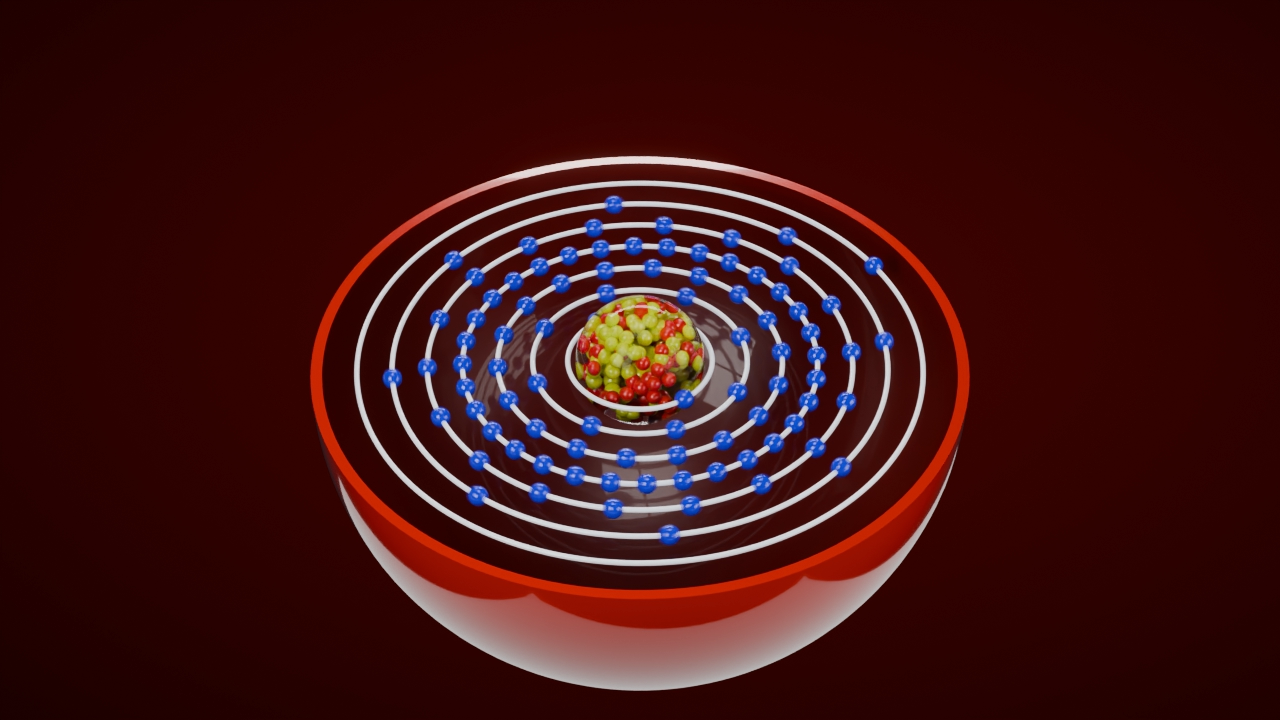
Rotate the 3D Bohr model of francium
Drag to orbit, scroll to zoom.
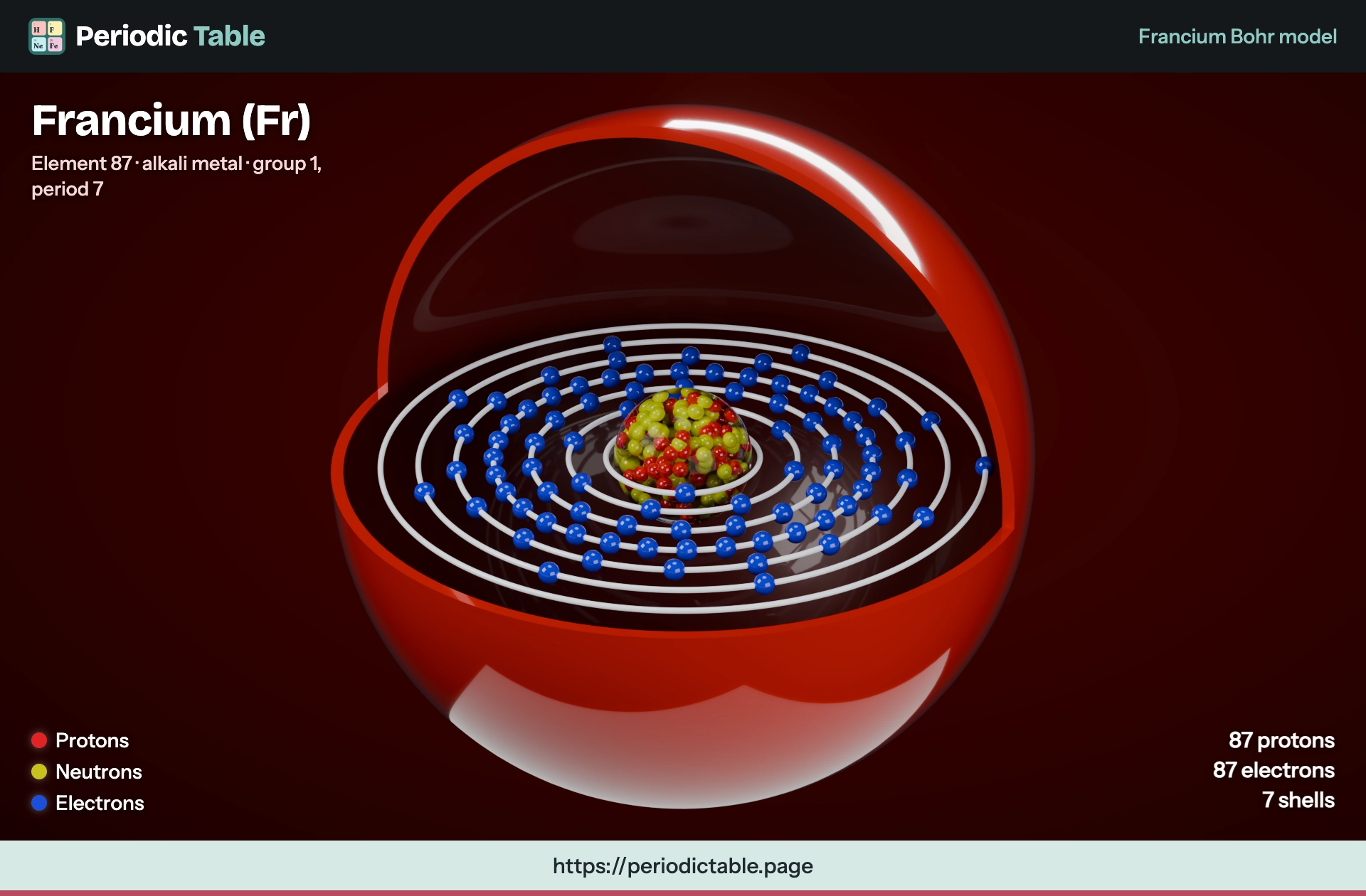
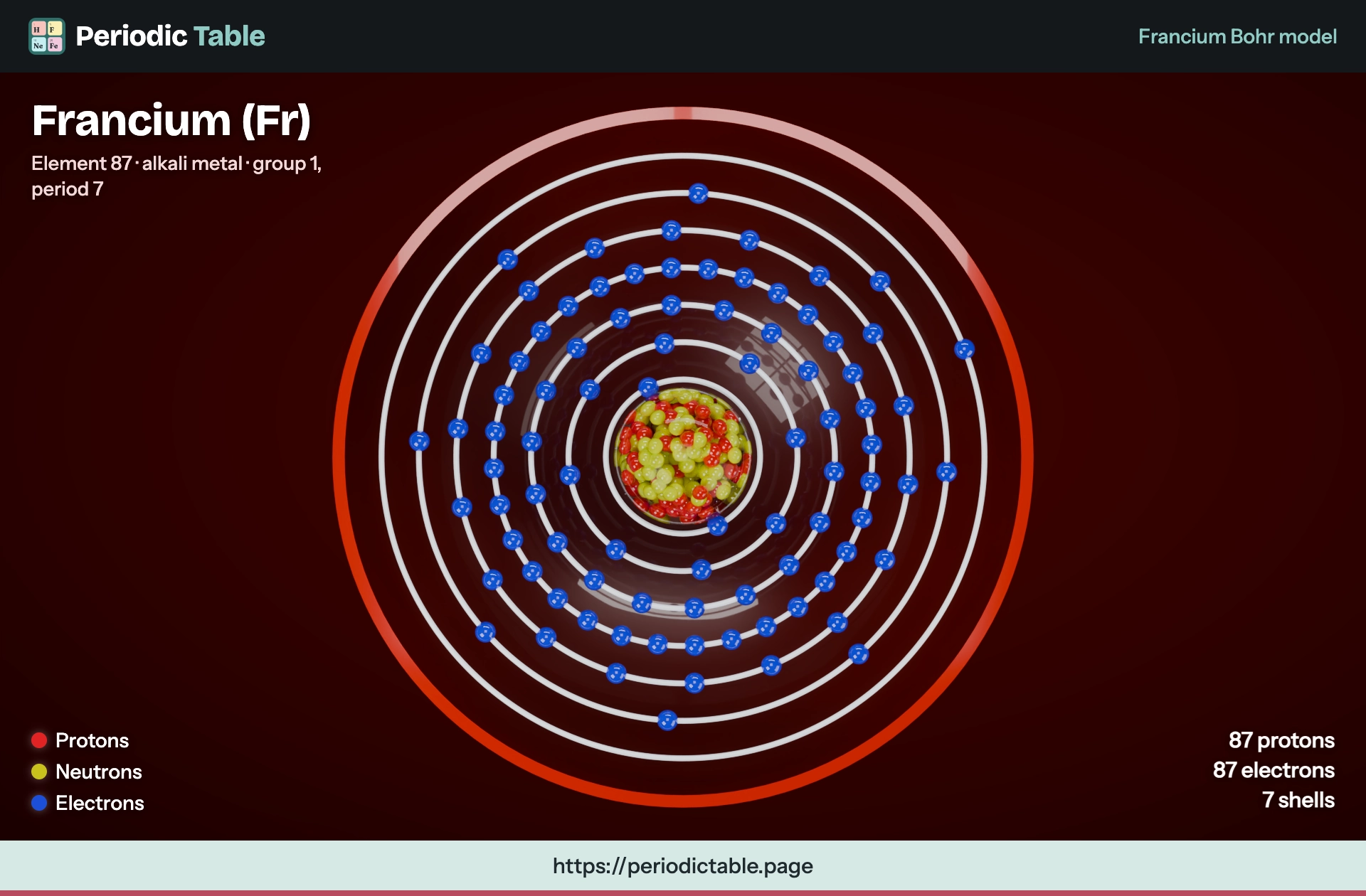
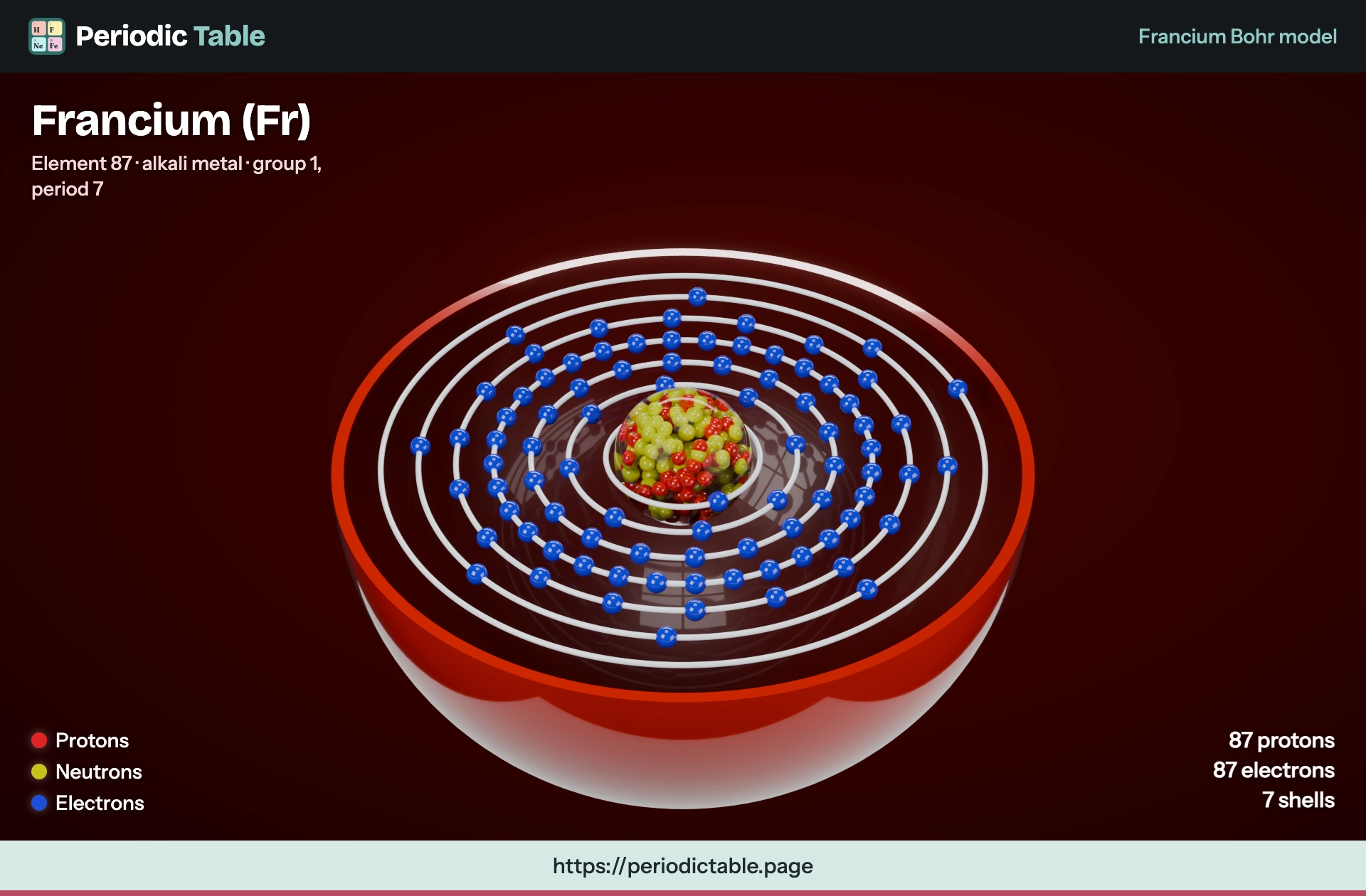
This is a Bohr model of francium (Fr), a simplified picture of a single francium atom. Its nucleus holds 87 protons, and a neutral francium atom has 87 electrons, arranged around it in 7 shells (2 in shell K, 8 in shell L, 18 in shell M, 32 in shell N, 18 in shell O, 8 in shell P and 1 in shell Q).
Francium periodic table electron configuration
- Shorthand
- [Rn] 7s1
- Full
- 1s2 2s2 2p6 3s2 3p6 4s2 3d10 4p6 5s2 4d10 5p6 6s2 4f14 5d10 6p6 7s1
- Electrons per shell
- 2, 8, 18, 32, 18, 8, 1
Francium element properties and atomic data
- Atomic number
- 87
- Atomic mass
- [223] u
- Phase at STP
- Solid
- Melting point
- 26.85°C (300 K)
- Boiling point
- 676.85°C (950 K)
- Density
- 1.87 g/cm³
- Electronegativity (Pauling)
- 0.79
- Period
- 7
- Group
- 1
- Block
- s-block
- Appearance
- Unknown
- Discovery date
- 1939
- Discovered by
- Marguerite Perey
- Named by
- —
Francium element data: atomic mass and electron configuration
Most numbers for the francium element are predictions or extrapolations from its lighter neighbours, because no weighable sample has ever existed. The table below collects the values chemists use today. Its mass is quoted as [223], matching the longest-lived form rather than a measured average. For lithium carbonate, hydroxide and chloride along with their oxidation states, see element 3 and compare each compound.
| Property | Value |
|---|---|
| Symbol | Fr |
| Atomic number | 87 |
| Atomic mass | [223] |
| Position | Group 1, period 7, s-block |
| Electron configuration | [Rn] 7s1 |
| State at 20 °C | Solid (predicted) |
| Crystal structure | Body-centered cubic (extrapolated) |
| Oxidation states | +1 |
| Electronegativity | about 0.7 on the Pauling scale |
| First ionization energy | about 393 kJ/mol |
| Electron affinity | roughly 44–47 kJ/mol (calculated) |
| Covalent radius | about 260 pm (extrapolated) |
| Van der Waals radius | about 348 pm (extrapolated) |
| CAS number | 7440-73-5 |
Element 87 on the periodic table
When Dmitri Mendeleev built his periodic table in 1869, he left an empty box beneath caesium. Chemists called the missing occupant eka-caesium, meaning "one place below," and they expected it to follow the pattern of lithium, sodium, potassium and rubidium above it. Element 87 fills that box in period 7, and its single outer s-electron explains nearly everything predicted about its chemistry. For compounds and atoms, strontium atoms gives a clear introduction that touches on electrons and electronegativity.
Francium as the heaviest alkali metal
Like every member of its column, Fr carries a single valence electron outside a closed shell of 86 electrons. That lone valence electron is easy to give away, which makes it highly reactive and strongly electropositive.
If enough of it could be gathered, it would almost certainly look and behave like a soft, silvery reactive metal, much like caesium (spelled cesium in American usage). In practice it would react violently with water, giving a strongly basic hydroxide and hydrogen gas.
Electronegativity and ionization energy
The simple group trend says the heaviest alkali metals should lose their outer electron most easily. Francium breaks that trend slightly. The energy needed to strip that electron is nearly 5% higher than for caesium, and the reason is relativistic effects: the 7s electron moves fast enough near the heavy core that it is pulled in tighter than expected.
So its lighter neighbour, not francium, is the one that most readily forms a cation. Linus Pauling put its value at 0.7, the same as its neighbour's, but there is no experimental chemistry yet to refine that number.
Physical properties of francium metal
Every listed physical property of francium is a model result. The reason is the heat of decay: any sample large enough to see would heat itself so quickly that it would vaporize almost at once. Researchers therefore work backward from the trends in lithium through caesium, plus relativistic calculations.
Melting point, boiling point and density estimates
Published estimates for the melting point range from about 8 °C to 27 °C, so francium would likely be a soft solid or a liquid close to room temperature. Estimates for the boiling point sit between roughly 598 °C and 677 °C. The predicted density is usually given as about 2.4–2.5 g/cm3, although one modern calculation lands much higher, near 3.6 g/cm3.
Its bulk modulus is predicted at 2.1–2.6 GPa, which would make it one of the most compressible metals. The spread in these figures is the honest answer: they differ by method, and nobody can settle them with a measurement.
Francium isotopes and half-life
There are 37 known francium isotopes, with mass numbers from 197 to 233, plus seven nuclear isomers. Only two occur naturally: Fr-223 and Fr-221.
The rest are synthetic. The first is the longest-lived isotope, with a half-life of 22.0 minutes; francium-221 lasts about 4.8 minutes, and the shortest-lived ground state, francium-215, survives only about 90 nanoseconds.
The amount of a radioactive isotope left after time \(t\) follows the half-life rule:
$$N(t) = N_0 \times \left(\frac{1}{2}\right)^{t / T_{1/2}}$$
Running that with \(T_{1/2} = 22.0\) minutes gives the share of a Fr-223 sample still present:
| Time elapsed | Share remaining |
|---|---|
| 15 minutes | 62.3% |
| 45 minutes | 24.2% |
| 90 minutes | 5.9% |
| 3 hours | 0.34% |
| 6 hours | 0.001% |
Put another way, 99% of any sample is gone in about 2 hours and 26 minutes, which is why this radioactivity rules out storage or shipping.
How francium-223 decays
Francium-223 forms inside the uranium-235 decay series when about 1% of actinium-227 nuclei undergo alpha decay instead of their usual beta path. Almost all of it then undergoes beta decay into radium-223, while a tiny branch of about 0.006% emits an alpha particle to give astatine-219.
The shorter-lived Fr-221 belongs to the neptunium decay series and turns into astatine-217. Francium-222 might in theory form from radon-222, but that route has never been observed.
Where francium occurs in nature
Natural francium exists only as trace amounts in uranium ores and related minerals, where the decay chain keeps producing atoms that disappear within the hour. Estimates put the total in the Earth's crust at any instant at roughly 30 grams, or about one ounce.
In uranium minerals such as uraninite, there is roughly one Fr atom for every 1018 host atoms. That scarcity makes it the second rarest naturally occurring element after astatine, and among the rarest substances ever studied.
Francium compounds and chemical behaviour
Because so few atoms are ever present at once, francium compounds are known mainly from coprecipitation: it is carried along when a much larger amount of caesium salts precipitates from solution. Perchlorate, iodate, picrate, tartrate and chloroplatinate carriers all pull it out this way, which is also how chemists separate it from other decay products.
Francium perchlorate and francium halides
Francium perchlorate forms when francium chloride reacts with sodium perchlorate, and it comes down together with caesium perchlorate. That route can isolate francium, although thallium follows it too.
The francium halides are expected to be water-soluble white salts. Francium chloride has been studied as a separation route because of its high vapour pressure, and the fluoride should be more volatile still.
Oxides, superoxide and hydroxide
Francium oxide is believed to break down into the peroxide and the uncombined alkali. Francium superoxide, FrO2, is predicted to have more covalent bonding than the superoxides of the lighter alkali metals, because the 6p electrons take part.
Its nitrate, sulfate, hydroxide and carbonate should all dissolve in water. Theory even allows higher oxidation states than +1 in exotic fluorides, but none has been confirmed.
How francium atoms are made in the laboratory
Since natural sources are hopeless, francium atoms for study are made in the laboratory. The standard method is a fusion reaction: a linear accelerator fires oxygen-18 ions into a gold target, first developed at Stony Brook in 1995.
The fused nucleus has 87 protons and sheds four, five or six neutrons, giving francium-211, -210 or -209 depending on beam energy. Other routes bombard radium with neutrons or thorium with protons, deuterons or helium ions.
Holding atoms in a magneto-optical trap
The new ions leave the hot gold, are neutralised on yttrium, and are captured in a magneto-optical trap, where six crossing laser beams and a magnetic field hold them in a cloud less than a millimetre across. Each atom stays only seconds, but fresh ones keep arriving, so the trap holds a steady population.
Experiments with francium-210 there gave the first precise maps of its energy levels. The work moved to TRIUMF in Canada in 2012, where more than a million atoms have been held at once.
Discovery of eka-caesium by Marguerite Perey
Marguerite Perey, a former assistant of Marie Curie at the Curie Institute in Paris, found it on 7 January 1939 while purifying actinium-227. She saw decay particles that did not fit actinium and ruled out thorium, radium, lead, bismuth and thallium. She first called the product actinium K, then proposed catium, which was rejected.
Her choice of "francium," after France, was adopted by IUPAC in 1949. That made it the second element named after France, following gallium, and the last one found in nature rather than by synthesis. Older texts also spell the provisional name as ekacaesium.
Earlier false claims to the element
Several researchers announced element 87 before Perey, and every claim fell apart once it was clear no isotope could last long enough to collect. Dmitry Dobroserdov proposed russium in 1925 after mistaking potassium-40 radiation for the missing one. Gerald Druce and Frederick Loring suggested alkalinium the next year.
Fred Allison named virginium in 1930 from studies of pollucite and lepidolite, a method later disproved. Horia Hulubei and Yvette Cauchois claimed moldavium in 1936, but their X-ray lines most likely came from mercury or bismuth.
Uses of the francium atom in physics research
The element francium has no commercial uses; it cannot be stored, shipped or handled in bulk, and its radiation makes even tiny samples hazardous. Its value is in research. Because it is the heaviest alkali, it pairs a simple atomic structure with a very large nucleus, which makes it a test bed for atomic physics.
The ISOLDE facility at CERN saw its first optical transition in 1978, and spectroscopy of trapped atoms has since matched quantum theory closely. Physicists now use it to search for parity violation, measure the nuclear anapole moment and test the standard model of the weak interaction, effects expected to be about ten times larger than in caesium. It was once explored as a cancer diagnostic aid, but that idea was dropped as impractical, leaving it purely a tool for fundamental science and chemistry.