Strontium element (Sr): strontium periodic table facts
Strontium periodic table facts: strontium (Sr) is element 38, an alkaline earth metal in group 2, period 5. If you have ever watched a firework burst into deep red, you have seen strontium at work. At the start of group 15, Bi, element 83 and its post-transition metal status are introduced in the bismuth atomic number page for beginners.
It is the chemical element with atomic number 38, a soft, pale, highly active member of the second column of the periodic table, and it turns up in places as different as old television screens, osteoporosis research and the cooling ponds of nuclear plants. This page gathers its key data, its chemistry, its isotopes and the reasons it matters.
Rotate the 3D Bohr model of strontium
Drag to orbit, scroll to zoom.
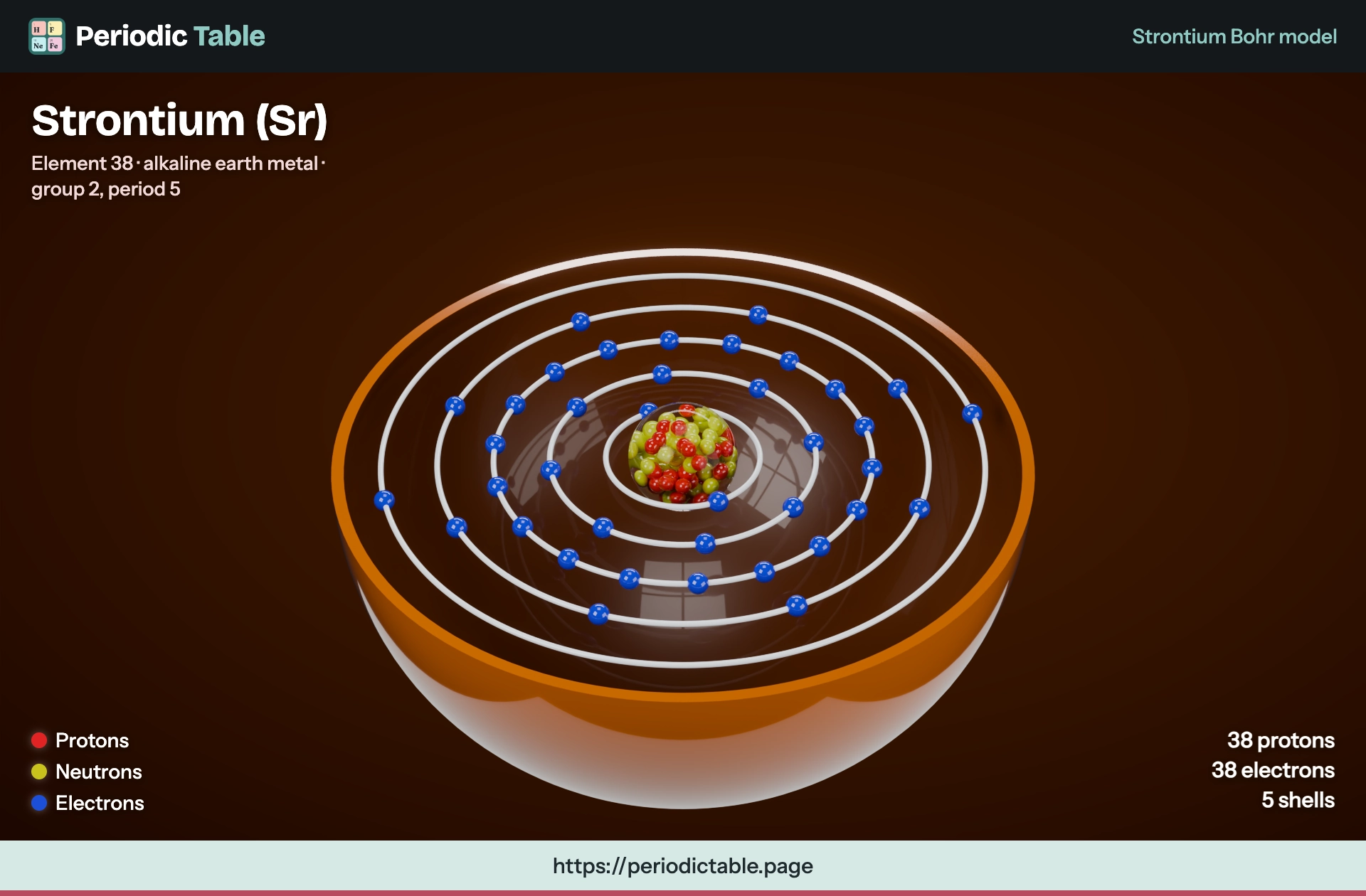
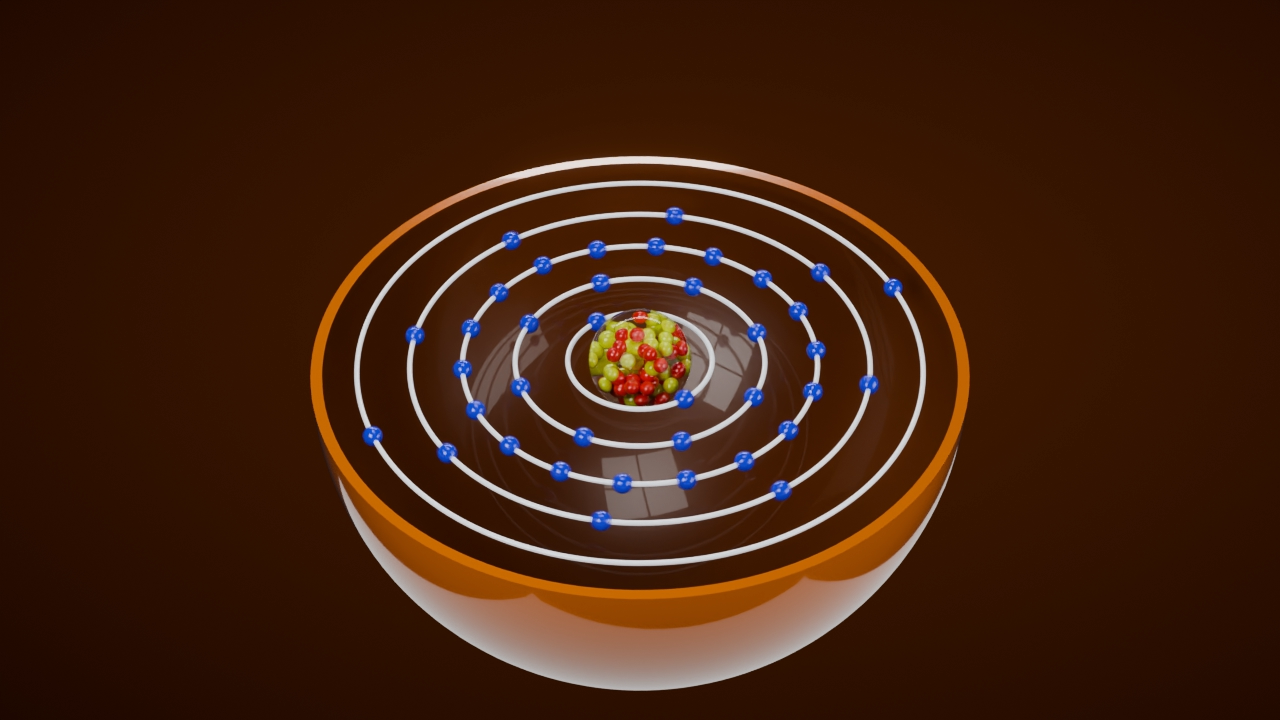
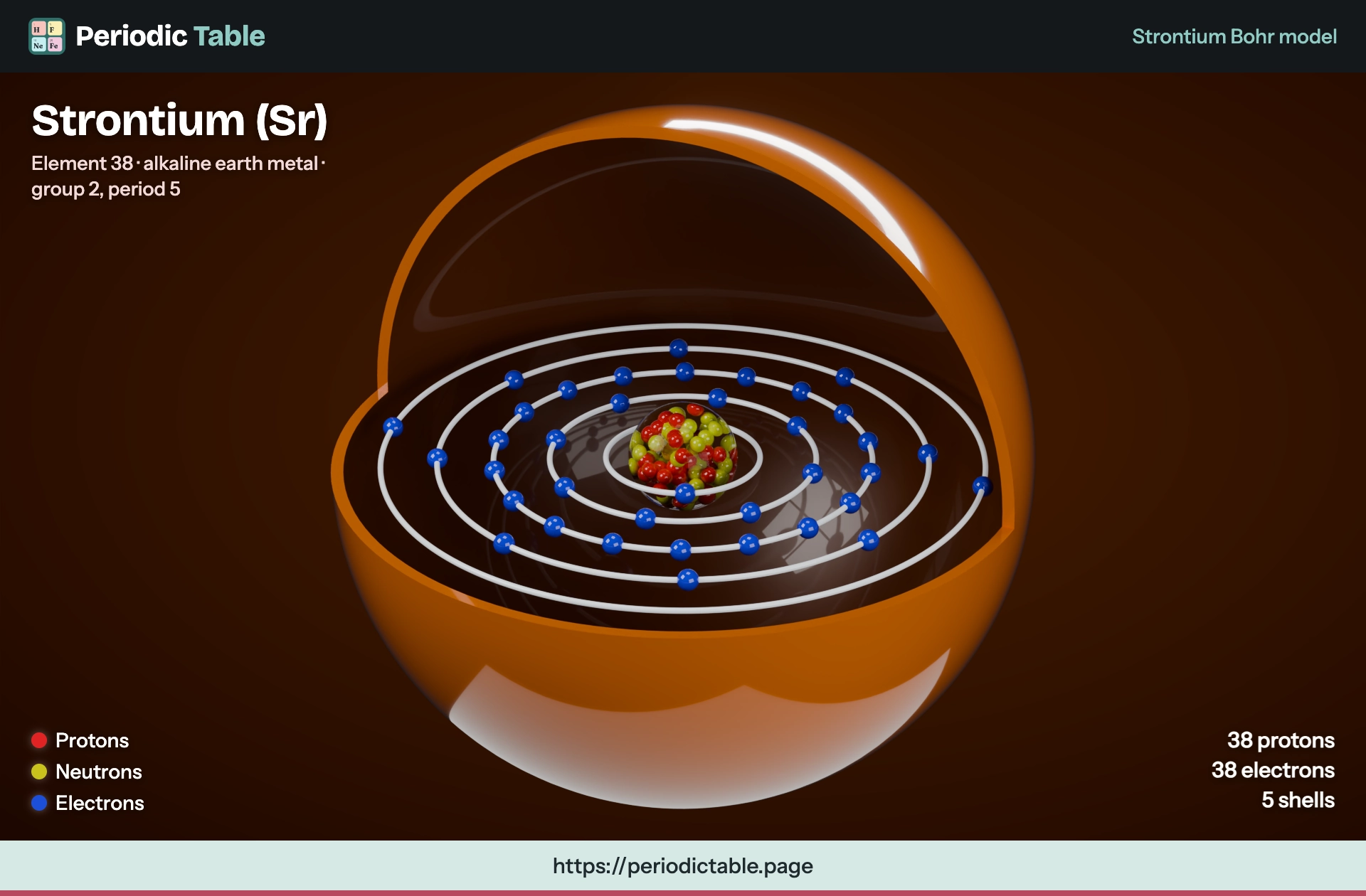
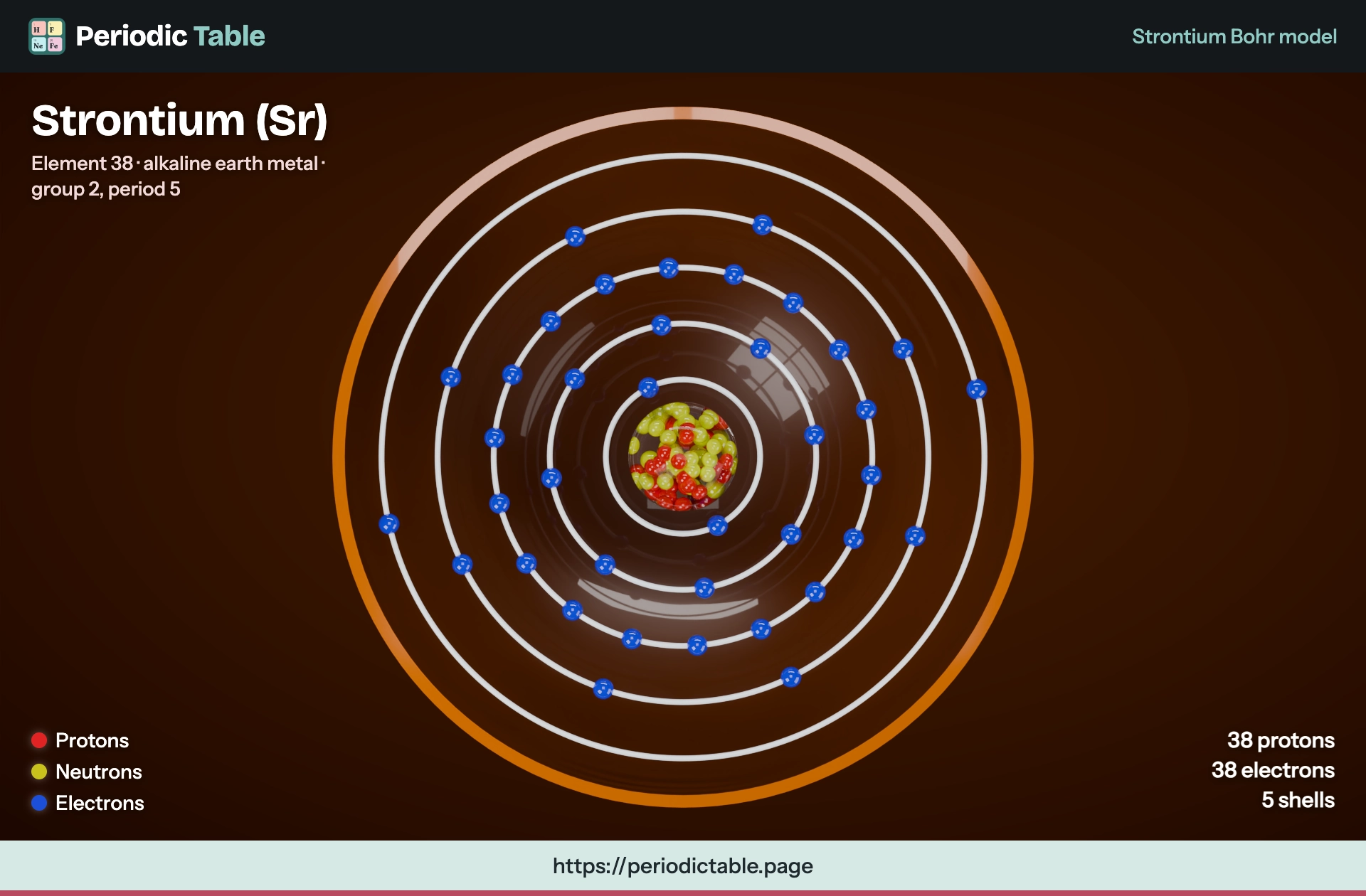
This is a Bohr model of strontium (Sr), a simplified picture of a single strontium atom. Its nucleus holds 38 protons, and a neutral strontium atom has 38 electrons, arranged around it in 5 shells (2 in shell K, 8 in shell L, 18 in shell M, 8 in shell N and 2 in shell O).
Strontium periodic table electron configuration
- Shorthand
- [Kr] 5s2
- Full
- 1s2 2s2 2p6 3s2 3p6 4s2 3d10 4p6 5s2
- Electrons per shell
- 2, 8, 18, 8, 2
Strontium element properties and atomic data
- Atomic number
- 38
- Atomic mass
- 87.621 u
- Phase at STP
- Solid
- Melting point
- 776.85°C (1050 K)
- Boiling point
- 1376.85°C (1650 K)
- Density
- 2.64 g/cm³
- Electronegativity (Pauling)
- 0.95
- Period
- 5
- Group
- 2
- Block
- s-block
- Appearance
- Unknown
- Discovery date
- 1790
- Discovered by
- William Cruickshank (chemist)
- Named by
- —
Strontium element facts: atomic number, atomic weight and melting point
The quickest way to understand the strontium element is to read its numbers side by side. Its symbol is Sr, and almost every value below sits between those of its lighter and heavier neighbours in the same group, which is the single most useful pattern to remember. Ekacaesium and actinium K were early labels, and the francium metal traces how they were replaced.
| Property | Value |
|---|---|
| Symbol | Sr |
| Atomic number | 38 |
| Standard atomic weight (relative atomic mass) | 87.62 |
| Group, period, block | Group 2, period 5, s-block |
| Electron configuration | [Kr] 5s2 |
| Melting point | 777 °C (1050 K) |
| Boiling point | 1377 °C (1650 K); some data sheets list 1382 °C |
| Density at 20 °C | 2.64 g/cm3 |
| Crystal structure at room temperature | Face-centered cubic |
| Common oxidation states | +2 |
| Electronegativity (Pauling) | 0.95 |
| State at 20 °C | Solid |
| CAS number | 7440-24-6 |
Two small discrepancies are worth knowing about. Reference sources disagree slightly on the boiling figure by a few degrees because high-temperature measurements of a hot vapour are hard to make, and the weight of 87.62 can shift in the second decimal place between rock samples because one isotope is constantly being added by radioactive decay. Neither difference matters for everyday chemistry, but it explains why two reputable tables rarely match to the last digit.
Physical properties of strontium metal
Freshly cut, strontium metal is a silvery metal with a pale yellow tint. Within minutes in open air the cut face dulls and turns more yellowish as a film forms on it, so lab samples are stored under mineral oil or in sealed argon ampoules. It is softer than calcium and harder than barium: you can cut it with a knife, but it does not smear like the alkali metals beside it. Pollucite ore, flame spectroscopy and the spectroscope that revealed its blue lines frame the story told in the cesium element page for chemistry students.
These physical properties follow from its loosely held outer shell, which gives it modest metallic bonding and a low melting range. Its specific heat capacity is about 306 J per kg per kelvin, lower than most lighter metals, so a gram of it warms quickly. It conducts electricity reasonably well, but the surface layer that forms in air makes clean electrical contact difficult outside an inert atmosphere.
Allotropes and crystal structure
Solid strontium has three allotropes. At room temperature its atoms pack in a face-centered cubic lattice.
Heating it past about 235 °C rearranges the packing, and a further change near 540 °C produces a third form that persists until the solid melts. Each switch slightly alters how hard and dense the solid is, which is one reason casting temperatures are chosen carefully.
Chemical properties and oxidation states of the alkaline earth metal
Like its group neighbours, strontium gives up both of its outer electrons almost every time it reacts, so it is divalent and its compounds contain the Sr2+ ion. Its chemical properties are dominated by that eagerness: it is highly reactive, more so than calcium and less so than barium, and it never occurs uncombined in nature.
- Air: a dark oxide layer forms quickly, and finely divided powder can ignite on its own.
- Water: it reacts steadily, releasing hydrogen and leaving a solution of strontium hydroxide, a strong base.
- Acids: it dissolves readily, forming the matching salts.
- Nitrogen: when heated it can form a nitride, as its group neighbours do.
Its standard electrode potential for the Sr2+/Sr couple is about −2.89 V, close to the value for its lighter neighbour, which tells you how strongly it prefers the ionic state. A classic flame test identifies it at once: its salts colour a flame crimson. This chemical reactivity is why metallic strontium has almost no direct uses of its own; nearly everything practical is done with its salts.
Electron configuration, electronegativity and ionization energies
The atom's outer shell is a single 5s orbital holding two electrons above a krypton core. Removing those two is relatively easy: the first two ionization energies are about 549.5 and 1064.2 kJ/mol, while the third jumps to roughly 4138 kJ/mol because it would break into the stable inner shell. That jump is the numerical reason strontium is almost always +2.
Its Pauling value of 0.95 marks it as a strongly electropositive element. The empirical atomic radius is around 215 pm and the covalent radius about 190 to 195 pm, large enough that the Sr2+ ion fits into crystal sites normally occupied by calcium.
Sr in group 2 and period 5: comparing the alkaline earth metals
Strontium is the fourth of the six alkaline earth metals, below beryllium, magnesium and calcium and above barium and radium. Across its period it sits between rubidium on its left and yttrium on its right. Comparing it with its vertical neighbours is the fastest way to predict how it behaves.
| Element | Melting (°C) | Boiling (°C) | g/cm3 at 20 °C | Flame colour |
|---|---|---|---|---|
| Calcium | 842 | 1484 | 1.54 | Orange-red |
| Strontium | 777 | 1377 | 2.64 | Crimson |
| Barium | 727 | 1900 | 3.59 | Pale green |
Melting falls steadily down the group, but boiling does not: the heaviest of the three boils far higher than either. The weight per volume rises in step with atomic mass.
Chemically, the closeness to calcium is what matters most in practice. Because the two ions are similar in size and charge, Sr2+ follows Ca2+ into bone, shell, coral and limestone, a habit that makes strontium both useful in treatment and dangerous when the atom is radioactive.
Strontium isotopes and their half-life
Natural strontium is a mix of four stable isotopes. Their approximate shares are:
- Sr-88: about 82.6%
- Sr-86: about 9.9%
- Strontium-87: about 7.0%
- Sr-84: about 0.6%
The odd one out is strontium-87, which is radiogenic: part of it was produced by the slow beta decay of rubidium-87, so slow that half of it takes about 49 billion years to decay. The ratio of Sr-87 to Sr-86 in a rock therefore grows with age, which geologists use to date ancient minerals.
The same ratio also differs from one landscape to another, so the isotopes locked in a tooth or bone record where a person or animal grew up. Archaeologists use that signal to trace ancient migration, and ecologists use it to follow migratory birds and fish.
Radioactive strontium-89 and strontium-90
Of the many artificial isotopes, two stand out. Sr-89 has a half-life of about 50.6 days and is used in medicine. Strontium-90 lasts far longer, about 28.8 years, and is a major fission product of uranium and plutonium.
Atmospheric weapons testing in the 1950s and 1960s spread Sr-90 as nuclear fallout; it moved from grass into milk and, measurably, into children's teeth. Because the body treats it like calcium, its radioactivity is delivered straight to bone and marrow, which is why this radioactive strontium isotope is one of the most closely monitored contaminants after any nuclear accident.
History of the element strontium
The element strontium is named after Strontian, a village on Loch Sunart in the western Highlands of Scotland. Its lead mines yielded an unusual heavy mineral that was first assumed to be a barium ore.
- 1790: the physician Adair Crawford, working with William Cruickshank, noticed that the Strontian mineral behaved differently from other known heavy spars and suggested it held a new "earth".
- 1791 to 1793: the Edinburgh chemistry professor Thomas Charles Hope studied it in detail, showed that it coloured flames red while barium coloured them green, and confirmed a new element.
- 1808: Humphry Davy isolated the free element in London by electrolysis of a moist chloride and mercuric oxide mixture, the same method he used on two of its neighbours.
The mineral itself was named after the village, and the element took its name from the mineral. It is one of only a handful of elements named after a place in the United Kingdom, and its discovery story is a neat example of early analytical chemistry: flame colour, not weight alone, was the clue that separated it from barium.
Natural strontium sources: Celestine and strontianite
Strontium is roughly the 15th most abundant element in the earth's crust, at around 320 to 370 parts per million, more common than carbon or chlorine. Because it combines so readily, it exists only in minerals, and two of them carry nearly all of it: celestine, the sulfate SrSO4, and strontianite, the carbonate SrCO3.
Celestine forms sizeable sedimentary deposits and is the mineral actually mined; strontianite is the more useful chemical form but rarely occurs in workable amounts. Seawater also holds about 8 mg of strontium per litre, though nobody extracts it from there.
Mining, refining and producing strontium oxide
Most celestine today comes from Spain, Iran, China and Mexico; deposits in the United States have not been worked since 1959. Refiners turn the sulfate into the carbonate in one of two ways: by leaching it with sodium carbonate solution, or by roasting it with coke so that the strontium sulfate is reduced to strontium sulfide, a "black ash" that is dissolved, filtered and precipitated as carbonate with carbon dioxide.
To get the pure element, refiners heat strontium oxide with aluminum in a vacuum and distil the vapour off, or electrolyse a molten chloride melt. The output of the free element is only a few hundred tonnes a year, tiny next to the compound trade.
Uses of strontium compounds
Almost all commercial demand is for strontium compounds rather than the element itself. Demand has shifted a great deal over the past thirty years as one large market disappeared and smaller specialised ones grew, and a handful of salts now cover most uses in industry and science.
The main commercial salts
Strontium carbonate
Refined from the sulfate ore, strontium carbonate is the intermediate from which most other salts are made. Before flat screens it went mainly into the glass of cathode-ray tubes; today it feeds ferrite production and ceramic frits.
Strontium nitrate
The nitrate is both oxidiser and colourant, which is why it is the standard red ingredient in fireworks and signal lights.
Strontium chloride
A soluble, easily purified salt, the chloride is the usual laboratory source of the Sr2+ ion and the base for dental and medical preparations described below.
Strontium hydroxide
A strong base that was once used on a large scale to recover sugar from beet molasses, a process that consumed tens of thousands of tonnes a year in the nineteenth century.
Fireworks, flares and glow-in-the-dark pigments
Red is the hardest firework colour to get pure, and strontium nitrate or carbonate is the standard answer. In pyrotechnics the salts form short-lived monochloride molecules in the flame, which emits the deep red color seen in shells, road flares and marine distress signals.
A very different compound, strontium aluminate doped with europium, absorbs light and re-emits it slowly for hours. It has largely replaced older zinc sulfide pigments on watch dials, exit signs and toys, because it glows roughly ten times brighter and longer.
Glass, ceramics, magnets and alloys
For decades the largest single use was the faceplate glass of colour televisions. The electron beam striking the screen generates X-rays, and adding the oxide to the front panel absorbed them without the browning that lead glass suffers. As flat panels replaced cathode ray tubes, that market collapsed.
Today ferrite magnets, made from the carbonate and iron oxide, are a leading outlet, alongside ceramics and pottery glazes, where it improves gloss and lowers firing temperatures. Small additions refine the grain of aluminium-silicon casting alloys, making them less brittle, and the element helps strip lead from zinc during electrolytic refining. Historically, strontium salts also had a niche in processing sugar beets.
Strontium atomic clocks and RTGs
Strontium atoms have an extremely narrow optical transition, and laboratories that trap thousands of them in a lattice of laser light have built atomic clocks that would lose less than a second over the age of the universe, outperforming the caesium standard that still defines the second. At the other end of the technology scale, the heat from Sr-90 decay has powered radioisotope thermoelectric generators (RTGs) for remote lighthouses, weather stations and buoys, mostly in the former Soviet Union, where a pellet of the fuel could run unattended for decades.
Stable strontium in medicine and the human body
Stable strontium is not toxic at normal intakes. You take in a few milligrams a day from water, grains and vegetables, and most of what you absorb ends up in your bones, where it sits in a ratio of roughly one strontium ion per thousand to two thousand calcium ions. That bone-seeking behaviour drives every medical use.
- Strontium ranelate was prescribed in Europe for osteoporosis because it slowed bone loss and raised measured bone density. Its use was restricted in 2014 after links to heart and clot problems, and it is no longer widely marketed.
- Strontium chloride appears in toothpastes for sensitive teeth, where it blocks exposed tubules in the dentine.
- Sr-89, sold as an injection, collects at sites of active bone growth and relieves pain from bone cancer that has spread from the prostate or breast.
- How much reaches your bones depends on the salt: soluble strontium salts such as the chloride and ranelate are absorbed readily, while poorly soluble strontium fluoride passes through largely unabsorbed, so dose comparisons only make sense within the same compound.
One caveat surprises many readers: because each such atom is more than twice as heavy as a calcium atom, any bone that has absorbed it looks denser on an X-ray scan than it really is. Part of the apparent gain on a scan was simply the heavier element itself, so doctors correct for this when judging bone health.
Strontium Sr-90 in nuclear waste
In nuclear reactors, roughly six of every hundred fissions produce an atom of mass 90, and much of that ends up as Sr-90. Together with caesium-137 it supplies most of the heat and radiation of spent fuel and high-level nuclear waste for the first few centuries.
Its 28.8-year half-life is short enough to make the waste intensely active, yet long enough that it takes around three hundred years to fall to a thousandth of its starting level. Cleanup methods take advantage of its chemistry: ion-exchange materials and some algae can pick strontium out of contaminated water even when far more plentiful ions compete, which is how sites such as Fukushima and Hanford have pulled it out of groundwater.