


Cesium element (Cs): cesium periodic table facts
Cesium periodic table facts: cesium (Cs) is element 55, an alkali metal in group 1, period 6. Cesium, spelled caesium outside the United States, is the chemical element with symbol Cs and atomic number 55: a soft, golden alkali metal that turns liquid on a warm day, bursts into flame in air and keeps the world's atomic clocks on time. Below you'll find its key data, how it behaves, where it is mined, what it is used for, and why one radioactive form, caesium-137, draws so much attention. For physical data on a heavy pnictogen, melting point, density and thermal conductivity are laid out in the bismuth element reference for students.
Rotate the 3D Bohr model of cesium
Drag to orbit, scroll to zoom.
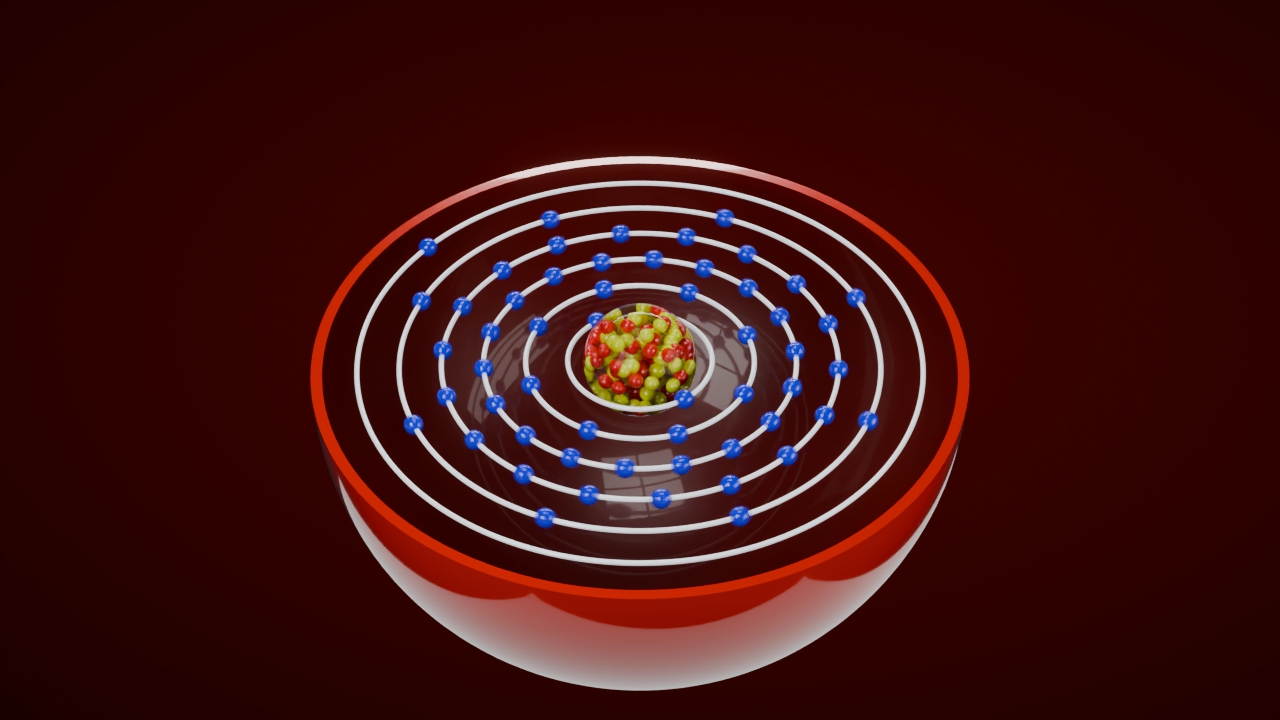
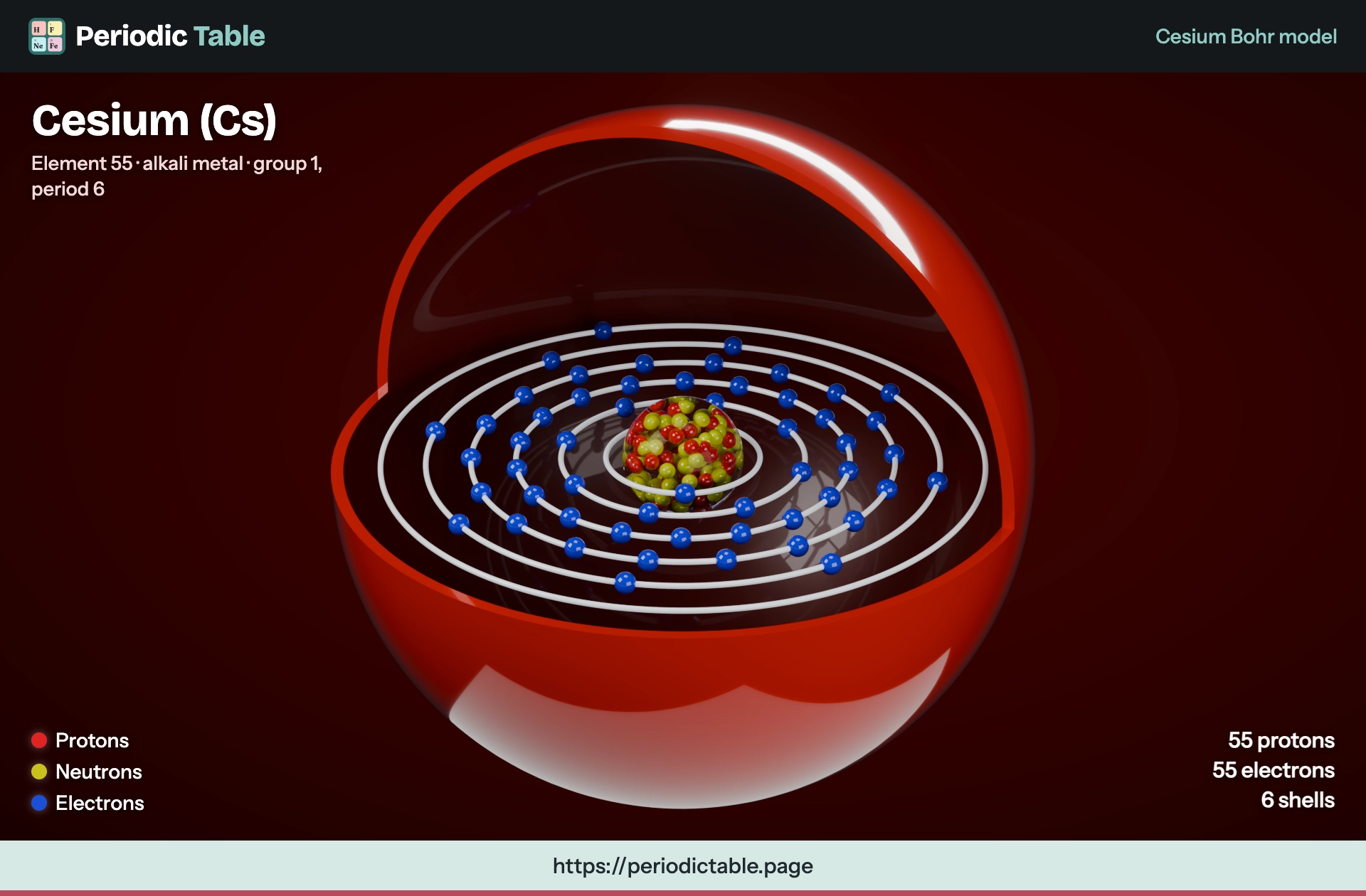
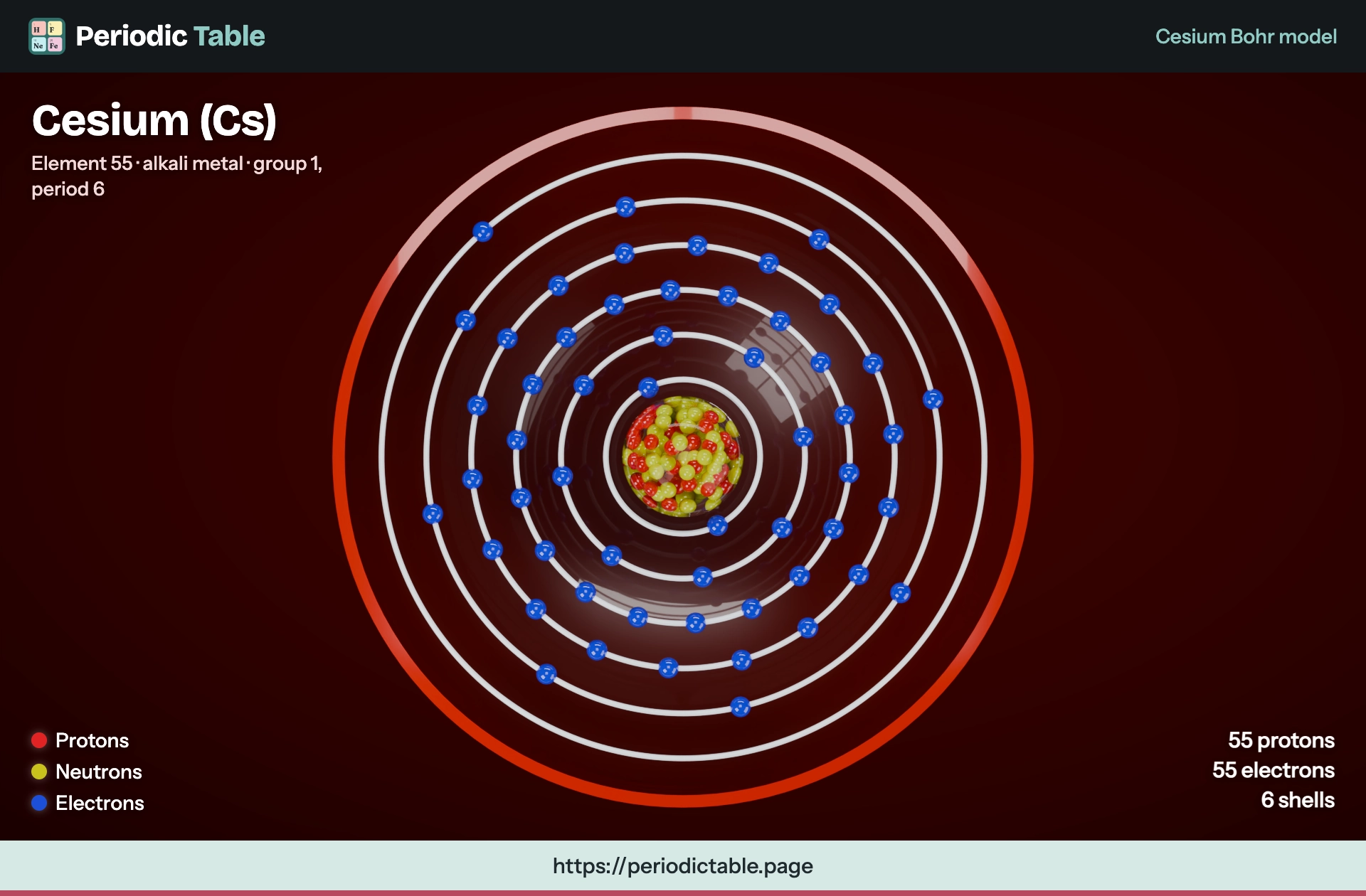
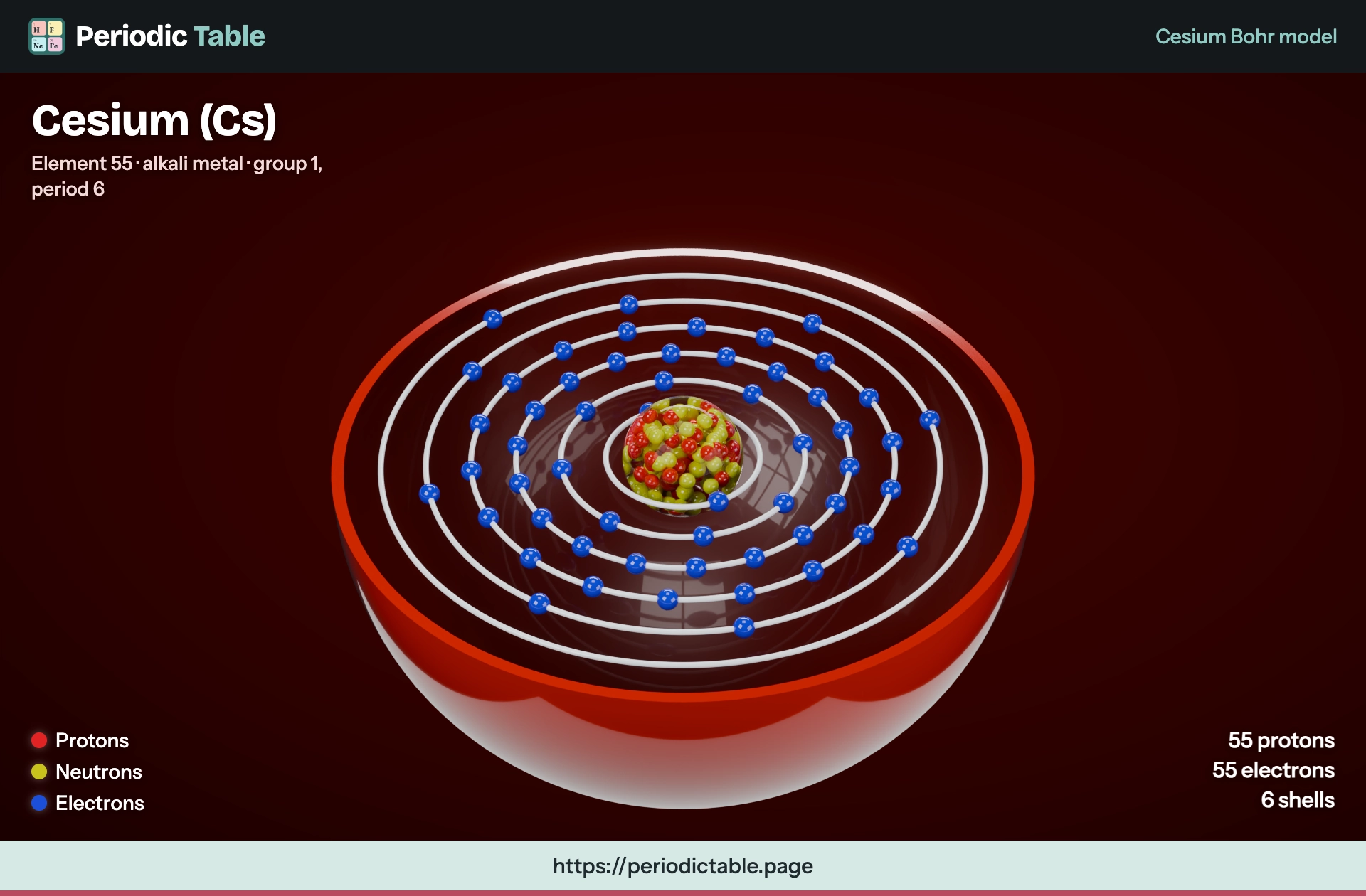
This is a Bohr model of cesium (Cs), a simplified picture of a single cesium atom. Its nucleus holds 55 protons, and a neutral cesium atom has 55 electrons, arranged around it in 6 shells (2 in shell K, 8 in shell L, 18 in shell M, 18 in shell N, 8 in shell O and 1 in shell P).
Cesium periodic table electron configuration
- Shorthand
- [Xe] 6s1
- Full
- 1s2 2s2 2p6 3s2 3p6 4s2 3d10 4p6 5s2 4d10 5p6 6s1
- Electrons per shell
- 2, 8, 18, 18, 8, 1
Cesium element properties and atomic data
- Atomic number
- 55
- Atomic mass
- 132.9055 u
- Phase at STP
- Solid
- Melting point
- 28.55°C (301.7 K)
- Boiling point
- 670.85°C (944 K)
- Density
- 1.93 g/cm³
- Electronegativity (Pauling)
- 0.79
- Period
- 6
- Group
- 1
- Block
- s-block
- Appearance
- Silvery gold
- Discovery date
- 1860
- Discovered by
- Robert Bunsen
- Named by
- —
Caesium element facts: atomic mass, weight and density
Caesium sits in the bottom-left corner of the periodic table, in group 1, period 6 and the s-block. Its standard atomic weight is 132.905, and the metal has only one naturally occurring form. The table gathers the values you'll look up most often. For basic atomic data, the natural strontium page lists atomic mass, electron configuration and oxidation states.
| Property | Caesium value |
|---|---|
| Symbol | Cs |
| Atomic number | 55 |
| Atomic mass | 132.905 u |
| Group / period / block | 1 / 6 / s |
| Appearance | Pale gold, lustrous |
| State at 20 °C | Solid, a few degrees below its melting temperature |
| Boiling point | 671 °C (944 K) |
| Density at 20 °C | 1.886 g/cm3 |
| Hardness | 0.2 on the Mohs scale |
| Discovered | 1860, by Robert Bunsen and Gustav Kirchhoff |
| First isolated | 1882 |
| Name origin | Latin caesius |
Electron configuration and ionization energies
The electron configuration of caesium is [Xe] 6s1, with shells holding 2, 8, 18, 18, 8 and 1 electrons. That lone outer electron sits far from the nucleus, so the first of its ionization energies is only 375.7 kJ/mol, the lowest of the stable alkalis, while pulling the next electron from the xenon core takes about 2,234 kJ/mol. This gap is why the atom almost always gives up exactly one of its electrons and stops there.
Size follows from the same structure. The empirical atomic radius is about 265 pm, the covalent radius about 244 pm, and the van der Waals radius 343 pm, giving caesium the biggest measured atomic size of all.
Cesium or caesium? spelling and name origin
Both spellings are correct. IUPAC recommends caesium, the form used in British, Australian and most international writing. Anyone studying element 14 will find the silicon metal covers pure silicon purification and the doping used in chips.
The American Chemical Society has used cesium since 1921, so US textbooks, agencies and labs write cesium. An old-fashioned form, cæsium, keeps the Latin ligature.
The name comes from the Latin caesius, usually translated as bluish grey or sky blue, after the colour of the two bright lines its glowing vapour produces. Whichever spelling you use, the physics of cesium atoms is identical, and the symbol is Cs either way.
Physical properties of caesium metal
The physical properties of caesium are unusual. It is the softest solid metal at room conditions, about as soft as wax, and very ductile.
Freshly cut caesium metal is silvery-golden; a trace of oxygen deepens the tint, and a sample stored for shipping turns dull grey. Only gold and copper share a non-silver colour among the metals, and the reason is optical: caesium absorbs some violet light and reflects the rest, so it looks yellow.
Caesium mixes with the other alkali metals except the lightest one, forms alloys with gold and amalgams with mercury, and makes photosensitive intermetallic compounds with antimony, gallium and indium. Its compounds colour a flame violet.
Melting point and boiling point
With a melting point of 28.5 °C (83.3 °F), caesium is one of five metals that are liquid near room temperature, alongside gallium, rubidium, francium and mercury. Hold a sealed ampoule in your hand and the crystals slump into a liquid. It boils at 671 °C, which is also low: among stable metals only mercury boils at a lower temperature.
Crystal structure: body-centred cubic
The solid has a body-centred cubic (bcc) crystal structure, with one atom at each cube corner and one in the centre, and a lattice constant of about 616 pm at 20 °C.
Chemical properties and reactivity of caesium
The chemical properties of caesium are those of its family turned up to the maximum. It is the most electropositive stable metal and often called the most reactive one. It is pyrophoric, igniting on its own in air, and it reacts explosively with water, even cold water, releasing hydrogen and heat:
$$2\,\mathrm{Cs} + 2\,\mathrm{H_2O} \rightarrow 2\,\mathrm{CsOH} + \mathrm{H_2}$$
It even reacts with ice at −116 °C. Because it reacts with water vapour and oxygen this readily, it is classed as a hazardous material. You'll find it stored under dry mineral oil, handled only under an inert gas such as argon, and sold in vacuum-sealed borosilicate glass ampoules; quantities above about 100 g travel in hermetically sealed stainless steel containers.
Its reactivity falls short of what its position suggests in one respect: the blast in water is often weaker than a sodium one, because the metal reacts so fast that little hydrogen collects before ignition.
Oxidation states and electronegativity on the Pauling scale
Caesium's electronegativity is 0.79 on the Pauling scale, making it the least electronegative stable element. Its common oxidation state is +1, as the cation Cs+.
The rare exception is the caeside anion Cs−, found in a few compounds made in liquid ammonia, which puts caesium in the −1 oxidation states list. Theory predicts higher states under pressures above 30 GPa, but none has been confirmed.
Caesium compounds and salts
Almost all caesium compounds contain Cs+ bonded ionically to an anion. Caesium salts are usually colourless and dissolve well in water; many are hygroscopic, though less so than their lighter relatives. The large ion also packs around more neighbours than smaller alkali ions do, which is useful when chemists need to pull Cs+ out of a mixture.
Caesium hydroxide (CsOH) is strongly basic and etches glass and silicon. It is often called the strongest base among the hydroxides, though it is a strong base only in the water-based sense: compounds such as butyllithium are stronger in non-aqueous solvents.
Heat it with gold and you get auride salt CsAu, in which gold behaves like a halide. US industrial suppliers list the same chemicals as cesium compounds.
Caesium chloride, fluoride and the oxides
- Caesium chloride (CsCl) gives its name to a crystal pattern: each Cs+ sits at the centre of a cube of eight chloride ions, unlike the six-neighbour rock-salt layout of NaCl.
- Caesium fluoride (CsF) is a dry source of fluoride ions in organic chemistry; US catalogues sell it as cesium fluoride.
- Caesium iodide (CsI) crystals detect X-rays and gamma rays.
- Burning the metal gives the orange superoxide CsO2; the yellow-orange caesium oxide Cs2O, the peroxide Cs2O2 and coloured suboxides such as Cs11O3 also exist.
Caesium isotopes: one stable isotope, many radioactive ones
Caesium has 41 known isotopes, with mass numbers from 112 to 152, yet only one stable isotope: caesium-133, which makes up all natural caesium and carries 78 neutrons. Every other form is a radioactive isotope.
Caesium-135 lasts about 1.33 million years, caesium-134 about 2.07 years, and most of the rest decay in seconds or minutes. Several of these isotopes form inside nuclear reactors as uranium splits.
Half-life of caesium-137, a fission product
Caesium-137 is the form people mean when caesium makes the news. It is a fission product that loses half its activity every 30.04 years, emitted from spent nuclear fuel and from the fallout of nuclear weapons testing. It undergoes beta decay to metastable barium-137, which then releases gamma radiation at 0.662 MeV.
Much of it forms indirectly, from short-lived iodine and xenon isotopes, so it can turn up far from where the uranium split. The share left after t years is:
$$\frac{N}{N_0} = \left(\tfrac{1}{2}\right)^{t / 30.04}$$
A sealed source made today keeps 79.39% of its activity after 10 years and 39.73% after 40 years; dropping below 0.1% takes about 299 years, roughly ten 30 years intervals. That long tail is why radioactive fallout from the 1950s still marks soil layers, and why US regulators track cesium-137 in food and water.
Where caesium comes from: pollucite and production
Caesium is a rare element, averaging about 3 parts per million in the earth's crust. It ranks around 45th by abundance, and rubidium is about 30 times more abundant. Because its ion is too large to fit into most crystals, it stays in the melt as magma cools and ends up concentrated in zoned pegmatite bodies.
The only commercial ore is the mineral pollucite, Cs(AlSi2O6), which occurs with the lithium minerals lepidolite and petalite. The richest deposit is the Tanco Mine at Bernic Lake, Manitoba, Canada, which holds over two-thirds of known reserves.
Other sources include the Bikita pegmatites in Zimbabwe and the Karibib area of Namibia. World mining output is only a few tonnes a year.
- Acid digestion: crushed pollucite is dissolved in a strong acid, and a caesium double salt is precipitated.
- Purification: the salt is converted to pure chloride, sulfate or carbonate.
- Reduction: the purified salt is reduced with calcium or barium at 700-800 °C, or by electrolysis of molten caesium cyanide, the route Carl Setterberg used during his doctoral research to make the first pure sample.
Most mined caesium never reaches the pure form; it goes straight into formate salt for drilling. The pure metal has a high price, on the order of tens of dollars per gram.
Caesium discovery: flame spectroscopy and the spectroscope
Caesium was the first element found with a spectroscope, an instrument Bunsen and Kirchhoff had built only a year earlier. In 1860 they evaporated mineral water from Dürkheim, Germany, heated the residue in a flame and saw two bright blue lines in its emission spectrum that matched no known substance. Flame spectroscopy had turned those spectral lines into proof of a new substance.
Isolating it was harder. From about 44,000 litres of water, Bunsen recovered only 7.3 g of caesium chloride, and his attempts at electrolysis gave a coloured, non-metallic product.
Pure caesium waited until 1882. For decades afterwards it remained mostly a research curiosity, until radio valves of the 1920s gave it a job.
Caesium uses and applications
Modern industry uses caesium in small but critical amounts, mainly in timekeeping, drilling, electronics and nuclear work. Older roles included scavenger metals in tubes and special glass for optics.
Atomic clocks and the definition of the second
The best-known use is the atomic clock. A hyperfine transition between two energy levels in the ground state of caesium-133 absorbs and emits light at a fixed microwave frequency. Since 1967 the International System of Units has used it for the definition of the second: the SI unit of time lasts exactly 9 192 631 770 periods of that wave, written as Δν(Cs) = 9 192 631 770 Hz.
Caesium clocks, the primary time and frequency standard, drift by only a few nanoseconds a day, and the best keep time to about one second in 20 million years. They anchor GPS satellites, cell phone networks and internet time servers, and they underpin precision physics experiments.
Caesium formate drilling fluids
By tonnage, the largest use is caesium formate brine in oil drilling. These drilling fluids lubricate the bit, carry rock cuttings up and hold pressure on the formation; the same brine serves as completion fluids once the oil well is drilled. Its high density, up to 2.3 g/cm3, replaces poisonous suspended solids, and the fluid is biodegradable and recyclable, which is easier on the environment.
Petroleum companies rent and recover it because each barrel is costly. US operators call it cesium formate, and a lighter drilling fluid is made by blending it with potassium formate.
Photoelectric cells, electronics and ion engines
- Low-threshold, photoemissive caesium cathodes made it standard in photoelectric cells, photomultiplier tubes and camera tubes.
- In early vacuum tubes it acted as a getter, absorbing stray oxygen; thermionic converters use its vapour to turn heat into electrical energy.
- Caesium iodide and fluoride scintillators power scintillation counters, and caesium vapour senses fields in magnetometers.
- Early ion engines used caesium as a propellant for spacecraft propulsion; a caesium ion thruster was later largely replaced by xenon, which corrodes less.
- Caesium nitrate colours infrared flares, and caesium carbonate improves glass for fibre optics and night vision devices.
Medical, laboratory and nuclear fission uses
Caesium-137 from nuclear fission has served as a gamma source in radiation therapy for cancer, in industrial gauges for thickness, fill level and moisture, in well logging and in hydrology, where fallout layers date sediments. Its water-soluble chloride form spreads easily, so medical sources are being replaced.
In the laboratory, caesium chloride solutions form a density gradient for ultracentrifugation that separates DNA and viruses. Its salts also act as catalysts and bases in organic chemistry, and caesium-133 is laser cooled to study ultracold atoms in quantum physics.
Caesium health and safety hazards
The health and safety hazards of caesium come in two kinds. The metal is a fire and explosion hazard: it ignites in air, reacts violently with moisture, and its hydroxide burns skin and eyes.
Nonradioactive salts, by contrast, are only mildly toxic. Your body handles Cs+ much like potassium, so a very large intake can upset that balance and cause hypokalemia, heart rhythm problems and cardiac arrest, but natural sources never deliver doses like that.
Radiocaesium is the real concern. Caesium-137 spreads through food chains the way potassium does, building up in mushrooms, fish and plants. About 10% of an absorbed dose leaves within days; the rest has a biological half-life of 50 to 150 days, so it does not linger for life.
After the Chernobyl disaster, it became the main source of residual radiation within months, and contamination of lakes and forests persists. Lost sources have caused serious accidents, and agencies list caesium-137 among materials that could be misused in dirty bombs.
Caesium among the alkali metals of group 1
Caesium sits below rubidium among the alkali metals. Moving down this column of the periodic table, each atom gets bigger, the outer electron is held more loosely, and melting points fall. The table shows how caesium caps the stable members of the family.
| Element | Symbol | Melts at (°C) | 1st ionization energy (kJ/mol) | Pauling value |
|---|---|---|---|---|
| Lithium | Li | 180.5 | 520.2 | 0.98 |
| Sodium | Na | 97.8 | 495.8 | 0.93 |
| Potassium | K | 63.5 | 418.8 | 0.82 |
| Rubidium | Rb | 39.3 | 403.0 | 0.82 |
| Caesium | Cs | 28.5 | 375.7 | 0.79 |
The trend explains caesium's place in chemistry: easier ionization means faster reaction with water, and a larger ion means bigger, more loosely packed crystals. Francium should continue the pattern, but relativistic effects hold its electron slightly tighter, so this chemical element, not its heavier neighbour, is the most reactive alkali metal you can actually handle. Its chemistry closely tracks rubidium's, which is why the two are mined, separated and studied together, and why caesium chemistry teaching usually starts from sodium and potassium.
- Most electropositive stable metal
- Caesium, with the lowest Pauling value in the table.
- Lowest-melting member you can hold
- Caesium, which melts in a warm hand.