


Silicon element (Si): silicon periodic table facts
Silicon periodic table facts: silicon (Si) is element 14, a metalloid in group 14, period 3. You probably touch silicon dozens of times a day without noticing it: it is in the computer chips inside your phone, the window you look through and the beach you walk on. For crystal habits and mechanical behavior, see bismuth properties for rhombohedral structure, brittleness and why it expands on solidification.
Silicon is a shiny, blue-grey solid that is never found free in nature, and its name comes from the Latin silex, meaning flint. Below you will find its key physical data, where it comes from, how it is refined and why one element ended up running the digital world.
Rotate the 3D Bohr model of silicon
Drag to orbit, scroll to zoom.
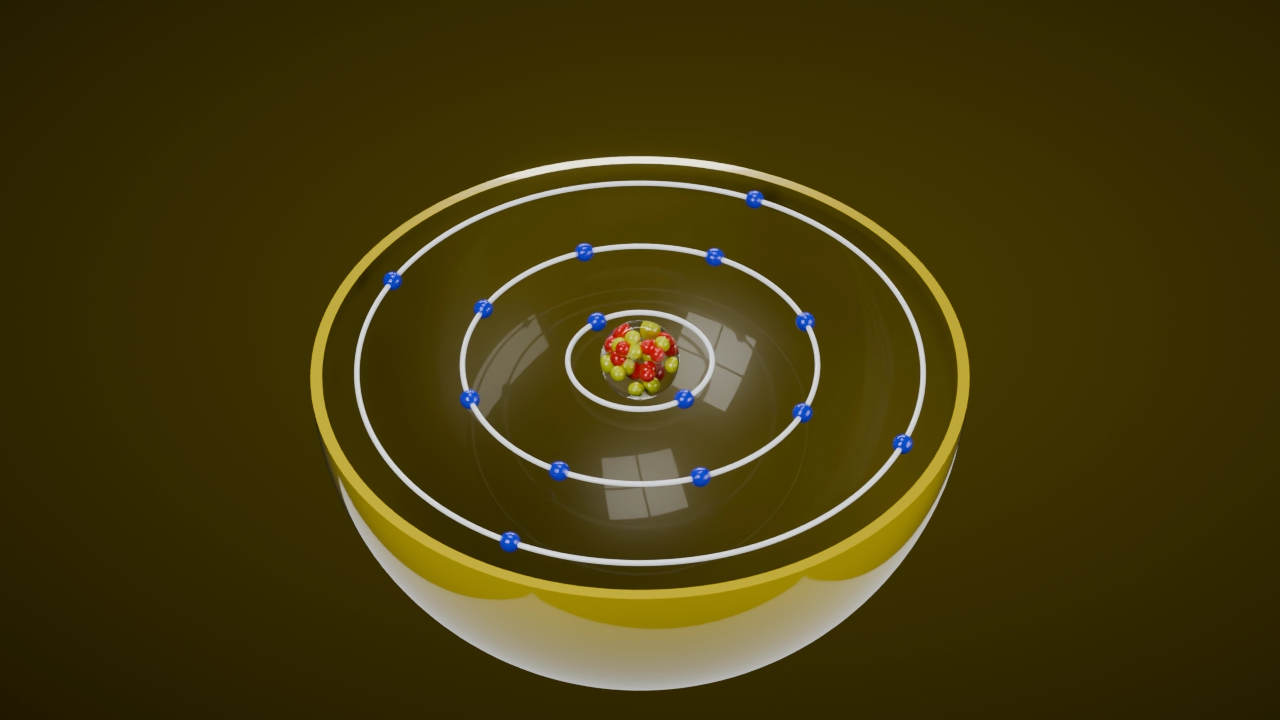
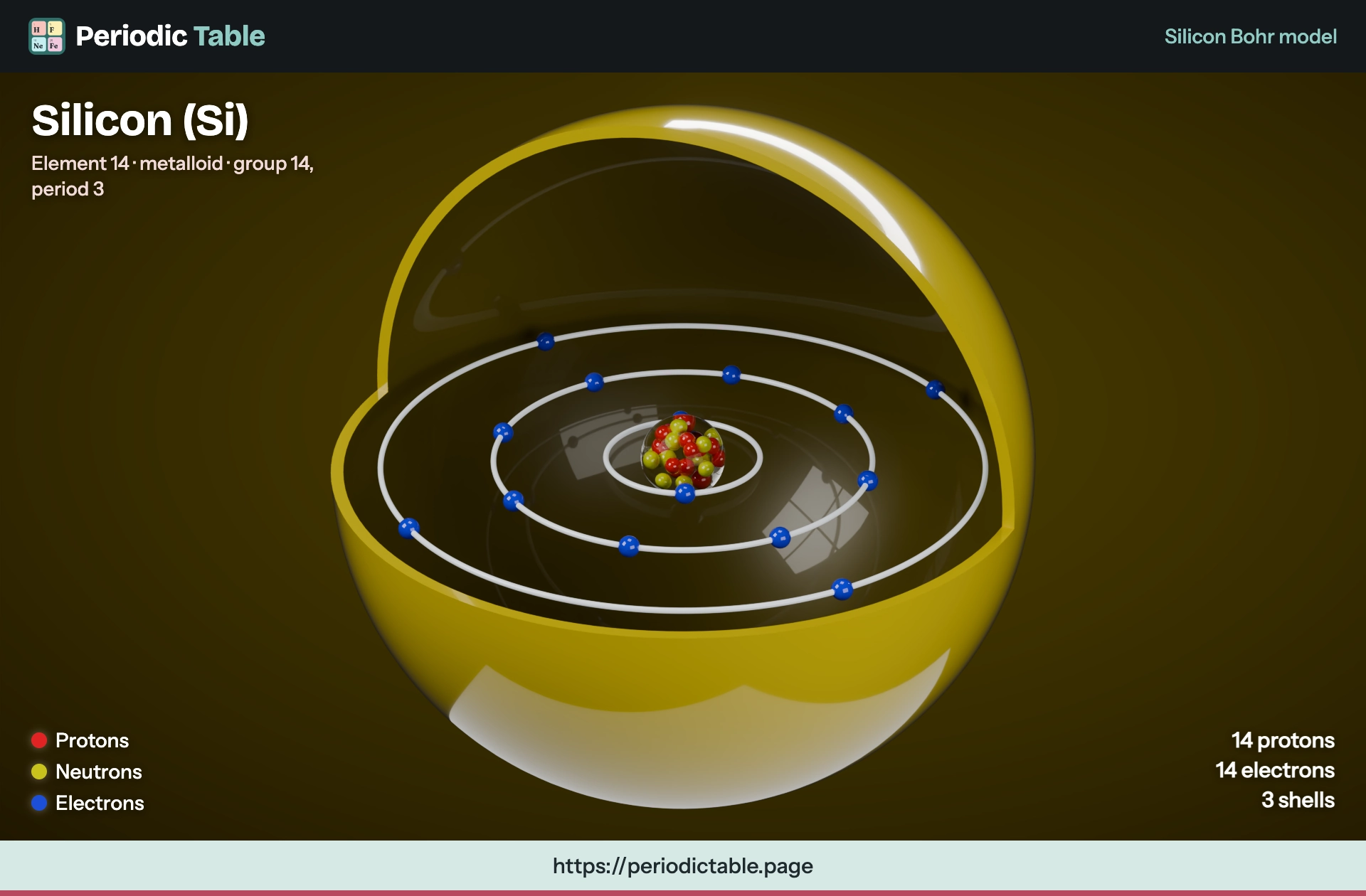
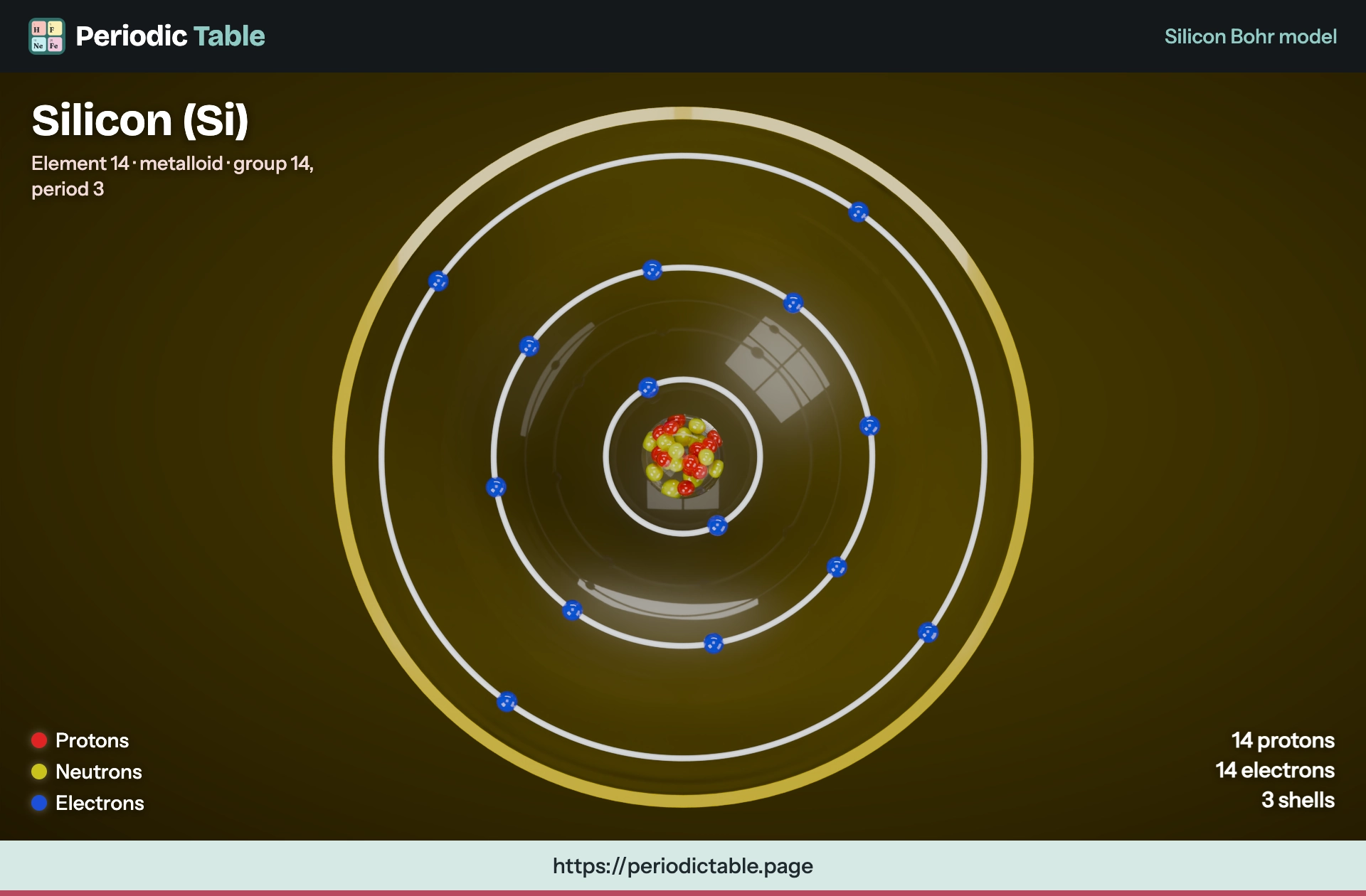
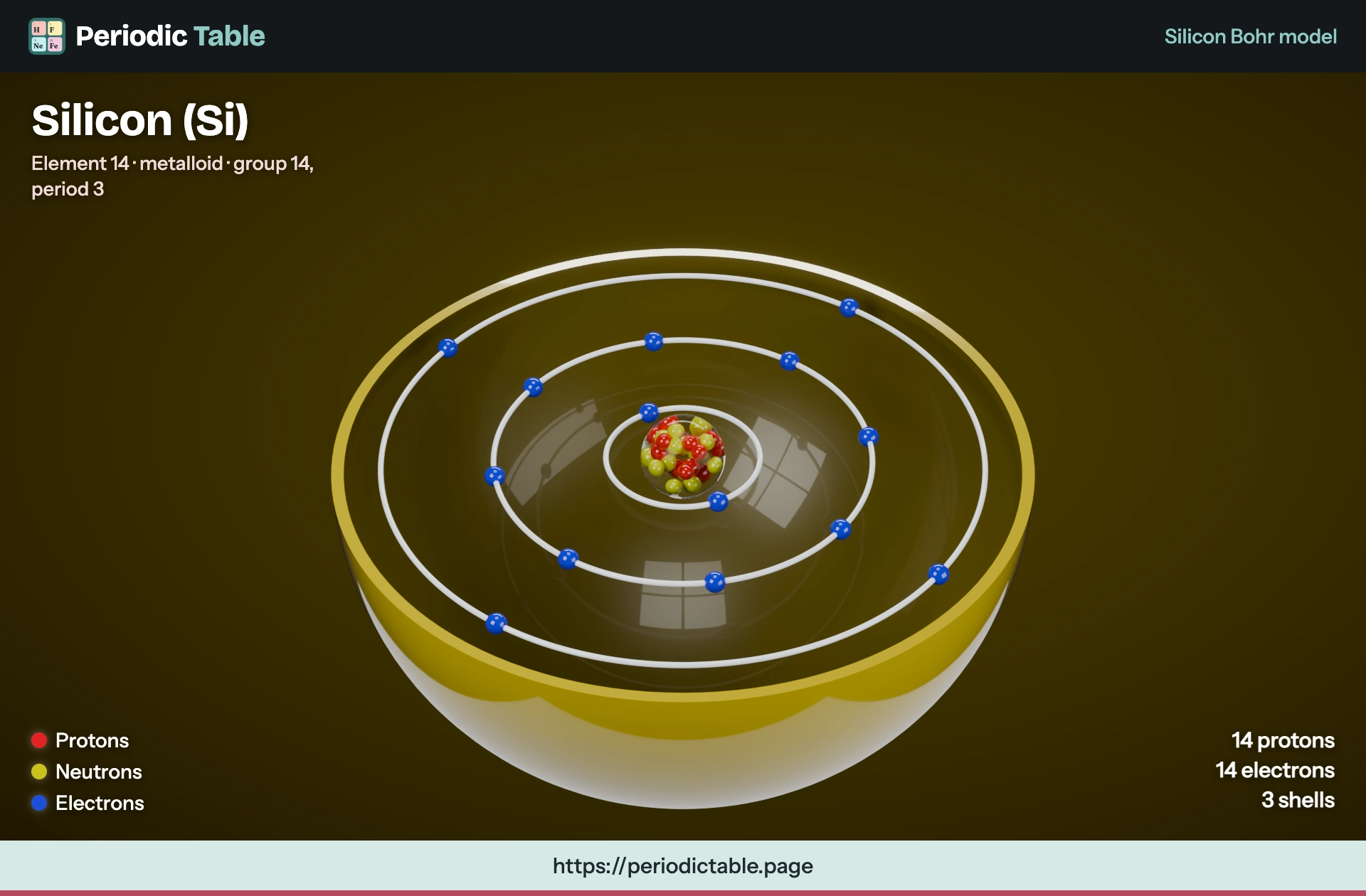
This is a Bohr model of silicon (Si), a simplified picture of a single silicon atom. Its nucleus holds 14 protons, and a neutral silicon atom has 14 electrons, arranged around it in 3 shells (2 in shell K, 8 in shell L and 4 in shell M).
Silicon periodic table electron configuration
- Shorthand
- [Ne] 3s2 3p2
- Full
- 1s2 2s2 2p6 3s2 3p2
- Electrons per shell
- 2, 8, 4
Silicon element properties and atomic data
- Atomic number
- 14
- Atomic mass
- 28.085 u
- Phase at STP
- Solid
- Melting point
- 1413.85°C (1687 K)
- Boiling point
- 3264.85°C (3538 K)
- Density
- 2.329 g/cm³
- Electronegativity (Pauling)
- 1.9
- Period
- 3
- Group
- 14
- Block
- p-block
- Appearance
- Crystalline, reflective with bluish-tinged faces
- Discovery date
- 1824
- Discovered by
- Jöns Jacob Berzelius
- Named by
- Thomas Thomson (chemist)
Silicon at a glance: key facts about its atoms
The table below collects the figures most people look up first. Every value is a published constant for the chemical element, rounded to the precision you will normally need. A reader curious about caesium-137, half-life data and fallout will find the radioactive side in the cesium on the periodic table guide with sources.
| Property | Value |
|---|---|
| Symbol | Si |
| Atomic number | 14 |
| Relative atomic mass | 28.085 |
| Group / period / block | 14 / 3 / p-block |
| Electron configuration | [Ne] 3s2 3p2 |
| Melting point | 1414 °C (1687 K) |
| Boiling point | 3265 °C (3538 K) |
| Density at 20 °C | 2.33 g/cm3 |
| Electronegativity (Pauling) | 1.90 |
| Specific heat capacity | 712 J kg−1 K−1 |
| Discovered | 1824, Jöns Jacob Berzelius |
Atomic number, atomic weight and density
Fourteen protons define the element. Its atomic weight of 28.085 is an average: most of it is the mass-28 isotope, with smaller shares of 29 and 30 pulling the figure up. At 2.33 g/cm3 it is lighter than aluminium, which is why a block of it feels surprisingly light for something that looks like metal.
Melting point and boiling point
Both values are high because each atom is locked into a rigid three-dimensional network of strong covalent bonds. That 1414 °C figure sets the temperature crystal growers must hold precisely when they pull large crystals from the melt.
Where the silicon atom sits in the periodic table
The silicon atom sits in group 14, period 3, directly below carbon and above the heavier members of the same group. It has 14 electrons arranged as [Ne] 3s2 3p2, so four of them occupy the outer shell. That outer set of four explains most of its chemistry: it prefers to form four bonds, its common oxidation states are +4 and −4, and it builds the same tetrahedral geometry that diamond does. Named for Tennessee, the tennessine atomic number is the heaviest of its column, synthesised in Dubna with Oak Ridge berkelium.
Three stable isotopes occur naturally, with mass numbers 28 (about 92.2%), 29 (4.7%) and 30 (3.1%). Its bond in the oxide, at roughly 452 kJ/mol, is one of the strongest single bonds it forms, which is why the element is almost always found tied up in rock rather than free.
Is it a metal? why the element counts as a metalloid
Polished and ultrapure, silicon has a glossy metallic sheen, so it is easy to mistake for a metal. It does not behave like one: it is hard and brittle, shattering under a hammer instead of bending, and its oxide is acidic rather than basic. Chemists therefore place it on the borderline between metals and nonmetals.
Its electrical behaviour is just as in-between. It carries electricity far less well than a true conductor such as copper, but far better than an insulator such as rubber. Industry sells the refined bulk material as silicon metalloid, and you will also see it described as a semi-metal, even though strictly speaking it is neither a metal nor half of one.
Silicon in the earth's crust: silica and silicates
By mass, silicon makes up about 27.7% of the crust, which makes it the second most abundant element after oxygen. A crustal abundance of roughly 282,000 parts per million also means supply is not limited by geology: the limit is the energy needed to free it.
Nearly all of it is held in silicates, minerals built from linked SiO4 tetrahedra. Granite, clays, mica, talc and feldspar all belong to this group, and together these minerals form most of the rock beneath your feet.
Quartz, sand and silicon dioxide
The simplest of these compounds is silicon dioxide, SiO2. It occurs as colourless quartz and rock crystal, as chert, and as most ordinary sand. Because the same tetrahedra can link in chains, sheets or open frameworks, the oxide family ranges from hard crystals to porous zeolites.
How elemental silicon is produced
To produce elemental silicon, producers load lumps of quartzite (not fine grains, which would clog the charge) into an electric arc furnace together with coal, coke and wood as the reducing agent. At around 2,000 °C the reducing agent strips the oxide apart:
$$\mathrm{SiO_2 + 2C \rightarrow Si + 2CO}$$
The carbon leaves as carbon monoxide, and any SiO vapour that escapes the furnace burns in air to form microsilica, a fine powder sold to concrete makers. It is one of the most electricity-hungry processes in metals manufacturing, so smelters cluster near cheap power.
From silicon metal to polysilicon
Molten product tapped from the furnace is refined in a ladle and cast into blocks, commercially 96% to 99.99% pure. This metallurgical silicon suits metallurgy and silicones but is far too dirty for microelectronics, so it is converted to a volatile chloride, distilled and deposited back out as polysilicon, reaching a purity of nine to eleven nines (99.9999999% and up). Melting it again and slowly pulling a seed crystal out of the melt grows single crystal ingots that can weigh more than 100 kg.
Why pure silicon works as a semiconductor
In pure silicon, each atom shares its four valence electrons with four neighbours, so at room temperature almost none are free to move. That makes the intrinsic crystal a poor carrier of current. It is a semiconductor: a little heat or light can lift a few charges across into a band where they move freely, and that small, controllable conductivity is exactly what a switch needs.
Doping with boron and phosphorus
Doping adds a few parts per million of another element to set the conductivity precisely:
- Phosphorus has one more outer electron than silicon, so each atom adds a spare negative charge and creates n-type material.
- Boron has one fewer, leaving a missing charge, or hole, and creating p-type material.
- Where n-type and p-type regions meet, you get a junction, the building block of diodes, photovoltaic cells and transistors.
Semiconductor properties compared with germanium
The first transistors were made from the heavier element below it, but the lighter one won. Its wider band gap keeps leakage low at high temperature, and above all it grows a stable, insulating oxide skin, which the other element cannot.
| Property (300 K) | Silicon | Germanium |
|---|---|---|
| Band gap | 1.12 eV | 0.67 eV |
| Electron mobility | ~1,400 cm2/V·s | ~3,900 cm2/V·s |
| Intrinsic carrier concentration | ~1 × 1010 cm−3 | ~2 × 1013 cm−3 |
| Native oxide | Stable, insulating | Water-soluble, unstable |
Silicon wafers and integrated circuits in electronics
Ingots are sliced into silicon wafers, then polished flat to within nanometres. To get a sense of scale, take a standard 300 mm wafer that is 0.775 mm thick: its volume is about 54.8 cm3, so at 2.33 g/cm3 it weighs roughly 128 g and holds about 2.7 × 1024 atoms. Onto that disc, fabs pattern hundreds of dies at once.
Nearly every product of digital technology starts this way, which is why the semiconductor industry still runs on one element:
- Microprocessors in computers and smartphones, each packing billions of transistors into integrated circuits.
- Memory microchips (DRAM and flash) that store everything those processors work on.
- Image sensors that turn light into the pixels of a camera photo.
- Power devices that switch and convert current in chargers, cars and grid electronics.
That is why "silicon chips" became shorthand for computing itself.
Other uses of silicon metal: alloys, silicones, glass and solar cells
Electronics take only a small share of the tonnage. Most of the refined element goes into bulk products:
- Alloys: aluminium–silicon castings (aluminum in US usage) for engine blocks and cylinder heads, and ferrosilicon for deoxidising steel and making transformer steel.
- Silicones: silicon–oxygen chains with organic side groups, giving a polymer family used for sealants, lubricants, cooking utensils and medical implants.
- Glass, ceramics, pottery glazes and enamels, all built on silicate chemistry.
- Solar cells: purified wafers convert sunlight to current and remain the backbone of solar energy installations.
- Silicon carbide abrasives and lasers, fumed silica fillers, and newer anodes for lithium-ion batteries.
Do not confuse silicon with silicone: the first is a hard grey crystal, the second a rubbery material made from it.
Silicon's biological role and health risks
Silicon itself is non-toxic, and some organisms use its oxide as a building material. Diatoms grow intricate glassy shells from it, many sponges build skeletal spicules with it, and plants such as rice, horsetails and grasses deposit it as stiffening particles called phytoliths. Whether humans need it is still undecided.
The danger lies in fine dust. Breathing crystalline silica dust over years causes silicosis, a scarring lung disease seen in miners, stonecutters and workers who cut engineered stone countertops, and asbestos, made of fibrous silicate crystals, can cause lung cancer.
Discovery of silicon as a chemical element
Flint tools and glassmaking go back thousands of years, but freeing the element proved hard. Humphry Davy suspected the oxide was a compound, and in 1811 Gay-Lussac and Thénard produced an impure form by reacting a silicon halide with potassium.
Credit usually goes to the Swedish chemist Berzelius, who in 1824 heated potassium fluorosilicate with potassium, washed out the by-products and obtained a fairly pure powder. Thomas Thomson had proposed the name in 1817, choosing an "-on" ending to mark it as a nonmetal.
The future of silicon in computing
Transistor features now measure only a few nanometres, close to the limit of individual atomic layers, and each new fab costs upwards of $20 billion. Chipmakers are keeping silicon in play with 3D transistor shapes and stacked dies rather than replacing it.
Other materials are taking specialised niches instead: gallium arsenide for radio-frequency parts, and silicon carbide and gallium nitride for high-voltage power devices. For mainstream logic and memory, nothing yet matches the cost, purity and huge manufacturing base built around element 14.