


Tennessine element (Ts): tennessine periodic table facts
Tennessine periodic table facts: tennessine (Ts) is element 117, a halogen in group 17, period 7. If you have ever wondered what sits in the second-to-last square of the periodic table, you are looking at tennessine, the man-made element 117 with the symbol Ts. Among mineral specimens, hopper crystals with a rainbow oxide film are photographed and explained in the bismuth element entry for collectors.
Fewer than two dozen of its atoms have ever existed, each lasting only a fraction of a second, so almost everything you read about it comes from a handful of experiments and a great deal of theory. This guide walks you through its discovery by a Russian–American research team, the national laboratory that made it possible, and the predicted chemistry that makes it unlike any other member of its group.
Rotate the 3D Bohr model of tennessine
Drag to orbit, scroll to zoom.
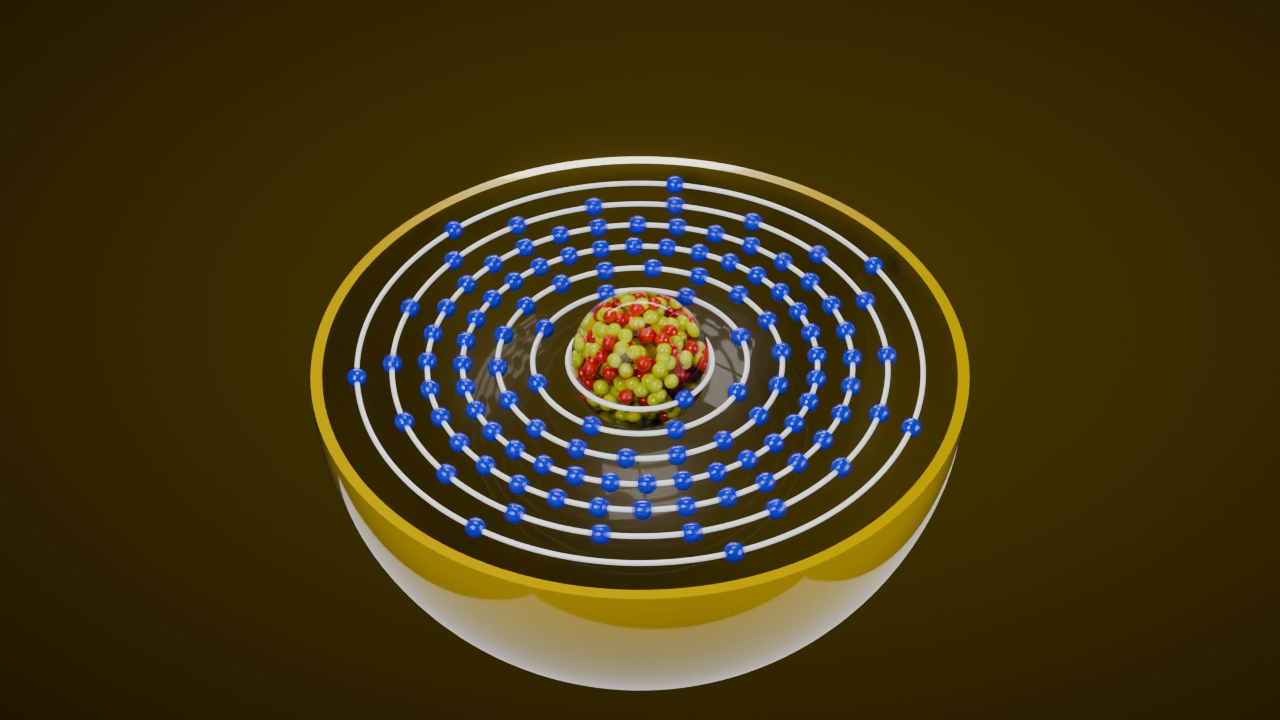
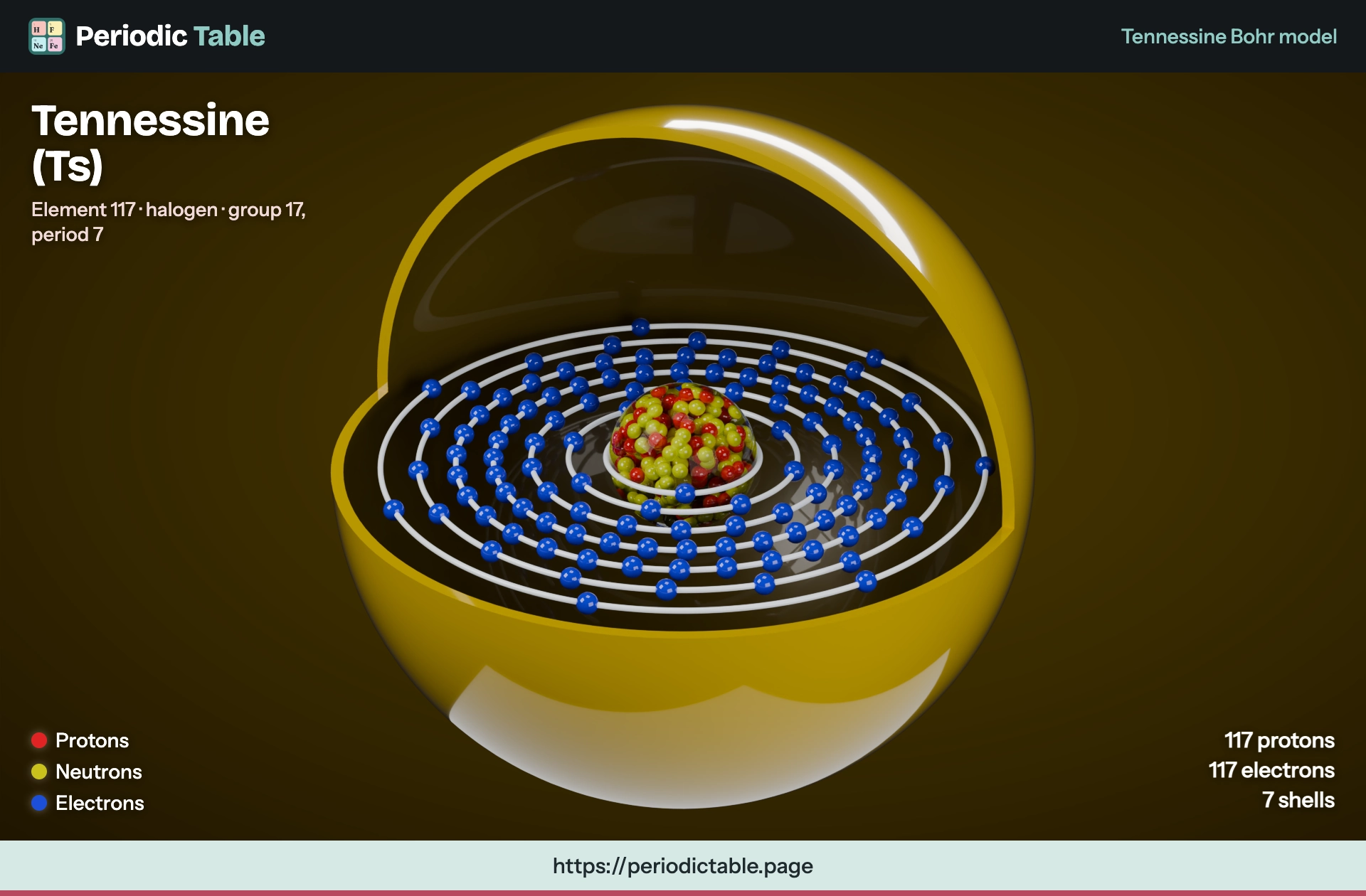
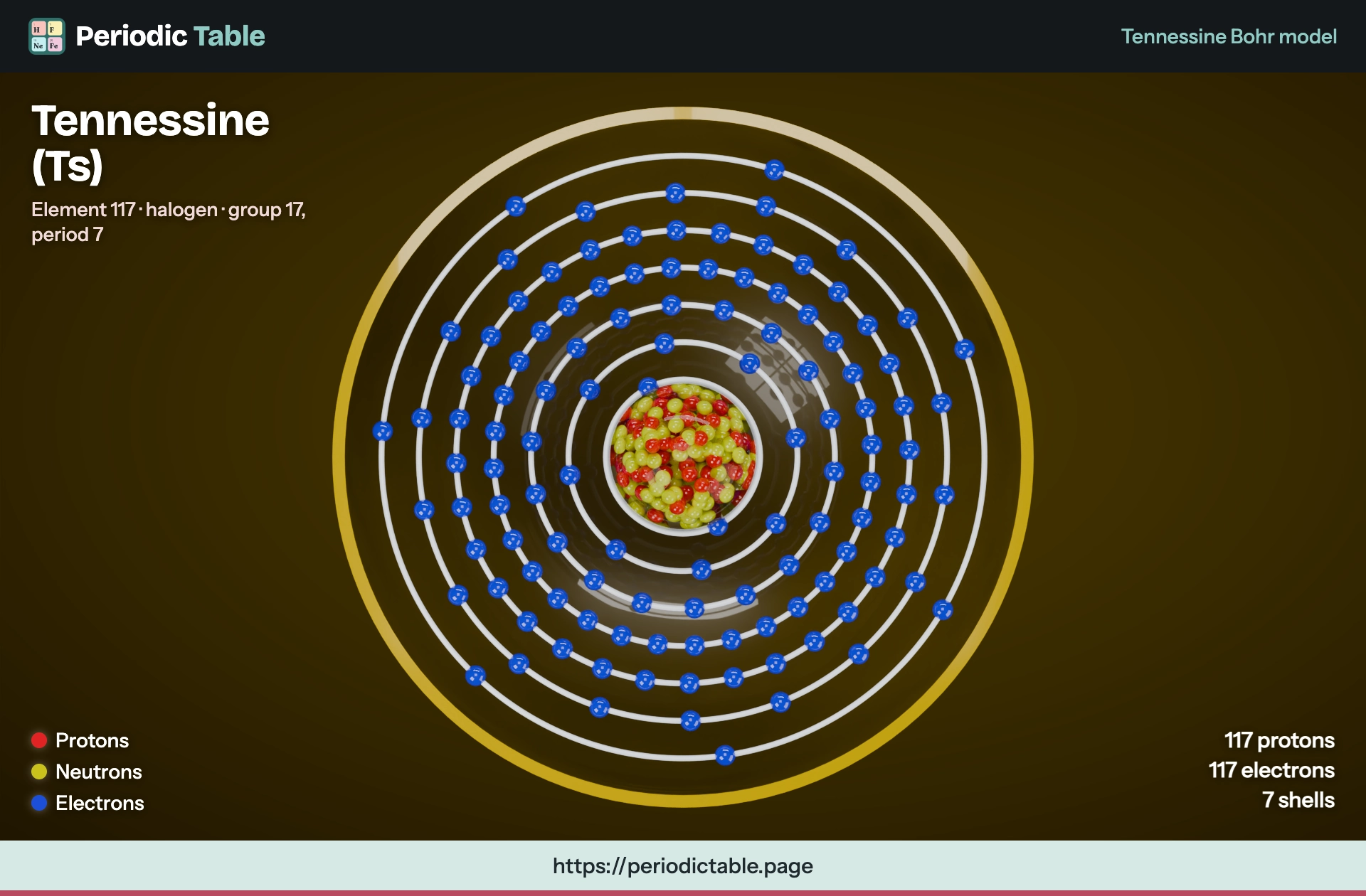
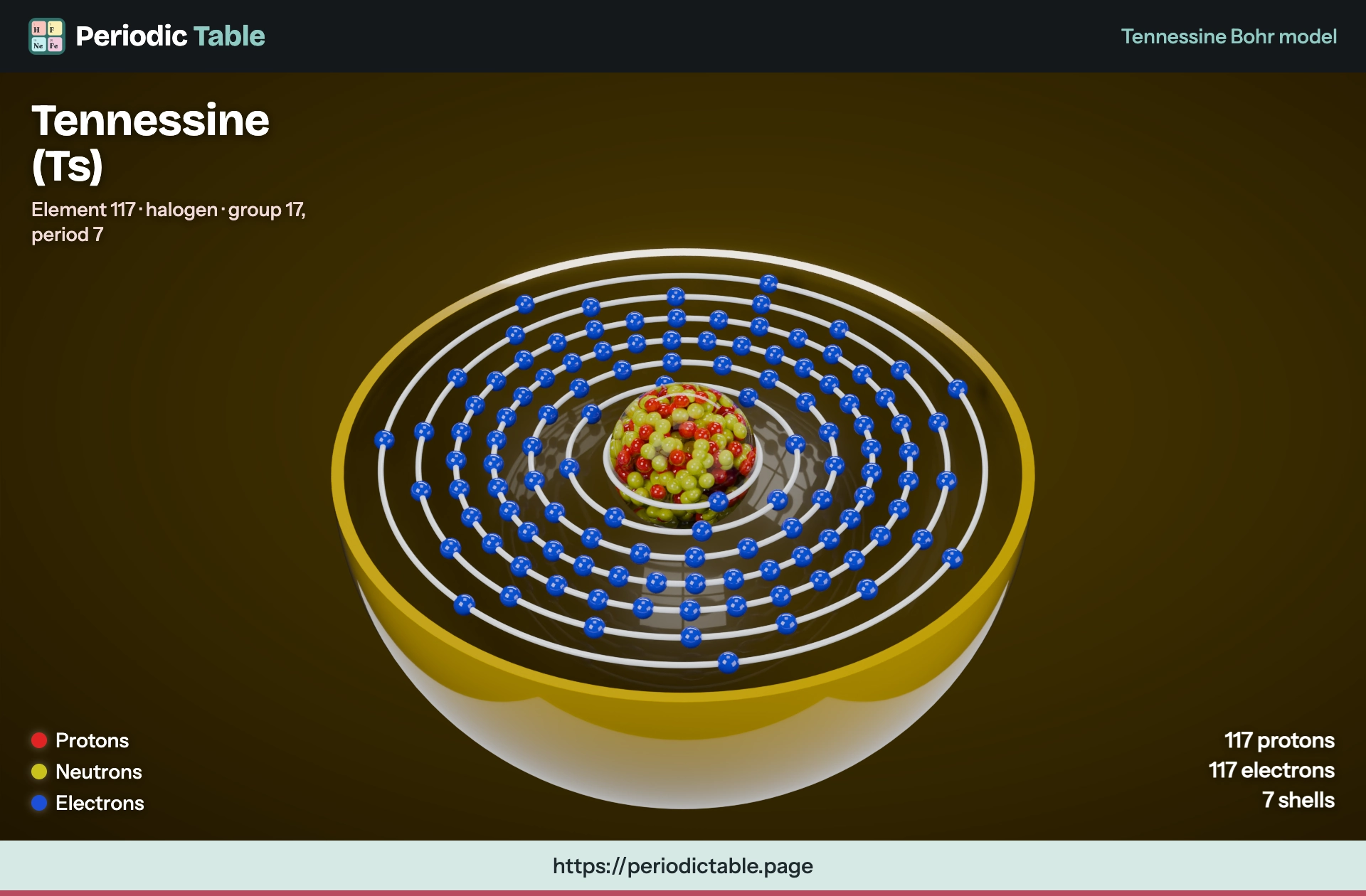
This is a Bohr model of tennessine (Ts), a simplified picture of a single tennessine atom. Its nucleus holds 117 protons, and a neutral tennessine atom has 117 electrons, arranged around it in 7 shells (2 in shell K, 8 in shell L, 18 in shell M, 32 in shell N, 32 in shell O, 18 in shell P and 7 in shell Q).
Tennessine periodic table electron configuration
- Shorthand
- *[Rn] 5f14 6d10 7s2 7p5
- Full
- 1s2 2s2 2p6 3s2 3p6 4s2 3d10 4p6 5s2 4d10 5p6 6s2 4f14 5d10 6p6 7s2 5f14 6d10 7p5
- Electrons per shell
- 2, 8, 18, 32, 32, 18, 7
Tennessine element properties and atomic data
- Atomic number
- 117
- Atomic mass
- [294] u
- Phase at STP
- Unknown
- Melting point
- 449.85°C (723 K)
- Boiling point
- 609.85°C (883 K)
- Density
- 7.17 g/cm³
- Electronegativity (Pauling)
- Unknown
- Period
- 7
- Group
- 17
- Block
- p-block
- Appearance
- Unknown
- Discovery date
- 2010
- Discovered by
- Joint Institute for Nuclear Research
- Named by
- —
What is tennessine? element 117 basics
Tennessine is a synthetic element: it does not occur in nature and can only be produced one atom at a time in a particle accelerator. It is a superheavy element, a label usually given to elements with more than 103 protons, and like all of them it is intensely radioactive. When studying how life builds skeletons, check element 14 for diatoms, sponges and plants that use silica.
When its discovery was announced in 2010 it became the most recently discovered chemical element, which is why it is sometimes called the baby of the periodic table. Of the 118 known elements, only one has a higher atomic number.
Each tennessine atom carries 117 protons in its nucleus, 117 electrons around it, and around 176 or 177 neutrons depending on the isotope. That puts it between livermorium (116) and oganesson (118) in period 7, and directly to the right of moscovium (115) and livermorium in the row of superheavy elements made since 1999.
Its neighbour oganesson sits in the noble gas column, so tennessine is the last element before the table closes its seventh row. Nobody has ever collected enough atoms to see a visible sample, so its phase, colour and appearance at room temperature are still predictions rather than observations.
Atomic number, atomic mass and electron configuration
The atomic number of tennessine is 117, and its atomic mass is usually quoted as [294], the mass number of its longest-lived known isotope. The square brackets tell you this is not a weighted average from a natural sample, because no natural sample exists. Its CAS number, the registry code chemists use to look up a substance, is 54101-14-3.
The predicted electron configuration is:
$$[\mathrm{Rn}]\,5f^{14}\,6d^{10}\,7s^{2}\,7p^{5}$$
That leaves seven electrons in the outer shell, the same count as every other element in its column, with shells filled as 2, 8, 18, 32, 32, 18, 7.
Group 17, period 7 and the p-block
On the standard periodic table, tennessine is placed in group 17, period 7 and the p-block, directly below astatine. On paper that makes it a halogen, the family of elements that runs from fluorine, chlorine, bromine, iodine and astatine. The placement follows from the 7p5 configuration above, but, as you will see further down, the physics of very heavy atoms means its column is a position on the chart rather than a promise of halogen-like behaviour.
Discovery of tennessine at oak ridge and Dubna
By 2009, scientists had already reported elements 113, 114, 115, 116 and 118, which left a conspicuous gap at 117. The Russian physicist Yuri Oganessian had developed the hot-fusion method behind those earlier finds, and in 2004 he proposed filling the gap with a joint experiment between his institute in Russia and partners in the United States. When comparing light metals by mass, look up beryllium facts for atomic mass, melting point and the density of this alkaline earth metal.
The plan stalled for several years over one ingredient. Joseph Hamilton of Vanderbilt University kept checking whether the right material would become available, work that later earned him the nickname "the father of 117."
Producing the berkelium-249 target in the high flux isotope reactor
To reach 117 protons by fusing a calcium nucleus (20 protons) with something heavier, you need an element with 97 protons: berkelium. The isotope required, berkelium-249, is a by-product of californium production, and the only place able to make enough was Oak Ridge National Laboratory (ORNL) in Tennessee, using its High Flux Isotope Reactor and the neighbouring Radiochemical Engineering Development Center. With approval from the U.S. Department of Energy, a 250-day irradiation campaign ending in December 2008 produced about 22 milligrams of the actinide.
Time was the real enemy. Berkelium-249 has a half-life of about 330 days, so the material lost value every day it sat on a shelf.
Running the numbers yourself shows why the team rushed: after 90 days of cooling, 22 mg falls to about 18.2 mg; after a further 90 days of chemical purification it is down to roughly 15.1 mg, and a full year would leave only about 10.3 mg. The finished target was flown to Russia in lead containers, held up twice at customs, and deposited as a layer roughly 300 nanometres thick on titanium foil before reaching the accelerator in July 2009.
Calcium-48 bombardment at the joint institute for nuclear research
At the Joint Institute for Nuclear Research (JINR) in Dubna, the team spent about 150 days bombarding the berkelium foil with a beam of calcium-48 ions accelerated in a heavy-ion cyclotron. Calcium-48 is chosen because its 28 neutrons give it a neutron-to-proton ratio of 1.4, unusually high for such a light nucleus, which pushes the fused nuclei toward heavier, more stable isotopes. The reaction for the lighter product looks like this:
$$^{249}_{97}\mathrm{Bk} + ^{48}_{20}\mathrm{Ca} \rightarrow\ ^{297}117^{*} \rightarrow\ ^{293}117 + 4\,^{1}_{0}n$$
The fusion creates an excited compound nucleus that sheds three or four neutrons. Out of trillions of beam particles striking the target every second, the bombardment yielded just six detected nuclei: five of mass 293 and one of mass 294. These six tennessine atoms were synthesized, identified through their decay products, and reported in Physical Review Letters on 9 April 2010, each having survived only tens to hundreds of milliseconds.
Confirmation and IUPAC recognition
A claim to a new element is only accepted once it is reproduced. In 2011 one of the claimed daughter isotopes was made directly, and its properties matched the 2010 data. The Dubna team repeated the full experiment in 2012, and in 2014 a German–American group at GSI in Darmstadt confirmed the result with two more atoms.
In December 2015, the joint working party of the IUPAC (the International Union of Pure and Applied Chemistry) and its sister body for physics formally recognized the discovery and credited JINR, ORNL and Lawrence Livermore National Laboratory, with Vanderbilt added after an omission was corrected. Clarice Phelps, part of the ORNL team, is recognized by the IUPAC as the first African-American woman involved in discovering a chemical element.
Naming Ts: from ununseptium to Tennessee
Before it had a real name, element 117 went by the systematic placeholder ununseptium (Latin and Greek roots for one-one-seven) with the temporary symbol Uus. Older literature also used eka-astatine, Mendeleev-style shorthand for "the element below astatine."
Once the discovery was accepted, the discoverers had the right to propose a permanent name. In June 2016 the IUPAC published the proposal, and it was officially adopted in November 2016.
The name honours the region of Tennessee, home to Oak Ridge National Laboratory, Vanderbilt University in Nashville and the University of Tennessee in Knoxville, all of which contributed to the work. The spelling follows a strict convention: elements in group 17 take the -ine suffix, as in chlorine, fluorine, bromine and iodine.
That is why the element is not "tennessium," the form a metal in another group would have received. The symbol Ts was chosen to stay distinct from every existing symbol, and Tennessee became only the second U.S. state, after California, to appear in an element name.
Predicted properties of tennessine
Every bulk property below is predicted or extrapolated from neighbouring elements, because no one has made enough material to weigh, melt or photograph. Its appearance is often listed as unknown, and some models suggest a semimetallic look. Treat the numbers as the best current estimates, not measurements, and expect the ranges to shift as theory improves.
Melting point, boiling point and density
Following the trend down group 17, element 117 is expected to be a solid at room temperature, as astatine is. Estimates put its melting point at 623–823 K (350–550 °C) and its boiling point near 883 K (610 °C).
Its density is extrapolated at 7.1–7.3 g/cm3, far denser than iodine at about 4.9 g/cm3. These values continue the steady rise in melting and boiling points you see across those elements from fluorine down to astatine.
Ionization energies, atomic radius and electron affinity
Calculated ionization energies are about 742.9 kJ/mol for the first electron and 1,435.4 kJ/mol for the second, the lowest first value in group 17. That fits the periodic trends of the column: the outer electron sits farther from the nucleus and is easier to pull away.
The predicted atomic radius is 138 pm, the covalent radius roughly 156–157 pm, and the electron affinity about 165.9 kJ/mol, noticeably weaker than chlorine's. A weaker pull for an extra electron is the first hint that this element will not behave like its lighter cousins.
Is tennessine a metal or a halogen?
Most models suggest the answer is closer to metal. Unlike the lighter halogens, element 117 is expected to be a volatile metal-like solid that rarely forms anions and avoids the high oxidation states of iodine.
Some chemists argue it may not count as one of the halogens at all under a strict chemical definition, even though its group number says otherwise. You can think of it as sharing a column with fluorine while behaving more like a post-transition metal such as thallium.
Chemistry of the superheavy element and its oxidation states
No compound of element 117 has ever been prepared, so its chemistry is entirely computational. The predicted oxidation states are −1, +1, +3 and +5, with +1 and +3 expected to be the most stable.
That is a sharp break from the lighter elements of the column, where −1 dominates and iodine readily reaches +5 and +7. For a superheavy atom, the −1 state is predicted to be weak because adding an electron to its outer shell gains little energy.
- −1: possible, but much less favourable than for chlorine or iodine.
- +1: expected to be the most stable state, similar to thallium.
- +3: likely in compounds with fluorine or oxygen.
- +5: theoretically possible, but strongly disfavoured.
Because no Ts atom survives long enough to react with anything in a flask, gas-phase chemistry experiments of the type already run on the superheavy elements copernicium and flerovium would be the only realistic route to testing any of this.
Relativistic effects on its valence electrons
The reason for this odd behaviour is relativistic effects, a piece of atomic physics that only matters in the heaviest atoms. With 117 protons pulling on them, the innermost electrons move at a large fraction of the speed of light, which contracts the 7s orbital and splits the 7p subshell into a tightly bound pair (7p1/2) and a looser set of four (7p3/2).
Of the five 7p electrons, the outer three are held loosely, so the atom gives them up more easily and has less appetite for a sixth. That is why the expected oxidation states favour +1 and +3, and why element 117 is often described as a halogen in name only.
Isotopes of tennessine and their half-life
Only two isotopes of the element have been confirmed, both made in the experiments described above. Their half-life values are measured in milliseconds, so a freshly formed atom is gone long before anyone could attempt chemistry on it.
| Isotope | Neutrons | Half-life | Main decay mode | Product |
|---|---|---|---|---|
| 293Ts | 176 | ~22 ms | Alpha decay | 289Mc (moscovium) |
| 294Ts | 177 | ~51 ms | Alpha decay | 290Mc (moscovium) |
To put tennessine's lifetime in perspective, run the decay formula yourself: after just 200 milliseconds, about 6.6% of a group of 294Ts nuclei would remain, but only about 0.18% of 293Ts. After one full second, the share of the heavier isotope left is roughly one in 800,000. In physics terms, each extra neutron buys measurable stability, a pattern that runs through all of the superheavy isotopes of tennessine and its neighbours.
Alpha decay, spontaneous fission and the decay chain
Both known isotopes undergo alpha decay, emitting a helium nucleus and dropping two places to an isotope of moscovium. That daughter decays again, and the sequence continues down through nihonium, roentgenium and meitnerium until a nucleus ends in spontaneous fission, splitting into two lighter fragments.
In the original experiment, one atom passed through six alpha steps before fission and another through three. Because each step in the decay chain happens at the same spot in the detector, physicists can link them and trace the chain back to its parent; that is how the discovery of tennessine was secured without the atom ever being seen directly.
- Each decay step is recorded by its position, energy and time.
- Known daughter nuclei confirm the parent's identity.
- Spontaneous fission ends the chain, since its fragments cannot be traced back.
Element 117 and the island of stability
Part of the motivation for making new superheavy nuclei is the island of stability, a prediction in nuclear physics that certain combinations of protons and neutrons, particularly near 184 neutrons, could live for minutes, days or longer. With 176 and 177 neutrons, the known isotopes of element 117 fall short of that magic number, but their trend is encouraging: 294Ts, with one more neutron, lasts more than twice as long as 293Ts. Its neutron-to-proton ratio of about 1.51 is still the limit of what today's beam and target combinations can reach.
Uses of tennessine in nuclear research
Outside the laboratory, element 117 has no practical applications and no biological role. With a total of only around 20 atoms ever produced and a lifetime measured in milliseconds, there is nothing to store, sell or build with. Its value lies entirely in nuclear research:
- Testing physics models of how superheavy nuclei hold together at extreme proton counts.
- Checking predictions about relativistic effects on chemistry in the heaviest elements.
- Making daughter isotopes of moscovium and nihonium that are hard to reach directly.
- Providing a stepping stone, through its decay products and the berkelium target, toward heavier elements beyond oganesson.
Its discovery also showed how much the hunt for new elements depends on shared facilities: a reactor in one country, an accelerator in another, and teams of physicists and chemists on two continents.
Tennessine element quick facts
Use this table as a quick reference for the key periodic table data on tennessine. Apart from the symbol, atomic number, mass number and discovery details, every value is a theoretical estimate.
| Property | Value |
|---|---|
| Symbol | Ts |
| Atomic number | 117 |
| Atomic mass | [294] |
| Group / period / block | Group 17 / period 7 / p-block |
| Electron configuration | [Rn] 5f14 6d10 7s2 7p5 |
| State at 20 °C | Solid |
| Melting point | 623–823 K |
| Boiling point | 883 K |
| Density | 7.1–7.3 g/cm3 (extrapolated) |
| Oxidation states | −1, +1, +3, +5 |
| Discovered | 2010, JINR Dubna with ORNL, LLNL and Vanderbilt |
| Named after | Tennessee, United States |