


Beryllium element (Be): beryllium periodic table facts
Beryllium periodic table facts: beryllium (Be) is element 4, an alkaline earth metal in group 2, period 2. Pick up a piece of beryllium and you would hardly notice it: a dull, lightweight grey chip that weighs less than aluminium yet is far stiffer than steel. Students interested in electronics and industry will find bismuth (Bi) lists electrical resistivity and sources of supply.
The beryllium element (symbol Be, atomic number 4) is the same chemical element locked inside beryl and emerald, and it shows up wherever chemistry and physics need a material that is light, rigid and almost invisible to X-rays. Below you get the key data, behaviour, uses and health risks of this unusual element, drawn together in one place, from its minerals and gemstones to the reactors and telescopes that depend on it.
Rotate the 3D Bohr model of beryllium
Drag to orbit, scroll to zoom.
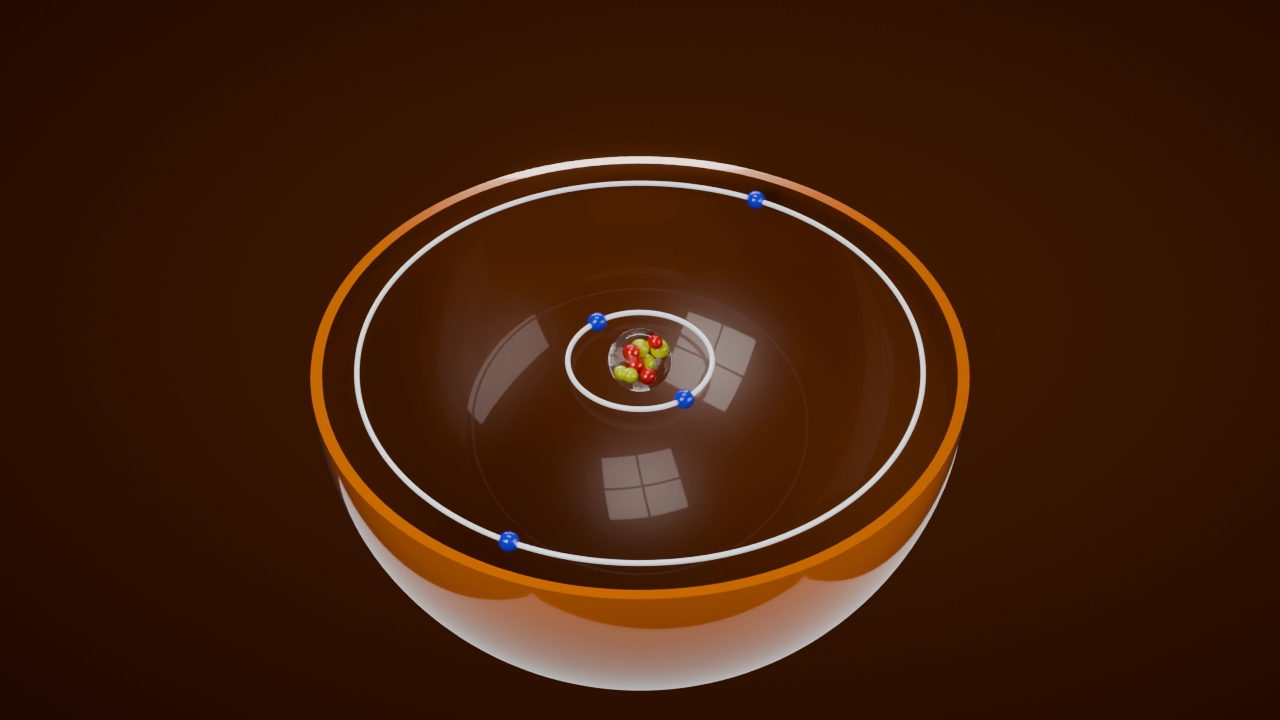
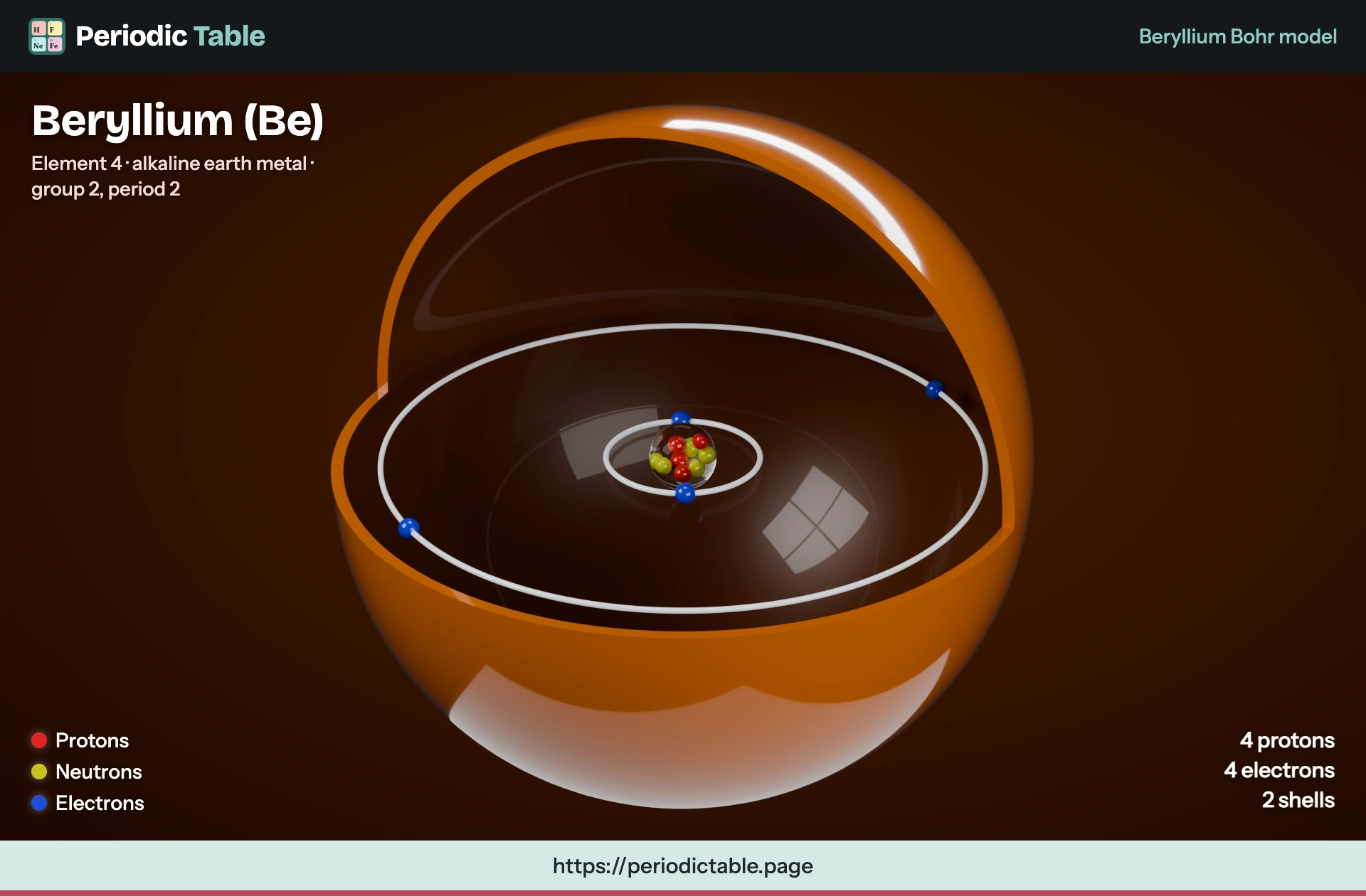
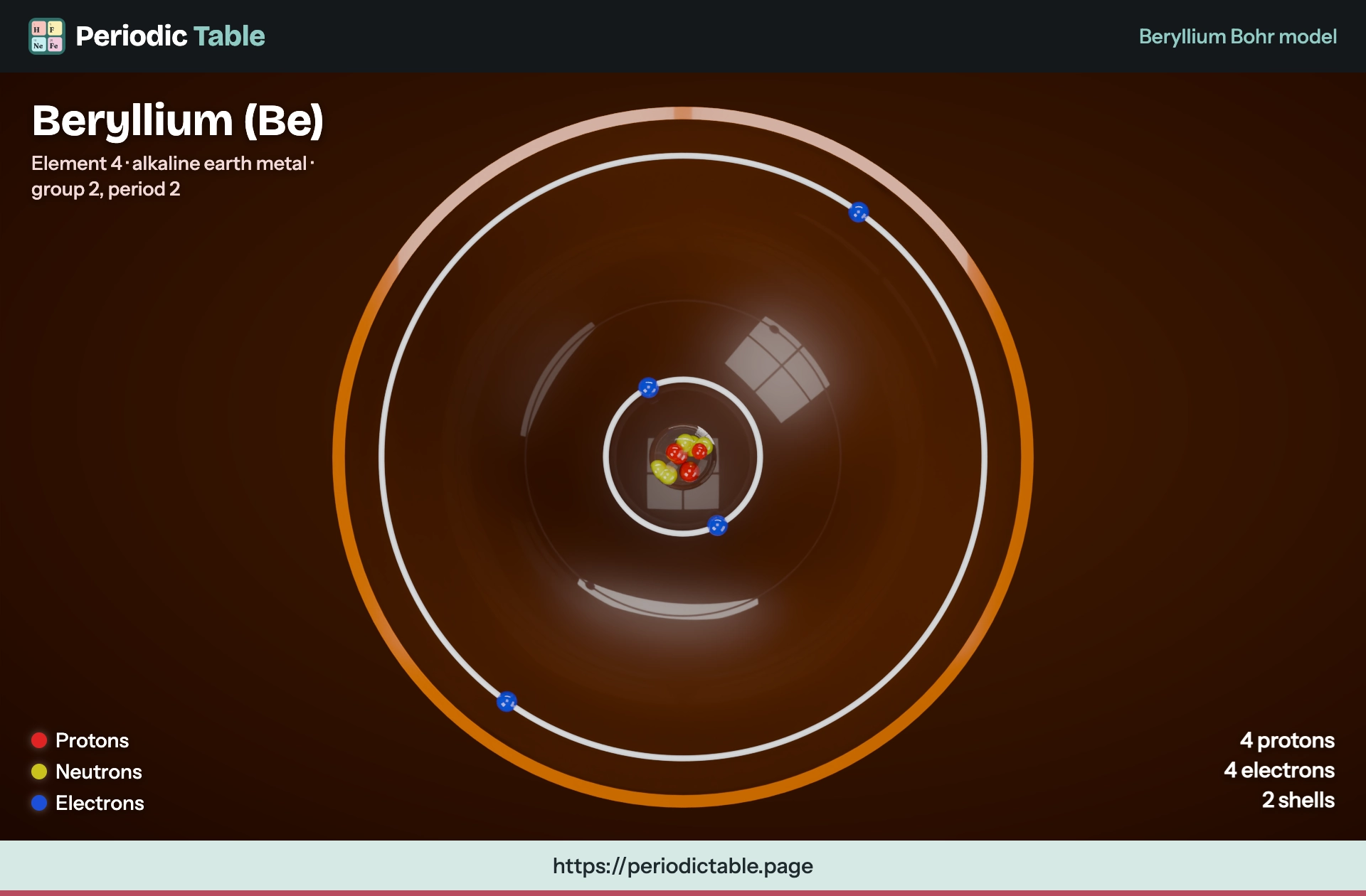
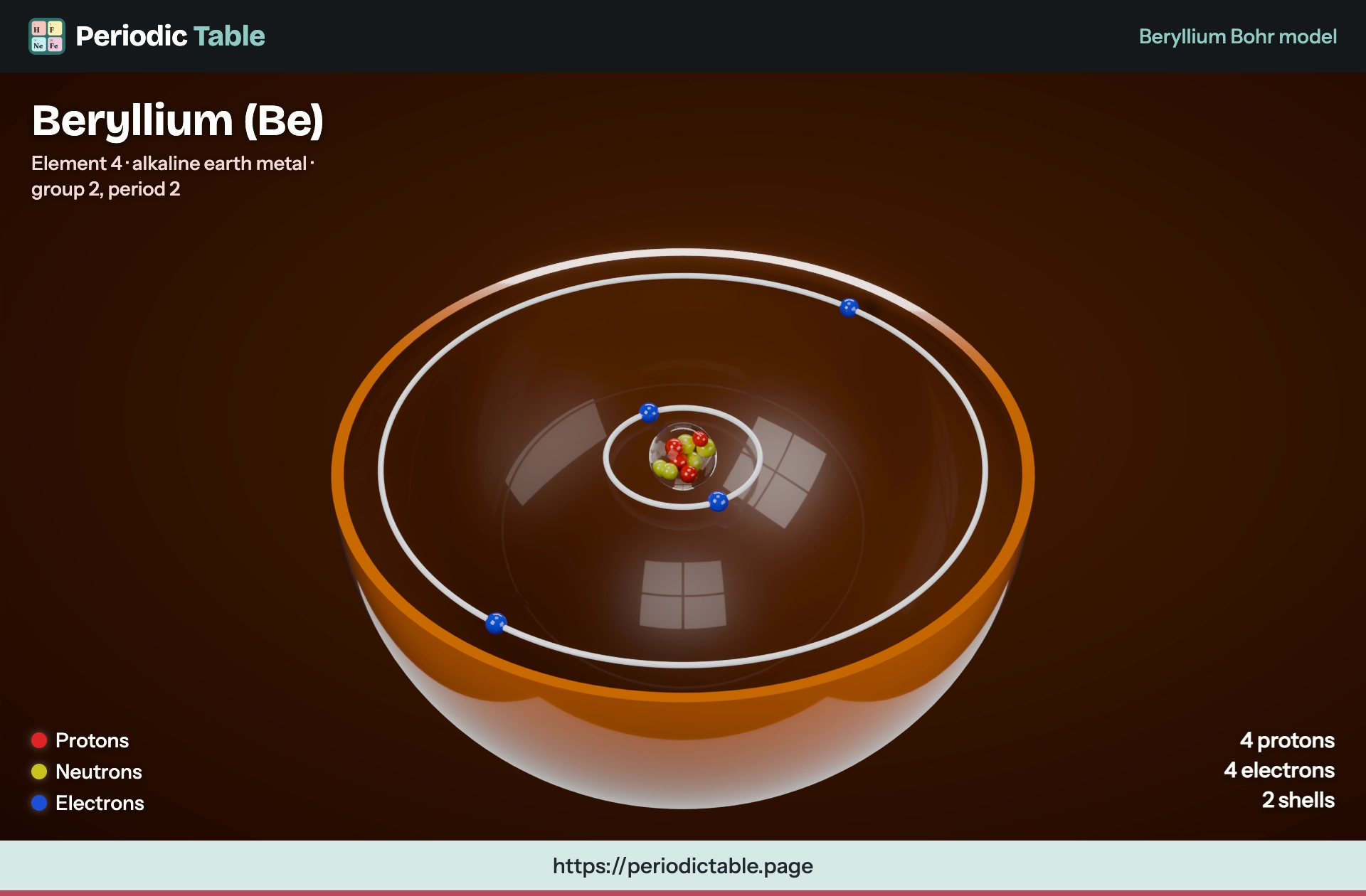
This is a Bohr model of beryllium (Be), a simplified picture of a single beryllium atom. Its nucleus holds 4 protons, and a neutral beryllium atom has 4 electrons, arranged around it in 2 shells (2 in shell K and 2 in shell L).
Beryllium periodic table electron configuration
- Shorthand
- [He] 2s2
- Full
- 1s2 2s2
- Electrons per shell
- 2, 2
Beryllium element properties and atomic data
- Atomic number
- 4
- Atomic mass
- 9.0122 u
- Phase at STP
- Solid
- Melting point
- 1286.85°C (1560 K)
- Boiling point
- 2468.85°C (2742 K)
- Density
- 1.85 g/cm³
- Electronegativity (Pauling)
- 1.57
- Period
- 2
- Group
- 2
- Block
- s-block
- Appearance
- White-gray metallic
- Discovery date
- 1798
- Discovered by
- Louis Nicolas Vauquelin
- Named by
- —
Beryllium facts at a glance
If you only need the headline numbers, the table below collects the core beryllium facts that chemistry references agree on. Small differences between sources (for example, in hardness or in the exact boiling figure) come from measurement conditions and sample purity, so treat the last digit as approximate. To learn about the reactor behind it, see properties of tennessine for how a high flux isotope reactor supplied the berkelium.
| Property | Value for beryllium |
|---|---|
| Symbol | Be |
| Atomic number | 4 |
| Relative atomic mass | 9.012 |
| Group / period / block | 2 / 2 / s |
| Chemical symbol in formulas | Be (e.g. Be(OH)₂, Be₃N₂) |
| Appearance | Steel gray, hard, brittle solid |
| Lattice | Hexagonal close-packed |
| Density at 20 °C | 1.85 g/cm³ |
| Melting point | 1287 °C (2349 °F) |
| Boiling point | about 2470 °C (4476 °F) |
| Mohs hardness | about 5.5 to 6 |
| Specific heat capacity | about 1825 J/(kg·K) |
| Electronegativity (Pauling) | 1.57 |
| Stable isotope | 9Be (100% of natural beryllium) |
| CAS number | 7440-41-7 |
| Name origin | Greek beryllos, the mineral beryl |
Two numbers in that table explain most of what makes Be special: a very low mass per particle and a very high melting temperature for something so light. Almost every application later in this article traces back to that pairing.
Where beryllium sits in the periodic table
Beryllium is the fourth element of the periodic table and the first member of the alkaline earth family. It sits between lithium and boron in its row, directly above magnesium in its column, yet it behaves quite differently from the heavier elements below it. To see how fusion of calcium and curium nuclei made only a few atoms, see livermorium atoms and its synthesis notes.
Group 2, period 2 and the s-block
As a group 2 element in period 2, beryllium fills the s-block orbital of the second shell. You would expect it to act like a typical alkaline earth metal such as calcium or barium, losing its outer pair to form a free ion in water. It doesn't.
A bare Be2+ ion would be so small and so highly charged that beryllium prefers to share its outer pair instead. Its behaviour actually matches aluminium, one row down and one column across, more closely than it matches magnesium. Chemists call this the diagonal relationship, and it is why the compounds of the two elements so often look alike in the lab.
Electron configuration and ionization energies
A beryllium atom has four protons, five neutrons in its core in every naturally occurring sample, and four electrons arranged as [He] 2s². Its electron configuration leaves exactly two valence electrons, both in the 2s orbital. Removing them takes real effort: the ionization energies are about 899.5 kJ/mol for the first electron, 1757.1 kJ/mol for the second and a huge 14,848.7 kJ/mol for the third, since that one comes out of the filled inner shell.
- Electronegativity: 1.57 on the Pauling scale, high for its family
- Atomic radius: about 112 pm (empirical)
- Covalent radius: about 96 pm, one of the smallest in its group
- Common charge in compounds: +2, with Be(I) and Be(0) complexes reported only in research
Physical properties of beryllium metal
In its pure form, beryllium metal is a hard, dark grey solid with a hexagonal lattice. Its physical properties are a strange mix: superb rigidity and heat handling on one side, and a brittle nature at room temperature on the other, which makes it difficult to machine or bend.
Density, melting point and stiffness
Beryllium's low density of about 1.85 times that of water puts it among the lightest structural materials, lighter than aluminum by roughly a third. Yet its rigidity is extraordinary: Young's modulus is about 287 GPa, roughly 35% higher than that of common construction alloys. Divide rigidity by weight and nothing else in a machine shop comes close.
The melting point of 1287 °C is also unusually high for so light an element. Because sound speed depends on rigidity divided by mass, beryllium carries sound at roughly 12,900 m/s, one of the fastest values of any element, a property that once made it attractive for high-end speaker domes.
Thermal and electrical behavior
Beryllium handles heat exceptionally well. Its thermal conductivity is around 200 W/(m·K), and its thermal expansion is modest (about 11 millionths per kelvin), so a part keeps its shape when temperature swings by hundreds of degrees.
That thermal stability is exactly what space hardware needs, where one side of a component faces the Sun and the other faces deep cold. The metal also has good electrical conductivity and is diamagnetic, so it does not disturb magnetic fields around it.
Chemical properties of the element beryllium
The chemical properties of the element beryllium follow from its small size. Rather than giving up its outer pair to form salts in the way calcium does, it forms covalent bonds and tends to build chains or networks, as in solid beryllium dichloride. Its hydroxide and oxide are amphoteric, dissolving in both strong acids and strong alkalis, another trait that can be traced to the diagonal link.
Oxidation state and the protective oxide layer
Beryllium's usual oxidation state is +2. Exposed to air at room temperature, the surface quickly grows a thin oxide layer, only a few nanometres thick, that acts as a passivation layer and blocks further attack. This is why the bare metal resists corrosion and even ignores water at ordinary temperatures.
Heat it above roughly 500 °C, though, and the attack creeps into the bulk; heat it much further and it burns with a brilliant white light, forming a mix of oxide and nitride. It dissolves readily in hydrochloric acid and dilute sulfuric acid but not in nitric acid.
Beryllium compounds: beryllium oxide, beryllium chloride and more
Most beryllium compounds are polymeric or network solids rather than simple ionic crystals. The ones you are most likely to meet are:
- Beryllium oxide (BeO): a white ceramic that is an electrical insulator yet conducts heat about as well as some metals.
- The chloride, BeCl₂: forms long chains in the solid but single linear molecules as a gas.
- Beryllium fluoride (BeF₂): a glassy, silica-like solid and a key step in refining the metal.
- Beryllium hydroxide, Be(OH)₂: insoluble above pH 5, the intermediate product of refining.
- Beryllium sulfate and nitrate: water-soluble salts whose solutions are acidic because of hydrolysis of the hydrated Be ion.
- Beryllium nitride (Be₃N₂) and beryllium carbide (Be₂C): high-melting solids that react with water, the carbide releasing methane.
Because Be(OH)₂ will not dissolve at the pH of the human body, inhaled particles stay put in tissue, a chemistry detail that becomes central in the toxicity section.
Beryllium isotopes and nuclear properties
The nuclear side of beryllium is as interesting as its chemistry. It has one stable form, a few short-lived ones, and a habit of releasing particles when struck, which turned it into a cornerstone of twentieth-century physics.
Beryllium-9, beryllium-7 and beryllium-10
Natural beryllium is essentially pure beryllium-9, making it monoisotopic, and the only such element with an even atomic number. Its other isotopes each tell a story:
- Beryllium-7
- Made by cosmic rays in the atmosphere; decays by electron capture with a half-life of about 53 days. Its decay rate shifts very slightly with chemical surroundings, a rare effect in nuclear physics.
- Beryllium-8
- Splits into two helium nuclei almost instantly, yet its fleeting existence is what lets stars build carbon through the triple-alpha process.
- Beryllium-10
- A radioisotope with a half-life of about 1.39 million years. Its levels in ice cores and sediments track past solar activity and are used to date soils and glaciers.
Even more exotic, the heavy forms 11Be and 14Be show a nuclear halo, with outer neutrons orbiting far beyond the normal core radius of the nucleus. You will not meet any radioisotope of beryllium outside a lab, but each one is a precise isotope tool for physicists.
Why beryllium is rare in the universe
Hydrogen, helium and a trace of lithium came out of the Big Bang, and most heavier elements are forged in stars. Beryllium fits neither route well: those furnaces burn it into heavier nuclei faster than they make it. Most of the beryllium in the universe instead comes from cosmic ray spallation, in which fast cosmic rays smash into carbon, nitrogen and oxygen nuclei in interstellar gas and chip nucleons off them.
Older texts call this cosmic-ray-induced fission, but strictly it is a separate, knock-out process. That slow, accidental origin keeps beryllium scarce on cosmic scales.
Where beryllium is found: minerals and supply
On Earth, beryllium is never found free; it is locked into more than 100 minerals, though only a handful matter. It makes up about 2 to 6 parts per million of Earth's crust, roughly 47th in abundance. Seawater holds only trace amounts.
| Mineral | Formula | Why it matters |
|---|---|---|
| Beryl | Be₃Al₂Si₆O₁₈ | Main ore; also the source of emerald and aquamarine |
| Bertrandite | Be₄Si₂O₇(OH)₂ | Low-grade but the leading commercial source in the United States |
| Chrysoberyl | BeAl₂O₄ | Gemstone mineral, including colour-changing alexandrite |
| Phenakite | Be₂SiO₄ | Uncommon, prized by collectors |
The precious varieties owe their colour to impurities: the green stone gets its hue from traces of chromium, while the blue one gets it from iron. A single gemstone of either kind is chemically a beryllium silicate crystal that also holds Al.
Commercial mining is concentrated in very few places. The United States dominates output, with China and Kazakhstan the other refiners at industrial scale, and Mozambique among mineral suppliers. The Royal Society of Chemistry rates beryllium's relative supply risk at 8.1 out of 10, with a recycling rate below 10%.
Annual world production is only a few hundred tonnes of contained beryllium, which keeps the refined product expensive and its ore supply strategically sensitive. Being both scarce and hard to refine, it is reserved for jobs where nothing else will do.
How beryllium is extracted from beryl
Getting pure beryllium out of its host mineral is notoriously hard, because the element clings tightly to oxygen at high temperature. Industry uses one of two routes to turn the crushed mineral into beryllium hydroxide:
- Sintering: the concentrate is heated with sodium fluorosilicate and soda ash at about 770 °C, forming a soluble fluoroberyllate that is leached with water and precipitated as the hydroxide.
- Melt process: the concentrate is melted at about 1650 °C, quenched in water, then treated with hot concentrated sulfuric acid; ammonia removes the Al and leaves the hydroxide behind.
From the hydroxide there are again two paths. In the fluoride route, the hydroxide is converted to beryllium fluoride and reduced with magnesium at around 900 °C, then remelted near 1300 °C into compact ingots.
In the chloride route, the oxide is turned into the chloride and the metal is recovered by electrolysis of the molten salt. Either way, every step needs strict dust handling, which adds substantially to the final cost.
History of beryllium: from glucinum to the neutron
People handled beryllium for millennia without knowing it. The green and blue gems were mined in Ptolemaic Egypt, and ancient texts describe recipes for faking both stones. The element itself took until the late eighteenth century to be recognised, and it carried a different name for much of its early life.
Discovery by Vauquelin and isolation by Wöhler and Bussy
In 1798 the French chemist Louis-Nicolas Vauquelin showed that beryl and emerald contained a new "earth" (oxide) distinct from alumina. Because some of its salts had a sweet taste, it was named glucine, and the element became glucinum in much of Europe. In 1828 Friedrich Wöhler and Antoine Bussy independently isolated the element by heating beryllium chloride with potassium:
$$\text{BeCl}_2 + 2\,\text{K} \rightarrow 2\,\text{KCl} + \text{Be}$$
Wöhler's name, beryllium, won out; IUPAC settled on it officially in 1949. Industrial interest grew around World War II, when non-sparking alloy tools and early fluorescent lamps created the first large workforce exposed to its dust.
Beryllium and the discovery of the neutron
In the early 1930s, researchers noticed that beryllium bombarded with alpha particles gave off a penetrating, uncharged radiation they took to be a gamma ray. In 1932 James Chadwick showed the energies didn't fit and that the emission was a new particle, the neutron, earning him the 1935 Nobel Prize. The reaction behind it is:
$$^{9}_{4}\text{Be} + {}^{4}_{2}\text{He} \rightarrow {}^{12}_{6}\text{C} + n$$
Each alpha particle that hits a Be nucleus has a small chance of freeing one, which is still how many laboratory neutron sources work.
Beryllium uses in aerospace, electronics and industry
The main beryllium uses all exploit the same trio of strengths: light weight, stiffness and stability across temperature. In aerospace it goes into structural parts for satellites, spacecraft, missiles and supersonic aircraft, inertial guidance gyroscopes and brake components.
The most famous example is the James Webb Space Telescope, whose 18 hexagonal primary mirrors are made of polished, gold-coated beryllium so they hold their exact shape at about −220 °C. Because it is non-magnetic, Be can also be found in instruments used near strong magnets, such as MRI scanners.
Beryllium alloys and beryllium copper
Most beryllium never leaves the factory in pure form. Instead, small amounts go into beryllium alloys, above all beryllium copper, which typically contains around 2% beryllium. That small addition makes copper several times stronger while keeping its conductivity, so the alloy is used for springs, connectors, switch contacts and welding electrodes.
Tools made from it are non-sparking tools, safe in oil refineries, mines and explosives plants. Beryllium is also added to nickel and aluminium to make each blend harder and more fatigue-resistant, which helped make helicopter rotor parts and precision instruments lighter.
Beryllium in electronics and heat management
In circuits, beryllium earns its place as a heat mover. BeO ceramic carries heat away from high-power transistors, radio-frequency amplifiers and laser diodes while keeping them electrically isolated, so it serves as substrates and heat sinks.
Be-Cu contacts appear in connectors and sockets that must flex millions of times. These parts use tiny amounts of the element, but they are hard to replace.
Beryllium in X-ray and nuclear technology
Beryllium's low atomic mass and small electron count give it two jobs no common material does as well: letting radiation through, and steering neutrons in nuclear systems.
X-ray windows, lenses and particle detectors
With only four electrons per atom, beryllium barely interacts with passing X-rays, so a thin foil is nearly transparent to them while still sealing a vacuum. That makes it the standard material for X-ray windows on X-ray tubes, medical imaging equipment and the inner beam pipes of particle detectors at colliders.
Facilities such as synchrotron light sources and X-ray free-electron lasers also stack concave beryllium pieces into compound refractive lenses that focus X-rays down to a spot under a micron wide. Element 3 has even fewer electrons, but it is far too reactive to be used as a window.
Neutron moderator and neutron reflector roles
In nuclear reactors, beryllium (or its oxide) acts as a neutron moderator, slowing fast particles so they sustain the chain reaction, and as a neutron reflector that bounces strays back into the core. Because a fast one can knock a second neutron loose from 9Be, it can even multiply them.
These traits serve research reactors and nuclear energy designs, and they also made beryllium part of nuclear weapons programmes. Paired with an alpha emitter, it forms a compact neutron source for oil-well logging and reactor start-up.
Beryllium toxicity and safety
For all its engineering appeal, beryllium carries a serious health catch. Solid parts are safe to handle, but fine particles are toxic when breathed in, and the International Agency for Research on Cancer classes beryllium and its compounds as known human carcinogens, linked to lung cancer. This is the main reason it is used sparingly despite its strengths, and why every process must be designed around containment.
Berylliosis and chronic beryllium disease
Inhaled particles can trigger berylliosis, also called chronic beryllium disease (CBD): an immune reaction in which the body walls off beryllium in the lung, forming granulomas. Only a sensitised minority of exposed people develop it, but for them even small exposures matter. Symptoms such as cough, breathlessness and fatigue can appear months or decades after inhalation, and severe cases progress to pulmonary fibrosis and heart strain.
There is no cure; treatment manages inflammation. A blood test, the beryllium lymphocyte proliferation test, can show sensitisation before symptoms start.
Workplace exposure and beryllium dust control
Risk comes almost entirely from beryllium dust and fumes released by machining, grinding, welding or melting. Regulators such as OSHA set tight limits on airborne exposure (0.2 µg/m³ averaged over eight hours in the United States), and employers must provide dust control through enclosed processes, local exhaust ventilation, wet methods and respirators.
Workers in machine shops, recycling, dental labs and component manufacturing get medical surveillance, and sites check surfaces and air with wipe and filter sampling. Good safety practice also keeps contaminated clothing out of homes, since family members have developed CBD from dust carried home on work clothes.