


Livermorium element (Lv): livermorium periodic table facts
Livermorium periodic table facts: livermorium (Lv) is element 116, a post-transition metal in group 16, period 7. If you have ever wondered what sits near the bottom right corner of the periodic table, livermorium is a good place to start: it is a synthetic element with symbol Lv, it is extremely radioactive, and it has never been found in nature. Only a few dozen livermorium atoms have ever existed, all made one at a time in experiments run by scientists in Russia and the United States, with later confirmation in Germany by the GSI. Low toxicity and lead replacement in alloys are discussed in the bismuth atomic number, including supply risk.
Element 116 takes its name from the Lawrence Livermore National Laboratory in California, and IUPAC recognised it in 2011. What you get from this guide is a clear picture of what is measured, what is only calculated, and why that gap exists for one of the heaviest elements in nuclear chemistry and physics.
Rotate the 3D Bohr model of livermorium
Drag to orbit, scroll to zoom.
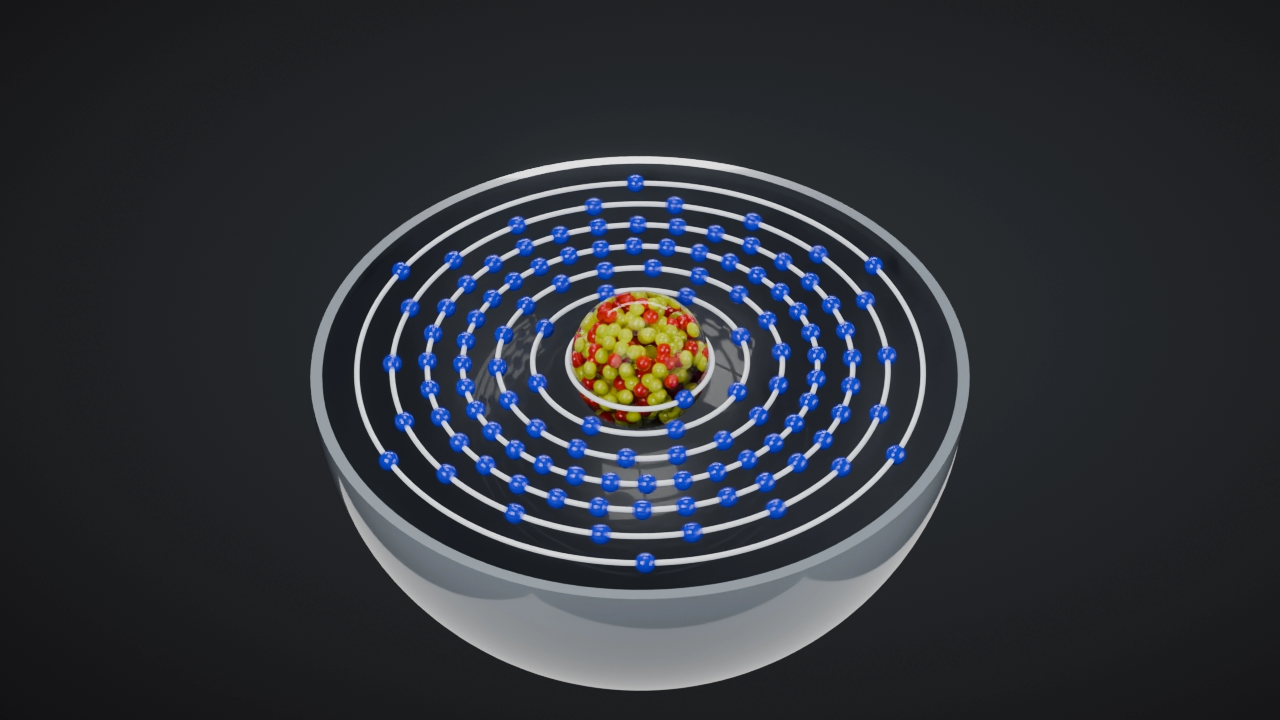
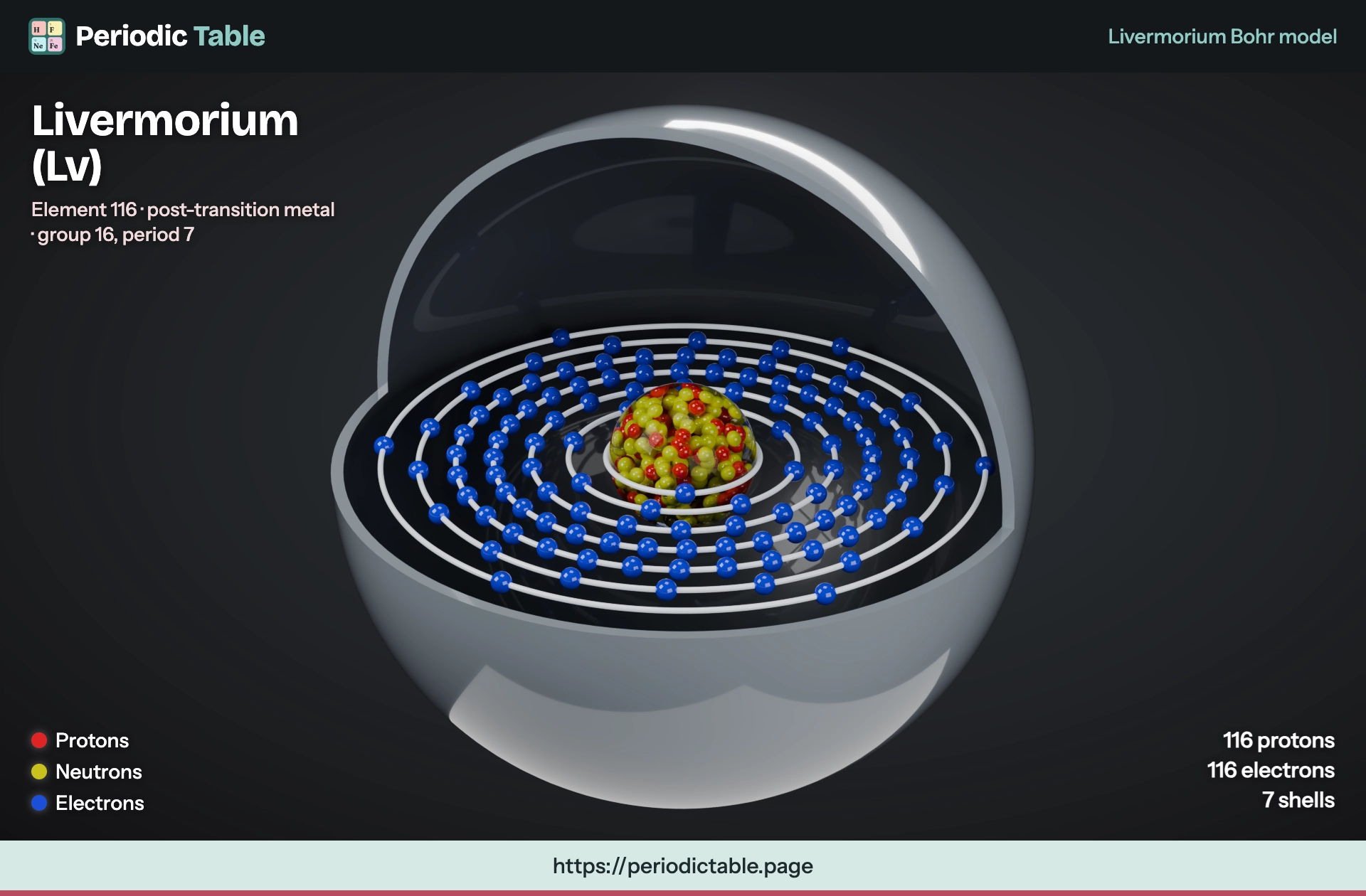
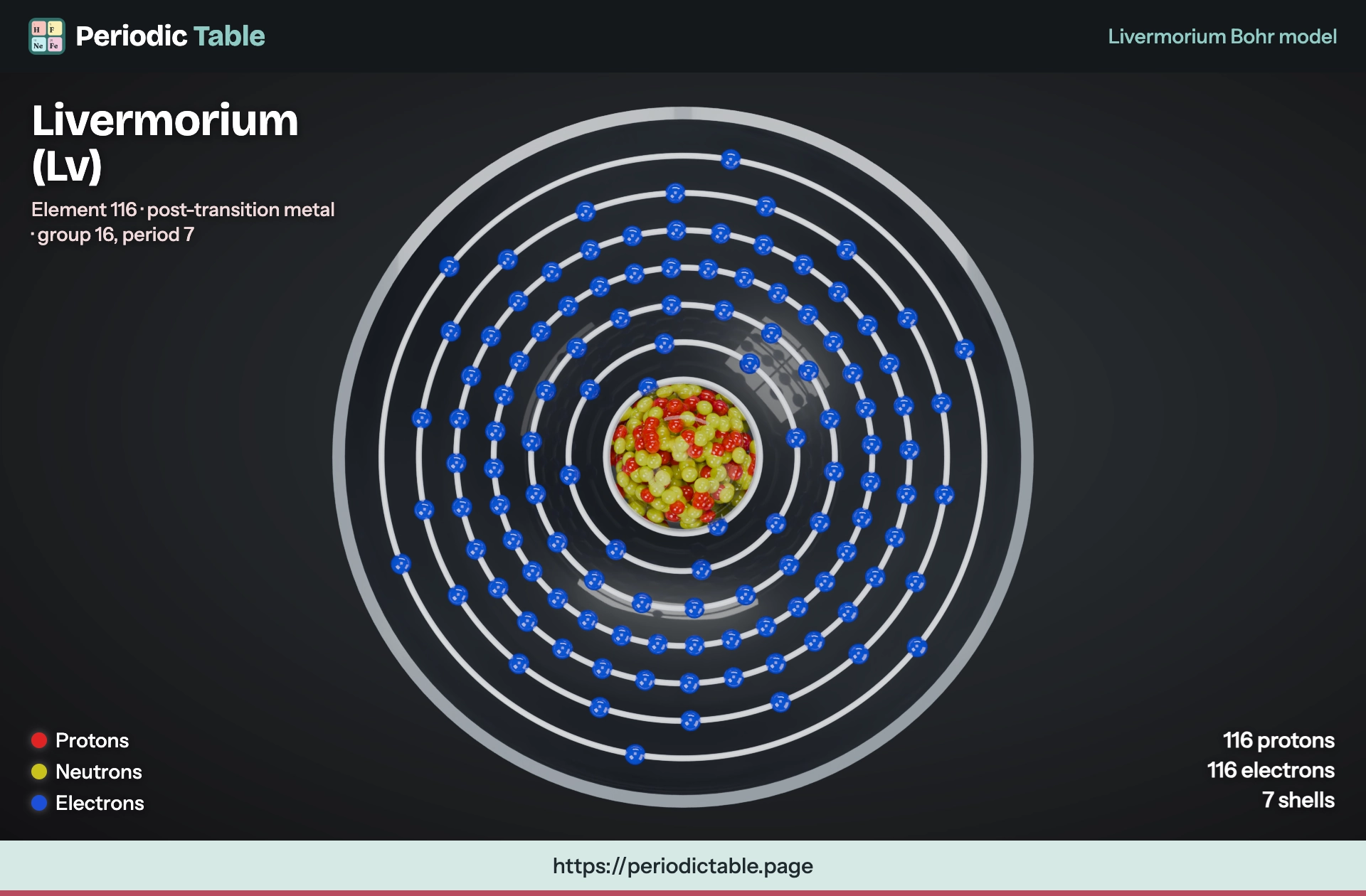
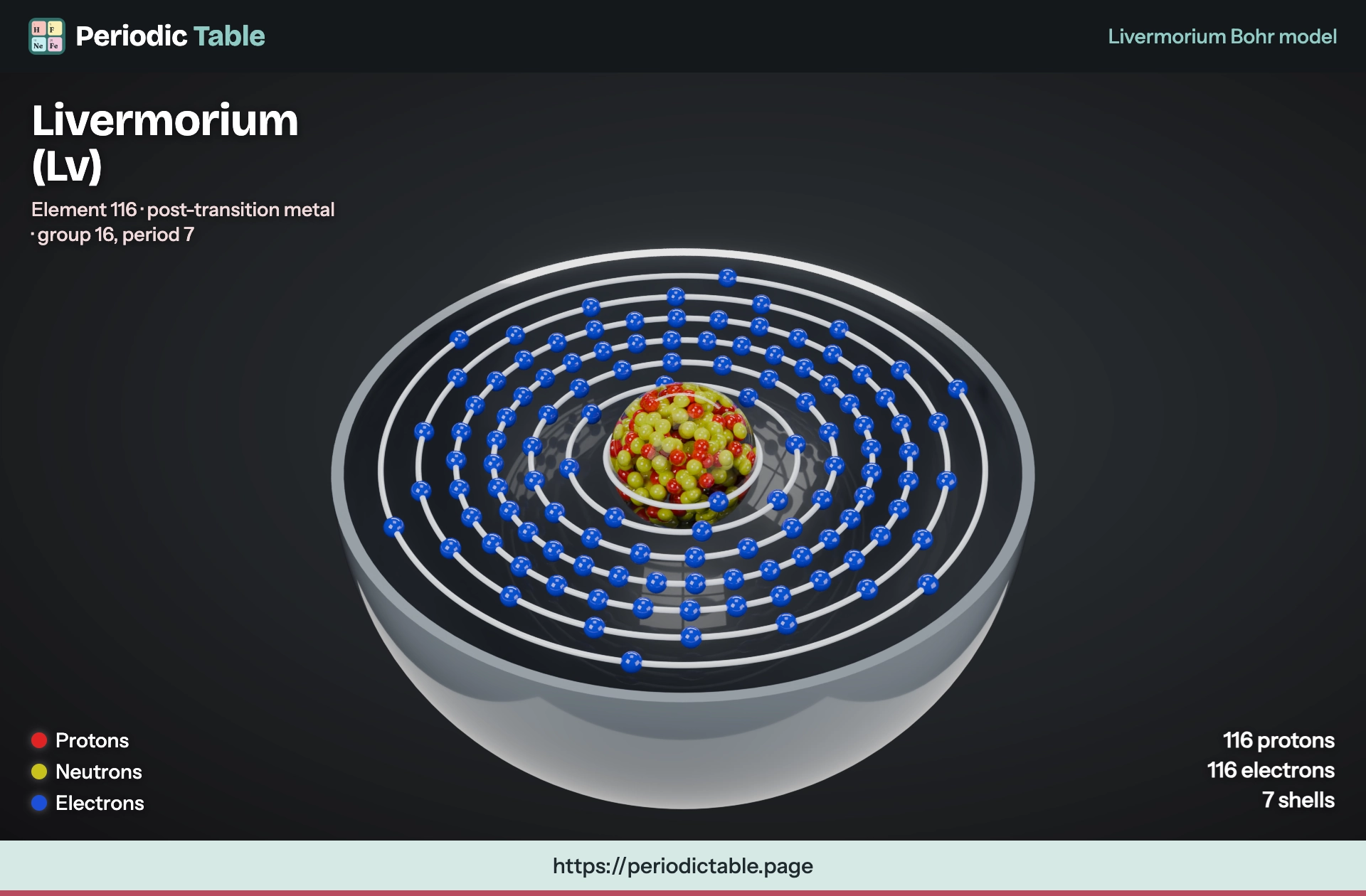
This is a Bohr model of livermorium (Lv), a simplified picture of a single livermorium atom. Its nucleus holds 116 protons, and a neutral livermorium atom has 116 electrons, arranged around it in 7 shells (2 in shell K, 8 in shell L, 18 in shell M, 32 in shell N, 32 in shell O, 18 in shell P and 6 in shell Q).
Livermorium periodic table electron configuration
- Shorthand
- *[Rn] 5f14 6d10 7s2 7p4
- Full
- 1s2 2s2 2p6 3s2 3p6 4s2 3d10 4p6 5s2 4d10 5p6 6s2 4f14 5d10 6p6 7s2 5f14 6d10 7p4
- Electrons per shell
- 2, 8, 18, 32, 32, 18, 6
Livermorium element properties and atomic data
- Atomic number
- 116
- Atomic mass
- [293] u
- Phase at STP
- Unknown
- Melting point
- 435.85°C (709 K)
- Boiling point
- 811.85°C (1085 K)
- Density
- 12.9 g/cm³
- Electronegativity (Pauling)
- Unknown
- Period
- 7
- Group
- 16
- Block
- p-block
- Appearance
- Unknown
- Discovery date
- 2000
- Discovered by
- Joint Institute for Nuclear Research
- Named by
- —
Livermorium fact box: atomic number, symbol and key data
Almost every entry below comes with a caveat. Because no one has ever held a weighable amount of the element, its physical and chemical properties come from calculation and from trends in the lighter elements of its group, not from the bench. In nuclear labs and aerospace, anyone studying beryllium alloys can read about neutron moderators, X-ray windows and spacecraft mirrors.
Only the nuclear data (mass numbers, lifetimes, decay modes) has been observed directly. Read the table with that in mind: the atomic number is a hard fact, while the figure for how dense it is remains a well-reasoned estimate.
| Property | Value |
|---|---|
| Symbol | Lv |
| Atomic number | 116 (116 protons in every nucleus) |
| Heaviest confirmed isotope | 293 |
| Position | Group 16 (chalcogens), period 7, p-block |
| Electron configuration | [Rn] 5f14 6d10 7s2 7p4 (predicted) |
| Phase at room temperature | Expected to be a solid |
| Density | About 12.9 g/cm3 (predicted) |
| Melting point | Roughly 637–780 K (extrapolated) |
| Boiling point | Roughly 1035–1135 K |
| Atomic radius | About 183 pm (calculated) |
| Covalent radius | About 162–166 pm |
| Ionization energies (first three) | 663.9, 1330 and 2850 kJ/mol (calculated) |
| Expected oxidation states | +2 favoured, +4 with strong ligands |
| Longest measured half-life | About 80 ms (the 293 isotope) |
| Appearance | Unknown |
| Former symbol | Uuh |
| CAS number | 54100-71-9 |
| Discovery | 2000, Dubna, Russia; confirmed later at labs in Germany and Japan |
A useful way to read the neutron count: subtract the atomic number from the mass number. For the 293 isotope that gives 293 − 116 = 177 neutrons, which is still several short of where the physics of nuclear shells places the most stable superheavy nuclei.
Where Lv sits on the periodic table
Lv is a transactinide, one of the superheavy elements that come after the actinide series on the seventh row. Its neighbours are a who's who of recent discoveries: flerovium (114) and moscovium (115) to its left, tennessine (117) to its right, and nihonium (113) a little further along the row. Like those elements, it is expected to behave as a post-transition metal rather than a nonmetal, even though it lands in a column that starts with a gas. When tracking a rare metal in the earth's crust, the rhodium price entry follows it through mining and ore refining.
Group 16, period 7 and the P-block
The column it closes is one of the oldest families of elements in chemistry. Read from top to bottom, you get oxygen, sulfur, selenium, tellurium, polonium and then Lv. Every member shares the same pattern of six valence electrons (written ns2 np4), which is why chemists slot it into this group at all.
Going down the column the metallic character climbs steadily: the lightest member is a reactive gas, tellurium is a metalloid, and the fifth member is a soft, radioactive metal. Extending that trend one step further points to a dense metal at the bottom.
Why Lv is treated as the heaviest chalcogen
Calling it the heaviest chalcogen is a statement about placement more than behaviour. Under Mendeleev's system for unfound elements it was once called eka-polonium, meaning "one place below" its lighter neighbour, and the expectation is that its properties will echo that lighter cousin.
The catch is that this has never been confirmed. Relativistic effects in very heavy elements can pull an element's chemistry away from what its column suggests, so the label is a working hypothesis that experiments have not yet been able to test.
Element 116 discovery timeline
The road from first attempt to official recognition took more than three decades. It involved failed searches, one fabricated claim, and several rounds of confirmation by independent teams. The short version is below; each step is explained underneath.
- 1977–1985: searches in three countries find nothing.
- 1999: a Berkeley team claims element 116, then retracts the claim.
- July 2000: Dubna detects the first genuine atom of the new element.
- 2004–2006: further runs produce the data IUPAC later accepts.
- 2011: discovery officially recognised; 2012: name adopted.
Unsuccessful synthesis attempts before 2000
The first search came in 1977, when a Livermore team fired calcium-48 at a curium-248 target and saw nothing. In 1978 Yuri Oganessian and colleagues at the Flerov Laboratory of Nuclear Reactions tried the same pairing without success, and a 1985 joint run by Berkeley and the GSI also came up empty, setting a cross section limit of roughly 10–100 picobarn.
The problem was not the idea but the sensitivity: beam intensities and detectors were simply too weak to catch a reaction that might succeed once in weeks. The Soviet, later Russian, team kept refining the approach through the 1990s with better separators and more intense calcium beams, and that work eventually made the synthesis of several superheavy elements possible.
The retracted 1999 Berkeley claim
In 1999 researchers at the Lawrence Berkeley National Laboratory announced they had made elements 118 (now oganesson) and 116 by fusing krypton with lead. Other groups could not reproduce the result, and neither could Berkeley.
In 2002 the lab stated that the claim rested on fabricated data, and it was withdrawn. The episode is a reminder of why a discovery in this field needs independent repetition before anyone accepts it.
First synthesis at Dubna in July 2000
On 19 July 2000, the team at Dubna bombarded curium-248 with calcium ions and detected a single atom. It decayed by alpha emission with a decay energy of 10.54 MeV, leaving a flerovium daughter. In nuclear notation the reaction reads:
$$^{248}_{96}\mathrm{Cm} + {}^{48}_{20}\mathrm{Ca} \rightarrow {}^{293}_{116}\mathrm{Lv} + 3\,{}^{1}_{0}\mathrm{n}$$
The atom was first assigned to the 292 isotope, but later work on the flerovium it decayed into showed it was actually livermorium-293. That correction is typical: the identity of each new atom is inferred from what it turns into, so a better understanding of the daughter can change the label on the parent.
Road to confirmation by IUPAC
More events followed in 2001 and 2005. Between 2004 and 2006 the team, still led by Oganessian, swapped to a lighter curium-245 target and found the 290 and 291 isotopes. In 2009 the Joint Working Party of IUPAC and IUPAP acknowledged the discovery of copernicium, which indirectly confirmed one of these heavier parents.
In 2011 the same body reviewed the 2000–2006 experiments, judged the 2004–2006 data convincing and formally recognised livermorium as discovered. Darmstadt repeated the synthesis in 2012, and RIKEN in Japan followed in 2014 and 2016. One of those chains may come from an isomer, an excited long-lived state of the 293 nucleus, which is still being studied.
Naming the superheavy element after Livermore
Under IUPAC rules, the team credited with discovering a superheavy element may propose a name. The name was settled in May 2012, alongside element 114, which became flerovium in honour of the Russian lab's founder, Georgy Flerov.
A formal naming ceremony for both was held in Moscow on 24 October 2012. The Russian team had at first considered "moscovium" for 116, but that name was later given to element 115 instead.
From ununhexium and eka-polonium to Lv
Before it had a real name, the element went by placeholders:
- Ununhexium (Uuh)
- The 1979 systematic name built from Latin and Greek roots for "one-one-six," used in textbooks and classrooms.
- E116 or simply 116
- The label most researchers actually used in papers and talks.
- Livermorium (Lv)
- The permanent name and symbol, adopted in 2012.
Why lawrence Livermore national laboratory got the honour
The name honours the US lab that worked with the Russian institute on the experiments, and through it the city of Livermore, California. The city itself was named after Robert Livermore, an English-born rancher who settled in the area in the nineteenth century.
IUPAC also pointed to the lab's long record in nuclear science: fission studies of the heaviest nuclei, the discovery of bimodal fission, research into isomers, and the chemistry of every heavy element it could reach. Livermore scientists have taken part in the discovery of six elements, from 113 to 118.
How livermorium atoms are made
Every atom of the element has come from nuclear reactions between colliding nuclei in an accelerator. In a fusion reaction, a light nucleus is fired at a heavy one fast enough to overcome the electric repulsion between their positive charges. If the two stick, they form a compound nucleus, which is very excited and usually breaks apart.
In a tiny fraction of cases it sheds energy by emitting neutrons instead and settles into a new, slightly more stable nucleus. This is nuclear fusion on the smallest scale imaginable, and the odds are brutal: most collisions between nuclei produce nothing useful at all.
Hot fusion: calcium-48 beams on curium targets
This element was made by hot fusion, which pairs a light, fast projectile with a very heavy actinide target. The resulting compound nuclei carry a lot of energy and must boil off three to five neutrons to survive. Cold fusion works the other way round, joining heavier projectiles with lighter lead or bismuth targets, and was used for elements 104 to 112.
That calcium isotope suits this route because it carries 28 neutrons against only 20 protons, so the products end up neutron-rich. Each curium target is bombarded by the calcium beam for months at a time.
Equipment at the joint institute for nuclear research
The work at the Joint Institute for Nuclear Research relies on three pieces of kit:
- A cyclotron, a circular particle accelerator that delivers an intense ion beam.
- A gas-filled separator that steers the rare new atoms away from the unreacted beam and every other product.
- A silicon detector that records where each atom lands, its energy and the exact time of every later decay.
Newer routes toward heavier elements
Recent experiments have used livermorium as a testing ground for the heavier projectiles the next superheavy elements will need, since element 120 cannot be reached with today's standard calcium beam at all. In 2023 the Russian lab fired chromium-54 at uranium-238 and recorded a new 288 isotope.
In 2024 a Berkeley team made two atoms by fusing titanium-50 with plutonium-244, a result RIKEN's leader called "truly groundbreaking," because his group is hunting for element 119. That same year the JINR team found the 289 isotope with a titanium-50 beam on plutonium-242.
Livermorium isotopes and half-life data
Six isotopes of livermorium are confirmed, with mass numbers 288 to 293, and a seventh at 294 has been reported but not confirmed. All of them are gone within a fraction of a second. The pattern you can see in the table is that the heavier, more neutron-rich isotopes tend to last longer, which is exactly what theory expects as nuclei approach the predicted region of extra stability.
| Mass number | Approximate lifetime | Main decay mode | Decays to (element 114) |
|---|---|---|---|
| 290 | 8.3 ms | Alpha (some fission) | Fl-286 |
| 291 | 19 ms | Alpha | Fl-287 |
| 292 | 16 ms | Alpha | Fl-288 |
| 293 | 57–80 ms | Alpha | Fl-289 |
These half-lives are measured in milliseconds, which is why each atom only ever exists long enough to be counted, not studied in a test tube. The newest isotopes, 288 and 289, are lighter and less well characterised, so they are left out of the table.
Alpha decay and spontaneous fission
Superheavy elements mostly break down in two ways. In alpha decay, the nucleus ejects an alpha particle (a helium-4 nucleus) and drops two places on the table, so element 116 becomes element 114:
$$^{293}_{116}\mathrm{Lv} \rightarrow {}^{289}_{114}\mathrm{Fl} + {}^{4}_{2}\alpha$$
In spontaneous fission, the nucleus splits into two large fragments. Fission becomes more common as atomic number climbs, because electric repulsion between protons grows faster than the strong force holding the nucleus together. For the known isotopes, alpha emission wins, which is helpful: each alpha step produces a nucleus that can be tracked, whereas spontaneous fission scatters the evidence.
Reading a decay chain
A decay chain is the sequence of alpha decays and final fission that follows a new atom, all recorded at the same spot on the detector. Scientists identify the starting atom by working backwards through its decay products: if a chain ends at a known nucleus, the energies and times of each step pin down every link above it.
This is how claims for new elements stay honest. When one link is missed, as happened with a possible 294 atom at the Japanese lab in 2016, the assignment stays tentative.
Lv and the island of stability
Physicists in the 1960s predicted an island of stability, a group of superheavy nuclei with "magic" numbers of nucleons and half-lives of seconds, minutes or longer instead of microseconds. The known livermorium nuclei sit just off its shore: they lack enough neutrons, but the longer lifetimes of the heavier isotopes show the trend pointing the right way.
Calculations suggest that a 295 isotope, made by firing the same calcium beam at curium-250, could decay down to copernicium-291, which may live for about 1,200 years. That is the main reason it matters to nuclear stability research and to nuclear physics as a whole, even though no one can use it for anything practical.
Predicted properties of livermorium
Beyond its nuclear behaviour, no property of the element has ever been measured, because no one can make enough of it and each atom vanishes almost at once. Everything in this section comes from extending the trends of the lighter elements above it and from relativistic quantum calculations. The properties of livermorium below should be read as best estimates, not lab values.
Density, melting point and boiling point
Following the pattern down the group, the physical properties shift in a clear direction: it should melt at a higher temperature than polonium but boil at a lower one, so its liquid range is narrower. It should also be noticeably heavier for its size: a calculated 12.9 g/cm3 for the α form, compared with 9.2 g/cm3 for α-polonium. Like its lighter neighbour, it is expected to form two crystal structures, an α and a β allotrope, and to look and behave like a metallic element if a visible piece could ever be gathered.
Electron configuration, atomic radius and ionization energies
The heaviest elements hold their inner electrons so tightly that those electrons move at a large fraction of the speed of light. These relativistic effects, through the spin-orbit interaction, split the 7p subshell into two parts: two electrons sit in a stable, unreactive 7p1/2 level and two in a more reactive 7p3/2 level. The 7s pair is pulled in too, which is called the inert pair effect.
The practical result is a large gap between the second and third ionization energy, a calculated electron affinity of about 74.9 kJ/mol, and an electronegativity that has not been firmly calculated. One striking number: in a hydrogen-like ion with a single electron left, that electron would behave as if it were 1.86 times its rest mass.
Lv chemistry and oxidation states
If you only learn one thing about the expected chemistry of Lv, make it this: it should be a metal that prefers to give up two electrons. That separates it from the top of its group, where the light nonmetals readily gain electrons, and lines it up instead with the heavy end of the column.
Why the +2 oxidation state dominates
Because the 7s and 7p1/2 electrons are held so tightly, only the two outer 7p3/2 electrons are easy to remove. That makes the +2 oxidation state the most stable, about as easy to form as it is for beryllium or magnesium.
A +4 state should exist only with very electronegative partners such as fluorine, and +6, common for sulfur and selenium, should not form at all. The −2 state seen in oxides and sulfides is expected to be very unstable here, so the chemistry should be almost purely cationic.
Livermorane and other predicted compounds
The simplest compound would be livermorium hydride, LvH2, also called livermorane. It would be the heaviest relative of water in the H2O, H2S, H2Se, H2Te series and is expected to be a covalent molecule rather than a salt.
Calculations also suggest a longer bond and a wider H–Lv–H angle than simple trends predict. With fluorine, the expected high-valence compound is livermorium(IV) fluoride, LvF4, while the heavier dihalides are expected to be linear and the lighter ones bent.
Experimental chemistry so far
No chemical experiment has been carried out on the element itself. The closest work came when polonium and bismuth formed by accident in a 2011 accelerator run showed surprisingly stable hydrides at 850 °C. Pure livermorium is expected to be volatile enough for gas-phase chemistry, but until a longer-lived isotope turns up, its lifetimes remain the barrier.
Uses of Lv and why superheavy elements matter
The element has no uses outside research, and with only a few dozen atoms made in total it never will in its current form. Its value lies in what it teaches.
Each new experiment tests models of how nuclei hold together and how many elements the periodic table can hold. Researchers at Livermore note that the skills gained, from target fabrication to fast radiochemistry, feed into fission science and work on nuclear safety.
To see where it fits, it helps to know the vocabulary of nuclear physics used in this field:
- A heavy element is one with an atomic number above 92; neptunium (93) is the first.
- Superheavy elements start around element 104 or element 112, depending on the definition, and are only made in accelerators.
- Livermorium isotopes are versions of element 116 with the same 116 protons and different neutron counts.
- Other heavy elements did find applications: americium in smoke detectors, curium and californium in neutron sources. That is why physics teams expect superheavy elements may one day be useful, especially any that turn out to sit on the island of stability.