Rhodium element (Rh): rhodium periodic table facts
Rhodium periodic table facts: rhodium (Rh) is element 45, a transition metal in group 9, period 5. Few people have ever held it, yet rhodium sits inside nearly every petrol car you have ridden in. For group 15 chemistry in industry and metallurgy, check bismuth alloys for oxidation states and low-melting alloy applications.
This silvery-white, hard chemical element (symbol Rh) belongs to the platinum group metals, and it is the most costly precious metal traded today in most years — rarer than gold, far rarer than silver, and almost never used as a solid alloy. Below you will find its key facts, how it was found, what makes it so useful, and why its value swings so wildly.
Rotate the 3D Bohr model of rhodium
Drag to orbit, scroll to zoom.
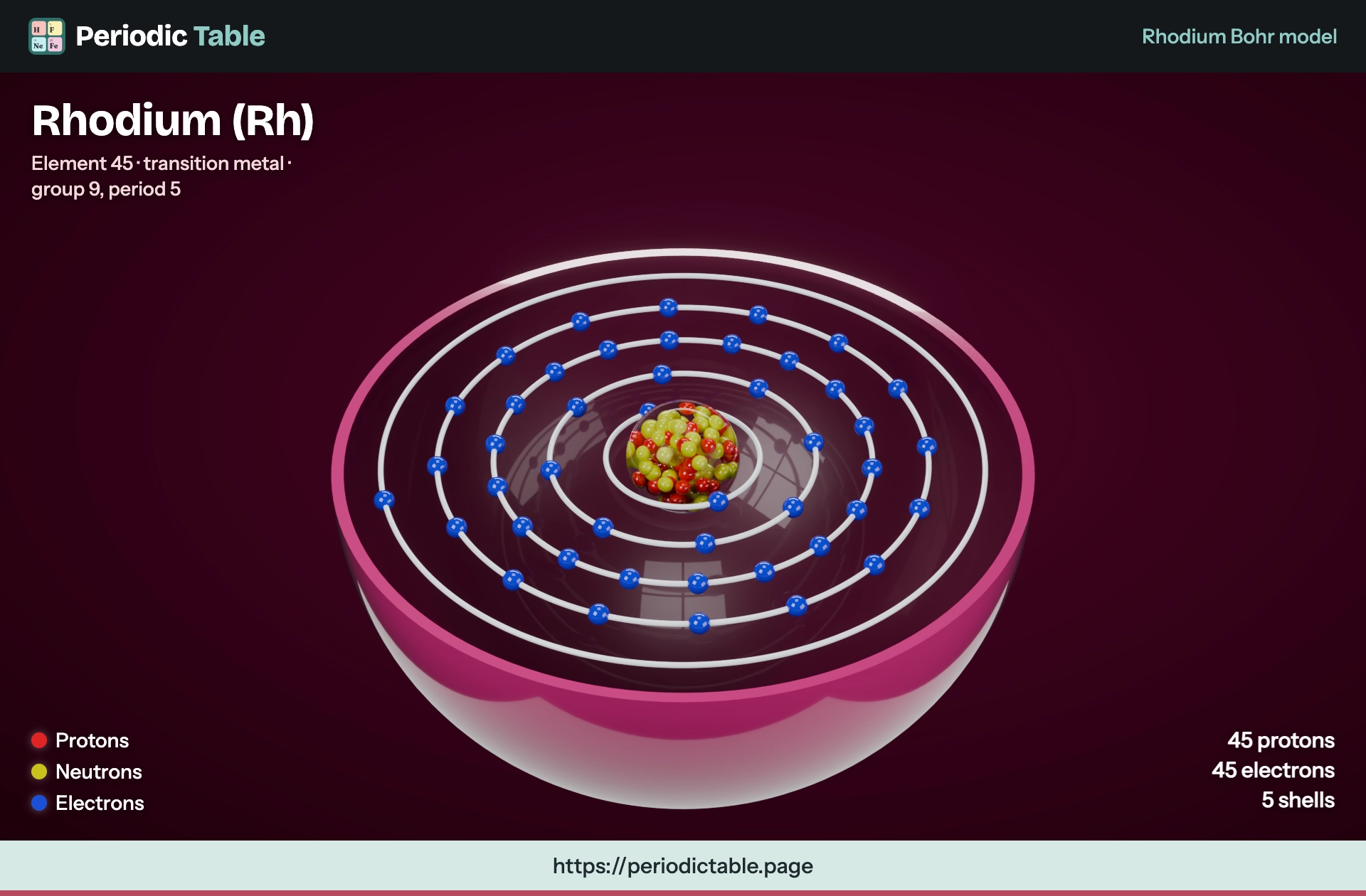
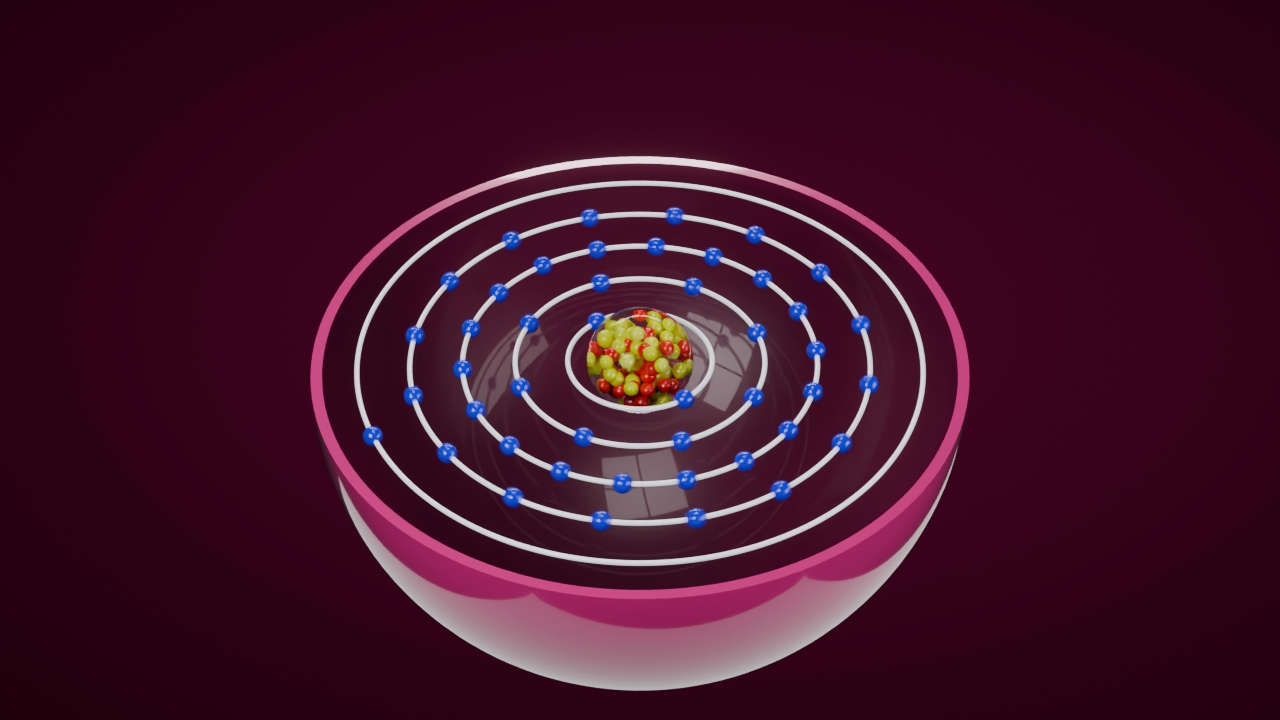
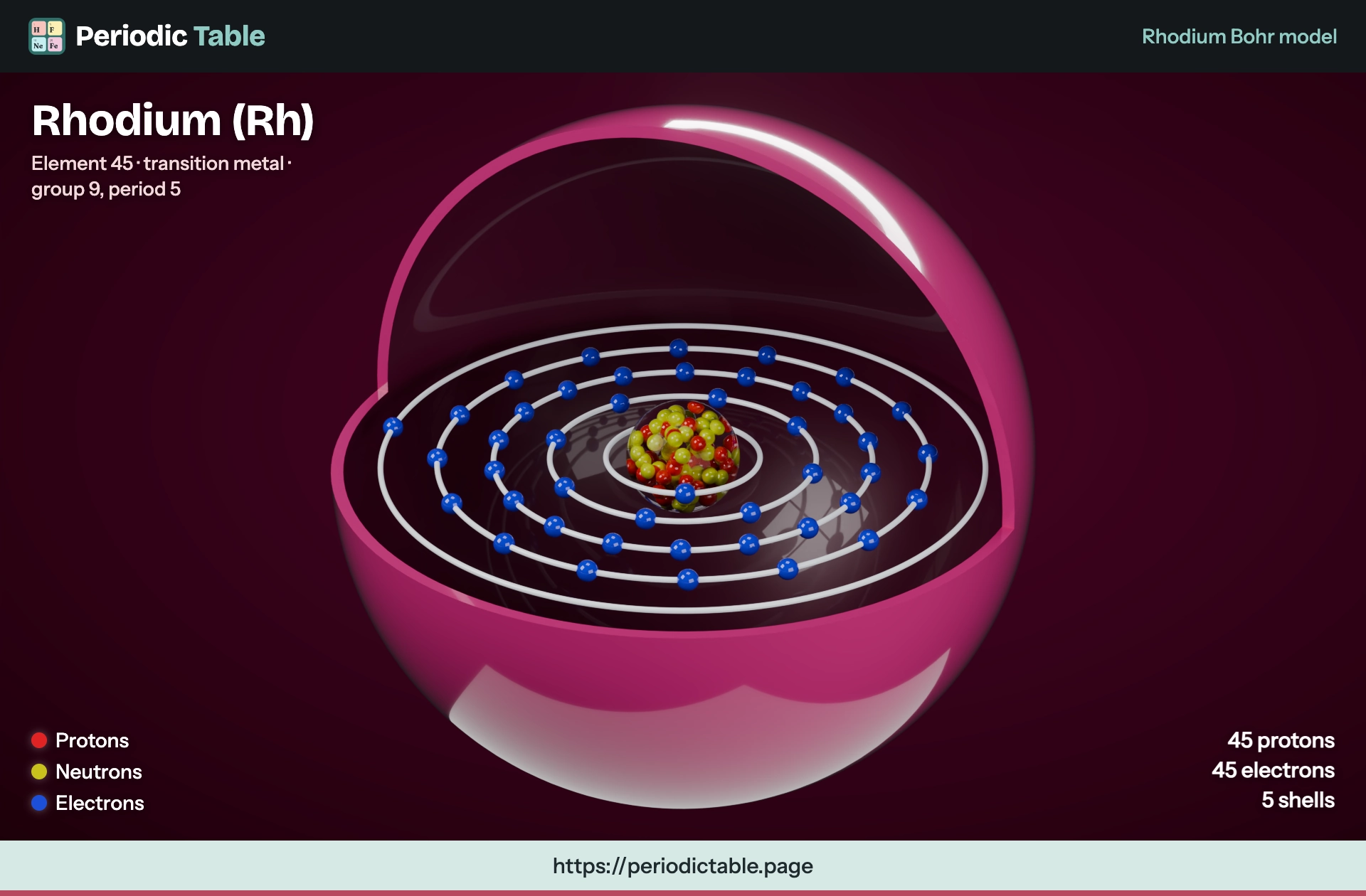
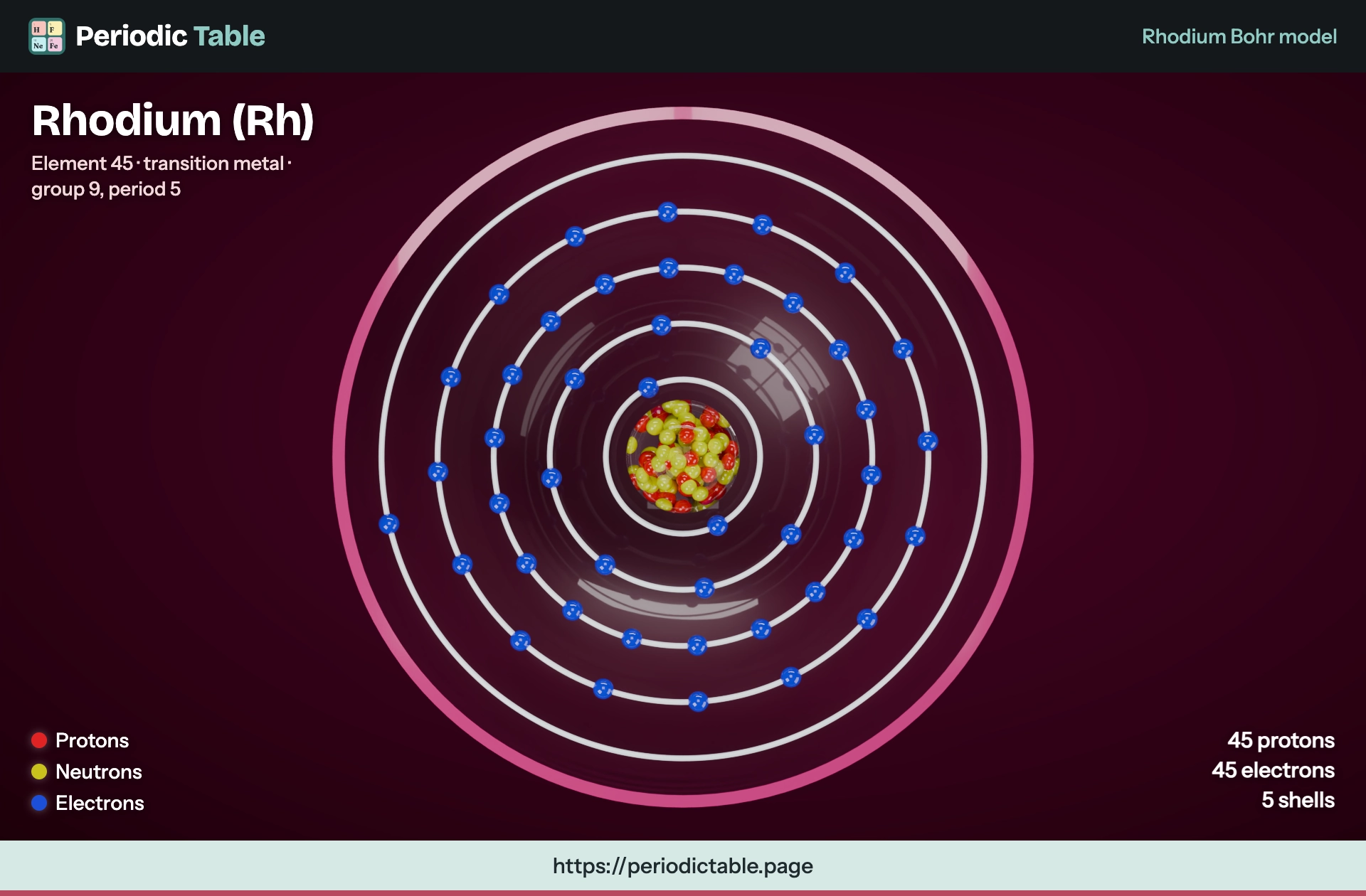
This is a Bohr model of rhodium (Rh), a simplified picture of a single rhodium atom. Its nucleus holds 45 protons, and a neutral rhodium atom has 45 electrons, arranged around it in 5 shells (2 in shell K, 8 in shell L, 18 in shell M, 16 in shell N and 1 in shell O).
Rhodium periodic table electron configuration
- Shorthand
- [Kr] 4d8 5s1
- Full
- 1s2 2s2 2p6 3s2 3p6 4s2 3d10 4p6 5s1 4d8
- Electrons per shell
- 2, 8, 18, 16, 1
Rhodium element properties and atomic data
- Atomic number
- 45
- Atomic mass
- 102.9055 u
- Phase at STP
- Solid
- Melting point
- 1963.85°C (2237 K)
- Boiling point
- 3694.85°C (3968 K)
- Density
- 12.41 g/cm³
- Electronegativity (Pauling)
- 2.28
- Period
- 5
- Group
- 9
- Block
- d-block
- Appearance
- Silvery white metallic
- Discovery date
- 1803
- Discovered by
- William Hyde Wollaston
- Named by
- —
Element 45 on the periodic table: Rh facts at a glance
The rhodium element carries atomic number 45 and sits in the fifth row of the periodic table. That makes it a group 9 element of the cobalt group and a transition metal in the d-block. The table lists the reference values you are most likely to need. A neat overview of livermorium (Lv) covers its half-life, its naming and its IUPAC approval in 2016.
| Property | Value for element rhodium |
|---|---|
| Symbol | Rh |
| Atomic number | 45 |
| Standard atomic weight | 102.91 |
| Group / period / block | Group 9 / period 5 / d-block |
| Electron configuration | [Kr] 4d8 5s1 |
| Melting point | 1,964 °C (2,237 K) |
| Boiling point | 3,695 °C (3,968 K) |
| Density at 20 °C | 12.41 g/cm3 |
| Crystal structure | Face-centered cubic |
| Appearance | Silvery white, highly reflective |
| CAS number | 7440-16-6 |
Melting point, boiling point and density
Rhodium melts about 200 °C above platinum yet is noticeably lighter, a combination few metals share. The gap between its solid and boiling states spans more than 1,700 °C, which is why it survives furnace work that softens most other elements.
Atomic weight and electron configuration
Its outer shell is unusual: Rh keeps only one electron in the 5s orbital instead of the two most group members hold, a quirk it shares with ruthenium and niobium. On the Pauling scale its electronegativity is 2.28, close to that of its neighbours, so its bonding behaviour follows the platinum family.
History of rhodium: discovered in 1803 by William Hyde Wollaston
The history of rhodium begins in London. William Hyde Wollaston was working through a batch of crude platinum ore from South America that he had bought with his partner Smithson Tennant. After dissolving it in aqua regia and stripping out the platinum and palladium, he was left with a solution that gave rose-red crystals of sodium rhodium chloride. In nuclear power engineering, the zirconium electron configuration page covers Zr, element 40, and why zircaloy cladding resists corrosion inside reactors.
Wollaston reduced those crystals to a grey powder and named it after the Greek word rhodon, meaning rose, for that colour. Tennant pulled osmium and iridium from the same sample, so one shipment gave chemistry four new elements in about two years.
For roughly a century the new element had few jobs. Around 1900, platinum–rhodium thermocouples began measuring furnace heat up to about 1,800 °C, and electroplating for decorative and protective finishes followed.
The real turning point came in 1976, when Volvo introduced the three-way catalytic converter, which needed rhodium to break down nitrogen oxides. Its fortunes have been tied to cars ever since.
Physical properties and corrosion resistance of rhodium metal
Pure rhodium is bright and durable, with a high reflectance — polished, it reflects about 80% of visible light, which is why it is used as a reflective coating. Its main physical properties come from a tightly packed face-centered cubic lattice:
- Mohs hardness of about 6, much harder than platinum
- Thermal conductivity of roughly 150 W/(m·K)
- Electrical resistivity of about 43 nΩ·m, low enough for contact surfaces
- Specific heat capacity of about 243 J/(kg·K)
- Paramagnetic, weakly drawn into a magnetic field
Its corrosion resistance is the property buyers pay for. Even at high temperatures the surface stays clean, so a corrosion-resistant layer only a fraction of a micron thick protects whatever lies underneath.
Chemical properties and oxidation states of the noble metal
As a noble metal, rhodium is close to inert. It does not form an oxide coating when heated in air; it takes up oxygen only near its melting temperature and releases it again on cooling. Nitric acid has no effect, and even hot aqua regia barely attacks the solid.
Its key chemical properties show up in solution chemistry instead, where Rh(III) and Rh(I) are the states you meet most. States from Rh(0) to Rh(VI) are known, including the rare rhodium pentafluoride and rhodium hexafluoride.
Among the rhodium oxides, black Rh2O3 is the stable one. Its ionization energies (about 720, 1,740 and 2,997 kJ/mol for the first three electrons) explain why losing more than three is uncommon.
Rhodium compounds and Wilkinson's catalyst
Most laboratory work starts from hydrated rhodium trichloride, RhCl3·3H2O, the commercial form of rhodium chloride. Heat it with triphenylphosphine and you get RhCl(PPh3)3, known as Wilkinson's catalyst, a square planar Rh(I) complex that adds hydrogen across carbon–carbon double bonds. Chiral versions of these compounds drive asymmetric hydrogenation, the route used to make single-handed drug molecules.
Isotopes of Rh and atomic data
Natural rhodium is made of a single stable isotope, Rh-103, which makes its standard mass very precise. Its nuclear spin of ½ lets chemists study rhodium isotopes by nuclear magnetic resonance, although the signal is weak. Dozens of radioisotopes have been made in the lab; the longest-lived, Rh-101, has a half-life of a few years.
Lighter ones decay by electron capture into ruthenium, heavier ones by beta emission into palladium. Its atomic radius is about 134 pm and its covalent radius about 142 pm.
Used nuclear fuel as a source of Rh
Rh is a fission product of uranium-235, so spent reactor fuel holds a real amount of it. In theory that makes old fuel a mine. In practice it comes out mixed with radioactive by-products that need around ten years of storage to cool, and the chemical separation is costly, so nobody has tried it at scale.
Rarest elements on Earth: where platinum group metals occur
Rhodium ranks among the rarest elements in the earth's crust, at roughly 0.0002 parts per million by common estimates — less than one gram in five thousand tonnes of rock. Nickel-iron meteorites carry about the same trace level. It almost never forms its own minerals; instead it hides inside rhodium ores that are really platinum and nickel deposits.
The richest are the Bushveld Complex, the Ural Mountains and Norilsk in Siberia, and Sudbury in Ontario, Canada. That scarcity, plus the rarity of deposits worth mining, is the root of everything that follows on cost.
Mining and recycling in South Africa, Russia and Zimbabwe
Global rhodium production runs at only about 30 tonnes a year, so you could fit a full year's output in a small truck. Roughly four-fifths comes from South Africa, with Russia and Zimbabwe a distant second and third.
Rh is always a by-product: ore is crushed, smelted into a matte rich in PGMs, then refined over weeks to separate each one. Recycling now supplies a large share of demand, mostly from scrapped catalytic converters, and recycled material from an old exhaust system is chemically identical to new output once a refiner has processed it.
Uses of rhodium in catalytic converters
The biggest of all rhodium uses is cleaning car exhaust: about 80% of yearly demand goes into automotive catalytic converters. Inside each one, a honeycomb coated with platinum, palladium and Rh turns the three main pollutants from a petrol engine into safer gases:
- Nitrogen oxides are reduced to nitrogen and oxygen — this is the step rhodium handles best
- Carbon monoxide is oxidized to carbon dioxide
- Hydrocarbons left unburned are oxidized to carbon dioxide and water
A typical catalytic converter holds only one or two grams of rhodium, yet without it automobiles could not meet modern emissions rules. That small dose per car, multiplied by tens of millions of new vehicles a year, is what ties its fortunes to the auto market.
Rh catalysts for acetic acid and hydroformylation
In the chemical industry, rhodium catalysts speed up reactions without being used up. For decades the Monsanto process used Rh iodide complexes to turn methanol and CO into acetic acid; it has since been largely replaced by the iridium-based Cativa process, which does the same job more efficiently. Rhodium also helps make nitric acid, as a platinum–rhodium gauze that oxidizes ammonia.
Its largest chemical role today is hydroformylation, which adds hydrogen and carbon monoxide to alkenes to give aldehydes:
$$\mathrm{RCH{=}CH_2 + H_2 + CO \longrightarrow RCH_2CH_2CHO}$$
Rh-based catalysis runs this reaction at lower heat and pressure than older cobalt systems, which is why it now feeds the production of detergents, plasticizers and fragrances. Smaller niches include sulfide electrodes for some fuel cells.
Plating, jewelry and other uses of the precious metal
Outside cars and chemical plants, rhodium plating and alloys account for most of what remains. These uses split into decorative work, where looks matter, and technical work, where heat and wear resistance matter.
Rhodium jewelry, white gold and sterling silver
Most white gold has a faint yellow tint, so jewelers electroplate it with a thin bright layer — a finish called rhodium flashing. Sterling silver is often rhodium-plated too, to stop tarnishing. The layer wears through with daily use, so a rhodium plated ring may need re-dipping every year or two; if your ring shows a yellow patch on the inside of the band, that is the tarnish-free coat wearing off, not a defect.
Pure rhodium pieces are very rare because it is brittle when cold and hard to shape. It has also served as a status prize: in 1979 the Guinness Book of Records gave Paul McCartney a disc made of it as the best-selling songwriter of all time.
Thermocouples, electrical contacts and other industrial uses
- Alloying agent: platinum alloyed with 10–30% Rh is stiffer and lasts longer in heat, used in furnace windings, laboratory crucibles and aircraft spark plugs
- Glass industry: Pt–Rh bushings shape molten glass into fiberglass and flat-panel glass
- Thermocouple wire for measuring very high furnace heat
- Electrical contacts that need low, stable resistance
- Optical instruments, mirrors and headlight reflectors
- Mammography X-ray filters and anodes
- Rhodium detectors that track neutron flux inside nuclear reactors
Rhodium price per troy ounce
The rhodium price is quoted in US dollars per troy ounce, like other precious metals, but it moves far more violently because so little is mined and the auto commodity buyers are so concentrated. Over the past decade it went from under $1,000 in 2016 to almost $30,000 in 2021 before falling back sharply. It is not listed on the London Fix like gold, so most quotes come from dealers and refiners; small bullion bars and coins exist, but the spread is wide.
To turn an ounce quote into a gram figure, divide by 31.1035, the gram weight of that ounce:
$$P_{\text{gram}} = \frac{P_{\text{oz t}}}{31.1035}$$
For example, if a dealer quotes $5,180 per ounce (an illustrative figure, not a live quote), each gram is worth 5,180 ÷ 31.1035 = $166.54. Check the date on any quote before you rely on it: a few months can change the answer by thousands. That swing is also why the rhodium worth recovering from an old converter makes it far more valuable to a scrapyard than the steel shell around it, and why converter theft rises whenever quotes climb, since the haul becomes so expensive.
Is rhodium toxic? safety, precautions and the exposure limit
In solid form it is harmless — it is too inert to react with your body. Its compounds are a different matter: some salts are toxic and may cause skin sensitization. The main risk is in the workplace, through inhalation of dust or fumes during refining or plating.
OSHA sets a legal exposure limit of 0.1 mg/m3 over an 8-hour shift for the element and insoluble compounds, and NIOSH recommends the same figure; soluble compounds have a limit 100 times lower. Standard safety precautions — local ventilation, dust masks and gloves — cover almost every case.