


Europium element (Eu): europium periodic table facts
Europium periodic table facts: europium (Eu) is element 63, a lanthanide in period 6 of the f-block. Europium (symbol Eu, atomic number 63) is a soft, silvery-white lanthanide that tarnishes within hours in air, and it is the reason an old tube TV could show a convincing red. Metallurgy and magnetism, especially strong diamagnetic behavior, are covered in the bismuth boiling point with a note on radioactivity.
If you want the short version, this chemical element is the most restless of the rare earth elements, and its habit of switching between two charge states gives elemental europium its glow, its magnetism and its value in banknote inks. Below you will find its key data, chemistry, isotopes, history, sources, uses and safety notes.
Rotate the 3D Bohr model of europium
Drag to orbit, scroll to zoom.
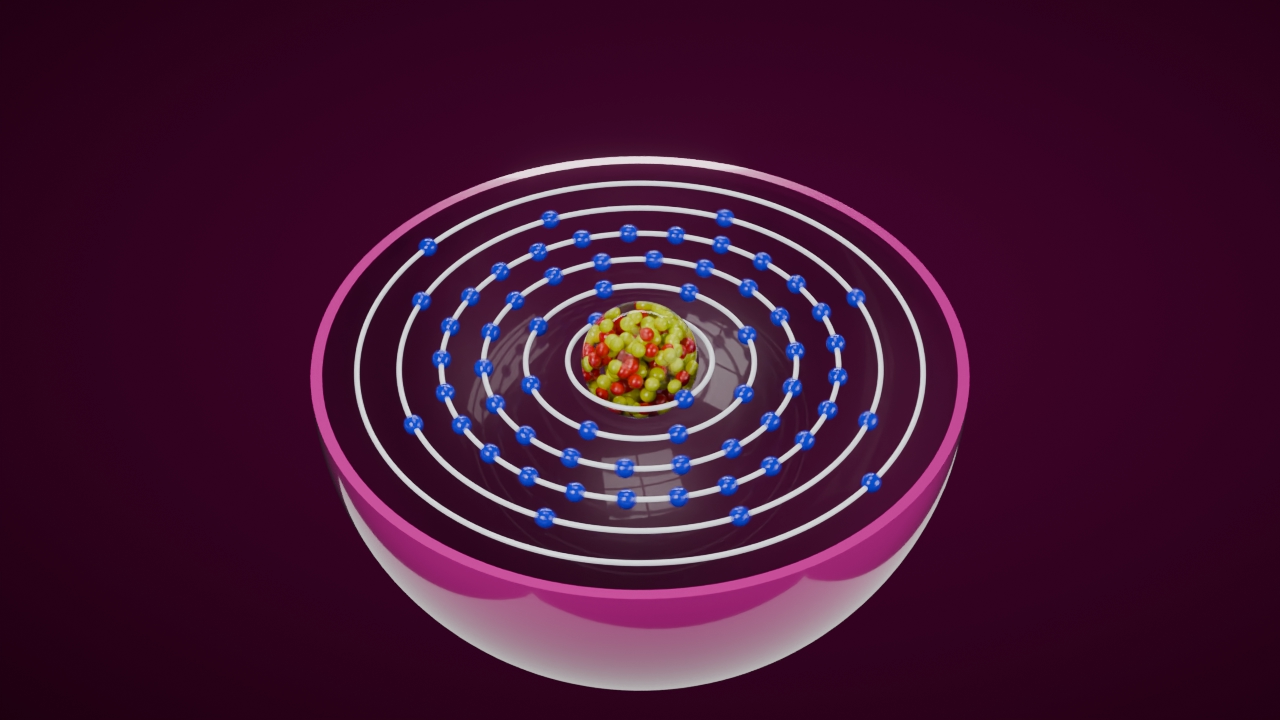
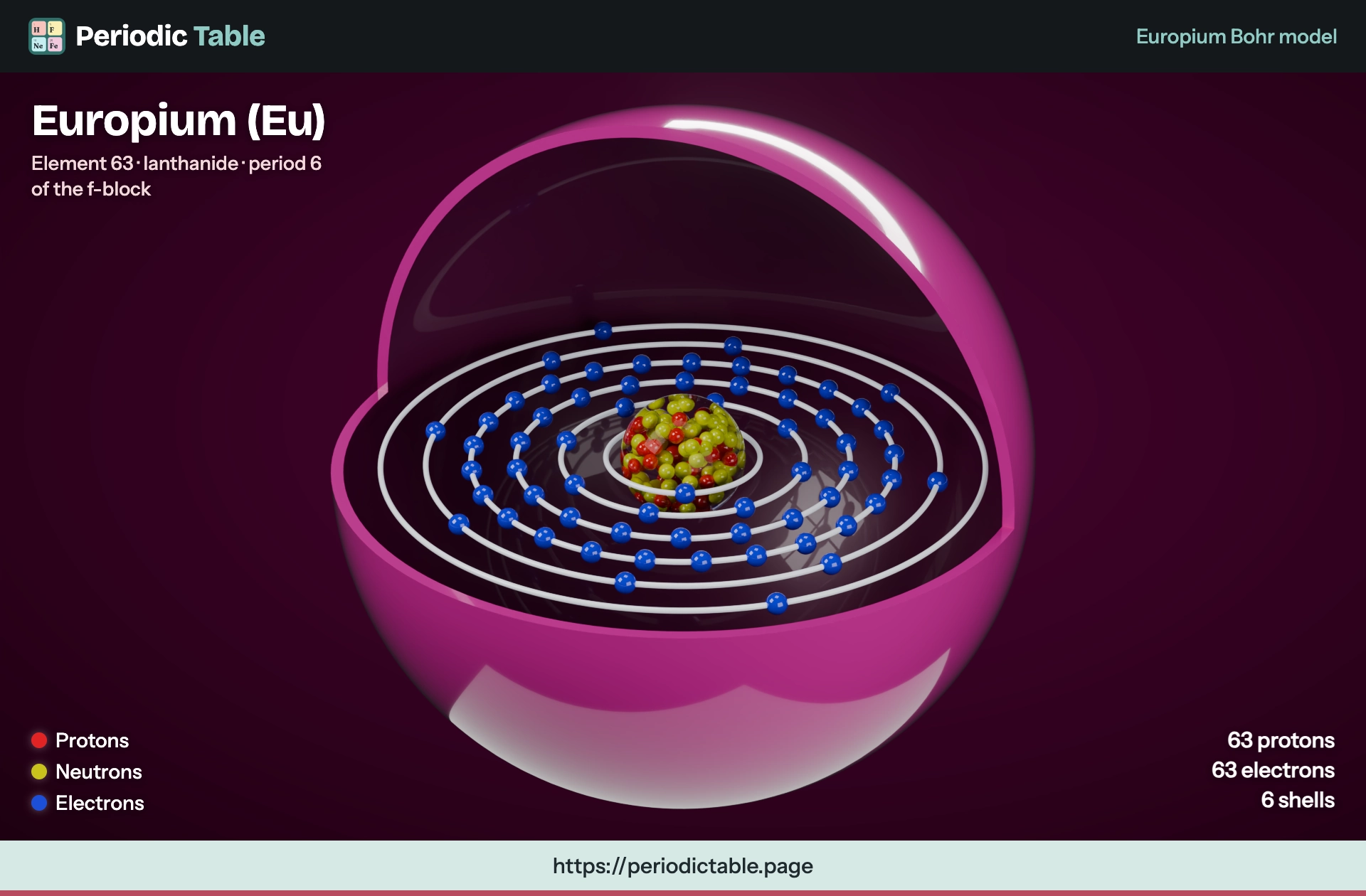
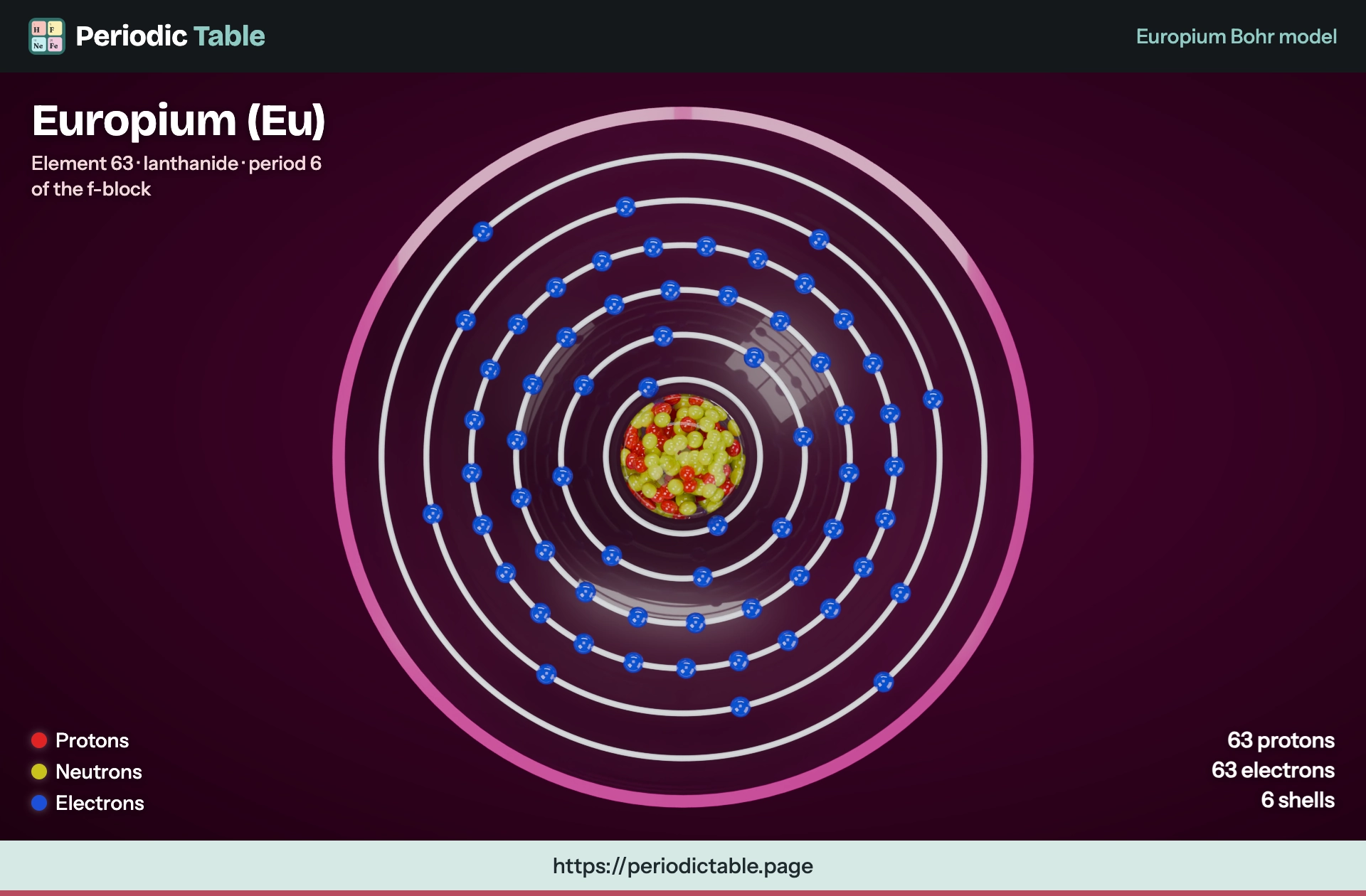
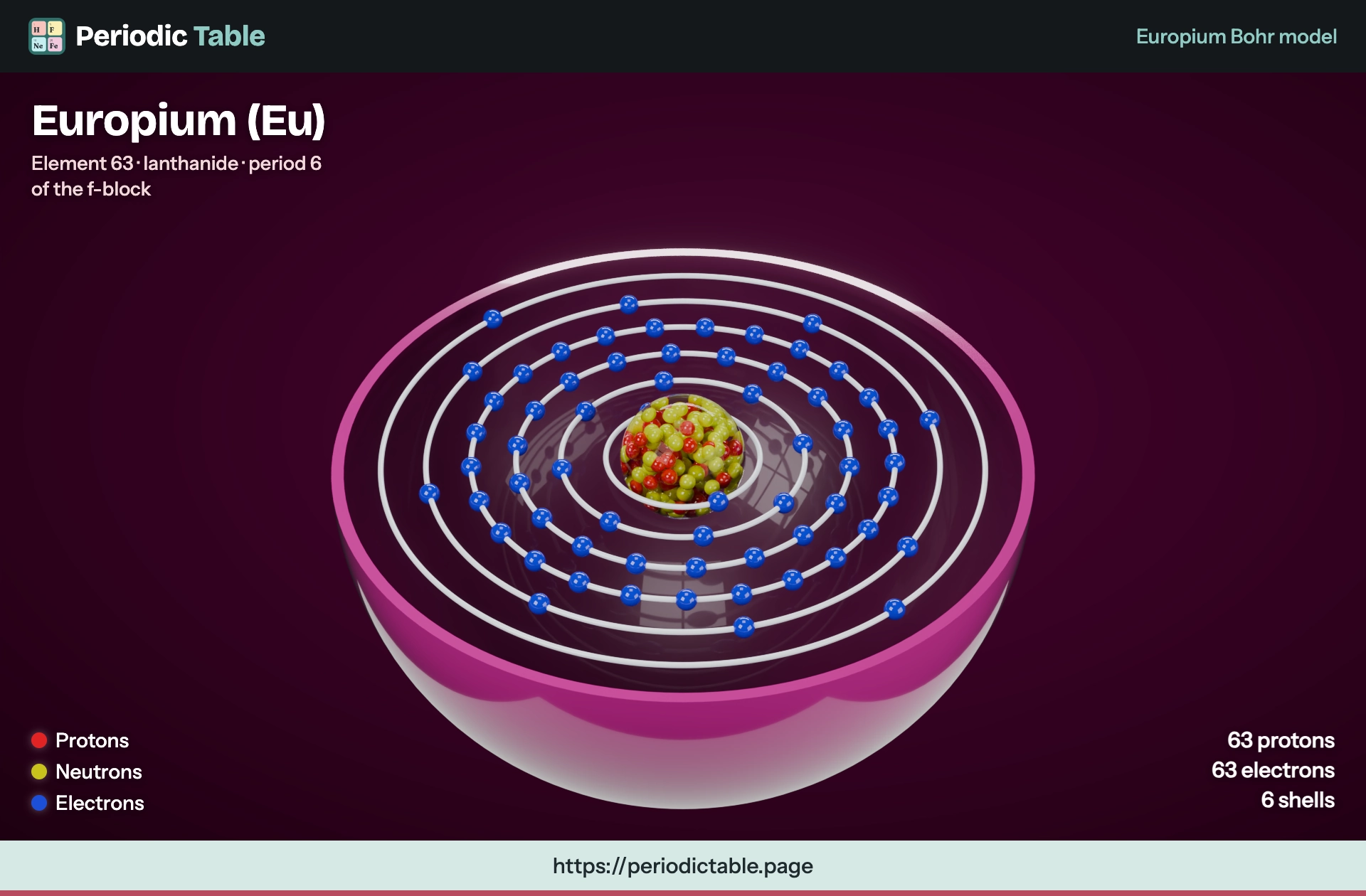
This is a Bohr model of europium (Eu), a simplified picture of a single europium atom. Its nucleus holds 63 protons, and a neutral europium atom has 63 electrons, arranged around it in 6 shells (2 in shell K, 8 in shell L, 18 in shell M, 25 in shell N, 8 in shell O and 2 in shell P).
Europium periodic table electron configuration
- Shorthand
- [Xe] 4f7 6s2
- Full
- 1s2 2s2 2p6 3s2 3p6 4s2 3d10 4p6 5s2 4d10 5p6 6s2 4f7
- Electrons per shell
- 2, 8, 18, 25, 8, 2
Europium element properties and atomic data
- Atomic number
- 63
- Atomic mass
- 151.9641 u
- Phase at STP
- Solid
- Melting point
- 825.85°C (1099 K)
- Boiling point
- 1528.85°C (1802 K)
- Density
- 5.264 g/cm³
- Electronegativity (Pauling)
- 1.2
- Period
- 6
- Group
- —
- Block
- f-block
- Appearance
- Unknown
- Discovery date
- 1901
- Discovered by
- Eugène-Anatole Demarçay
- Named by
- —
Europium at a glance: key data for element 63
The table below collects the numbers you will reach for most often. They are standard reference values, so they match any good chemistry handbook; temperatures are rounded to the nearest degree. Spent nuclear fuel, radiation hazards and nuclear waste disposal questions are discussed under americium uses with clear figures.
| Property | Value |
|---|---|
| Symbol | Eu |
| Atomic number | 63 |
| Atomic mass | 151.964 u |
| Position | Period 6, f-block, lanthanides |
| Electron configuration | [Xe] 4f7 6s2 |
| Melting point | 822 °C (1,095 K) |
| Boiling point | 1529 °C (1,802 K) |
| Density at 20 °C | 5.24 g/cm³ |
| Crystal structure | Body-centered cubic (bcc) |
| Oxidation states | +2, +3 |
| State at room temperature | Solid |
| CAS number | 7440-53-1 |
| Discovery | 1901, Eugène-Anatole Demarçay; named after Europe |
Where the lanthanide sits in the periodic table
Element 63 sits in period 6 among the lanthanides, the 15-element row usually printed below the main body of the table, between samarium (62) and gadolinium (64). Its f-block position means each step along the row adds to an inner shell rather than the outer one, so neighbours look chemically alike. For superconducting magnets and steel additives, the main topics covered, open the niobium element page for the details.
It breaks that pattern: in the solid it gives up only two electrons per atom instead of three, a trait it shares with ytterbium, and its large Eu(II) ion is close in size to strontium. That is why it sometimes behaves less like a typical rare-earth metal and more like an alkaline-earth element in its chemistry.
| Element | Atomic number | Density (g/cm³) | Valence in the solid |
|---|---|---|---|
| Samarium | 62 | 7.52 | 3 |
| Europium | 63 | 5.24 | 2 |
| Gadolinium | 64 | 7.90 | 3 |
| Ytterbium | 70 | 6.90 | 2 |
Electron configuration, ionization energies and atomic radius
The europium atom ends its configuration with a half-filled 4f subshell: seven unpaired spins in the f-shell plus two outer 6s electrons. That half-filled shell is the single most useful fact about this element, because almost every oddity in the sections below traces back to it.
- First three ionization energies: 547.1, 1085 and 2404 kJ/mol
- Electronegativity: 1.2 on the Pauling scale
- Atomic radius (empirical): 180 pm; covalent radius: about 198 pm
- Ground-state term: 8S7/2
Physical properties of europium metal
Freshly cut, the element is pale silver with a faint yellow tint, but you will rarely see it that way because a dull oxide film forms quickly. It is ductile and about as hard as lead, so a knife will cut it.
Because of that two-electron bonding, its atoms sit further apart than in neighbouring lanthanides, which gives it an unusually large atomic volume and a light build for its row. At ambient pressure it adopts a body-centered cubic crystal structure with a lattice constant of 458.2 pm; squeeze it past about 12.5 GPa and it turns hexagonal close-packed, with further transitions above 31.5 GPa.
| Property | Value |
|---|---|
| Young's modulus | 18.2 GPa |
| Shear modulus | 7.9 GPa |
| Bulk modulus | 8.3 GPa |
| Poisson ratio | 0.152 |
| Specific heat capacity | 182 J/(kg·K) |
| Thermal conductivity | 13.9 W/(m·K) |
| Vapour pressure | 1 Pa at 863 K; 100 kPa near 1,796 K |
The vapour pressure figures matter in practice. Europium evaporates far more easily than most rare earths, which is exactly how producers distil the purest grades (see the production section below).
Magnetic behaviour and electrical data
The seven unpaired f-shell spins make europium strongly magnetic at the atomic level. At room temperature the solid is paramagnetic, with a molar magnetic susceptibility of about +34,000 × 10−6 cm³/mol.
Cool it below roughly 91 K, its Néel temperature, and it becomes antiferromagnetic: the spins line up in a helix that rotates a little from one atomic plane to the next, with an ordered moment near 5.9 Bohr magnetons per atom. Electrical resistivity at room temperature is about 0.900 µΩ·m, several times higher than copper or aluminium.
Chemical properties: why europium is the most reactive lanthanide metal
Europium is the most reactive of the lanthanides, closer in temperament to calcium than to its neighbours. Left exposed it dulls fast, and when heated in oxygen it burns to europium(III) oxide:
$$4\,\text{Eu} + 3\,\text{O}_2 \rightarrow 2\,\text{Eu}_2\text{O}_3$$
It reacts slowly with cold water and briskly when heated, releasing hydrogen and leaving a hydroxide:
$$2\,\text{Eu} + 6\,\text{H}_2\text{O} \rightarrow 2\,\text{Eu(OH)}_3 + 3\,\text{H}_2$$
Dilute acids dissolve it quickly to give very pale pink solutions of Eu(III), and it combines readily with the halogens on warming. For you as a handler, this means europium is stored under mineral oil or argon and never left on an open bench.
Oxidation states: why Eu(II) is so easy to reach
Most lanthanides live almost entirely in the trivalent state. Europium has two everyday states, +3 and +2, and its divalent state is the most accessible of any rare earth. The reason is electron counting: Eu(III) has six in its f-shell, while Eu(II) reaches the extra-stable set of seven.
$$\text{Eu}^{3+} + e^{-} \rightarrow \text{Eu}^{2+} \qquad E^{\circ} \approx -0.34\ \text{V}$$
That standard reduction potential is mild enough that zinc can do the job, which is the basis of the classic separation method. Eu(II) is a gentle reducing agent and slowly converts back to Eu(III) whenever oxygen is around.
Size matters too: Eu(II) is much larger than Eu(III) and almost the same size as Sr(II), so the two states differ sharply in coordination preferences, emission and magnetic behaviour. Eu(III) favours hard oxygen donors and high coordination numbers, while Eu(II) is softer and tolerates nitrogen and sulfur donors.
Europium compounds and their chemistry
Europium compounds span simple salts, semiconductors and light-emitting complexes. Unlike most rare earths, it builds large families in both charge states, and the two families look and behave very differently.
Europium oxides and chalcogenides
Three binary oxides are well established. Europium(II) oxide, EuO, holds only Eu(II) in a rock-salt lattice and turns into a ferromagnetic semiconductor below about 69 K, which made it a test bed for magnetic refrigeration and spin-based electronics research.
Eu3O4 is a mixed-valence oxide, and europium oxide in its familiar commercial form, Eu2O3, is the white sesquioxide used to make red phosphor powders. The heavier chalcogenides EuS, EuSe and EuTe also hold Eu(II) and form a classic series of magnetically ordered crystals.
Halides, hydrides and other salts
Europium forms the full set of trihalides, from EuF3 to EuI3, and, unusually, a complete set of dihalides too; several of the divalent ones glow blue under ultraviolet light. Its hydrides stay in the +2 state, unlike their samarium counterparts. Among the oxosalts, europium(II) sulfate stands out: EuSO4 barely dissolves in water, whereas the sulfates of the trivalent rare earths stay in solution.
Coordination compounds and metallocenes
In solution, Eu(III) complexes are prized for their emission: light absorbed by an organic ligand passes to the europium ion (the antenna effect), which then gives off narrow orange-red lines. Because that red emission is sensitive to symmetry, chemists use it to probe local structure. Eu(II) also forms soluble metallocenes such as Eu(C5Me5)2, which act as one-electron reducing agents.
Europium isotopes, half-life and nuclear properties
Natural europium is a near 50/50 mix of two isotopes. Europium-153 makes up 52.19% and is stable, while europium-151 (47.81%) is technically radioactive: it undergoes alpha decay with a half-life of about 4.6 × 10¹⁸ years, hundreds of millions of times the age of the universe, so the mix never changes in practice.
| Isotope | Natural abundance | Half-life | Main decay |
|---|---|---|---|
| Eu-151 | 47.81% | 4.6 × 10¹⁸ years | Alpha, to promethium-147 |
| Eu-153 | 52.19% | Stable | None observed |
| Eu-150 | Synthetic | 36.9 years | Positron emission |
| Eu-152 | Synthetic | 13.517 years | Electron capture or beta |
| Eu-154 | Synthetic | 8.592 years | Beta minus |
| Eu-155 | Synthetic | 4.742 years | Beta minus |
Dozens of artificial radioisotopes are known, and the long-lived ones matter more than you might expect. Eu-152 and Eu-154 emit many well-defined gamma rays, so labs use them to calibrate gamma-ray spectrometers. Both natural isotopes also have large neutron-capture cross-sections, especially europium-151, which lets the element absorb neutron radiation and makes europium a product to track in spent nuclear fuel.
History and discovery of europium
The element was not found in one moment; it was teased out of samarium over about two decades. Through the 1800s, rare-earth chemistry kept showing that supposedly single "earths" hid more elements: cerium (1803) gave up lanthanum and didymium, and didymium was later split into praseodymium and neodymium. In 1879 Paul-Émile Lecoq de Boisbaudran pulled samarium out of that mixture, but his sample was still impure.
In 1885 William Crookes saw an unexplained band in the phosphorescence of a sample containing yttrium, and in 1892 Lecoq de Boisbaudran recorded more unidentified spectral lines. Eugène-Anatole Demarçay reported a new element in 1896 and then spent years on fractional crystallisation of double magnesium nitrates, checking each fraction by spectroscopy. By 1901 the material was pure enough to name: europium, after Europe.
Georges Urbain described the intense red luminescence of europium oxide dispersed in lime in 1906, an early hint of the element's future, while the free element was first isolated in 1937. Because an English physicist and a French chemist can both claim a share, credit is still debated, though most references name the Frenchman.
Where europium is found: ores and the europium anomaly
You will not find europium in native form. It averages about 2 ppm in Earth's crust, scattered through rare-earth minerals such as bastnäsite, monazite, xenotime and loparite, always as a minor passenger alongside its neighbours.
What makes it special to geologists is the europium anomaly. In a cooling magma, some europium is reduced to the divalent ion, which is close in size and charge to calcium and slips into feldspar, especially plagioclase. Plagioclase-rich rocks therefore show a positive spike on a chondrite-normalised rare-earth plot, while the leftover melt shows a dip.
The sign and size of that spike tell petrology and geochemistry a lot about how a body of magma crystallised. Trace Eu(II) is also what makes some natural fluorite glow blue under UV, the effect that gave fluorescence its name in 1852.
How pure europium is extracted and produced
No ore is worked for europium alone, so it comes out as a by-product of mining for mixed rare-earth ores. Concentrates of bastnäsite or monazite are leached in acid, then multistage solvent extraction splits the dissolved elements. Europium gets a shortcut through its separation chemistry: reduce it to Eu(II) with zinc, add sulfate, and europium(II) sulfate precipitates while the trivalent ions stay dissolved.
The oxide is then turned into pure europium by heating it with lanthanum metal under vacuum at roughly 1,100 to 1,200 °C. Europium is volatile enough to distil away from the reaction and condense as high-purity metal in a cooler zone, and repeated vacuum distillation or sublimation cleans it further.
Supply risk and global production
Global output is small. European Commission estimates put average production of the oxide at around 422 tonnes a year over 2012 to 2016, with China supplying about 86%, Australia about 6%, and Russia and the United States around 2% each.
The Royal Society of Chemistry rates its relative supply risk at 9.5 out of 10, with less than 10% recycled and reserves concentrated in a few countries. Demand first spiked with colour TV sets, and the Mountain Pass mine in California expanded largely to feed it.
Main applications of europium today
Nearly every commercial use of europium comes back to light: the sharp red of Eu(III) and the tunable broad emission of Eu(II). Its knack for neutron capture covers most of the rest. Here is where the technology actually shows up.
Red phosphors and luminescence for colour television and fluorescent lamps
Europium's first big job came in the 1960s, when europium-doped yttrium orthovanadate gave cathode-ray tube television screens a bright, saturated red. Later CRT screens switched to Eu-activated yttrium oxide and oxysulfide. In three-band fluorescent lighting, an Eu(III) phosphor supplies the red, an Eu(II) phosphor the blue emission and a terbium-based phosphor the green, together making white light that renders skin tones well.
Today the same chemistry runs through LEDs and display backlights. As an activator in a phosphor-converted white LED, Eu(II) can be tuned across much of the visible spectrum by changing its host crystal, while Eu(III) emitters give narrow red light for wide-gamut displays. If you use light-emitting diodes at home, there is a good chance europium is in them.
Glow-in-the-dark and persistent phosphors
Strontium aluminate co-activated with Eu(II) and dysprosium glows green for hours after the lights go off, which is why it replaced older sulfide paints on exit signs, watch dials and toys. Such persistent phosphors are also being studied for stress sensing and optical data storage.
Anti-counterfeiting security on Euro banknotes
Hold a euro note under a UV lamp and the red-glowing fibres and printed marks show the narrow line pattern typical of Eu(III). The exact recipe is secret, but those characteristic emission lines are hard to fake, which is why rare-earth inks also appear on passports, product labels and many other banknotes.
Medical imaging, immunoassays and research
Eu(III) chelates stay excited for up to a millisecond, far longer than the nanosecond background glow of blood or tissue. Time-resolved assays exploit that: they wait for the background to fade, then read the europium signal, which makes europium-labelled antibodies the basis of sensitive immunoassays and drug-screening platforms. Eu(III) complexes also served as NMR shift reagents that spread out crowded spectra, and europium-activated storage plates in computed radiography capture X-ray exposures for medical imaging.
Neutron absorbers in nuclear reactors
Because natural europium captures slow neutrons so readily, and its capture products are themselves good absorbers, Eu2O3 mixed into stainless steel served in the control elements of small military power reactors such as the SM-1. It never became mainstream, but it remains a known option for long-life reactor control.
Is europium safe? toxicity, health and handling
Europium has no known biological role, and the evidence so far points to low toxicity for its salts. In a 28-day rat study, europium(III) chloride at up to 1,000 mg/kg per day caused stomach irritation only at the top dose, and the authors set a no-observed-effect level of 200 mg/kg/day; uptake from the gut is low. Still, long-term health data for this group of elements are thin, so treat its compounds with ordinary lab care.
The bigger hazard is the metal itself. Commercial europium metal is classed as a category 1 pyrophoric solid (H250): fine pieces can ignite on exposure, and it reacts violently with moisture.
Keep it under oil or an inert atmosphere, wear gloves and eye protection, and fight any fire with dry powder only, as the safety data sheet specifies. Environment-wise, the main concern is waste from rare-earth mining and refining, not europium itself.
Surprising europium facts
- Named for a continent: its discoverer chose the name at the turn of the 20th century, and today the element helps protect that same continent's currency.
- A clock for old stars: astronomers compare europium with iron in ancient stars to measure rapid neutron-capture (r-process) enrichment.
- Odd one out: many properties of europium, from its low melting point to its two-electron metallic bonding, look more like barium than a typical rare earth.
- Two colours from one element: the trivalent ion glows red, while the divalent ion can glow anywhere from blue to green depending on its host.
- A stand-in for heavier elements: because Eu(III) behaves so much like americium and curium in solution, chemists use it as a safe proxy when studying how radioactive waste moves through rock and groundwater.