


Niobium element (Nb): niobium periodic table facts
Niobium periodic table facts: niobium (Nb) is element 41, a transition metal in group 5, period 5. Pick up a ring of pure niobium and you are holding a grey metal that hides a surprising résumé: it strengthens long-distance pipelines, keeps rocket nozzles from melting, and carries the current in hospital magnets. In stomach remedies, medicine and pharmaceuticals, from Pepto-Bismol to subsalicylate, feature in the bismuth production entry for curious readers.
Niobium (Nb) is a chemical element that spent its first 150 years with two competing names, and today it is just as likely to show up in body jewelry as in a particle accelerator. Below you get its atomic data, physical and chemical behavior, discovery story, sources and main uses in one place.
Rotate the 3D Bohr model of niobium
Drag to orbit, scroll to zoom.
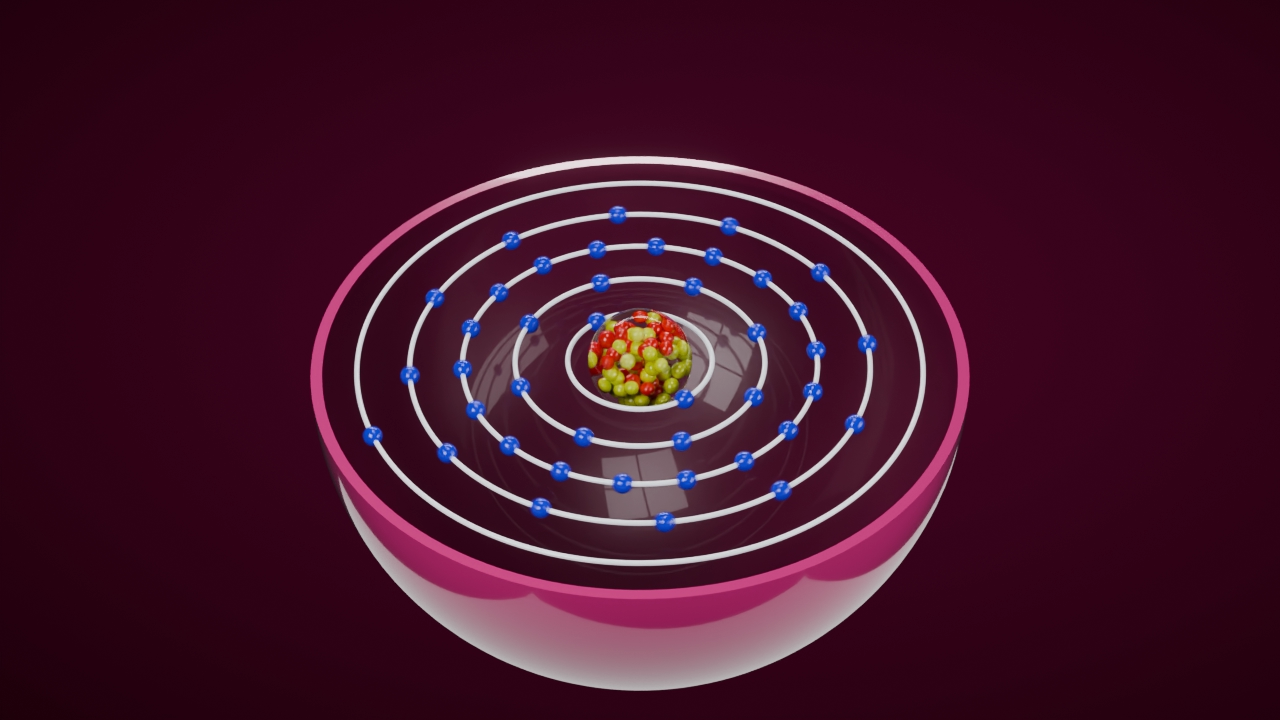
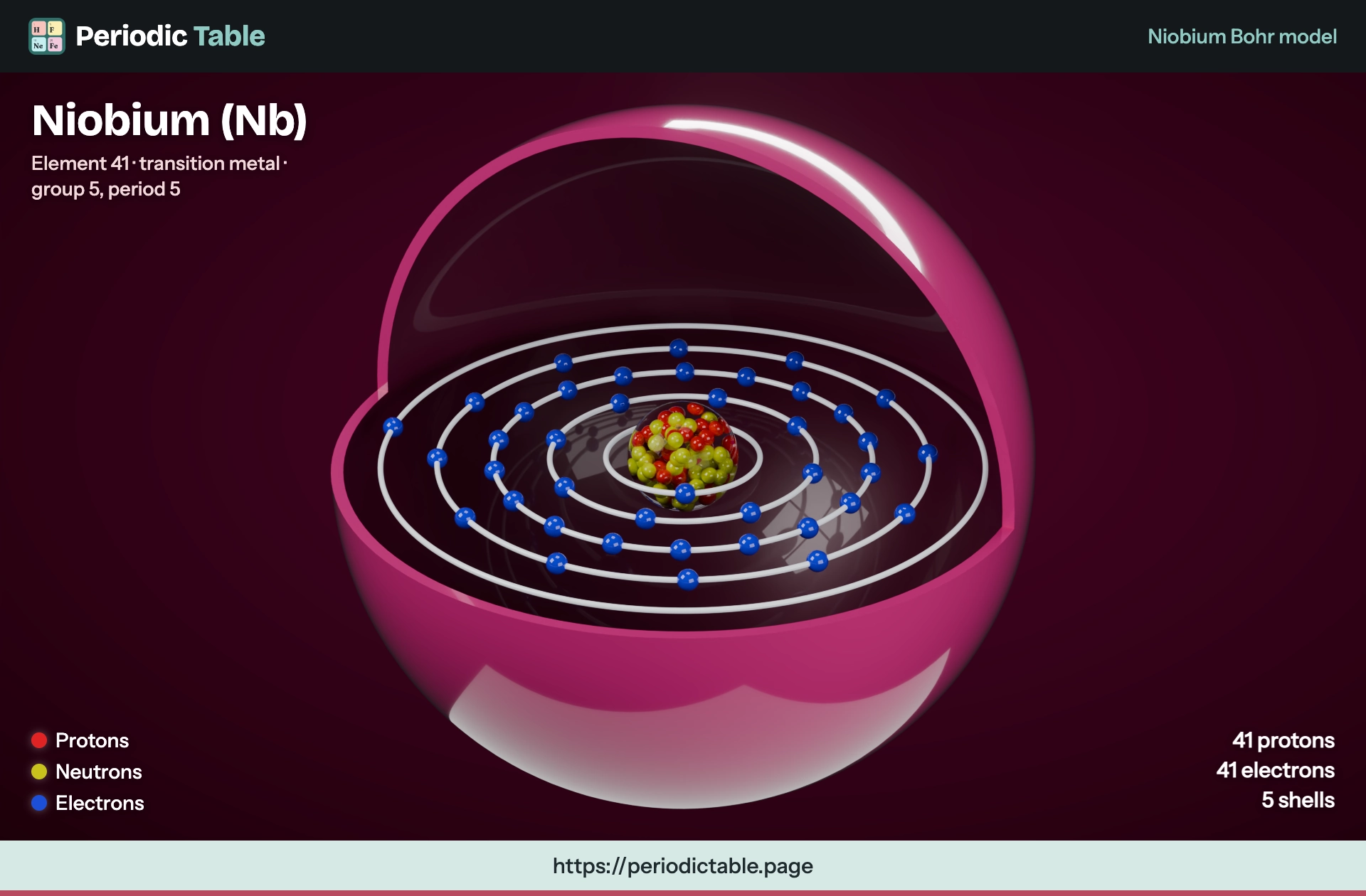
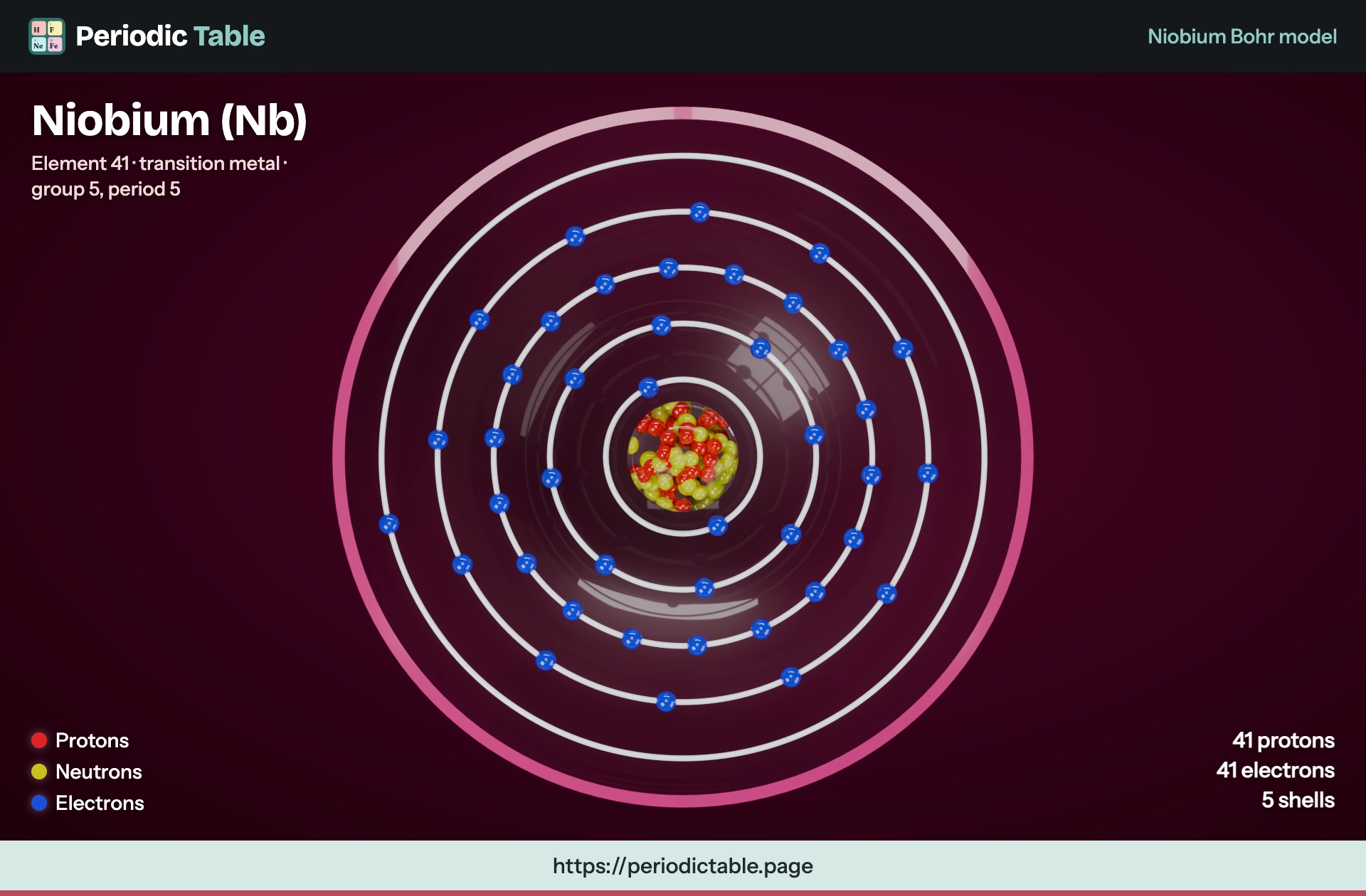
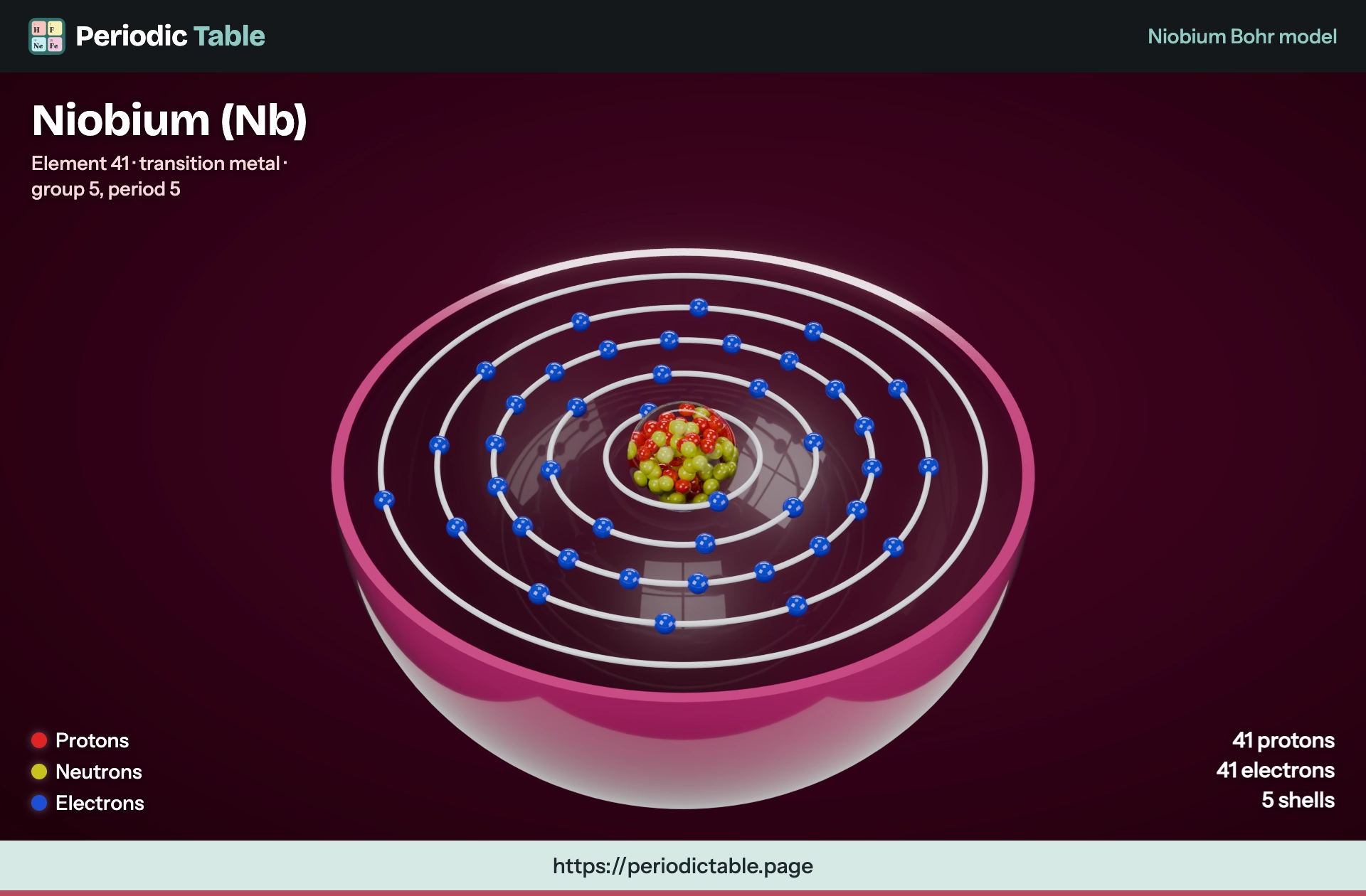
This is a Bohr model of niobium (Nb), a simplified picture of a single niobium atom. Its nucleus holds 41 protons, and a neutral niobium atom has 41 electrons, arranged around it in 5 shells (2 in shell K, 8 in shell L, 18 in shell M, 12 in shell N and 1 in shell O).
Niobium periodic table electron configuration
- Shorthand
- [Kr] 4d4 5s1
- Full
- 1s2 2s2 2p6 3s2 3p6 4s2 3d10 4p6 5s1 4d4
- Electrons per shell
- 2, 8, 18, 12, 1
Niobium element properties and atomic data
- Atomic number
- 41
- Atomic mass
- 92.9064 u
- Phase at STP
- Solid
- Melting point
- 2476.85°C (2750 K)
- Boiling point
- 4743.85°C (5017 K)
- Density
- 8.57 g/cm³
- Electronegativity (Pauling)
- 1.6
- Period
- 5
- Group
- 5
- Block
- d-block
- Appearance
- Gray metallic, bluish when oxidized
- Discovery date
- 1801
- Discovered by
- Charles Hatchett
- Named by
- —
What is niobium? element 41 at a glance
Niobium is element 41, a soft, ductile, lustrous transition metal that looks bright grey when freshly cut. Left in air at room temperature for a long time, its surface slowly takes on a bluish tinge as a thin oxide forms. In the United States it was long called columbium, with the symbol Cb, and some metallurgists still use that name today. Anyone reading about rare earths can check europium (Eu) to see how bastnasite and monazite supply it.
Its closest relative is tantalum, the element directly beneath it. The two are so alike in size and behavior that separating them took chemists most of the 19th century, and they still turn up in the same minerals. The key facts are summarized in the table below.
What makes niobium worth knowing is the combination it offers. It melts almost a thousand degrees hotter than iron, yet it is light for a refractory element, easy to shape, and nearly immune to corrosion. Most of it never reaches you as a shiny bar; it disappears into girders, engines and magnets in fractions of a percent, quietly doing work that few other elements can do as cheaply.
| Property | Value for Nb |
|---|---|
| Atomic number | 41 |
| Standard atomic weight | 92.906 |
| Group / period / block | 5 / 5 / d |
| Electron configuration | [Kr] 4d4 5s1 |
| Melting point | 2,477 °C (2,750 K) |
| Boiling point | about 4,744 °C (5,017 K) |
| Density (20 °C) | 8.57 g/cm3 |
| State at 20 °C | Solid |
| CAS number | 7440-03-1 |
Where Nb sits on the periodic table
You find niobium on the periodic table in group 5 and period 5, in the d-block, between zirconium (40) on its left and molybdenum (42) on its right. Below it sit tantalum and the synthetic element dubnium. Across alchemists, regulations and public health, the inorganic arsenic overview covers a toxic metalloid in one place.
Its electron configuration is a little unusual for its column. Its column neighbors keep a pair in their outermost s shell, but this element moves one of them into the d subshell, ending with a single 5s electron. Because of the lanthanide contraction, the two atoms come out almost exactly the same size, which is the root of their near-identical behavior.
| Z | Group 5 element | Electrons per shell |
|---|---|---|
| 23 | Vanadium | 2, 8, 11, 2 |
| 41 | Niobium | 2, 8, 18, 12, 1 |
| 73 | Tantalum | 2, 8, 18, 32, 11, 2 |
History of columbium and niobium
The history starts in 1801, when English chemist Charles Hatchett analyzed a black mineral that had been shipped to London from Connecticut decades earlier. He found the oxide of a new element and called it columbium, after Columbia, a poetic name for the United States. The mineral became columbite.
Confusion followed quickly. In 1809 William Hyde Wollaston compared columbium with tantalum and decided they were the same thing.
In 1844 German chemist Heinrich Rose argued that tantalum ores held a second, distinct element. Between 1864 and 1866 Christian Wilhelm Blomstrand, Henri Sainte-Claire Deville, Louis Troost and Jean Charles Galissard de Marignac proved there were exactly two elements, not the several that had been claimed.
Blomstrand made the first niobium sample by reducing the chloride with hydrogen. The first commercial use, in the early 1900s, was as an incandescent lamp filament, a job it soon lost to tungsten, which survives even hotter filaments.
Naming the element after Niobe
Rose chose a name from Greek mythology: Niobe was the daughter of Tantalus, the king who gave his name to tantalum. The family link mirrors the chemical one.
For roughly a century the naming split along an ocean, with Europe on the new name and American chemists on columbium. In 1949 a chemistry conference in Amsterdam picked niobium, and in 1950 the International Union of Pure and Applied Chemistry (IUPAC) made it official, as a trade-off that let the American name tungsten stand over wolfram.
Atomic properties of the Nb element
The atomic properties describe a single atom of the Nb element. Every atom has 41 protons in its nucleus, and a neutral atom carries 41 electrons.
Nature makes only one stable isotope, niobium-93, so you can get its neutron count by simple subtraction: \(93 - 41 = 52\) neutrons. That is also why its atomic mass sits so close to 93.
Electronegativity, radius and ionization energies
On the Pauling scale, the element has an electronegativity of 1.6, a little higher than zirconium and very close to its heavier cousin. Its first three ionization energies are about 652, 1,380 and 2,416 kJ/mol, and it takes far more energy to strip the sixth electron than the fifth, which is why +5 is its most stable state.
- Empirical atomic radius: 146 pm
- Covalent radius: about 164 pm
- Electron affinity: about 88.5 kJ/mol
Physical properties of niobium metal
The physical properties of niobium start with its crystal structure: a body-centered cubic lattice that stays stable from very low temperatures all the way up to where it melts. It is paramagnetic, conducts heat moderately well, and in very pure form is soft enough to roll into foil and draw into fine wire. Small amounts of dissolved gases or carbon make it noticeably harder, so the purity of a sample changes how it behaves under the hammer.
Among the refractory metals it is the lightweight: its density is roughly half that of tantalum, which matters whenever every gram has to fly. Its low capture cross-section for thermal neutron radiation adds another niche: niobium parts that must stay nearly transparent to a reactor's radiation.
Mechanical properties and hardness
The mechanical properties below are typical for annealed, commercially pure material. Note how its Mohs hardness of about 6 puts it near pure titanium, while it bends and forms more like iron.
| Mechanical property | Typical value |
|---|---|
| Tensile strength (room temperature) | about 275 MPa |
| Young's modulus | 105 GPa |
| Shear modulus | 38 GPa |
| Bulk modulus | 170 GPa |
| Poisson ratio | 0.40 |
| Mohs hardness | 6.0 |
Thermal properties and vapor pressure
The thermal properties of the element suit hot, demanding service. Its thermal conductivity is about 53.7 W/(m·K), its linear thermal expansion is about 7.1 × 10⁻⁶ per kelvin near room conditions, and its specific heat capacity is about 265 J/(kg·K). The vapor pressure stays tiny even when glowing hot: it only reaches about 1 Pa near 2,942 K, so it barely evaporates in a vacuum furnace.
Niobium as a superconductor
Cool niobium below 9.2 K (about −264 °C) and its electrical resistance drops to zero. That critical temperature is the highest of any element at normal pressure, making it the best elemental superconductor.
It is also one of only three elements that are type II superconductors, along with vanadium and technetium, and it has the greatest magnetic penetration depth of any element. Its superconductivity depends strongly on purity, so research-grade material is refined far beyond ordinary industrial grades.
Chemical properties of Nb
Most of niobium's chemical properties come from a thin, tough oxide layer that forms on its surface almost instantly. That film makes the surface highly corrosion-resistant: it shrugs off water, air at ordinary temperatures, and most acids, including aqua regia. Its corrosion resistance is a step below tantalum's, but the lower price makes niobium the sensible choice for less severe service such as chemical-plant linings.
- Begins to oxidize in air at about 200 °C, so hot work is done in vacuum or inert gas.
- Dissolves in hydrofluoric acid, hot concentrated sulfuric acid, and hot strong alkali solutions.
- Reacts with halogens, oxygen, nitrogen and carbon when heated, often giving non-stoichiometric products.
Oxidation states and isotopes
Niobium's oxidation states run from −3 to +5, but +5 dominates its chemistry, and in water solution it is the only state you will meet. Lower states such as +4 and +3 tend to form Nb–Nb bonds.
All natural niobium is the stable isotope 93Nb. Of the radioactive isotopes, niobium-92 is the longest-lived, with a half-life of about 34.7 million years, followed by niobium-94 at about 20,000 years.
Niobium compounds and their chemistry
Almost all niobium compounds and alloys trace back to one starting material: the pentoxide, Nb2O5, a white powder.
Oxides and niobates
Besides the pentoxide, the element forms a dioxide (NbO2) and a monoxide (NbO). Dissolving this oxide in strong base or fusing it with alkali oxides gives niobates. The best-known is lithium niobate, LiNbO3, a ferroelectric crystal that bends and modulates light and filters radio signals in phones.
Halides, nitrides and carbides
Among the halides, niobium pentachloride (NbCl5) is a yellow crystalline compound that serves as a handy starting reagent for organometallic chemistry; the pentafluoride is white. Two hard binary compounds have industrial roles: niobium nitride (NbN) superconducts at low temperatures and is used in sensitive light detectors, while niobium carbide (NbC) is an extremely hard ceramic used in cutting tools.
Where niobium occurs in nature
Niobium never occurs as a free metal. Its occurrence in Earth's crust is about 20 ppm, which ranks it roughly 33rd among the elements, and some geologists think much more of it sank into the core because it is so heavy.
The main ore mineral today is pyrochlore, a calcium-sodium niobate found in carbonatite intrusions, rare igneous rocks rich in carbonate. Columbite and tantalite, iron-manganese oxides found in granite pegmatites, form a continuous series, and the trade name coltan refers to that mixed concentrate. Smaller deposits are worked in Nigeria, Australia, Rwanda and the Congo.
Because niobium and tantalum travel together through geology, almost every deposit carries some tantalum, and the ratio between them decides how a mine sells its output. Pyrochlore deposits are rich in niobium and poor in Ta, which is why they feed the steelmaking market, while pegmatite ores are prized more for their tantalum.
Niobium production and supply risk
Global production is concentrated in a way few metals can match. Brazil supplies around nine-tenths of world output, led by the CBMM mine at Araxá in Minas Gerais, with a second Brazilian operation near Catalão.
Canada follows with the Niobec mining operation in Quebec. With so few suppliers, the Royal Society of Chemistry rates it a high supply risk, even though reserves are large.
Annual production has grown with the demand for lighter, stronger construction materials. Output roughly doubled between the mid-1990s and the mid-2000s, and world mine production now runs in the tens of thousands of tonnes of contained niobium each year, almost all of it leaving the mine already blended with iron.
From ore to ferroniobium
Most of the concentrate never becomes pure metal. It is turned straight into ferroniobium, an iron alloy with 60–70% Nb, by an aluminothermic reaction in which aluminium strips oxygen from the oxides:
$$3\,\mathrm{Nb_2O_5} + \mathrm{Fe_2O_3} + 12\,\mathrm{Al} \rightarrow 6\,\mathrm{Nb} + 2\,\mathrm{Fe} + 6\,\mathrm{Al_2O_3}$$For electronic-grade material and superconducting wire the industry goes further: the mixed oxides are dissolved in hydrofluoric acid, Nb and Ta are separated by solvent extraction, and the oxide is reduced and then refined by electron-beam melting in vacuum. This purer route accounts for only a small slice of niobium production, but it supplies the grades that superconducting cavities and wire demand.
Uses of niobium across industry
The uses of niobium are dominated by one market. The table shows roughly how its applications divide.
| Application | Share of use | What Nb does |
|---|---|---|
| Structural and pipeline steel | about 90% | Fine grain, higher strength |
| Heat-resistant engine alloys | second largest | Heat resistance in engines |
| Superconductors and other uses | small | Zero-resistance wire, capacitors |
Steel and high-strength low-alloy steels
Adding as little as 0.1% Nb to high-strength low-alloy steels makes a big difference. In this microalloying role, the element forms tiny carbide and nitride particles that pin grain boundaries. The resulting grain refining raises strength and toughness while keeping good weldability, so builders can use thinner, lighter sections for car bodies, bridges and gas pipelines.
Grades of stainless steel are stabilized with it too, and it appears in some welding rods. For steel production this is a cheap upgrade: a few hundred grams per tonne can let a mill cut thickness and weight without losing strength.
Superalloys and niobium alloys in aerospace
In nickel-, cobalt- and iron-based superalloys, a few percent of niobium creates a hardening phase that holds up at high heat. Inconel 718, with about 5% Nb, is used in jet engines, gas turbines and turbochargers.
The best-known of the niobium alloys is C-103 (89% Nb, 10% hafnium, 1% titanium), developed in the early 1960s and used for rocket thruster nozzles from the Apollo lunar module to modern upper-stage engines. Because each niobium alloy oxidizes above about 400 °C, aerospace parts need a protective coating.
Superconducting magnets for MRI and accelerators
The niobium-titanium wire NbTi and the compound niobium–tin (Nb3Sn) are the workhorse wires of superconducting magnets. Wound into coils and cooled with liquid helium, they produce the strong, steady magnetic field inside MRI scanners used for magnetic resonance imaging and NMR spectrometers. The same wires drive particle accelerators such as the Large Hadron Collider, and fusion magnets use niobium-tin strands by the hundreds of tonnes.
SRF cavities and light detectors
High-purity sheet is pressed and welded into superconducting radio frequency cavities, bell-shaped chambers that accelerate electron beams in free-electron lasers and linear colliders with almost no energy lost to heat. Thin NbN films, meanwhile, become ultra-sensitive bolometers for terahertz astronomy.
Electronics, optics and nuclear uses
Beyond steel and magnets, niobium turns up in a long tail of smaller applications where one property, such as a high refractive power or low absorption of reactor radiation, matters more than price:
- Electroceramics: lithium niobate in optical modulators and surface acoustic wave filters.
- Electronics: niobium capacitors as a lower-cost alternative to tantalum.
- Optics: niobium oxide raises the refractive index of glass, allowing thinner eyeglass lenses.
- Nuclear engineering: corrosion-resistant parts for nuclear reactors that absorb few neutrons.
- Lighting: arc-tube seals in high-pressure sodium lamps.
Niobium jewelry, implants and coins
Because it is inert in the body and hypoallergenic, niobium is a favorite for earrings and piercings worn by people who react to nickel. When the metal is anodized, a controlled voltage grows a clear oxide film whose thickness sets the color, through light interference rather than any dye. Anodization gives an iridescent range from gold through purple and blue to green, and the color will not chip because it is the metal itself.
The same inertness makes niobium useful in medical devices, including pacemakers, bone plates and dental implants. Since 2003 Austria has minted bimetallic silver-niobium coins whose colored niobium centers are produced the same way.
Is niobium safe? toxicity and handling
Niobium has no known biological role. Bulk niobium is physiologically inert and harmless to handle, which is why it is trusted against skin and inside the body.
The toxicity concerns lie elsewhere: fine Nb dust irritates eyes and skin and can be a fire hazard, and some soluble compounds, such as the pentachloride and soluble niobium salts, have proved toxic in animal tests. Wear eye protection and a dust mask when you grind or machine it, and store powders away from ignition sources.
- Bulk niobium: inert, safe to wear and implant.
- Niobium powder and dust: irritant, flammable when finely divided.
- Soluble compounds: handle as toxic chemicals in the lab.