


Arsenic element (As): arsenic periodic table facts
Arsenic periodic table facts: arsenic (As) is element 33, a metalloid in group 15, period 4. You probably know arsenic as a poison first and an element second, but the story is richer than that. For physical data on a heavy pnictogen, melting point, density and thermal conductivity are laid out in the bismuth element reference for students.
In its pure form, elemental arsenic is a brittle, steel grey metalloid that sits between metals and nonmetals, and it turns up everywhere from rocks and the environment to car batteries and computer chips. Below you get the key facts, the chemistry, where arsenic comes from, how industry uses it, and why it is toxic, so you can read any label, water report or textbook mention with confidence.
Rotate the 3D Bohr model of arsenic
Drag to orbit, scroll to zoom.
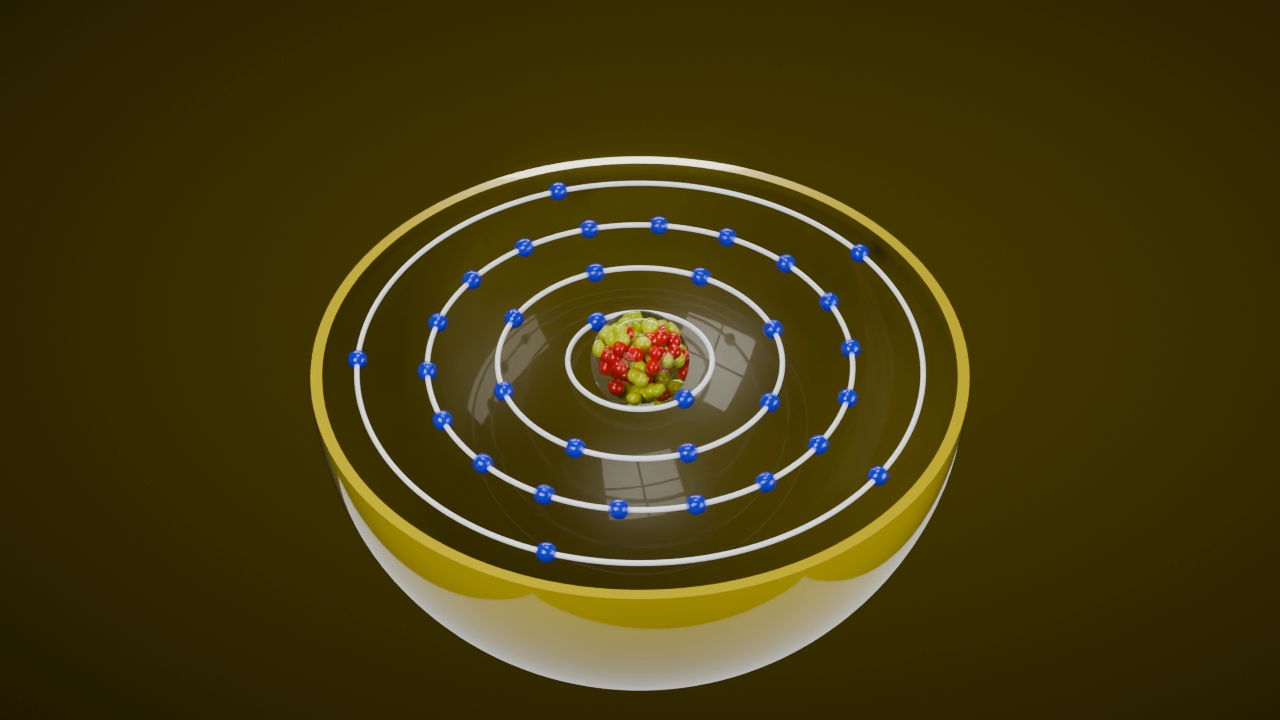
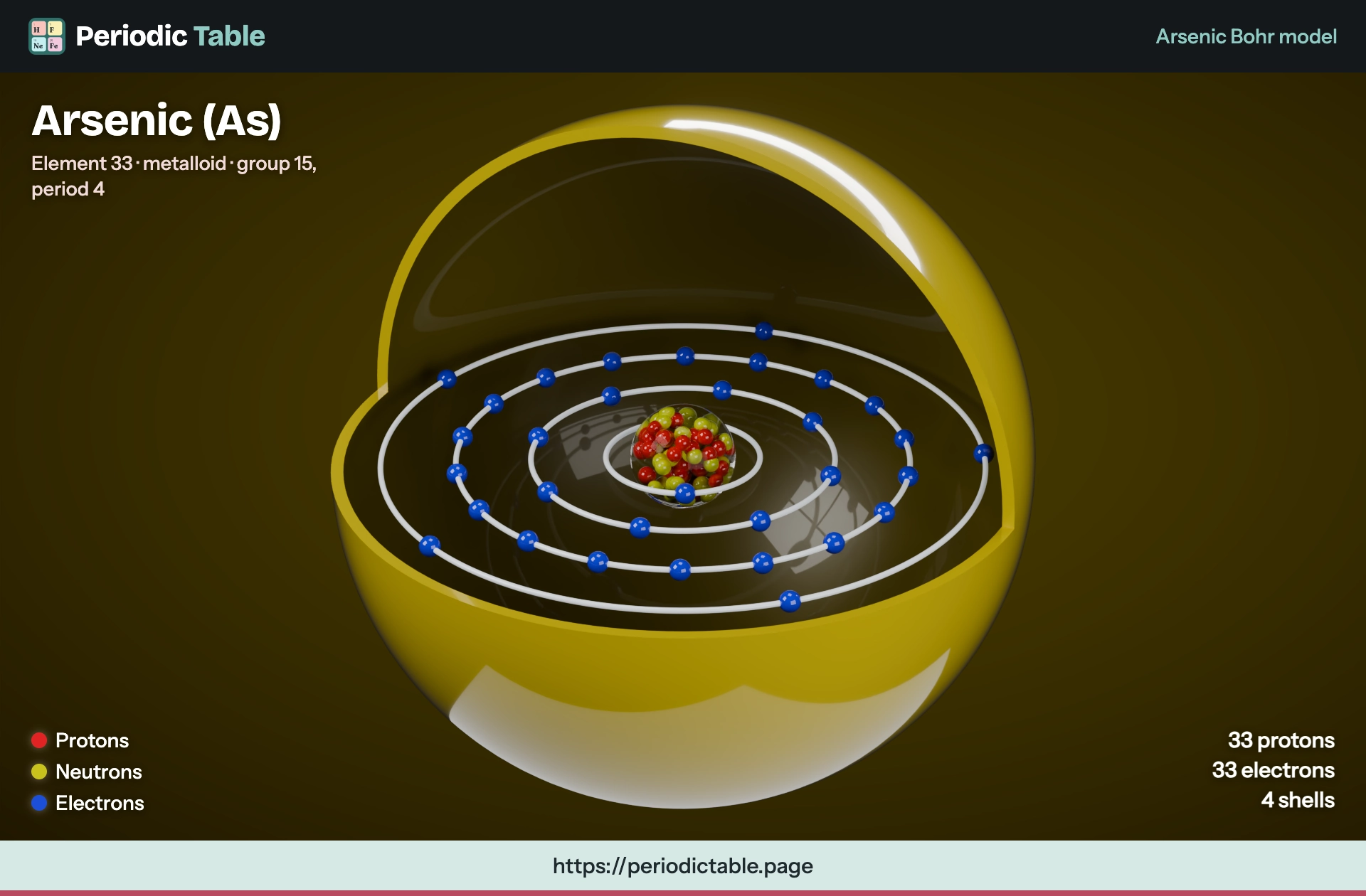
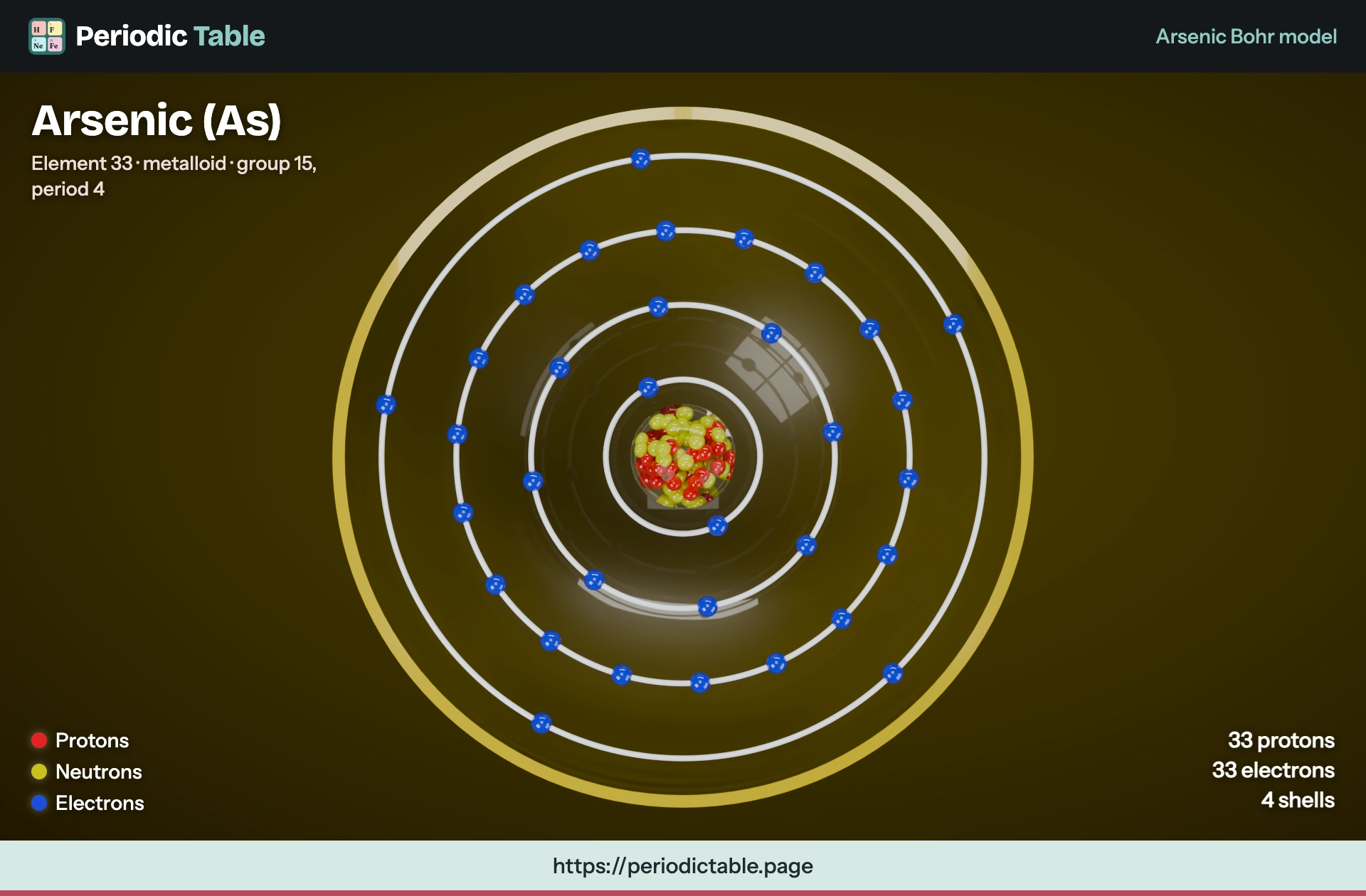
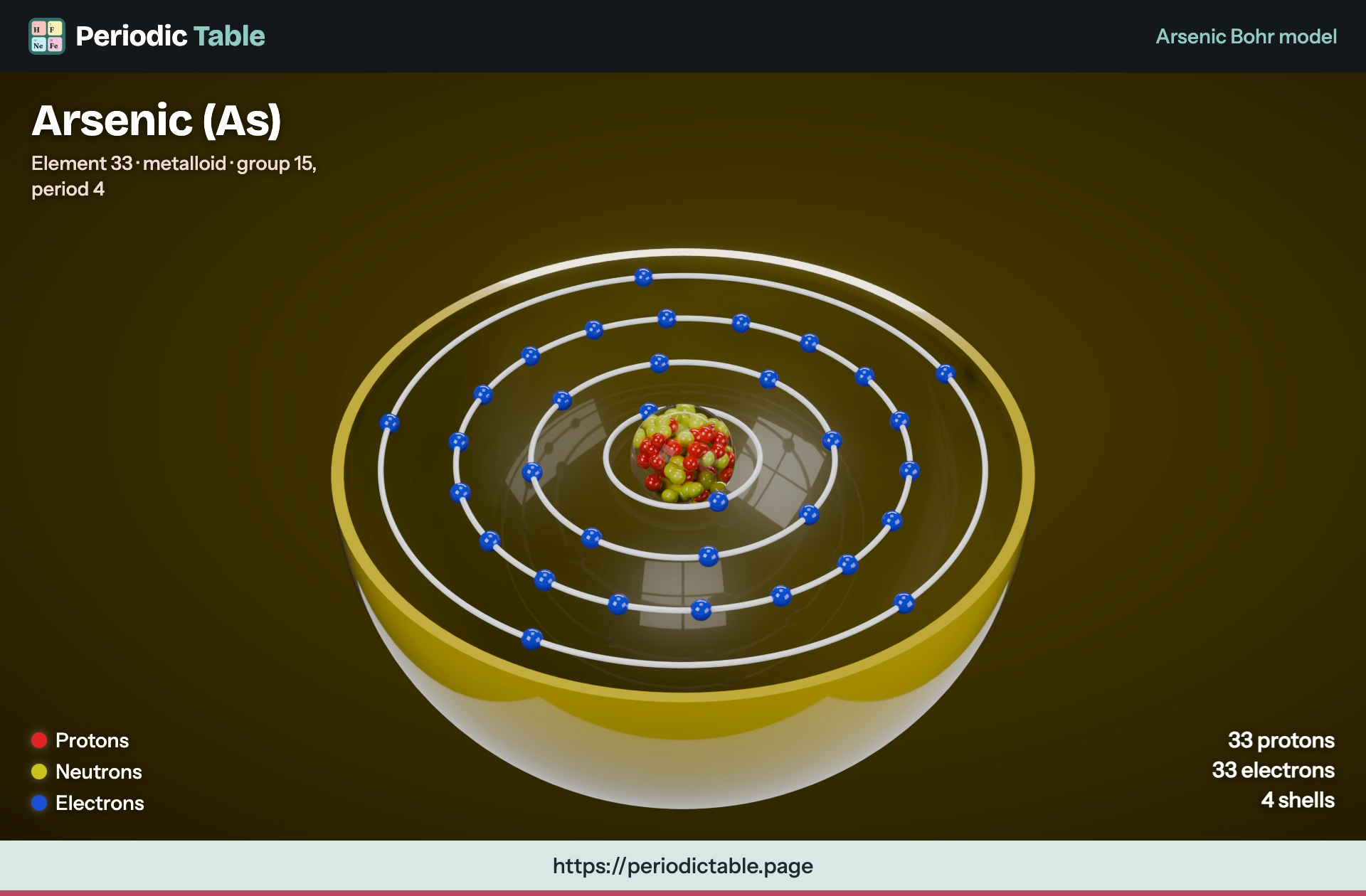
This is a Bohr model of arsenic (As), a simplified picture of a single arsenic atom. Its nucleus holds 33 protons, and a neutral arsenic atom has 33 electrons, arranged around it in 4 shells (2 in shell K, 8 in shell L, 18 in shell M and 5 in shell N).
Arsenic periodic table electron configuration
- Shorthand
- [Ar] 3d10 4s2 4p3
- Full
- 1s2 2s2 2p6 3s2 3p6 4s2 3d10 4p3
- Electrons per shell
- 2, 8, 18, 5
Arsenic element properties and atomic data
- Atomic number
- 33
- Atomic mass
- 74.9216 u
- Phase at STP
- Solid
- Melting point
- 816.85°C (1090 K)
- Boiling point
- Unknown
- Density
- 5.727 g/cm³
- Electronegativity (Pauling)
- 2.18
- Period
- 4
- Group
- 15
- Block
- p-block
- Appearance
- Metallic grey
- Discovery date
- 1250
- Discovered by
- Bronze Age
- Named by
- —
Arsenic element facts at a glance
The arsenic element is a chemical element with the symbol As, and it is the lightest member of its column that behaves as a true metalloid. The fact table below gathers the numbers you will see quoted most often. Values for density and the sublimation temperature differ slightly from source to source, because measurements depend on the allotrope and on how pure the sample is, so treat the last digit as approximate. For superconducting magnets and steel additives, the main topics covered, open the niobium on the periodic table page for the details.
| Property | Value for arsenic |
|---|---|
| Symbol | As |
| Atomic number | 33 |
| Atomic weight | 74.922 |
| Group / period / block | Group 15 (nitrogen group), period 4, p-block |
| Electron configuration | [Ar] 3d10 4s2 4p3 |
| State at 20 °C | Solid (grey arsenic is the stable form) |
| Density (grey arsenic) | about 5.73–5.78 g/cm3 |
| Sublimation point | about 615 °C (887 K) at normal pressure |
| Melting point | about 817 °C, only under pressure (triple point) |
| Electronegativity (Pauling) | 2.18 |
| First ionization energy | about 947 kJ/mol |
| Covalent radius | about 119 pm |
| Common oxidation states | −3, +3, +5 |
| Stable isotope | Arsenic-75 (100% of natural arsenic) |
| Hazard class | Toxic; inorganic arsenic is a carcinogen |
| CAS number | 7440-38-2 |
The covalent radius and atomic radius of arsenic are both close to 119 pm, which is small enough for arsenic to slip into crystal sites normally held by phosphorus. Its electronegativity of 2.18 and its ionization energies (roughly 947, 1,798 and 2,735 kJ/mol for the first three electrons) explain why arsenic shares electrons in covalent bonds instead of giving them up to form simple cations, the way true metals do.
Atomic number, atomic weight and electron configuration
An atomic number of 33 means every arsenic atom holds 33 protons in its nucleus and, when neutral, 33 electrons around it. The atomic weight of 74.922 is almost exactly the mass of arsenic-75, because natural arsenic contains only that one isotope, so a mole of arsenic weighs about 74.9 grams.
The electron configuration [Ar] 3d10 4s2 4p3 places five electrons in the outer shell (2, 8, 18, 5). Those three half-filled 4p orbitals are what make arsenic a p-block element in period 4, and they set up its favourite bonding pattern: three covalent bonds plus a lone pair, or five bonds when it is strongly oxidized.
Group 15: arsenic in the nitrogen group of the periodic table
On the periodic table, arsenic lives in group 15, the nitrogen group, whose members are also called the pnictogens. Reading down the column you meet nitrogen, phosphorus, arsenic, antimony and bismuth. Germanium sits to the left of arsenic and selenium to the right, so arsenic is boxed in by other semiconducting or semi-metallic elements.
The trend down the group runs from nonmetals at the top to metals at the bottom. Nitrogen and phosphorus are nonmetals, antimony and bismuth are increasingly metallic, and arsenic falls in the middle. That middle position is why every pnictogen comparison you read starts with phosphorus: arsenic mimics phosphorus closely enough to fool living cells, a theme that returns in the toxicity section below.
Grey arsenic and the other allotropes
Arsenic exists in several solid forms, or allotropes, and they behave very differently. Grey arsenic (also spelled gray arsenic) is the common, stable form and the only one that matters to industry. Its crystal structure is rhombohedral: atoms are stacked in puckered double layers of six-membered rings, with strong bonds inside each layer and weak forces between them. Half-lives, oxidation states and the 5f orbital are covered in the actinide contraction, along with its synthetic members.
Those weak forces make grey arsenic brittle, with a Mohs hardness of about 3.5, roughly the same as a copper coin. It has a metallic lustre and conducts electricity, so chemists class it as a semimetal; if the ordered layers are disrupted into an amorphous solid, it becomes a semiconductor instead.
Yellow arsenic and black arsenic
Yellow arsenic is made of separate As4 molecules, four atoms arranged in a tetrahedron, just like white phosphorus. It forms when arsenic vapour is chilled rapidly, it is soft and waxy, and it is the least dense (about 2 g/cm3), most volatile and most toxic form. Light quickly converts it back into grey arsenic, so you will rarely see it outside a laboratory.
Black arsenic is a glassy, brittle form with a layered structure similar to black phosphorus. It is a poor electrical conductor and also slowly reverts to the grey form when heated.
Density, sublimation and melting point
The density of grey arsenic, close to 5.75 g/cm3, is high for a metalloid because its atoms pack tightly inside each layer. Heat it in open air and something unusual happens: instead of melting, arsenic sublimes, turning straight from solid to vapour at about 615 °C. That direct sublimation is why many data tables list identical "melting" and "boiling" values for arsenic.
A true melting point appears only under pressure. At the triple point, around 817 °C and roughly 36 atmospheres, solid, liquid and vapour arsenic can coexist. Industrial refiners exploit sublimation to purify the element, collecting the vapour and condensing it as a cleaner solid.
Arsenic chemistry and oxidation states
The chemistry of arsenic looks a lot like that of phosphorus, with one important twist: arsenic in the +5 state is less stable and therefore a stronger oxidizer. The three common oxidation states are:
- −3 in arsenides, alloy-like compounds with metals such as gallium, iron or nickel, and in arsine gas.
- +3 in arsenites and arsenic trioxide, where the lone pair gives the molecule a pyramid shape.
- +5 in arsenates, arsenic acid and most organoarsenic compounds found in nature.
Each oxidation state equals the valence state arsenic adopts when it bonds: in the +3 state it makes three bonds and keeps one lone pair of electrons, while in the +5 state it uses all five outer electrons. Dry arsenic is stable in air, but humid air gives it a golden-bronze tarnish that darkens to black. Heated in air it burns to arsenic trioxide, and the fumes carry a distinctive garlic odor, a clue miners once used to recognise arsenic-bearing rock.
Strong nitric acid converts arsenic to arsenic acid (H3AsO4), dilute nitric acid gives arsenous acid, and the element does not react with water or with non-oxidizing acids. With halogens it forms all of the trihalides (AsF3, AsCl3, AsBr3, AsI3), and with fluorine it also forms arsenic pentafluoride, AsF5, a very strong fluorinating agent. The arsenides it forms with metals are not ionic salts; they behave more like intermetallic alloys.
Isotopes of arsenic
Natural arsenic is monoisotopic: every atom in a rock or a water sample is 75As, the only stable isotope. Scientists have made dozens of radioisotopes in reactors and accelerators, but nearly all of them decay within hours or minutes. The longest-lived is arsenic-73, with a half-life of about 80 days, followed by arsenic-74 at about 18 days.
Arsenic-74 is useful in medicine because it emits positrons, which makes it a tracer for a PET scan. Lighter isotopes decay toward germanium, heavier ones toward selenium, and arsenic-74 is unusual because it decays both ways.
Common arsenic compounds
Most of the arsenic you will ever encounter is not the element itself but one of its compounds. Arsenic compounds fall into two big families: inorganic ones, where arsenic is bonded to oxygen, sulfur, chlorine or metals, and organic ones, where it is bonded to carbon.
In water, the most important inorganic forms are oxyanions. An arsenate ion carries arsenic in the +5 valence state (AsO43−), while an arsenite carries arsenic in the +3 state.
Arsenic acid gives rise to the arsenates; arsenious acid, H3AsO3, gives rise to the arsenites. Arsenate looks so much like phosphate that it shares phosphate's transport routes into cells, while arsenite is generally the more toxic and more mobile of the two.
Arsenic trioxide, arsenic pentoxide and arsine
Arsenic trioxide, As2O3 (often written As4O6), is the most important commercial arsenic compound. It is also called white arsenic or arsenious oxide, and it is the white, almost tasteless powder behind most historical poisonings. Smelters collect it as a by-product, and nearly every other arsenic chemical is made from it.
Arsenic pentoxide, As2O5, forms when an oxidizing agent such as nitric acid acts on arsenic trioxide. It dissolves in water to give arsenic acid and has been used in insecticides, herbicides and wood treatments.
Arsine, AsH3, is a colourless, flammable and highly toxic gas. Despite the danger, the semiconductor industry uses tightly controlled arsine to add arsenic atoms to silicon wafers. The sulfur compounds are just as historic: arsenic trisulfide (orpiment) and the red sulfides of realgar were ground into paint pigments for thousands of years.
Organoarsenic compounds
Organoarsenic compounds contain arsenic bonded to carbon, and they range from harmless to deadly. Cacodyl, an evil-smelling liquid first prepared in the 18th century, was among the first organometallic compounds ever made, and cacodylic acid later became a herbicide.
At the harmless end sits arsenobetaine, the main arsenic species in fish and shellfish, which your body excretes almost unchanged. At the deadly end is lewisite, a blister agent developed as a chemical weapon after World War I.
Where native arsenic occurs in nature
Arsenic is spread thinly but widely through the Earth's crust, at an average of a few parts per million (estimates range from about 1.5 to 5 ppm). Small amounts of native arsenic, the pure element, occur as grey nodules or crusts, but most arsenic is locked into minerals, especially those that also hold copper, gold, lead, cobalt or silver.
Natural processes move it around constantly. Weathering of rocks releases arsenic into soil and rivers, volcanic gases and ash carry it into the air, and geothermal waters and hot springs can carry far more arsenic than ordinary groundwater, sometimes leaving orange, arsenic-rich crusts at the water's edge.
Arsenopyrite, realgar and orpiment
More than 150 arsenic minerals are known, but a handful dominate. Arsenopyrite (FeAsS), also called mispickel, is the most common arsenic mineral and the main ore of the element. Realgar (As4S4) is a bright orange-red sulfide, and orpiment (As2S3) is a golden-yellow one; both were prized as pigments and both slowly crumble in light.
Other arsenic-bearing minerals include loellingite (FeAs2), the copper ore enargite (Cu3AsS4) and the cobalt arsenide skutterudite. Because so many sulfide ores of valuable metals carry arsenic as an impurity, mining is a major route by which arsenic reaches the surface environment.
How arsenic is recovered from ores
Almost nobody mines rock just for its arsenic. Instead, the element is a by-product of smelting other metal ores.
When arsenic-bearing ores are roasted in air, arsenic oxidizes and rises as vapour, and smelters trap it as fine smelter dust rich in arsenic trioxide. Copper smelting is the main source today, and the arsenic content of copper concentrates has been creeping up as miners move into deeper, dirtier ore bodies.
Roasting arsenopyrite without air gives metallic arsenic directly, and further sublimation or distillation produces the high-purity grades used in electronics. World production is concentrated in a few countries, with China and Peru leading supply of arsenic trioxide, while most refining in Europe and the United States has closed over environmental concerns.
History of arsenic, the King of poisons
The history of arsenic is older than chemistry itself. The name traces back through Greek arsenikon and Arabic al-zarnikh to a Persian word for "gold-coloured", a reference to yellow orpiment.
Ancient writers described these sulfides, and the alchemist Zosimos, around 300 AD, roasted realgar to obtain white arsenic. In the Bronze Age, smiths alloyed copper with arsenic to make arsenical bronze, a harder metal that came before tin bronze.
Arabic alchemists described isolating the element before 815 AD, and in Europe Albertus Magnus is often credited with preparing it around 1250 by heating orpiment with soap. The first clearly documented preparation of the free element came in 1649, when the German pharmacist Johann Schroeder heated the oxide with charcoal.
White arsenic's lack of taste and its vague, stomach-bug symptoms made it the ideal poison for centuries. It earned the nicknames the king of poisons and the poison of kings, and in Renaissance Europe it was grimly called inheritance powder. That changed in 1836, when the Marsh test gave forensic chemists a sensitive way to detect arsenic in a body; the simpler Reinsch test followed soon after.
Arsenic's reputation as the perfect poison lasted only as long as nobody could detect it. Once the Marsh test existed, poisoners lost their best weapon.
The 19th century also brought arsenic into homes through colour. Scheele's Green (a copper arsenite, 1775) and Paris Green (copper acetoarsenite, 1814) were brilliant pigments used in paint, fabric, sweets and wallpaper.
In damp rooms, moulds could release volatile arsenic compounds from these pigments, and one theory links Napoleon's death in 1821 to the green wallpaper of his room on Saint Helena. As the dangers became clear, the same arsenic compounds moved from the parlour wall to the orchard as insecticides.
Uses of metallic arsenic and its compounds
Metallic arsenic is consumed in fairly small quantities, but a little goes a long way. Beyond the big uses covered below, arsenic has served as a decolorizer and fining agent in glass, a white opacifier in ceramic glazes, an ingredient in pyrotechnics and bronzing, and a preservative in taxidermy and historical embalming fluids. Many of these uses have faded as safer substitutes appeared.
Alloys, gallium arsenide and semiconductors
The largest single use of arsenic metal is in lead alloys. Adding a fraction of a percent of arsenic hardens the lead grids inside car batteries and cable sheathing, and around 1% arsenic helps molten lead shot form round drops.
Lead-based bearing alloys containing a few percent arsenic resist heat and wear better. In brass, a trace of arsenic blocks dezincification, the slow leaching of zinc that weakens plumbing fittings, so these alloys are standard in wet environments.
Arsenic's most high-tech role is in semiconductors. As an n-type dopant, arsenic adds one extra electron for every atom placed in a silicon lattice, which is how chip makers tune conductivity. Combined with gallium, it forms gallium arsenide (GaAs), a III–V semiconductor that switches faster than silicon and has a direct bandgap, so it can turn electricity straight into light.
That is why GaAs and related arsenides appear in laser diodes, LEDs, solar cells for satellites, high-frequency transistors and integrated circuits in phones and radar, giving arsenic a permanent place in modern electronics. Indium arsenide and aluminium arsenide fill related niches as a dopant partner material.
Pesticides and wood preservative treatments
For most of the 20th century, agriculture was the main market for arsenic. Lead arsenate was sprayed on apple and other fruit orchards, calcium arsenate on cotton, and many other arsenical pesticides, insecticides and herbicides followed. Organic arsenicals such as MSMA (monosodium methyl arsenate) and DSMA later replaced the most toxic lead arsenate sprays, and in the United States their use has since been restricted to cotton.
The biggest modern use was chromated copper arsenate, or CCA, a wood preservative forced into timber under pressure to stop rot, termites and fungi. CCA-treated wood, sold as "pressure-treated" lumber, built decks, fences and playgrounds for decades.
In the United States, manufacturers voluntarily ended CCA for most residential uses at the end of 2003, and the European Union restricted it around the same time, although CCA is still used for industrial poles and pilings. Old CCA structures can leach arsenate into the soil beneath them, and treated scraps should never be burned.
Arsenic also entered the food chain directly as a feed additive. Roxarsone was widely added to poultry feed to promote growth and control parasites, until studies showing inorganic arsenic in chicken meat led to its withdrawal in the United States by 2015.
Medical and military uses
Arsenic has a surprisingly long record in medicine. Fowler's solution, a potassium arsenite tonic, was prescribed for psoriasis, fevers and even leukaemia from the late 1700s.
In 1910 Paul Ehrlich's arsphenamine (Salvarsan) became the first effective treatment for syphilis, until penicillin replaced it. Melarsoprol is still used against late-stage African trypanosomiasis (sleeping sickness), and arsenic trioxide is an approved, highly effective drug for acute promyelocytic leukemia.
The military history is darker. Lewisite and related organoarsenicals were stockpiled for chemical warfare, and during the Vietnam War the herbicide Agent Blue, based on cacodylic acid, was sprayed to destroy rice crops and cover.
Arsenic in drinking water and the environment
For most people today, the arsenic that matters is the arsenic in their water. Arsenic in drinking water is one of the largest chemical contamination problems on the planet, affecting well users in Bangladesh, India, China, Chile, Argentina and parts of the United States. Most of it is natural: arsenic dissolves out of rocks and sediments, so the contamination is invisible, tasteless and odourless.
Concentrations are reported in ppb (parts per billion), which equals micrograms of arsenic per litre of water. The international guideline and the U.S. standard are both 10 ppb. You can turn a test result into a daily dose with a simple product:
$$\text{daily intake}\ (\mu g) = C\ (\mu g/L) \times V\ (L)$$
For example, a household well testing at 14 ppb, with someone drinking 2.3 litres of that water a day, gives \(14 \times 2.3 = 32.2\) micrograms of arsenic per day, which is 1.4 times what water right at the 10 ppb limit would deliver. Private wells are not covered by public water regulations, so testing wells when you buy a home, and again every few years, is the only way to know.
Groundwater, soil and pH
Groundwater is far more likely to carry high arsenic than rivers or lakes, because water sits in contact with minerals for years. Two chemical conditions release it.
In oxygen-poor aquifers, microbes dissolve the iron oxides that hold arsenic on their surfaces, freeing it into the water. In oxygen-rich aquifers with a high pH, arsenate is pushed off mineral surfaces as the surfaces lose their positive charge.
The oxidation state matters here too. At the near-neutral pH of most natural water, arsenate carries a negative charge and sticks to iron, aluminium and manganese oxides in soil and sediment.
Uncharged arsenious acid does not stick as well, so arsenite in groundwater moves more freely and is more likely to end up in your drinking water. Treatment plants therefore often oxidize arsenite to arsenate first, then remove it with iron-based adsorbents, coagulation, ion exchange or reverse osmosis.
Human activity adds to the natural load. Mining waste, smelters, coal-burning power plants, old pesticide orchards and soil around CCA lumber can all raise local arsenic levels, and arsenic can never be destroyed in the environment, only moved or changed from one form to another.
Arsenic in rice, seafood and other foods
Food is usually your largest source of arsenic. Rice stands out because it grows in flooded paddies, where arsenic is mobile and the plant absorbs it along with silicon. Cooking rice in plenty of water and draining the excess, as with pasta, can noticeably reduce its inorganic arsenic.
Seafood often shows the highest total arsenic of any food, but most of it is arsenobetaine, the so-called fish arsenic, which is considered practically non-toxic. Some seaweeds, such as hijiki, are the exception and can contain a lot of inorganic arsenic. Mushrooms, poultry and fruit juices contribute smaller amounts.
Arsenic toxicity and health effects
Arsenic toxicity comes from its talent for impersonation. In the +3 state, arsenic binds tightly to sulfur groups in enzymes, shutting down the reactions cells use to make energy.
In the +5 state, arsenate swaps in for phosphate and sabotages energy-carrying molecules. The health effects depend on the dose, the chemical form and how long exposure lasts, and they range from acute poisoning to cancer decades later.
Inorganic arsenic is a toxin with no safe threshold for cancer risk, and international agencies class it as a group 1 carcinogen, the same category as tobacco smoke, which means there is firm evidence it causes cancer in humans. It also tops priority lists of hazardous substances at contaminated sites.
Inorganic arsenic vs organic arsenic
When you read a test report or a food study, the first question is which form it measured. Inorganic arsenic, the arsenite and arsenate dissolved in water or bound in rice, is the form linked to poisoning and cancer. Organic arsenic compounds vary: arsenobetaine from fish passes through you harmlessly, while some methylated forms are still toxic.
Your liver methylates inorganic arsenic to help clear it, and people with certain genetic variants do this more efficiently than others, which partly explains why two people drinking the same water can show different symptoms.
Symptoms of arsenic poisoning
Acute arsenic poisoning from a large dose looks like severe food poisoning at first:
- Nausea, vomiting, abdominal pain and watery diarrhea, often with a garlic smell on the breath
- Muscle cramps, dehydration and, in severe cases, heart rhythm problems and circulatory collapse
- Later, tingling or numbness in the hands and feet from nerve damage
Chronic exposure, typically years of drinking contaminated water, produces a more distinctive pattern. Darkened patches and hard, corn-like skin lesions on the palms and soles are the hallmark.
Over time the risk climbs for skin cancer, lung cancer and cancers of the bladder, kidney and liver, along with heart disease, diabetes and, in children, effects on development. Treatment for acute poisoning uses chelating drugs such as dimercaprol, but for chronic exposure the most effective step is removing the source.
Testing for arsenic exposure
If you suspect arsenic exposure, a laboratory can measure arsenic in urine, hair, fingernails or blood. Urine reflects the last few days of exposure and is the most reliable test, but a recent seafood meal can inflate the total, so ask for a speciated test that separates fish arsenic from inorganic arsenic.
Hair and nails record exposure over months, which makes them useful for long-term exposure but less precise for low levels. If a result comes back high, test your drinking water before anything else, since it is the most common hidden source. A raised result confirms exposure; on its own it cannot predict whether health effects will follow.
Drinking water limits and workplace rules
Several regulations protect public health from arsenic:
- Drinking water: the EPA set the Maximum Contaminant Level for arsenic in public water at 10 ppb, lowered from 50 ppb, with compliance required from 2006. The World Health Organization uses the same 10 µg/L guideline.
- Workplace air: OSHA sets a permissible exposure limit of 10 µg/m3 of inorganic arsenic, averaged over an 8-hour shift, for smelters, glass works and similar industries.
- Contaminated land: arsenic ranks at the top of the priority list of hazardous substances at Superfund sites, which guides how the EPA cleans up old mines, smelters and wood-treatment plants.
- Food: regulators in several countries now cap inorganic arsenic in rice and rice products for infants.
Biological role of the metalloid in bacteria
Toxic as it is to us, this metalloid is food for some microbes. Certain bacteria breathe arsenate instead of oxygen, reducing it to arsenite to generate energy, and others do the opposite, oxidizing arsenite to arsenate.
One bacterium even runs a form of photosynthesis using arsenite in place of water. These microbes drive much of the arsenic cycling in aquifers and hot springs.
In 2010, researchers claimed that a bacterium called GFAJ-1, from California's arsenic-rich Mono Lake, could build arsenic into its DNA in place of phosphorus. Follow-up studies found that GFAJ-1 still needs phosphate and does not put arsenate into its DNA, and the original paper was eventually retracted. Trace arsenic has been proposed as essential for a few animals such as rats, goats and chickens, but no essential role has been shown in humans.
- Arsenate-respiring bacteria
- Use arsenate as an energy source in oxygen-free sediments, releasing arsenite into groundwater.
- Arsenite-oxidizing bacteria
- Convert arsenite back to the less mobile arsenate, a process water treatment plants try to copy.