


Xenon element (Xe): xenon periodic table facts
Xenon periodic table facts: xenon (Xe) is element 54, a noble gas in group 18, period 5. Pick up a sealed ampoule of xenon (Xe) and it looks empty: the heaviest stable noble gas is colorless, odorless and present in Earth's atmosphere only in trace amounts, yet it lights cinema screens, puts patients to sleep and pushes probes between planets. This guide walks you through the element's atomic data, physical behavior, surprising chemistry, isotopes, production and uses, so you can see why a "lazy" xenon atom turned out to be one of the most useful atoms in modern science. To see how electron capture in potassium-40 builds the radiogenic isotope, check the noble gas argon for details and examples.
Rotate the 3D Bohr model of xenon
Drag to orbit, scroll to zoom.
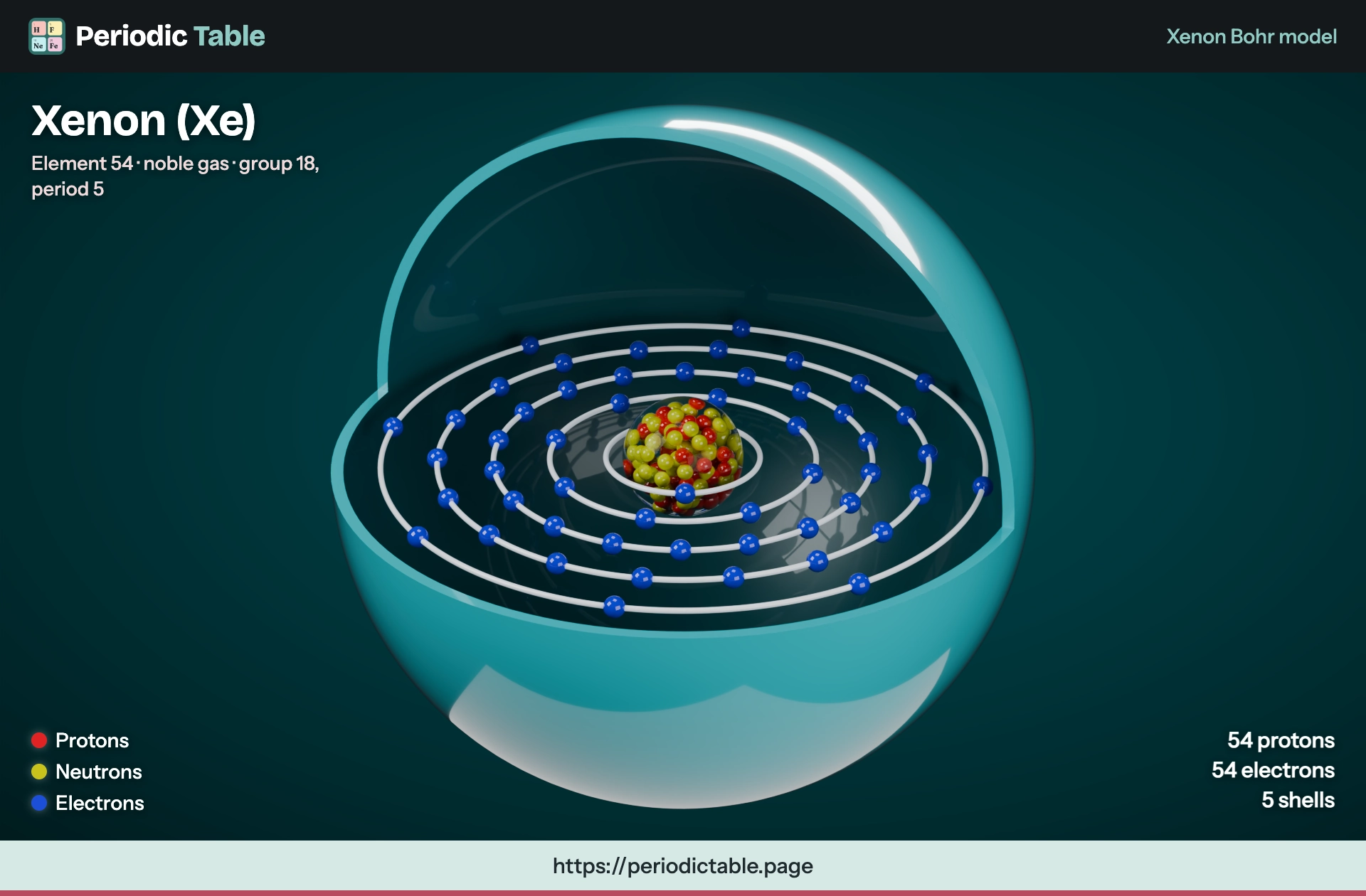
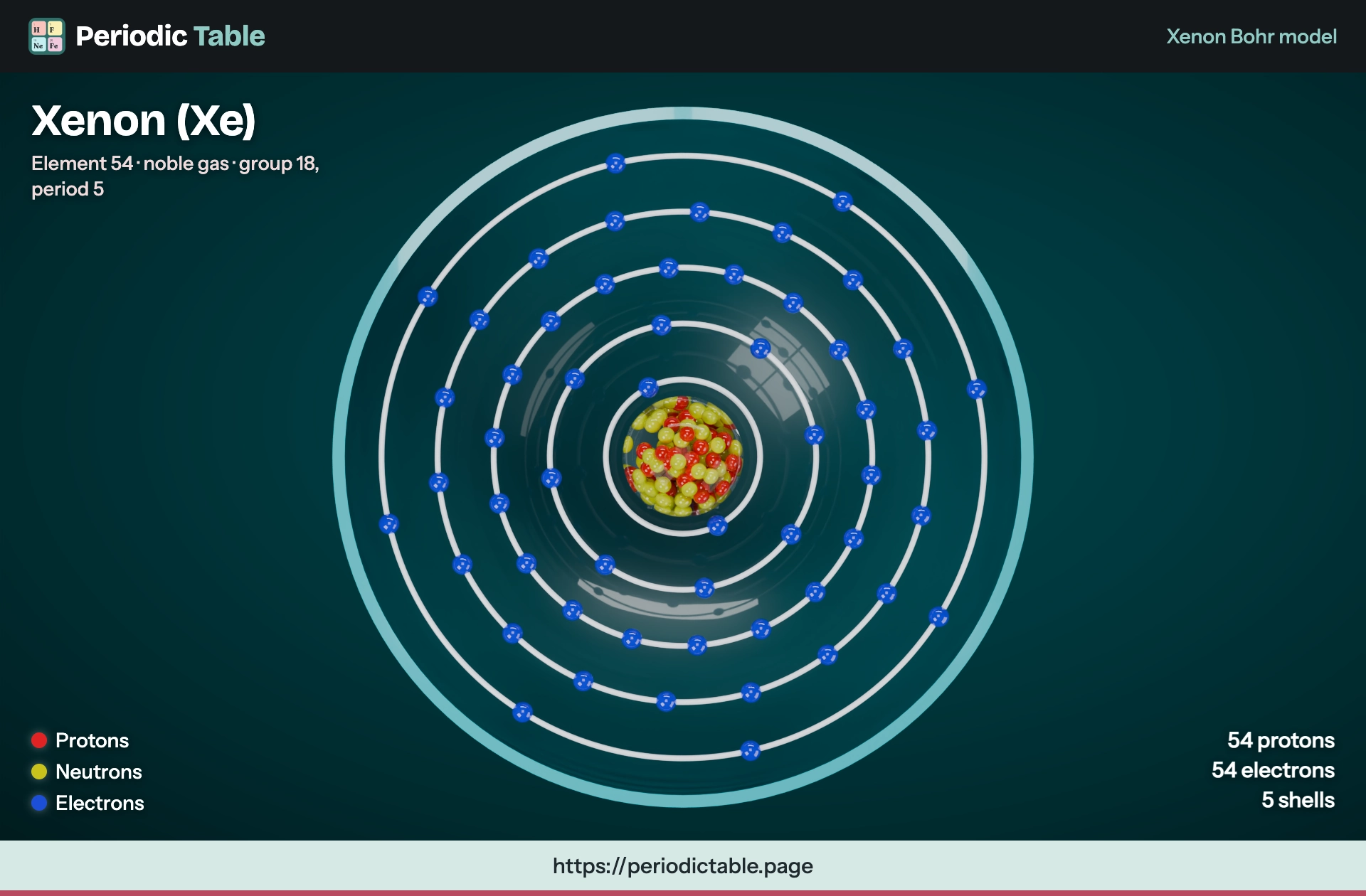
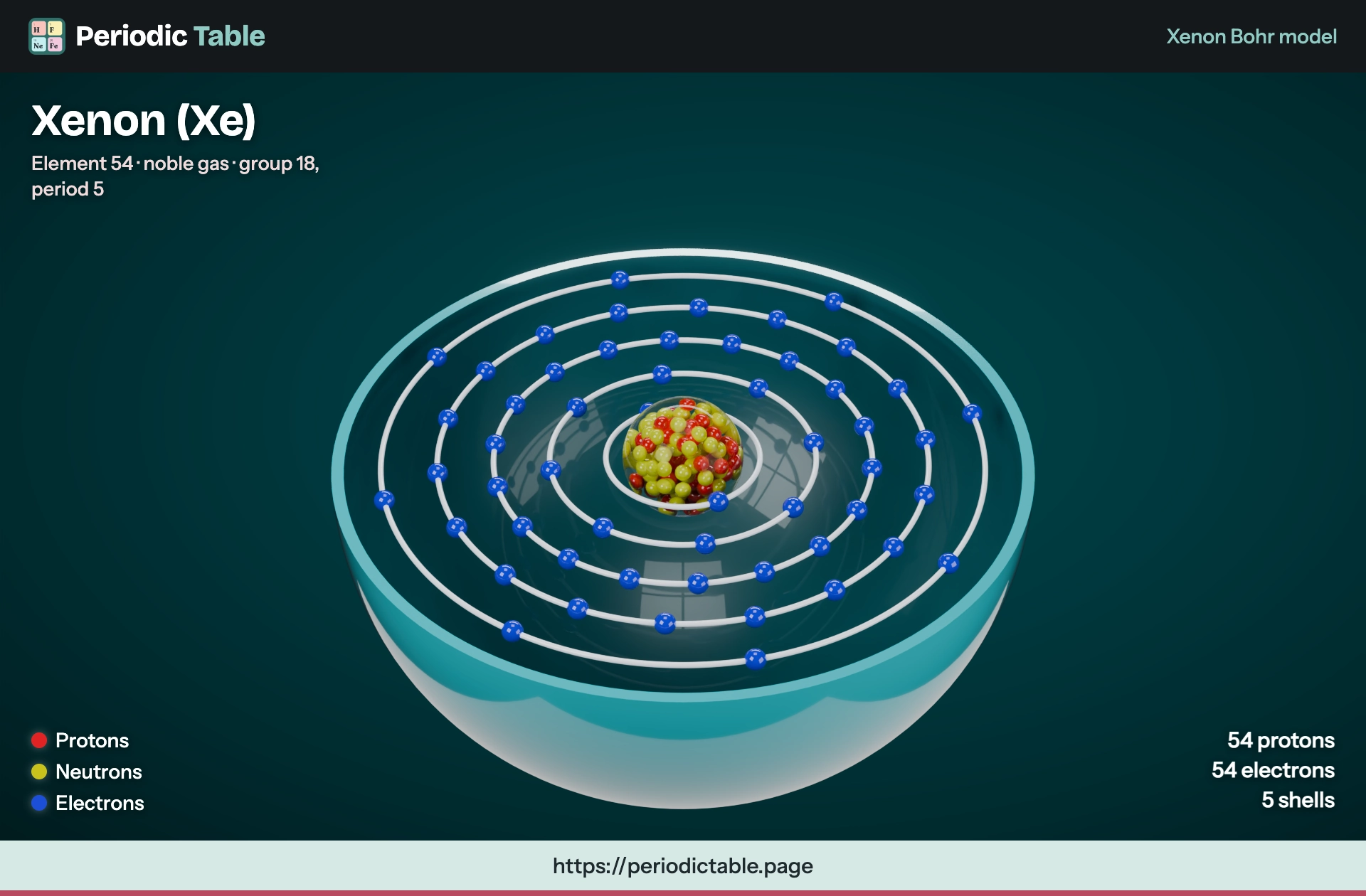
This is a Bohr model of xenon (Xe), a simplified picture of a single xenon atom. Its nucleus holds 54 protons, and a neutral xenon atom has 54 electrons, arranged around it in 5 shells (2 in shell K, 8 in shell L, 18 in shell M, 18 in shell N and 8 in shell O).
Xenon periodic table electron configuration
- Shorthand
- [Kr] 4d10 5s2 5p6
- Full
- 1s2 2s2 2p6 3s2 3p6 4s2 3d10 4p6 5s2 4d10 5p6
- Electrons per shell
- 2, 8, 18, 18, 8
Xenon element properties and atomic data
- Atomic number
- 54
- Atomic mass
- 131.2936 u
- Phase at STP
- Gas
- Melting point
- -111.75°C (161.4 K)
- Boiling point
- -108.1°C (165.051 K)
- Density
- 0.005894 g/cm³
- Electronegativity (Pauling)
- 2.6
- Period
- 5
- Group
- 18
- Block
- p-block
- Appearance
- Colorless gas, exhibiting a blue glow when placed in a high voltage electric field
- Discovery date
- 1898
- Discovered by
- William Ramsay
- Named by
- —
Xenon element facts and its place on the periodic table
The xenon element sits in the last column of the periodic table, directly below krypton and above radon. With atomic number 54, every xenon nucleus carries 54 protons, and the neutral atom balances them with 54 electrons arranged in completely filled shells. A reader of the chemistry of hassium meets isotopes from hassium-265 to 277 and a deformed-nucleus shell effect.
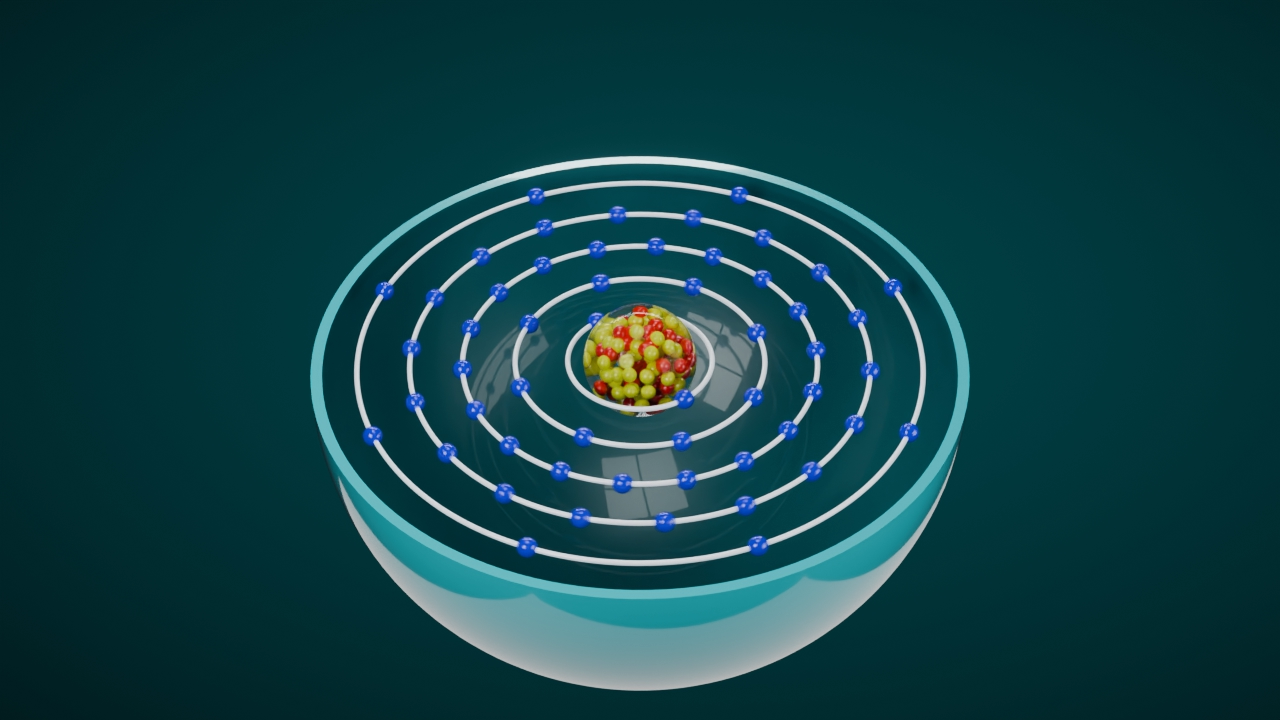
That filled arrangement is why chemists long filed it as an inert gas, and why the few reactions it does undergo were such a shock. The table below collects the reference values you will most often need.
| Property | Value for xenon |
|---|---|
| Symbol | Xe |
| Atomic number | 54 |
| Standard atomic mass | 131.293 u |
| Group / period / block | Group 18 / period 5 / p-block |
| Electron configuration | [Kr] 4d10 5s2 5p6 |
| Phase at STP | Gas (monatomic) |
| Melting point | 161.40 K (−111.75 °C) |
| Boiling point | 165.051 K (−108.099 °C) |
| Density of the gas at STP | 5.894 g/L |
| Triple point | 161.405 K, 81.77 kPa |
| Critical point | 289.733 K, 5.842 MPa |
| Crystal structure (solid) | Face-centered cubic |
| Electronegativity (Pauling scale) | 2.60 |
| First three ionization energies | 1170.4, 2046.4, 3099.4 kJ/mol |
| Van der Waals radius / covalent radius | 216 pm / 140 pm |
| Common oxidation states | +2, +4, +6 (also 0 and +8) |
| CAS number | 7440-63-3 |
Group 18, period 5 and the p-block
Its column is the family of noble gases: helium, neon, argon, krypton, Xe and radon. Being in the fifth row means the outermost shell lies far from the nucleus.
That distance is the whole story of this atom's personality. Its outer cloud is held less tightly than those of its lighter neighbors, so strong oxidizers can pull charge away, which is why xenon forms far more stable compounds than any lighter member of the family.
Atomic mass, atomic weight and electron configuration of xenon (Xe)
The standard atomic weight of xenon, 131.293, is not the mass of any single atom. It is an abundance-weighted average of nine naturally occurring nuclides. You can check this yourself: multiply each isotope's mass by its natural abundance, add the products and divide by 100. Those wondering about Greek mythology in chemistry can read element 61, promethium to see where the name comes from.
Doing that with the abundances in the isotope table further down returns 131.2928, which rounds to the published value. The heaviest contributors are Xe-132 and Xe-129, which together make up more than half of every sample.
The full configuration, 1s2 2s2 2p6 3s2 3p6 4s2 3d10 4p6 5s2 4d10 5p6, ends in a closed valence shell of eight. Each valence electron sits in the 5s or 5p subshell, and none is unpaired. That is the textbook reason noble gases rarely bond, and the atom's Van der Waals radius of 216 pm tells you how large and soft its electron cloud is.
Ionization energies and electronegativity
The first ionization energy, 1170.4 kJ/mol, is the key number. It is almost exactly the energy needed to ionize an O2 molecule (about 1165 kJ/mol), a coincidence that guided the first synthesis of a noble-gas compound.
On the Pauling scale Xe scores 2.60, slightly above carbon, so in its compounds it behaves as the less electronegative partner. Removing a second and third electron costs progressively more, which is why only the most aggressive oxidizers can push it to high positive charges.
Physical properties of xenon
At room conditions xenon gas is transparent and gives no hint of its presence. Pass an electrical discharge through a sealed discharge tube filled with it, however, and you get a vivid blue glow, sometimes described as lavender.
The spectrum contains lines across the visible range, but the strongest fall in the blue, which sets the color. This is the same effect Ramsay and Travers saw in their first vacuum tube sample.
A practical way to feel how heavy xenon atoms are is to compare a balloon of it with ordinary air. Air weighs about 1.29 g/L at 0 °C, so a litre of xenon is roughly 4.6 times heavier. A balloon filled with it drops like a stone, and it pours out of an open beaker the way water would, pooling at the bottom of any container.
Boiling point, melting point and density
You can predict the gas's weight per litre from the ideal gas law. Rearranging \(PV = nRT\) with the molar mass gives:
$$\rho = \frac{P \times M}{R \times T}$$
Plug in standard pressure (101,325 Pa), M = 0.131293 kg/mol, R = 8.314 J/(mol·K) and T = 273.15 K and you get 5.858 g/L. The measured value is 5.894 g/L, about 0.6% higher, because a big, polarizable atom attracts its neighbors more than an ideal gas assumes.
Warm the same sample to a room temperature of 20 °C and the ideal estimate falls to 5.458 g/L. Note also how narrow the liquid range is at one atmosphere: only about 3.65 K separates freezing from boiling.
Liquid xenon, solid xenon and metallic xenon
Liquid xenon reaches about 3.1 g/cm3 near its triple point and is an unusually good solvent; its large, polarizable electron clouds help it dissolve hydrocarbons and even biological molecules. Cool it further and solid xenon forms a face-centered lattice at about 3.64 g/cm3, denser than granite.
Squeeze that solid to a pressure of around 140 GPa and it begins to conduct; by about 155 GPa it is fully metallic xenon, a sky-blue, poorly conducting semimetal that absorbs red light. Few substances in materials science show such a dramatic change from insulator to metal.
Chemical behavior of xenon among the noble gases
For decades every chemistry textbook described the group as completely unreactive, and xenon still ignores most everyday reactions: it does not burn, corrode or combine with water. A full valence shell gives it a stable arrangement with nothing to gain from sharing.
Yet its large size changes the picture. Fluorine, the strongest oxidizing agent among the elements, can oxidize it, and once bonded to fluorine the atom can be passed on to oxygen, carbon, nitrogen and even gold.
A useful rule of thumb from inorganic chemistry is that xenon behaves like its neighbor iodine in the next-lower oxidation state. That analogy predicts the shape and reactivity of many of its compounds before you ever run an experiment.
Oxidation states of xenon
- +2 in the difluoride, the easiest compound to make.
- +4 in the tetrafluoride and the dioxide.
- +6 in the hexafluoride, the trioxide and xenate salts.
- +8 in the tetroxide and in sodium perxenate, Na4XeO6, a perxenate salt used as a powerful oxidizer in analytical chemistry.
- 0 in a few exotic species where the atom acts as a ligand, such as the tetraxenonogold(II) cation.
Discovery and history of xenon
The discovery came on 12 July 1898 in London. William Ramsay and his student Morris Travers had just found krypton and neon by boiling off liquefied air, and they kept fractionating the heavier residues. A late-evening bubble left in their pump, rather than being thrown away, produced a spectrum with unfamiliar blue lines in the spectroscope.
Ramsay named the newcomer from the Greek xenos, meaning foreign, stranger or guest. By 1898 standards it was the hardest of the atmospheric gases to collect, and it took months to gather enough to weigh.
The twentieth century turned the "stranger" into a working material for science and engineering:
- 1930s: Harold Edgerton used it in the strobe tube, freezing bullets and hummingbird wings in high-speed photography.
- 1939-1951: research on divers led to the first surgical use of xenon as an anesthetic in 1951.
- 1962: the first true compound was made (below).
- 1989: IBM researchers used a scanning tunneling microscope to place 35 xenon atoms on a chilled nickel crystal, spelling the company's initials and positioning individual atoms for the first time.
Neil Bartlett and the 1962 noble gas breakthrough
At the University of British Columbia, Neil Bartlett noticed that platinum hexafluoride could oxidize O2. Because xenon's first ionization energy is almost identical, he mixed the two gases in March 1962 and obtained an orange-yellow solid, xenon hexafluoroplatinate.
Within months other groups had made simple fluorides, and the idea that the group was chemically dead was gone. By the early 1970s more than 80 compounds were known.
Xenon compounds
Almost all xenon compounds contain fluorine or oxygen bonded directly to the noble atom. They are prepared in specialized laboratory setups using metal vessels, because the fluorides attack glass when moisture is present. Below are the families you will meet most often.
Xenon fluorides and oxides
The three xenon fluorides are the starting point for nearly all of this chemistry:
- Xenon difluoride (XeF2): colorless crystals formed when a mix of the two gases is exposed to ultraviolet light, even ordinary sunlight.
- Xenon tetrafluoride (XeF4): a square-planar molecule, made pure by heating the hexafluoride with sodium fluoride.
- Xenon hexafluoride (XeF6): made by long heating over a metal fluoride catalyst; it donates and accepts fluoride ions to form salts.
Hydrolysis of the hexafluoride gives xenon trioxide (XeO3), a weak acid in water and a dangerous contact explosive when dry. Treating a barium salt of the +8 state with sulfuric acid releases xenon tetroxide (XeO4), a pale-yellow solid that explodes above about −36 °C. The dioxide, reported only in 2011, may even substitute for silicon in some minerals.
Clathrates, excimers and unusual bonds
Not every xenon "compound" involves a true bond. In clathrates, atoms sit trapped inside another crystal's cage.
Xenon hydrate is the classic example, a clathrate of water ice that melts at about 24 °C. A single atom can also be locked inside a fullerene, where it acts as a sensitive magnetic probe of the carbon cage's chemistry.
When two excited atoms meet they form a short-lived excimer, Xe2*, which falls apart within a few nanoseconds and emits ultraviolet light near 172 nm. More exotic still are compounds with xenon bonded to carbon, nitrogen and boron, and the AuXe42+ ion in which xenon bonds to gold, two famously unreactive partners joined together.
Xenon isotopes
Natural xenon is a mixture of nine isotopes, more than any other entry in the table except tin. Seven are stable isotopes; two, Xe-124 and Xe-136, are radioactive but so long-lived that they count as effectively stable.
Over 40 short-lived ones have been made artificially. Here is the natural mix:
| Isotope | Natural abundance (%) | Half-life / decay |
|---|---|---|
| Xe-124 | 0.095 | 1.1 × 10²² years, double electron capture |
| Xe-126 | 0.089 | Stable |
| Xe-128 | 1.910 | Stable |
| Xe-129 | 26.401 | Stable |
| Xe-130 | 4.071 | Stable |
| Xe-131 | 21.232 | Stable |
| Xe-132 | 26.909 | Stable (most abundant) |
| Xe-134 | 10.436 | Stable |
| Xe-136 | 8.857 | 2.18 × 10²¹ years, double beta decay |
Xe-132 is the most common isotope, which is why xenon-132 is the "key isotope" in most data sheets, while xenon-136 is studied in giant detectors searching for neutrinoless decay. Xe-129 is special for another reason: it builds up from the beta decay of iodine-129, so its excess in rocks acts as a clock.
Nuclear spin and hyperpolarized xenon-129
Nuclei with an odd mass number, Xe-129 and Xe-131, have a non-zero nuclear spin. Shine circularly polarized laser light through rubidium vapor mixed with the gas and the spins can be aligned far beyond normal, a process called optical pumping. The resulting hyperpolarization can exceed half the maximum possible, compared with roughly 0.001% in an ordinary magnet, and because xenon-129 has spin 1/2 it can hold that state for hours as a gas and days when frozen.
Xenon-135 as a neutron absorber in nuclear reactors
Fission of uranium produces iodine-135, which decays to xenon-135, the strongest neutron absorber known, with a capture cross section of about 2.6 million barns. In steady operation the reactor burns it off as fast as it forms. Cut the power, though, and the iodine keeps decaying while fewer neutrons destroy the product, so this neutron poison builds up and can stop a restart for many hours.
Operators call the effect xenon poisoning or the "iodine pit", and mishandling it was one of the factors behind the Chernobyl accident. Using its 9.14-hour half-life, you can work out that about 16% of a given batch of Xe-135 is still present a full day after it forms.
Stable isotopes also appear in quantity among fission products: spent fuel holds a higher share of them than air does, although nobody yet recovers them commercially. Nuclear fission is therefore both a source of the gas and one of its biggest headaches.
Radioactive xenon, meteorites and nuclear test monitoring
Because the iodine-to-xenon decay is a reliable clock, isotope ratios in meteorites date events from the birth of the Solar System; an excess of Xe-129 showed that a supernova seeded our solar nebula shortly before the planets formed. Mars, by the same logic, appears to have lost much of its early atmosphere.
Closer to home, radioactive xenon such as xenon-133 escapes from underground blasts, and monitoring stations use it to confirm nuclear explosions and enforce the test ban. Because half of it decays every 5.25 days, the clock is short: three weeks after an event only about 6% of the original Xe-133 remains.
Where the trace gas xenon occurs
Xenon is the rarest stable member of its family in air, at about 87 parts per billion by volume, or 0.087 ppm. To put that in a room you know: a bedroom of 3.6 m × 4.2 m × 2.7 m holds about 40.8 m3 of air, which contains only 3.6 mL of xenon, roughly 21 mg. It also bubbles out of some mineral springs.
Across the solar system it is rare in the Sun and on Earth, yet Jupiter's atmosphere holds about 2.6 times the solar share, a puzzle that points to icy building blocks trapping it early. Ordinary stars cannot make it by fusion; it forms in supernova explosions and by slow neutron capture in red giant stars.
The missing Xe problem
Measured against argon and krypton, our atmosphere holds far less of it than geochemists expect. Proposed explanations for this missing Xe problem include xenon locked into quartz and silica, bonded to iron oxides deep in the mantle, or alloyed with metals in the core. None has yet been confirmed.
How xenon is made by fractional distillation of liquid air
There are no xenon mines. It is a by-product of the large plants that separate air into oxygen and nitrogen for industry. Production follows a clear sequence:
- Air is compressed, cooled and liquefied, then separated by fractional distillation in a double column.
- Being the least volatile component, the heavy noble gases collect in the liquid oxygen at the bottom.
- Further distillation enriches that stream into a krypton/xenon mixture of a few tenths of a percent.
- The mixture is pulled out by adsorption on silica gel or more distillation, then split into its two gases and purified.
Because a plant must process enormous volumes of air to collect a few litres, scarcity drives the economics. World output is only tens of tonnes a year, so xenon gas is far more expensive than argon, and its price swings sharply when demand from chip makers or satellite builders rises.
Uses and applications of xenon gas
Rare and costly as it is, xenon earns its place wherever its weight, inertness or light output can't be matched. The main uses fall into five groups, and almost every one depends on a property described above. These applications make the gas a quiet part of everyday technology.
Flash lamps, arc lamps and lasers
Xenon flash lamps produce intense microsecond bursts of white light for camera flashes and stroboscopes, and they pumped the first solid-state laser in 1960. Continuous xenon arc lamps have a color temperature close to noon daylight, so they replaced carbon arcs in movie projectors and still light many IMAX and digital screens, as well as solar simulators.
It also starts the HID headlights on many cars, fills each cell of older plasma display panels, and helps metal halide and sodium street lights strike quickly. In lasers, Bell Laboratories first saw lasing in it soon after, and the excimer laser built on Xe2 was the first of its kind; xenon chloride excimer devices are now used in some skin treatments.
Medical imaging and xenon as an anesthetic
Breathed at about 70% with oxygen, xenon is a fast, clean general anesthetic. It blocks the NMDA receptor, yet unlike nitrous oxide it is not neurotoxic and is even neuroprotective, and it is not a greenhouse gas. Animal and early clinical work on neuroprotection after birth asphyxia is one reason xenon anesthesia keeps attracting interest despite its cost.
In nuclear medicine, the radioisotope Xe-133 maps blood flow in the brain and lungs, while hyperpolarized Xe-129 serves as a contrast agent for MRI. Unlike conventional magnetic resonance imaging, which sees only water and fat, this shows where each breath actually goes, so doctors can watch ventilation in real time.
Ion propulsion for spacecraft
Electric thrusters ionize the propellant and fire the ions out at tens of kilometres per second. A heavy, easily ionized, chemically quiet atom is ideal, and xenon is the standard choice for ion propulsion.
Each xenon ion carries a lot of momentum, and the propellant is stored as a dense supercritical fluid without corroding the ion engine. Ion thrusters running on it propelled NASA's Deep Space 1 and Dawn spacecraft and ESA's SMART-1, and they hold thousands of communication satellites in position today.
NMR, dark matter detectors and chip etching
Because the atom's big electron cloud responds to its surroundings, xenon NMR can tell whether the atom sits in water, in a solvent or bound to a protein. In particle physics, tonnes of the liquid fill detectors hunting for dark matter particles called WIMPs; its weight makes collisions more likely and its outer layer shields the detector's inner volume from background radiation.
It has also filled bubble chambers and calorimeters for gamma rays. In industry, the difluoride is a dry etchant for silicon in MEMS manufacturing and a fluorinating agent in making the cancer drug 5-fluorouracil, and research into xenon physics keeps finding new roles.
Xenon doping in sport and mountaineering
Inhaling it can raise erythropoietin, the hormone that drives red blood cell production, so it has been used as a doping method. WADA banned it in 2014, though studies have not shown a real performance benefit. In 2025 a British team cited xenon inhalation for a one-week Everest ascent, a claim climbing bodies rejected as unproven and potentially dangerous.
Xenon safety and handling precautions
Xenon is non-toxic and is stored safely in sealed metal or glass cylinders, though it slowly leaks through rubber and plastic seals. The real hazards come from its weight and its effect on the brain.
Like carbon dioxide, it can collect unseen in a pit or tank and displace the air you need, making it a simple asphyxiant. At high concentration it also dissolves into the blood, crosses into the brain and causes anesthesia, more potently than nitrous oxide does, so it is never safe to inhale for fun.
Speaking after a breath of it lowers the voice, the opposite of the helium trick, because sound travels slowly in such a heavy medium. You can estimate the speed from the formula for a monatomic ideal gas, \(v = \sqrt{\gamma RT/M}\) with \(\gamma = 5/3\), which gives about 170 m/s at 0 °C, roughly half the value in air.
Because the demonstration risks sudden unconsciousness, many teachers swap in sulfur hexafluoride, which is similar in weight but does not sedate. Any dense breathing mixture should contain at least 20% oxygen if someone may breathe it.