


Promethium element (Pm): promethium periodic table facts
Promethium periodic table facts: promethium (Pm) is element 61, a lanthanide in period 6 of the f-block. Look for promethium in a rock and you will almost never find it: only a few hundred grams of element 61 exist in Earth's crust at any moment, because every one of its isotopes falls apart within years. Chemistry readers can use the discovery of argon to see why the atmosphere holds about 0.934% of it.
Sitting between neodymium and samarium, it is the rare earth metal chemists predicted long before anyone could hold it, and the one lanthanide with no stable form at all. Here you get its properties, compounds, isotopes, history, uses and the precautions it demands.
Rotate the 3D Bohr model of promethium
Drag to orbit, scroll to zoom.
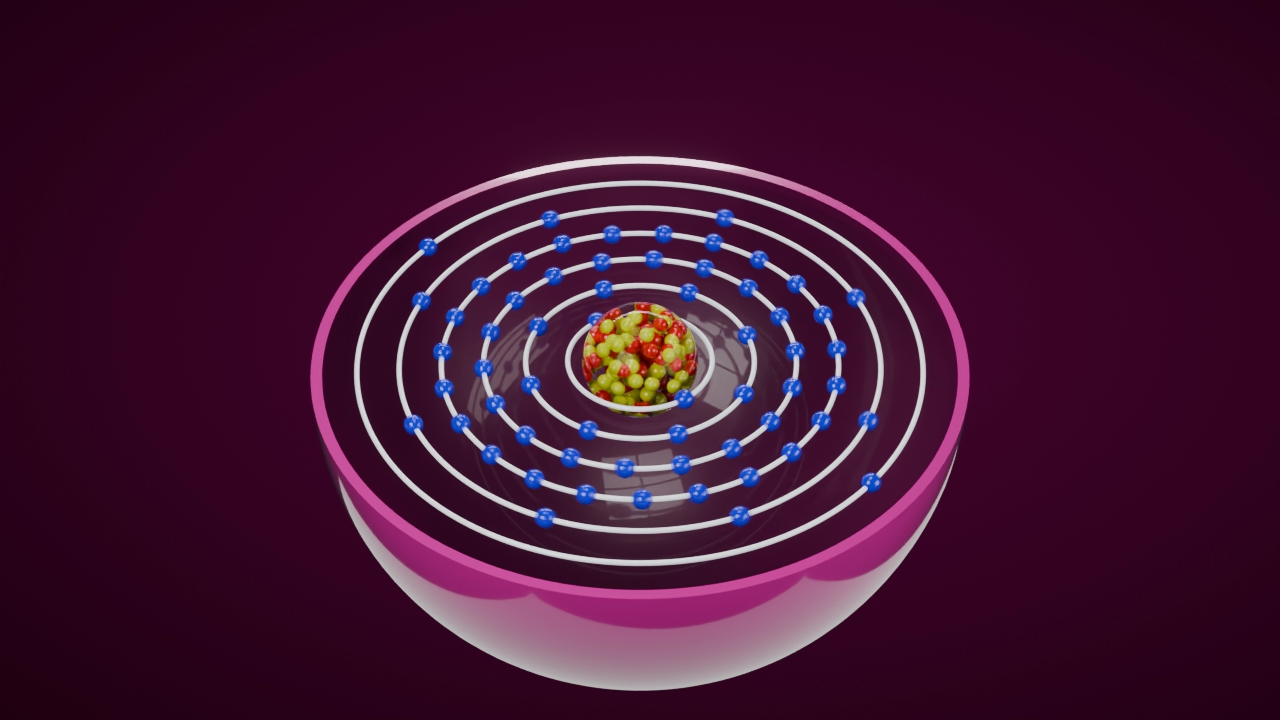
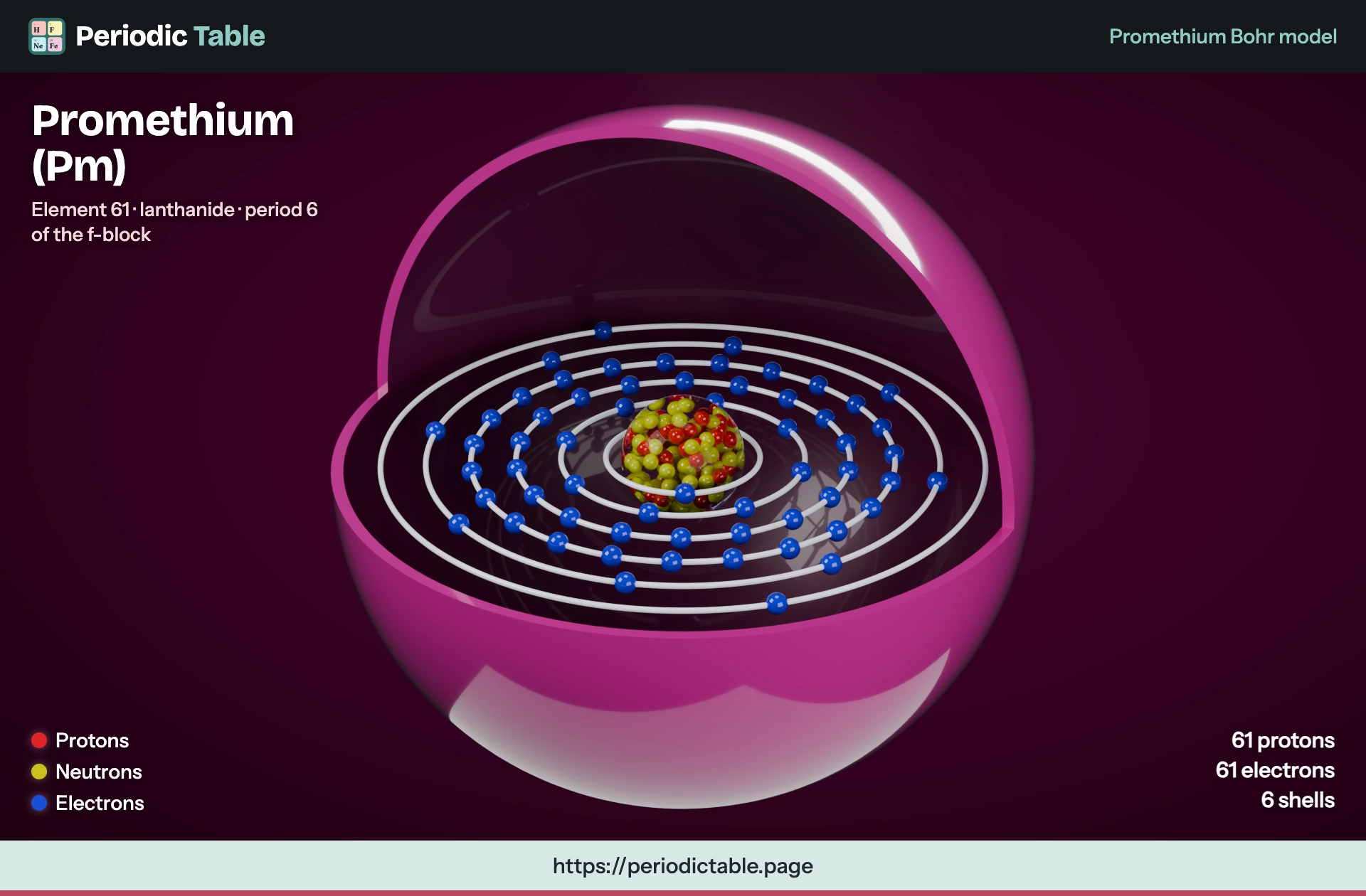
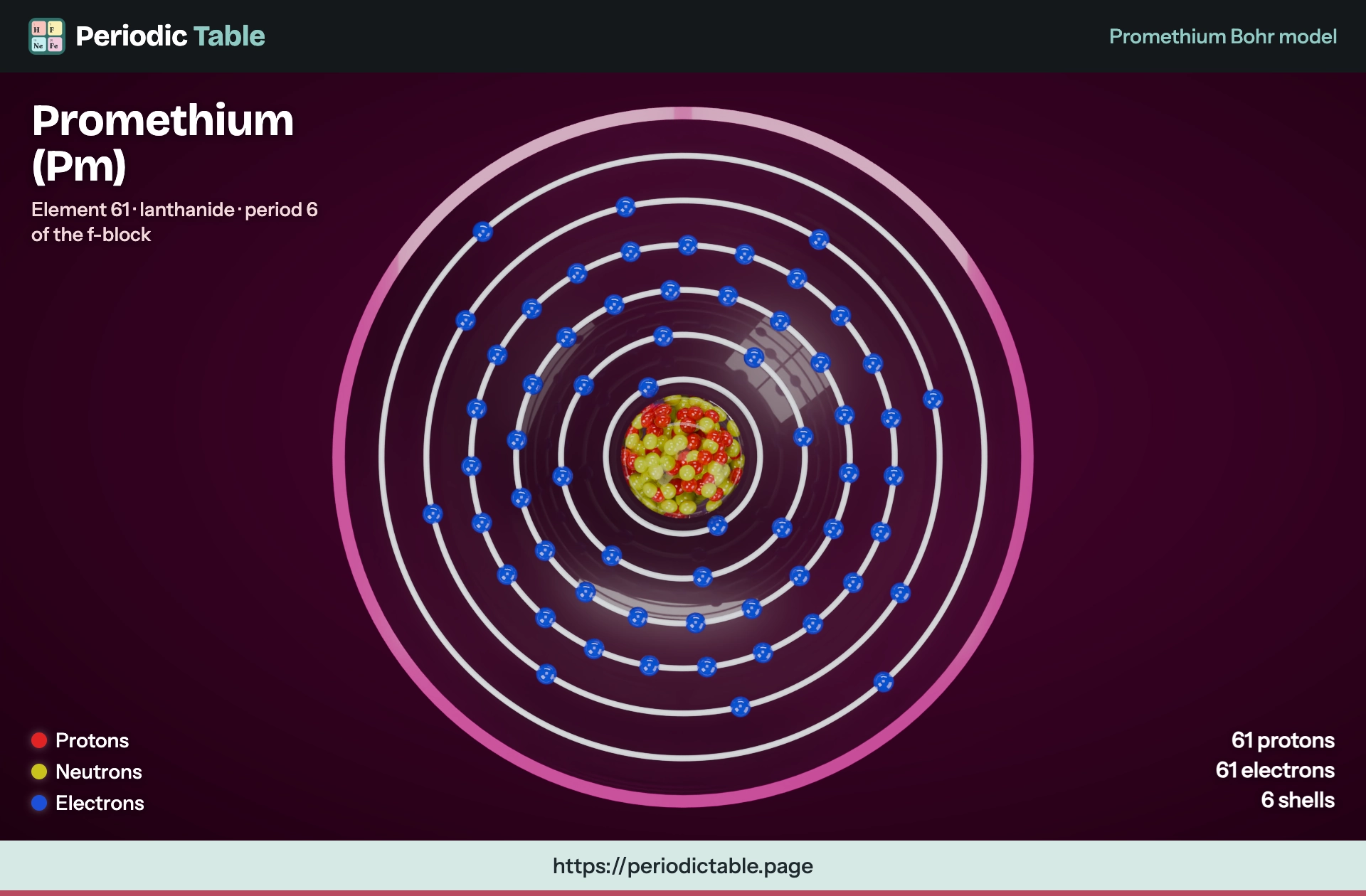
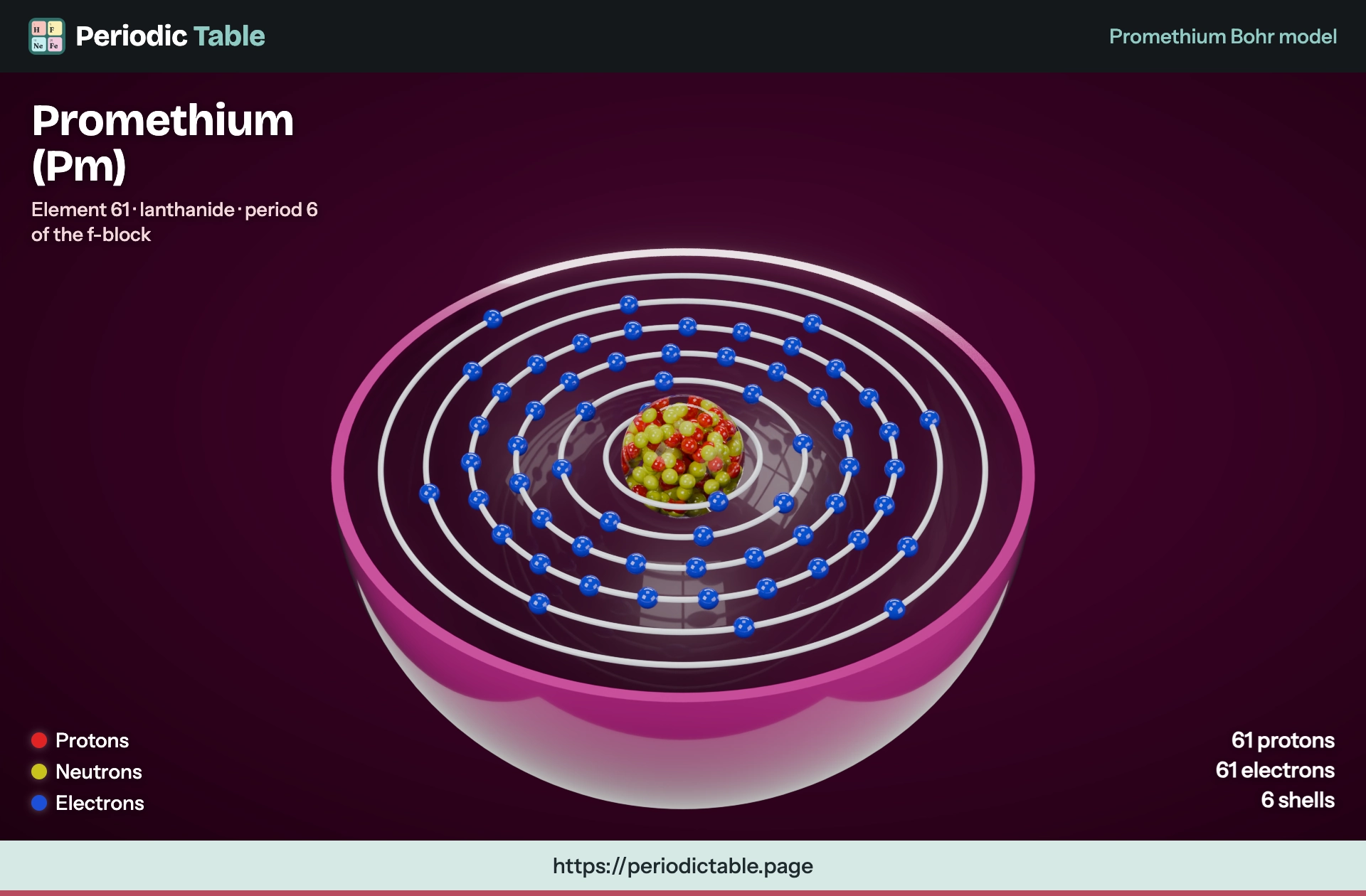
This is a Bohr model of promethium (Pm), a simplified picture of a single promethium atom. Its nucleus holds 61 protons, and a neutral promethium atom has 61 electrons, arranged around it in 6 shells (2 in shell K, 8 in shell L, 18 in shell M, 23 in shell N, 8 in shell O and 2 in shell P).
Promethium periodic table electron configuration
- Shorthand
- [Xe] 4f5 6s2
- Full
- 1s2 2s2 2p6 3s2 3p6 4s2 3d10 4p6 5s2 4d10 5p6 6s2 4f5
- Electrons per shell
- 2, 8, 18, 23, 8, 2
Promethium element properties and atomic data
- Atomic number
- 61
- Atomic mass
- [145] u
- Phase at STP
- Solid
- Melting point
- 1041.85°C (1315 K)
- Boiling point
- 2999.85°C (3273 K)
- Density
- 7.26 g/cm³
- Electronegativity (Pauling)
- 1.13
- Period
- 6
- Group
- —
- Block
- f-block
- Appearance
- Metallic
- Discovery date
- 1945
- Discovered by
- Chien Shiung Wu
- Named by
- Isotopes of promethium
Promethium element at a glance: Pm, atomic number 61
The promethium element carries the symbol Pm and sits at atomic number 61, which means every atom holds 61 protons in its nucleus. It is a chemical element made almost entirely by people today: the synthetic promethium used in labs comes out of reactors, not mines. In pure form it is a silvery, metallic solid, although you will rarely see a clean surface, because its own radiation and quick oxidation dull it. On the discovery side, William Ramsay and Morris Travers, who found the gas in 1898, feature in the story behind the xenon boiling point entry and its history.
| Property | Value |
|---|---|
| Symbol | Pm |
| Atomic number | 61 |
| Atomic mass | [145] (mass number of the longest-lived isotope) |
| Series and block | Lanthanides, f-block, period 6 |
| State at 20 °C | Solid |
| Melting point | 1042 °C (1315 K) |
| Boiling point | 3000 °C (3273 K) |
| Density | 7.26 g/cm³ |
| Electron configuration | [Xe] 4f5 6s2 |
| CAS number | 7440-12-2 |
Where element 61 sits on the periodic table: lanthanides, F-block, period 6
On the periodic table, promethium belongs to the lanthanide series, the run of fifteen metals from lanthanum (57) to lutetium (71) that is usually printed as a separate row beneath the main grid. Together with the actinides, these are the inner transition elements, filling the 4f subshell one electron at a time. Chemists also group promethium with the rare earth elements, though its scarcity comes from radioactivity rather than from geology.
Properties of promethium
Most properties of promethium fall neatly between those of its two neighbors, which is exactly why its absence was noticed in the first place. The subsections below cover the physical form, its atomic data and its key temperatures; where values are estimates rather than measurements, that is because so little of it has ever been made for chemistry work. To connect ore, energy and industry, readers can use tellurium isotopes to see how electricity and compounds tie together.
Physical properties and crystal structure of promethium metal
Solid promethium metal packs in a double hexagonal close-packed (dhcp) lattice at room temperature, the same arrangement several light lanthanides share. Heat it past roughly 890 °C and the alpha form converts to a body-centered cubic beta phase. It is paramagnetic, lustrous when freshly prepared and a fair conductor of heat and electricity, like most metals in its row.
Its atomic radius (about 183 pm, empirical) is slightly larger than its neighbors', an exception to the lanthanide contraction, the steady shrinking of atoms across the series as nuclear charge grows. The covalent radius is listed at around 199 pm.
Electron configuration, oxidation state and ionization energies
The neutral atom has 61 electrons arranged as [Xe] 4f5 6s2, giving seven valence electrons in the 4f and 6s subshells. When promethium forms compounds it gives up both 6s electrons and one 4f electron, so its usual oxidation state is +3; a +2 state has also been observed in molten salts.
- First three ionization energies: roughly 540, 1050 and 2150 kJ/mol
- Electronegativity: about 1.13 on the Pauling scale (some tables list it as unknown)
- Trivalent ion configuration: [Xe] 4f4, which gives the ion its pink tint
Melting point, boiling point and density
With a melting temperature of 1042 °C and a boiling temperature near 3000 °C, Pm stays solid across an enormous range, which matters for sealed sources that might be exposed to heat. Its 7.26 g/cm³ value is typical for a mid-series lanthanide, a little heavier than iron by volume.
Promethium compounds and chemical behavior
Chemically, promethium behaves like the other light lanthanides, so most promethium compounds mirror those of neodymium. Because samples are tiny and radioactive, few have been studied in depth, and many of them tend toward pink or red colors. Here is how the main ones form:
- Promethium oxide (Pm2O3): the metal reacts with oxygen in air; heated from the oxalate, the oxide starts as a white or lavender powder and changes crystal structure at higher temperatures.
- Promethium chloride (PmCl3): a water-soluble yellow salt made by dissolving Pm in hydrochloric acid; it was the form once mixed into glowing paints.
- Promethium nitrate: dissolving in nitric acid gives a well-soluble salt that dries to pink crystals.
- Promethium fluoride (PmF3): the purple-pink starting material used in 1963 to reduce the first metal sample with lithium.
- Other salts and halides: adding ammonia to an acidic solution of the trivalent ion drops a light-brown hydroxide, the sulfate is only slightly soluble, and the oxalate is the least soluble of all lanthanide oxalates.
Like other lanthanides, Pm dissolves readily in acids to form the matching salts. In 2024, a team managed to characterize a Pm coordination complex in water for the first time, filling a long-standing gap in lanthanide chemistry.
Promethium isotopes and radioactive decay
Promethium is the only lanthanide, and one of just two elements among the first 83 (technetium is the other), with no stable isotope. Mattauch's isobar rule explains why: the neighboring stable isotopes of neodymium and samarium leave no gap for a stable nucleus at Z = 61. As a radioactive element, it currently has 41 known isotopes, from mass 126 to 166, plus 18 nuclear isomers.
Lighter promethium isotopes decay mostly by electron capture or positron emission toward neodymium, while heavier ones undergo beta decay into samarium, so the decay products are almost always one of those two neighbors. Pm-145 also shows a very rare alpha decay to stable praseodymium-141, because its 84 neutrons sit two above the magic number 82. Its specific activity is about 139 Ci per gram.
Half-life of promethium-145 and promethium-147
Two isotopes matter in practice. The table below adds a figure you won't find on a data sheet: the share of a fresh sample still left after 1, 5 and 10 years, worked out from each half-life with the standard decay law.
$$N(t) = N_0 \times \left(\frac{1}{2}\right)^{t / T_{1/2}}$$
| Isotope | Half-life | Main decay | Left after 1 yr | Left after 5 yr | Left after 10 yr |
|---|---|---|---|---|---|
| promethium-145 | 17.7 years | Electron capture | 96.2% | 82.2% | 67.6% |
| Pm-147 | 2.62 years | Beta | 76.8% | 26.7% | 7.1% |
The contrast explains a lot about its radioactivity in use: promethium-147 is the workhorse, yet a source made from it loses roughly three-quarters of its output within five years.
Natural occurrence of the rare earth element
As a rare earth element, promethium is extraordinarily scarce in nature, and what exists is constantly being replaced. Two processes keep a trace supply going:
- Spontaneous fission of uranium-238: pitchblende and other uranium ore hold Pm at about four parts per quintillion by mass, which adds up to roughly 560 grams across the crust.
- Alpha decay of europium-151: with a half-life of about 5 × 10¹⁸ years, it contributes roughly 12 grams more.
Only trace amounts have ever been separated from a natural source: in 1965, a rare earth concentrate refined from apatite yielded a tiny amount of promethium-147. Oddly, the element shows up more clearly in space. Spectra of the star HR 465 in Andromeda, of Przybylski's star (HD 101065) and of HD 965 carry its lines, which means it must be forming near those stars' surfaces.
Promethium discovery: the long search
The promethium discovery story starts with a gap. In 1902, Czech chemist Bohuslav Brauner noticed that neodymium and samarium differed more than any other pair of neighboring rare earths and proposed a missing metal between them. In 1914, Henry Moseley showed that atomic number could be measured and confirmed that 61 had no known owner.
False claims followed. In 1926, Italian scientists named their find florentium after examining monazite, and a University of Illinois team announced illinium; neither could be reproduced, since the spectral lines came from impurities. Work at Ohio State University from 1938 produced radioactive nuclides tentatively named cyclonium, but without chemical proof.
Isolation at oak ridge national laboratory
Proof came in 1945 at Oak Ridge National Laboratory, then called Clinton Laboratories. Jacob A. Marinsky, Lawrence E. Glendenin and Charles D. Coryell separated element 61 from the fission products of uranium fuel irradiated in a graphite reactor.
Busy with World War II work, they waited until 1947 to publish. Their first choice of name was clintonium, after the laboratory.
Named after Prometheus in Greek mythology
Grace Mary Coryell, Charles's wife, suggested a better name: Prometheus, the Titan in Greek mythology who stole fire from Mount Olympus and gave it to humans. The choice was meant to capture both the daring and the possible misuse of mankind's intellect, a pointed reference in the first years of the atomic age. The spelling later shifted from "prometheum" to match other metals.
How Pm is produced in a nuclear reactor
Every usable sample of element 61 starts in a nuclear reactor. The main route is bombarding uranium-235 with thermal neutrons: Pm-147 makes up about 2.6% of the resulting nuclear fission output. Two other routes exist:
- Irradiating enriched neodymium-146, which becomes Nd-147 and then beta-decays to Pm-147 with an 11-day half-life
- Recovering it as a byproduct while making plutonium-238, then purifying it by ion exchange and chromatography to a nearly pure batch
Output has always been small. Oak Ridge managed several hundred grams a year in the 1960s, but gram-scale production in the United States stopped in the early 1980s; today the High Flux Isotope Reactor turns out milligram quantities, enough for research rather than industry.
Promethium uses in industry and research
Almost every application relies on promethium-147, because its half-life is long enough to be useful and its beta particles barely penetrate matter. Beyond the two main uses below, promethium uses under study include portable X-ray sources, scintillators for medical imaging, thermoelectric materials and radiopharmaceuticals for cancer treatment, while auxiliary power for space probes and satellites has mostly gone to plutonium-238 instead.
Atomic batteries powered by beta radiation
In atomic batteries, a thin promethium-147 source is sandwiched between two semiconductor plates that turn its beta radiation directly into electric current. The first one, built in 1964, produced a few milliwatts. These cells deliver tiny amounts of energy for about five years, roughly twice the isotope's half-life, which made them attractive for pacemakers, guided missiles and remote sensors where swapping a chemical cell is hard.
Luminous paint and thickness measurement
Mixed with a phosphor such as zinc sulfide, Pm-147 makes luminous paint that glows in the dark without outside light. It replaced radium on watch dials, instrument panels and safety signage because it does not age the phosphor the way alpha emitters do, though tritium later displaced it. Very small amounts still sit in some compact fluorescent lamp starters.
How a promethium beta gauge reads thickness
Industry also uses it for thickness measurement: a gauge counts how many beta particles pass through a moving sheet of paper, plastic or metal foil, and the count reveals its thickness.
Handling Pm safely: hazards and precautions
Promethium has no biological role, and its hazards come entirely from its decay. Beta emission is easy to stop, but it can produce gamma rays and X-rays as the particles slow down in heavy materials, so even a small sample gives off a low background dose. The organ most at risk if it gets inside the body is thought to be bone, and long exposure carries the usual risks of radiation damage, including cancer.
- Old luminous watch dials, beta thickness gauges and lamp starters hold sealed sources that are harmless while intact; a cracked dial or gauge window is where radioactive contamination begins, because the paint or salt can then flake off as dust.
- Its emissions are stopped by a few millimetres of plastic or aluminium, so sources are shielded with those thin materials first; lead alone is a poor choice, since heavy nuclei turn the beta energy into the X-rays mentioned above.
- Anyone handling an unsealed sample wears gloves, safety glasses and protective clothing that can be stripped off quickly, and contaminated skin is washed with soap but never scrubbed raw.
- Because the mass-147 form loses about three-quarters of its activity every five years, spent sources are often held in licensed storage to weaken before disposal under nuclear safety rules.
How element promethium compares with its neighbors
Placing element promethium beside the metals on either side shows why chemists could predict it decades before isolating it. Its melting point, first three ionization energies and hydration energy all land between neodymium's and samarium's, and its nitrate resembles the neodymium salt while its oxide looks more like the samarium one.
The big difference is stability. Neodymium and samarium both have stable isotopes, occur in nature in workable ores and are mined by the tonne for magnets and other uses, while promethium decays away within decades.
Among the first 83 elements, only technetium shares that trait, which makes these two the gaps in an otherwise stable stretch of the table. For anyone comparing lanthanides, that is the single fact to remember: the chemistry of element 61 is ordinary, but its nucleus is not.