


Tellurium element (Te): tellurium periodic table facts
Tellurium periodic table facts: tellurium (Te) is element 52, a metalloid in group 16, period 5. Few elements pack as many surprises into a small sample as tellurium. If you wonder why a complete octet keeps this colorless, odorless gas unreactive, the argon element has the answer.
This rare, brittle, silver-white chemical element (symbol Te) sits on the border between metals and nonmetals, so chemists class it as a metalloid, and it turns sunlight into power, makes steel easier to cut and leaves anyone who absorbs it with unmistakable breath. Below you get its key data, how it reacts, where it comes from and why solar makers want more of it each year, plus why it is considered mildly toxic.
Rotate the 3D Bohr model of tellurium
Drag to orbit, scroll to zoom.
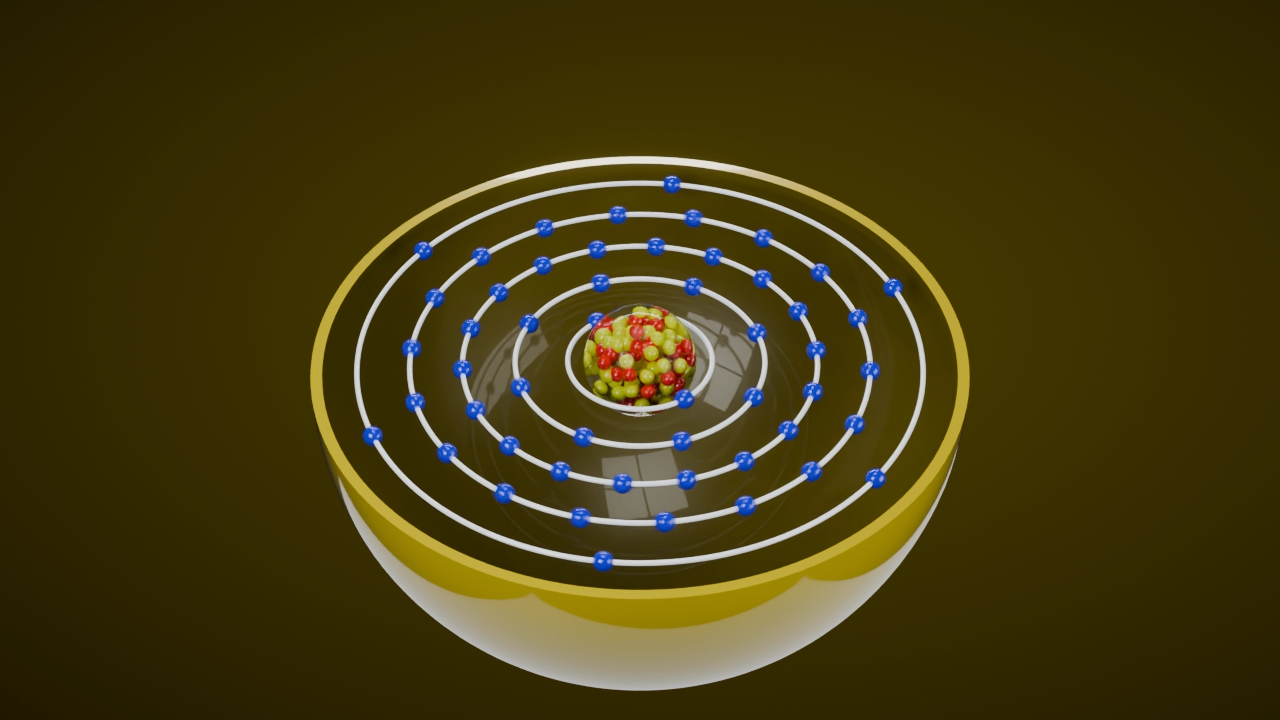
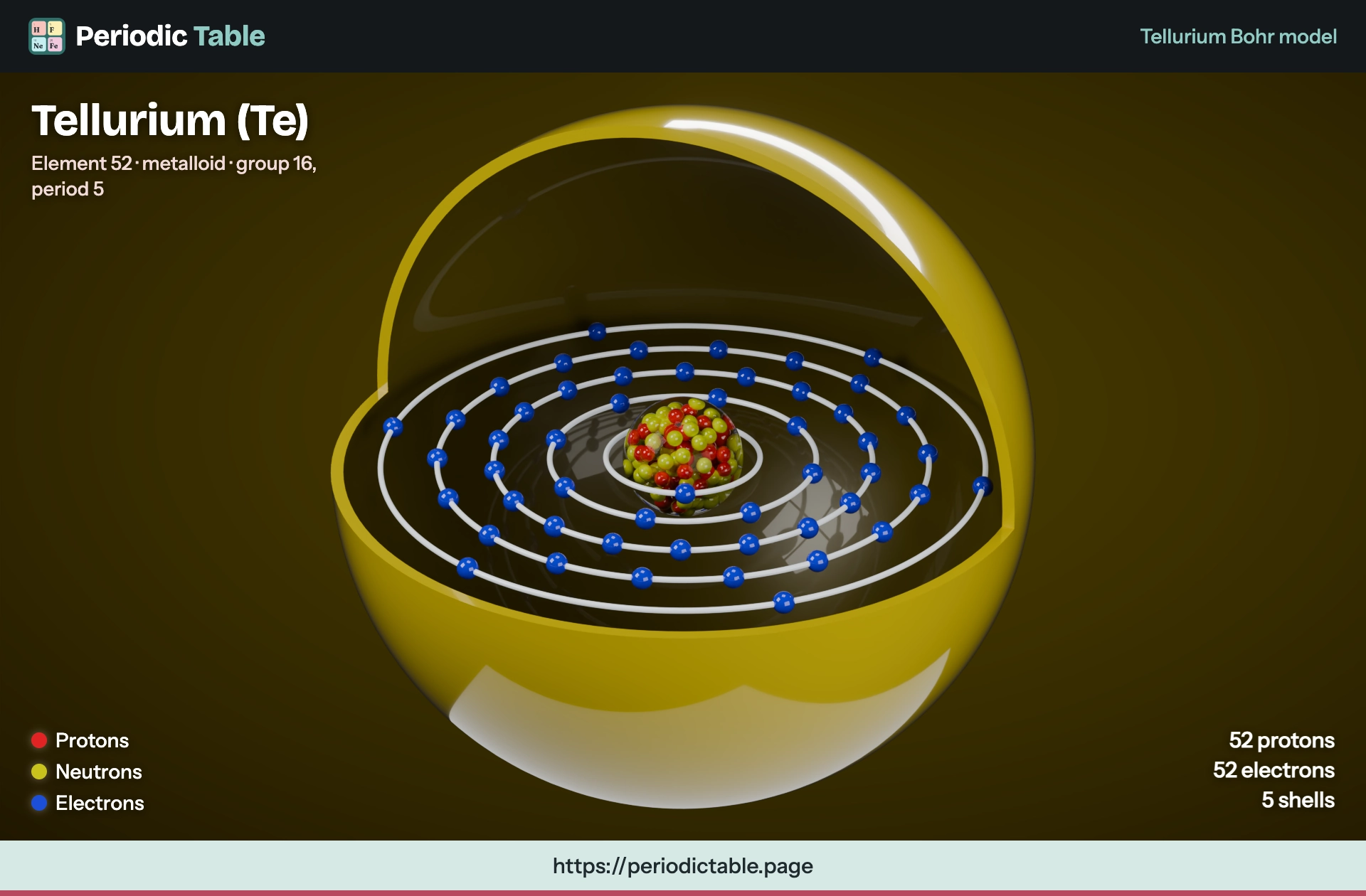
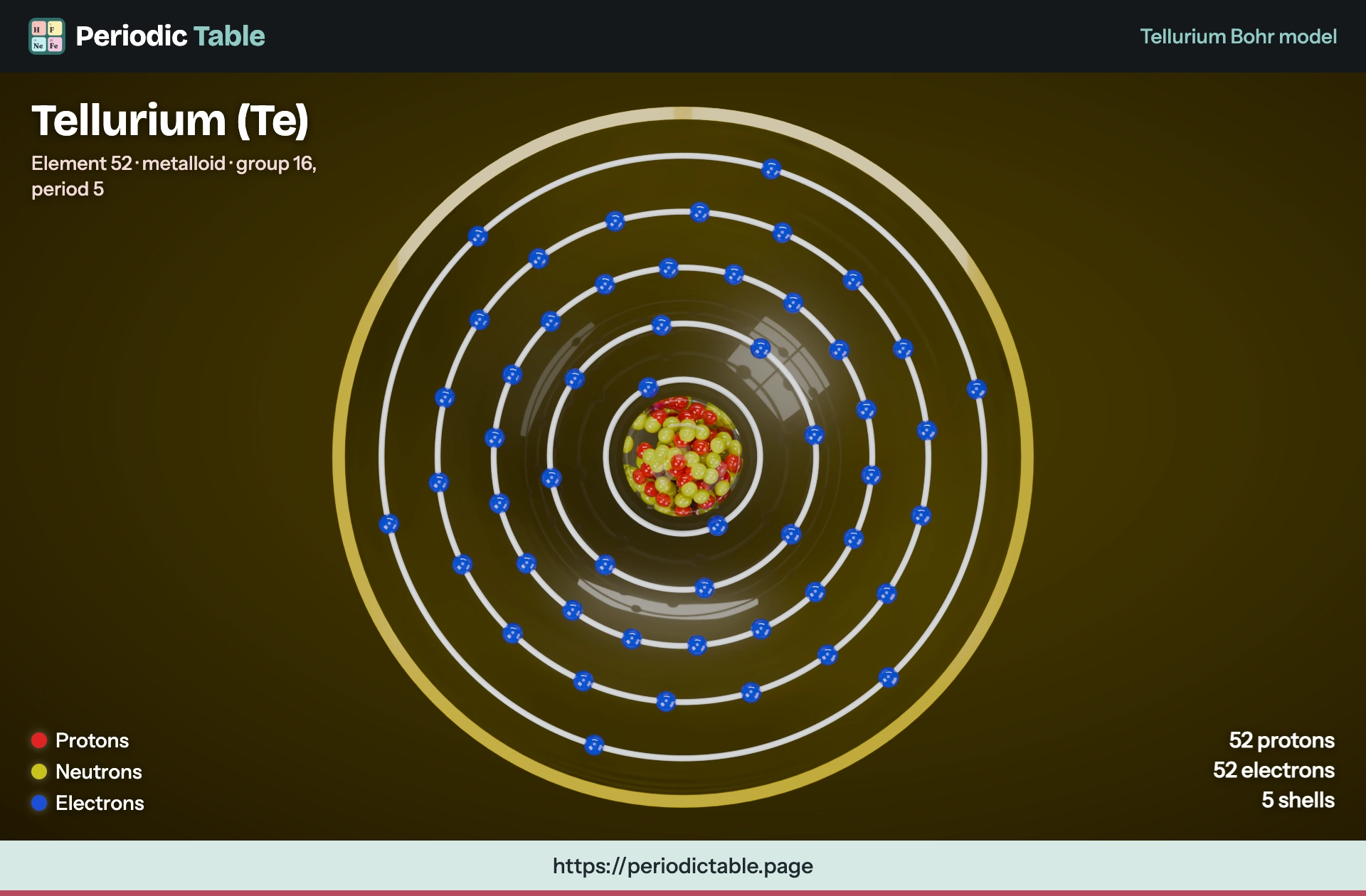
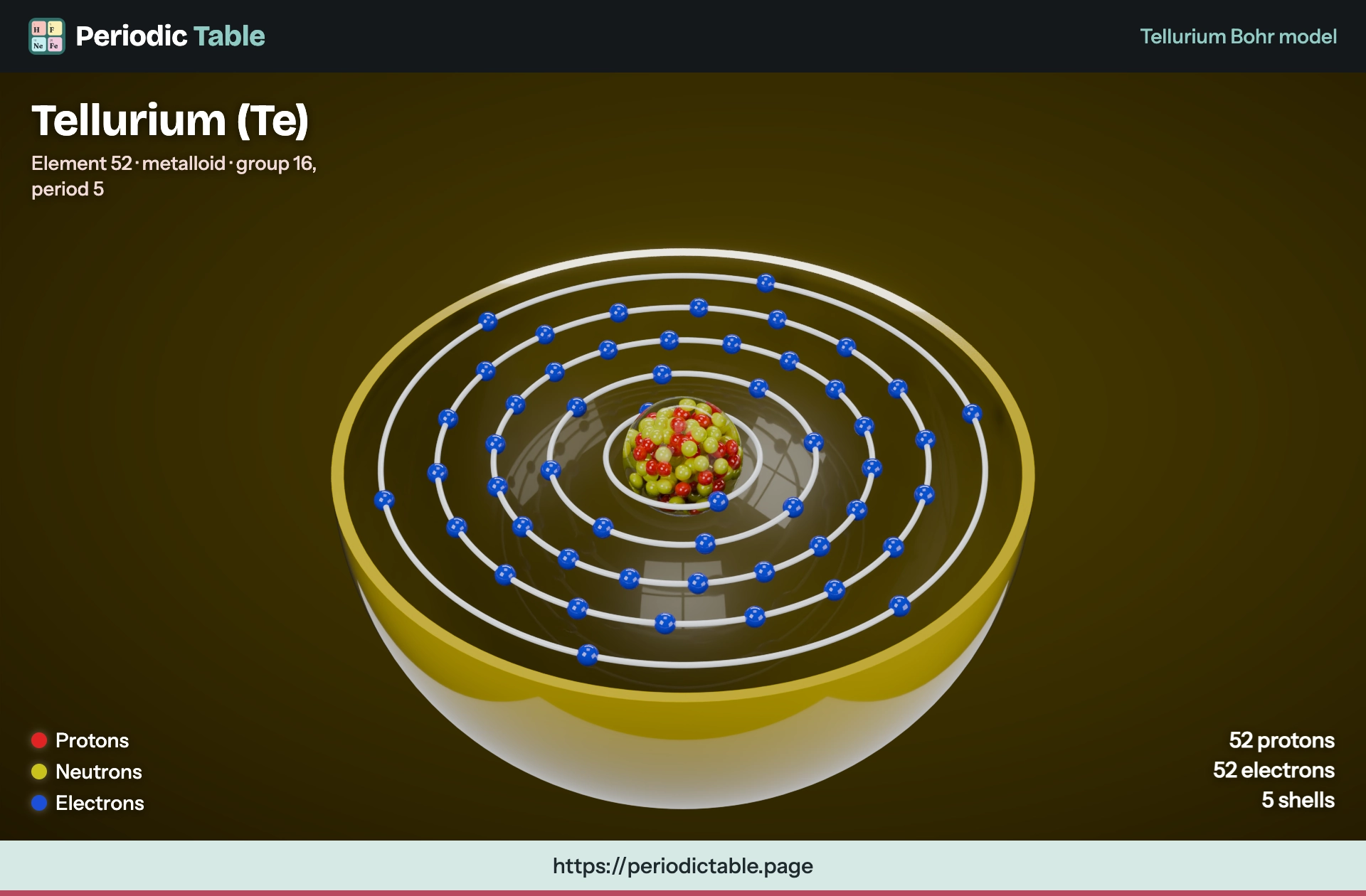
This is a Bohr model of tellurium (Te), a simplified picture of a single tellurium atom. Its nucleus holds 52 protons, and a neutral tellurium atom has 52 electrons, arranged around it in 5 shells (2 in shell K, 8 in shell L, 18 in shell M, 18 in shell N and 6 in shell O).
Tellurium periodic table electron configuration
- Shorthand
- [Kr] 4d10 5s2 5p4
- Full
- 1s2 2s2 2p6 3s2 3p6 4s2 3d10 4p6 5s2 4d10 5p4
- Electrons per shell
- 2, 8, 18, 18, 6
Tellurium element properties and atomic data
- Atomic number
- 52
- Atomic mass
- 127.603 u
- Phase at STP
- Solid
- Melting point
- 449.51°C (722.66 K)
- Boiling point
- 987.85°C (1261 K)
- Density
- 6.24 g/cm³
- Electronegativity (Pauling)
- 2.1
- Period
- 5
- Group
- 16
- Block
- p-block
- Appearance
- Unknown
- Discovery date
- 1782
- Discovered by
- Franz-Joseph Müller von Reichenstein
- Named by
- —
Tellurium element at a glance: atomic number 52
The tellurium element holds position 52 on the periodic table, so every neutral atom carries 52 protons and 52 electrons. Its relative mass is 127.60, and it is registered under CAS number 13494-80-9. The table below collects the constants you will reach for most often in chemistry coursework or on a materials datasheet. Beta decay, half-life and atomic batteries are all part of the promethium atomic mass, which centres on a lanthanide with no stable isotope.
| Property | Value |
|---|---|
| Symbol | Te |
| Atomic number | 52 |
| Standard atomic weight | 127.60 |
| Position | Group 16, period 5, p-block |
| Electron configuration | [Kr] 4d10 5s2 5p4 |
| Electronegativity (Pauling) | 2.1 |
| State at 20 °C | Solid |
| CAS number | 13494-80-9 |
Group 16, period 5 and the p-block
Its column is the chalcogen family: oxygen, sulfur, selenium, Te and polonium. Moving down that column, the elements become heavier, less electronegative and more metallic, and tellurium lands right at the crossover point. Being in the fifth row means its outermost electrons occupy the fifth shell, and because its last electrons fill p orbitals it belongs to the same block as carbon, nitrogen and fluorine.
Electron configuration and electronegativity
Six valence electrons (5s2 5p4) explain most of its behaviour: the atom can gain two electrons to reach a noble-gas shell, or share and lose up to six. A Pauling value of 2.1 is close to that of hydrogen, which is why its bonds are mostly covalent rather than ionic. The covalent radius is about 138 pm and the van der Waals radius about 206 pm, noticeably larger than selenium's.
Physical properties of the metalloid
The physical properties of tellurium sit halfway between a metal and a nonmetal. Polished pieces are silvery-white with a metallic shine, yet the solid shatters under a hammer and is soft enough that a fingernail can scratch it. In the chemistry of borates, see boron uses for borax, boric acid and boranes, plus boron trifluoride and sodium perborate.
It is a semiconductor whose electrical conductivity changes with direction through the crystal and rises slightly in light, an effect called photoconductivity. It is also diamagnetic, so a strong magnet weakly repels it.
Melting point, boiling point and density
Among the chalcogens it has the highest melting and boiling temperatures, and the solid is denser than zinc. The values below are published reference constants.
| Property | Value |
|---|---|
| Melting point | 449.51 °C (722.66 K) |
| Boiling point | 988 °C (1,261 K) |
| Density at 20 °C | 6.24 g/cm³ |
| Mohs hardness | 2.25 |
| Specific heat capacity | 202 J/(kg·K) |
| Heat of fusion | 17.49 kJ/mol |
Allotropes and crystal structure
There are two forms. Crystalline tellurium has a trigonal lattice (often described as hexagonal) built from parallel helical chains of Te atoms, three atoms per turn, which gives the crystals their handedness and their direction-dependent conductivity. Amorphous tellurium is a brown-black powder that drops out when the element is precipitated from a solution of one of its acids; heating it slowly converts it to the grey crystalline form.
Chemical properties of Te and its oxidation states
The oxidation states you will meet most in tellurium chemistry are −2, +2, +4 and +6, with +4 the most common in its compounds. The grey solid resists air at room temperature, but heated in oxygen it burns with a blue flame to form the dioxide.
It reacts directly with the halogens, dissolves in nitric acid and hot concentrated acids, and is attacked by molten alkalis. When melted, it attacks iron containers, which matters for anyone handling the liquid.
Ionization energies and atomic mass
The first three ionization energies are about 869, 1,790 and 2,698 kJ/mol, higher than those of its neighbours antimony and tin. A classic oddity of tellurium is its atomic mass: at 127.60 it is heavier than iodine (126.90), the next element. Mendeleev placed them in this order on chemical behaviour alone; the reason became clear later, when it emerged that the two heaviest Te nuclides make up about two-thirds of natural samples.
Tellurium isotopes and their half-life
Natural tellurium is a mix of eight nuclides. Six are stable; Te-128 and Te-130 are technically radioactive but disappear so slowly, by double beta decay, that a sample is effectively permanent. Te-128 has the longest known half-life of any measured radionuclide, roughly 2.2 × 1024 years, which is far longer than the age of the universe.
Te-130 is so valuable for neutrino physics that underground detectors use crystals of its dioxide to hunt for an even more elusive process. More than 30 artificial nuclides are also known, all short-lived.
| Nuclide | Natural abundance | Stable or radioactive |
|---|---|---|
| Te-120 | 0.09% | None detected |
| Te-122 | 2.55% | None detected |
| Te-123 | 0.89% | None detected |
| Te-124 | 4.74% | None detected |
| Te-125 | 7.07% | None detected |
| Te-126 | 18.84% | None detected |
| Te-128 | 31.74% | About 2.2 × 1024 years |
| Te-130 | 34.08% | About 7.9 × 10²⁰ years |
Tellurium compounds
Tellurium compounds mirror those of the lighter chalcogens, but the larger atom makes them less robust and more metallic in character. Most of them fall into a few families you can recognise by the oxidation level.
Tellurides of zinc, hydrogen and gold
In the −2 state the element forms tellurides with metals. Heating it with zinc gives zinc telluride (ZnTe), a material for green LEDs and detectors; treating that with hydrochloric acid releases hydrogen telluride (H2Te), a foul, unstable gas that decomposes far more easily than hydrogen sulfide. In nature the best-known examples are gold telluride minerals, one of the few ways gold occurs chemically combined.
Tellurium dioxide and the tellurium acids
TeO2 is the common +4 oxide and the usual starting point for making the pure metal. Dissolved and hydrated, the oxides give two acid series: tellurous acid (H2TeO3), whose salts are tellurite ions, and telluric acid (Te(OH)6), whose salts are tellurate ions. The dioxide is also prized in specialty glass because it raises the refractive index.
Halides, Zintl cations and organotellurium chemistry
All four common halogens form tetrahalides (TeCl4, TeBr4, TeI4, TeF4), while fluorine alone pushes it to the +6 hexafluoride. Dissolving the element in concentrated sulfuric acid produces a bright red solution of the square Zintl cation Te42+.
Organotellurium chemistry covers telluroethers and related molecules used mainly in research and as precursors for semiconductor growth. Layered lanthanide tritellurides (RTe3) are now studied for unusual quantum effects in their electrons.
Where the element tellurium occurs
The element tellurium is one of the rarest solid elements in Earth's crust, at roughly 1 microgram per kilogram, about as scarce as platinum. In the wider cosmos it is far more plentiful. The leading explanation is that, while Earth was forming, it combined with hydrogen into a volatile hydride that boiled away into space.
Astronomers even observed fresh tellurium being made in a neutron star merger in 2023. Occasionally it is found as a native mineral, but usually it is bound to gold, silver, nickel or lead.
Calaverite, sylvanite and other ores
Calaverite (AuTe2) and sylvanite (AgAuTe4) are the classic gold telluride minerals. In 1896, miners in Kalgoorlie, Western Australia, realised that waste rock used to fill potholes was rich in gold-bearing telluride, and they dug up their own streets for the gold. The mining town of Telluride, Colorado was named in hope of similar ore, which never appeared in quantity.
Discovery history: from aurum paradoxum to tellurium
In 1782 Franz-Joseph Müller von Reichenstein, chief inspector of mines in Transylvania, examined a puzzling gold ore from Kleinschlatten, today Zlatna in Romania. He first took the unknown ingredient for bismuth sulfide, then for antimony. After three years and more than fifty tests, Müller still could not identify it, so he called it aurum paradoxum ("paradoxical gold") and metallum problematicum ("problem metal").
The Hungarian Pál Kitaibel found the same substance independently in 1789. It was Martin Heinrich Klaproth, the Berlin chemist who had isolated it from those samples, who confirmed it was new and named it tellurium in 1798 from the Latin tellus, "earth".
Klaproth had already named uranium after the planet Uranus, so the Earth, the one planet still without an element, fitted neatly. In the 1920s Thomas Midgley Jr. found that it stopped engine knocking but abandoned it because of the smell.
Tellurium production and tellurium price
Global tellurium production runs to only a few hundred tonnes a year. In 2022 China supplied about 340 tonnes, followed by Russia (80 t), Japan (70 t) and Canada (50 t), while the United States publishes no official figure. China is the one country mining it as a main target.
The tellurium price follows solar-panel demand: high-purity metal sold for about $30/kg in 2000 and $74/kg in 2018, and supply cannot rise quickly because output depends on how much ore smelters process. Commercial tellurium ships as ingots, slabs or sticks.
Recovery as a by-product of copper refining
Almost all tellurium is a by-product. It enters the system in porphyry copper deposits, concentrates in the anode slime left by electrolytic refining of blister copper, and is recovered in a few steps:
- Roast the slime with sodium carbonate in air at about 500 °C, turning the metal compounds into soluble salts.
- Leach with water, then acidify with sulfuric acid so the dioxide precipitates while selenium stays dissolved.
- Reduce the oxide to the element by electrolysis or with sulfur dioxide.
Roughly 1,000 tonnes of ore yield only about one kilogram of tellurium, which is why supply is tied to base-metal output, not to demand for tellurium itself.
What tellurium is used for
In 2022 the tellurium market split roughly into thin-film solar (40%), thermoelectrics (30%), metallurgy (15%) and vulcanizing agents (5%), with the first two growing fastest as the energy industry moves away from fossil fuels.
Cadmium telluride solar cells
Cadmium telluride (CdTe) absorbs sunlight so strongly that a layer a few micrometres thick is enough, which makes it ideal for thin-film photovoltaic modules. CdTe solar cells are among the cheapest to manufacture per watt, and utility-scale solar panels built on them now consume the largest share of world tellurium output.
Thermoelectric devices and electronics
- Bismuth telluride (Bi2Te3) powers Peltier coolers and waste-heat generators.
- Lead telluride works at higher temperatures and in infrared detectors.
- An alloy of mercury, cadmium and Te is the sensor material in thermal imaging cameras.
- Cadmium zinc telluride detects x-ray and gamma radiation, including on NASA's NuSTAR telescope.
- A suboxide film stores data on rewritable optical discs such as CD-RW and DVD-RW.
- Telluride glasses are used in phase change memory chips and caesium telluride photocathodes in particle accelerators.
Together these make tellurium a strategic material for semiconductors and electronics.
Alloys, rubber, catalysts and ceramics
A fraction of a percent of tellurium added to copper or steel gives "free-machining" alloys that cut cleanly, improving machinability without hurting electrical conductivity. In lead it improves corrosion resistance and ductility and reduces fatigue. It also vulcanizes rubber, acts in oxidation catalysts for petroleum processing and acrylonitrile, colours ceramics as specialty pigments, and is bombarded with neutrons to make iodine-131 for thyroid treatment.
Tellurium poisoning, tellurium breath and health
Tellurium poisoning is rare, but the health effects of exposure are distinctive. The body converts absorbed tellurium into dimethyl telluride, which leaves through the lungs and sweat as a strong garlic-like odor. Inhalation of air containing only 0.01 mg/m³ can cause this "tellurium breath", and volunteers given 15 mg still had garlic breath eight months later.
Other signs include a metallic taste, nausea, fatigue and dark patches on the skin. Its toxicity is hard to treat because many chelating drugs make it worse, so workplaces rely on ventilation, gloves and dust control.
Biological role of Te in living things
No organism needs tellurium. Some fungi build it into amino acids in place of sulfur or selenium, forming tellurocysteine and telluromethionine. Many bacteria take up tellurite and reduce it to black deposits of the element, and labs exploit this with tellurite agar to identify the bacterium behind diphtheria.