


Boron element (B): boron periodic table facts
Boron periodic table facts: boron (B) is element 5, a metalloid in group 13, period 2. Pick up a Pyrex measuring jug, a box of laundry booster or a tube of fiberglass insulation and you are already holding boron, the chemical element with atomic number 5 and symbol B. To see how electron capture in potassium-40 builds the radiogenic isotope, check argon oxidation states for details and examples.
On the periodic table it sits at the top of group 13 as a metalloid: in crystalline form it is a hard, glossy solid, and in amorphous form a dull brown powder. Here you will find its key data, the forms it takes, where it is mined, the compounds it builds and why plants cannot grow without it.
Rotate the 3D Bohr model of boron
Drag to orbit, scroll to zoom.
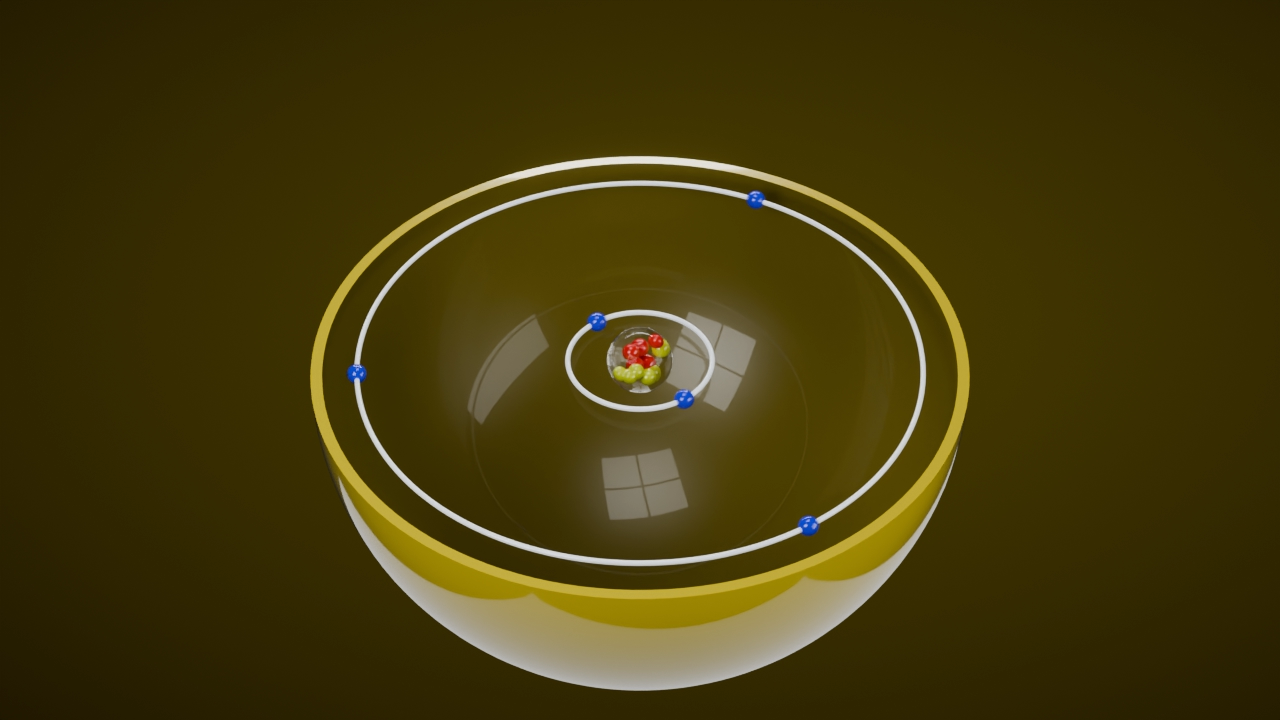
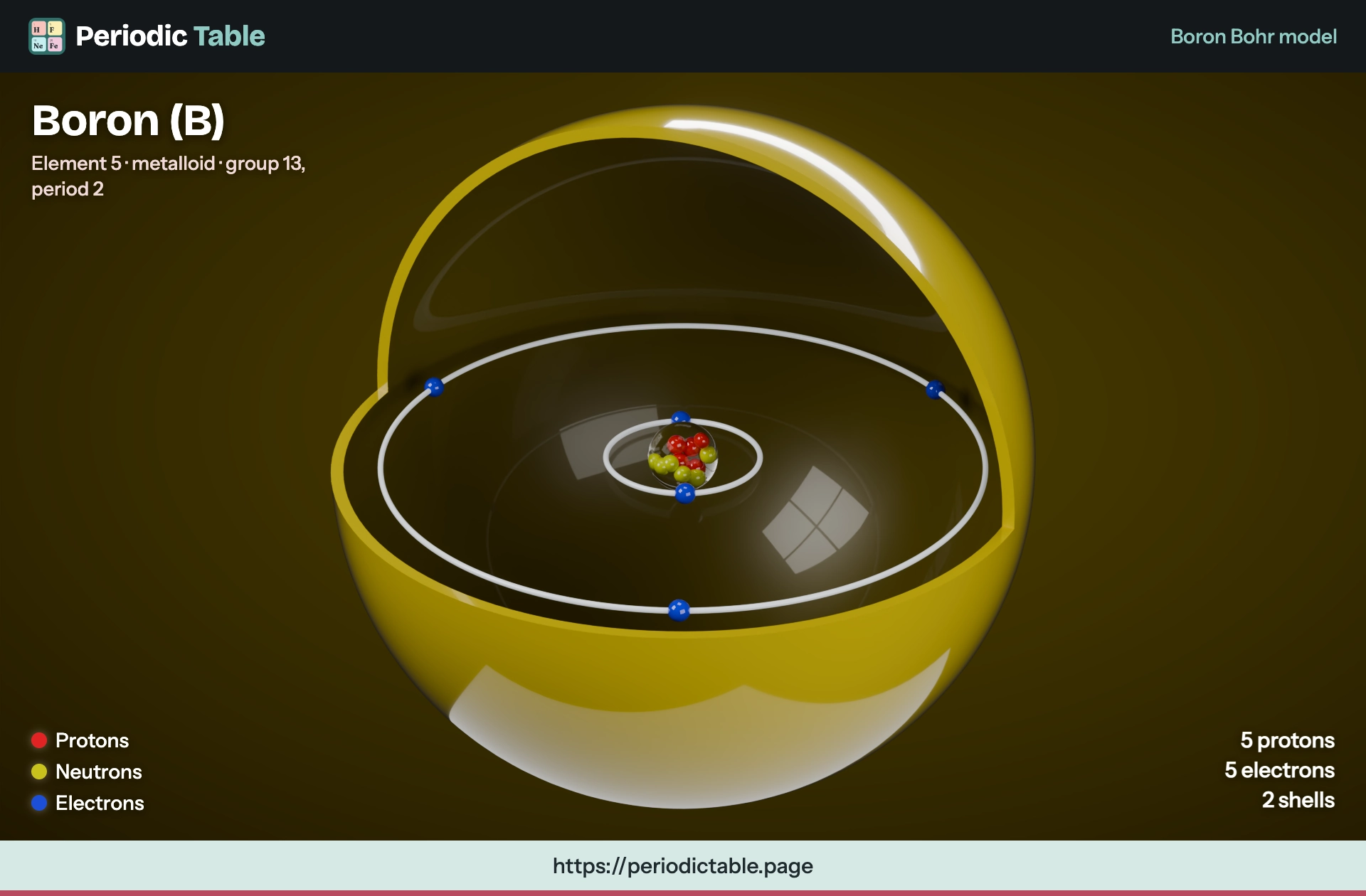
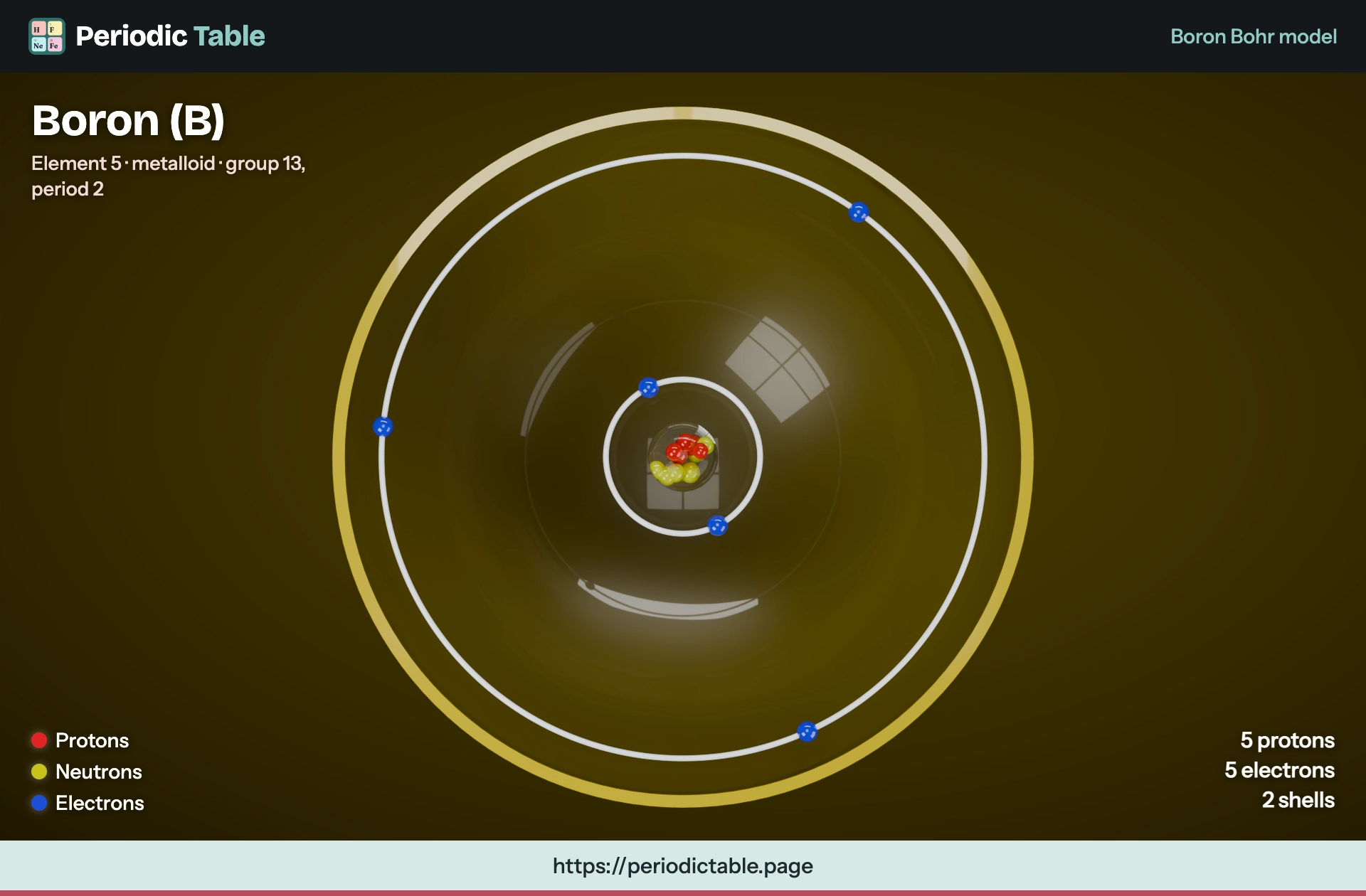
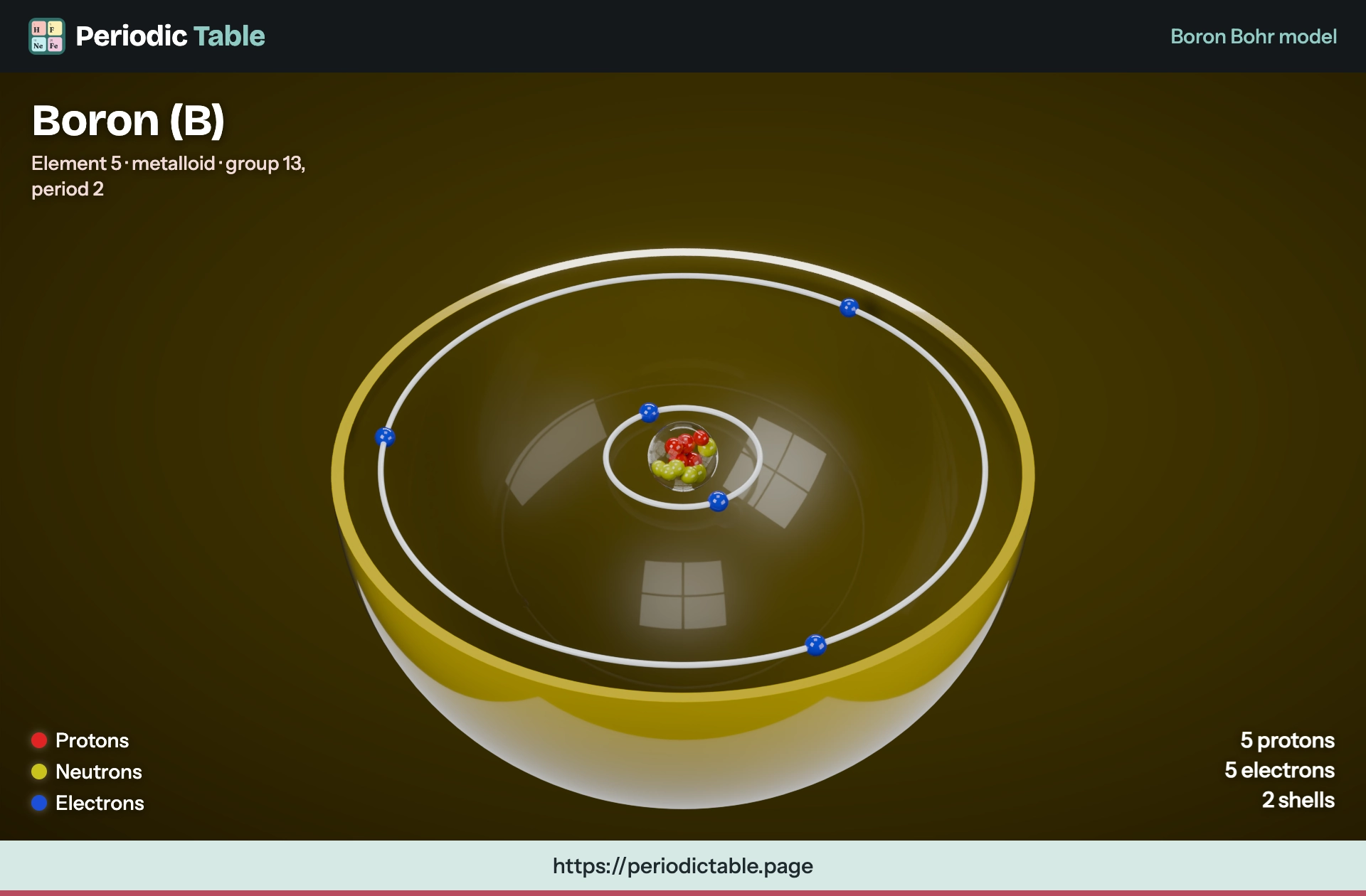
This is a Bohr model of boron (B), a simplified picture of a single boron atom. Its nucleus holds 5 protons, and a neutral boron atom has 5 electrons, arranged around it in 2 shells (2 in shell K and 3 in shell L).
Boron periodic table electron configuration
- Shorthand
- [He] 2s2 2p1
- Full
- 1s2 2s2 2p1
- Electrons per shell
- 2, 3
Boron element properties and atomic data
- Atomic number
- 5
- Atomic mass
- 10.81 u
- Phase at STP
- Solid
- Melting point
- 2075.85°C (2349 K)
- Boiling point
- 3926.85°C (4200 K)
- Density
- 2.08 g/cm³
- Electronegativity (Pauling)
- 2.04
- Period
- 2
- Group
- 13
- Block
- p-block
- Appearance
- Black-brown
- Discovery date
- 1808
- Discovered by
- Joseph Louis Gay-Lussac
- Named by
- —
Boron at a glance: key facts about element boron
Before getting into the chemistry, it helps to have the core numbers in one place. Element boron is the first member of the boron group, which also contains aluminium, gallium, indium and thallium. Copper refining and anode sludge explain where most of the tellurium production supply actually comes from.
It is the only member of that column that is not a metal, and its small size gives boron a high melting point, a light build and a firm grip on the bonding pairs it shares. The table below collects the values most often looked up for B.
| Property | Value |
|---|---|
| Symbol | B |
| Atomic number | 5 |
| Standard atomic weight | 10.81 |
| Position | Group 13, period 2, p-block |
| Electron configuration | [He] 2s2 2p1 |
| State at room temperature | Solid (black crystals or a brown amorphous solid) |
| Melting point | about 2,076 °C (2,349 K) |
| Boiling point | about 3,927 °C (4,200 K) |
| Density | 2.08–2.46 g/cm3, depending on the form |
| Electronegativity (Pauling) | 2.04 |
| First three ionization energies | 800.6, 2,427.1 and 3,659.7 kJ/mol |
| Covalent radius | 84 pm |
| Common oxidation state | +3 |
Two of those numbers explain a lot of its behavior. An electronegativity of 2.04 is close to hydrogen's 2.20, so B forms covalent bonds rather than ionic ones. The jump from the third to the fourth ionization energy (over 25,000 kJ/mol) shows why boron almost always forms exactly three bonds and no more.
Electron configuration of the boron atom
A boron atom has five electrons around a nucleus of five protons: two in the inner shell and three valence electrons in the outer shell. It is the lightest element with an electron sitting in a p-orbital in its ground state. Three outer ones can form only three bonds, which leaves B with a share of six instead of the eight that would fill its shell.
That makes the element electron-deficient: many of its neutral compounds break the octet rule and keep an empty p-orbital that eagerly accepts a lone pair from another molecule. This is what makes BF3 a textbook Lewis acid, and it is the thread that runs through almost everything else in this article, from cage-shaped hydrides to the catalysts used in drug synthesis.
Boron properties: hardness, color and structure
Is boron a metal? No. Anyone tracking the island of stability will find moscovium atoms summarised with its isotopes and half-lives.
Boron sits right on the dividing line, which is why chemists class it as a metalloid: it looks shiny like a metal, but it conducts electricity poorly and bonds like a nonmetal. The physical boron properties are unusual for such a light element.
Crystalline samples are black and lustrous, poor conductors at room temperature, and close to diamond in hardness at about 9.3–9.5 on the Mohs scale. That combination of low weight and extreme stiffness is why boron keeps turning up in armor, abrasives and aerospace parts.
Allotropes of crystalline boron and amorphous boron
Boron has several allotropes, and almost all of them are built from the same unit: a 12-atom cage shaped like an icosahedron. How those icosahedra pack together decides the form. Crystalline boron is usually the β-rhombohedral phase, the most stable one, while amorphous boron is a brown powder in which the cages are linked at random with no long-range order.
| Phase | Crystal system | Atoms per unit cell | Density (g/cm3) |
|---|---|---|---|
| α-R | Rhombohedral | 12 | 2.46 |
| β-R | Rhombohedral | about 105 | 2.35 |
| γ | Orthorhombic | 28 | 2.52 |
| β-T | Tetragonal | — | 2.36 |
The γ form appears when other phases are squeezed to 12–20 GPa and heated to 1,500–1,800 °C, and it stays stable after the pressure is released. Push the element above 160 GPa and it turns into a superconductor below roughly 6–12 K, a striking result for something that is a near-insulator at room temperature.
How elemental boron is prepared and reacts
Elemental boron is surprisingly hard to make clean. Early chemists reduced boron oxide with magnesium or other reactive metals, but the product was contaminated with metal borides. Today high-grade material comes from reducing volatile halides with hydrogen at high temperature, and the ultrapure grade chipmakers need is made by decomposing diborane and then zone-refining the result.
Once made, the crystalline solid is remarkably inert. Boiling hydrochloric or hydrofluoric acid barely touches it, and in air a thin protective film forms on the surface. Only when it is heated strongly does it burn, giving boron trioxide:
$$4\,\mathrm{B} + 3\,\mathrm{O_2} \rightarrow 2\,\mathrm{B_2O_3}$$
Because free boron is so difficult to isolate, manufacturers rarely start from it. Nearly every compound you will meet below is made from borate ores instead.
Boron isotopes: boron-10 and boron-11
Natural boron is a mixture of two stable isotopes. About 80.1% is boron-11 and 19.9% is the lighter 10B. Thirteen isotopes are known in total, but the others are short-lived; the heavy 17B even has a "halo" structure far larger than its mass predicts, and the least stable 7B has a half-life of about 3.5 × 10⁻²² seconds.
| Isotope | Atomic mass | Natural abundance | Main use |
|---|---|---|---|
| 10B | 10.013 | 19.9% | Neutron capture in reactors and cancer therapy |
| 11B | 11.009 | 80.1% | Radiation-hardened chips, fusion fuel research, NMR |
The two behave very differently with neutrons. The lighter isotope has a huge cross-section for neutron capture, so reactor suppliers enrich natural boron to nearly pure 10B, leaving "depleted" boron that is almost all 11B. Their small mass difference also lets geochemists use boron isotopes as a record of ancient seawater pH, and through it of past atmospheric CO2.
Nuclear spin and NMR spectroscopy
Both isotopes have a nuclear spin (3 for 10B and 3/2 for 11B), so both can be observed by NMR spectroscopy. Spectrometers tuned for 11B are sold commercially, and chemists use them to check the structure of borane clusters and boron-containing drugs, since each B environment gives its own signal and splits the proton signals next to it.
History of boron: from borax glazes to pure boron
People used boron minerals for well over a thousand years before anyone knew the element existed. The Egyptians are credited with using borax in mummification, and Chinese potters used it in ceramic glazes from about 300 AD.
The crude mineral later travelled west along trade routes; an Arab alchemist wrote about it around 700 AD, and Georgius Agricola described it as a metalworking flux around 1600. In 1777, boric acid was found in the volcanic hot springs near Florence, where the mineral form was later named sassolite.
- 1808 – Humphry Davy in London, and Gay-Lussac and Thénard in Paris, isolate an impure dark powder by reducing the acid with potassium or iron. Davy calls it boracium.
- 1824 – Jöns Jacob Berzelius confirms it is a new element.
- Late 1800s – Francis Marion Smith's Pacific Coast Borax Company makes borates cheap and widely available.
- 1909 – American chemist Ezekiel Weintraub produces what is arguably the first truly pure sample.
The name itself comes from borax, through the Arabic buraq, with the ending borrowed from carbon because the two elements behave alike in many ways. That the early isolations were only around half pure is a reminder of how stubborn the element is: a full century passed between its discovery and the first clean sample.
Where boron occurs in nature
Boron is a low-abundance element, making up only about 0.001% of Earth's crust by weight (around 11 ppm). Yet it is mined by the millions of tonnes, because water dissolves its compounds, carries them and deposits them in rich beds of minerals. It never occurs free on Earth; only tiny traces of the uncombined element have been found in meteorites and lunar soil.
Why boron is rare in the solar system
Most light elements were made in the Big Bang or are cooked in stars, but boron is an exception. Its nucleus is fragile, and stellar interiors destroy it rather than build it.
Almost all of it comes from cosmic ray spallation, where fast cosmic rays smash heavier nuclei such as carbon and oxygen in interstellar gas, with a smaller share from supernovas. That is why it is scarce across the solar system compared with its neighbors on the periodic table.
Borate minerals: borax, kernite, colemanite and ulexite
More than 100 borate minerals are known, and around 300 boron minerals in total if you count rarer silicates found in pegmatites and skarns. Four of them supply about 90% of mined ore:
- Tincal – crude borax, a sodium borate and the most important single ore
- Kernite (also called rasorite) – a denser, less hydrated form of the same salt, found with tincal
- Colemanite – a calcium borate, widely worked in Turkey
- Ulexite – a sodium-calcium borate, nicknamed "TV rock" for its fiber-optic crystals
Most commercial deposits are evaporites: dry lake beds where borate-rich water from volcanic spring waters evaporated over thousands of years. That geology explains why the big deposits cluster in arid, volcanic regions. The difference between the element and these minerals matters: the minerals are oxides of B(III) combined with metals such as calcium or magnesium, and what you buy as "borax" is a refined borate salt, not the free element.
Boron mining, production and supply
Global proven reserves of boron ore exceed one billion tonnes, against yearly output of about four million tonnes. Turkey dominates. Its state-owned Eti Mine Works holds a monopoly over borate extraction in a country that has roughly 72% of the world's known deposits, mainly in the provinces of Eskişehir, Kütahya and Balıkesir.
The United States is the other major producer. Rio Tinto runs a huge open-pit operation in the Mojave Desert near the town of Boron, California, which accounts for almost a quarter of world production.
Chile, Russia and China round out the list of boron suppliers. The Royal Society of Chemistry gives boron a relative supply risk of 4.5 out of 10, a middling score driven by how concentrated production is in one country.
Prices tell their own story. Crystalline elemental material cost about US$5 per gram in 2008, while bulk refined borates sold for roughly US$377 per tonne in 2019. Nearly all ore is refined to boric acid or sodium tetraborate first, and those two feed almost every other boron compound sold, with glass makers taking the largest share.
Boron compounds and their chemistry
Boron forms thousands of compounds, and its chemistry looks more like that of carbon and silicon than of aluminium, the next element down the group. It readily forms covalent networks, nearly always in the +3 state, and compounds that seem impossible on paper often turn out to be stable. The four families below cover most boron compounds you are likely to meet.
Boric acid, borates and boron trifluoride
Every borate starts with oxygen. Boric acid, B(OH)3, is a weak acid used as a mild antiseptic, while borates link B–O units into chains, rings and sheets; the tetraborate ion in borax is the classic example. Zinc borates are common wood preservatives and fire retardants.
The element also forms a full series of trihalides, BX3, with flat, triangular shapes. Boron trifluoride is the most important: its empty orbital grabs fluoride or other electron pairs, which is why refineries use it as a catalyst. Treat any of the halides with water and you get boric acid back.
Boranes and organoboron chemistry
Boranes are compounds of boron and hydrogen. The simplest isolable one, diborane (B2H6), is made from sodium borohydride and holds its two halves together with a pair of bridging B–H–B bonds, a structure that puzzled chemists until the 1940s.
Larger boranes form cages and polyhedra, and the work explaining their bonding won William Lipscomb the 1976 Nobel Prize. Many of these clusters ignite on contact with air, and in the 1950s they were tested as high-energy jet and rocket fuel additives.
Adding a B–H bond across a C=C double bond, called hydroboration, opened up a huge range of organic reactions and earned H. C. Brown a share of the 1979 chemistry prize.
What is boronic acid?
Boronic acid is boric acid with one OH group swapped for an organic R group, giving the formula R–B(OH)2. Like its parent, it acts as a mild Lewis acid and forms reversible bonds with sugars and other molecules that carry OH groups.
Its biggest role is in the Suzuki coupling, which joins two organic fragments using a palladium catalyst and earned Akira Suzuki a share of the 2010 prize. That reaction is now routine in organic synthesis of pharmaceuticals, agrochemicals and electronic materials, making boronic acid derivatives a staple of materials science and drug discovery.
Boron nitride, boron carbide and metal borides
Boron nitride pairs B with nitrogen, and because a B–N pair is isoelectronic with a C–C pair, it copies the structures of carbon. Hexagonal BN is a slippery, white analogue of graphite used as a high-temperature lubricant, while cubic boron nitride, sold as borazon, is nearly as hard as diamond and more chemically stable.
Boron carbide (roughly B4C) is made by heating boron oxide with carbon in an electric furnace:
$$2\,\mathrm{B_2O_3} + 7\,\mathrm{C} \rightarrow \mathrm{B_4C} + 6\,\mathrm{CO}$$
It is one of the hardest materials known and very light, which is why it is used in body armor and tank plating. Metal borides such as TiB2 melt above 3,000 °C, and magnesium diboride (MgB2) is a superconductor at 39 K that is now drawn into wires for magnets.
Boron uses in industry and everyday products
The main boron uses are almost all as boron compounds rather than the pure element. In the United States about 70% goes into glass and ceramics. Worldwide, the split looks roughly like this:
| End use | Share of global consumption |
|---|---|
| Insulating and structural glass fiber | about 46% |
| Super-hard materials, abrasives and tiles | about 15% |
| Agriculture (fertilizers) | about 11% |
| Borosilicate glassware | about 10% |
| Bleaches and cleaning products | about 6% |
Fiberglass and borosilicate glass
The single largest market is fiberglass used for insulation and reinforced plastics. Borate or boron oxide added to the melt makes the fibers stronger and easier to work; E-glass, the standard electrical-grade glass fiber, is an alumino-borosilicate. Borosilicate glass, typically 12–15% B2O3, expands very little when heated, which gives it excellent resistance to thermal shock.
That is why laboratory beakers and kitchen bakeware sold as Pyrex or Duran can go from fridge to oven without cracking. Borates also strengthen many technical ceramics and enamels.
Boron fibers, abrasives and boron steels
Here pure boron, rather than its compounds, finally earns its keep. Boron fibers are made by chemical vapor deposition of boron onto a fine tungsten wire. The result is lightweight and high strength, ideal for composite materials in aerospace structures and in premium sporting goods such as golf clubs and fishing rods.
Boron carbide and cubic BN powders are widely used as abrasive grits for cutting and polishing. In metallurgy, just a few parts per million in boron steels greatly improves hardenability, and boriding a steel surface or coating tools with metal borides raises wear resistance.
Semiconductors, magnets, detergents and flares
- Semiconductor chips: B is the standard dopant for silicon. With one electron fewer than the host atom, it creates a "hole" and makes the material p-type. Since the 1970s it has been added mainly by ion implantation.
- Neodymium magnets (Nd2Fe14B), the strongest permanent magnets, power hard drives, phone speakers, MRI scanners and electric motors.
- Detergents and bleach: sodium perborate releases active oxygen in laundry powders, and borax remains a common cleaning booster.
- Pest control: boric acid is a cheap household insecticide, far more toxic to insects than to people.
- Metalwork: borates act as a flux for soldering silver and gold and for welding iron.
- Flares and fireworks: the amorphous powder burns with a distinctive green flame, and triethylborane has ignited engines from the SR-71 to the Saturn V and Falcon 9.
Nuclear and medical uses of boron
The ability of 10B to soak up slow neutrons is the basis of boron's most specialized roles, from reactor safety to an experimental form of cancer treatment.
Neutron absorber in nuclear reactors
As a neutron absorber, boron is cheap and does not form long-lived radioactive waste. Boron carbide pellets are packed into control rods and shutdown systems, and borated steel and polymers provide radiation shielding.
In pressurized water nuclear reactors, operators dissolve boric acid in the cooling water and slowly reduce its concentration as the fuel burns down, fine-tuning reactivity without moving rods. On the other side of the coin, chip designers for spacecraft use depleted, 11B-rich material so that stray neutrons do not trigger bit flips.
Boron neutron capture therapy
In neutron capture therapy, or BNCT, a patient receives a drug carrying 10B that collects in the tumor. A beam of low-energy neutrons is then aimed at the area. Each capture breaks the absorbing atom into alpha particles and a lithium ion that travel only about one cell width, destroying the cancer cell while largely sparing healthy tissue nearby.
It has been tested on brain tumors, head and neck cancer and melanoma, and newer accelerator-based neutron sources are making it more practical than reactor-based beams. The appeal of boron neutron capture therapy is that the damage is set by where the boron sits, not where the beam points, so the real challenge is a carrier drug that loads the tumor far more than the tissue around it.
Beyond BNCT, boron is the active part of bortezomib, a drug for multiple myeloma, and of tavaborole, an antifungal for toenail infections. Natural antibiotics containing it, such as boromycin from soil bacteria, have been known since the 1960s.
Superconductors and nuclear fusion research
In nuclear fusion devices, thin boron coatings on plasma-facing walls reduce the release of impurities. A more radical idea is aneutronic fusion: a proton striking 11B produces three alpha particles and 8.7 MeV of energy but no neutrons, which could mean a reactor that does not become radioactive. Meanwhile, MgB2 cables developed at CERN have carried 20,000 amperes in tests for future particle collider upgrades.
Boron in plants, diet and human health
Boron is an essential plant nutrient. It holds together the pectin network in plant cell walls, and a shortage shows up first in growing tips, flowers and seeds, because pollination and fruit set depend on it.
The safe range is narrow, though: soil levels above about 1.0 ppm cause leaf-tip burn in sensitive crops, and few crops do well above 2.0 ppm. That narrow window is why farmers test soil before adding borate fertilizer.
For people, the role of boron is less settled. It is not officially classed as an essential human nutrient, and no recommended daily allowance exists, but studies link low intake to weaker bone health and a higher risk of osteoporosis, and suggest roles in calcium metabolism, vitamin D function and brain health. Adults typically take in about 1 to 1.5 mg a day from food.
Rich sources include avocados, raisins and other dried fruit, peanuts and other nuts, and leafy greens. It is also sold in dietary supplements, which deserve the same caution as any supplement. Some researchers even suspect borate minerals helped stabilize the first RNA molecules, linking the element to the origin of life itself.
Boron toxicity and safety
Elemental boron and simple borates have low toxicity for mammals, roughly comparable to table salt: the lethal dose for animals is around 6 g per kg of body weight. Even so, swallowing boric acid can cause vomiting, abdominal pain and diarrhea, and repeated intakes above about 0.5 g a day lead to digestive problems, so keep these cleaners away from children. The real hazards are the boranes and other volatile boron hydrides, which are genuinely poisonous and can ignite in air, so they are handled only under strict laboratory controls.