


Moscovium element (Mc): moscovium periodic table facts
Moscovium periodic table facts: moscovium (Mc) is element 115, a post-transition metal in group 15, period 7. Moscovium is a synthetic element you will never hold, see or buy. Its symbol is Mc, its atomic number is 115, and its most stable isotope lasts well under a second before it decays. Industrial gas suppliers serve metals, lighting and medicine, and the argon gas explains how that works.
Everything you can learn about element 115 comes from a few hundred atoms made one at a time, plus the predictions that theorists built around them. That gives you the clearest picture of how a superheavy element behaves at the edge of the periodic table.
Rotate the 3D Bohr model of moscovium
Drag to orbit, scroll to zoom.
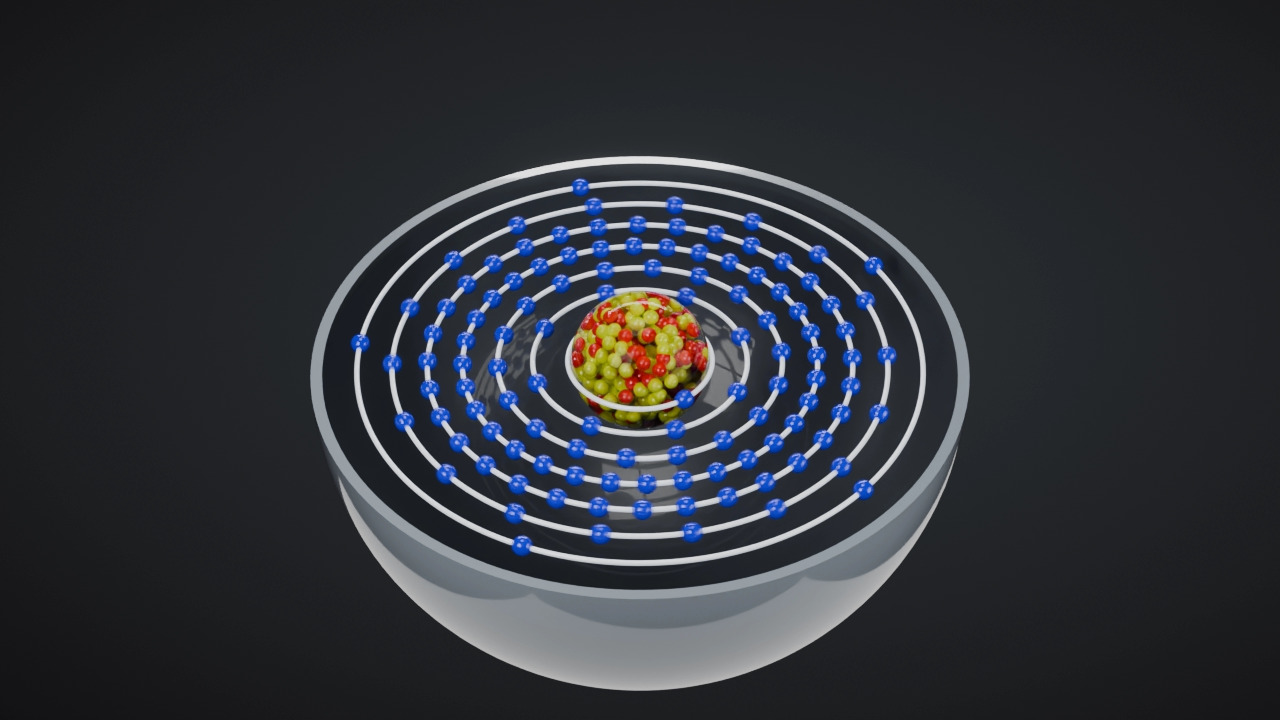
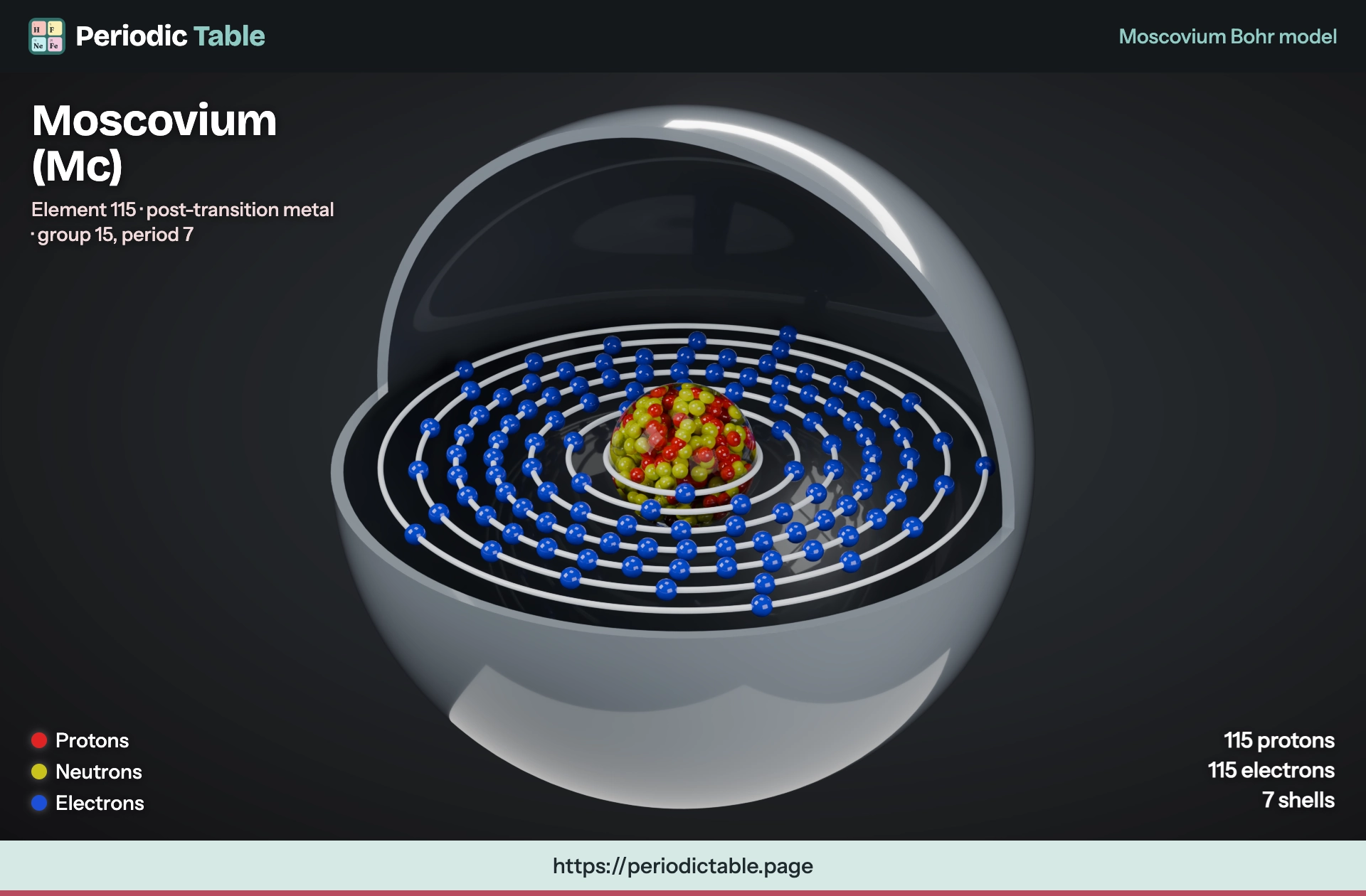
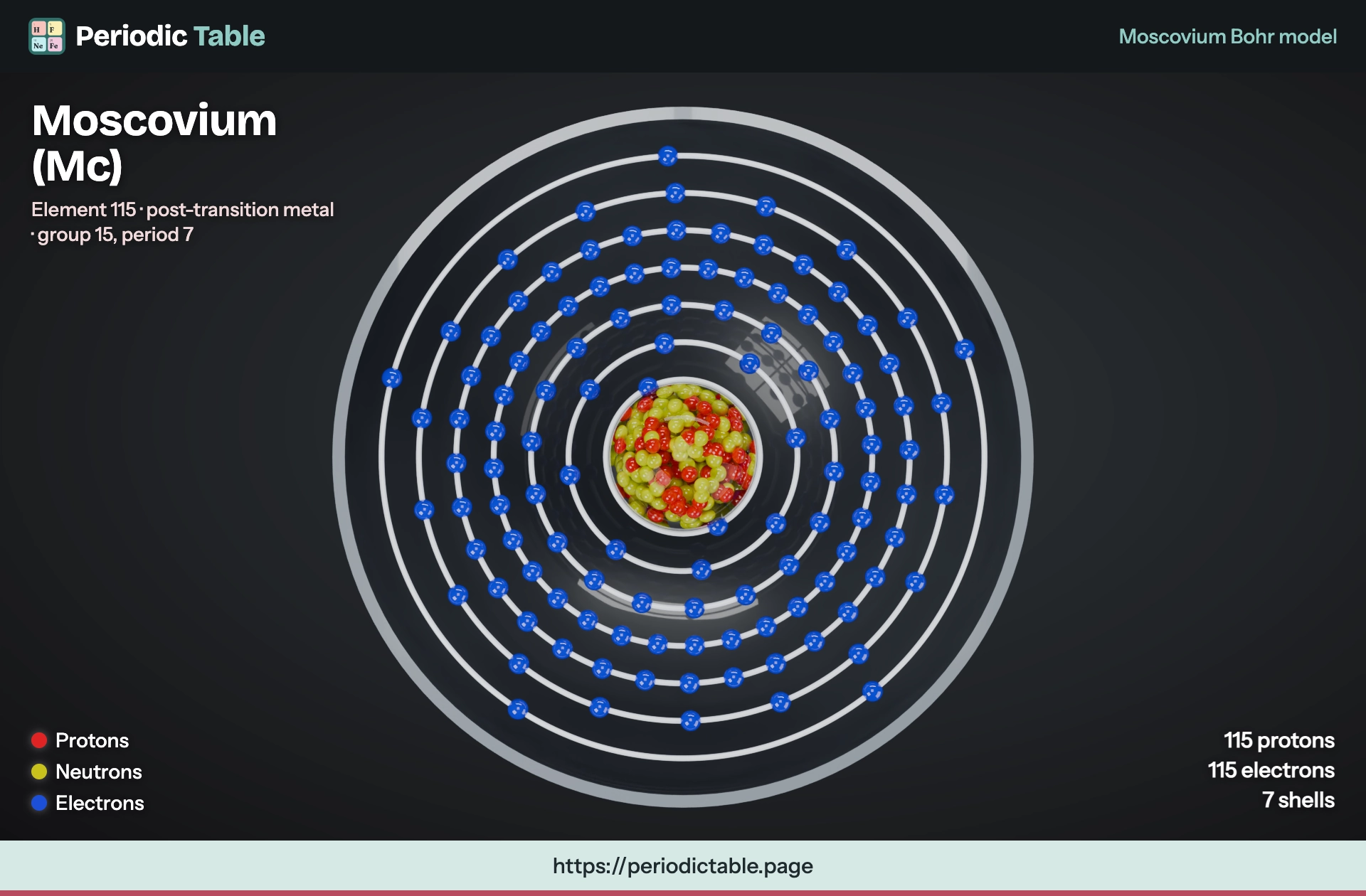
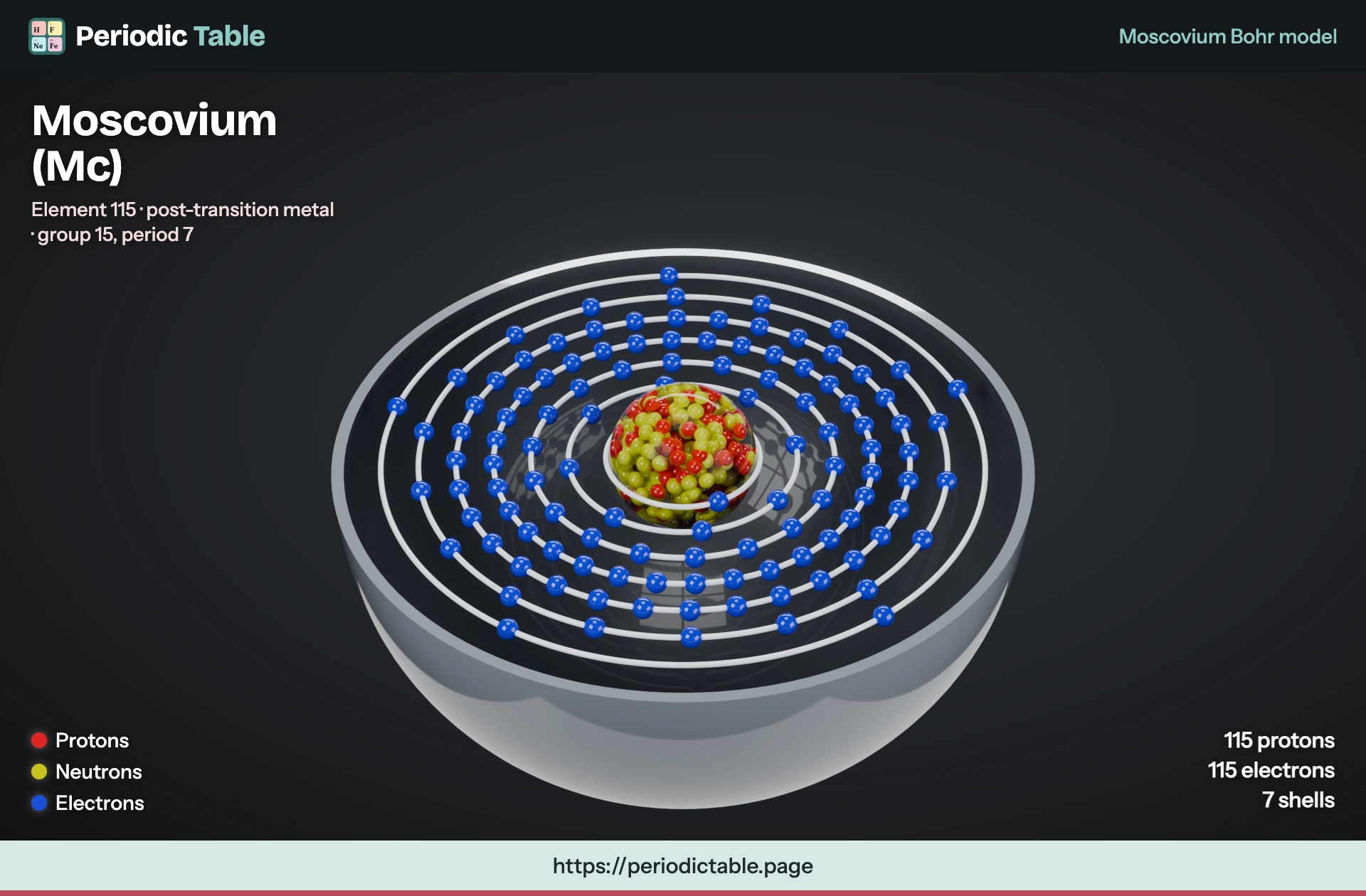
This is a Bohr model of moscovium (Mc), a simplified picture of a single moscovium atom. Its nucleus holds 115 protons, and a neutral moscovium atom has 115 electrons, arranged around it in 7 shells (2 in shell K, 8 in shell L, 18 in shell M, 32 in shell N, 32 in shell O, 18 in shell P and 5 in shell Q).
Moscovium periodic table electron configuration
- Shorthand
- *[Rn] 5f14 6d10 7s2 7p3
- Full
- 1s2 2s2 2p6 3s2 3p6 4s2 3d10 4p6 5s2 4d10 5p6 6s2 4f14 5d10 6p6 7s2 5f14 6d10 7p3
- Electrons per shell
- 2, 8, 18, 32, 32, 18, 5
Moscovium element properties and atomic data
- Atomic number
- 115
- Atomic mass
- [289] u
- Phase at STP
- Unknown
- Melting point
- 396.85°C (670 K)
- Boiling point
- 1126.85°C (1400 K)
- Density
- 13.5 g/cm³
- Electronegativity (Pauling)
- Unknown
- Period
- 7
- Group
- 15
- Block
- p-block
- Appearance
- Unknown
- Discovery date
- 2003
- Discovered by
- Joint Institute for Nuclear Research
- Named by
- —
Moscovium (Mc) atomic number, atomic mass and key facts
The table below gathers the core data for moscovium. Most physical values are marked as predicted. Boron-10 neutron capture and a boron-11 isotope ratio are covered in the boron group, for nuclear and plant nutrient uses.
So little material has ever existed that nobody has measured a bulk sample, and none ever will at current production rates. Because the element has no stable form, its mass is quoted in square brackets as the mass number of its longest-lived isotope.
| Property | Value |
|---|---|
| Symbol | Mc |
| Atomic number (Z) | 115 |
| Atomic mass | [290] |
| Group / period / block | 15 / 7 / p |
| Classification | Synthetic, superheavy, transuranium |
| Electron configuration (predicted) | [Rn] 5f14 6d10 7s2 7p3 |
| State at 25 °C (predicted) | Solid |
| First ionization energy (predicted) | 538.3 kJ/mol |
| Atomic radius, empirical (predicted) | 187 pm |
| Covalent radius (extrapolated) | 156–158 pm |
| CAS number | 54085-64-2 |
| Natural occurrence | None, made only in accelerators |
As a transuranium element, moscovium sits far beyond uranium (Z = 92) in the periodic table. Every one of those heavier elements is radioactive and, past plutonium, essentially absent from nature.
Like the other superheavy elements, it is known only from accelerator runs. The CAS registry number 54085-64-2 was assigned decades before anyone made it, so chemists could index it in the literature ahead of time.
Where element 115 sits in the periodic table
Moscovium fills box 115 of the periodic table, between flerovium (114) and livermorium (116). In December 2015 it was confirmed as one of four new elements, together with nihonium (113), tennessine (117) and oganesson (118). That announcement completed the seventh row of the table for the first time since Mendeleev's layout took shape. To understand trace amounts in the atmosphere and fractional distillation, learn about them through krypton (kr) and its notes.
Group 15, period 7 and the P-block
Placement is read straight from the electron shells. Moscovium is predicted to put its last three electrons in the 7p subshell, which makes it a p-block element in period 7 and the heaviest known member of group 15. It is also a transactinide, the label for all elements past lawrencium (103), and that label tells you where its chemistry is least certain.
Moscovium among the pnictogens
Elements in this column are called the pnictogens. Reading down the column, you get:
- Nitrogen: a gas that makes up most of the air
- Phosphorus: a reactive nonmetal found in DNA and fertilisers
- Arsenic: a metalloid
- Antimony: a metalloid used in alloys
- Bismuth: a heavy, very weakly radioactive element
- Mc: the synthetic newcomer at the bottom
Before discovery, chemists used Mendeleev's convention and called the empty slot eka-bismuth, from the Sanskrit word for "one", meaning one place further down. Each pnictogen has five valence electrons, so you would expect it to act like a heavier homologue of its lighter homologues.
In practice it is a loose fit: as the next sections show, its closest chemical congener may sit in a different group altogether. A heavy pnictogen that does not quite behave like one is exactly why the element interests chemists.
Discovery of moscovium at Dubna
The discovery belongs to a Russian-American team. They worked at the Joint Institute for Nuclear Research (JINR) in Dubna, Russia, together with scientists from the Lawrence Livermore National Laboratory in California, United States. The same collaboration had already produced elements 114 and 116, and it would go on to make the last two members of the seventh row.
The 2003 synthesis and the physical review C report
In August 2003, scientists led by Yuri Oganessian fired a beam at a target of americium-243 and recorded four nuclei of the new element. They described the synthesis in Physical Review C in February 2004. The nuclei lived for milliseconds and then alpha-decayed into nihonium, and that daughter decayed in turn.
To strengthen the claim, the team chemically separated the long-lived end of the chain. They showed that it behaved like dubnium, a group 5 element, so the decay products pointed back up the chain to Z = 115.
Road to confirmation by the joint working party
A claim to a new element is judged by the Joint Working Party of IUPAC (chemistry) and IUPAP (physics). In 2011 it ruled the early Dubna evidence insufficient: none of the nuclides in the chain had been seen before, and the dubnium chemistry could not cleanly rule out a group 4 element. The case firmed up over the next four years as other laboratories repeated the work:
- 2009–2010: moscovium-289 and its heavier sibling turned up as decay daughters in the experiments that made tennessine.
- 2013: a team from Lund University working at GSI in Darmstadt, Germany, repeated the 2004 reaction and confirmed the original result.
- 2015: scientists at Lawrence Berkeley published further confirmation.
- December 2015: IUPAC and IUPAP recognised the discovery and gave naming rights to the Dubna-Livermore group.
Questions about whether the decay chains truly came from one nuclide were raised in 2016 and answered in a 2017 reanalysis. The recognition has stood since.
Naming moscovium: from ununpentium to Mc
Until a name was approved, element 115 went by the IUPAC placeholder for undiscovered elements, ununpentium (symbol Uup), which spells out "one-one-five" in Latin roots. The scheme dates from 1979. Researchers in the field mostly ignored it and simply wrote "element 115", E115 or just 115.
The discoverers floated several options, including langevinium after the French physicist Paul Langevin. In the end they proposed a name honouring the Moscow Oblast, the province around Dubna. IUPAC put the name out for public comment in June 2016 and adopted it on 28 November 2016.
The official naming ceremony for moscovium, tennessine and oganesson took place on 2 March 2017 at the Russian Academy of Sciences. So the name points to the Moscow region rather than the city itself, which is a detail many short summaries get wrong.
How moscovium atoms are made in the laboratory
You cannot mine, refine or stockpile moscovium. Every one of the moscovium atoms on record was built in a laboratory, using a heavy-ion accelerator (a cyclotron at the Joint Institute for Nuclear Research) that pushes beam nuclei to roughly a tenth of the speed of light. Production runs last weeks, and a good run yields a handful of events.
Nuclear fusion of calcium-48 ions and americium
The standard route is hot fusion. A spinning americium target (Z = 95) is bombarded with calcium-48 ions (Z = 20), and 95 + 20 = 115.
Both nuclei are positive, so electrostatic repulsion pushes them apart. Only a beam with enough energy gets them close enough for the short-range strong interaction to take over.
Most close encounters still fail. When fusion does occur, the merged compound nucleus is highly excited and sheds that energy by boiling off three or four neutrons. In a newer variant reported in 2024, the nucleus emitted protons as well: one proton plus two neutrons.
Physicists summarise how likely a reaction is with its cross section, and for this reaction it is tiny, measured in picobarns. That is why one atom per day of beam time counts as a good result.
Detecting a decay chain in superheavy nuclei
New nuclei leave the target with the beam and pass through a gas-filled separator, which strips away unreacted beam particles. Each surviving nucleus is driven into a silicon detector that logs where, when and with what energy it landed. When that nucleus decays, the same pixel fires again.
A run of alpha particles from one spot, each with a characteristic energy, forms a decay chain. Physicists trace that chain down to known nuclei to prove what was made at the top. This is the core method for identifying all superheavy nuclei: nobody ever weighs or sees a sample, and the evidence is a timed sequence of decays.
Moscovium half-life and known isotopes
Five isotopes have been observed, with mass numbers 286 to 290. The heaviest, moscovium-290, is the most stable, with a half-life of about 0.65 seconds. The general rule holds here as well: within this small set, every extra neutron buys a longer life.
| Isotope | t1/2 | Decay | Daughter |
|---|---|---|---|
| 286Mc | 20 ms | α | 282Nh |
| 287Mc | 38 ms | α | 283Nh |
| 288Mc | 193 ms | α | 284Nh |
| 289Mc | 250 ms | α | 285Nh |
| 290Mc | 650 ms | α | 286Nh |
To see how fast that is, apply the standard decay law:
$$N(t) = N_0 \left(\tfrac{1}{2}\right)^{t / t_{1/2}}$$
With \(t_{1/2} = 0.65\) s, only about 0.48% of a batch would remain after 5 seconds, and 99% would be gone within about 4.3 seconds. That is why the element is called extremely radioactive, and why its radioactivity, not its toxicity, is the main barrier to studying it. Older references quote about 220 ms for the 289 isotope, measured before later runs refined the value.
Alpha decay and spontaneous fission
Every known form decays mainly by alpha decay: the nucleus ejects an alpha particle (two protons and two neutrons) and drops two places, to element 113. The chain then keeps alpha-decaying through roentgenium and meitnerium until it reaches a nucleus that ends in spontaneous fission, splitting into two lighter fragments. Theory also allows minor decay modes for heavier, not-yet-seen isotopes, such as electron capture or beta decay.
Those modes would matter because they move a nucleus sideways toward more stable territory. Every observed nucleus has been highly radioactive, so none has survived long enough to be handled.
Moscovium and the island of stability
Nuclear shell model calculations predict an island of stability: a region of superheavy nuclei, centred near copernicium and flerovium, where closed proton and neutron shells resist fission and half-lives stretch from seconds toward years. The known Mc isotopes are a few neutrons short of that region. Still, each heavier one lives longer, and that trend is the experimental evidence that the island is real.
A hypothetical Mc-291 could decay down its chain to a nucleus of element 112 predicted to last about 1,200 years. That is why moscovium matters in nuclear physics far more than its sub-second lifetime would suggest. It is one of the few footholds physics has for testing nuclear stability at this extreme.
Predicted properties of moscovium
Almost every property below is a calculation, not a measurement. These predicted properties come from relativistic quantum models and from extrapolating trends down the column of lighter elements, a core exercise in theoretical chemistry. Treat them as the best current predictions rather than settled values.
Physical properties: melting point, boiling point and density
Its main physical properties are expected to be:
- Standard state: a solid at room temperature, and probably a dense metal with a silvery to whitish-grey look
- Melting point: about 670 K (400 °C)
- Boiling point: about 1,400 K (1,100 °C)
- Density: about 13.5 g/cm3, a molar volume of roughly 22 cm3 per mole
Those figures fit a post-transition metal, the soft, low-melting kind that sits between the transition block and the metalloids. Mc and nihonium both carry one loosely held electron outside a near-closed shell, so their metallic bonding, and with it their melting and boiling behaviour, should be similar.
Electron configuration and relativistic effects
The ground-state arrangement is predicted to be [Rn] 5f14 6d10 7s2 7p3, so it has the five valence electrons expected for its group. However, in so heavy an element the inner electrons move at a large fraction of light speed.
Relativistic effects then reshape the outer shell, and the strongest of them is spin-orbit coupling. It splits the 7p subshell into a tightly bound pair (7p1/2) and a looser upper level (7p3/2).
The practical result: the 7s pair and the lower p pair both hold on hard, which leaves a single upper-level electron free to react. Predicted ionization energies follow that pattern. The first is low, at 538.3 per mole in kilojoules (about 5.58 eV).
The second and third jump to roughly 1,760 and 2,650, because the next two come from the stabilised pair. In quantum terms, its outer shell acts less like a set of five and more like one easy electron plus two tightly held pairs.
Moscovium chemistry and oxidation states
That electron structure drives the main prediction of moscovium chemistry. The lighter elements of the group can reach +5, and bismuth already prefers +3 because of the inert-pair effect on its 6s electrons. Mc should go further.
Its likely oxidation states are +1 and +3, and the +5 oxidation state is probably out of reach. Some older summaries still list +5 as most common, but that comes from copying group trends rather than from relativistic calculations. The +1 state should behave much like thallium(I), which gives it an unexpected link to group 13 chemistry.
Chemical properties compared with bismuth and thallium
Its predicted chemical properties split between two neighbours:
- As Mc+, it should resemble Tl+, with an ionic radius of about 1.5 Å. Mc(I) hydroxide and fluoride should dissolve in water, while the chloride should be only slightly soluble.
- As Mc3+, it should follow Bi3+, with an insoluble trifluoride and readily hydrolysed trihalides that form oxyhalides.
- Its hydride, moscovine (McH3), should be a trigonal pyramid like ammonia and bismuthine.
Overall it should be a fairly reactive metal, with a standard reduction potential near −1.5 V for the Mc+/Mc couple.
What single-atom experiments on Mc have shown
Only the 288 to 290 isotopes live long enough for chemistry. In 2024, a team at GSI produced 288Mc atoms and passed them, one at a time, over silica and gold surfaces to measure adsorption. The element bound less strongly to silica than bismuth does, but more strongly than closed-shell copernicium and flerovium.
That is the first real chemical data point beyond theory, and it matches the relativistic prediction: the tightly bound p pair makes it less reactive than its lighter congener. Future runs aim to repeat the test with moscovium-290, which lives longest.
Uses of moscovium in superheavy elements research
Moscovium has no commercial, medical or industrial use, and it never will while each one lasts under a second and costs weeks of accelerator time. It is made for research purposes only. It tests the models that predict how superheavy elements behave, it anchors decay chains used to confirm heavier elements, and it gives scientists a rare case where relativity, rather than group position, decides behaviour, which makes it a test bed for both chemistry and physics.
It also marks how far the limits of the periodic table have been pushed. The same accelerators and detectors that made it are now chasing elements 119 and 120, and every new chain through it refines the map those searches rely on.