


Krypton element (Kr): krypton periodic table facts
Krypton periodic table facts: krypton (Kr) is element 36, a noble gas in group 18, period 4. Look up krypton on the periodic table and you land on element 36, a colorless, odorless noble gas present in only trace amounts in Earth's atmosphere. For liquid air, air separation and the welding shield made from it, open the argon boiling point for a closer look.
The name comes from the Greek kryptos, "hidden", which suits a chemical element that stayed out of sight until someone boiled away a flask of liquefied air. Below you get its full data set, its unusual chemistry and the real jobs this rare gas does in lamps, lasers, hospitals and satellites.
Rotate the 3D Bohr model of krypton
Drag to orbit, scroll to zoom.
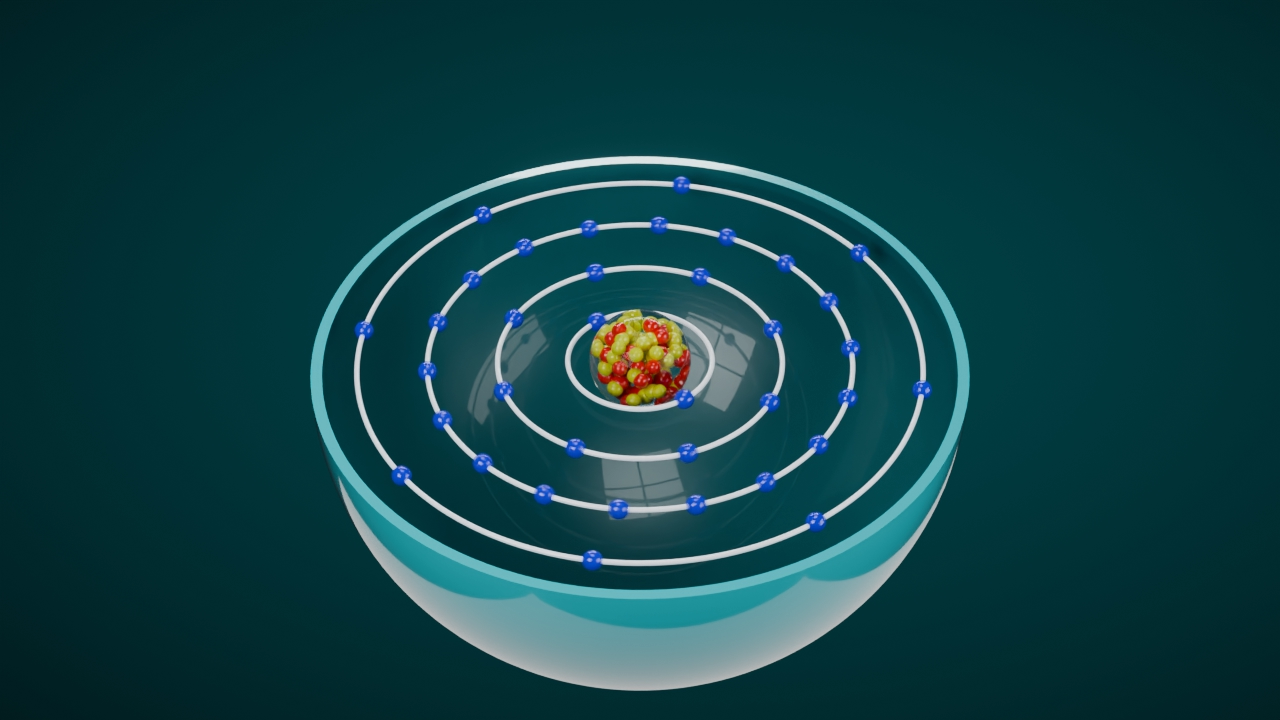
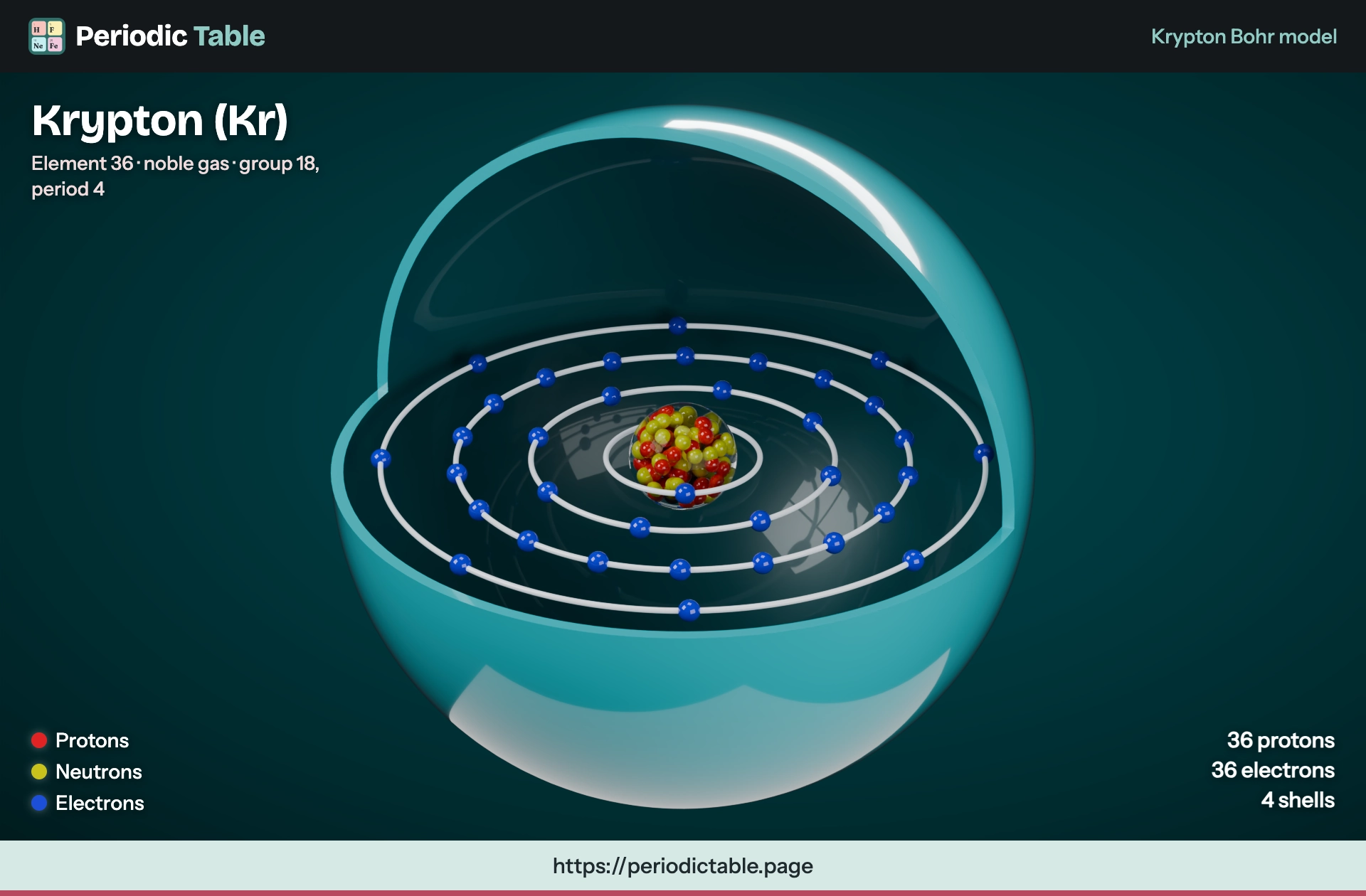
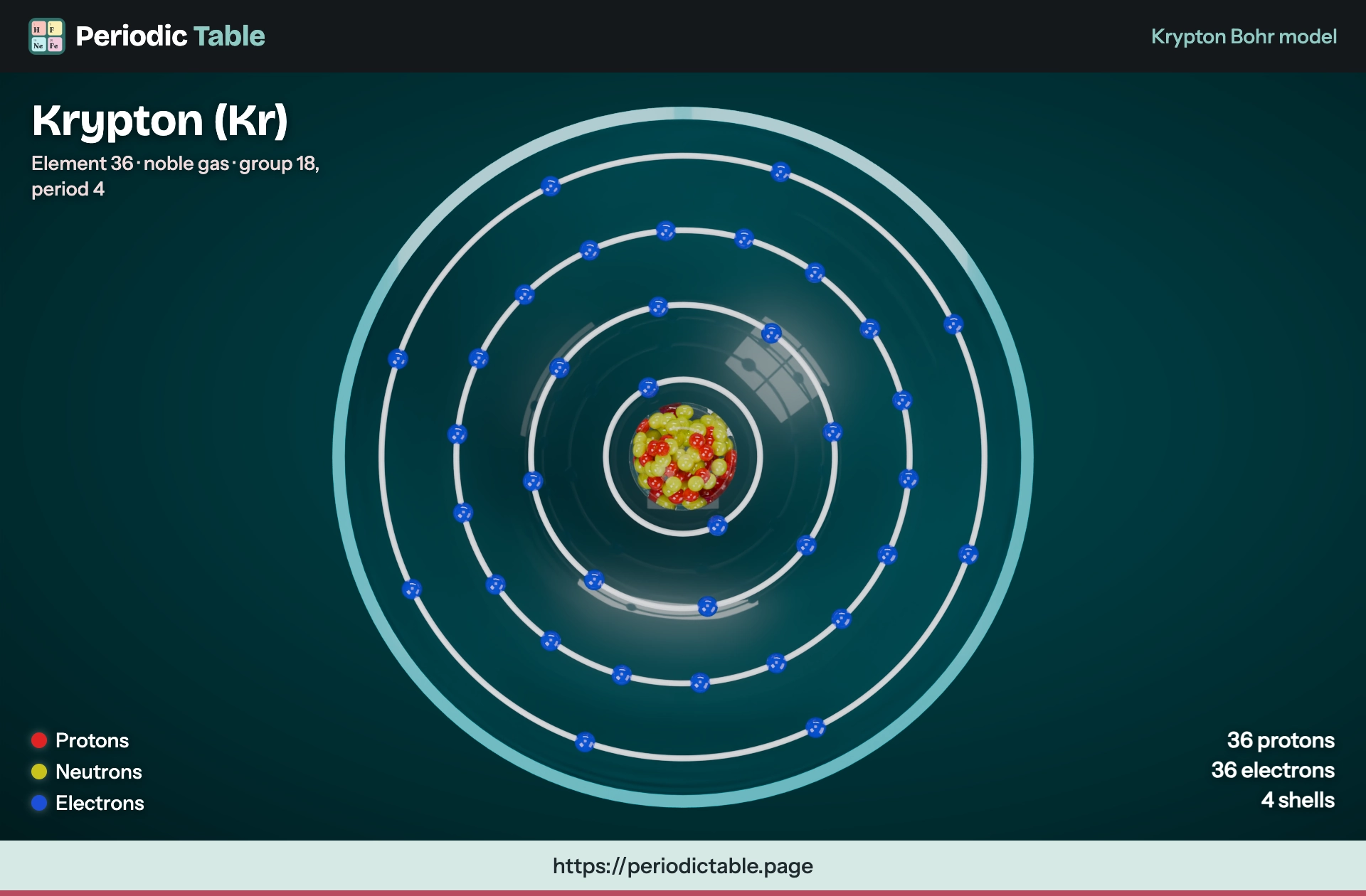
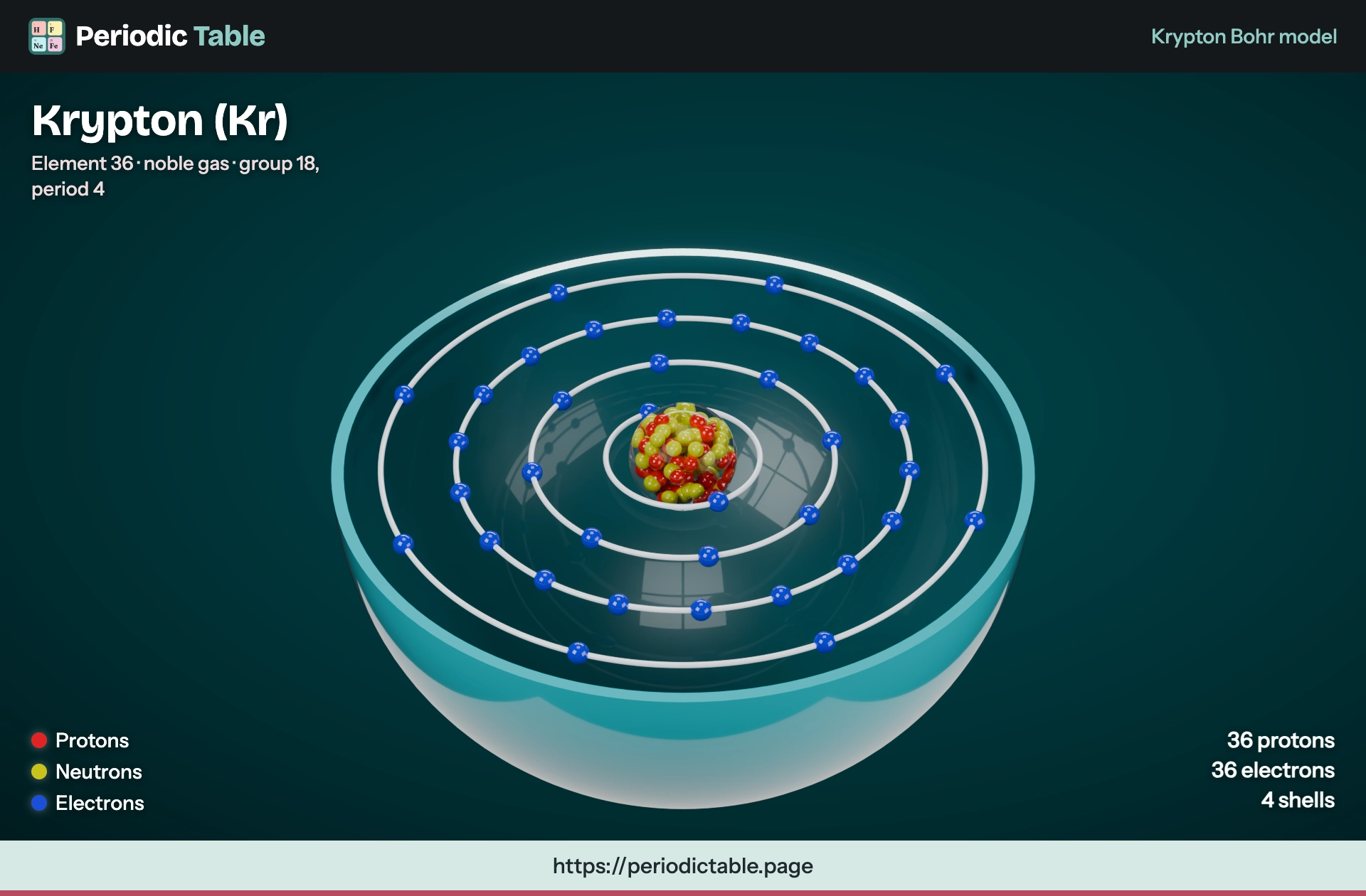
This is a Bohr model of krypton (Kr), a simplified picture of a single krypton atom. Its nucleus holds 36 protons, and a neutral krypton atom has 36 electrons, arranged around it in 4 shells (2 in shell K, 8 in shell L, 18 in shell M and 8 in shell N).
Krypton periodic table electron configuration
- Shorthand
- [Ar] 3d10 4s2 4p6
- Full
- 1s2 2s2 2p6 3s2 3p6 4s2 3d10 4p6
- Electrons per shell
- 2, 8, 18, 8
Krypton element properties and atomic data
- Atomic number
- 36
- Atomic mass
- 83.7982 u
- Phase at STP
- Gas
- Melting point
- -157.37°C (115.78 K)
- Boiling point
- -153.22°C (119.93 K)
- Density
- 0.003749 g/cm³
- Electronegativity (Pauling)
- 3
- Period
- 4
- Group
- 18
- Block
- p-block
- Appearance
- Colorless gas, exhibiting a whitish glow in a high electric field
- Discovery date
- 1898
- Discovered by
- William Ramsay
- Named by
- —
Facts about krypton: atomic number, group 18 and period 4
The symbol is Kr, and the table collects the reference values chemists quote most often. These are published constants, rounded where sources disagree in the last digit. Scientists in the Russia and United States collaboration reported the moscovium periodic table, studying atoms in short chains of alpha decay.
| Property | Value |
|---|---|
| Symbol | Kr |
| Atomic number | 36 |
| Atomic weight | 83.798 |
| Position | group 18, period 4, p-block |
| Electron configuration | [Ar] 3d10 4s2 4p6 |
| Electrons per shell | 2, 8, 18, 8 |
| Melting point | 115.78 K (−157.37 °C) |
| Boiling point | 119.93 K (−153.42 °C) |
| Density at STP | 3.749 g/L |
| Triple point | 115.775 K, 73.53 kPa |
| Critical point | 209.48 K, 5.525 MPa |
| Heat of fusion | 1.64 kJ/mol |
| Heat of vaporization | 9.08 kJ/mol |
| Specific heat capacity | 248 J/(kg·K) |
| Thermal conductivity | 9.43 × 10⁻³ W/(m·K) |
| Lattice constant | 583.57 pm |
| Covalent / van der Waals radius | 116 pm / 202 pm |
| Magnetic ordering | diamagnetic |
| Speed of sound (gas, 20 °C) | 221 m/s |
| CAS number | 7439-90-9 |
In the column it sits between argon above and xenon below, with radon the only heavier natural member of the noble gases. Every value in the table follows from one fact: a completely filled outer shell, which you'll see again in the sections on bonding and chemistry.
Discovery of krypton in liquid air
The discovery came in May 1898 at University College London. William Ramsay, a Scottish chemist, and Morris Travers, his English assistant, let a sample of liquid air evaporate almost completely and studied the last residue with a spectroscope. It showed bright lines no known element produced.
They named the gas krypton, after the Greek word for hidden, and within weeks the same approach gave them neon and then xenon, following argon from a few years earlier. Ramsay received the 1904 Nobel Prize in Chemistry for this run of noble gases.
The element later changed how you measure length. In 1960 the meter was redefined as 1,650,763.73 wavelengths of the orange-red light given off by krypton-86, replacing the platinum-iridium international prototype bar kept at Sèvres. That definition of the metre held until 1983, when science switched to the distance light travels in 1/299,792,458 of a second.
Physical properties of krypton gas
At room temperature krypton is a colorless gas about 2.9 times denser than air. Put it in an electric field inside a glass tube and it gives a whitish glow, because its emission lines spread across the visible range instead of crowding into one colour.
The strongest spectral lines are green and yellow, while the orange-red spectral line at a wavelength of 605.78 nm is the one behind the 1960 length standard. Spectroscopy of exactly this pattern is how Ramsay and Travers recognised what they had.
Melting point, boiling point and density
The liquid range is narrow. The gas condenses at 119.93 K and freezes at 115.78 K, a window of barely 4 kelvin.
At standard temperature and pressure its density is 3.749 g/L, and the liquid near its boiling temperature reaches about 2.41 g/cm3, roughly two and a half times as dense as water. Vapor pressure climbs steeply across the cold end of the scale, from 1 Pa at 59 K to about 100 kPa at 120 K, which is why the liquid only survives in insulated, pressurised containers.
Solid krypton: crystal structure and face-centered cubic packing
Below 115.78 K the atoms lock into a white solid. Like every noble gas except helium, it takes a face-centered cubic crystal structure, with a lattice constant of 583.57 pm at the triple point. Squeeze it hard enough and new phases appear: in high-pressure experiments above about 5 GPa, mixtures with hydrogen grow crystals of krypton hydride, Kr(H2)4, in which the noble atoms form an octahedral frame surrounded by randomly oriented hydrogen molecules.
Kr electron configuration and oxidation states
The ground-state arrangement, [Ar] 3d10 4s2 4p6, closes the 4p subshell, and that is what makes the atom so stable. Its neighbours show the effect by contrast: bromine, one place to the left, is one electron short and grabs one readily, while rubidium, one place to the right, gives one away almost at once. For krypton the usual oxidation state is 0, +2 appears in its fluorides, and +1 shows up only in a handful of exotic ions.
Ionization energies, electronegativity and covalent radius
Removing the first electron costs 1,350.8 kJ/mol, and the next two cost 2,350.4 and 3,565 kJ/mol. That first value is lower than argon's but higher than xenon's, which puts this element right on the border of reactivity: only fluorine pulls hard enough to oxidise it.
On the Pauling scale its value is usually given as 3.00, though some data tables leave it blank because so few bonds exist to measure. The bonded radius of 116 pm is little more than half the 202 pm non-bonded radius, a gap that shows how loosely neighbouring atoms pack when no bond holds them.
Kr isotopes and half-life
Natural Kr is a mix of six isotopes, five of them stable isotopes and one so long-lived it counts as stable in practice.
| Isotope | Natural abundance | Half-life |
|---|---|---|
| 78Kr | 0.355% | about 9.2 × 10²¹ years |
| 80Kr | 2.286% | stable |
| 82Kr | 11.593% | stable |
| 83Kr | 11.500% | stable |
| 84Kr | 56.987% | stable |
| 86Kr | 17.279% | stable |
78Kr is technically radioactive, but it decays by double electron capture to selenium so slowly that nobody has to account for it. About thirty unstable isotopes and isomers are also known, and two of them matter outside the lab. 81Kr is cosmogenic: cosmic ray hits on 80Kr make it in the upper air, and its 230,000-year lifetime makes it ideal for dating groundwater 50,000 to 800,000 years old.
Krypton-85, with a 10.7-year half-life, comes from uranium fission in nuclear reactors and weapons tests. It escapes when spent fuel is dissolved, so air samples rich in it have exposed hidden nuclear fuel reprocessing plants.
Chemistry of krypton compounds
For decades textbooks called this gas chemically inert, and under ordinary conditions it is still unreactive: it doesn't burn, form salts or bind to metals. That changed in 1963, a year after the first xenon compounds, when chemists made a stable fluoride.
A small family has followed, including the kryptonium ion KrH+, known only in dilute gas phase, and molecules such as HKrCN that survive up to 40 K. Compounds with Kr–O and Kr–N bonds exist only at low temperature, and each is built from the fluoride rather than by direct reaction with oxygen or nitrogen.
Krypton difluoride and exciplex lasers
Krypton difluoride, KrF2, forms when the gas and fluorine are activated by an electric discharge or ultraviolet light at very low temperature:
$$\mathrm{Kr + F_2 \rightarrow KrF_2}$$It is one of the strongest oxidisers known and slowly breaks down even at room temperature, so it is stored cold.
Inside the krypton fluoride laser
The short-lived excited molecule KrF, an exciplex, is the working medium of this device, one of the excimer lasers. During each pulse the gas mix runs as a plasma, and the beam comes out at 248 nm. Its uniform, short-wavelength beam has made it a driver in nuclear fusion research and a light source for chip lithography.
Natural occurrence and fractional distillation of the noble gas
Earth has kept almost all of its heavier primordial gases, yet the atmosphere holds only about 1 ppm of this one by volume, roughly one millilitre in every cubic meter of air. Supply comes from the same air separation plants that make oxygen and nitrogen: fractional distillation of liquefied air leaves a small krypton-xenon fraction, which is then purified.
That tiny yield is why its cost runs around 100 times that of argon, and why industry uses it only where cheaper fills fall short. Abundance in space is less certain, since estimates rest on meteoric samples and solar winds.
Kr applications in industry and science
Nearly all uses of krypton rely on two traits: a bright, near-white light when the gas is ionised, and poor heat transfer. Krypton light suits lamps and flashes, while the slow heat flow suits windows.
Lighting, photography and insulation
Lighting is the oldest market, and the list below covers where you still find it:
- Fluorescent lamps: mixed into the fill, it lowers power consumption, though it also trims light output and raises the lamp price.
- Incandescent lamps: a heavy-gas fill slows filament evaporation so the bulb can run hotter and brighter.
- Photographic flashes: discharge tubes filled with it give the near-white burst that high speed photography needs.
- Luminous signs: with a little mercury, a discharge tube of it glows greenish-blue.
- Gas lasers: the red line of the ion laser drives multi-watt stage light shows.
- Window panes: as an insulating gas in double glazing, its thermal conductivity is about a third of air's.
One of the more surprising facts about krypton is that the thin gaps it suits best are in triple glazing, where its insulation beats argon in the narrow cavities.
Medicine, particle physics and space propulsion
In nuclear medicine, krypton-81m, with a 13-second half-life, is inhaled for lung ventilation scans and imaged with a gamma camera. Hyperpolarised krypton-83 is being tested in magnetic resonance imaging (MRI) of the airways, and mixtures with xenon improve computed tomography ventilation images.
In particle physics, the NA48 calorimeter at the CERN laboratory held about 27 tonnes of liquid krypton to measure radiation showers with fine spatial detail. Physics on a bigger scale uses it too: SpaceX's Starlink satellites burn it as propellant in Hall-effect electric propulsion thrusters, because it is far cheaper than xenon.
Kr safety precautions
The element krypton is non-toxic, but it is an asphyxiant: a leak in a closed room displaces oxygen with no smell to warn you. It is also an anaesthetic at high partial pressure.
Breathing a 50:50 mix with air causes narcosis similar to breathing air at four times atmospheric pressure, about what scuba diving at 30 m feels like. Keep cylinders secured, ventilate low spaces because the gas is heavier than air, and use an oxygen monitor wherever liquid or compressed supplies are handled in medicine or the lab.