


Hassium element (Hs): hassium periodic table facts
Hassium periodic table facts: hassium (Hs) is element 108, a transition metal in group 8, period 7. If you want to know what hassium (Hs) actually is, start here: it is a synthetic element with atomic number 108, a superheavy element that scientists have only ever made a few atoms at a time in a laboratory. For dating rocks by potassium-argon dating, radioactive decay and argon-40, the liquid argon covers the method.
As a chemical element it sits directly below osmium, and that one fact explains most of what you will read below. You will learn how it was discovered and named, why its isotopes vanish within seconds, what its predicted properties look like, and how researchers proved that one of the heaviest elements ever studied really behaves like a group 8 metal.
Rotate the 3D Bohr model of hassium
Drag to orbit, scroll to zoom.
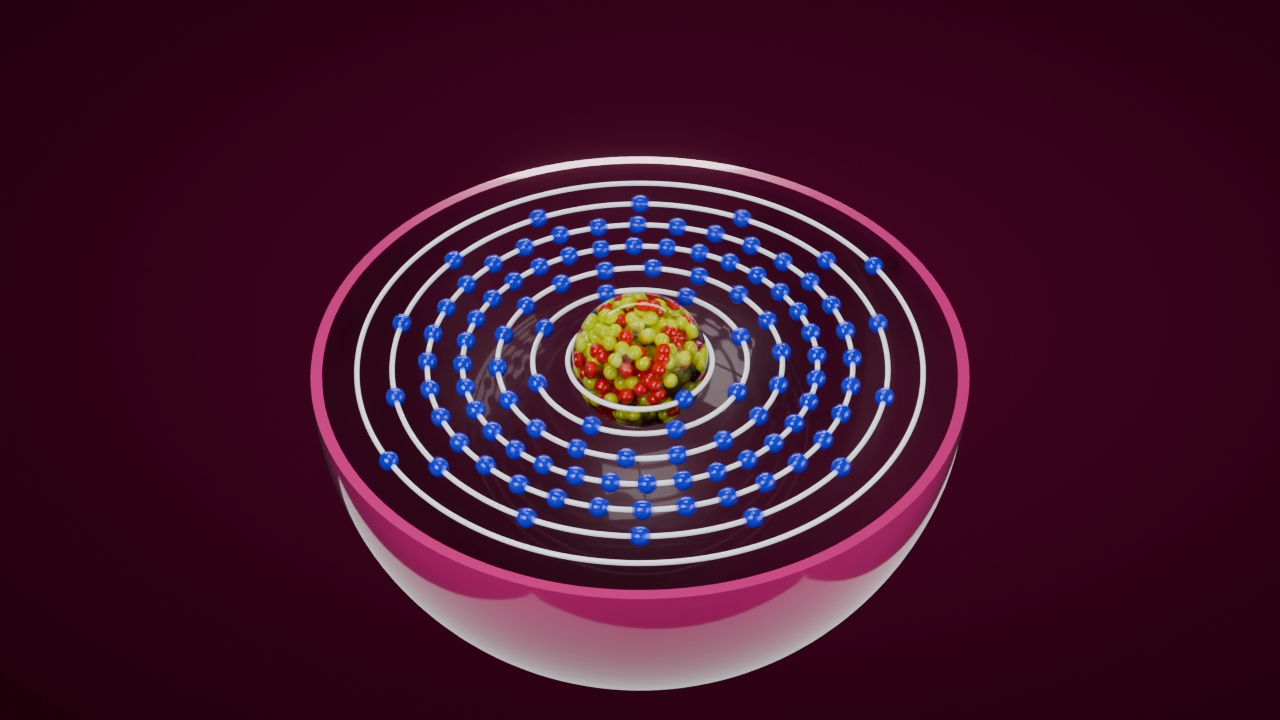
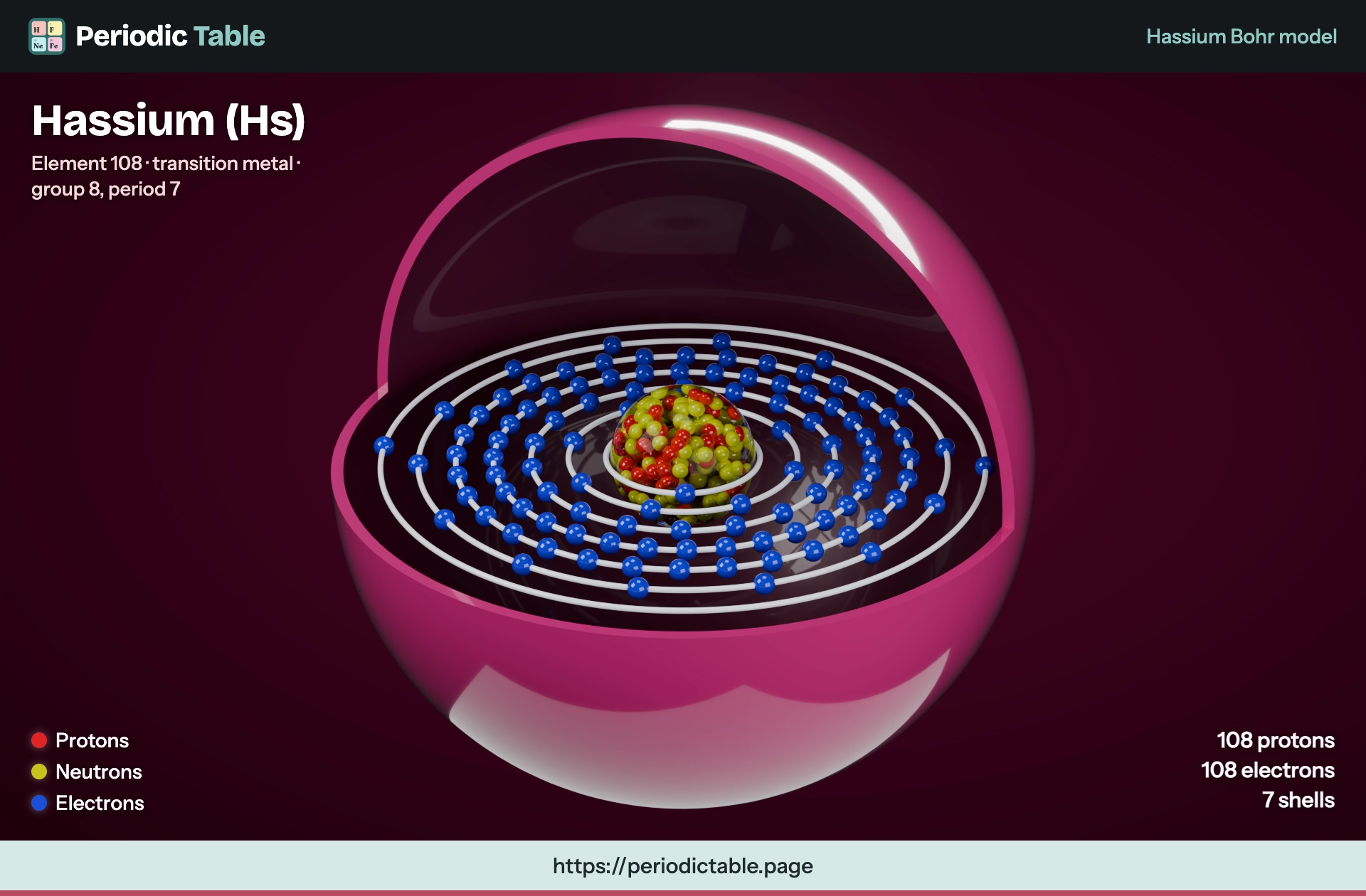
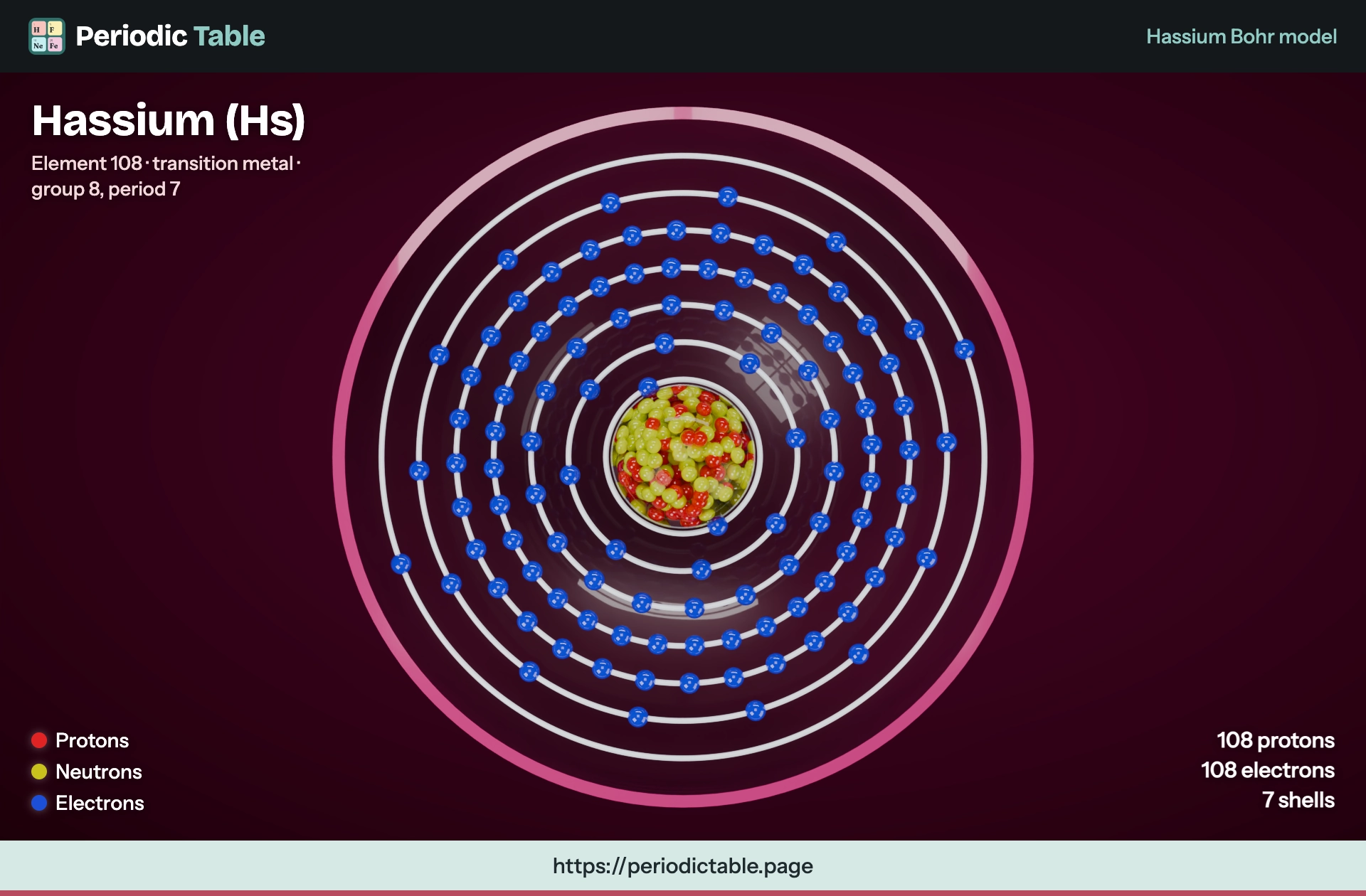
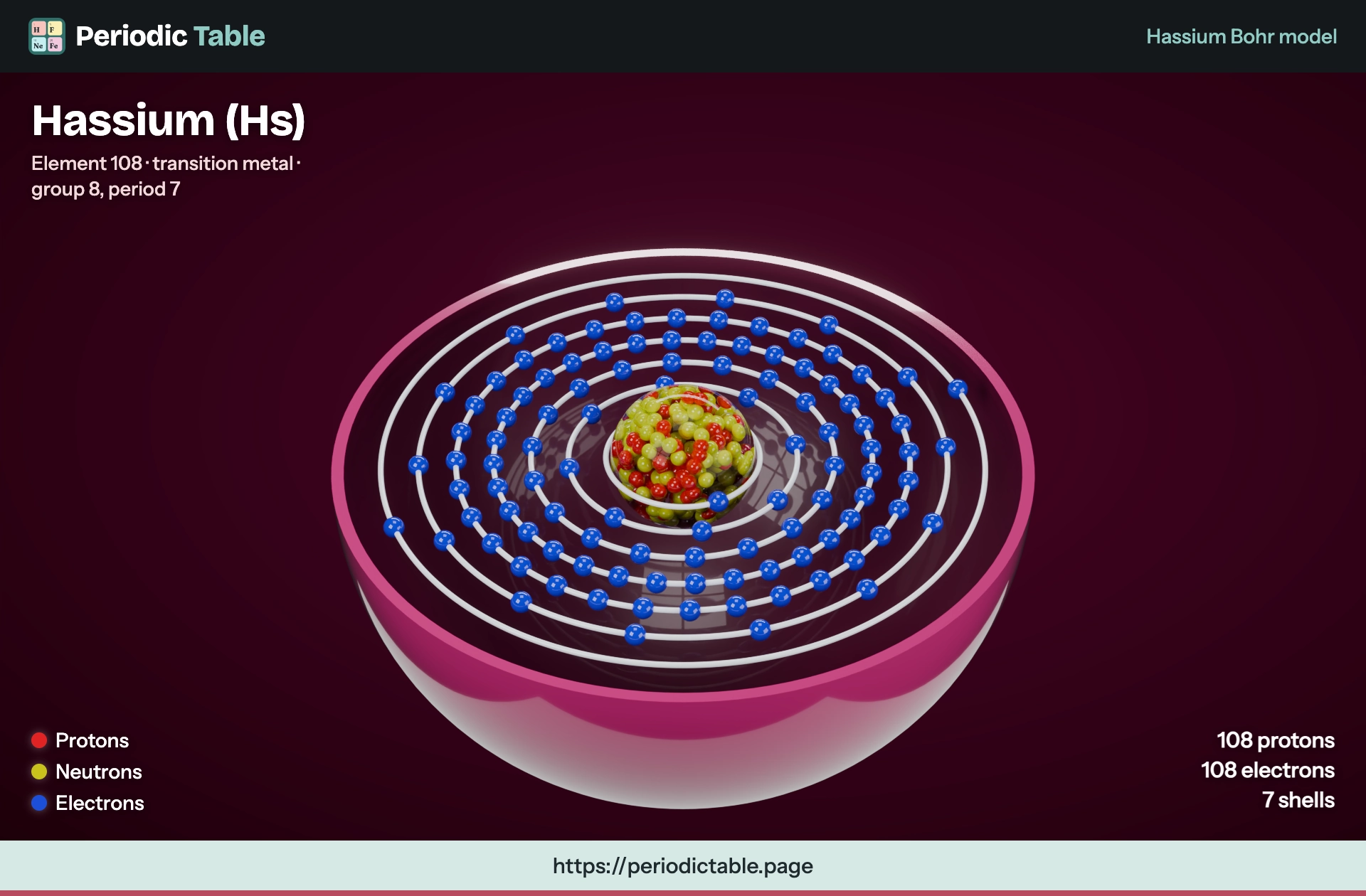
This is a Bohr model of hassium (Hs), a simplified picture of a single hassium atom. Its nucleus holds 108 protons, and a neutral hassium atom has 108 electrons, arranged around it in 7 shells (2 in shell K, 8 in shell L, 18 in shell M, 32 in shell N, 32 in shell O, 14 in shell P and 2 in shell Q).
Hassium periodic table electron configuration
- Shorthand
- *[Rn] 5f14 6d6 7s2
- Full
- 1s2 2s2 2p6 3s2 3p6 4s2 3d10 4p6 5s2 4d10 5p6 6s2 4f14 5d10 6p6 7s2 5f14 6d6
- Electrons per shell
- 2, 8, 18, 32, 32, 14, 2
Hassium element properties and atomic data
- Atomic number
- 108
- Atomic mass
- [269] u
- Phase at STP
- Unknown
- Melting point
- Unknown
- Boiling point
- Unknown
- Density
- 40.7 g/cm³
- Electronegativity (Pauling)
- Unknown
- Period
- 7
- Group
- 8
- Block
- d-block
- Appearance
- Unknown
- Discovery date
- 1984
- Discovered by
- Gesellschaft für Schwerionenforschung
- Named by
- —
Hassium (Hs) at a glance: atomic number, group 8 and period 7
Every atom of this element carries 108 protons in its nucleus, so its atomic number is 108 and a neutral atom holds 108 electrons. Its chemical symbol is Hs. For readers who like discovery stories, the uranium density page tells how Klaproth identified the metal in 1789 and Becquerel found its radioactivity in 1896.
On the periodic table it sits in group 8 and period 7, between bohrium (element 107) on its left and meitnerium (element 109) on its right, with osmium directly above it. Like the other superheavy elements in period 7, it has to be made artificially.
Because no isotope lives long enough to weigh a bulk sample, the atomic mass is quoted as the mass number of a key isotope in square brackets. Different sources quote different isotopes, so you will see [269], [270] or 277 depending on the reference. The table below collects the core data in one place.
| Property | Value for Hs |
|---|---|
| Atomic number | 108 |
| Chemical symbol | Hs |
| Relative atomic mass | [269] (mass number of a key isotope) |
| Group / period / block | Group 8 / period 7 / d-block |
| Electron configuration | [Rn] 5f14 6d6 7s2 |
| State at 20°C | Solid (predicted) |
| Covalent radius | 134 pm (estimated) |
| Atomic radius | About 126 pm (estimated) |
| Ionization energies | 1st 730, 2nd 1760, 3rd 2830 kJ/mol (predicted) |
| CAS number | 54037-57-9 |
| Discovered | 1984, GSI, Darmstadt |
Almost every physical entry is a prediction. That is the normal situation for elements at the bottom of the periodic table, not a gap in the record.
Electron configuration and the D-block
The ground-state electron configuration is [Rn] 5f14 6d6 7s2, which places Hs in the d-block. It is the sixth member of the 6d series, mirroring osmium's 5d6 6s2 one row up.
The six d electrons plus two s electrons give eight valence electrons, which is why the +8 state matters so much in its chemistry. The very large charge on the nucleus changes how those electrons behave, as you will see in the section on relativistic effects.
Why element 108 belongs with the transition metals
Groups 3 to 12 form the transition metals, and group 8 contains iron, ruthenium, osmium and Hs. Element 108 is expected to be the heavier homologue of osmium, a metal that shares its group's chemistry because it shares its outer electron pattern.
Iron is the odd one out among its lighter homologues: ruthenium and osmium form stable compounds in the +8 state, but iron does not. So when chemists wanted a reference for element 108, they compared it with ruthenium and osmium rather than iron.
Hassium discovery: from Dubna to Darmstadt
The hassium discovery story involves two laboratories and a decade of disputed claims, because its synthesis, like that of other superheavy elements, was claimed by more than one team. The first attempt came in 1978 at the Joint Institute for Nuclear Research (JINR) in Dubna, near Moscow, where a team led by Yuri Oganessian fused radium with calcium. Their data were uncertain, and the paper did not claim a discovery. For fluoride chemistry fans, details on element xenon include XeF2, XeF4 and XeO3, with the oxidation states each one shows.
In 1983 JINR tried again with three reactions: bismuth bombarded with manganese, lead with iron, and californium with neon. Those results were announced at a conference rather than in a written report. A 1984 JINR run recorded spontaneous fission events that the team attributed to element 108, but the identification rested on indirect evidence.
The question of credit went to the Transfermium Working Group, formed in 1985 by IUPAC and IUPAP. Its 1993 report found that the GSI work in Germany was enough on its own to establish the discovery, while the JINR work only "very probably" showed element 108. Major credit went to GSI in Darmstadt, and both laboratories accepted the ruling.
Cold fusion and the 1984 GSI experiment
The method that made the synthesis possible is called cold fusion. It has nothing to do with room-temperature fusion claims.
Instead of firing very light nuclei at a very heavy target, you fire a medium-weight ion at a target close to lead-208, a nucleus with magic numbers of protons and neutrons. That stability lowers the excitation energy of the compound nucleus, so fewer neutrons boil off and the product is more likely to survive.
In 1984 a team led by Peter Armbruster and Gottfried Münzenberg at the Gesellschaft für Schwerionenforschung (GSI, the Institute for Heavy Ion Research) fired iron-58 ions from the UNILAC linear accelerator at a lead target. The nuclear fusion of lead and iron produced three atoms of hassium-265, each lasting about two milliseconds. Two years later the same accelerator delivered one atom of Hs-264.
How superheavy atoms are made and detected
Making superheavy elements is a numbers game. A beam of lighter nuclei strikes a target of heavier nuclei, and almost every collision fails because the positively charged nuclei repel each other.
In the language of physics, the odds of a successful nuclear reaction are expressed as a cross section, and for element 108 it is tiny, measured in picobarns. The beam needs enough energy to overcome that repulsion but not so much that the merged nucleus falls apart.
When fusion does succeed, a separator pulls the new nucleus away from the beam and lodges it in a detector, which records its position, energy and arrival time. Physicists then wait for its decay products.
Because each decay happens in the same spot, the chain can be traced back to the parent, which is how synthesis of a new element is confirmed one atom at a time. A nucleus must exist for at least 10-14 seconds to count as an element, about the time it takes to gather electrons around its nucleons.
Naming hassium: unniloctium, hahnium and the transfermium wars
Before discovery, element 108 already had placeholder names. Mendeleev's system would have called it eka-osmium, "one below osmium."
In 1979 IUPAC introduced the systematic element name unniloctium (symbol Uno), built from Latin roots for 1-0-8, as a placeholder until a discovery was confirmed. Many physicists ignored it and simply wrote "element 108."
After the ruling, the GSI team held a naming ceremony on 7 September 1992 and proposed hassium, from Hassia, the Latin name for Hesse, the German state where the GSI institute stands. That should have settled it, but the naming of elements 101 to 109 had become a three-way fight between JINR, GSI and Berkeley over who had made which elements first, known as the Transfermium Wars.
In 1994 an IUPAC committee recommended calling it hahnium (Hn), after Otto Hahn, so that it would sit next to meitnerium and honour Hahn and Lise Meitner's joint discovery of nuclear fission. GSI protested that discoverers had always held naming rights, and the American Chemical Society backed them. Hahnium had also been used by American scientists for element 105, which made the proposal even more confusing.
After an ad hoc committee produced another revised list in 1995, IUPAC reached a compromise in 1996, published in 1997: element 108 became hassium (Hs), element 105 became dubnium, and hahnium was retired. The name also completed a set of GSI place names alongside darmstadtium, element 110.
Hassium isotopes and their half-lives
The element has no stable isotopes and none that occur in nature. Thirteen isotopes of hassium have been reported, with mass numbers from 263 to 277, and several have metastable states, excited forms of the nucleus with their own half-lives. Light ones come from direct fusion.
Heavier ones turn up as decay products of heavier elements such as darmstadtium, flerovium and livermorium. As of 2019, the total amount ever produced across all experiments was only a few hundred atoms.
| Isotope | Half-life | Main decay mode | How it was first made |
|---|---|---|---|
| Hs-265 | 1.96 ms | Alpha, fission | Lead-208 + iron-58 (1984) |
| Hassium-269 | 13 s | Alpha | Decay of copernicium-277 (1996) |
| Hs-270 | 7.6 s | Alpha | Curium-248 + magnesium-26 (2006) |
| Hs-271 | 46 s | Alpha | Curium-248 + magnesium-26 (2008) |
| Hassium-277 | 12 ms | Alpha | Decay of flerovium-289 (2010) |
| Hs-277m | about 130 s | Spontaneous fission | Decay of livermorium-293 (2012) |
The longest half-lives sit in the tens of seconds, and the error bars are wide because so few decays have been counted. Older summaries cite a 1.1-hour Hs-276 or a 12-minute hassium-277. Those figures come from early estimates and do not match current measurements, so treat them with caution.
Alpha decay and spontaneous fission
Most hassium isotopes undergo alpha decay: the nucleus throws out two protons and two neutrons and becomes seaborgium. Hs-270, for example, decays to seaborgium-266. Each alpha particle has a characteristic energy, so a decay chain of several alpha steps ending in a known nucleus pins down exactly which isotope started it.
The other route is spontaneous fission, where the nucleus splits into two large fragments. Basic physics explains why: electrostatic repulsion between protons grows faster than the strong force holding the nucleus together, so fission becomes more important as atomic number rises. The old liquid drop model predicted that the fission barrier would vanish at about 280 nucleons, which would make elements this heavy impossible.
Real nuclei turned out to be tougher than that, as the next section explains. Both modes are types of radioactive decay and both are what detectors watch for.
Magic numbers and the deformed nucleus of hassium-270
The nuclear shell model says that nuclei with certain magic numbers of protons or neutrons are extra stable. For spherical nuclei the highest known magic numbers are 82 protons and 126 neutrons.
Superheavy nuclei, though, are not spherical. They are deformed nuclei, stretched like a rugby ball, and they follow their own set of magic numbers.
In 1991 theorists predicted that 108 protons and 162 neutrons would be magic for deformed nuclei. Hassium-270 has exactly that combination, which makes it a candidate "deformed doubly magic" nucleus.
Decay data from isotope 270 and its neighbours support 162 as a neutron magic number. This is one of the clearest experimental tests in nuclear physics of how shell effects hold up the heaviest nuclei, and it is why Hs-270 matters more to physics than its 7.6-second half-life would suggest.
A half-life example: how many atoms survive?
A half-life is the time it takes for half of a group of atoms to decay. The number left after a time t follows:
$$N = N_0 \times \left(\frac{1}{2}\right)^{t / T_{1/2}}$$
Suppose an experiment collects 9 atoms of Hs-270, with \(T_{1/2} = 7.6\) s. After 7.6 seconds you expect 4.5 to remain, after 15.2 seconds about 2.25, and after 30 seconds only about 0.58 of an atom, meaning there is roughly a 6.5% chance per atom that it is still intact. To fall to 1% of the starting number takes \(T_{1/2} \times \log_2 100 \approx 7.6 \times 6.64 \approx 50.5\) seconds.
Even the 46-second Hs-271 drops to 1% in about 306 seconds. That is the window that every piece of research on the element has to fit inside.
Physical properties of hassium: density and crystal structure
The physical properties of Hs have never been measured on a bulk sample, because no bulk sample has ever existed. What exists are predicted properties from calculations. It is expected to be a solid at room temperature, like the group 8 metals above it, and to crystallise in a hexagonal close-packed crystal structure, the same arrangement as osmium.
The headline prediction is its density: about 27 to 29 g/cm3, compared with 22.59 g/cm3 measured for osmium, the densest element that has been weighed. That would make Hs one of the densest of the 118 known elements. Some older educational sources quote around 40.7 g/cm3, which comes from an earlier estimate.
Calculations also predict a bulk modulus of about 450 GPa, close to diamond's 442 GPa, so the metal would resist compression about as strongly as diamond. These figures place it firmly among the heavy elements.
Melting point, boiling point and other unknowns
The melting point and boiling point are unknown, and so are the electronegativity, electron affinity and heat capacity. Researchers can still estimate the trend: iron melts at 1538 °C, ruthenium at 2334 °C and osmium at 3033 °C, so the heaviest member of the group should also melt at a very high temperature. The RSC data sheet simply lists "unknown" for most of these entries, which is the honest answer.
Relativistic effects in a transactinide atom
Hassium is a transactinide, one of the elements after the actinides with atomic numbers above 103. In transactinides the nucleus carries so much charge that the inner electrons move at a large fraction of the speed of light. These relativistic effects pull the s orbitals closer to the nucleus and push the 6d orbitals outward.
The practical result is that an Hs+ ion is predicted to lose a 6d electron rather than a 7s electron, the opposite of osmium. Relativistic effects are also expected to raise the ionization energy and make the +8 oxidation state more stable than it is for osmium. Across the transactinides, these effects are the main reason chemists test new elements instead of assuming it follows the table.
Chemical properties and oxidation states of the hassium element
The chemical properties of the hassium element are mostly predicted from its position in the periodic table, with a few key points confirmed by gas-phase chemistry experiments. Hassium is expected to behave as a noble metal, much like the platinum group metals, and to share the wide range of oxidation states seen in ruthenium and osmium.
| Element | Symbol | Stable oxidation states | Tetroxide |
|---|---|---|---|
| Iron | Fe | +6, +3, +2 | None (forms ferrate instead) |
| Ruthenium | Ru | +8, +6, +5, +4, +3, +2 | RuO4, volatile |
| Osmium | Os | +8, +6, +5, +4, +3, +2 | OsO4, very volatile |
| Hassium | Hs | +8 expected, plus +6, +4, +3, +2 | HsO4, measured in 2001 |
The +8 state is rare in chemistry: among stable elements only ruthenium, osmium and xenon reach it in reasonably stable compounds. Oxidation to +8 becomes easier down group 8, so Hs should hold it well. In water, the +4 state is predicted to be more stable than +8.
Hassium tetroxide and the group 8 volatility trend
Group 8 has a distinctive oxide chemistry. Osmium burns in oxygen to form osmium tetroxide, OsO4, a very volatile solid, and ruthenium forms RuO4.
Both molecules are volatile because they are symmetrical tetrahedra with no overall charge. Hassium tetroxide, HsO4, was predicted to be a similar volatile tetroxide, a gaseous oxide at modest temperatures that can be carried by a gas stream.
The measured volatility trend runs RuO4 < OsO4 > HsO4: the hassium oxide is volatile, but slightly less so than the osmium compound. That pattern is what you would expect from a genuine member of group 8.
Experimental chemistry of hassium: the 2001 gas-phase test
The first experimental chemistry on element 108 was done in 2001 at GSI, using equipment developed with Lawrence Berkeley National Laboratory and built in Switzerland. Because only a few atoms could be made, the chemistry had to work on single molecules.
A beam of magnesium-26 ions struck curium-248 targets mounted on a rotating wheel, producing atoms of mass 269 and 270. Seven hassium atoms in total were made. Each was swept into a mixture of helium and oxygen, where it reacted to form HsO4.
The molecules then travelled along a channel of semiconductor detectors cooled from about −20 °C down to −170 °C, a technique called thermochromatography. Each molecule would condense at the point where the surface temperature matched its volatility, then its decay revealed where it had stopped.
The chemistry of hassium showed up clearly in the gas phase. Hassium tetroxide deposited at a higher temperature than osmium tetroxide, meaning it was less volatile, and that result placed Hs firmly in group 8. The measured enthalpy of adsorption for HsO4 was −46 ± 2 kJ/mol, compared with −39 ± 1 kJ/mol for OsO4.
Adsorption enthalpy is the energy released when a molecule sticks to a surface, so the more negative value confirms the stronger hold. Later calculations in 2008 matched the experiment closely.
In 2004 a follow-up experiment reacted the tetroxide with sodium hydroxide to form sodium hassate(VIII), the first acid-base reaction of a hassium compound. Researchers have since planned studies of hassocene, Hs(C5H5)2, to test the low +2 oxidation state, though no results have been reported yet.
Natural occurrence: could Hs exist in nature?
As far as anyone knows, there is no natural occurrence of Hs on Earth. Every known isotope decays in seconds, so any Hs present when the planet formed is long gone. That has not stopped people from looking.
In 1963 Soviet geologist Viktor Cherdyntsev claimed to have found element 108 in the mineral molybdenite and proposed the name "sergenium." Physicists pointed out that his claimed half-life and decay energy did not fit nuclear physics, and the claim was dropped. In 2006 another proposal suggested that a long-lived isomer of Hs-271 might explain unusual alpha signals in molybdenite and osmiridium, but the predicted half-life is still too short for meaningful amounts to remain.
From 2004 JINR ran a search at the Modane Underground Laboratory in France, deep underground to block cosmic rays. Experiments in 2008-09 and 2012-13 found neutron events in natural osmium that hinted at hassium in nature in amounts detectable by analytical chemistry, but only if a long-lived isotope exists.
Theorists also flagged Hs-292, near the predicted island of stability at 184 neutrons, as unusually resistant to alpha decay and fission, yet it should be unstable to beta decay. For now, hassium belongs with the other synthetic chemical elements and the other superheavy elements that exist only when people make them.
Hassium uses: a radioactive element made only for research
There are no practical hassium uses outside the laboratory. Only a few hundred atoms have ever existed, each lasting seconds or less, so there is nothing to build with, sell or put into medicine.
The element has no biological role. Being radioactive, any sizeable amount would be toxic, but that risk is theoretical because no such amount will ever be made.
What the element does offer is information. Every new measurement of hassium properties tests three things at once: whether the periodic table still predicts chemistry this far down, how strongly relativistic effects bend the trends, and how well the physics of shell models describes deformed superheavy nuclei. As a transactinide element that has been chemically characterised, hassium also serves as a benchmark for the techniques now used on even heavier elements such as copernicium and flerovium.