


Uranium element (U): uranium periodic table facts
Uranium periodic table facts: uranium (U) is element 92, an actinide in period 7 of the f-block. If you have ever wondered what actually powers a nuclear plant, the answer starts with uranium, the chemical element with symbol U and atomic number 92. To read about argonium, clathrates and the first compound, argon fluorohydride, look up argon (ar) first for the basics.
Uranium is a dense, silvery-white metal in the actinide series of the periodic table, and it is radioactive. That combination is why uranium can release enormous amounts of energy from a very small mass, and why the uranium in rocks, reactors and weapons gets so much attention.
Rotate the 3D Bohr model of uranium
Drag to orbit, scroll to zoom.
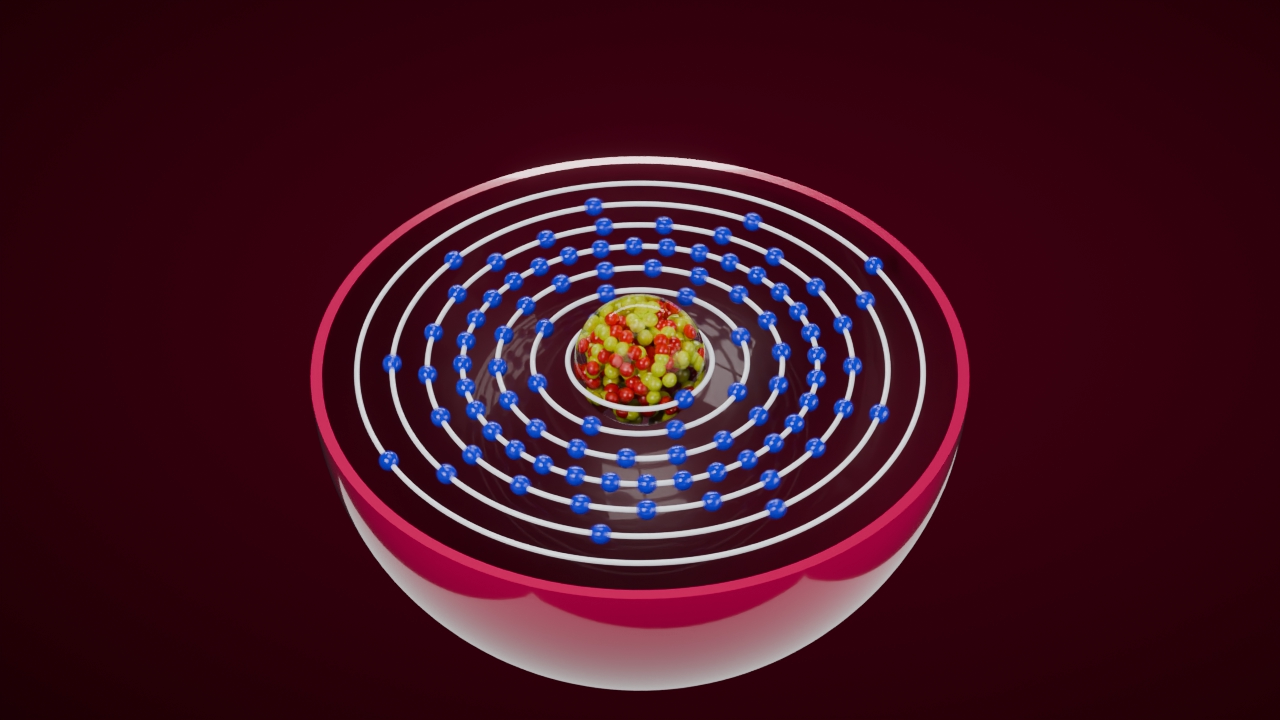
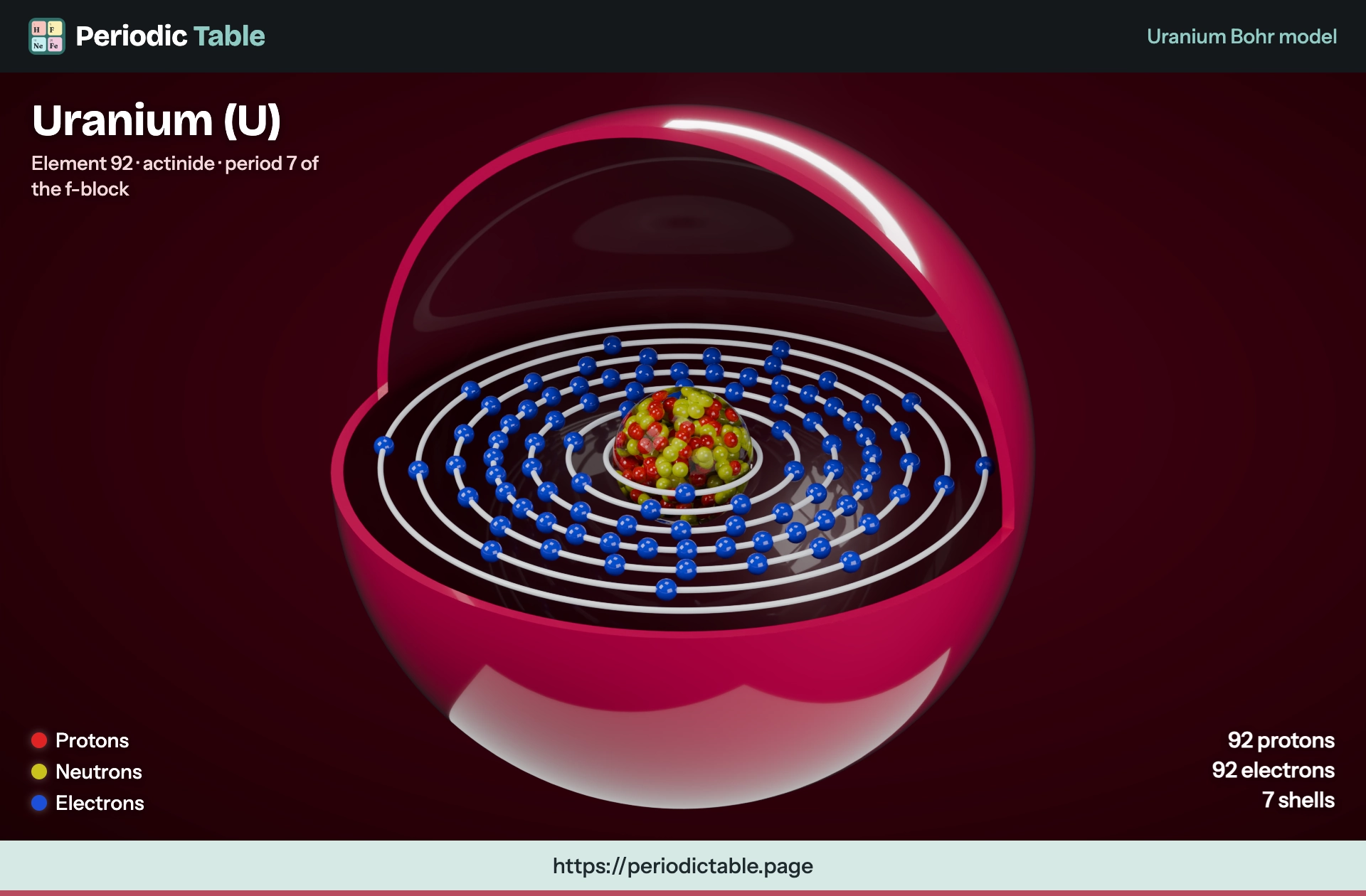
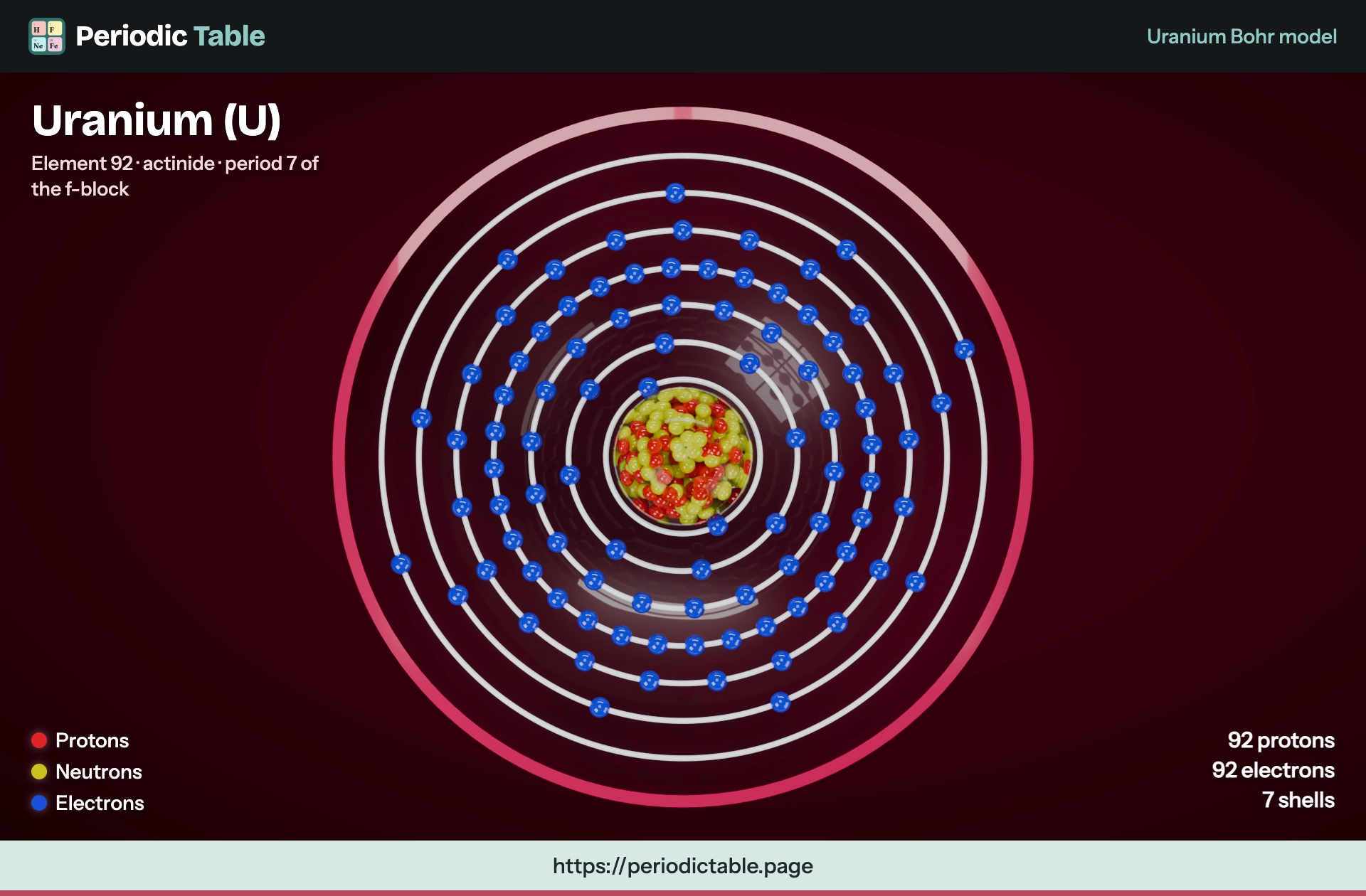
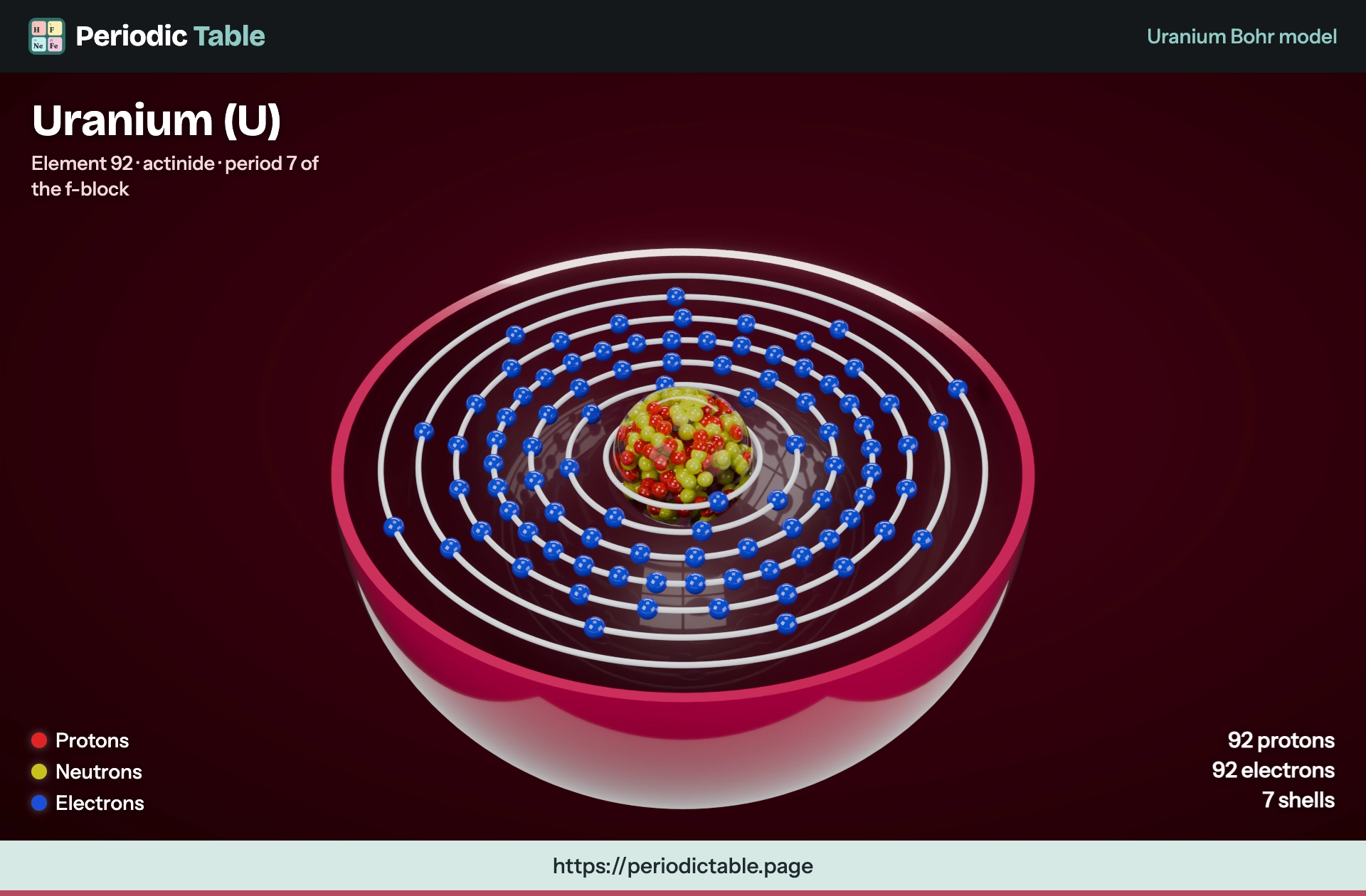
This is a Bohr model of uranium (U), a simplified picture of a single uranium atom. Its nucleus holds 92 protons, and a neutral uranium atom has 92 electrons, arranged around it in 7 shells (2 in shell K, 8 in shell L, 18 in shell M, 32 in shell N, 21 in shell O, 9 in shell P and 2 in shell Q).
Uranium periodic table electron configuration
- Shorthand
- [Rn] 5f3 6d1 7s2
- Full
- 1s2 2s2 2p6 3s2 3p6 4s2 3d10 4p6 5s2 4d10 5p6 6s2 4f14 5d10 6p6 7s2 5f3 6d1
- Electrons per shell
- 2, 8, 18, 32, 21, 9, 2
Uranium element properties and atomic data
- Atomic number
- 92
- Atomic mass
- 238.0289 u
- Phase at STP
- Solid
- Melting point
- 1132.15°C (1405.3 K)
- Boiling point
- 4130.85°C (4404 K)
- Density
- 19.1 g/cm³
- Electronegativity (Pauling)
- 1.38
- Period
- 7
- Group
- —
- Block
- f-block
- Appearance
- Unknown
- Discovery date
- 1789
- Discovered by
- Martin Heinrich Klaproth
- Named by
- —
Uranium at a glance: key facts for element 92
Uranium sits in period 7 of the periodic table and belongs to the f-block, among the actinides. It lies between protactinium (element 91) and neptunium (element 93), and it is the heaviest primordial element, meaning uranium has survived on Earth since the planet formed. Students studying hazards of acids will find hydrofluoric acid, hydrogen fluoride and toxicity covered carefully in fluorine atoms in this section of the guide.
Because it is so heavy and so dense, uranium is often described as a heavy metal in both the chemical and the toxicological sense. Every actinide is radioactive, and uranium is one of only two, with thorium, found in large natural deposits.
The table below collects the uranium data you are most likely to need for chemistry homework or a quick reference check.
| Property | Uranium (U) value |
|---|---|
| Atomic number | 92 |
| Standard atomic weight | 238.029 |
| Group, period, block | Actinides, period 7, f-block |
| Electron configuration | [Rn] 5f3 6d1 7s2 |
| Melting point | 1132 °C (1405 K) |
| Boiling point | 4131 °C (4404 K) |
| Density at 20 °C | 19.05 g/cm3 |
| Electronegativity (Pauling scale) | 1.38 |
| Atomic radius (empirical) | 156 pm |
| Covalent radius | 196 pm |
| Van der Waals radius | 186 pm |
| Common oxidation states | +6, +4 (also +3, +5) |
| CAS number | 7440-61-1 |
| State at room temperature | Solid metal |
Sources quote the atomic mass slightly differently (238.03 is the usual rounded atomic weight), because uranium in nature is a mix of isotopes and the abundance varies slightly from deposit to deposit.
Electron configuration and valence electrons
A neutral uranium atom has 92 protons in its core balanced by 92 electrons. Written in full, the electron configuration ends in 5f3 6d1 7s2, giving uranium six valence electrons. Because the 5f, 6d and 7s orbitals sit close in energy, uranium can lend out anywhere from three to all six of them, which explains its unusually wide spread of oxidation states compared with the lanthanides directly above it.
Physical properties of uranium metal: density, melting point and boiling point
Freshly cut uranium metal is silvery white, but it tarnishes within hours to a dark oxide skin. Its standout property is density: at 19.05 g/cm3 it is far denser than lead (11.34 g/cm3) and only a little lighter than gold and tungsten (both about 19.3 g/cm3). A standard 1-litre milk carton filled with uranium would weigh just over 19 kg. Chemists and physicists use the isotopes of hassium to follow synthesis, radioactive decay and heavy ion experiments.
Uranium has a melting point of 1132 °C and a boiling point of 4131 °C. Other physical traits worth knowing:
- It is malleable and ductile, and with a Mohs hardness of about 6 it can scratch glass.
- It is slightly paramagnetic, strongly electropositive and a poor electrical conductor for a metal.
- Finely divided uranium powder is pyrophoric: it can ignite on its own in air.
- Its specific heat capacity is about 116 J/(kg·K), and Young's modulus is roughly 208 GPa.
The metal is also allotropic: its crystal structure changes twice before it melts. The orthorhombic alpha form is stable up to 668 °C, a tetragonal beta form exists from 668 to 775 °C, and the body-centered cubic gamma form, the softest and most workable, runs from 775 °C to the melting point. Fuel fabricators care about these phase changes because each one shifts the volume of the metal.
Uranium isotopes: uranium-238, uranium-235 and uranium-234
All uranium atoms have 92 protons, but they differ in how many neutrons sit in the nucleus. These versions are the uranium isotopes. Scientists have identified more than two dozen isotopes of uranium, yet natural uranium contains only three: uranium-238 (U-238, 146 neutrons), uranium-235 (U-235, 143 neutrons) and a trace of uranium-234 (U-234).
| Isotope | Neutrons | Natural abundance | Half-life | Main decay |
|---|---|---|---|---|
| U-238 | 146 | 99.27% | 4.47 billion years | Alpha |
| U-235 | 143 | 0.72% | 704 million years | Alpha |
| U-234 | 142 | 0.005% | 246,000 years | Alpha |
| U-236 | 144 | Trace | 23.4 million years | Alpha |
| U-233 | 141 | Trace (bred from thorium) | 159,000 years | Alpha |
| U-232 | 140 | Synthetic | 69 years | Alpha |
Uranium-234 is not primordial in its own right. It is a decay product of U-238, which is why it is always found mixed in at a tiny, steady proportion.
Uranium-236 forms inside reactors when U-235 captures a neutron without splitting, so its presence is a fingerprint of material that has been through a reactor. Uranium-233 is fissile and can be bred from thorium, while uranium-232 is a nuisance contaminant whose decay chain emits penetrating gamma radiation.
Half-life and radioactivity of each isotope
Uranium's radioactivity is gentle by the standards of most radioactive materials. Every natural isotope decays mainly by emitting an alpha particle, which is why uranium is classed as a weakly radioactive alpha emitter. A very small fraction of nuclei also undergo spontaneous fission.
The half-life sets how quickly each isotope disappears. Run the numbers over the 4.54 billion years since Earth formed and you get a striking contrast: about 49% of the original U-238 is still here, but only about 1.1% of the original U-235 survives.
That uneven decay is why U-235 is now so scarce. It also means the slow decay of uranium, together with thorium and potassium-40, supplies much of the decay heat that keeps Earth's interior hot.
Uranium's decay chain does not stop at the uranium itself. Its daughters include radium and radon, which give off gamma radiation and are responsible for most of the dose near uranium ore.
Fissile vs fertile: how uranium-238 breeds plutonium-239
Uranium-235 is fissile: its nucleus splits readily when it absorbs slow neutrons, also called thermal neutrons. It is the only naturally occurring fissile isotope present in more than trace amounts.
U-238 is different. It only splits when struck by fast neutrons, and even then not efficiently enough to sustain a reaction on its own.
What U-238 does instead is capture a neutron and transform. That makes it fertile, and the sequence runs:
$$^{238}_{92}\mathrm{U} + n \rightarrow\ ^{239}_{92}\mathrm{U} \xrightarrow{\beta^-}\ ^{239}_{93}\mathrm{Np} \xrightarrow{\beta^-}\ ^{239}_{94}\mathrm{Pu}$$
The end product, plutonium-239, is fissile. In an ordinary reactor some of that plutonium burns where it forms and adds a meaningful share of the fuel's energy output. A breeder reactor is designed to push this further, producing more fissile plutonium than it consumes.
How nuclear fission splits the uranium atom
When a uranium-235 nucleus absorbs a neutron, it becomes so unstable that it splits into two lighter nuclei, releasing about 200 MeV of energy and freeing two or three more. That process is nuclear fission, and splitting the uranium atom releases millions of times more energy than burning a carbon atom.
To see the scale for yourself, take a single gram of uranium-235 and assume every nucleus fissions:
$$E = \frac{6.022 \times 10^{23}}{235.04} \times 202.5\ \mathrm{MeV} \approx 8.3 \times 10^{10}\ \mathrm{J}$$
That is roughly 23 megawatt-hours of heat from one gram, about what you would get from burning nearly 3.5 tonnes of coal at 24 MJ/kg. In practice a reactor never fissions every atom, but the ratio explains why a reactor core of fuel assemblies only needs part of its load replaced every one to two years.
Chain reaction inside a nuclear reactor
Because each fission frees more neutrons than it used, one split can trigger the next. If, on average, exactly one neutron from each fission causes another, you have a steady chain reaction. A nuclear reactor is built to hold that balance:
- A moderator in the nuclear core (ordinary water, heavy water or graphite) slows neutrons so U-235 captures them more easily.
- Control rods made of neutron absorbers are inserted or withdrawn to set the reactor's power.
- The fission heat boils water into steam, which spins a turbine and generator to make electricity.
Most of the world's nuclear plants are light-water designs that need enriched fuel. Heavy-water designs such as CANDU, and older graphite reactors, can run on unenriched uranium because their moderators absorb fewer neutrons.
Where natural uranium occurs: pitchblende, uraninite and other minerals
Uranium is far more common than its reputation suggests. It averages about 2 to 4 parts per million in Earth's crust, ranking roughly 48th among the elements, which makes it more plentiful than silver or tin and about as common as molybdenum. You will find small amounts in almost all soil and rock, and seawater carries around 3 parts per billion (sea water across all the oceans holds billions of tonnes in total, though it is hard to recover).
Uranium occurs in hundreds of minerals, almost always combined with oxygen and other elements rather than as a native metal. The economically important ones include:
- Uraninite (UO2), the main ore mineral; its massive, pitch-black variety is called pitchblende.
- Carnotite, a bright yellow vanadate mineral common in sandstone deposits.
- Autunite and torbernite, green phosphate minerals; autunite glows strongly under ultraviolet light, while the copper in torbernite quenches it.
- Uranophane (a calcium-bearing silicate) and coffinite (a uranium silicate).
- Low-grade sources such as phosphate rock, lignite and monazite sands.
In geology, uranium's high solubility in its oxidized form lets groundwater dissolve it, carry it and then drop it where conditions turn reducing. That is how many sandstone and unconformity deposits formed.
Origin of uranium in supernovae
Uranium was not made on Earth. Like other elements heavier than iron that need rapid neutron capture, it forms through the r-process in supernovae and neutron-star mergers. Earth inherited its uranium and thorium from those events, and both have been decaying ever since.
Uranium mining and world production
Uranium mining is concentrated in a handful of countries. Kazakhstan has led world output since 2009, mostly through in situ methods, with Canada, Namibia and Australia following.
Australia holds the largest share of known recoverable resources. The ranking below groups recent producers by order of magnitude rather than exact tonnages, which change every year.
| Country | Role in uranium supply | Main mining approach |
|---|---|---|
| Kazakhstan | Largest producer, around 40% of world output | In situ recovery |
| Canada | Second-largest producer; very high-grade ore | Underground |
| Namibia | Major producer | Open pit |
| Australia | Largest identified resources | Underground and by-product |
| Uzbekistan | Mid-sized producer | In situ recovery |
| Russia | Mid-sized producer | Underground and in situ |
| Niger | Historic producer, output now falling | Open pit and underground |
Uranium is traded under international safeguards: most sales go to members of the Nuclear Non-Proliferation Treaty that accept inspections, and the few exceptions need special bilateral agreements, so trade flows are tightly tracked.
In situ leaching vs open-pit and underground mines
Conventional mining digs the ore out, either from an open pit or underground workings, then crushes it and dissolves the uranium with acid at a mill. In situ leaching skips the digging: a weak acid or alkaline solution is pumped through a porous ore body underground, dissolves the uranium in place, and is pumped back to the surface for processing.
In situ leaching now produces more than half the world's uranium. It leaves less surface disturbance, but it only works where the ore sits in permeable rock confined by impermeable layers.
From uranium ore to nuclear fuel
Raw uranium ore cannot go straight into a nuclear reactor core. Turning it into nuclear fuel is a chain of chemical and physical steps known as the front end of the fuel cycle:
- Milling or in situ leaching produces yellowcake, a uranium oxide concentrate (mainly U3O8), which is the form uranium is traded in.
- Conversion turns the oxide into a gas so the isotopes can be separated.
- Enrichment raises the share of uranium-235.
- Fabrication turns the enriched material back into ceramic fuel.
Uranium hexafluoride and enrichment
Conversion produces uranium hexafluoride (UF6), a compound that turns to gas at a modest temperature, which makes it suitable for isotope separation. Enrichment exploits the tiny mass difference between U-235 and U-238. Modern plants use cascades of gas centrifuges spinning at very high speed, which push the heavier U-238 molecules outward and let slightly U-235-rich gas be drawn off.
Here is a worked mass balance you can reproduce. Suppose you want 10 kg of uranium enriched to 4.5% U-235, starting from a natural feed at 0.711% and leaving tails at 0.25%:
$$F = P \times \frac{x_p - x_t}{x_f - x_t} = 10 \times \frac{4.5 - 0.25}{0.711 - 0.25} \approx 92.2\ \mathrm{kg}$$
So about 92 kg of natural feed yields 10 kg of product and leaves roughly 82 kg of depleted tails, which is why depleted material piles up wherever enrichment happens. After enrichment the UF6 is converted to uranium dioxide powder, pressed and baked into fuel pellets about the size of a fingertip, and stacked inside zirconium-alloy tubes to form fuel rods. Bundles of rods become the uranium fuel assemblies loaded into the core.
Enriched uranium grades: LEU, HEU and depleted uranium
The U-235 content defines what enriched uranium can be used for:
- Natural uranium: about 0.71% U-235, used directly in heavy-water reactors.
- Low enriched uranium (LEU): above natural but below 20% U-235. Most power reactors use 3% to 5%, sometimes called reactor-grade uranium.
- Highly enriched uranium (HEU): 20% U-235 or more, used in naval propulsion, some research reactors and, at around 90%, weapons.
- Depleted uranium (DU): the leftover tails, below 0.711% U-235 and often near 0.2% to 0.3%.
Weapon material from dismantled nuclear warheads has been blended down with depleted or natural uranium and burned as reactor fuel, turning a security risk into electricity.
Uses of uranium in nuclear power and beyond
By far the biggest of the uses of uranium is nuclear power. Around 440 reactors in about 30 countries generate close to a tenth of the world's electricity from uranium fuel, and some countries, France most notably, get the majority of their power that way. Nuclear power plants release almost no carbon dioxide while operating, which is why uranium features in many low-carbon energy plans.
Uranium also has smaller roles outside power generation:
- Uranium metal is used as a target to produce high-energy X-ray beams.
- Research reactors fuelled with uranium make medical isotopes, supporting diagnosis and treatment in medicine.
- Uranyl acetate stains biological samples for electron microscopy.
- Naval reactors use highly enriched fuel so submarines and carriers can go years between refuelling.
Nuclear weapons and military uses
Highly enriched uranium-235 was the explosive in Little Boy, the first nuclear weapon used in war, dropped on Hiroshima in August 1945. Nuclear weapons since then have mostly relied on plutonium bred from U-238, often with a uranium casing that adds to the yield.
The military also uses depleted uranium for its density rather than its radioactivity. DU penetrators in anti-tank rounds sharpen themselves as they pierce a target, and DU plates harden tank armor. Away from weapons, the same density makes DU useful for aircraft counterweights, yacht keels, gyroscopic instruments and radiation shielding in containers for strong radioactive sources, where it outperforms lead shielding of the same thickness.
Uranium glass, glazes and radiometric dating
Long before anyone split an atom, uranium was a colouring agent. Uranium oxide gave yellow glass and ceramic glazes their vivid hues, and uranium glass (often called vaseline glass) glows bright green under UV light.
The orange-red glaze on vintage Fiestaware dinnerware also contained uranium. These pieces give a measurable reading on a radiation meter but are generally considered low risk to handle.
Science found a quieter use in radiometric dating. Because U-238 and U-235 decay to lead at known rates, the uranium-to-lead ratio in zircon crystals can date rocks billions of years old, and uranium-thorium dating covers younger corals and cave deposits.
History of the element uranium: from Klaproth to the Manhattan project
The element uranium was named after a planet. In 1789 the German chemist Martin Heinrich Klaproth dissolved pitchblende in nitric acid, precipitated a yellow compound and heated it to a black powder he believed was a new metal.
It was really an oxide, but he had found a new element and named it after the planet Uranus, discovered eight years earlier. The key milestones that followed:
- 1789: uranium is identified in the black ore and named after Uranus.
- 1841: Eugène-Melchior Péligot isolates the first uranium metal by heating uranium tetrachloride with potassium.
- 1896: Henri Becquerel finds that uranium salts fog a wrapped photographic plate, discovering radioactivity.
- 1898: Marie and Pierre Curie extract radium from uranium ore, and Becquerel's rays get a name.
- 1934: Enrico Fermi's team bombards uranium with neutrons and gets puzzling products.
- 1938-1939: Otto Hahn and Fritz Strassmann detect barium among those products, and Lise Meitner and Otto Frisch explain it as fission.
- 1942: Fermi's Chicago Pile-1 achieves the first self-sustaining chain reaction under the Manhattan Project.
- 1951-1954: the first reactor-generated electricity in Idaho, then the first grid-connected nuclear power station at Obninsk.
Nature beat everyone to it. At Oklo in Gabon, ore deposits ran as natural fission reactors about 1.7 billion years ago, when U-235 made up close to 3% of uranium, enough for water-moderated chain reactions. During the Cold War, the US and Soviet Union amassed huge uranium stockpiles, and securing that material became a priority after 1991.
Uranium compounds and chemistry
Uranium's chemistry is rich because it reacts with nearly every non-metal. The metal dissolves in hydrochloric acid and nitric acid, reacts with hot water, and combines with hydrogen to form uranium hydride, a powder once used as a route to finely divided metal.
With carbon and nitrogen it forms refractory uranium carbide and nitrides, studied as advanced reactor fuels. Its halides range from UF6 to the grass-green tetrachloride.
The most important uranium compounds for the nuclear industry are the oxides and the fluorides that move uranium through the fuel cycle.
Oxidation states of uranium
Uranium shows oxidation states from +3 to +6, with +4 and +6 the most stable. In water, +6 uranium exists as the linear uranyl ion, UO22+, with two oxygen atoms bonded tightly on opposite sides. The +4 state is far less soluble, so whether uranium stays dissolved or settles out depends on how oxidizing its surroundings are.
Uranium dioxide, uranyl and other oxides
Uranium dioxide (UO2) is the ceramic inside most fuel pellets: it has a very high melting point and holds fission products well. U3O8 is the stable form shipped from mines, and uranium trioxide (UO3) is an intermediate in conversion. Uranyl salts are the uranium salts you are most likely to meet in a lab; uranyl acetate is the classic example.
Uranium health effects and radiation safety
For most people, the health risk from uranium is chemical rather than radiological. Soluble uranium salts are toxic to the kidneys in roughly the way lead is, and soluble forms that are swallowed or inhaled pose the main hazard.
Because uranium is an alpha emitter, its radiation barely penetrates skin; the danger comes from dust that gets inside the body. Miners face a separate risk from radon gas, and long-term studies have linked work in uranium mines to higher lung cancer rates, a clear occupational health signal.
The bigger environment and public health question is what happens once fuel leaves the nuclear reactor. Spent fuel is still mostly U-238 but carries intensely radioactive fission products.
Spent nuclear fuel is cooled in pools, then moved to dry casks, and ultimately needs deep geological disposal. Managing radioactive waste and nuclear waste from mines and mills, including tailings piles, is one of the long-term costs of nuclear energy, and regulators set exposure limits to protect worker health around these sites.