Fluorine element (F): fluorine periodic table facts
Fluorine periodic table facts: fluorine (F) is element 9, a halogen in group 17, period 2. Nothing on the periodic table pulls on electrons as hard as fluorine, the pale yellow halogen that sits at atomic number 9. In this guide you get the full picture of this chemical element: its core data, why it reacts with almost everything, where it comes from, and how a gas this dangerous ends up in your toothpaste, your cookware and the fuel in nuclear reactors. Industrial gas suppliers serve metals, lighting and medicine, and the argon on the periodic table explains how that works.
Rotate the 3D Bohr model of fluorine
Drag to orbit, scroll to zoom.
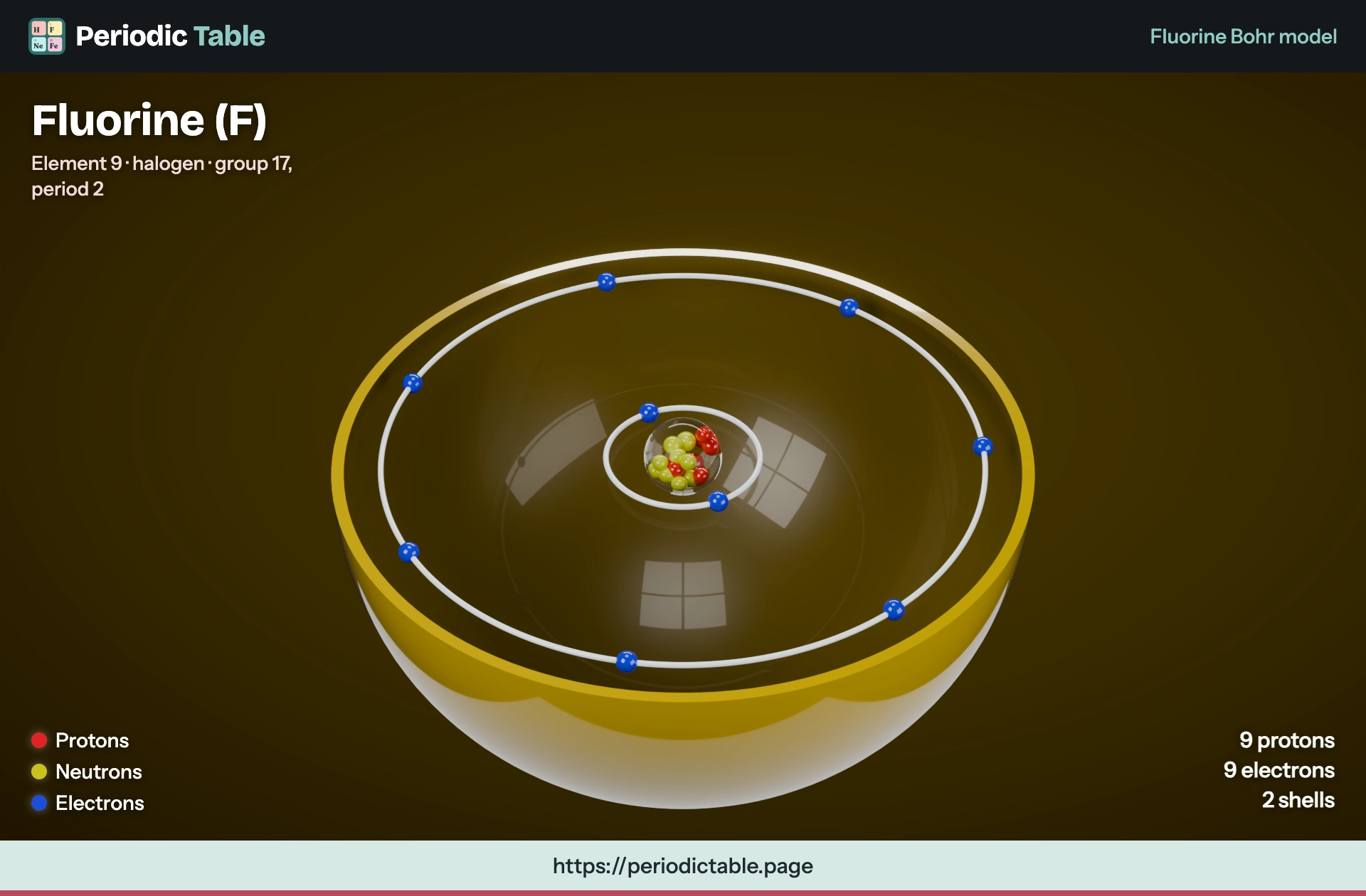
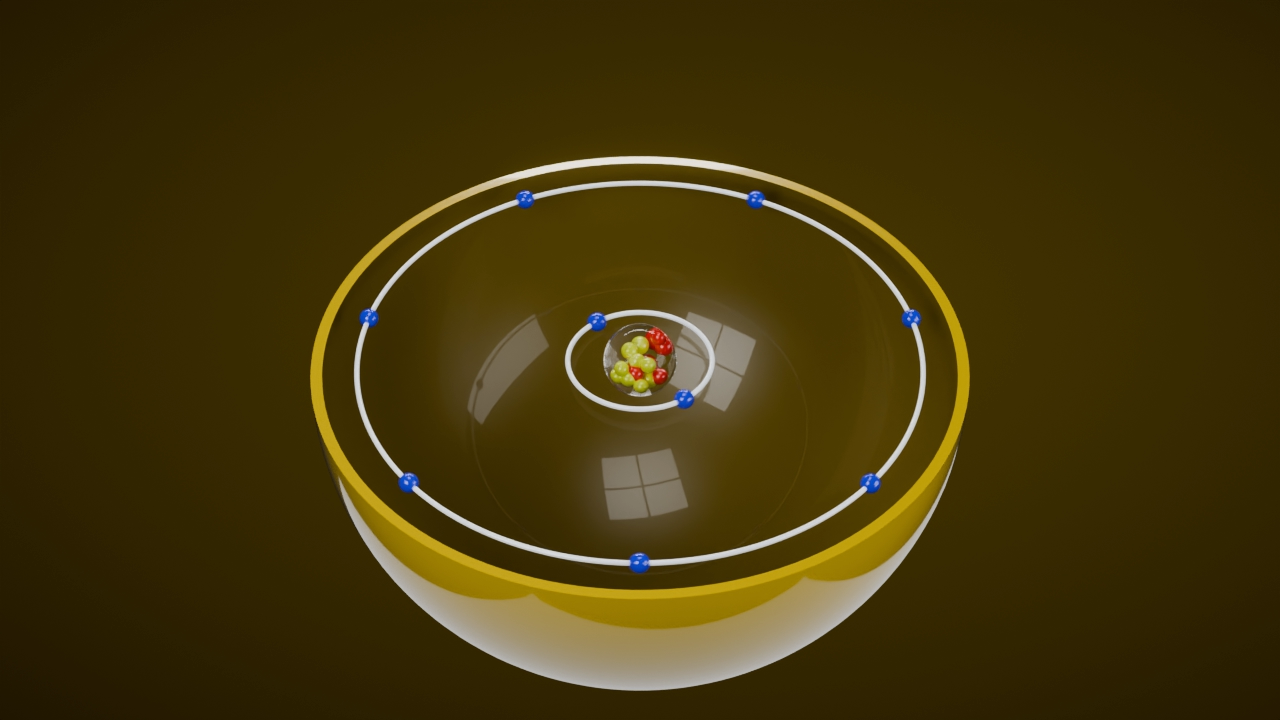
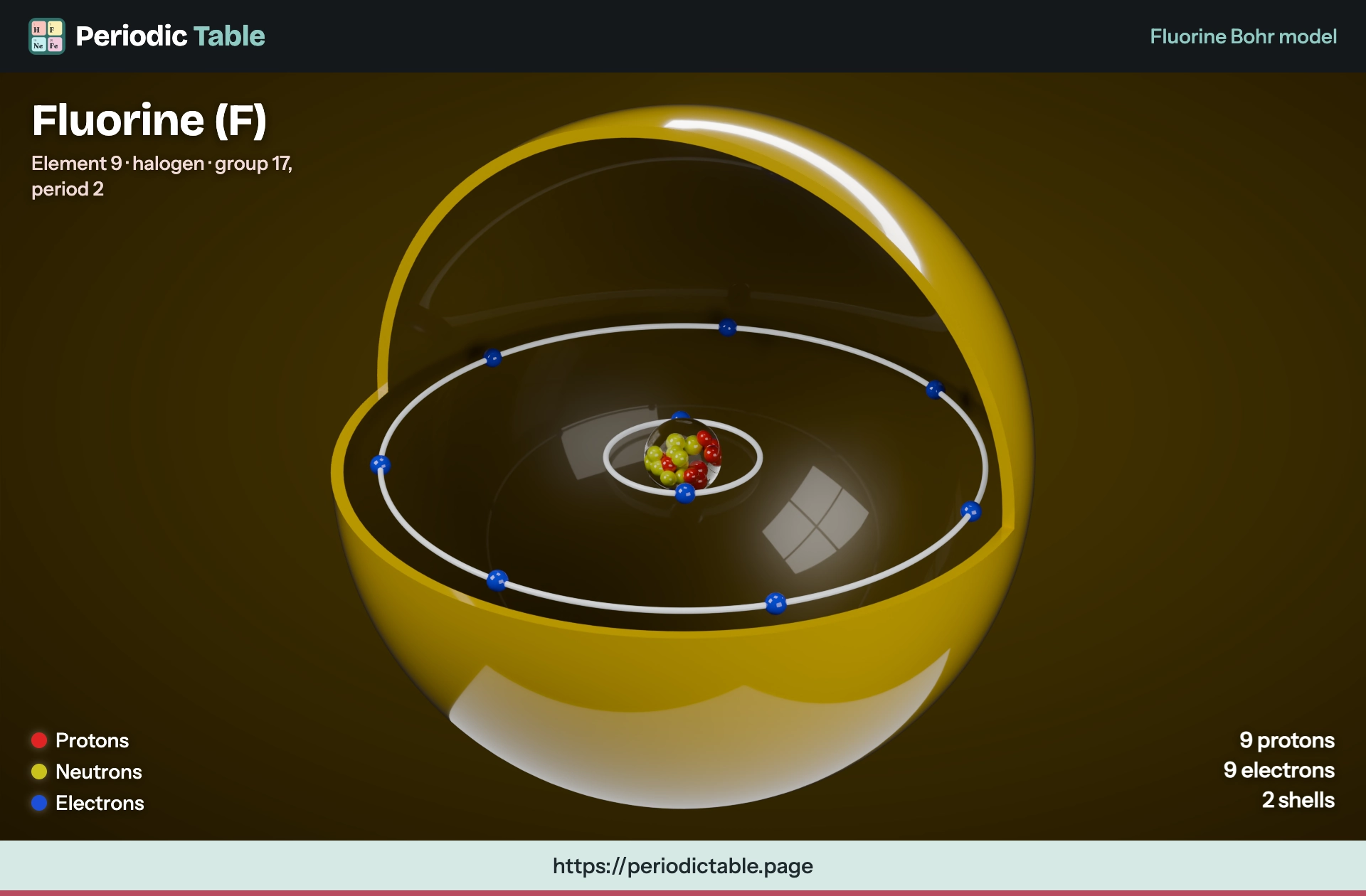
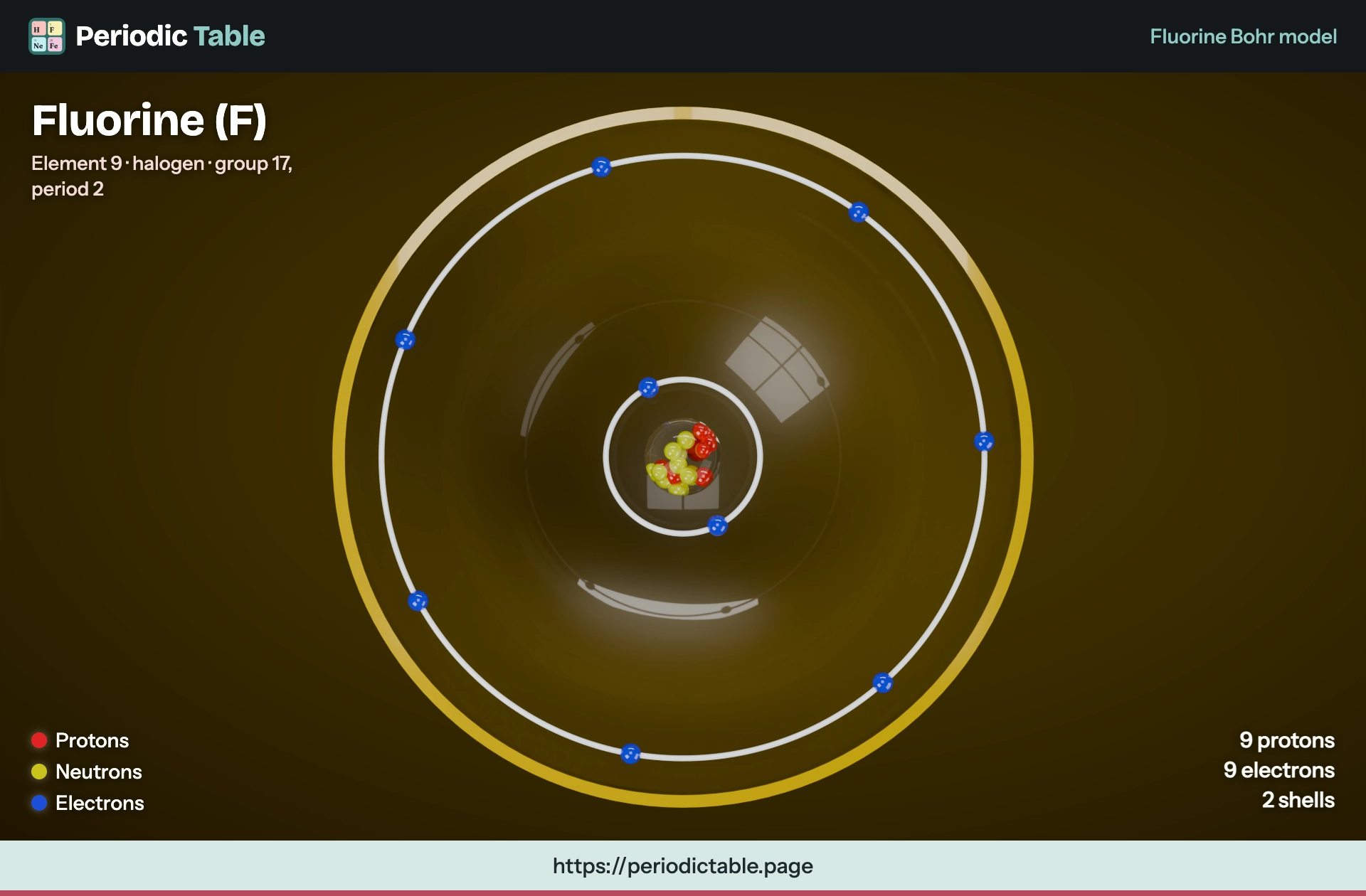
This is a Bohr model of fluorine (F), a simplified picture of a single fluorine atom. Its nucleus holds 9 protons, and a neutral fluorine atom has 9 electrons, arranged around it in 2 shells (2 in shell K and 7 in shell L).
Fluorine periodic table electron configuration
- Shorthand
- [He] 2s2 2p5
- Full
- 1s2 2s2 2p5
- Electrons per shell
- 2, 7
Fluorine element properties and atomic data
- Atomic number
- 9
- Atomic mass
- 18.9984 u
- Phase at STP
- Gas
- Melting point
- -219.67°C (53.48 K)
- Boiling point
- -188.12°C (85.03 K)
- Density
- 0.001696 g/cm³
- Electronegativity (Pauling)
- 3.98
- Period
- 2
- Group
- 17
- Block
- p-block
- Appearance
- Unknown
- Discovery date
- 1886
- Discovered by
- André-Marie Ampère
- Named by
- Humphry Davy
Fluorine element quick facts
If you need the headline numbers first, the table below collects them in one place. Element 9 is a nonmetal in period 2 of the p-block, and at room temperature it is a two-atom vapour. Its single stable nucleus gives it a very precise standard atomic weight, which is why chemistry reference tables quote it to so many decimal places. Readers following laboratory research on heavy elements can read curium properties to see how spent fuel yields small amounts.
| Property | Value |
|---|---|
| Symbol | F |
| Atomic number | 9 |
| Standard atomic weight | 18.998 |
| Group / period / block | Group 17, period 2, p-block |
| Electron configuration | [He] 2s2 2p5 |
| Electronegativity (Pauling) | 3.98 |
| Molecular form | Two atoms per molecule |
| Melting point | −219.67 °C (53.48 K) |
| Boiling point | −188.11 °C (85.03 K) |
| Density at STP | 1.696 g/L |
| Triple point | 53.48 K, 0.252 kPa |
| Critical point | 144.41 K, 5.1724 MPa |
| Heat of vaporization | 6.51 kJ/mol |
| Specific heat capacity | 824 J/(kg·K) |
| Usual charge when bonded | −1 |
| CAS number | 7782-41-4 |
Two rows in that table do most of the explaining for everything that follows: the 2p5 outer shell, which is one electron short of a full octet, and an electron-pulling strength that tops the scale.
Melting point, boiling point and density
The element only becomes a liquid below −188 °C and freezes below −220 °C, temperatures close to those of nitrogen. That narrow 31-degree liquid range is typical for small, nonpolar particles held together by weak dispersion forces.
In vapour form it is about 1.3 times as heavy as air, so a leak tends to pool near the floor rather than rise. You can check the listed value yourself: two atoms at 18.998 g/mol divided by the 22.414 L molar volume of an ideal gas gives roughly 1.695 g/L.
Position in the periodic table and group 17 neighbours
Fluorine heads the halogens, the column it shares with chlorine, bromine, iodine and astatine. It sits between oxygen (element 8) and neon (element 10) in its row, so it has one electron fewer than the noble gas next door. Moving down the column, atoms get larger and less hungry for extra charge, which is why the top member is the most extreme in all of chemistry:
- Electron-pulling power falls with every step down the column.
- Physical state shifts from vapour (the first two members) to a liquid (bromine) and then solids.
- Reactions get gentler with each step down, so the lightest member is also the most aggressive.
Electron configuration of fluorine atoms
Fluorine atoms carry nine electrons arranged as 1s2 2s2 2p5: two in a filled inner shell and seven in the outer shell. Only the two inner ones shield the nucleus, so the outer seven feel an effective nuclear charge of about +7. That strong pull explains three linked facts. Learners comparing heavy metals can open uranium isotopes to read about oxide compounds, alpha emitters and uses in medicine.
The first ionization energy, 1681 kJ/mol, is the third highest of any element, after helium and its row neighbour. The electron affinity is about 328 kJ/mol, second only to chlorine. And the covalent radius is tiny, roughly 60-64 picometres, similar to its row neighbours.
Put simply, the atom finds it very hard to lose an electron and very easy to gain one. Picking up a single extra electron gives the fluoride ion (F−) the same arrangement as neon, which is the driving force behind almost all of its chemistry.
Why electronegativity peaks at 3.98
Electronegativity measures how strongly an atom draws a shared bonding pair toward itself in a bond. On the Pauling scale, element 9 sets the ceiling, ahead of oxygen at 3.44.
The small radius matters as much as the nuclear charge: the bonding pair sits very close to the nucleus, so they are held tightly. In practice this means bonds to it are strongly polar, and in many metal salts the electron is handed over completely, giving ionic bonding.
Physical properties of fluorine and its phases
Among the properties of fluorine you notice first is its colour. At room temperature the element is a diatomic gas, F2 (sometimes called difluorine), that looks very pale yellow and is often described as yellow-green in thicker layers. It has a sharp, pungent smell that people can detect at about 20 parts per billion, far below a safe exposure level.
Cooling it to −188 °C gives liquid fluorine, a bright yellow fluid. Freeze it and you get two solid allotropes:
- Beta form: forms at about −220 °C. It is transparent and soft, with a disordered cubic structure.
- Alpha form: forms on further cooling to about −228 °C. It is opaque and hard, with a monoclinic structure of angled layers.
The switch from beta to alpha releases more heat than condensation and can be violent. Both solids are built from the same F–F diatomic molecules, just packed differently.
The F–F bond itself is surprisingly weak, an oddity in halogen chemistry. Its bond enthalpy is only about 155 kJ/mol, lower than in Cl2, because the lone pairs on two very small atoms crowd and repel each other. A weak bond inside the molecule combined with very strong bonds to almost any other partner is the recipe for the violent behaviour described below.
| Bond | Bond enthalpy (kJ/mol) | Found in |
|---|---|---|
| F–F | 155 | Fluorine molecules |
| C–F | 485 | CF4 and fluoropolymers |
| H–F | 565 | Hydrogen fluoride |
Fluorine isotopes and fluorine-18
Natural samples contain only one of its isotopes: fluorine-19, a stable isotope with nine protons and ten neutrons. Because it is monoisotopic, every natural atom has the same mass, and that turns out to be very useful. In uranium enrichment, any mass difference between UF6 units must come from the uranium, not the fluorine, so the two uranium forms can be separated cleanly.
The 19F nucleus is also very sensitive to magnetic fields, which makes it excellent for NMR spectroscopy and magnetic resonance imaging. Chemists use 19F NMR to follow fluorinated drugs without background signal, since the human body contains almost no organic fluorine.
Eighteen radioactive versions, with mass numbers from 13 to 31, have been made in laboratories. The longest-lived is 18F, with a half-life of 109.7 minutes.
That is long enough to make it in a cyclotron, attach it to a sugar molecule and inject it into a patient, but short enough that the radiation dose fades within a day. Every other radioisotope decays in less than about 70 seconds.
Reactivity and the chemistry of fluorine
The chemistry of fluorine is defined by one word: reactivity. It is the most reactive of all the elements and one of the strongest oxidizing agents known, combining with every other element except the three lightest members of group 18. Its weak F–F bond breaks easily, and the links it then forms with other atoms are very strong, so the reactions release a lot of energy.
What that looks like in practice is striking. Powdered steel, glass fragments and asbestos react quickly with cold fluorine gas.
Wood and water spontaneously burst into flame under a jet of it, and even carbon tetrachloride, normally fireproof, can explode. Typical fluorine reactions include:
- Alkali metals explode on contact, while most others form a thin protective skin that slows the attack unless they are powdered.
- Hydrogen reacts explosively, even in the dark and at very low temperatures.
- Sulfur and phosphorus burn vigorously to give their highest fluorides.
- Graphite reacts above about 400 °C, and organic matter often ignites.
- Nitrogen and oxygen resist it at room temperature and need an electric discharge to react.
Because this behaviour is so extreme, much of modern fluorine chemistry is about taming it: diluting it with nitrogen, cooling the reaction or swapping the free element for gentler fluorinating agents.
Oxidation state in every compound
In its compounds the element almost always takes an oxidation state of −1, and in the F2 molecule it is 0 by definition. No positive value appears in stable substances, because nothing is electronegative enough to pull an electron away from it. That makes the F− anion the form you meet in salts, ores and solutions.
Fluorine reactions with noble gases
For decades chemists assumed the noble gases could not form compounds at all. That changed in 1962, when Neil Bartlett made a xenon compound with platinum hexafluoride. Soon after, xenon difluoride, the tetrafluoride and the hexafluoride were isolated as stable crystals.
Krypton forms a difluoride under special conditions, and radon reacts readily to give a solid thought to be radon difluoride. The lighter members still hold out: no compound of the two lightest has ever been made in bulk.
Fluoride salts and other compounds of fluorine
Because the atom gains an electron so easily, its chemistry covers both inorganic and organic substances, and it combines with metals, nonmetals and metalloids alike. With reactive metals it forms ionic salts, each containing the fluoride ion.
Sodium fluoride (NaF) is a typical example: an ionic solid with the same cubic structure as table salt. Moving across to elements with higher charges, the bonding turns more covalent and the structures change:
- Metal fluorides of the alkaline earth group, such as CaF2, are strongly ionic and barely dissolve in water.
- Thirteen metal hexafluorides are known, all octahedral, including volatile uranium and tungsten hexafluorides.
- Rhenium heptafluoride is the only well characterized metal heptafluoride.
With nonmetals the products are usually covalent gases or volatile liquids. Carbon tetrafluoride (CF4) is tetrahedral and almost inert. Sulfur hexafluoride (SF6) is so stable it is used as an electrical insulator, and by mass it is 78% fluorine.
Nitrogen trifluoride resists hydrolysis and is used to clean semiconductor equipment, while chlorine trifluoride is one of the most aggressive substances known and can set fire to concrete and sand. Boron trifluoride and antimony pentafluoride act as a strong Lewis acid, accepting electron pairs from other species.
Hydrogen fluoride and hydrofluoric acid
Hydrogen fluoride (HF) is the gateway chemical for the whole industry: elemental fluorine and almost every other fluorine compound are made from it. Its molecules hydrogen bond to each other so strongly that it boils at 19.5 °C, far above hydrogen chloride, and it behaves more like water than like the other hydrogen halides.
Dissolved in water it becomes hydrofluoric acid. Unlike HCl, it is a weak acid at low concentrations, yet it dissolves glass, which none of the other hydrohalic solutions can do.
That is why glassmakers used it to etch designs as early as the 1720s. Weak does not mean safe, though, as the safety section below explains.
Organofluorine chemistry and fluoropolymers
The carbon–fluorine bond is the strongest single bond in organic chemistry, which makes organofluorine substances unusually stable. Replacing hydrogen atoms with fluorine in a hydrocarbon makes it more volatile and heavier, and makes the molecule more resistant to heat and chemicals. Fully substituted molecules, the perfluorocarbons, barely react with anything under normal conditions.
The best-known fluoropolymers are polytetrafluoroethylene (PTFE), sold as Teflon, which Roy Plunkett discovered by accident in 1938, and its easier-to-mould relatives. PTFE coats non-stick pans, lines chemical pipes and insulates cables. Related fluorocarbons and fluorosurfactants repel water and oil, so they appear in stain-resistant carpets, waterproof clothing and firefighting foams.
Where fluorine occurs in nature
Since the element reacts with almost everything, it is essentially never found free in nature. A tiny amount of the trapped free element has been detected inside a dark purple crystal called antozonite, but almost all of it is locked in minerals.
It is the 13th most abundant element in Earth's crust, at roughly 600-700 parts per million by mass. Three of them matter most:
- Fluorite, also called fluorspar: calcium fluoride (CaF2), the main commercial source.
- Fluorapatite: a phosphate mineral that holds most of the world's fluoride and is recovered as a by-product of fertilizer production.
- Cryolite: sodium aluminium fluoride, the richest fluorine mineral, now mostly made synthetically.
The share of fluorine in each mineral varies a lot. Working from standard atomic weights, the mass fraction is the fluorine in one formula unit divided by its total mass:
$$\text{F mass fraction} = \frac{n_F \times A_r(\text{F})}{M_{\text{mineral}}} \times 100\%$$
| Mineral | Formula | Molar mass (g/mol) | Fluorine by mass |
|---|---|---|---|
| Fluorite | CaF2 | 78.07 | 48.7% |
| Cryolite | Na3AlF6 | 209.94 | 54.3% |
| Fluorapatite | Ca5(PO4)3F | 504.30 | 3.8% |
So a tonne of pure fluorite holds about 487 kg of the element, while the same mass of the phosphate mineral holds only about 38 kg. That is why fluorite, chemically calcium difluoride, is mined for it and the phosphate is only a side source.
In space the picture is very different. The element ranks only 24th in cosmic abundance, rarer than every neighbour from carbon to magnesium, because fusion in stars tends to skip it and convert any that forms into oxygen or neon. The small amount that exists is thought to come from neutrino bombardment in supernovae and from certain giant stars.
Crustal abundance and major producers
The Royal Society of Chemistry lists a crustal abundance of 553 ppm and gives the element a moderate supply-risk score. Mining is concentrated: China is by far the largest producer, followed by Mexico and Mongolia, while South Africa holds the largest reserves.
History of fluorine and Henri moissan
The story starts with a mineral, not a gas. In 1529 Georgius Agricola described fluorspar as a flux that lowered the melting point of ores during smelting.
He named it from the Latin verb fluere, meaning "to flow", and that root eventually gave the element its name and its symbol, F. By the 1720s, a liquid made from the mineral was already being used for glass etching.
In 1764 Andreas Marggraf heated fluorite with sulfuric acid and found that the resulting solution ate through his glass vessel. Carl Wilhelm Scheele repeated the work in 1771. In 1810 the French physicist André-Marie Ampère suggested the acid contained hydrogen plus an unknown element related to the one in common salt, and in 1812 he proposed the name in a letter to Humphry Davy, combining "fluor" with the -ine ending of the other halogens.
Isolating elemental fluorine by electrolysis
Naming the element was easy; isolating it took 74 years. The acid attacked the experimenters as well as their equipment, and several 19th-century chemists who were poisoned or killed became known as the fluorine martyrs. In 1869 the British chemist George Gore produced a small amount by electrolysis, only for it to react explosively with the hydrogen at the other electrode, wrecking much of his laboratory.
The breakthrough came from Henri Moissan in 1886. He electrolysed a solution of potassium bifluoride in dry HF, which conducts electricity where pure HF does not.
He cooled the cell to about −50 °C and built it from platinum and iridium with stoppers carved from the mineral, and elemental fluorine finally bubbled out at the anode. Moissan received the Nobel Prize in Chemistry in 1906 and died two months later; his method is still the basis of industrial production today.
Fluorine production today
Modern fluorine production still follows Moissan's idea, scaled up. Fluorite is first reacted with sulfuric acid in kilns to make hydrogen fluoride:
$$\text{CaF}_2 + \text{H}_2\text{SO}_4 \rightarrow 2\,\text{HF} + \text{CaSO}_4$$
The HF is then mixed with potassium fluoride to form a molten electrolyte (KF·2HF, which melts at about 70 °C) and electrolysed at 8-12 volts in large electrochemical cells. Hydrogen forms at the steel cathode and fluorine at the carbon anode:
$$2\,\text{HF} \rightarrow \text{H}_2 + \text{F}_2$$
Handling the product is the hard part. Pure fluorine is stored in steel cylinders whose inner surfaces have been given a thin protective coating, a process called passivation. Above about 200 °C, nickel or the copper-bearing alloy Monel is used instead, and valves and pipes are made from the same alloys.
Moisture and grease must be kept out completely for safety. In 1986 Karl Christe showed that the element can also be made chemically in a laboratory, using potassium hexafluoromanganate and antimony pentafluoride, ending a century of claims in chemistry textbooks that this was impossible.
Industrial uses of fluorine
Because the free element is so expensive to handle, most of the uses of fluorine rely on its compounds rather than the free element. About half of mined fluorite goes straight into steelmaking, where a few kilograms per tonne of steel lower the slag's fusion temperature and thin it. Most of the rest becomes HF, the starting point for the whole fluorochemical industry.
Global sales of fluorochemicals run to tens of billions of US dollars a year. Key uses include:
- Aluminium refining: mineral fluxes lower the melting temperature of the ore bath in the Hall-Héroult process.
- Electronics: tungsten hexafluoride deposits metal films, while carbon tetrafluoride is used in plasma etching of silicon chips.
- Electrical grids: SF6 insulates high-voltage switchgear and circuit breakers.
- Glass and metal treatment: hydrofluoric acid etches glass and cleans steel surfaces.
- Organic synthesis: controlled fluorination with gentler reagents such as iodine pentafluoride.
Uranium hexafluoride and nuclear fuel
The single largest use of the free element is in making uranium hexafluoride (UF6), which consumes thousands of tonnes a year. Large-scale production began with the Manhattan Project during World War II.
UF6 sublimes at just 56.5 °C, which makes uranium enrichment by gaseous diffusion or centrifuge possible: the slightly lighter molecules containing uranium-235 are separated from those containing uranium-238. The enriched material is then converted back into oxide for nuclear fuel.
Fluorinated refrigerants and the shift away from CFCs
In the late 1920s, chemists working for General Motors developed chlorofluorocarbons as safer refrigerants than the toxic ammonia and sulfur dioxide used before. Sold as Freon, they spread into fridges, air conditioners and aerosol cans.
The element's strong bond to carbon is what made them work: it kept them non-flammable, barely poisonous and stable enough to circulate for years. After they were linked to ozone loss, CFCs were phased out under the 1987 Montreal Protocol and replaced first by HCFCs and then by hydrofluorocarbons, which are now also being cut back because they trap heat.
Fluoride in medicine and dental health
The same element that is lethal in its free form is valuable in medicine once it is safely bound. Its effects on health depend almost entirely on the form and the dose: fluoride ions at low levels protect teeth, while drug designers add C–F links to make medicines last longer in the body.
Water fluoridation and toothpaste
Fluoride helps prevent tooth decay by converting some of the hydroxyapatite in tooth enamel into a harder, more decay-resistant fluoride mineral. That is the basis of water fluoridation, where public water supplies are adjusted to about 0.7 mg per litre.
Most dental pastes contain sodium monofluorophosphate or stannous fluoride for the same reason. Fluoride has been shown to reduce dental cavities, though the size of the benefit from community water programs is still debated in high-income countries where brushing with fluoridated paste is universal.
Pharmaceuticals and PET scanning
In medicinal chemistry, around a fifth of modern pharmaceuticals contain at least one fluorine atom. A C–F bond blocks the spots where the liver would normally break a drug down, and it can change how a molecule fits its target. Well-known examples include the antidepressant fluoxetine, the cholesterol drug atorvastatin (Lipitor) and the antibiotic ciprofloxacin.
In hospitals, PET scanning relies on 18F-labelled glucose: tumours absorb more sugar than healthy tissue, so they light up on the scan. Some liquid perfluorocarbons can even dissolve enough breathing gas to have been tested as blood substitutes.
Fluorine toxicity and safe handling
The toxicity of the element comes from two directions. Fluorine gas itself is highly toxic and corrosive, and a serious health hazard: at concentrations of a few parts per million it irritates the eyes and lungs, and higher levels can be fatal. On contact with moist tissue it immediately forms hydrofluoric acid, so exposure brings the dangers of both.
HF is especially treacherous because its weakness as an acid lets it slip through skin before splitting apart. Once inside, free fluoride binds calcium and magnesium, killing cells, damaging bone and, if enough is lost, stopping the heart.
Concentrated acid burns covering as little as 2.5% of the body can kill, and symptoms from dilute solutions may not appear for hours. Standard safety practice includes:
- Working only in a fume hood with sealed Monel or passivated steel equipment.
- Wearing a face shield, plus gloves and an apron rated for HF.
- Keeping calcium gluconate gel on hand, applied immediately after any skin contact while medical help is called.
Fluorine plays no known role in human metabolism. Swallowing too much fluoride causes stomach upset at a few milligrams per kilogram of body weight, while long-term excess intake harms dental and skeletal health, leading to mottled teeth (dental fluorosis) or, at higher levels, skeletal fluorosis. Some plants make fluoroacetate as a poison against grazing animals.
Environmental impact of fluorine compounds
The stability that makes many fluorine compounds useful also makes them a problem for the environment. Chlorofluorocarbons drift into the stratosphere, where ultraviolet light frees reactive atoms that destroy ozone; that damage is slowly reversing now that they are banned.
Many fluorinated gases are also powerful greenhouse gases. Their global warming potential ranges from about 100 to over 23,000 times that of carbon dioxide, with SF6 at the top of the list.
Biopersistence of organofluorine chemicals
Because the C–F bond is so hard to break, certain fluorinated chemicals, especially the PFAS family used in coatings and firefighting foams, show strong biopersistence. They resist natural breakdown, collect in water and soil, and build up in people and wildlife, raising health concerns. Regulators in the US and Europe have tightened limits on several of them, and finding replacements that keep the useful properties without the persistence is now one of the main goals of fluorine chemistry.