


Curium element (Cm): curium periodic table facts
Curium periodic table facts: curium (Cm) is element 96, an actinide in period 7 of the f-block. If you have ever wondered what let a Mars rover read the chemistry of a rock, the answer is curium. If you wonder why a complete octet keeps this colorless, odorless gas unreactive, the argon electronegativity has the answer.
Curium (Cm) is a synthetic, silvery, intensely radioactive actinide with atomic number 96, and it never occurs in usable amounts in nature. Here you will find its key data, how it was discovered, how it behaves physically and chemically, and why so few labs on Earth ever handle more than a few milligrams of it.
Rotate the 3D Bohr model of curium
Drag to orbit, scroll to zoom.
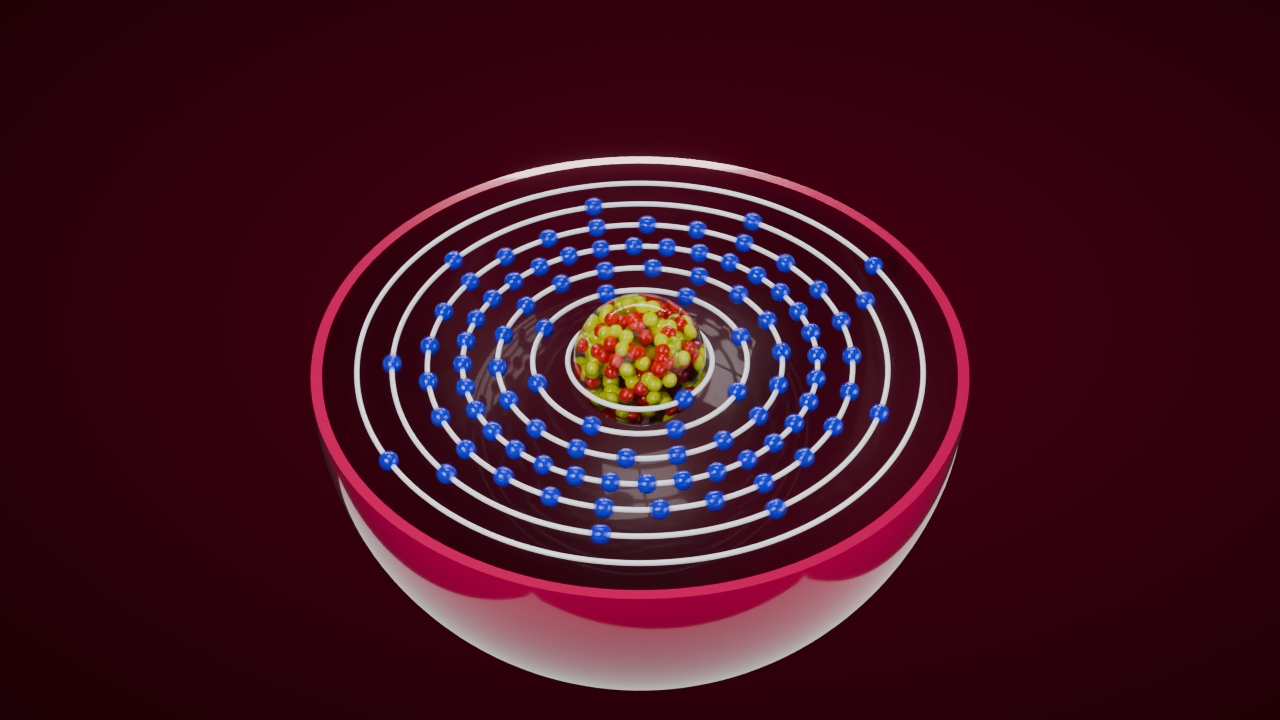
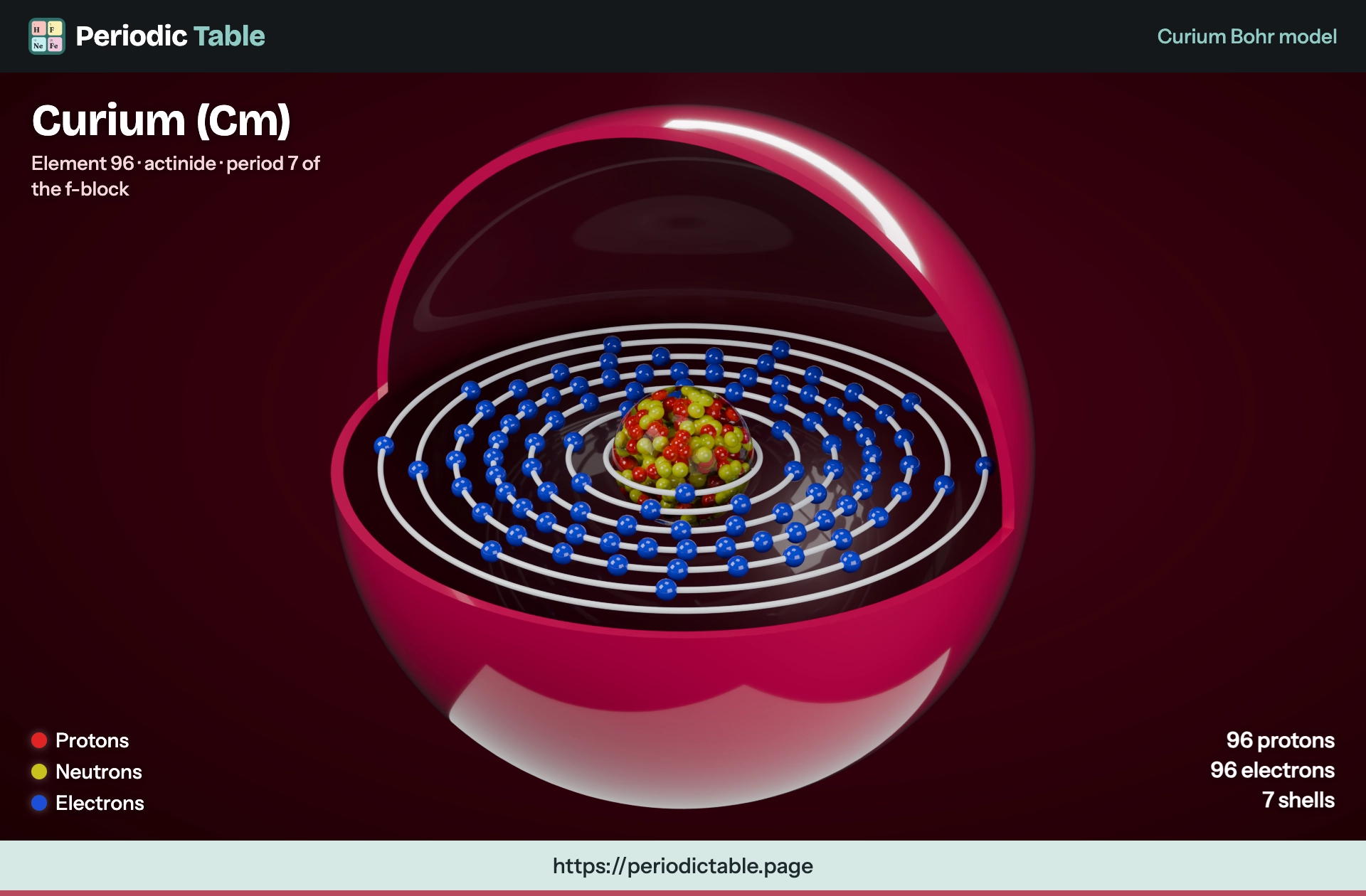
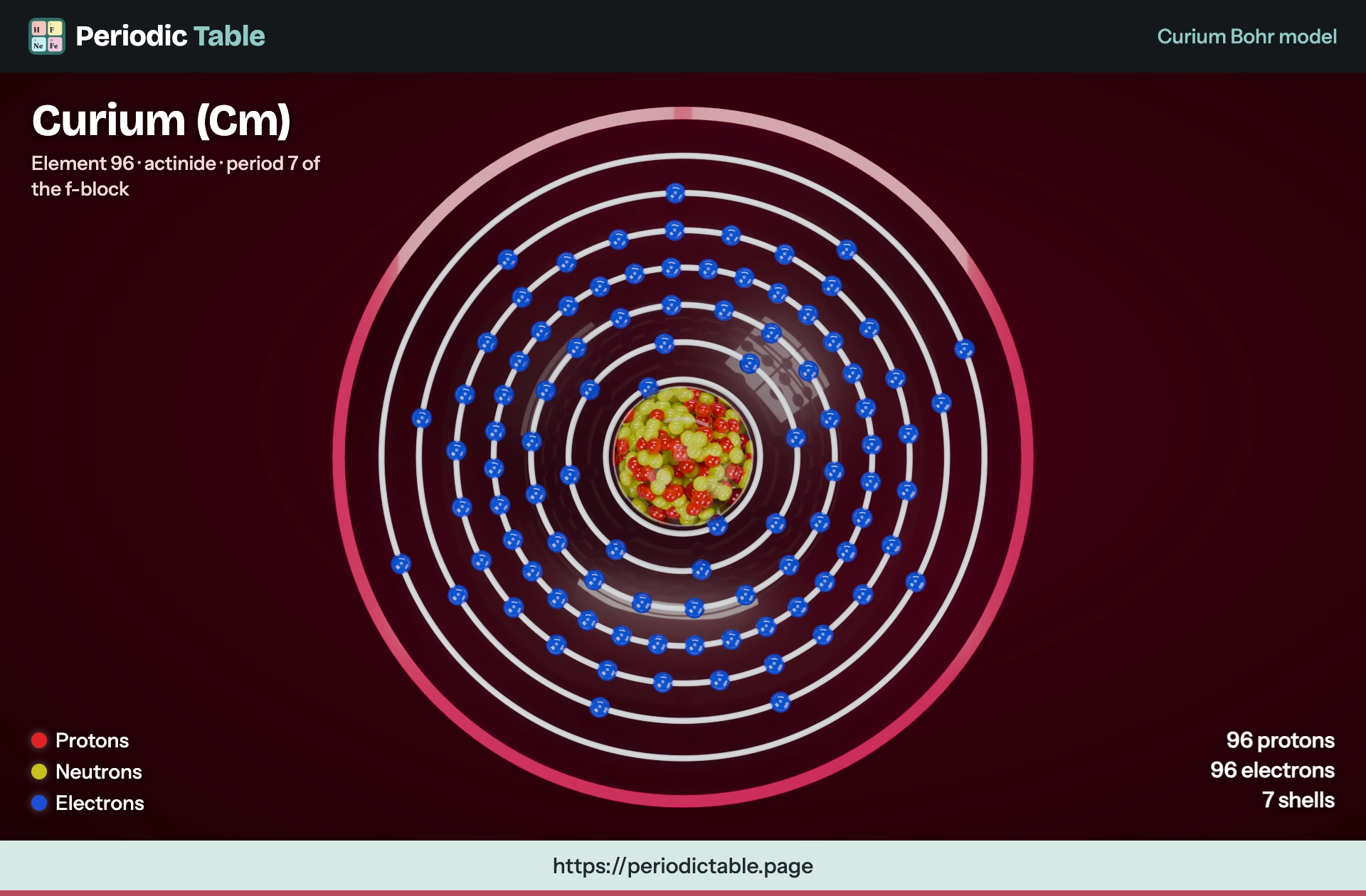
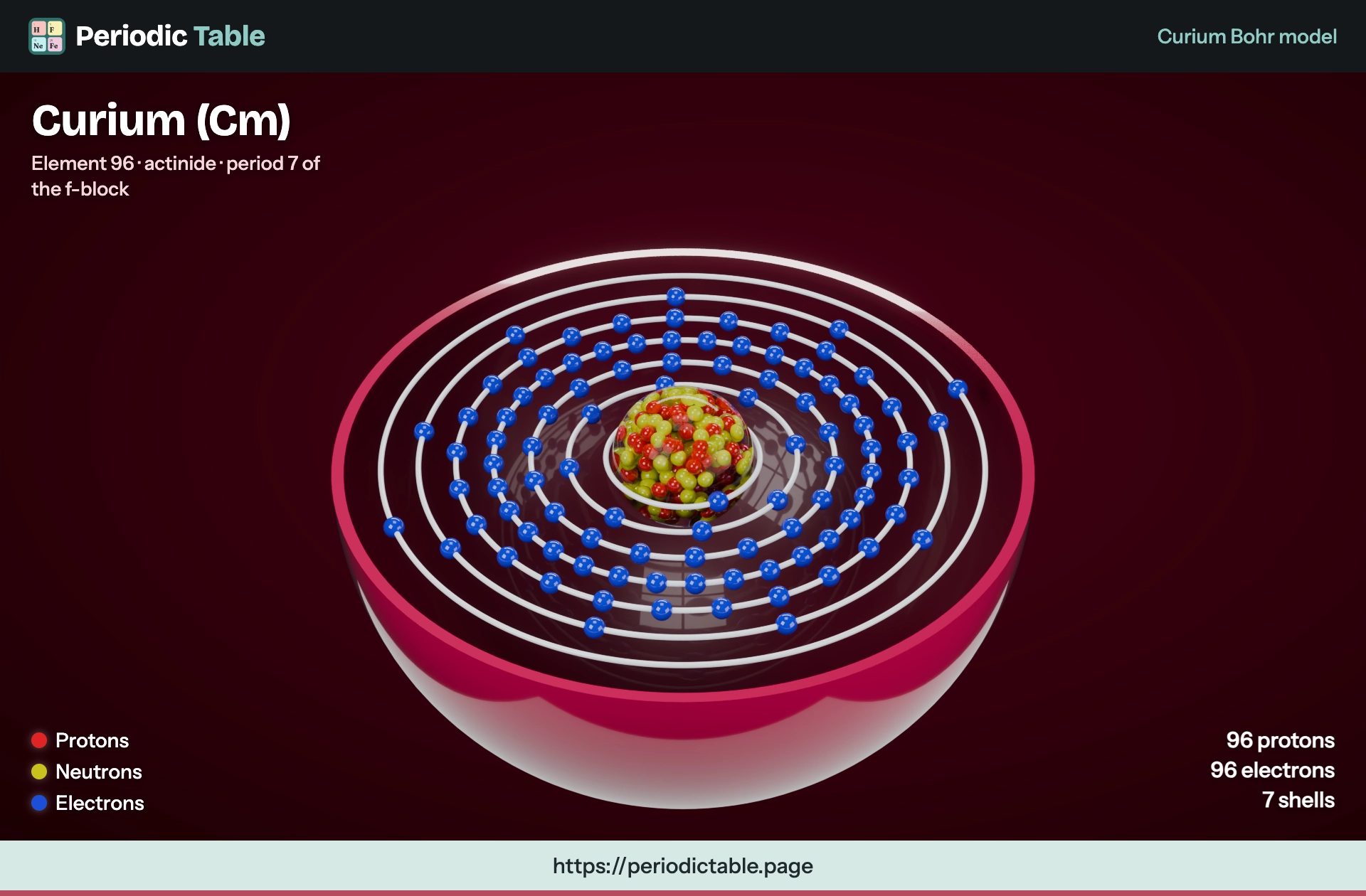
This is a Bohr model of curium (Cm), a simplified picture of a single curium atom. Its nucleus holds 96 protons, and a neutral curium atom has 96 electrons, arranged around it in 7 shells (2 in shell K, 8 in shell L, 18 in shell M, 32 in shell N, 25 in shell O, 9 in shell P and 2 in shell Q).
Curium periodic table electron configuration
- Shorthand
- [Rn] 5f7 6d1 7s2
- Full
- 1s2 2s2 2p6 3s2 3p6 4s2 3d10 4p6 5s2 4d10 5p6 6s2 4f14 5d10 6p6 7s2 5f7 6d1
- Electrons per shell
- 2, 8, 18, 32, 25, 9, 2
Curium element properties and atomic data
- Atomic number
- 96
- Atomic mass
- [247] u
- Phase at STP
- Solid
- Melting point
- 1339.85°C (1613 K)
- Boiling point
- 3109.85°C (3383 K)
- Density
- 13.51 g/cm³
- Electronegativity (Pauling)
- 1.28
- Period
- 7
- Group
- —
- Block
- f-block
- Appearance
- Silvery metallic, glows purple in the dark
- Discovery date
- 1944
- Discovered by
- Glenn T. Seaborg
- Named by
- —
Curium (Cm) key facts and atomic data
Most of the data below comes from very small samples, because nobody can make or handle it in bulk. Self-heating and lattice damage also blur some measurements, so different references quote values a few degrees or a few hundredths of a gram apart. Treat the table as a reliable summary rather than a set of six-figure constants. When comparing boiling points and London dispersion forces going down the noble gas family, each trend is explained step by step.
| Property | Value |
|---|---|
| Symbol | Cm |
| Atomic number | 96 |
| Atomic mass | [247] (mass number of the longest-lived isotope) |
| Block and period | f-block, period 7 (actinides, no group number) |
| Electron configuration | [Rn] 5f7 6d1 7s2 |
| State at room temperature | Solid |
| Melting point | about 1,340 °C (1,613 K) |
| Boiling point | about 3,110 °C (3,383 K) |
| Density | 13.51 g/cm3 |
| Electronegativity | 1.3 on the Pauling scale |
| First ionization energy | about 581 kJ/mol |
| Main oxidation state | +3 (also +4, rarely +2, +5, +6) |
| CAS number | 7440-51-9 |
Two values deserve a second look. The density puts it well above iron or copper, yet below its lighter neighbours neptunium and plutonium. The melting point is high for an actinide: roughly 700 °C above its neighbour two places to the left and some 160 °C above element 95.
Discovery of element 96 at Berkeley
The discovery came in the summer of 1944, at the height of World War II. A team at the University of California, Berkeley, led by Glenn T. Seaborg with Ralph A. James and Albert Ghiorso, coated a thin platinum foil with plutonium-239 oxide and fired alpha particles at it from the 60-inch cyclotron. Each helium nucleus that fused with a target nucleus left behind a curium atom and a free neutron: Nuclear energy depends on uranium hexafluoride, a topic the fluorine electron affinity describes along with laboratory safety rules.
$$^{239}_{94}\text{Pu} + ^{4}_{2}\text{He} \rightarrow ^{242}_{96}\text{Cm} + ^{1}_{0}n$$
The irradiated foil was then sent to the Metallurgical Laboratory at the University of Chicago, where chemists dissolved the target and separated a barely visible trace of the new isotope. They identified curium-242 not by weighing it, but by the characteristic energy of the alpha radiation it gave off as it decayed back to Pu-238.
Because the work belonged to the Manhattan Project, the work stayed secret. The story of how it went public is one of the oddest in chemistry.
In November 1945, five days before the official presentation at an American Chemical Society meeting, Seaborg appeared on the children's radio show Quiz Kids. A young listener asked whether any new elements had been found during the war, and Seaborg simply told him about elements 95 and 96.
Separating curium from americium, which formed alongside it and behaves almost identically, was so frustrating that the Berkeley group nicknamed the pair pandemonium and delirium. The first weighable sample, around 30 micrograms of curium hydroxide, was made in 1947 by irradiating Am-241 in a reactor, and the metallic form followed in 1951.
Why it is named after Marie and Pierre Curie
The name honours Marie and Pierre Curie, the couple whose study of radioactivity and discovery of radium shaped nuclear science. Seaborg chose it by analogy with the lanthanide directly above curium in the periodic table: gadolinium, named after the Finnish chemist Johan Gadolin, who explored the rare-earth elements. Both atoms carry seven f electrons, so naming the actinide after scientists mirrored how its upper neighbour was named.
The same logic named element 95 after the Americas, mirroring europium. Marie Curie remains one of very few women honoured in the name of a chemical substance, alongside Lise Meitner for meitnerium.
Physical properties of curium metal
In physical properties, curium metal is a hard, dense, silvery metal that looks much like any other polished actinide until you turn off the lights. Its alpha emission ionizes the surrounding air, so a sample glows purple in the dark.
It tarnishes slowly in dry air and resembles its lanthanide twin more than it resembles neptunium. Precise thermal and mechanical figures, such as specific heat or elastic moduli, are still unknown, because every sample is tiny and constantly damages its own structure.
Crystal structure and high-pressure phases
At room temperature, the stable form of curium, α-Cm, has a double hexagonal close-packed (dhcp) crystal structure, with layers stacked in an ABAC sequence like α-lanthanum. Squeeze it above about 23 GPa and it rearranges into β-Cm, a face-centered cubic lattice.
Above roughly 43 GPa a third phase, γ-Cm, appears with an orthorhombic structure similar to α-U, and no further change has been seen up to 52 GPa. Some older encyclopedia entries simply describe solid curium as hexagonal, which is true for the ambient phase only.
Magnetism and yellow-orange fluorescence
Magnetically, curium is unusual among its neighbours. It is paramagnetic at ambient conditions, but α-Cm becomes antiferromagnetic when cooled below about 52 K, while americium shows no such transition at any temperature. The electrical resistivity of curium also creeps upward over time as self-irradiation damages the lattice.
In solution and in many complexes, the Cm(III) ion gives strong, stable yellow-orange fluorescence under ultraviolet light, peaking between about 590 and 640 nm. Chemists exploit that glow to track how curium binds to other molecules, a handy tool in coordination chemistry.
Chemical properties and oxidation states of Cm
The chemical properties of curium are dominated by one charge. In water, almost all of it exists as the trivalent curium(III) ion, the most stable oxidation state by a wide margin, and that valence makes it behave more like americium and the lanthanides than like thorium or uranium. That is why separating it from its neighbours is so hard.
- +3: the normal state in solutions and most compounds; the ion is colourless to pale green.
- +4: seen in a few solids such as CmO2 and CmF4; aqueous curium(IV) needs strong oxidizers and quickly reverts.
- +6: reported only in isolated experiments, including the volatile trioxide CmO3.
- +2 and +5: observed in chloride melts and in gas-phase nitrate complexes respectively.
Curium oxidizes readily, which is why its oxide is the form most labs store. Cm(III) ions are hard Lewis acids, binding most strongly to hard bases such as oxygen donors, with mostly ionic bonding. In complexes, the ion usually sits at the centre of nine surrounding atoms arranged as a tricapped trigonal prism.
Electron configuration, electronegativity and ionization energy
In its ground state the atom carries [Rn] 5f7 6d1 7s2. A half-filled 5f shell is especially stable, which explains why losing three electrons, and no more, is so favoured.
The same half-filled shell appears in gadolinium. On the Pauling scale curium sits near 1.3, typical of reactive metals, and its first ionization step costs roughly 581 kJ, low enough that curium gives up electrons easily to oxygen and halogens.
Curium isotopes and their half-life values
None of the curium isotopes is stable. About 19 radioactive isotopes and 7 nuclear isomers are known, spanning mass numbers from 233 to 251.
Most of them undergo alpha decay and become plutonium, though several also undergo spontaneous fission, and Cm-250 decays almost entirely that way. The table lists the isotopes you are most likely to meet.
| Isotope | Half-life | Main decay | Why it matters |
|---|---|---|---|
| Cm-242 | 162.8 days | Alpha, to Pu-238 | First isotope made; intense heat source |
| Cm-243 | 29.1 years | Alpha | Odd mass, splits easily |
| Cm-244 | 18.11 years | Alpha, some fission | Most common; space instruments |
| Cm-245 | 8,250 years | Alpha | Odd mass, compact critical size |
| Cm-246 | 4,706 years | Alpha | Builds up in spent fuel |
| Cm-247 | 15.6 million years | Alpha | Longest-lived isotope |
| Cm-248 | 348,000 years | Alpha, some fission | Target for superheavy synthesis |
The longest-lived of them, curium-247, has a half-life long enough to matter on geological timescales but far too short to survive since Earth formed. Curium-248 is the research favourite because it decays slowly and can be produced fairly pure. Curium-243, with its roughly 30-year half-life, gives useful heat but also brings unwanted gamma and beta emission from its decay products.
Critical mass and reactor fuel potential
Every isotope from Cm-242 to Cm-248, plus Cm-250, can sustain a nuclear chain reaction. The odd-mass isotopes (243, 245 and 247) are strongly fissile, so they can burn in ordinary thermal reactors, whereas a mixed batch of isotopes only suits fast breeder reactors.
The bare-sphere critical mass of Cm-245 is roughly 6.8 kg, and a water reflector can bring it down to around 60 g. In practice curium is not used as nuclear fuel: there is too little of it and it costs too much.
Designers of MOX fuel actually try to keep it out, because a neutron absorbed by Cm-248 creates californium, a fierce neutron emitter that raises doses for workers. Curium-247's very long half-life and compact size at criticality have also drawn interest for nuclear weapons, but no such device is known to have been built.
Curium compounds: oxides, halides and pnictides
Most known curium compounds are built on the +3 ion, with a smaller set of tetravalent solids. Because only microgram or milligram amounts exist, much of this chemistry was mapped with X-ray diffraction on specks of material. The curium oxide family is the most important, since oxide is the form in which it is stored and used in heat sources.
Oxygen and halogen compounds
Curium reacts readily with oxygen to give black CmO2 and whitish Cm2O3. These are the common oxides; heating the dioxide to 600–650 °C under vacuum drives off oxygen and leaves the sesquioxide. Among the halides, colourless curium(III) fluoride (CmF3) precipitates when fluoride ions are added to a Cm(III) solution, while brown CmF4 needs fluorine gas.
Curium(III) chloride forms from the hydroxide and dry hydrogen chloride, and can be converted to the bromide or iodide. The fluoride also matters historically: reducing it with barium or lithium vapour produced the first metallic samples.
Pnictides and organic complexes
Heating curium or its hydride with nitrogen, phosphorus, arsenic or antimony gives compounds of the type CmX, several of which turn ferromagnetic on cooling. Sulfides, selenides and tellurides are made the same way with chalcogen vapours.
No organometallic curium sandwich compound comparable to uranocene has been made yet, although theory predicts a stable "curocene." In solution, curium(III) binds to many organic molecules, including urea, hydroxamic acids and adenosine triphosphate, and certain triazine-based ligands grab it selectively, which helps separate curium from lanthanides in nuclear chemistry.
How the transuranic element is made and where it occurs
As a transuranic element (a transuranium element, in older usage, meaning any atom with more than 92 protons), curium has to be built atom by atom. It can be synthesized in a particle accelerator, as in 1944, but nearly all of the world's supply comes from reactors. Only government laboratory sites with remote-handling cells can work with it.
Neutron capture in nuclear reactors
In nuclear reactors, uranium-238 absorbs a neutron and becomes plutonium-239 after two quick beta decays. Repeated absorption then climbs the ladder: Pu-241 undergoes beta decay to americium-241, which captures another neutron and decays to curium-242. For research purposes, labs irradiate plutonium in a very high neutron flux instead, which favours Cm-244 and, through further captures, heavier isotopes.
The purest curium-248 comes from the decay of californium-252, at only a few tens of milligrams a year. All of this explains the high price, once quoted at well over US$100 per milligram.
Separating Cm from spent fuel
Every tonne of used reactor fuel holds roughly 20 g of curium, mixed with uranium, plutonium, americium and fission products. A typical route dissolves the fuel in nitric acid and removes the bulk of the uranium and plutonium by PUREX solvent extraction. The trivalent actinides and lanthanides left in the residue are then pulled out together and split apart by chromatography, ion exchange or selective ligands.
Separating curium from americium is the last and hardest step; one trick oxidizes americium to a soluble tetravalent complex with ozone while curium stays put. This is also how spent nuclear fuel recycling programmes recover it.
Natural traces and weapons fallout
Any curium present when Earth formed decayed long ago, even its 15.6-million-year isotope. Some researchers have reported traces of Cm-247 in deep-sea sediment cores, and tiny amounts might form in pitchblende, but neither has been firmly confirmed. Most of what exists in the environment today came from fallout during atmospheric nuclear weapons testing.
Debris from the 1952 Ivy Mike thermonuclear test contained several of its isotopes, alongside berkelium, californium, einsteinium and fermium. In soil, curium clings to mineral particles thousands of times more strongly than it dissolves in pore water, so it moves very little. Like the other transuranic elements up to fermium, it would have formed in the natural fission reactor at Oklo, Gabon, but it has long since decayed.
Applications of curium-244 and other isotopes
Almost all practical applications of curium rely on two facts: its isotopes are strong alpha emitters, and they release a lot of heat per gram. Cm-242 produces about 120 W per gram and curium-244 about 3 W per gram. Outside space missions, most of it is used in research.
Alpha particle X-ray spectrometer on Mars rovers
The best-known use is the alpha particle X-ray spectrometer (APXS). A sensor head carries small curium sources that bombard a rock with alpha particles; the backscattered particles and the X-rays they trigger reveal which elements the rock contains and in what proportions. APXS instruments flew on the Sojourner rover of Mars Pathfinder, on the Spirit and Opportunity rovers, on Curiosity, and on the Philae lander that touched down on comet 67P; another was lost with Russia's Mars 96 probe, which failed at launch.
Earlier Surveyor 5–7 Moon landers used Cm-242. Few materials have done more for space exploration per gram than curium, and APXS data from Mars rovers is still how scientists classify many Martian rocks.
Radioisotope thermoelectric generators and pacemakers
Because of its heat output, curium has been studied for radioisotope thermoelectric generators, which turn decay heat into electricity for spacecraft and remote space probes. The drawback is penetrating emission: compared with Pu-238, Cm-244 emits about 500 times more neutrons through fission, so a 1 kW source would need roughly 51 mm of lead shielding to block gamma rays, against about 2.5 mm for Pu-238.
A more practical route uses Cm-242 to make Pu-238 itself, the preferred fuel for such generators and once for heart pacemakers. As nuclear energy sources go, it remains a niche choice.
Building superheavy elements
Cm-248 is a favourite target for making superheavy elements. Hitting it with neon-22 ions produced seaborgium, magnesium-26 produced hassium, and calcium-48 produced livermorium. Californium itself was discovered in 1950 when a microgram target of Cm-242 was bombarded with helium nuclei at Berkeley, yielding only about 5,000 atoms.
Element curium safety and health risks
Every sample of element curium is highly radioactive, so safety starts with containment. Its alpha emission is stopped by a sheet of paper or the outer layer of skin, but some decay products give off beta and gamma radiation, and the fission of Cm-244 releases neutrons that need a thick barrier. Labs therefore keep the work to tiny quantities in glove boxes and hot cells.
The real health risks come from getting curium inside the body:
- Swallowed: only about 0.05% reaches the blood; most passes out within days.
- Absorbed: about 45% settles in the liver and 45% in the bones, where it lines the surfaces next to the bone marrow.
- Long stay: the biological half-life of curium is about 20 years in liver tissue and 50 years in bone.
- Inhalation: breathing it in is far more dangerous than swallowing it, and the permitted body burden of soluble Cm-244 is just 0.3 µCi.
Once lodged in bone, its alpha radiation destroys marrow and stops the production of red blood cells. Animal studies link it to bone tumours and, after it is breathed in, to cancer of the lungs and digestive organs.
Unlike the radionuclides used in nuclear medicine, curium has no diagnostic or therapeutic role, so any intake is pure risk. That is why its radioactive decay is a concern for long-term waste storage as well as for lab workers.
Spent nuclear fuel and transmutation
The isotopes Cm-245 to Cm-248 last thousands of years or longer, so they add to the long-term heat and radiotoxicity of nuclear waste. One proposed fix is transmutation: separate curium, then bombard it in special reactors until it fissions or turns into short-lived nuclides.
For all the minor actinides this approach is still at the research stage, and curium is among the hardest to handle because its strong neutron and heat output complicates fuel fabrication. National laboratories such as Los Alamos study how curium would behave in such reactors; if it works, removing it would cut a large share of the waste's heat and radiotoxicity over the first few centuries.
Cm in the periodic table and the actinide series
Curium sits in the actinide series, the row of 15 metals from actinium (89) to lawrencium (103) placed below the main body of the periodic table. It lies between americium (95) and berkelium (97), directly under its lanthanide twin. That vertical link is not just cosmetic: as an actinide element with a half-filled 5f shell, it is the point where the actinides start to behave much like the lanthanides, holding firmly to a +3 charge.
Curium was the third transuranic atom to be discovered, even though it is the fourth in order, because element 95 proved harder to isolate. For you as a reader, that position is the quickest way to predict its chemistry: think "heavy, radioactive gadolinium," and you will be right more often than not.