


Terbium element (Tb): terbium periodic table facts
Terbium periodic table facts: terbium (Tb) is element 65, a lanthanide in period 6 of the f-block. Ask a chemist what is terbium and you will usually hear two answers in the same breath: light and magnets. Nuclear waste, proliferation and safety are weighed in the discovery of plutonium page, along with MOX fuel and spent fuel handling.
Terbium is the silvery-white rare earth metal sitting at atomic number 65 on the periodic table, a chemical element scarce enough to be priced by the gram, yet common enough in daily life that you have probably looked at its green glow on a screen today. Below you will find the key data, the chemistry that explains it, and where the element actually ends up, so you can read any element data sheet with confidence.
Rotate the 3D Bohr model of terbium
Drag to orbit, scroll to zoom.
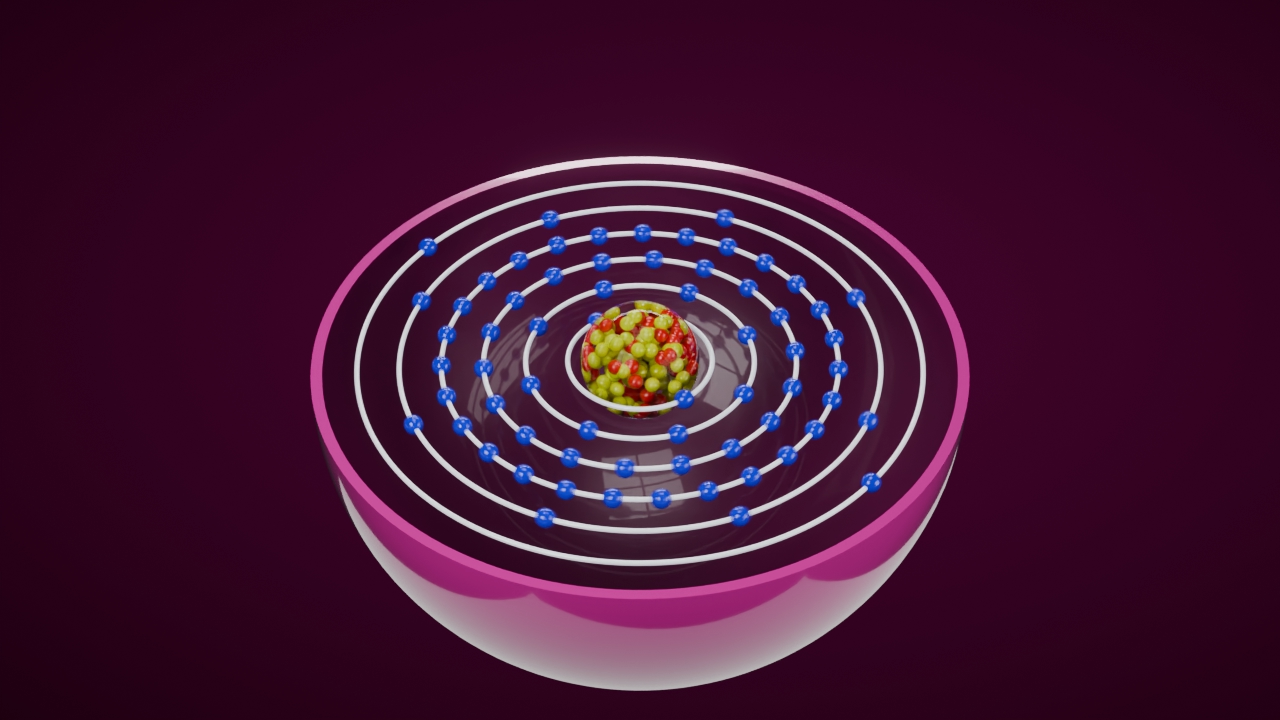
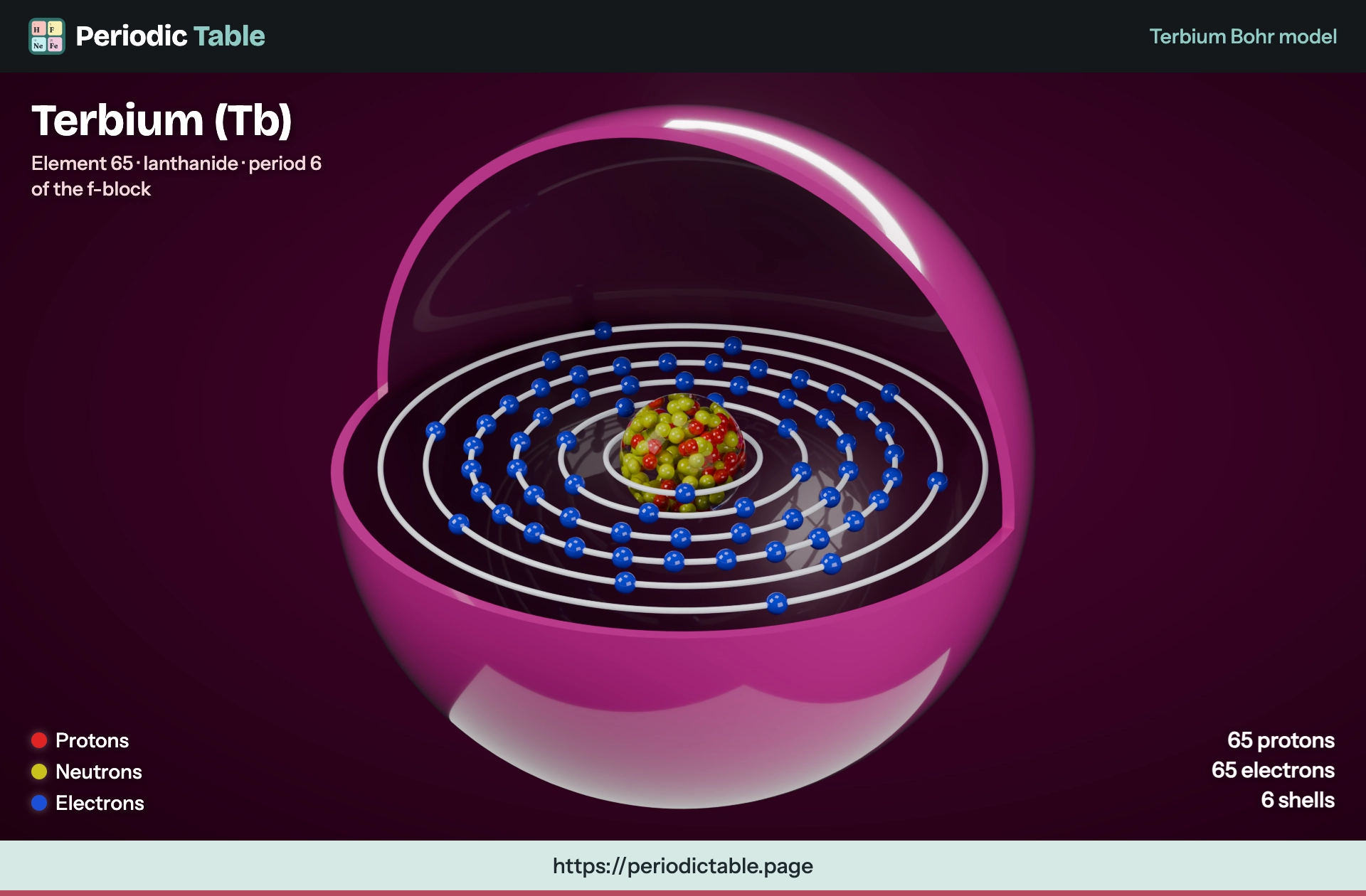
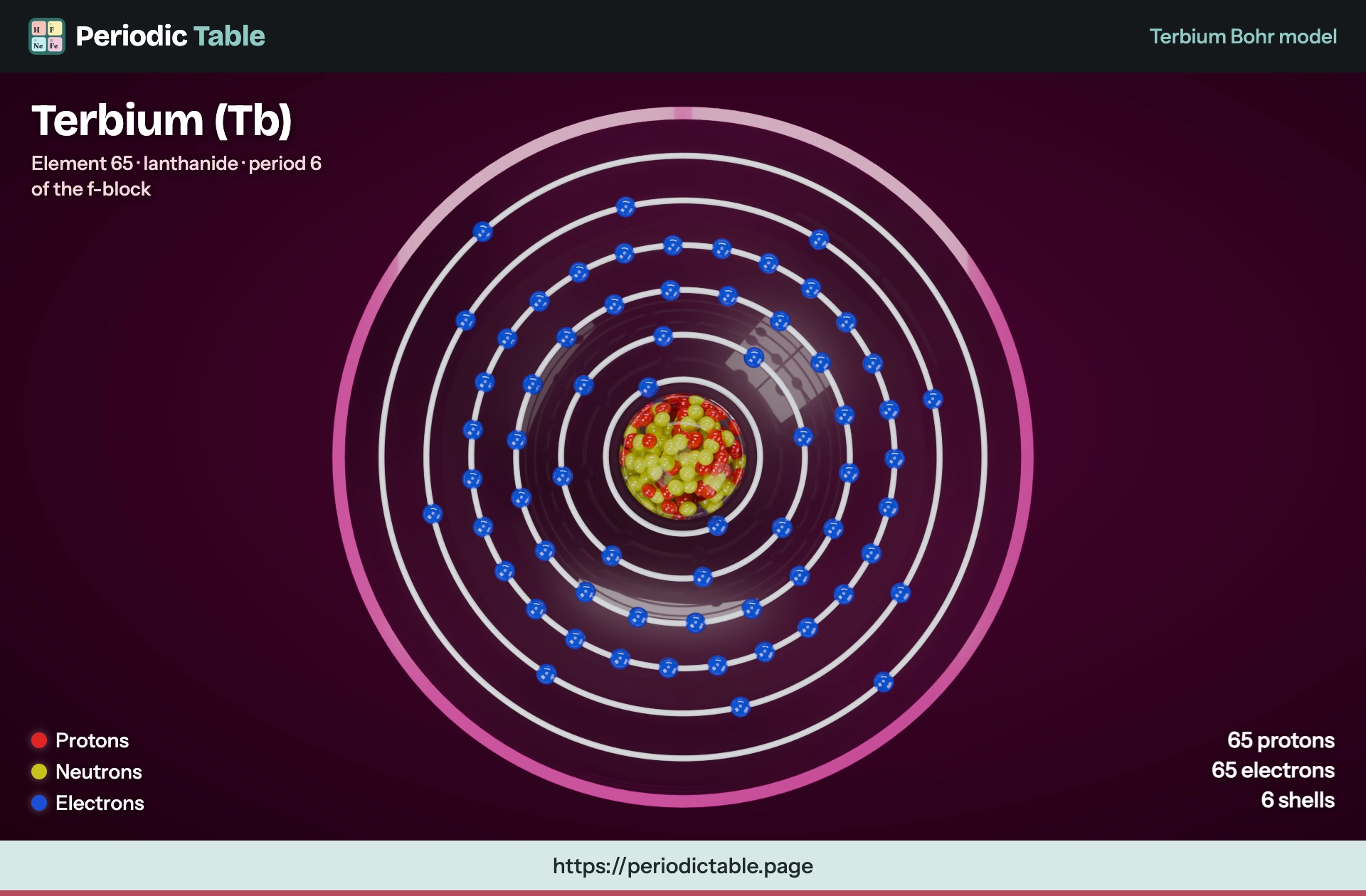
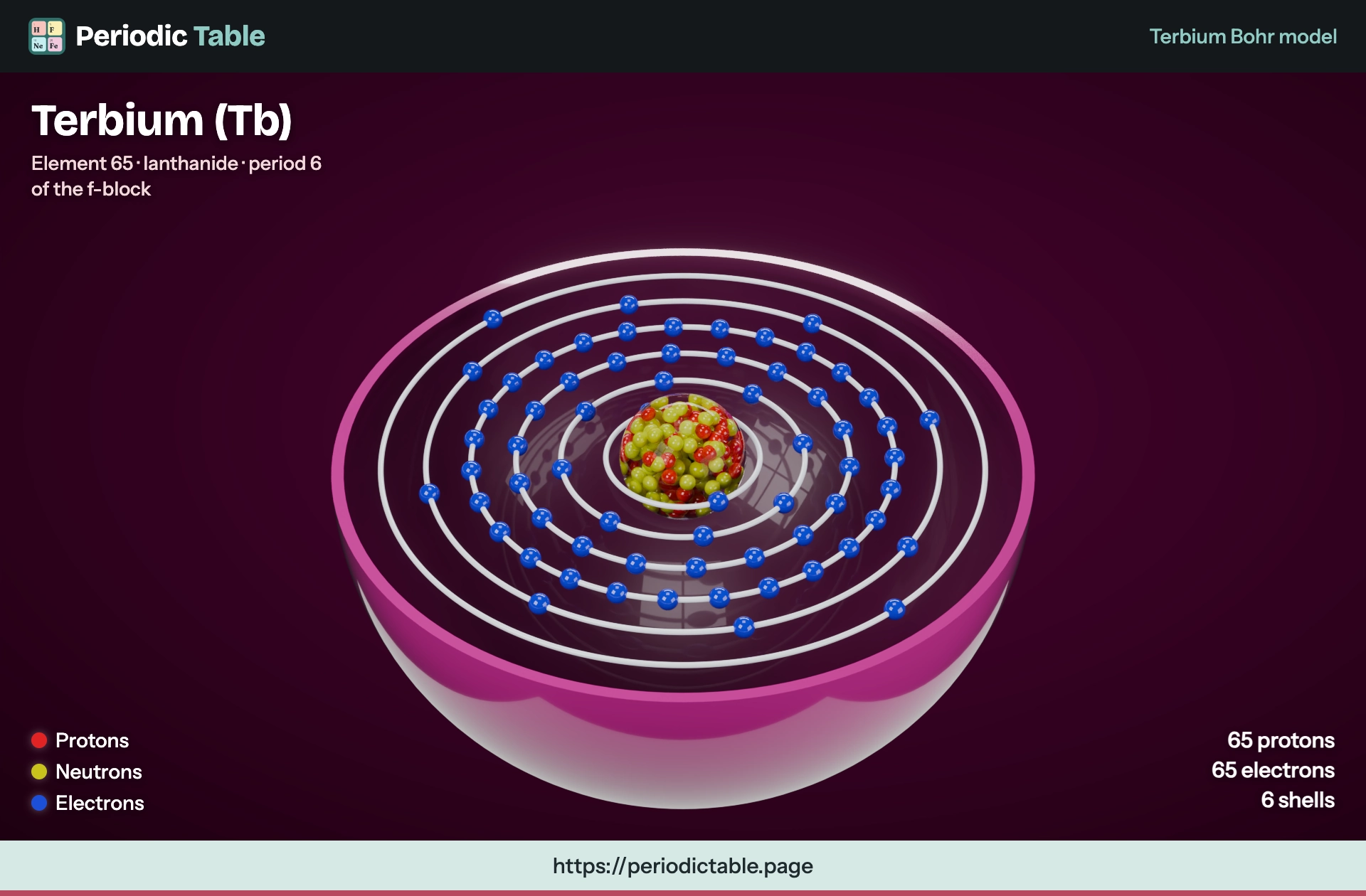
This is a Bohr model of terbium (Tb), a simplified picture of a single terbium atom. Its nucleus holds 65 protons, and a neutral terbium atom has 65 electrons, arranged around it in 6 shells (2 in shell K, 8 in shell L, 18 in shell M, 27 in shell N, 8 in shell O and 2 in shell P).
Terbium periodic table electron configuration
- Shorthand
- [Xe] 4f9 6s2
- Full
- 1s2 2s2 2p6 3s2 3p6 4s2 3d10 4p6 5s2 4d10 5p6 6s2 4f9
- Electrons per shell
- 2, 8, 18, 27, 8, 2
Terbium element properties and atomic data
- Atomic number
- 65
- Atomic mass
- 158.9254 u
- Phase at STP
- Solid
- Melting point
- 1355.85°C (1629 K)
- Boiling point
- 3122.85°C (3396 K)
- Density
- 8.23 g/cm³
- Electronegativity (Pauling)
- 1.1
- Period
- 6
- Group
- —
- Block
- f-block
- Appearance
- Silvery white
- Discovery date
- 1843
- Discovered by
- Carl Gustaf Mosander
- Named by
- —
Terbium facts: atomic number, melting point and density
Most of what you need to identify terbium fits into one table. The values are the commonly cited figures for the pure solid near room conditions. Where sources disagree slightly, as they do for the boiling point, the gap comes from older versus newer measurements, so it is good practice to quote the reference you used. Among historical names, eka-iodine, alabamine and astatos are traced in the astatine symbol entry for further reading.
| Property | Value |
|---|---|
| Symbol | Tb |
| Atomic number | 65 |
| Atomic weight | 158.925 u |
| Block and period | f-block, period 6 |
| Family | Lanthanides (no group number) |
| Electron configuration | [Xe] 4f9 6s2 |
| Melting point | 1356 °C (1629 K) |
| Boiling point | 3123 °C (3396 K) |
| Density | 8.23 g/cm3 at 20 °C |
| Crystal structure | Hexagonal close-packed (hcp) |
| Electronegativity | 1.2 on the Pauling scale |
| State at 20 °C | Solid |
| CAS number | 7440-27-9 |
Two rows explain most of what follows. The nine 4f electrons in terbium's outer subshell are the source of both the famous green emission and the strong magnetic response. The hcp crystal structure holds until roughly 1289 °C, where the solid rearranges into a body-centred cubic form shortly before it melts.
Where Tb sits in the lanthanide series
Terbium is the ninth member of the lanthanide series, wedged between gadolinium (element 64) and dysprosium (element 66). Chemists also file it among the "heavy" rare earths, the group that starts at element 64 and is typically scarcer and costlier to separate than the light members such as lanthanum or cerium. Starting from ore, the pure copper covers chalcopyrite, bornite and malachite, plus how mining and smelting yield the metal.
Its neighbours matter because the rare earth elements behave almost identically in solution. Each step across the row adds one proton and one 4f electron, and that inner electron barely changes how the ion bonds. The result is a family of near-twins, which is why isolating terbium from its neighbours was the main obstacle in its history and is still the costly step in its production.
Electron configuration of the terbium atom
A neutral atom holds 65 electrons arranged in shells of 2, 8, 18, 27, 8 and 2. Eleven of them sit in the 4f and 6s orbitals and act as the valence set, but only a few come off in normal reactions. The ionization energies show why:
- First: 565.8 kJ/mol
- Second: 1110 kJ/mol
- Third: 2114 kJ/mol
- Fourth: 3839 kJ/mol, lower than for most of its neighbours, because losing a fourth electron leaves a stable half-filled 4f7 shell
Size-wise, the empirical atomic radius is about 177 pm and the covalent radius about 194 pm, in line with the steady lanthanide contraction across the row.
Physical properties of Tb
A freshly cut piece of terbium metal is a bright, silvery-white solid. It is malleable and ductile, so it can be hammered flat or drawn into wire, and it is soft enough to be cut with a knife.
Compared with the more reactive lanthanides at the start of the row, it is fairly stable in dry air and dulls slowly rather than crumbling. It exists in two allotropes, the room-condition hcp form and a cubic form at high heat.
Magnetism from ferromagnetic to paramagnetic
The magnetic behaviour changes in three clear steps as the sample warms:
- Below 219 K (about −54 °C) it is ferromagnetic, with all atomic moments lined up.
- Between 219 K and 230 K it becomes a helical antiferromagnetic state, where each atomic layer's moments turn by a fixed angle relative to the layer beside it.
- Above 230 K it is paramagnetic, which is the state you handle at room temperature.
Even in that disordered state, terbium responds unusually strongly to a field, with a molar magnetic susceptibility near +146,000 × 10−6 cm3/mol, which is the property magnet and actuator makers exploit.
Mechanical and thermal data
- Young's modulus
- 55.7 GPa
- Shear modulus
- 22.1 GPa
- Bulk modulus
- 38.7 GPa
- Specific heat capacity
- 182 J/(kg·K)
- Thermal conductivity
- 11.1 W/(m·K)
- Vickers hardness
- 450–865 MPa
These figures place it close to its neighbours: stiffer than lead, far softer than steel, and a poor conductor of heat for so heavy a solid.
Chemical behaviour and the Tb oxidation state
Terbium is electropositive. It oxidizes in moist air, dissolves in dilute acids such as sulfuric acid, reacts with all of the halogens, and attacks water slowly, releasing hydrogen gas in each case. With acid the reaction looks like this:
$$2\,\mathrm{Tb} + 3\,\mathrm{H_2SO_4} \rightarrow 2\,\mathrm{Tb^{3+}} + 3\,\mathrm{SO_4^{2-}} + 3\,\mathrm{H_2}$$
Left in air, the surface turns into a dark mixed oxide rather than a simple one:
$$8\,\mathrm{Tb} + 7\,\mathrm{O_2} \rightarrow 2\,\mathrm{Tb_4O_7}$$
The usual oxidation state is +3, the trivalent form found in salts, solutions and minerals. What sets this element apart from most of its family is that a tetravalent form also exists in solids such as \(\mathrm{TbO_2}\) and \(\mathrm{TbF_4}\), thanks to that half-filled shell. In water the higher state is unstable, although ozone in strongly basic solution can push it there.
In aqueous chemistry the terbium ion is typically surrounded by nine water molecules in a tricapped trigonal prism. A quick summary of each oxidation state:
- +3: the everyday state in salts, solutions and ores
- +4: solid oxides and fluorides only; strongly oxidizing
- +2, +1 and 0: seen only in specialised organometallic or cluster chemistry
Tb compounds and oxides
At high heat terbium combines directly with nitrogen, carbon, sulfur, phosphorus, boron, selenium, silicon and arsenic, giving binary compounds such as nitrides, sulfides and silicides. Oxygen and halide compounds are the ones you are most likely to meet in a lab or a supplier catalogue.
| Compound | Formula | Key traits |
|---|---|---|
| Terbium(III) oxide | \(\mathrm{Tb_2O_3}\) | Dark brown, insoluble in water, slightly hygroscopic; the main form in ores and clays |
| Mixed-valence oxide | \(\mathrm{Tb_4O_7}\) | The usual commercial terbium oxide; forms when the element burns in air |
| Terbium tetrafluoride | \(\mathrm{TbF_4}\) | Powerful fluorinating agent that gives off nearly pure atomic fluorine when heated |
| Trichloride | \(\mathrm{TbCl_3}\) | Starting material for most coordination chemistry |
| Sulfate | \(\mathrm{Tb_2(SO_4)_3}\) | Glows green under ultraviolet light |
The tetrafluoride is the only fluoride the higher state can form, and it is made by treating the trifluoride or trichloride with fluorine gas at about 320 °C. Reduction runs the other way too: heating the trichloride with the pure element gives lower halides, including a layered monochloride with a graphite-like structure.
Tb isotopes: one stable isotope, many short half-lives
Natural terbium is a single nuclide, terbium-159, which makes the element mononuclidic: every atom dug out of the ground has the same mass. Beyond it, laboratories have characterised about 39 radioisotopes, from mass 135 to 174, plus around 31 nuclear isomers. Nearly all terbium isotopes made this way are short-lived; most vanish in under half a minute.
| Mass number | Half-life | Main decay | Why it matters |
|---|---|---|---|
| 159 | Stable | None | 100% of natural material |
| 158 | 180 years | EC, β− | Longest-lived radioactive form |
| 157 | 71 years | EC | Second longest-lived |
| 160 | 72.3 days | β− | Common activation product |
| 161 | 6.95 days | β− | Studied for cancer treatment |
| 149 | 4.1 hours | EC, α | Rare alpha emitter for therapy |
EC = electron capture. Lighter nuclides decay mostly by capturing an electron and becoming gadolinium; heavier ones emit beta particles and move one step up the row.
The medical interest is real: terbium-149 is a candidate for targeted alpha therapy and can also be imaged by positron emission tomography, while terbium-161 offers beta therapy from the same element. That "matched set" idea is what draws nuclear medicine groups to the element.
Tb luminescence and green phosphors
Terbium's triply charged ion has a strong emission line near 545 nm in the green, with weaker lines in the orange and red. Your eye blends them into a bright lemon-yellow fluorescence that is often visible without any instrument. The emission also lasts milliseconds, far longer than the background glow of biological molecules, so chemists use this luminescence as a time-gated probe in protein, DNA and drug assays.
The same glow powers its largest market. Green phosphors based on terbium are blended with europium-based red phosphors and blue phosphors to make trichromatic lighting, the white light in compact fluorescent lamps and many office tubes, which gives far more light per watt than old incandescent lighting.
Some of its salts are also triboluminescent, flashing green when a crystal cracks, a property explored for stress sensing in aircraft structures. You will even find these phosphors in security inks on euro bank notes.
Main terbium uses in industry
By volume, phosphors take the largest share, first in colour television and cathode-ray tubes and now in flat screen displays and lamps. Most of the remainder goes into magnets: a small addition of terbium to neodymium-iron-boron magnets keeps them from losing strength when electric-vehicle motors and wind-turbine generators run hot. The rest is spread across electronics, optics and specialist doping, covered below.
Terfenol-D and magnetostriction
Terfenol-D is an alloy of terbium, dysprosium and iron with the highest magnetostriction of any commercial material among today's alloys: it lengthens or shortens measurably when you place it in a magnetic field. That makes it ideal for naval sonar transducers, precision actuators, vibration sensors and surface speakers that turn a desk into a sound board.
Magneto-optical isolators for fiber optic links
Garnet crystals built around the element, such as terbium gallium garnet, have a high Verdet constant, meaning they rotate polarised light strongly in a magnetic field. That rotation lets optical isolators pass laser light one way while blocking reflections, protecting lasers in long-distance fiber optic systems and other magneto-optical optics.
Dopant roles in solid-state devices and fuel cells
As a dopant, terbium is added to calcium fluoride, calcium tungstate and strontium molybdate for solid-state devices, and together with zirconium dioxide it stabilises the crystal lattice in fuel cells that run at high heat. Pure samples go mostly to research, because the element oxidizes too readily to be used bare.
Carl Gustaf Mosander and the discovery of terbia at Ytterby
The story starts with a black mineral, gadolinite, from a quarry at Ytterby near Stockholm, Sweden. In 1843 Mosander, working at the Karolinska Institute, showed that yttria (yttrium oxide) was not one substance but three, and he named all three fractions after the village.
Then came a famous mix-up. Mosander's original "terbia" was the pinkish fraction, and his "erbia" was the yellow one.
When spectral analysis by Marc Delafontaine finally confirmed the separate elements, the two names were published the other way round, after a brief period in which the element was called "mosandrum." The swap stuck, so today's terbium came from Mosander's yellow fraction, and the pink one became erbium.
Purifying it was slow. Nineteenth-century chemists dissolved gadolinite and samarskite residues, then precipitated them repeatedly with oxalic acid and potassium sulfate; in 1881 no satisfactory way to split the yellow and pink fractions existed. Werner Fischer's 1937 solvent-partition work laid the basis for modern methods, and the pure element arrived only with post-war column separation.
Where Tb occurs in nature
You will never find terbium free. It is spread through several minerals, including monazite (up to about 0.03%), xenotime, bastnäsite and euxenite (1% or more).
No mineral yet found has it as the dominant rare earth. Its abundance in the crust is around one part per million, which makes it scarcer than most metals in everyday use but still more abundant than silver.
The richest commercial sources are the ion-adsorption clays of southern China, where concentrates rich in yttrium carry about 1% of its oxide. Large volumes of bastnäsite add a significant share as a by-product.
In 2018, deep-sea mud near Japan's Minamitori Island was reported to hold a heavy rare earth reserve large enough to cover global demand for centuries. Astronomers have even detected ionised atoms of the element in the atmosphere of the hot exoplanet KELT-9b.
How Tb is refined by solvent extraction and ion exchange
Getting terbium from ore to a shiny ingot takes a long chain of steps, each one removing a different set of impurities:
- Crushed ore is treated with hot concentrated sulfuric acid to form water-soluble rare earth sulfates.
- The solution is partly neutralised to pH 3–4, so thorium drops out as a hydroxide.
- Ammonium oxalate converts the rare earths to insoluble oxalates, which are heated to oxides.
- Nitric acid then dissolves everything except cerium.
- Multi-stage solvent extraction separates the heavy rare earths at industrial scale; ion exchange resins give the highest-grade separation.
- The anhydrous chloride is reduced with calcium metal, and vacuum remelting or zone melting strips out calcium and tantalum.
Each stage of refining raises purity, but the near-identical neighbours mean hundreds of repeated separation stages can be needed to reach 99.9% or better.
Tb supply, price and China's role
Global demand was estimated at roughly 340 tonnes a year in 2020, small in mass but critical in value. The Royal Society of Chemistry rates terbium's relative supply risk at 9.5 out of 10: about 97% of production is concentrated in one country, recycling recovers under 10%, and few substitutes match its glow or magnetic boost.
Price reflects that squeeze: terbium is among the costliest rare earths, typically many times the price of neodymium per kilogram, though still well below precious metals such as platinum. To steady terbium supply, manufacturers are trimming how much goes into each magnet, and recyclers are recovering it from old lamps and electronic waste.
Is Tb safe? toxicity and handling
Like most rare earths, terbium is poorly studied in toxicology terms. No occupational exposure limits have been set by OSHA or ACGIH, and it is not classed as hazardous under the Globally Harmonized System, so it is generally treated as non-hazardous in small amounts. That label reflects missing data more than proven safety, and its long-term toxicity and environmental effects remain open questions.
In practice, store the solid under an inert gas or oil to slow oxidation, handle fine powder away from ignition sources because it can burn, and wear gloves and a dust mask when working with its powdered compounds.