


Astatine element (At): astatine periodic table facts
Astatine periodic table facts: astatine (At) is element 85, a halogen in group 17, period 6. Nobody has ever seen a lump of astatine. Element 85 (symbol At) is the heaviest halogen found in nature and the rarest naturally occurring element on the periodic table: it exists only as trace amounts made by the decay of uranium and thorium, and every one of its isotopes is radioactive. Physics and chemistry teachers use plutonium alloys to show neutron capture, beta decay and spontaneous fission side by side.
Even the longest-lived isotope loses half its atoms in about 8 hours. Below you will find its key data, how it behaves, how it is made and why cancer researchers want it.
Rotate the 3D Bohr model of astatine
Drag to orbit, scroll to zoom.
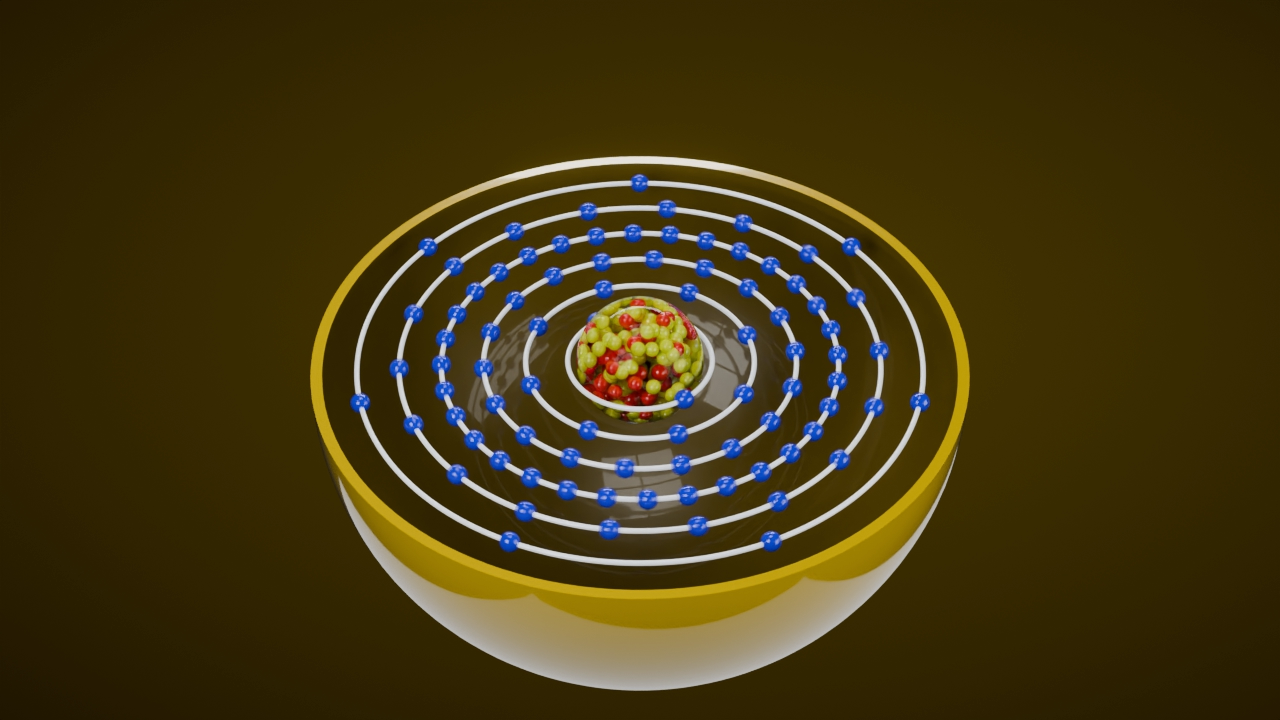
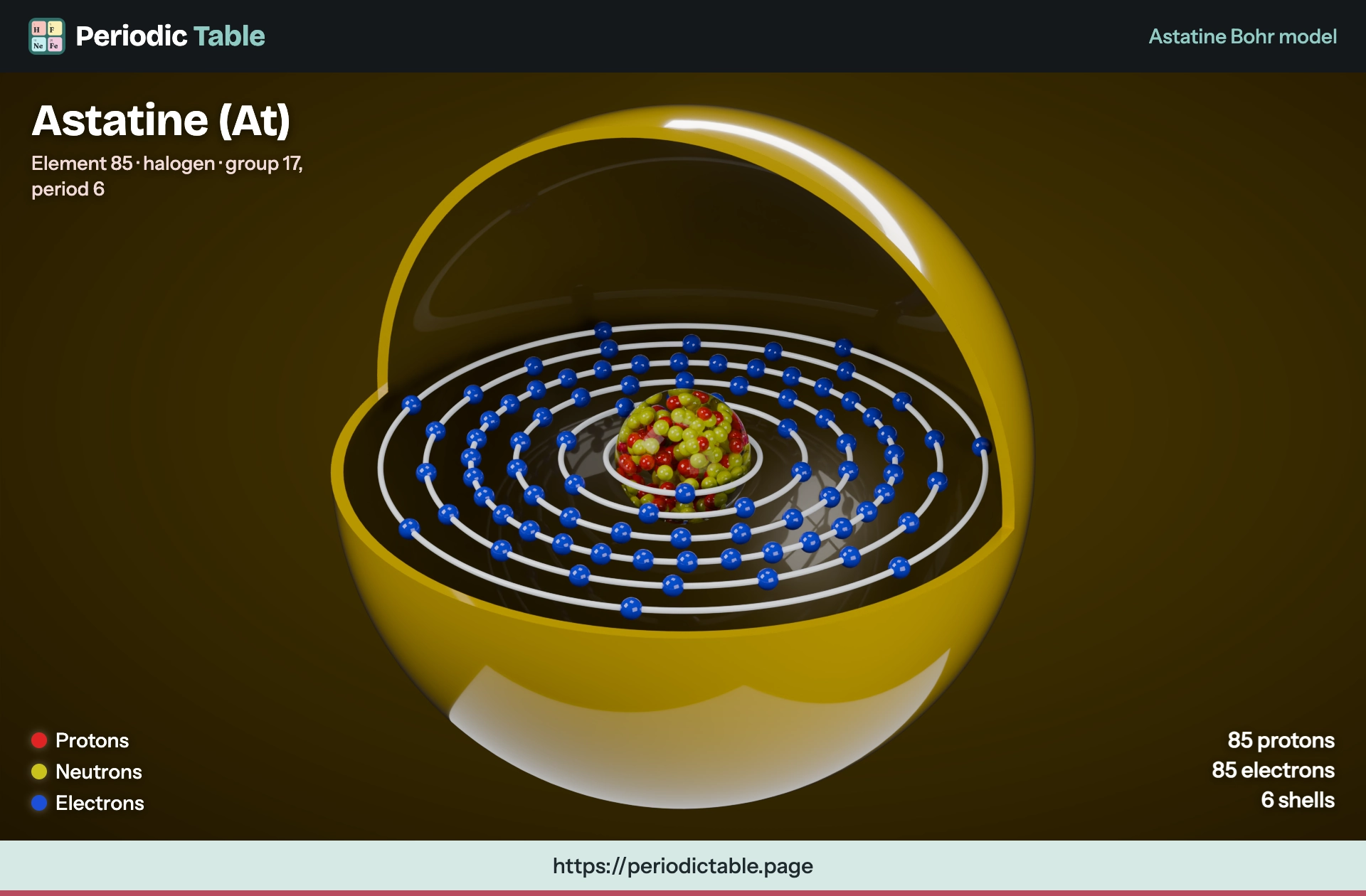
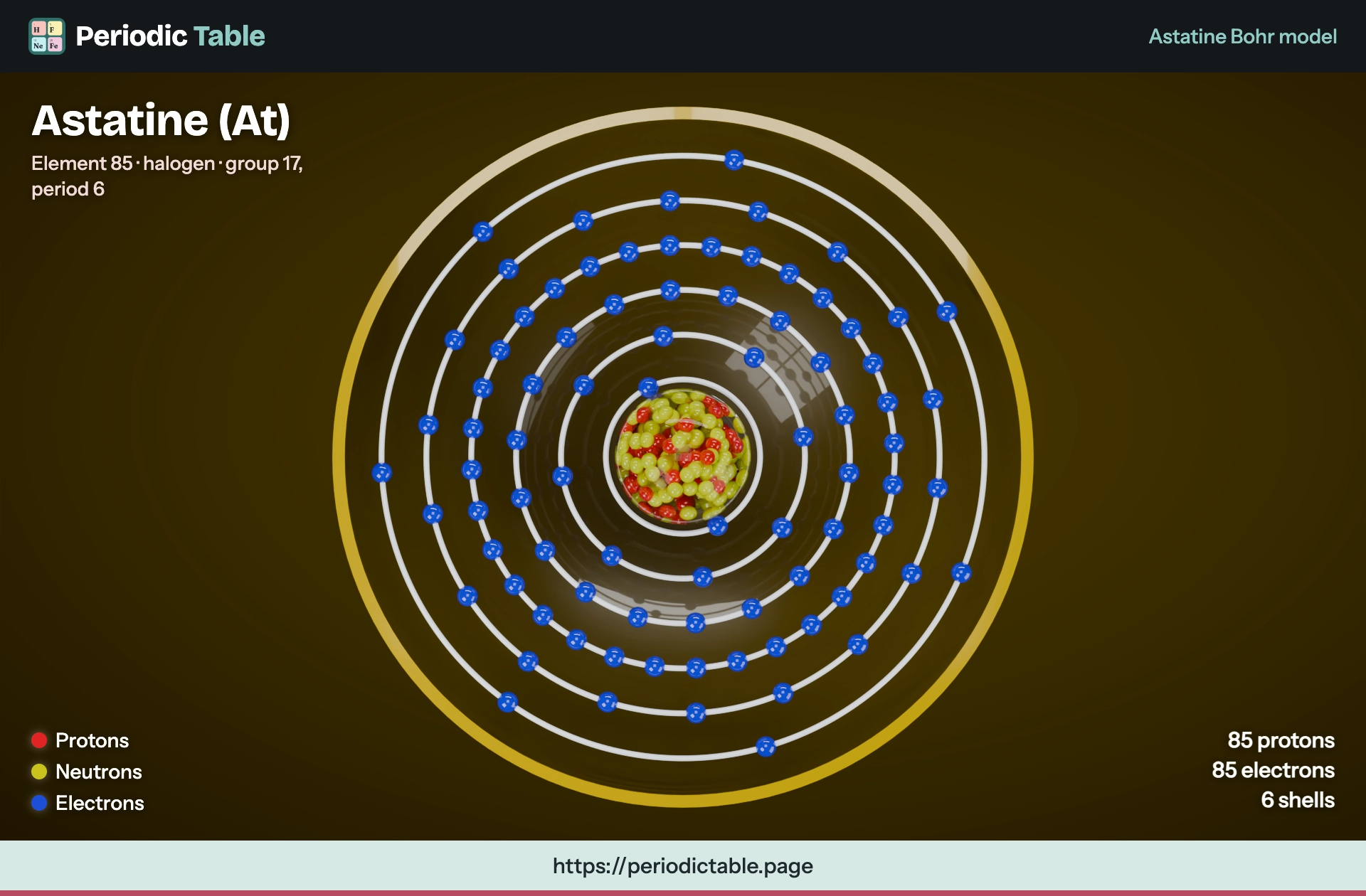
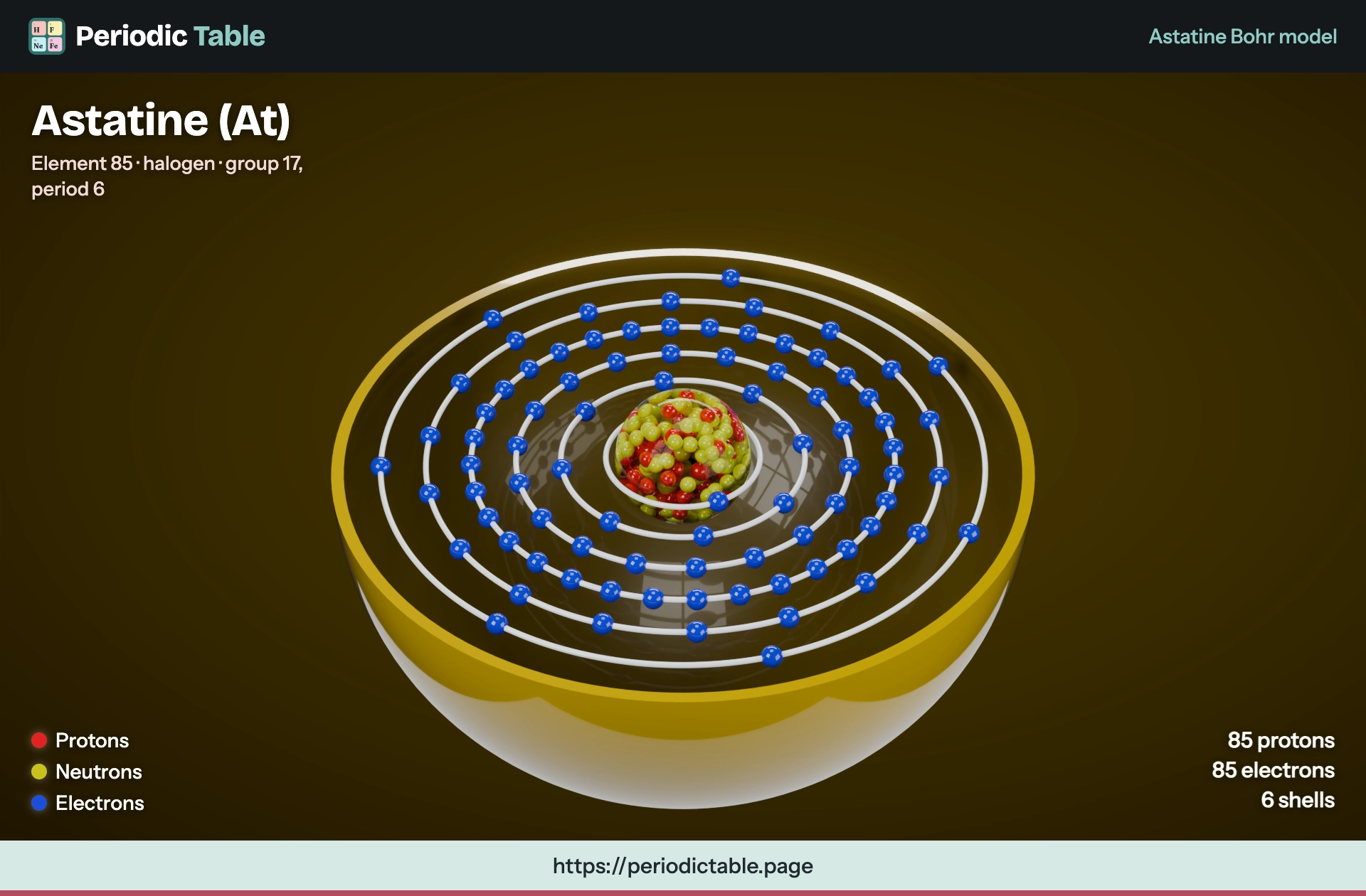
This is a Bohr model of astatine (At), a simplified picture of a single astatine atom. Its nucleus holds 85 protons, and a neutral astatine atom has 85 electrons, arranged around it in 6 shells (2 in shell K, 8 in shell L, 18 in shell M, 32 in shell N, 18 in shell O and 7 in shell P).
Astatine periodic table electron configuration
- Shorthand
- [Xe] 4f14 5d10 6s2 6p5
- Full
- 1s2 2s2 2p6 3s2 3p6 4s2 3d10 4p6 5s2 4d10 5p6 6s2 4f14 5d10 6p5
- Electrons per shell
- 2, 8, 18, 32, 18, 7
Astatine element properties and atomic data
- Atomic number
- 85
- Atomic mass
- [210] u
- Phase at STP
- Solid
- Melting point
- 301.85°C (575 K)
- Boiling point
- 336.85°C (610 K)
- Density
- 6.35 g/cm³
- Electronegativity (Pauling)
- 2.2
- Period
- 6
- Group
- 17
- Block
- p-block
- Appearance
- Unknown, probably metallic
- Discovery date
- 1940
- Discovered by
- Dale R. Corson
- Named by
- —
Astatine element at a glance: atomic number, group 17 and key data
The atomic number of astatine is 85, so every atom carries 85 protons. It sits in group 17, period 6 and the p-block, directly below iodine and between polonium and radon in the same row. Because no isotope is stable, its relative atomic mass is written in brackets as [210], the mass number of its longest-lived isotope rather than a weighted average. Before you compare metals, look up indium uses for melting point, boiling point, density and atomic weight.
Most of the numbers in the table below are predictions or extrapolations. No one has collected enough of this chemical element to weigh it, melt it or measure its density directly, so sources disagree on several values. Where they differ, the range is shown.
| Property | Value |
|---|---|
| Symbol | At |
| Atomic number | 85 |
| Relative atomic mass | [210] |
| Group, period, block | Group 17 (halogens), period 6, p-block |
| Electron configuration | [Xe] 4f14 5d10 6s2 6p5 |
| State at 20 °C | Solid (predicted) |
| Melting point | About 300-302 °C (estimated) |
| Boiling point | About 337-350 °C (estimated) |
| Density | 6.2-6.5 g/cm3 as a molecular solid; 8.91-8.95 g/cm3 if metallic |
| Electronegativity | 2.2 (Pauling scale) |
| Covalent radius | About 150 pm |
| Van der Waals radius | About 202 pm |
| Common oxidation states | -1, +1, +3, +5, +7 |
| Key isotopes | 210At, 211At |
| CAS number | 7440-68-8 |
| Discovered | 1940, University of California, Berkeley |
The covalent radius and Van der Waals radius continue the halogen trend of atoms growing larger down the group, and the CAS number 7440-68-8 is the registry identifier chemists use to look the element up in databases.
Electron configuration, protons and neutrons
The electron configuration [Xe] 4f14 5d10 6s2 6p5 gives a neutral astatine atom 85 electrons arranged in shells of 2, 8, 18, 32, 18 and 7. The last shell holds seven valence electrons (two in 6s, five in 6p), one short of a full octet, which is exactly the pattern that makes fluorine, chlorine, bromine and iodine grab an extra electron.
The number of neutrons depends on the isotope, because the atomic mass of each isotope is roughly protons plus neutrons:
$$N = A - Z$$For astatine-211, the isotope used in medicine, \(N = 211 - 85 = 126\) neutrons. That number matters for its atomic structure: 126 is a nuclear "magic number," a completely filled neutron shell, which is why this isotope decays in a different way from its neighbours.
Why astatine is the rarest naturally occurring element
Any astatine present when the Earth formed vanished within days. What exists today is produced continuously as a decay product of heavier elements, and it disappears almost as fast as it forms. Readers interested in the Tb3+ ion can consult terbium compounds to see why it glows green under ultraviolet light.
Estimates of how much astatine sits in the whole of Earth's crust at any moment range from less than one gram to about 25-30 grams, which is why record books often list it as the rarest element on the planet. Some sources rank berkelium, a transuranium element, as even scarcer, leaving astatine the rarest of the non-transuranic elements.
To put the scale in perspective, scientists estimate that all of North and South America, down to a depth of 16 km, holds only around a trillion atoms of astatine-215 at any instant. That is less than a billionth of a gram spread through billions of tonnes of rock, so nobody mines it. Every sample used in research is made artificially.
Natural occurrence: each decay chain that makes astatine
The natural occurrence of astatine comes from minor branches of three radioactive decay series. Each decay chain passes through a short-lived isotope on a side path:
- Astatine-218 appears in the uranium series, formed by beta decay of polonium-218. It was the first isotope found in nature, identified in 1943.
- Astatine-215 and astatine-219 appear in the actinium series, which also passes through radium. The second, with a half-life of about 56 seconds, is the longest-lived of the natural isotopes.
- Astatine-217 belongs to the neptunium series. Primordial neptunium-237 is long gone, but traces form in uranium ores by neutron capture, so this chain still runs in tiny amounts.
Because each branch is a small fraction of its chain, and each of these isotopes lives for seconds or less, the amount of element 85 in the ground stays vanishingly small.
Physical properties of astatine
Nearly all the physical properties of astatine are predictions, because any visible amount would vaporise itself almost at once from the heat of its own radioactivity. Researchers fill the gaps by following the trends of the lighter halogens. Fluorine is a pale gas, chlorine is yellow-green, bromine is a red-brown liquid and iodine is a dark violet-grey solid, so astatine is expected to be darker still: either a black solid or a dark, lustrous one with a metallic sheen.
Two crystal structures compete for the solid. If astatine behaves like iodine, it would form an orthorhombic lattice of diatomic At2 molecules and act as a semiconductor with a band gap near 0.7 eV.
If instead it condenses as a metal, as several calculations suggest, it would adopt a monatomic face-centered cubic structure and might even be a superconductor, like iodine under high pressure. Whether At2 molecules exist at all is still debated.
What has been observed fits a volatile halogen. With a lower vapor pressure than iodine, astatine still sublimes: about half of a deposit left on clean glass at room temperature evaporates in roughly an hour. Its predicted heat of vaporization for At2 is about 54 kJ/mol.
Melting point, boiling point and density
Published estimates put the melting point near 300-302 °C and the boiling point near 337-350 °C, both higher than iodine's 114 °C and 184 °C, as the group trend predicts. These values are calculated for At2 molecules, not measured. The predicted density depends on which structure is real: about 6.2-6.5 g/cm3 for a molecular solid, or 8.91-8.95 g/cm3 if the metallic phase forms.
Metal, metalloid or nonmetal?
Astatine lies on the rough diagonal that separates metals and nonmetals, and it shows signs of both. Most chemistry texts list it as a nonmetal halogen or a metalloid, while modern relativistic calculations lean towards a metal.
Its metallic side shows up in experiments: it deposits on a cathode and coprecipitates with metal sulfides, behaviour no lighter halogen shows. Its discoverers originally classified it as a metal for exactly these reasons.
Chemical properties of at and its halogen behavior
The chemical properties of astatine have been worked out on samples so dilute that each experiment involves only a few billion atoms, often at concentrations below 10-10 mol per litre. At that scale, impurities, container walls and radiation damage can all distort results, so this chemistry carries more uncertainty than any other halogen's.
Within the halogen family, astatine is the least reactive of the naturally occurring members. Like fluorine, chlorine, bromine and iodine it forms a -1 anion (astatide, At-), and most of its organic chemistry mirrors iodine's. Unlike them, it also forms a stable cation in water and binds to EDTA, a chelating agent normally used to grab metals.
In its +1 state it resembles silver more than iodine. The heavier tennessine, element 117, sits below it in group 17, but its chemistry has not yet been studied.
Electronegativity, electron affinity and ionization energy
On the revised Pauling scale, astatine's electronegativity is 2.2, lower than iodine's 2.66 and the same as hydrogen's. That has an odd consequence: in hydrogen astatide the negative charge may sit on the hydrogen, so the compound could fairly be called astatine hydride.
Its electron affinity, measured at about 233 kJ/mol, is around 21% lower than iodine's, a much bigger drop than between any other pair of halogens. Relativistic spin-orbit effects on the heavy 6p electrons are the usual explanation.
The first ionization energy, about 899 kJ/mol (9.32 eV), was unknown until 2013, when a team at CERN measured it by laser spectroscopy. It continues the steady decline down the group.
Oxidation states from -1 to +7
Like iodine, astatine takes odd-numbered oxidation states from -1 to +7: -1 in astatides, +1 in species such as AtO- and its cations, +3, +5 in the astatate ion AtO3-, and +7 in perastatate, AtO4-. The higher states need strong oxidisers to reach and survive only in neutral or alkaline solution.
Compounds of at: astatides, interhalogens and oxyanions
All known astatine compounds have been made in nano-scale amounts and studied in the minutes or hours before they decay. To make filtration and precipitation work at all, chemists add ordinary iodine as a carrier: the iodine forms enough solid to handle, and the astatine follows it.
- Hydrogen astatide (HAt) was noticed by the first astatine chemists. Dissolved in water it gives hydroastatic acid, a weaker relative of hydrochloric acid. It oxidises easily, so silver ions only partly precipitate it as silver astatide, whereas iodide precipitates almost completely as silver iodide.
- Metal astatides have been reported for sodium, palladium, silver, thallium and lead. Each astatide salt so far is known only from tracer work.
- Interhalogen molecules AtI, AtBr and AtCl form when astatine meets iodine, bromine or chlorine vapour. AtI is the heaviest known diatomic interhalogen. No astatine fluoride has been found yet.
- Oxyanions include astatate (AtO3-), which can be co-precipitated as lanthanum triastatate, and perastatate (AtO4-), made by oxidising astatate with xenon difluoride or periodate.
- Organic compounds include astatobenzene, C6H5At, in which one At atom replaces a hydrogen on benzene. The element also bonds to boron, carbon and nitrogen, and At-B bonds in boron cage molecules are more stable than At-C bonds.
That last point is practical. A drug molecule only works if the radioactive atom stays attached, so the search for stronger bonds drives much of today's astatine chemistry.
History and discovery of the fifth halogen
The history of element 85 begins with a gap. When the periodic table was first drawn up in 1869, the space below iodine was empty, and later work confirmed a fifth halogen belonged there. Searches of minerals produced a string of false claims through the 1930s, because the element is too rare to find in rocks.
The real discovery came in 1940 at the University of California, Berkeley. Dale R. Corson, Kenneth Ross MacKenzie and Emilio Segrè bombarded a bismuth target with alpha particles in a cyclotron and made astatine-211. It was the second synthetic element to be confirmed, after technetium, which Segrè had co-discovered three years earlier.
The team held back on a name, since an element made in "invisible quantities" was not yet seen as fully valid. In 1943, Austrian physicist Berta Karlik and her assistant Traude Bernert found astatine in the uranium and actinium decay series, confirming it occurs in nature. In 1947 the discoverers proposed "astatine," from the Ancient Greek astatos, meaning unstable, with the "-ine" ending of the other halogens.
Eka-iodine, alabamine and other false claims
Before its discovery, the missing element was called eka-iodine, following Mendeleev's habit of naming predicted elements "one place below" a known one. Several claims came and went:
- Alabamine (symbol Ab), announced in 1931 at Alabama Polytechnic Institute and disproved in 1934.
- Dakin, claimed in 1937 in Dacca; its reported properties did not match the real element.
- Dor, from X-ray lines reported in 1936-1944 in Romania and France, rejected in 1947.
- Helvetium (1940) and anglo-helvetium (1942) from Switzerland and England, which could not be reproduced.
Isotopes of at and their half-life
There are about 41 known astatine isotopes, with mass numbers from 188 to 229, and none is stable. A long-lived or stable isotope is not expected to exist. Only five have a half-life longer than an hour (mass numbers 207 through 211), and the extremes are striking: astatine-210 lasts 8.1 hours, while astatine-213 survives only 125 nanoseconds before it decays to bismuth-209.
| Isotope | Half-life | Main decay | Decays mainly to |
|---|---|---|---|
| 209At | 5.41 hours | Electron capture / positron emission | Polonium-209 |
| 210At | 8.1 hours | Electron capture / positron emission | Polonium-210 |
| Astatine-211 | 7.21 hours | Electron capture (58%), alpha (42%) | Polonium-211, bismuth-207 |
| 213At | 125 nanoseconds | Alpha | Bismuth-209 |
| 219At | 56 seconds | Alpha | Bismuth-215 |
The fast decay of every isotope is easy to see with the half-life equation, where \(N_0\) is the starting number of atoms and \(t_{1/2}\) the half-life:
$$N(t) = N_0 \left(\tfrac{1}{2}\right)^{t / t_{1/2}}$$For the medical isotope (\(t_{1/2} = 7.214\) hours), a dose prepared at 8 a.m. keeps 74.96% of its atoms by 11 a.m., just 9.97% after 24 hours and 0.99% after 48 hours. In practice that gives a hospital roughly one working day to use it. Astatine-210 lasts slightly longer, keeping 12.83% after 24 hours, but its decay product is the highly toxic polonium-210, which is why it is unwanted in medical batches.
Astatine also has 24 known nuclear isomers, excited nuclear states with their own half-lives. The longest-lived is astatine-202m1, at about 3 minutes.
Among the first 101 elements, only francium is less stable. Taken together, these isotopes of astatine decay into isotopes of bismuth, polonium or radon depending on the path taken.
Radioactivity and decay modes
The radioactivity of astatine follows a clear pattern by mass. Lighter isotopes decay mostly by positron emission; astatine-211 decays by electron capture or alpha decay; and isotopes from mass 217 upwards (except 218) undergo beta decay, emitting an electron to become radon.
The 126-neutron shell of the 211 isotope raises its alpha probability to about 42%, compared with under 0.2% for its 210 neighbour, and every path in its radioactive decay ends at stable lead-207. That clean ending matters for medicine.
Synthesis: how at-211 is made in a cyclotron
The method from 1940 is still the main synthesis route. A metal target of bismuth-209 is hit with alpha particles accelerated in a cyclotron or another particle accelerator, and the nucleus absorbs the alpha particle and ejects two neutrons:
$$^{209}_{83}\text{Bi} + {}^{4}_{2}\text{He} \rightarrow {}^{211}_{85}\text{At} + 2\,{}^{1}_{0}n$$Operators keep the beam energy close to 28 MeV. Higher energies push a third neutron out and create the 210 isotope, which decays into polonium-210 and contaminates the batch. The bismuth target is usually a thin layer of bismuth on an aluminium, copper or gold backing, cooled with water under nitrogen so the astatine does not evaporate during the run.
Yields are measured in activity, not weight. One gigabecquerel of this isotope is about 3.7 × 10¹³ atoms, which works out to roughly 13 nanograms, and production runs reach only a few gigabecquerels.
Only a few dozen cyclotrons worldwide can supply the right beam, and the bismuth target melts if pushed too hard, which is a major limit on how much research can be done. The element is not normally made in a nuclear reactor.
Separating astatine by dry distillation and solvent extraction
After the run, the astatine has to be pulled out of the bismuth quickly. In dry distillation, the target is heated to around 650 °C so the volatile astatine evaporates and condenses on a cooled surface such as a cold finger or a chilled capillary tube.
The solvent extraction (wet) method dissolves the target in acid and extracts it into an organic solvent. Both have to finish within an hour or two, in a shielded laboratory, because the clock of the 7.2-hour half-life is already running.
How scientists study element 85 without a visible sample
With no sample to put under a microscope, researchers study astatine through its radiation. Each atom announces its decay, so a detector can follow where it goes: into a precipitate, onto a filter, into one solvent layer or another. Using it as a radioactive tracer this way, chemists infer its behaviour from where the activity ends up, even when they never have more than a few billion atoms.
Physical methods fill in the rest. Plasma mass spectrometry confirmed ions such as AtI+ and AtBr+, and laser methods at isotope separators now measure properties one atom at a time. This kind of research also tests theory: for heavy elements, relativistic effects on fast-moving inner electrons change chemistry noticeably, and astatine is one of the few places where nuclear physics and halogen chemistry meet in an element you can still experiment with.
Astatine uses in targeted alpha therapy
For an element that barely exists, astatine has a promising future in medicine. Outside research, the main use of astatine-211 is targeted alpha therapy, a form of radiotherapy that delivers a lethal dose to cancer cells while sparing most of the healthy tissue around them.
The idea is to attach the isotope to a carrier molecule that seeks out a specific tumor, such as one of the monoclonal antibodies that bind to proteins on cancer cell surfaces. As an alpha emitter with a half-life of 7.2 hours, it delivers its dose within a day or two, and its X-rays let doctors track where it has gone. Among radiopharmaceuticals it is a leading candidate for treating small, scattered cancer, including:
- Recurrent brain tumours, tested in an early clinical trial at Duke University.
- Ovarian cancer that has spread through the abdomen, treated with astatine-labelled antibodies.
- Thyroid cancer and blood cancers in more recent studies, including Japanese trials of labelled compounds.
The hard part is chemistry. The astatine must be fixed to its targeting molecule fast, before it decays, and must stay attached once injected. The broader nuclear medicine field is working on more stable bonds to solve this.
Alpha particles versus beta particles in tissue
Standard treatments such as iodine-131, used for thyroid cancer, emit beta particles: fast electrons that travel a few millimetres through tissue. That suits large tumours but spreads energy far outside small clusters of cells.
Alpha particles travel only about 50-70 micrometres, a few cell widths, and deposit far more energy along the way, so the damage stays where the isotope sits. Like iodine, the free element collects in the thyroid, so carriers are designed to keep it away from that gland.
Toxicity and radiation safety when handling at-211
The chemical toxicity of astatine is not known, but it is not the real concern. At the scale anyone handles it, the hazard is radiation.
Alpha particles cannot pass through skin, but inside the body they do intense local damage, so the main risk is swallowing or breathing in the volatile element. Like iodine, any that enters the body tends to gather in the thyroid, along with the stomach, lungs and spleen.
That is why work with astatine-211 takes place in sealed fume hoods and glove boxes with dedicated monitoring. There is no environmental hazard from the natural element, since even the highest estimates put the total on Earth at any moment under 30 grams, and laboratory batches are only micrograms or less and decay within days.
How at compares with iodine and the other halogens
Looking down group 17 shows where astatine follows the trend and where it breaks away. Values below are standard published figures; the last row is the least certain.
| Halogen | Atomic number | Electronegativity (Pauling) | First ionization energy (kJ/mol) | Electron affinity (kJ/mol) |
|---|---|---|---|---|
| Fluorine | 9 | 3.98 | 1681 | 328 |
| Chlorine | 17 | 3.16 | 1251 | 349 |
| Bromine | 35 | 2.96 | 1140 | 325 |
| Iodine | 53 | 2.66 | 1008 | 295 |
| Astatine | 85 | 2.2 | 899 | 233 |
Ionization energy falls smoothly, so the outer electron is easier to remove, which explains the metallic hints. Electron affinity drops sharply after iodine, and electronegativity falls to hydrogen's level. Taken together, these astatine properties describe the least typical halogen: it still forms an anion, but it is also the one most willing to act like a metal.
Key facts about at, the heaviest natural halogen
- Element astatine has symbol At, atomic number 85 and a relative atomic mass of [210].
- It is the heaviest naturally occurring halogen and the rarest natural element, with under 30 grams in Earth's crust even by the highest estimates.
- No visible sample has ever been made; most of its properties are predicted.
- All 41 or so isotopes are radioactive; the longest-lived lasts 8.1 hours.
- It was first made in 1940 at Berkeley by bombarding bismuth with alpha particles.
- Its name comes from the Greek word for "unstable."
- Astatine-211 is being tested as a targeted alpha therapy for cancer.