


Indium element (In): indium periodic table facts
Indium periodic table facts: indium (In) is element 49, a post-transition metal in group 13, period 5. Press a fingernail into a bar of indium and it leaves a dent, because this chemical element is one of the softest metals you can hold. Hanford, Los Alamos and the Trinity test are placed in context when you read the plutonium on the periodic table guide to the history and environmental legacy.
You will also find it behind almost every touchscreen you use, since it is what makes a clear screen conduct electricity while staying clear. This guide covers its chemistry, the numbers that define it, where the element is mined, and why electronics makers depend on it more than on most other elements.
Rotate the 3D Bohr model of indium
Drag to orbit, scroll to zoom.
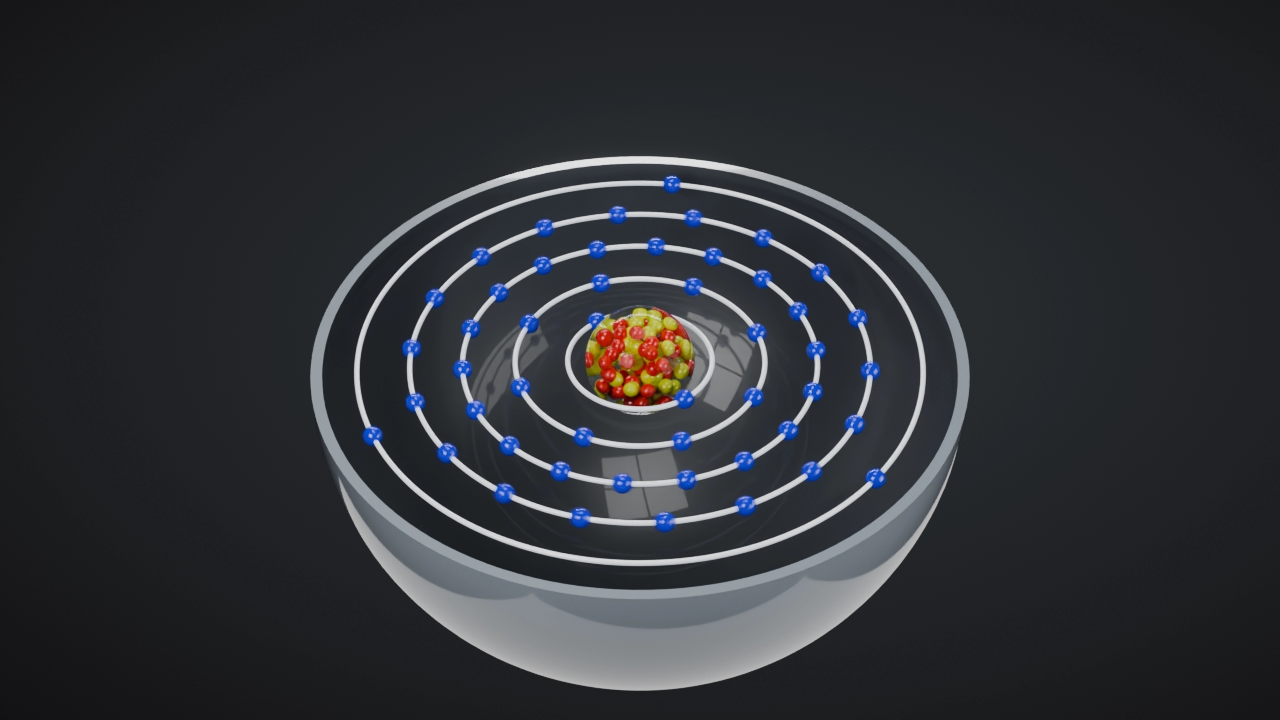
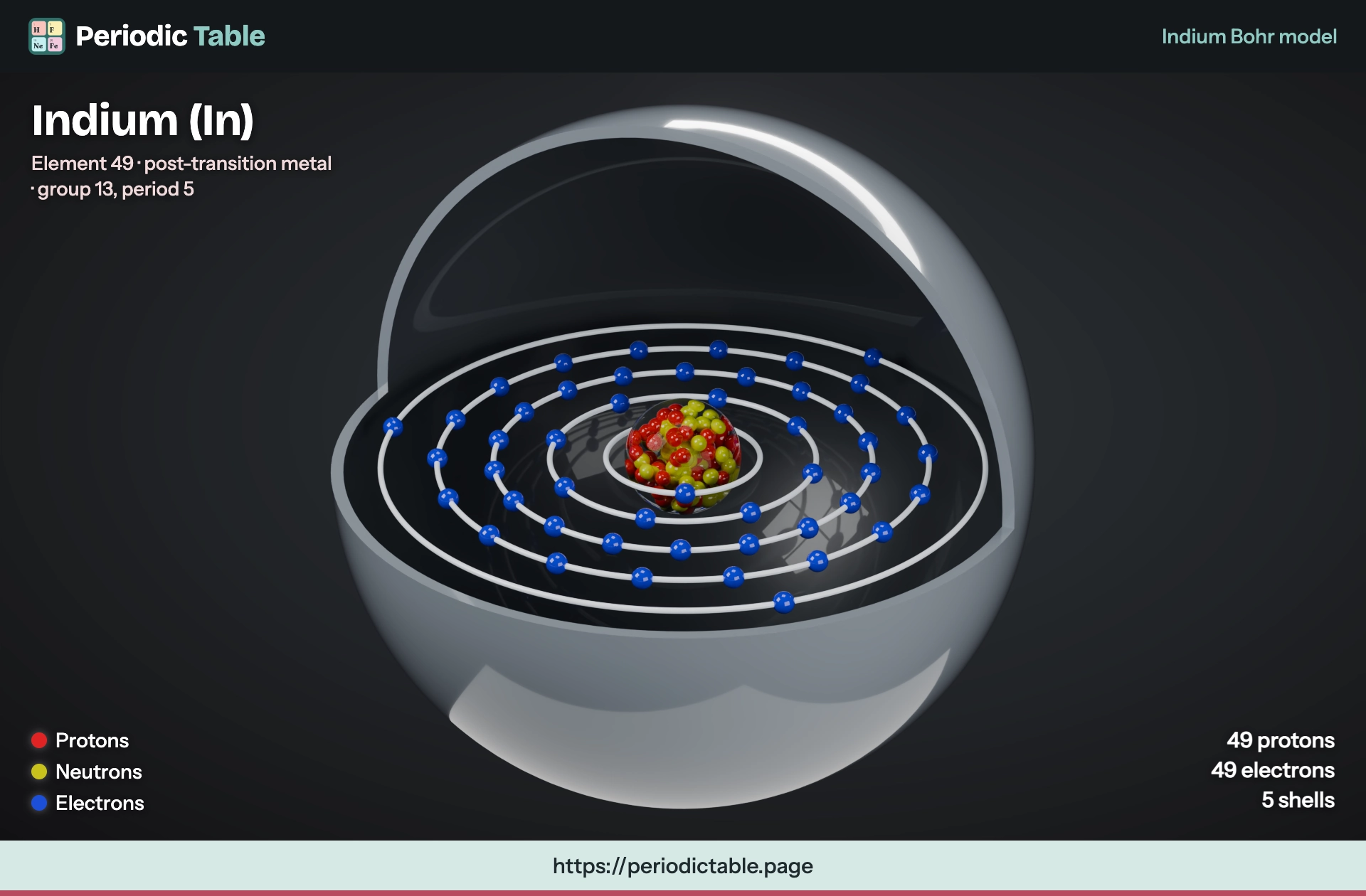
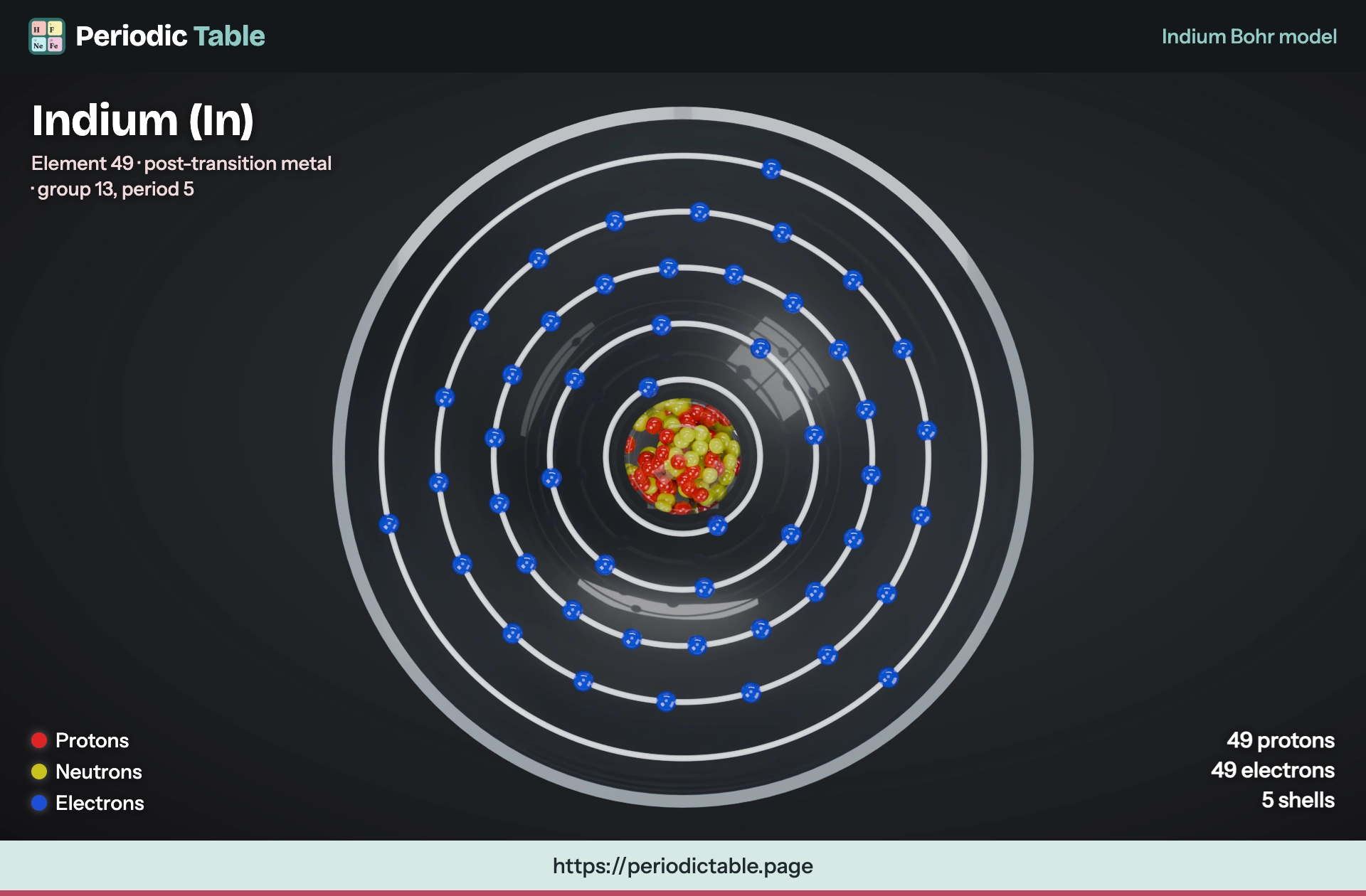
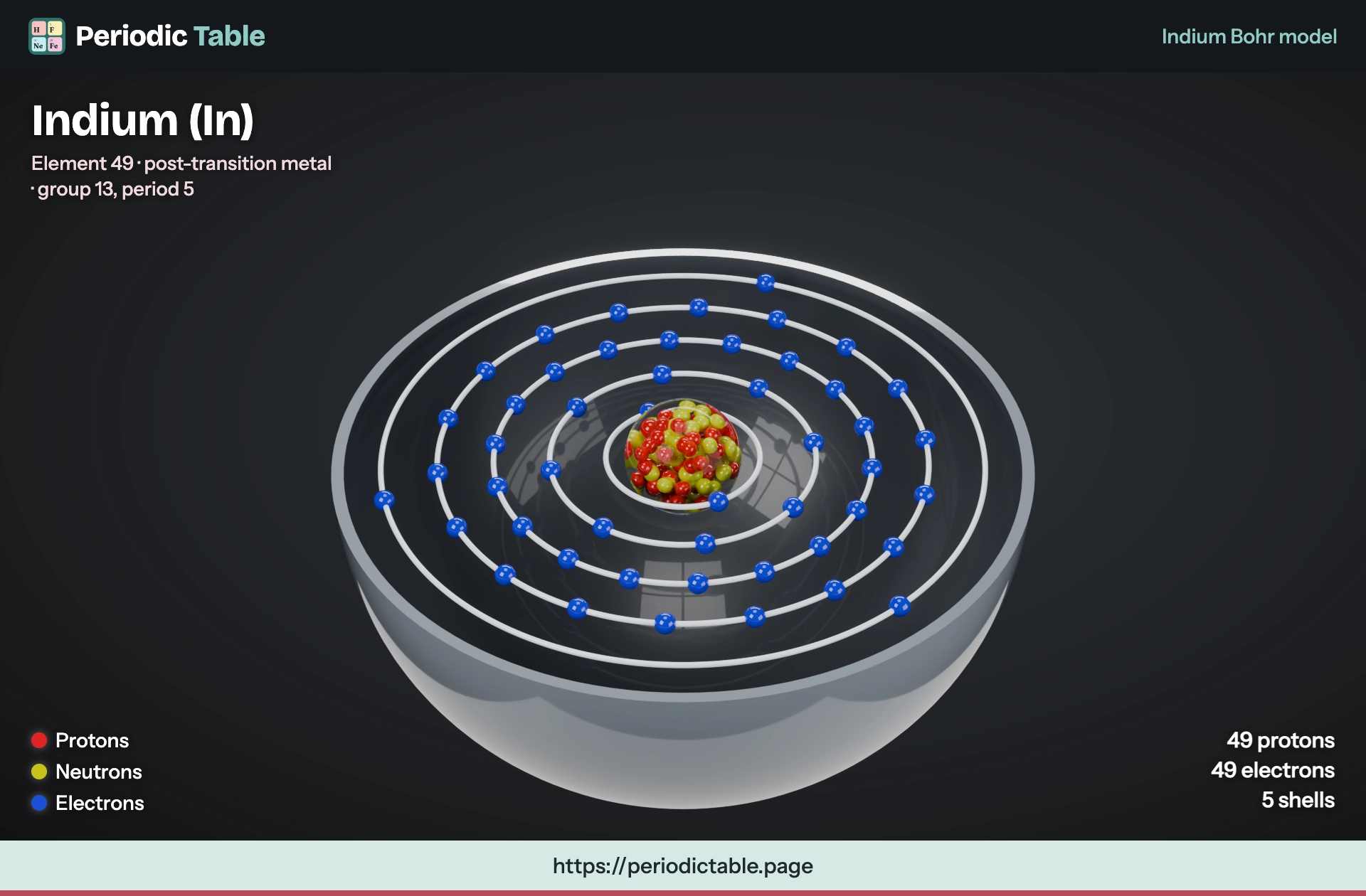
This is a Bohr model of indium (In), a simplified picture of a single indium atom. Its nucleus holds 49 protons, and a neutral indium atom has 49 electrons, arranged around it in 5 shells (2 in shell K, 8 in shell L, 18 in shell M, 18 in shell N and 3 in shell O).
Indium periodic table electron configuration
- Shorthand
- [Kr] 4d10 5s2 5p1
- Full
- 1s2 2s2 2p6 3s2 3p6 4s2 3d10 4p6 5s2 4d10 5p1
- Electrons per shell
- 2, 8, 18, 18, 3
Indium element properties and atomic data
- Atomic number
- 49
- Atomic mass
- 114.8181 u
- Phase at STP
- Solid
- Melting point
- 156.6°C (429.7485 K)
- Boiling point
- 2071.85°C (2345 K)
- Density
- 7.31 g/cm³
- Electronegativity (Pauling)
- 1.78
- Period
- 5
- Group
- 13
- Block
- p-block
- Appearance
- Silvery lustrous gray
- Discovery date
- 1863
- Discovered by
- Ferdinand Reich
- Named by
- —
Indium element facts: atomic number and electron configuration
The indium element carries the symbol In and atomic number 49, which means every atom holds 49 protons in its nucleus and, when neutral, 49 electrons around it. Its standard atomic weight is 114.818, and its electron configuration is written [Kr] 4d10 5s2 5p1, so three outer ones (two 5s and one 5p) take part in bonding. That single 5p electron places it in the p-block and in period 5. When tracing radioactive decay, you can follow the chain from alpha particles down to lead through the thorium melting point guide for learners.
| Property | Value |
|---|---|
| Symbol / atomic number | In / 49 |
| Atomic weight | 114.818 |
| Group, period, block | Group 13, period 5, p-block |
| Ground-state configuration | [Kr] 4d10 5s2 5p1 |
| Melting point | 156.6 °C (429.75 K) |
| Boiling point | 2072 °C (2345 K) |
| Density at 20 °C | 7.31 g/cm3 |
| State at 20 °C | Solid, silvery-white |
| CAS number | 7440-74-6 |
Where indium sits in the periodic table and the boron group
On the periodic table it lies between cadmium (48) on its left and tin (50) on its right. Vertically it belongs to group 13, the boron group, with gallium directly above and thallium directly below. Most of its behaviour lands between those two neighbours: it melts higher than the lighter member above it but lower than the heavier one below, and its weight per cubic centimetre follows the same pattern.
Atomic radius, electronegativity and ionization energies
Its empirical atomic radius is about 167 pm, its covalent radius about 142 pm, and its Van der Waals radius 193 pm. On the Pauling scale its electronegativity is 1.78, a middling value that explains why it forms both ionic salts and covalent molecules.
- First of the ionization energies: 558.3 kJ/mol
- Second: 1820.7 kJ/mol
- Third: 2704 kJ/mol
- Fourth: 5210 kJ/mol, a jump that shows why +3 is the usual limit
Physical properties of indium metal: melting point, boiling point and density
Indium metal is silvery-white and lustrous, highly malleable and ductile. With a Mohs hardness of only 1.2 it is a true soft metal: a knife cuts it, and it leaves a grey line on paper the way a pencil does. To follow decay chain branches, alpha decay, beta decay and electron capture channels, see the halogen astatine for the full set.
It melts at 156.6 °C, low enough for a kitchen oven, yet it boils only at 2072 °C, so the liquid range spans almost 1,900 degrees. It can also wet glass, and liquid mercury dissolves more than half its own mass of indium at 0 °C.
The solid has a body-centered tetragonal crystal structure, a slightly squashed version of a face-centred cube. Cool it below 3.41 K and it becomes a superconductor. Its specific heat capacity is about 233 J/(kg·K), and it stays soft and workable even at very low temperature, which is why cryogenic engineers like it.
The figure of 7.31 g/cm3 (its relative density or specific gravity compared with water) is the figure engineers use most, because it turns a length of wire into a weight:
$$m = \rho \times \pi r^{2} \times L$$
For 25 m of 1.0 mm wire, the radius is 0.05 cm and the length 2,500 cm, so the volume is \(\pi \times 0.05^{2} \times 2500 = 19.63\) cm3 and the mass is \(19.63 \times 7.31 \approx\) 143.5 g. The same spool in lead (11.34 g/cm3) would weigh about 222.7 g.
Why this soft metal gives a high-pitched cry
Bend a pure bar and you hear a faint crackle, the same high-pitched cry that tin gives. The sound comes from crystal twinning: layers of the crystal lattice suddenly flip into a mirror-image arrangement as the bar deforms, and each tiny slip clicks.
Indium isotopes and their half-life
Scientists know 39 indium isotopes, with mass numbers from 97 to 135, but only two occur in nature. The odd part is that the stable isotope is the rare one. Indium-113 makes up only about 4.3% of natural indium, while indium-115, which is very slightly radioactive, makes up about 95.7%.
This isotope is primordial, left over from before Earth formed, and its half-life of 4.41 × 10¹⁴ years is tens of thousands of times longer than the age of the universe, so in practice it behaves as stable. It decays by beta decay to Sn-115.
| Isotope | Natural abundance | Decay time | Decay |
|---|---|---|---|
| In-113 | 4.28% | Stable | None |
| In-115 | 95.72% | 4.41 × 10¹⁴ years | Beta minus to Sn-115 |
| In-111 | Synthetic | 2.80 days | Electron capture to Cd-111 |
| In-114m | Synthetic | 49.5 days | Isomeric transition |
Indium-111 is the most stable artificial isotope and the one medicine uses. Lighter isotopes tend to decay into Cd and heavier ones into Sn.
Indium compounds and oxidation states
The usual oxidation states are +3 and, less often, +1. In most of its chemistry the atom gives up its three outer ones to form In3+. Sometimes the two 5s electrons hold back, a result of the inert pair effect, and the +1 ion forms instead.
The effect gets stronger down group 13, so the +1 state is uncommon for gallium and dominant for thallium. The best-known organometallic, trimethylindium, is the starting material for chip-grade crystals:
$$\mathrm{In(CH_3)_3 + PH_3 \rightarrow InP + 3\,CH_4}$$
Indium(III) and indium(I) compounds
Indium(III) compounds dominate its aqueous chemistry. The chloride, bromide and iodide trihalides act as Lewis acids, much like the aluminium halides. Burning indium in air gives indium oxide, In2O3, a pale yellow solid.
With group 15 elements it forms indium phosphide (InP) and indium antimonide (InSb), both semiconductors. Indium(I) compounds are fewer and deeply coloured, and many of them are strong reducing agents. The element itself does not react with water and does not form a boride, silicide or carbide.
History of the chemical element: discovery and name
In 1863, Ferdinand Reich and Hieronymus Theodor Richter at the mining school in Freiberg, Saxony, were testing ore from local mines for thallium. Reich was colour-blind, so Richter looked through the spectroscope for him. Instead of thallium's green line they saw a bright indigo blue line that matched no known substance, and they concluded a new element was in the ore.
They named it after that line, from the Latin indicum, the word for indigo and for violet dye that came to Europe from India. Richter isolated pure indium in 1864, and a 0.5 kg ingot went on show at the 1867 World Fair in Paris.
The two men later fell out after Richter claimed to be the sole discoverer. For decades it stayed a laboratory curiosity, studied in chemistry departments rather than factories: until 1924 the world's isolated supply was about a gram.
Where indium comes from: crustal abundance, zinc ores and indium production
It is rare. Its crustal abundance is roughly 50 ppb, about the same abundance in the Earth's crust as silver. It almost never forms minerals of its own; fewer than ten are known, and none is rich enough to mine.
Instead it hides as a trace in common ores, chiefly sphalerite, a zinc sulfide, and to a lesser degree chalcopyrite. In stars it is built by the s-process, the slow capture of neutrons that turns lighter nuclei into indium-115.
Because of this, indium production is always a by-product of mining and smelting zinc ores. During zinc refining it collects in the iron-rich residues, is leached out, and is purified by electrolysis. Nobody digs a mine for it alone.
Indium supply, recycling and price
That by-product status shapes the entire indium supply: output rises only when more zinc is processed. China is the largest producer, followed by South Korea, Japan and Canada.
Demand jumped from the late 1990s as flat screens replaced tube monitors, and the price has swung widely since. Factory scrap from coating lines is reclaimed efficiently, especially in Japan, but end-of-life recycling of old devices stays below 1%, so most of the indium in a discarded phone is lost.
Indium tin oxide in flat-panel displays and solar cells
The largest use by far is indium tin oxide (ITO), roughly 90% In2O3 and 10% SnO2. Laid down as thin films on glass or plastic, it is a transparent conductive coating: it lets visible light through while carrying current. That combination makes it the electrode layer in flat-panel displays, from LCD televisions and monitors to phone touchscreens, and in many thin-film solar cells.
Screens account for around half of all consumption. ITO also reflects infrared, so coated windows and windscreens keep heat out and can be electrically demisted.
Semiconductor uses: LEDs, laser diodes and CIGS cells
The semiconductor industry is the next big buyer. Indium gallium nitride (InGaN) is the material that makes blue and white LEDs and violet laser diodes possible, while InP and InAs carry fast signals in fibre-optic and high-frequency transistors.
In photovoltaics, copper indium gallium selenide, known as CIGS, is a thin-film absorber that turns sunlight into current. Each of these materials has a band gap that can be tuned by changing the indium content.
Indium solder, indium wire and low-melting alloys
Its softness and stickiness make it a natural joining material. Indium solder melts at low temperature, so it bonds heat-sensitive parts and dissimilar materials without stressing them, and lead-free solders often include it. Indium wire and foil squash into irregular gaps, which is why they are used as a vacuum seal, for hermetic sealing, and as a thermal conductor for thermal management between chips and heat sinks, including in cryogenic equipment near absolute zero.
- Fusible alloys with bismuth and lead melt at 50-100 °C and trigger fire sprinkler heads.
- Galinstan, a gallium-indium-tin alloy, is liquid at room temperature and replaces mercury in some thermometers.
- Small additions harden gold and platinum and improve dental amalgam.
- It replaces mercury in alkaline batteries to stop the zinc from corroding.
- Silver-indium-cadmium control rods absorb neutron radiation in nuclear reactors.
Its first large job came in World War II, when it coated engine bearings in high-performance aircraft to resist wear and corrosion.
Nuclear medicine and the YInMn blue pigment
In nuclear medicine, tiny amounts of indium-111 serve as a radiotracer: doctors label a patient's white blood cells with it and track where they gather to find hidden infections. In 2009, chemists at Oregon State University combined it with yttrium and manganese to make YInMn Blue, the first new inorganic blue pigment in about two centuries.
Is the post-transition metal toxic? safety and biological role
As a post-transition metal, element indium has no known biological role in any organism. Swallowed compounds are poorly absorbed, but they are toxic by inhalation or injection, and workers who breathe ITO dust have developed lung disease. Handle solid pieces freely, but use extraction and a mask wherever its powder or fumes are produced.