


Thorium element (Th): thorium periodic table facts
Thorium periodic table facts: thorium (Th) is element 90, an actinide in period 7 of the f-block. Thorium is the silvery, weakly radioactive thorium element that sits at number 90 on the periodic table, with the symbol Th. If you've ever wondered why an actinide that most people never see was once inside millions of camping lanterns, and why engineers now talk about it as a future reactor fuel, this guide walks you through its properties, isotopes, sources, uses and safety. On fissile isotopes, critical mass and the Manhattan Project story, the plutonium periodic table page gives all the background.
You'll find that this soft, malleable member of the radioactive metals is far more common, and far more useful, than its obscure reputation suggests. Thorium is a chemical element whose story runs from a Norwegian island to modern nuclear research.
Rotate the 3D Bohr model of thorium
Drag to orbit, scroll to zoom.
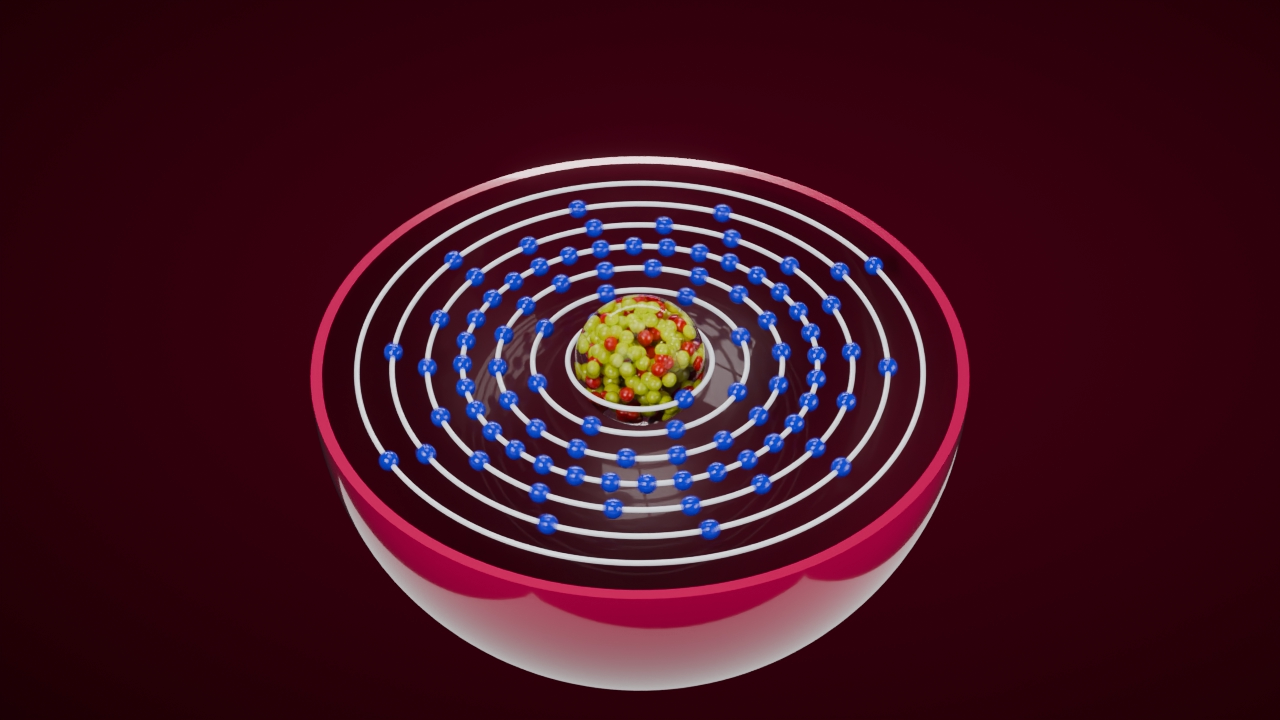
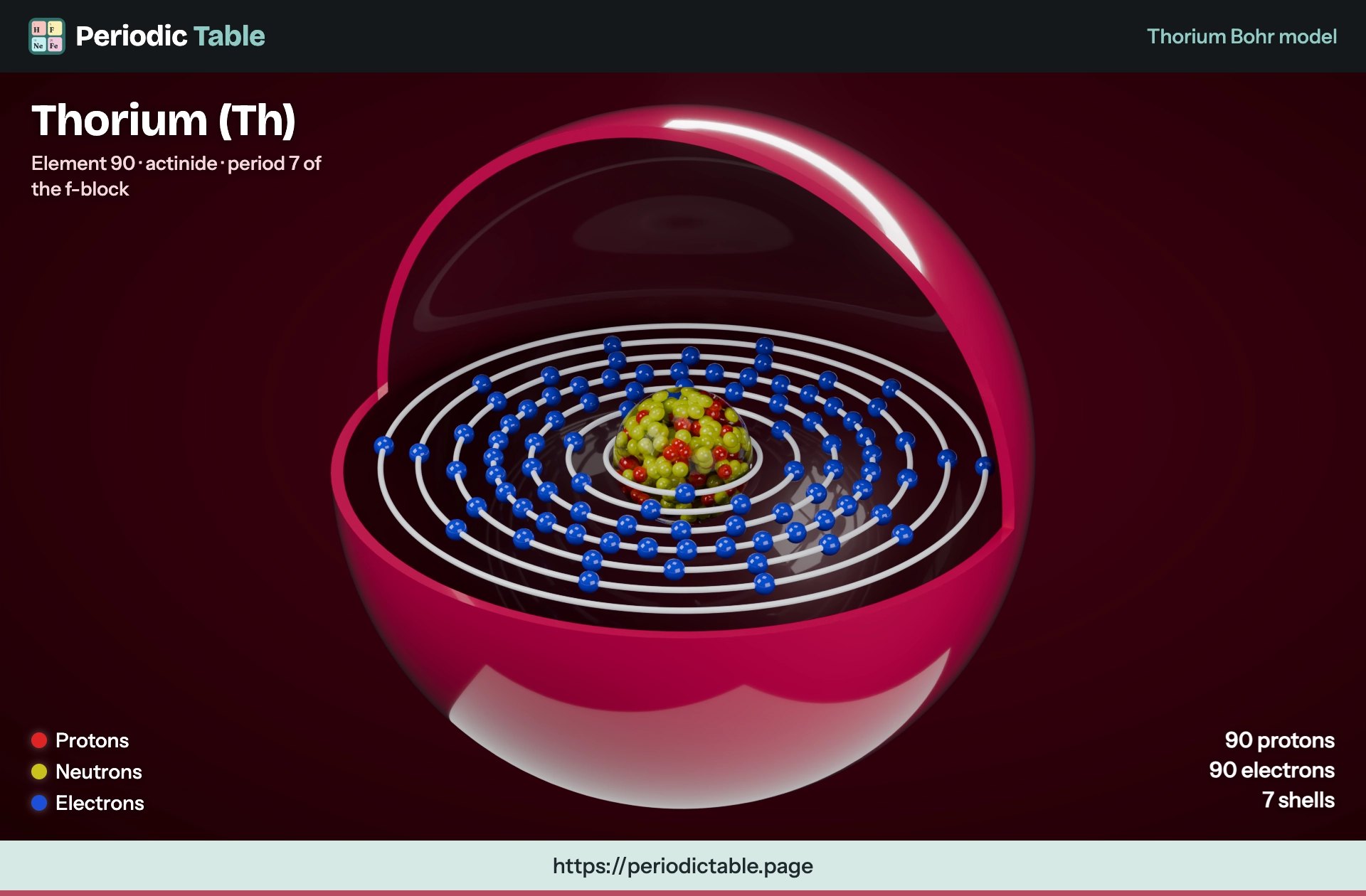
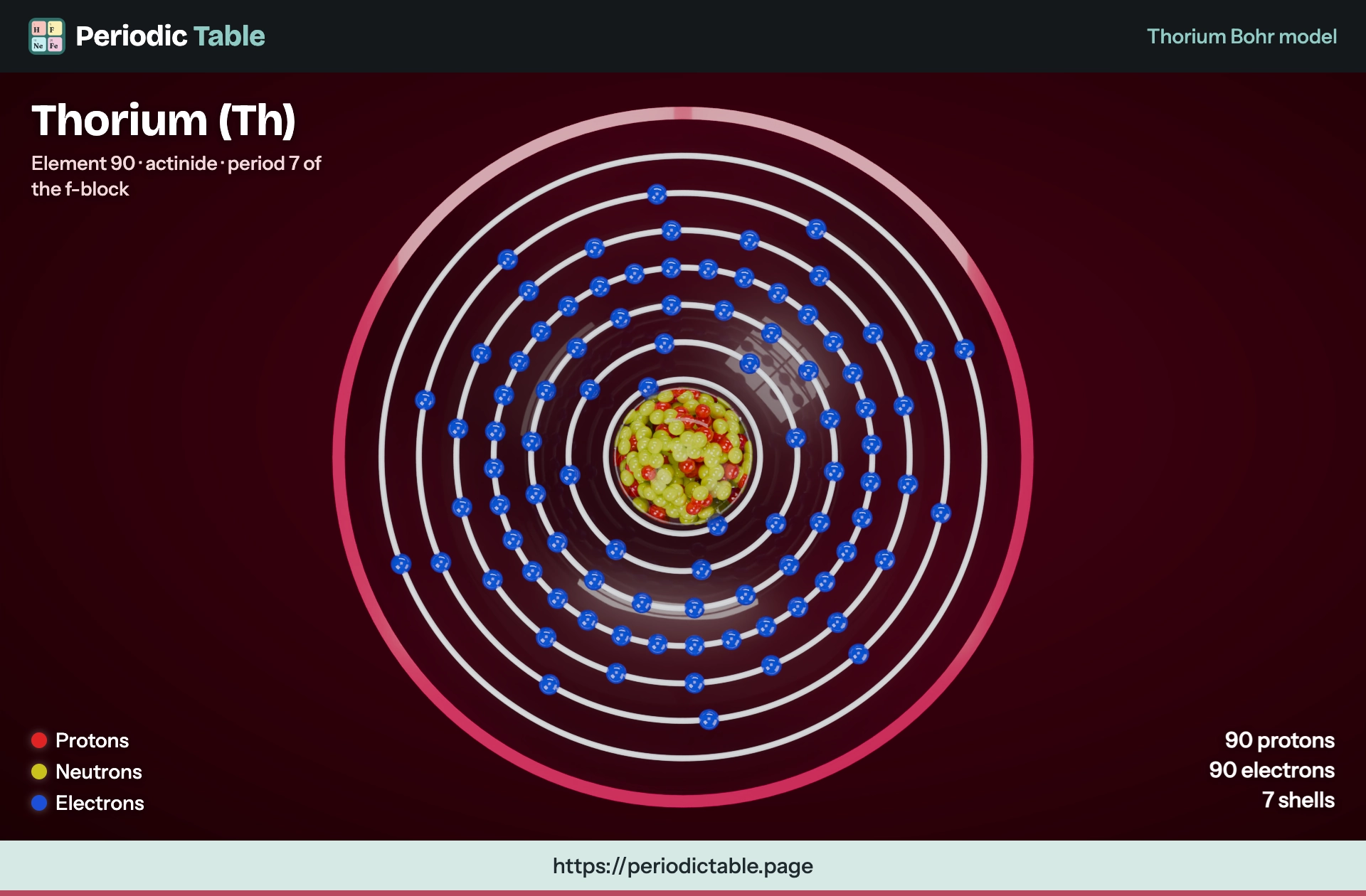
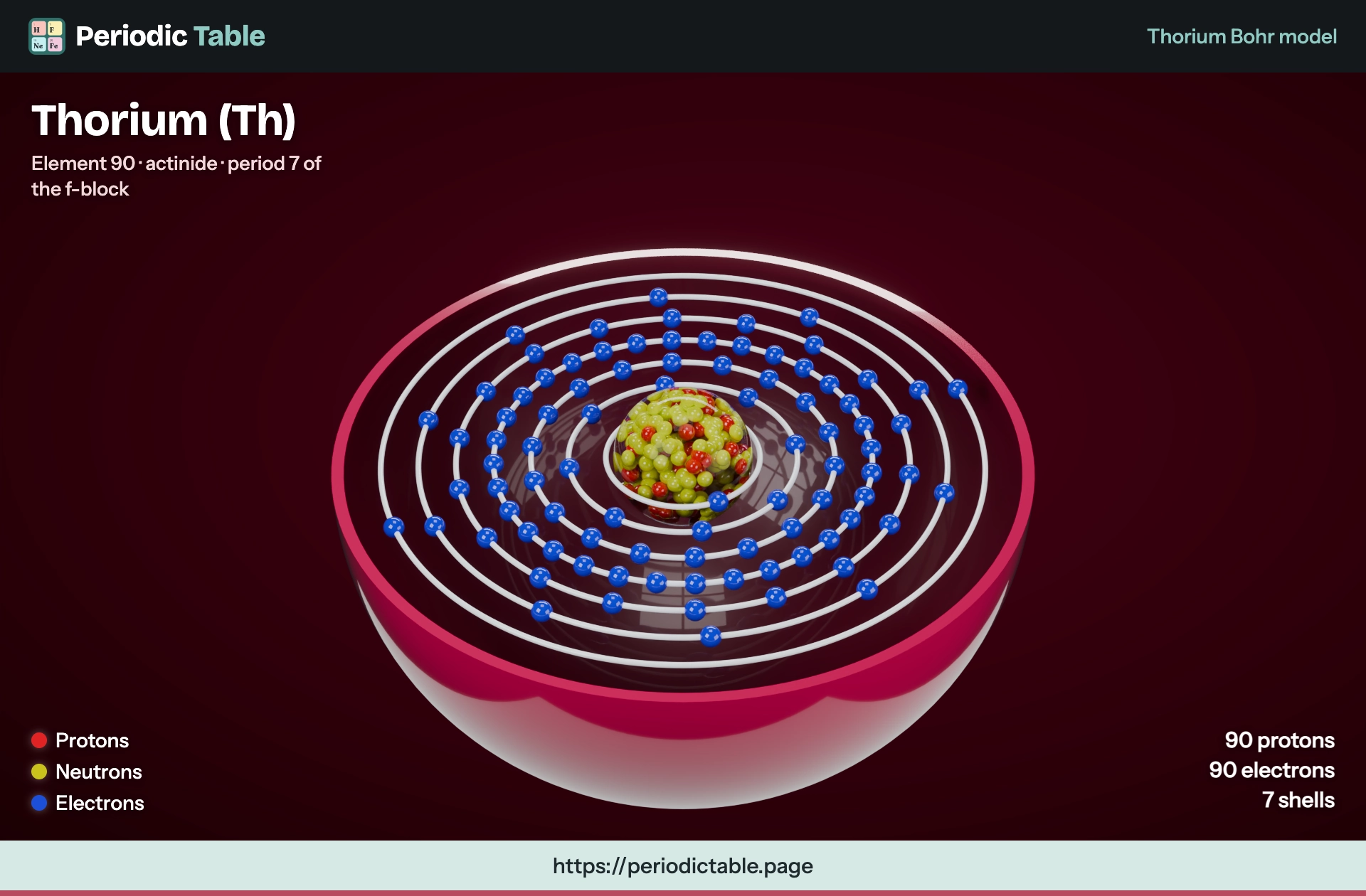
This is a Bohr model of thorium (Th), a simplified picture of a single thorium atom. Its nucleus holds 90 protons, and a neutral thorium atom has 90 electrons, arranged around it in 7 shells (2 in shell K, 8 in shell L, 18 in shell M, 32 in shell N, 18 in shell O, 10 in shell P and 2 in shell Q).
Thorium periodic table electron configuration
- Shorthand
- [Rn] 6d2 7s2
- Full
- 1s2 2s2 2p6 3s2 3p6 4s2 3d10 4p6 5s2 4d10 5p6 6s2 4f14 5d10 6p6 7s2 6d2
- Electrons per shell
- 2, 8, 18, 32, 18, 10, 2
Thorium element properties and atomic data
- Atomic number
- 90
- Atomic mass
- 232.0377 u
- Phase at STP
- Solid
- Melting point
- 1749.85°C (2023 K)
- Boiling point
- 4787.85°C (5061 K)
- Density
- 11.724 g/cm³
- Electronegativity (Pauling)
- 1.3
- Period
- 7
- Group
- —
- Block
- f-block
- Appearance
- Silvery, often with black tarnish
- Discovery date
- 1829
- Discovered by
- Jöns Jakob Berzelius
- Named by
- —
Thorium (Th) at a glance
Before getting into the chemistry, it helps to see the core numbers in one place. Thorium is element 90, so every thorium atom carries 90 protons and 90 electrons. Its atomic number places it in period 7 of the f-block, between actinium and protactinium, directly below cerium. Medicine, plastics and electronics use the halogen compounds, found in the ocean and in minerals.
| Property | Thorium (Th) value |
|---|---|
| Atomic number | 90 |
| Symbol | Th |
| Standard atomic mass | 232.0377 ± 0.0004 |
| Group / block | Actinides, f-block, period 7 |
| Electron configuration | [Rn] 6d2 7s2 |
| State at 20 °C | Solid, silvery metal |
| Melting point | 1750 °C (2023 K) |
| Boiling point | about 4788 °C (5061 K) |
| Density | 11.7 g/cm3 |
| Main compound | Thorium oxide (ThO2), melting near 3390 °C |
| Natural isotopic makeup | 232Th about 100%, Th-230 and other Th isotopes in trace amounts |
| CAS number | 7440-29-1 |
The atomic mass of 232.0377 is unusual for a radioactive element. Because natural thorium has a stable, predictable isotopic makeup, it is one of only a handful of radioactive elements with a standard atomic weight at all.
Its natural abundance is dominated by a single isotope, so the mass barely varies from one sample to the next. The CAS number 7440-29-1 is the registry ID you'll see on safety data sheets for Th metal.
Physical properties of thorium metal
Freshly cut thorium metal is bright and silvery, but it slowly tarnishes in air, turning grey and then black over several months as a film of dioxide builds up. It is moderately soft, about as hard as mild steel, and very ductile: pure samples can be cold-rolled, swaged and drawn into wire. Glass coatings and displays are the focus of the indium density, with notes on mining and recycling of scrap.
Finely divided powder is pyrophoric, which means it can ignite on its own in air, so Th turnings and dust are stored with care. Thorium also forms alloys with many other metals; a small addition to magnesium raises its strength at high temperature, which is why thoriated magnesium once appeared in aircraft parts.
Melting point, boiling point and density
Thorium's melting point of 1750 °C is higher than its neighbours actinium (1227 °C) and protactinium (1568 °C). Its boiling point of roughly 4788 °C is among the highest of any element, which gives it the widest liquid range on the periodic chart, spanning more than 3000 degrees. Of all the early actinides, Th has both the highest melting and boiling points.
Its density of 11.7 g/cm3 is only about half that of uranium and plutonium, yet the metal is harder than both. Measured values often come in a little lower, between 11.5 and 11.66 g/cm3, because cast metal holds tiny voids and traces of dioxide that drag the figure down.
Crystal structure and allotropes
At room temperature thorium has a face-centred cubic crystal structure. It has two other allotropes: a body-centred cubic form above about 1360 °C and a body-centred tetragonal form at extreme pressure, near 100 GPa.
The cubic room-temperature lattice only makes sense if the 5f electrons take part in bonding, which is the clearest physical proof that thorium is a true actinide rather than a heavy cousin of titanium. The metal also becomes superconducting below about 1.4 K.
Thorium atomic data and electron configuration
A neutral thorium atom has the electron configuration [Rn] 6d2 7s2. That is odd for an f-block element: no 5f electron appears in the ground state, because relativistic effects push the 6d level slightly below the 5f level near the bottom of the periodic table. The four outer electrons sit so close in energy that thorium almost always gives up all four at once.
- Electronegativity: 1.3 on the Pauling scale
- First three ionisation energies: about 587, 1110 and 1930 kJ/mol
- Empirical atomic radius: 179.8 pm
- Covalent radius: 206 ± 6 pm
- Standard reduction potential of the Th4+/Th couple: about −1.90 V
The low electronegativity tells you thorium holds its outer electrons loosely, which matches its behaviour as a reactive, metal-like donor in compounds.
Oxidation state and chemical behaviour
Thorium chemistry is dominated by the +4 oxidation state. Lower states (+3, +2 and +1) exist only in special compounds made in the lab.
Because Th4+ has no 5f or 6d electrons left, tetravalent thorium compounds are usually colourless or pale yellow. In this sense the chemistry of thorium looks much more like that of the transition metals zirconium and hafnium than like cerium, the lanthanide directly above it, for which the +3 oxidation state matters far more.
Thorium isotopes and the decay chain
All thorium isotopes are radioactive; there is no stable isotope of thorium. Around 32 radioisotopes have been characterised, with mass numbers from 207 to 238. In nature, almost all thorium is Th-232, and IUPAC reclassified thorium as a binuclidic element in 2013 because Th-230, made by uranium decay, can reach measurable levels in deep seawater.
| Isotope | Half-life | Decay mode | Where it comes from |
|---|---|---|---|
| Th-232 | 1.40 × 10¹⁰ years | Alpha | Primordial, about 100% of natural thorium |
| Th-230 | 75,400 years | Alpha | Uranium-238 series |
| Th-229 | 7,916 years | Alpha | Uranium-233 decay |
| Th-228 | 1.91 years | Alpha | Thorium series |
| Th-234 | 24.11 days | Beta | Uranium-238 series |
| Th-227 | 18.69 days | Alpha | Uranium-235 series |
The alpha decay of Th-232 starts the thorium series, the 4n decay chain whose members all have mass numbers divisible by four. It passes through radium, radon, polonium and bismuth and ends at stable lead-208. That is why any thorium sample also contains small amounts of these daughters, and why a thorium ore gives off radon gas.
Very rarely, Th-232 undergoes spontaneous fission instead, with a partial half-life of more than 1021 years. The chain's final product, lead, accumulates in old thorium minerals over geological time.
Half-life of thorium-232
Thorium-232 has a half-life of about 14 billion years, slightly longer than the age of the universe and roughly three times the age of the Earth. That makes it a primordial isotope: most of the Th that formed before the Solar System is still here. Running the decay law yourself shows how slow this is.
After one billion years, 95.2% of a Th-232 sample remains; after the Earth's 4.54 billion years, about 79.9% remains; and after 13.8 billion years, just over half. The same slow rate gives Th-232 a low specific activity of about 4,070 becquerels per gram, which is why the metal can be handled without heavy shielding.
A different isotope, Th-229, has a nuclear isomer with an excitation energy of only about 8 eV, the lowest known. Researchers are using that transition to build a nuclear clock, which could keep time more precisely than today's atomic clocks and serve as a sensitive test bed for fundamental physics.
Radiometric dating with Th isotopes
Two forms of radiometric dating rely on thorium. Uranium–thorium dating measures how far uranium-234 has decayed into Th-230 in corals, cave formations and other carbonate materials, and works over several hundred thousand years.
Ionium–thorium dating compares Th-230 with Th-232 in ocean sediments. Both work because uranium dissolves in water while thorium does not, so new thorium in a sample can only have come from uranium decaying in place.
Thorium compounds and reactivity
In its chemistry, thorium behaves as a highly electropositive metal, a little more so than zirconium or aluminium. In bulk it reacts slowly with air and water, but heated turnings burn with a brilliant white light. It resists most acids: it dissolves in hydrochloric acid (leaving a black residue), and in concentrated nitric acid only when a little fluoride is present, otherwise the surface passivates.
Most thorium compounds form by heating the metal with a nonmetal. All four tetrahalides are known. Thorium tetrafluoride (ThF4) is the starting point for making the metal and has been studied for molten-salt reactors.
Thorium nitrate is soluble in water and alcohols and is a key intermediate in purification. Th4+ is a large ion, so it reaches very high coordination numbers, up to 14 in its borohydride, and it forms organometallic sandwich compounds such as thorocene.
Thorium dioxide, the highest-melting oxide
Thorium dioxide (ThO2, also called thorium oxide or thoria) has the fluorite crystal structure and the highest melting point of any known oxide, about 3390 °C. By mass it is 87.9% thorium.
When heated in a flame, ThO2 glows; mixed with about 1% cerium dioxide, the light turns brilliant white. That effect, called candoluminescence, is brighter than ordinary incandescence would predict at the same temperature, and it made thoria the material of choice for gas lighting.
Where natural thorium is found
Natural thorium was made in the r-process, the rapid neutron capture that happens in supernovae and neutron star mergers. Only that process can build nuclei as heavy as thorium and uranium.
In the universe as a whole, thorium is rare. On Earth, its slow decay is one of the largest sources of Earth's internal heat, ahead of uranium-238 and potassium-40.
Thorium is present at trace levels almost everywhere in the environment: in soil, rocks, water, plants and animals. Because its common compounds dissolve so poorly, the element tends to stay where it is rather than spread.
Monazite and other thorium minerals
The most important source is monazite, a rare earth phosphate found as yellow or brown monazite sands. It holds around 2.5% thorium on average and up to 20% in rich deposits, and it is mined mainly for its rare-earth elements, with thorium as a by-product. Other thorium-bearing minerals include:
- Thorite (ThSiO4), the mineral in which thorium was first discovered
- Thorianite, nearly pure ThO2
- Bastnasite and allanite, rare-earth minerals with smaller thorium content
- Zircon, which can hold up to 0.4% thorium
Large monazite deposits lie in India, Brazil, Australia, Malaysia and South Africa. India leads production and holds some of the largest reserves, which is why its nuclear programme has long planned around thorium.
Abundance in Earth's crust
Estimates for thorium in the Earth's crust range from about 6 to 12 parts per million, making it roughly three times as common as uranium and about as common as lead. It was long thought to be rare only because it occurs as a minor part of many minerals rather than in its own large ore bodies. In geology, the alpha radiation from thorium often damages the crystal lattice of its host mineral, leaving it glassy, or metamict.
How pure thorium is produced
Making pure thorium starts with mining monazite sand and concentrating it by gravity, magnetic and electrostatic separation. The concentrate is then digested, either in hot concentrated sulfuric acid or in hot sodium hydroxide.
The alkaline route is now preferred because it separates the phosphate more cleanly. The rest is wet chemistry: thorium is pulled away from the rare earths by solvent extraction, often as thorium nitrate, and converted to ThO2 or ThF4.
The metal itself is made by reducing thorium dioxide with calcium, or thorium tetrafluoride with calcium, or by electrolysis of fused salts. Ultra-pure samples come from the iodide (van Arkel) process.
Because the market for thorium is small, much of the separated material is simply stored. Processing leaves behind mill tailings that must be managed, a cost the rare-earth industry carries whether or not the thorium is sold.
History of the element thorium
The history of the element thorium begins with a false start. In 1815 the Swedish chemist Jöns Jacob Berzelius thought he had found a new earth in a mineral from Falun and named it after Thor, the Norse god of thunder. The sample turned out to be yttrium phosphate, and he withdrew the claim in 1824.
Discovery and naming
In 1828 the priest and amateur mineralogist Morten Thrane Esmark found a black mineral on Løvøya island in Norway and passed it to his father, who sent it to Berzelius. This time the new element was real, and Berzelius, already one of the leading figures of European chemistry, reused the name thorium; the mineral became thorite.
He published in 1829 after reducing a potassium thorium fluoride with potassium metal. The first commercial use came decades later, when Carl Auer von Welsbach developed the thoria gas mantle in the 1880s and 1890s.
Radioactivity and the periodic table
Thorium's radioactivity was discovered in 1898, independently by Gerhard Carl Schmidt and Marie Curie, making it the second radioactive element after uranium. Ernest Rutherford's work on its emissions in physics led to the discovery of radon.
Mendeleev had placed thorium under zirconium and hafnium; only in the 1940s did Glenn Seaborg move it into the actinide row, where it sits today. In the 1930s and 1940s, a colloidal thoria suspension called Thorotrast was used as an x-ray contrast agent, until its long-term cancer risk became clear.
Uses of thorium today
The uses of thorium have shrunk as safer substitutes appeared, but several remain. A thin coating on tungsten wire improves electron emission and high-temperature strength, which is why it was used in vacuum tubes and light bulbs.
Thorium oxide adds a high refractive index and low dispersion to glass, so older camera and telescope lenses often contain it. Its heat-resistant dioxide goes into ceramics and laboratory crucibles, and thoriated alloys have appeared in the aerospace sector.
In nuclear medicine, Th-227 and the daughter lead-212 are being developed for targeted alpha therapies against cancer. Th-229 supplies actinium-225 for the same purpose. Much of today's research on the metal focuses on these medical isotopes and on nuclear fuel.
Gas mantles and welding electrodes
The classic use was in gas mantles: a fabric mesh soaked in 99% thorium nitrate and 1% cerium nitrate burns away to leave a fragile thoria-ceria skeleton that glows white in a gas flame. Most mantles sold today are thorium-free. The biggest remaining market is welding: thoriated tungsten electrodes for TIG welding hold an arc well and last longer, though ceriated and lanthanated versions are steadily replacing them.
Thorium reactors and nuclear energy
Thorium cannot sustain a chain reaction on its own, because Th-232 is fertile rather than fissile. When it absorbs a neutron, it becomes Th-233, which beta-decays to protactinium-233 and then to uranium-233, a fissile isotope. Thorium reactors use that neutron capture step to breed their own fuel, starting with a fissile driver such as uranium-235 or plutonium.
Several nuclear reactors have run on thorium fuels, including the molten-salt experiment at Oak Ridge in the 1960s and the Shippingport plant in the United States. India's three-stage programme aims to use its large thorium reserves for nuclear energy, and China has tested a small thorium molten-salt reactor. For energy planners looking for low-carbon energy, the attraction is that Th-232 can be used almost entirely, while only 0.7% of natural uranium is fissile uranium-235.
Thorium fuel cycle advantages and drawbacks
Supporters of the thorium fuel cycle point to several advantages over uranium:
- Thorium is about three times more abundant than uranium, and nearly all of it is usable as nuclear fuel
- It produces far fewer long-lived transuranic elements, so nuclear waste loses most of its radioactivity within a few hundred years rather than many thousands
- The ThO2 fuel form is chemically stable and resists further oxidation
- Uranium-233 is contaminated with uranium-232, whose strongly radioactive daughters make diversion for weapons harder
The drawbacks are real too. Thoria's very high melting temperature makes fuel fabrication harder and costlier. Uranium-233 can still be used in a weapon, so proliferation is reduced rather than removed.
Reprocessing spent thorium fuel is difficult, and decades of development have gone into uranium instead, so thorium lacks a commercial supply chain. The uranium-232 that helps against diversion also gives off hard gamma rays, so the fuel needs remote handling.
Thorium radiation, health and safety
Thorium's radiation is mostly alpha particles, with weak gamma rays from its daughters. Alpha particles travel only a few centimetres in air and are stopped by skin or paper, so a piece of thorium metal outside the body poses little health risk. The danger comes from getting it inside the body, which is why exposure through breathing or swallowing matters most.
- If inhaled as dust, thorium can stay in the lung for a long time and raises the risk of lung cancer.
- If ingested, most of it leaves the body within days; the small share that is absorbed settles in bone, where it can stay for years.
- Its daughters, especially radon-220 (thoron), add to the dose near ores and processing sites.
Thorotrast patients showed the long-term risk clearly: many developed liver cancer and leukaemia decades after their scans. Everyday exposure, from food, water and air, is tiny. People near mining and old processing sites, and workers who sharpen thoriated tungsten rods, face higher levels.
Sensible radiation protection means controlling dust: use local exhaust when sharpening rods, avoid crushing old gas mantles, and follow site safety rules where thorium is processed. Thorium is chemically toxic as a heavy metal too, but at realistic exposures its radiation is the bigger concern.