


Copper element (Cu): copper periodic table facts
Copper periodic table facts: copper (Cu) is element 29, a transition metal in group 11, period 4. Pick up a new length of electrical cable, an old penny or a green church roof and you are looking at copper, the reddish-brown chemical element with the symbol Cu and atomic number 29. Nuclear waste, proliferation and safety are weighed in the plutonium metal page, along with MOX fuel and spent fuel handling.
It is a soft, malleable metal and the best everyday conductor of heat and current, with a pinkish-orange shine and heat transfer beaten only by silver among pure metals. Below you get the full picture of copper: its atomic data, properties, compounds, ores, alloys, uses, health role and history, laid out so you can find any fact quickly.
Rotate the 3D Bohr model of copper
Drag to orbit, scroll to zoom.
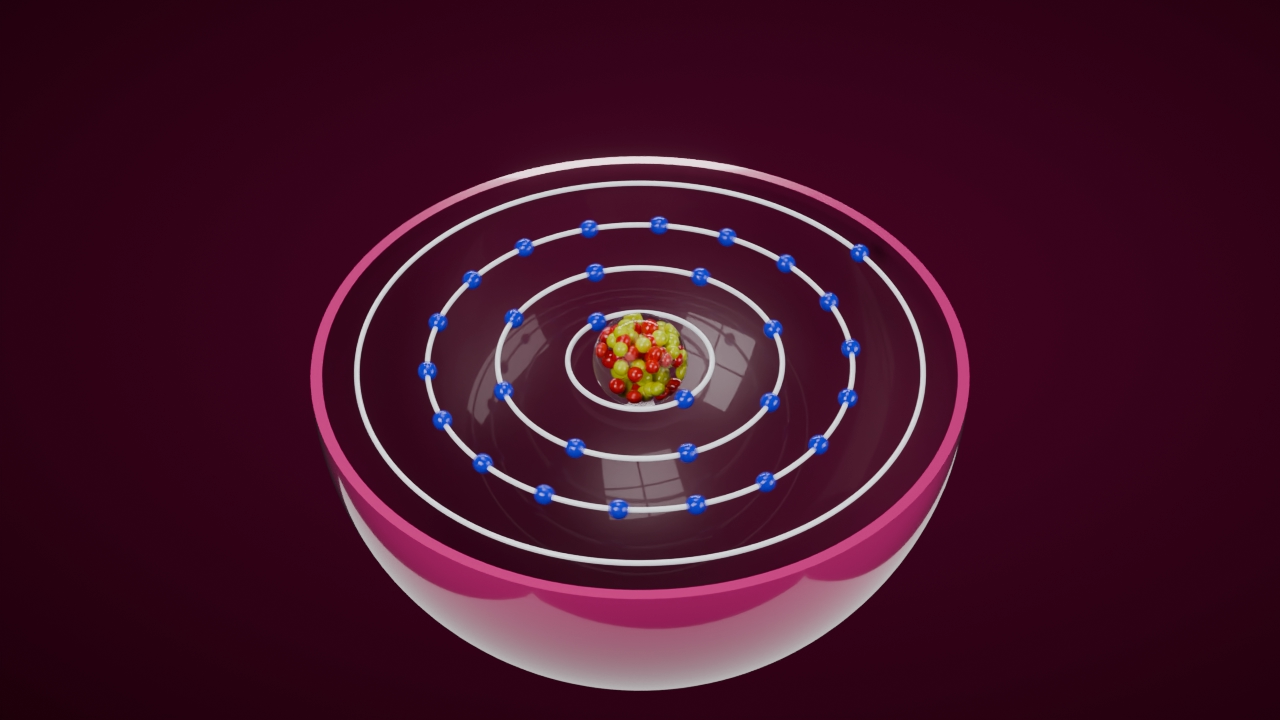
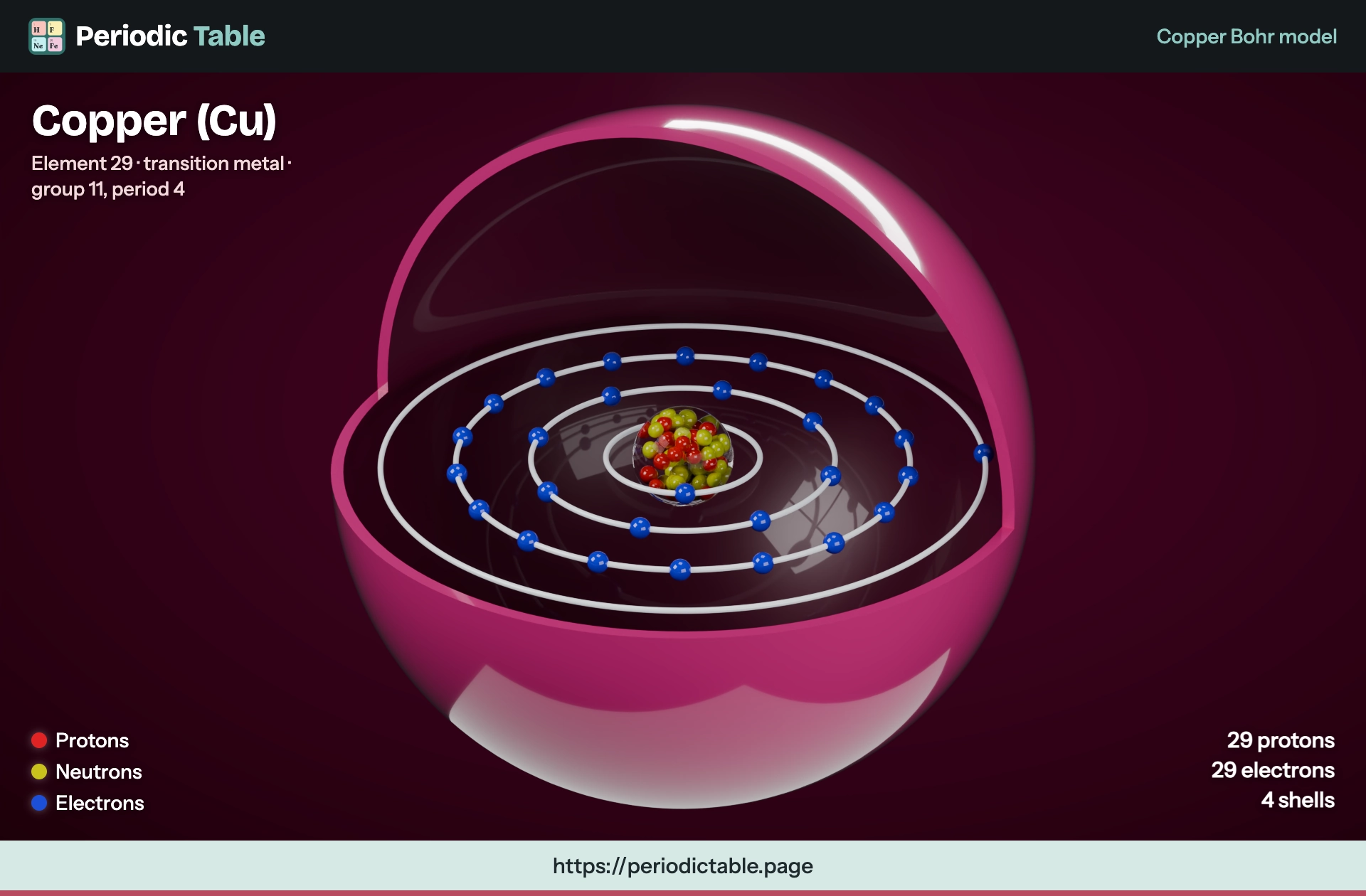
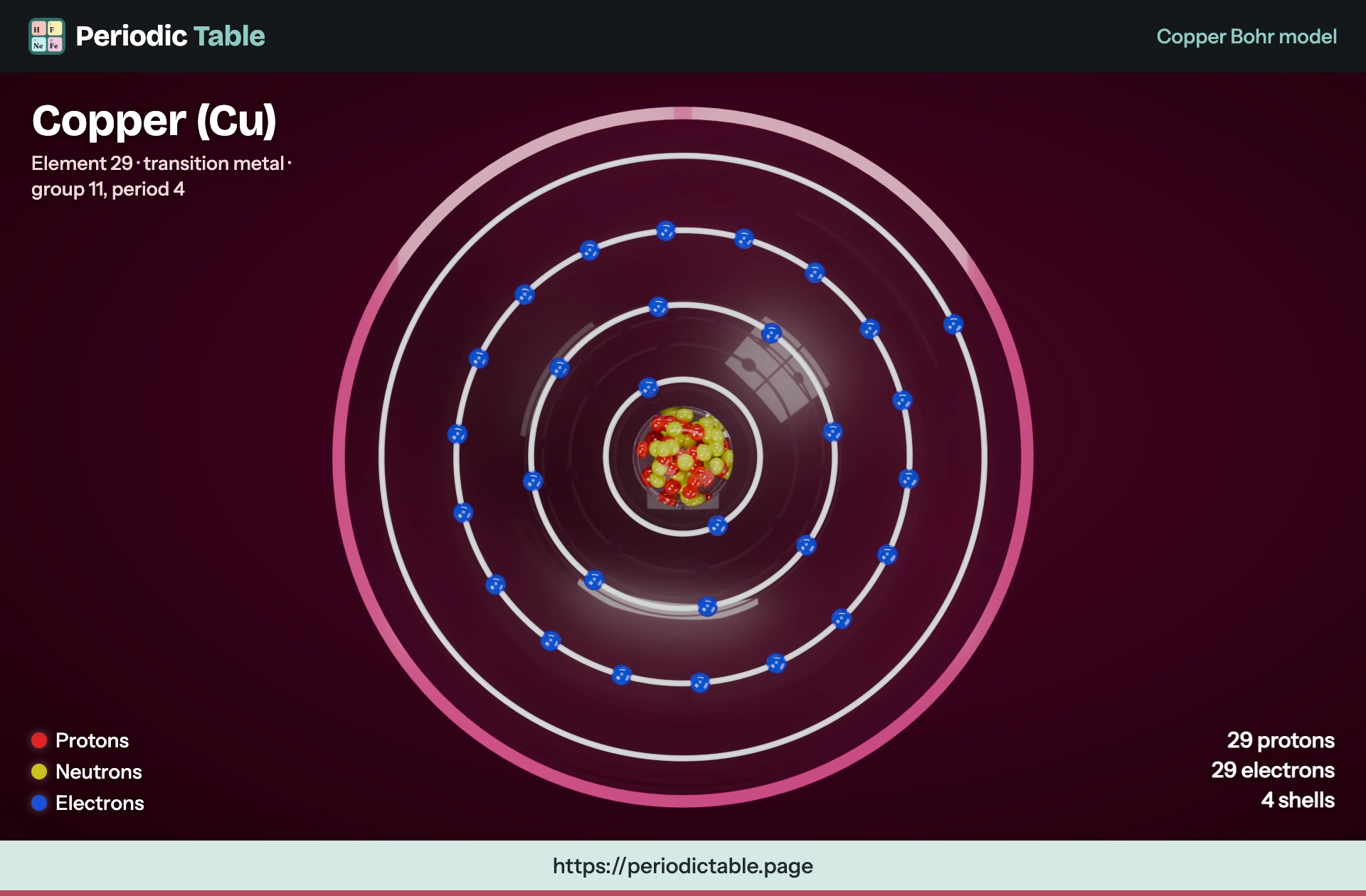
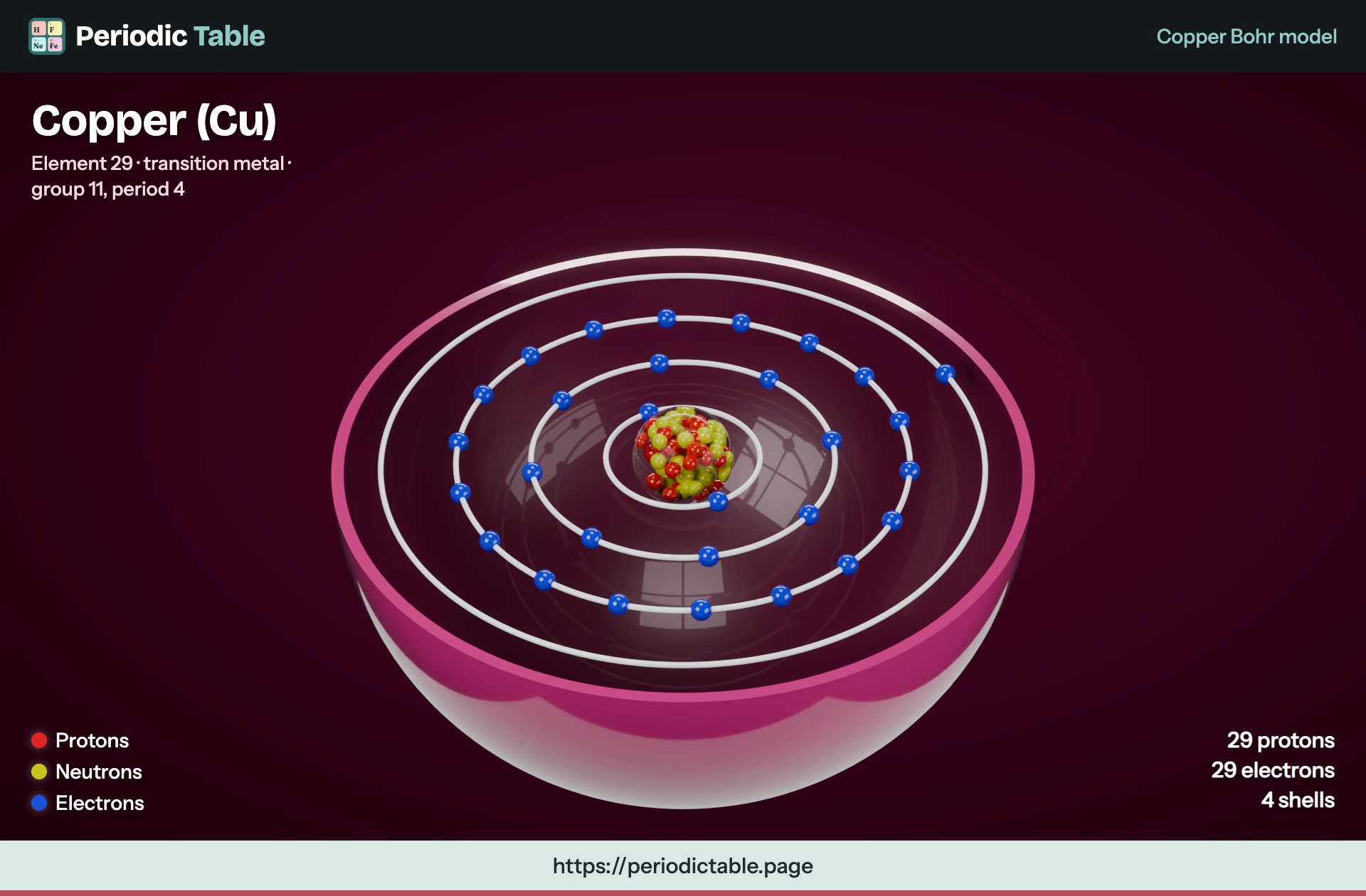
This is a Bohr model of copper (Cu), a simplified picture of a single copper atom. Its nucleus holds 29 protons, and a neutral copper atom has 29 electrons, arranged around it in 4 shells (2 in shell K, 8 in shell L, 18 in shell M and 1 in shell N).
Copper periodic table electron configuration
- Shorthand
- [Ar] 3d10 4s1
- Full
- 1s2 2s2 2p6 3s2 3p6 4s1 3d10
- Electrons per shell
- 2, 8, 18, 1
Copper element properties and atomic data
- Atomic number
- 29
- Atomic mass
- 63.5463 u
- Phase at STP
- Solid
- Melting point
- 1084.62°C (1357.77 K)
- Boiling point
- 2561.85°C (2835 K)
- Density
- 8.96 g/cm³
- Electronegativity (Pauling)
- 1.9
- Period
- 4
- Group
- 11
- Block
- d-block
- Appearance
- Red-orange metallic luster
- Discovery date
- Ancient
- Discovered by
- Middle East
- Named by
- —
Copper element at a glance: key facts and atomic data
The copper element sits in group 11 and period 4 of the periodic table, directly above silver (Ag) and gold. Those three are often called the coinage metals, and the shared column explains a lot about Cu: soft, bright, easy to shape and very good at carrying current. Readers interested in the Tb3+ ion can consult terbium compounds to see why it glows green under ultraviolet light.
Chemists class it as a transition metal, but its behaviour is gentler than that of neighbours such as iron or nickel. The table below collects the copper facts most people look up first.
| Property | Value for copper (Cu) |
|---|---|
| Atomic number | 29 |
| Standard atomic weight | 63.546 |
| Group, period, block | Group 11, period 4, d-block metal |
| Melting point | 1,084.62 °C (1,357.77 K) |
| Boiling point | about 2,562 °C (2,835 K) |
| Density at 20 °C | 8.96 g/cm³ |
| Electronegativity | 1.90 on the Pauling scale |
| Crystal structure | Face-centred cubic |
| Appearance | Red-orange metallic luster |
| Stable isotopes | 63Cu and 65Cu |
| Chemistry category | Transition metals, coinage group with silver and gold |
A few facts about copper are worth keeping in mind as you read the rest of this page. Its atomic mass is set by a mix of two stable isotopes rather than one, which is why the figure is not a whole number.
It is solid at room temperature, never occurs as a gas outside a furnace, and holds its strength well down to very low temperatures. And unlike most metals, which look grey or silvery, Cu has a natural colour of its own, a trait it shares only with gold.
Electron configuration in the d-block
Copper's electron configuration is [Ar] 3d10 4s1, written out in full as 1s2 2s2 2p6 3s2 3p6 3d10 4s1. You might expect 3d9 4s2 from the usual filling order, but a completely filled d-shell is more stable, so one electron moves down. That arrangement shapes almost everything else about the element.
The filled d-shell barely takes part in bonding, so the bonds in the crystal come mostly from that single outer s-electron. The result is a weak, non-directional metallic bond: layers slide past each other easily, which is why the solid bends without cracking, and the loosely held electron moves freely, which is why current flows so well. Lose that one electron and you get Cu(I); lose one more from the d-shell and you get the far more common Cu(II).
Where the name cuprum comes from
The symbol Cu comes from the Latin cuprum. Romans called it aes cyprium, "metal of Cyprus", because the island supplied so much of it; late Latin shortened that phrase, Old English turned it into coper, and the modern spelling followed. Organ pipes, pewter and lead-free solder all feature in the facts gathered for the tin electron configuration, along with its atomic data.
That island link also tied Cu to the goddess Aphrodite, born there in myth and known to the Romans as Venus. In alchemy, copper shared her symbol, a circle above a cross, and it was paired with the planet Venus among the seven metals known in antiquity.
Physical properties of copper
The physical properties of copper are what made it the default material for wire, pipe and cookware. It combines high ductility (it can be drawn into very fine wire), good tensile strength for something so soft, low thermal expansion and excellent current flow in one package. Few other materials match all of those at once, and none at that price.

Electrical conductivity and thermal conductivity
Pure Cu has an electrical conductivity of about 59.6 million siemens per metre at room temperature, second only to silver among pure metals. For heat the figure is around 401 W/(m·K), again second only to silver. The two values move together because the same free charge carriers move both charge and heat.
In a soft solid the lattice vibrates weakly, so fewer of those carriers get scattered, and resistance stays low. For comparison, silver reaches about 63.0 MS/m, gold 41.0 MS/m, aluminium 37.7 MS/m and iron only about 10.0 MS/m.
Aluminium conducts only about 60% as well by volume, which is why those cables have to be thicker to carry the same current. This performance is also the basis of the International Annealed Copper Standard (IACS), which rates other conductors as a percentage of annealed copper.
Colour, softness and crystal structure
A freshly cut surface of pure copper is orange-red rather than grey. It absorbs green and blue light and reflects the red end of the spectrum, which gives it its warm colour. Cu atoms pack in a face-centered cubic lattice, a structure with many planes along which layers can slip, so single crystals are soft (about 3 on the Mohs scale).
Commercial stock is supplied fine-grained instead, because grain boundaries block that slipping and add strength. Cu is also one of the few native metals, found in nature already in usable metallic form.
Copper chemistry: oxidation states and corrosion
Copper is a fairly noble metal, and that shapes its whole chemistry. It does not react with water, and in dry air it changes slowly. Its common oxidation states are +1 (cuprous) and +2 (cupric), with +2 the stable form in water and in most minerals; +3 and +4 exist only in a few special compounds.
In moist air the surface reacts with oxygen to form a thin brown-black copper oxide layer. Unlike rust on iron, that film sticks and protects what lies beneath, which gives Cu its natural corrosion resistance. Sulfur compounds in polluted air make it tarnish faster, forming dark copper sulfides.
The weak spot is contact with dissimilar metals. If copper touches steel or aluminium while both are wet with an electrolyte, galvanic corrosion eats away the less noble partner, so plumbers use insulating fittings at those joints. This chemistry is why copper pipes outlast steel ones but still need care at mixed joints.
Patina and verdigris on old copper
Leave copper outdoors for a decade or two and the brown oxide slowly turns into a green patina. The green layer is mostly basic copper carbonate and sulfate, formed as rain, carbon dioxide and sulfur from the air react with the surface; the name verdigris is used for these green copper salts in general.
The Statue of Liberty went from shiny brown to its famous green within about 30 years of being built. Copper roofs on churches and city halls follow the same path, and the green crust is so stable that it shields the sheet underneath for centuries.
Copper isotopes and their uses
Natural Cu is a blend of two stable forms. Copper-63 makes up about 69% of the atoms and copper-65 the remaining 31%, and that mix sets the average of 63.546. About 29 radioactive forms have also been made in reactors and accelerators.
| Isotope | Natural abundance | Half-life | Main use |
|---|---|---|---|
| 63Cu | 69.15% | Stable | Most of natural Cu |
| 65Cu | 30.85% | Stable | Rest of natural Cu |
| Copper-64 | Synthetic | 12.7 hours | PET imaging and cancer research |
| Copper-67 | Synthetic | 61.83 hours | Targeted radiotherapy research |
Among the radioactive forms, copper-67 has the longest half-life at 61.83 hours. Copper-64 is unusual because it decays both by emitting a positron (to nickel) and by emitting an electron (to zinc), which makes it handy for medical scans. Copper-62 serves as a short-lived tracer for positron emission tomography of blood flow in the brain.
Copper compounds chemists use
Copper compounds are everywhere in labs, farms and industry. The simplest are binary compounds built from just two elements: copper oxide (black cupric oxide, CuO, and red cuprous oxide, Cu2O), sulfides and halides. The best known of all is copper sulfate, sold as blue crystals of the pentahydrate.
Copper(II) sulfate is the starting point for many other salts and the active ingredient in several farm sprays. Cuprous oxide gives red colour to glass and antifouling paint, and the acetate, nitrate and chloride all have their own uses.
Dissolve a Cu(II) salt in water and the ion surrounds itself with six water molecules, giving the pale blue colour typical of Cu(II) solutions. Add ammonia and the colour deepens to royal blue as ammonia molecules replace water around the ion, a classic demonstration in school chemistry.
Cuprous and cupric salts in the lab
Two famous tests rely on the switch between Cu(II) and Cu(I). In Fehling's solution and in Benedict's reagent, a blue Cu(II) complex is reduced by sugars such as glucose to a brick-red precipitate of cuprous oxide, so the colour change tells you a reducing sugar is present. The element also forms rare Cu(III) compounds; the most important are the cuprate superconductors such as yttrium barium copper oxide, which carry current with zero resistance when cooled with liquid nitrogen.
Organocopper reagents
Compounds with a carbon-copper bond are called organocopper compounds. The best known is the Gilman reagent, a lithium diorganocuprate made from Cu(I) salts and organolithium reagents. It is a workhorse of organic chemistry for joining carbon fragments cleanly, and copper catalysts also drive coupling reactions used to make medicines.
Where copper ore is found
The element makes up roughly 27 to 50 parts per million of Earth's crust, depending on the estimate, which places it around 26th in abundance. Most of it is locked in minerals rather than in metallic form. The most important copper ores are sulfides: chalcopyrite (CuFeS2), the most mined of all, plus bornite, chalcocite and covellite.
Oxide and carbonate ores include cuprite, the green malachite and the deep blue azurite, while turquoise is a copper phosphate prized as a gemstone. Native copper, the free element, occurs too; the largest mass ever found weighed about 420 tonnes and came from Michigan's Keweenaw Peninsula in 1857.
Cu also moves through the wider environment. Weathering of rock and volcanic activity release it into soil, rivers and the air, and plants take it up as a micronutrient. Typical farmland holds well under 150 mg/kg, and seawater only a fraction of a microgram per litre.
Smelting, electrolysis and bioleaching
Copper mining today relies on huge open pit mines in porphyry copper deposits, where ore carries only 0.4% to 1% copper. Chuquicamata in Chile and Bingham Canyon in Utah are two of the largest pits on Earth. Processing follows a set path:
- The ore is crushed and ground, then the valuable minerals are separated by froth flotation into a concentrate of around 25% to 30% Cu.
- Smelting the concentrate with air burns off sulfur, first as cuprous oxide and then as blister copper, about 98% pure.
- Electrolysis then refines it to cathodes of 99.99% Cu, and silver and gold collect in the slime at the bottom of the tank.
Oxide ores, about 15% of supply, take a different route: leaching with sulfuric acid dissolves it, and electrowinning plates it back out of solution. In bioleaching, bacteria do part of this work, converting insoluble sulfides into soluble copper sulfate in heaps of low-grade rock.
Copper production, reserves and prices
World copper production reached about 22.8 million tonnes of mined metal in 2024. The leading producers are:
- Chile, the largest producer, with roughly a quarter or more of world mine output
- Peru, the second-largest producer
- The Democratic Republic of the Congo, China and the United States, followed by Zambia, Australia and Russia
It trades on the London Metal Exchange, where prices passed $11,000 per tonne in 2024. Demand keeps climbing because of the energy transition: an electric vehicle uses around 80 kg or more, several times more than a petrol car, and wind farms, solar plants and grid upgrades all need it. Known reserves cover several decades of current mining, and recycling stretches that further.
Recycling copper metal and its environmental footprint
Copper metal can be recycled again and again with no loss of quality, and around 80% of all copper ever mined is thought to still be in use. Reuse supplies roughly a third of global demand.
Clean scrap such as old wire is simply melted and cast again; mixed scrap is melted to "black copper", refined to blister copper and then electrolysed like freshly mined material. The process uses a fraction of the energy needed for primary production.
Producing copper from ore has real environmental costs. Copper tailings, the crushed rock left over after processing, can leach toxic elements into rivers and soil. Because copper usually comes from sulfide minerals, older smelters emitted large amounts of sulfur dioxide, the gas behind acid rain, although modern plants capture most of it to make sulfuric acid.
Abandoned mines can leak acid mine drainage for decades. These impacts are a big part of why sustainability groups push for more recycling and for cleaner mining.
Copper alloys: bronze, brass and cupronickel
Pure copper is too soft for many jobs, so most hard-wearing products are alloys. More than 400 copper alloys are in use today, and each alloy trades a little current-carrying ability for extra strength, hardness, colour or corrosion resistance. The table compares the most common ones.
| Alloy | Approximate makeup | Typical uses |
|---|---|---|
| Bronze | About 88% Cu, 12% tin | Bearings, bells, statues |
| Brass | About 70% Cu, 30% zinc | Plumbing fittings, cartridges, musical instruments |
| Muntz metal | 60% Cu, 40% zinc | Ship sheathing, bolts |
| Cupronickel | 75% to 90% Cu, rest nickel | Coins, seawater pipes |
| Sterling silver | 92.5% silver, 7.5% copper | Jewellery, cutlery |
| 18-karat gold | 75% gold, rest copper and silver | Rings and chains |

Bronze, copper with tin, was the first alloy humans made on purpose and gave its name to an age. Brass, made with zinc, is more golden and easier to machine. Cupronickel resists seawater so well that it lines ship pipes, and it is the alloy in silver-coloured coins: the US five-cent "nickel" is 75% copper and only 25% nickel.
Small amounts of Cu also harden sterling silver and karat gold, and lead-free solder is mostly tin with a little copper. Constantan, a copper-nickel alloy whose resistance barely changes with temperature, is used in thermocouples and strain gauges. US pennies tell the story of rising prices: solid copper until 1837, bronze or brass for most of the next 140 years, and since 1982 zinc with a thin copper skin, only 2.5% copper by weight.
Uses of copper in industry and daily life
The main copper uses break down roughly like this: about 60% goes into electrical wire, around 20% into roofing and plumbing, about 15% into industrial machinery, and the remaining 5% into alloys where extra hardness matters. Construction is the single largest buyer, followed by the electrical and electronics industry, transport and consumer goods. It also turns up in cookware, where it spreads heat evenly, and in jewelry and art.

Electrical wiring and electric motors
Electrical wiring is copper's biggest market: house wiring, power cables, appliance cords, data cable and the fine magnet wire wound inside motors and transformers. Copper wire wins on current flow, strength, resistance to creep and corrosion, and ease of soldering. Aluminum is preferred only for overhead power transmission lines, where its lower weight matters more.
Copper wiring also links telecommunications networks, and it has replaced aluminium in the tracks of printed circuit boards and microchips. Heat sinks, busbars in switchgear, and the windings of electric motors all depend on it.
Because motors use close to half of the world's electricity, a little more copper in each winding saves a large amount of energy. That is why premium-efficiency motors deliberately use heavier copper windings.
Copper pipes, roofing and architecture
Copper pipes have carried drinking water in homes for about a century because they resist corrosion, block bacteria and are easy to join. Plumbing and heating systems are a major part of the 20% share above. In architecture, Cu roofing, gutters, domes and cladding last a hundred years or more, so it is part of the long-lived infrastructure of many cities.
Antimicrobial surfaces and fungicide use
Copper is naturally antimicrobial. Bacteria, fungi and many viruses die on bare and alloyed copper surfaces, including MRSA and E. coli, and the US EPA has registered hundreds of these alloys as antimicrobial materials. Hospitals use them for door handles, bed rails and taps.
The same effect stops biofouling: copper sheathing and antifouling paints keep barnacles and weed off ship hulls, and alloy nets do the same in fish farms. In farming, copper is an old fungicide and pesticide. Bordeaux mixture, made from copper sulfate and lime, has protected vines since the 1880s, and similar compounds are also a common wood preservative.
Copper in human health and nutrition
Copper is an essential nutrient: your body cannot make it, so it has to come from food. It is a trace element, needed in milligram amounts, yet good health depends on it. An adult body holds roughly 1.4 to 2.1 mg of Cu per kilogram of body weight, about 100 mg in total.
After absorption in the gut, it travels to the liver, which packs most of it onto ceruloplasmin, the main copper-carrying protein in blood. Any excess leaves through bile. Good nutrition keeps this balance without effort for most people, and a normal diet supplies enough.
Copper bracelets are often sold to ease arthritis, but controlled trials have found no benefit, and there is no evidence that it passes through the skin.
Copper enzymes and biochemistry
Copper sits at the heart of many enzymes, more than 30 in humans. In the mitochondria, cytochrome c oxidase uses Cu to pass electrons to oxygen in the last step of respiration. Superoxide dismutase uses it to break down harmful superoxide radicals.
Other Cu enzymes help build collagen and elastin for connective tissue, form melanin and help move iron into hemoglobin, which is why low copper can mimic iron-deficiency problems. In plants, the blue protein plastocyanin carries electrons during photosynthesis. And in octopuses, snails and horseshoe crabs, the copper protein hemocyanin carries oxygen, giving them blue blood.
Daily intake and food sources
The recommended dietary allowance is listed below, with the US upper intake level set at 10 mg a day for adults. European authorities set a stricter upper limit of 5 mg a day.
| Group | US recommended daily copper intake |
|---|---|
| Children 1 to 3 years | 340 µg |
| Children 4 to 8 years | 440 µg |
| Children 9 to 13 years | 700 µg |
| Teens 14 to 18 years | 890 µg |
| Adults 19 and over | 900 µg |
| Pregnancy / breastfeeding | 1,000 µg / 1,300 µg |
The richest sources are organ meats, especially liver, and shellfish such as oysters and lobster. Nuts, seeds, dark chocolate and cocoa, whole grains, beans, lentils and mushrooms add steady amounts. A handful of cashews or a square of dark chocolate covers a good share of an adult's daily need.
Copper toxicity, deficiency and exposure limits
Copper has a narrow window between enough and too much. Copper deficiency is rare, but it can follow gut surgery, very high zinc intake or certain genetic conditions; it causes anemia, low white blood cell counts, weak bones and nerve damage.
At the other end, copper toxicity from food is unusual in healthy people because the liver excretes the surplus, but swallowing salts such as copper sulfate can cause vomiting, liver and kidney damage and even death. Breathing copper dust and copper fumes at work irritates the airways and can cause "metal fume fever", with chills and aches.
- Main sources of extra copper: corroding plumbing, acidic water, unlined pans with acidic food, and farm sprays
- Early signs of too much copper: nausea, stomach pain, vomiting and diarrhoea
- People most at risk: those with liver disease or an inherited copper disorder, and workers near mines and smelters
Wilson's disease and who is at risk
Wilson's disease is an inherited disorder in which the liver cannot excrete copper, so it builds up in the liver, brain and eyes. It affects about 1 in 30,000 people and, untreated, leads to liver failure and nerve and mental-health problems.
Treatment is lifelong: chelating agents such as penicillamine bind the excess so it leaves in urine, and zinc acetate blocks copper absorption in the gut. Menkes disease is the opposite problem, a genetic defect in copper transport that starves the body of the element, mostly in baby boys.
Drinking water and workplace standards
Regulators set clear limits for copper exposure:
- EPA action level for copper in public water: 1.3 mg per litre
- FDA limit for bottled water: 1 mg per litre
- OSHA workplace limit: 1 mg/m³ for copper dust, 0.1 mg/m³ for copper fumes
- NIOSH recommended limit: 1 mg/m³ over a work shift
Soft or acidic water picks up more copper from pipes, especially after it has sat overnight. Running the cold tap for a short while before drinking, and never using hot tap water for cooking, keeps levels low.
History of copper from the stone age to electricity
Copper may be the oldest metal people worked. Native copper was hammered into beads and tools in the Middle East by about 9000 BC, and a pendant from northern Iraq dates to around 8700 BC. In North America, the Old Copper Complex around the Great Lakes worked local deposits from about 6500 BC.
The Chalcolithic, or "copper-stone", period followed, when copper tools were used alongside stone ones. Ötzi the Iceman, who died in the Alps around 3300 BC, carried an axe with a 99.7% pure blade. Each step in this early history was a step forward for civilization:
- Cold hammering of native copper, before 8000 BC
- Smelting ore, by about 5000 BC
- Casting in moulds, by about 4000 BC
- Alloying copper with tin to make bronze, by about 3500 BC
Copper also coloured the ancient world: Egyptian blue, a calcium copper silicate first made around 3250 BC, is the oldest known synthetic pigment.

The bronze age
The Bronze Age began in southeastern Europe around 3700 to 3300 BC and in northwestern Europe about 2500 BC. Bronze was harder than copper and held an edge, so it replaced stone for tools and weapons and drove long-distance trade in tin. Sumerian and Egyptian craftsmen made copper and bronze goods by 3000 BC, and in China bronze was cast into ritual vessels and great bells.
Copper from Roman coins to the industrial revolution
Romans used copper lumps as money and mined it across Spain, Cyprus and central Europe on a scale not matched again until the Industrial Revolution. Sweden's Great Copper Mountain at Falun supplied two thirds of Europe's supply in the 17th century. The British navy began sheathing ship hulls in copper in the 18th century.
Then the electrical age changed everything: from the 1880s, telegraphs, telephones, motors and power grids made copper wire essential, and the United States produced up to half the world's new output. Flash smelting, developed in Finland in 1949, now handles about half of primary output.