


Tin element (Sn): tin periodic table facts
Tin periodic table facts: tin (Sn) is element 50, a post-transition metal in group 14, period 5. Pick up a bar of tin and bend it, and you will hear it creak, a faint crackle that metalworkers recognise instantly. For space exploration, NASA probes and electricity from radioisotope generators, the plutonium boiling point page offers a summary.
This soft, silvery-white chemical element carries the symbol Sn and atomic number 50, and almost all tin is refined from a single oxide mineral. Below you will find its key data, the two forms it switches between, the reasons it ends up in solder, cans and window glass, and the long trading story behind it.
Rotate the 3D Bohr model of tin
Drag to orbit, scroll to zoom.
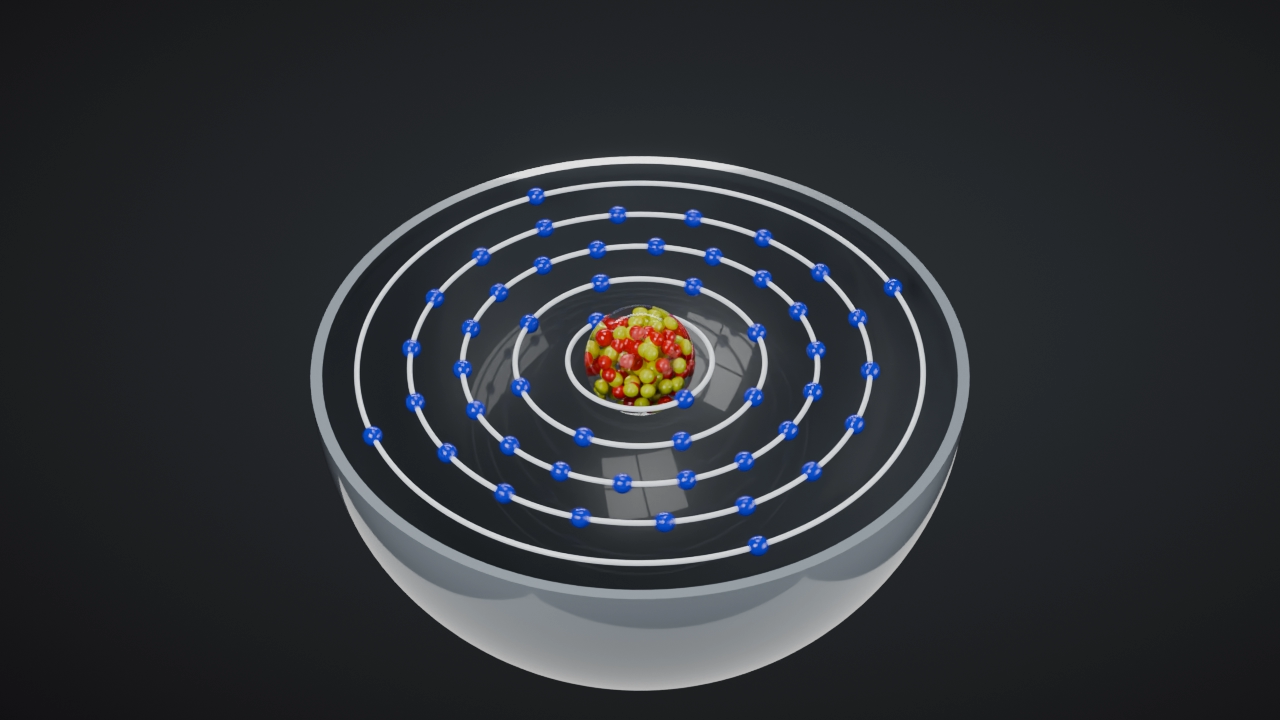
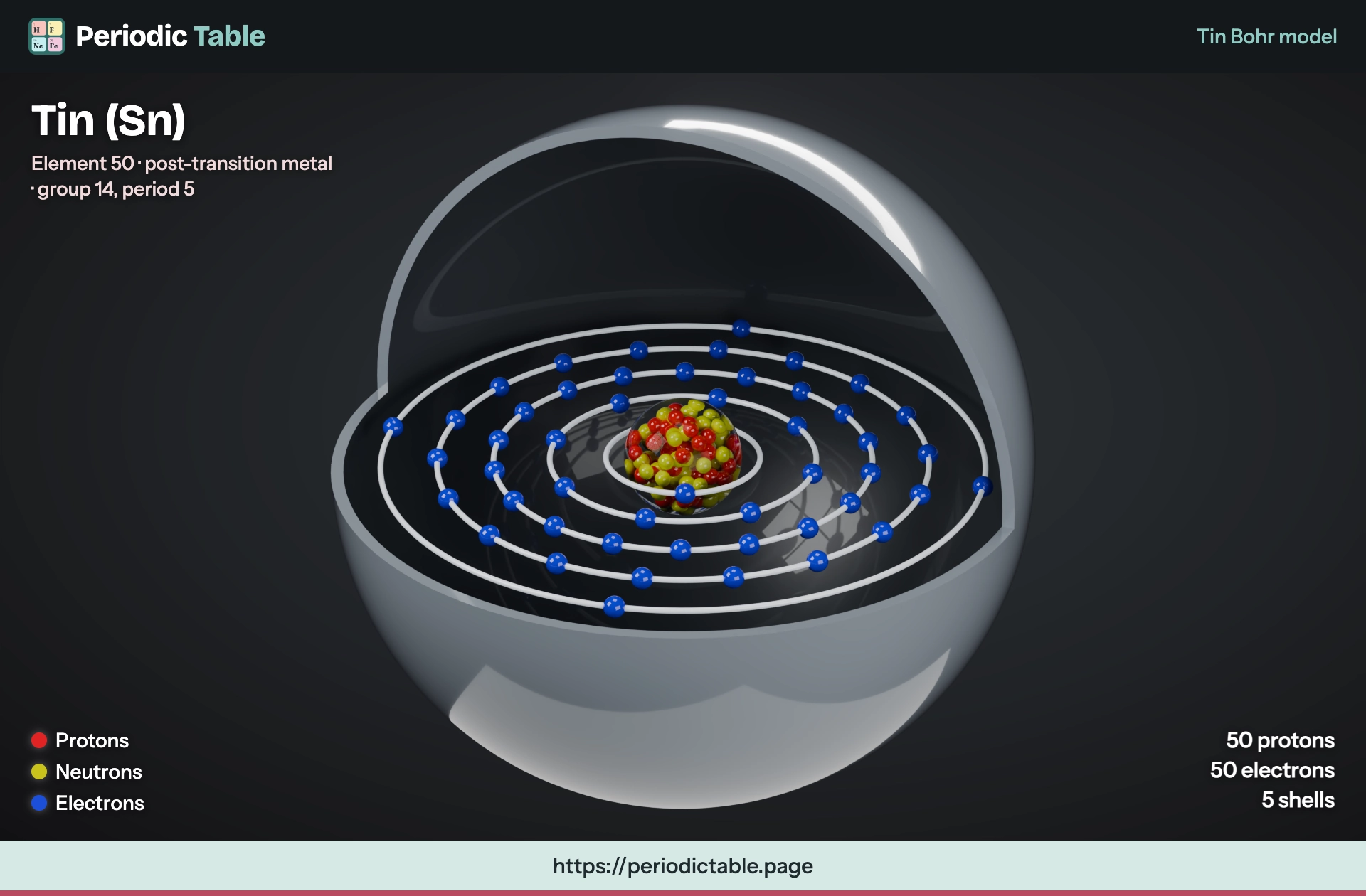
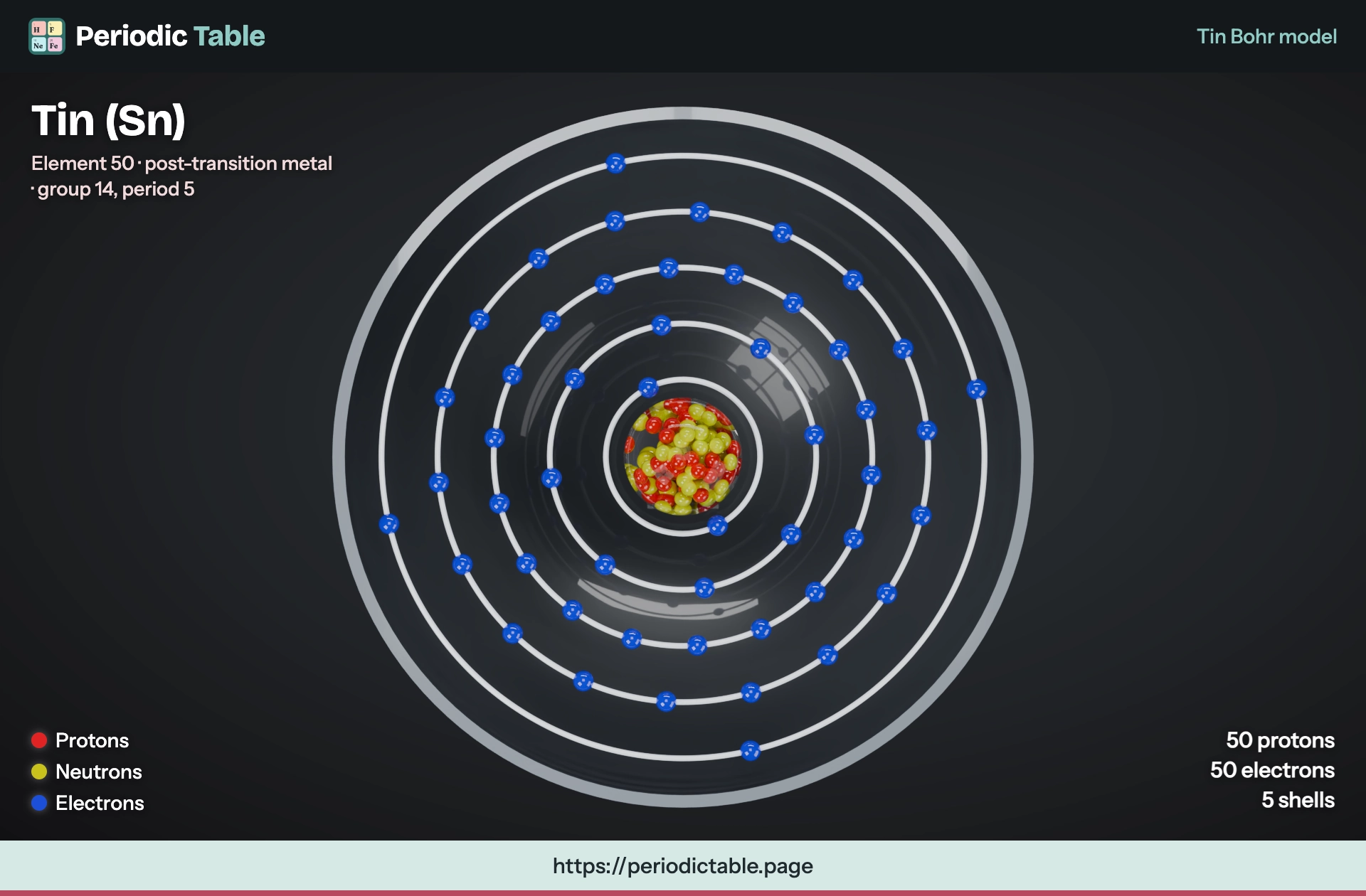
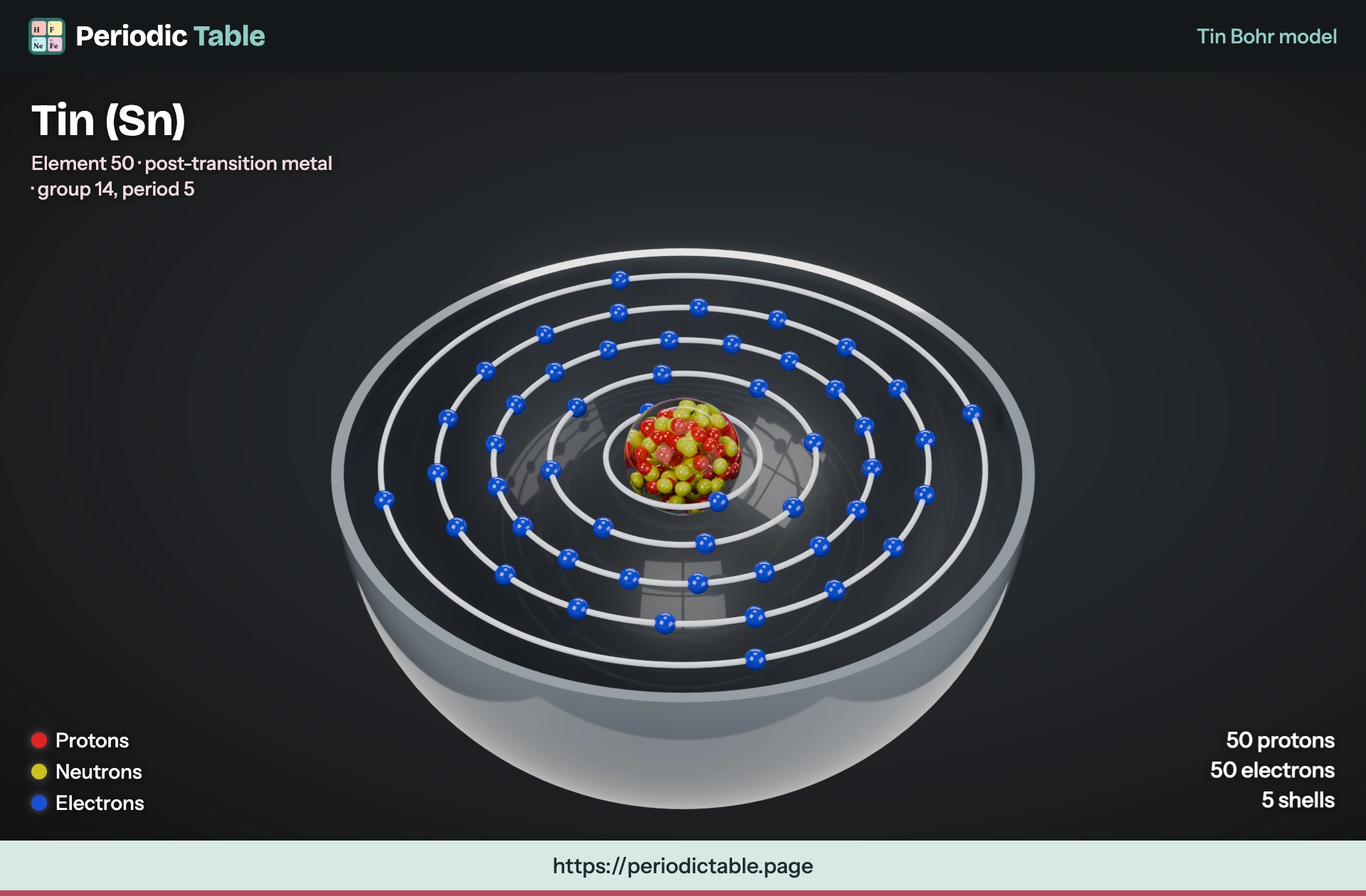
This is a Bohr model of tin (Sn), a simplified picture of a single tin atom. Its nucleus holds 50 protons, and a neutral tin atom has 50 electrons, arranged around it in 5 shells (2 in shell K, 8 in shell L, 18 in shell M, 18 in shell N and 4 in shell O).
Tin periodic table electron configuration
- Shorthand
- [Kr] 4d10 5s2 5p2
- Full
- 1s2 2s2 2p6 3s2 3p6 4s2 3d10 4p6 5s2 4d10 5p2
- Electrons per shell
- 2, 8, 18, 18, 4
Tin element properties and atomic data
- Atomic number
- 50
- Atomic mass
- 118.7107 u
- Phase at STP
- Solid
- Melting point
- 231.93°C (505.08 K)
- Boiling point
- 2601.85°C (2875 K)
- Density
- 7.365 g/cm³
- Electronegativity (Pauling)
- 1.96
- Period
- 5
- Group
- 14
- Block
- p-block
- Appearance
- Silvery-white (beta, β) or gray (alpha, α)
- Discovery date
- Ancient
- Discovered by
- Unknown
- Named by
- —
Element tin at a glance: key atomic data
On the periodic table, element tin sits in group 14 between indium and antimony, directly below germanium and directly above lead. Chemists class it as a post-transition metal: it behaves like a true metal in its everyday form, but its group neighbours drift from nonmetal (carbon) through metalloids (silicon, germanium) to heavy metal (lead), and it shares traits with both sides. Its outer shell holds four electrons, two in the 5s orbital and two in 5p, which is why its chemistry centres on losing either two or four of them. Cupric and cuprous ions, oxygen reactions and the green patina of corrosion are explained in the copper element entry with photos.
| Property | Value |
|---|---|
| Symbol | Sn |
| Atomic number | 50 |
| Relative atomic mass | 118.71 |
| Position | Group 14, period 5, p-block |
| Electron configuration | [Kr] 4d10 5s2 5p2 |
| Electronegativity (Pauling scale) | 1.96 |
| First three ionization energies | 708.6, 1411.8 and 2943.0 kJ/mol |
| Atomic radius (empirical) | 140 pm |
| Van der Waals radius | 217 pm |
| State at 20 °C | Solid |
| CAS number | 7440-31-5 |
The jump between the second and third ionization energies is worth noticing. Removing the first two electrons (the 5p pair) is relatively cheap; the third has to come out of the more tightly held 5s shell, which is one reason the +2 state is so stable for this element and becomes more stable still further down the group in lead.
Melting point, boiling point and density of tin
The metal melts at 231.93 °C (505.08 K, or 449.47 °F), the lowest value in its group, and boils at 2602 °C. That huge liquid range, about 2,370 degrees, is what makes molten tin so useful as a flat bath for glassmaking. The common white form has a density of 7.289 g/cm³ at room temperature, while the gray form is much lighter at roughly 5.77 g/cm³, a difference that matters for the transformation described further down.
Physical properties of tin metal
Freshly cast tin metal is bright, silvery and so soft that a knife cuts it with little effort. It is malleable enough to roll into thin sheets and ductile enough to draw into wire, yet it has a strongly crystalline grain that shows up as a frosted pattern on a cooled ingot. It conducts heat and electricity reasonably well, though far less than aluminium. Lustrous, malleable and ductile, the transition metals on the periodic table also conduct heat and electricity well.
At 3.72 K it becomes a superconductor, and it was one of the first metals studied in that state, which places it in the early story of cryogenic physics as well as in metalworking. Among the physical properties that set it apart from most metals, how easily it melts and its resistance to air and water are the two that drive nearly every use you will read about below.
Why a bent bar makes the tin cry
The crackle you hear when bending a bar comes from twinning: whole blocks of crystal snap into a mirror-image orientation, and each sudden shift releases a tiny click. The tin cry is a quick bench test for purity, since a heavily alloyed bar stays quiet. Zinc and indium twin in a similar way, but neither is as audible.
White tin, gray tin and tin pest: the allotropes of Sn
At normal pressure the element exists as two allotropes, and they could hardly be more different. White tin, also called β-tin, is the shiny, workable metal you know; it has a body-centered tetragonal crystal structure and is stable above 13.2 °C.
Gray tin, or α-tin, takes over below that temperature. It adopts the same diamond cubic lattice as silicon and diamond, its atoms are held together by covalent bonds rather than a sea of free electrons, and the result is a dull, brittle powder that behaves as a semiconductor instead of a metal.
Because α-tin is about a fifth less dense, an object that converts swells, cracks and crumbles. This slow decay is known as tin pest (older texts say "tin disease" or "tin leprosy"), and it has damaged organ pipes in cold European churches. A popular story claims it destroyed the uniform buttons of Napoleon's soldiers during the 1812 winter in Russia; historians treat that as a legend, but the chemistry behind it is real.
- Above the transition: β-form is stable, metallic and malleable.
- Below 13.2 °C: α-form is thermodynamically favoured, but the change is very slow and often needs seeding or deep cold (around −30 °C) to start.
- With additives: small amounts of antimony or bismuth suppress the transformation almost completely.
Commercial metal at 99.8% purity usually resists the change because of trace impurities. The real risk comes from very pure coatings in cold climates, which is why some electronics makers still alloy their finishes deliberately.
Chemical behavior of tin: oxidation states and tin compounds
In almost every compound the element shows one of two oxidation states, +2 or +4. Compounds of Sn(II) traditionally take the "-ous" ending and those of Sn(IV) the "-ic" ending.
The metal tarnishes only slowly in air because heating or long exposure builds a thin film of stannic oxide (SnO₂) that blocks further attack; that self-sealing film gives it excellent corrosion resistance in water and air. Strong acids and alkalis do dissolve it, and the oxide itself is amphoteric, reacting with both.
A few compounds are worth knowing by name:
- Stannous chloride (SnCl₂) is the most important commercial halide and a common reducing agent in organic synthesis.
- Stannous fluoride (SnF₂) is added to toothpastes to fight decay and gum disease.
- Tin oxide (SnO₂) is the ore mineral itself and a white glaze opacifier for ceramics.
- Mosaic gold, a tin(IV) sulfide, was once a gilding substitute and is one of several historic pigments built on this element.
Organotin compounds, PVC stabilizers and biocides
Organotin compounds contain direct tin–carbon bonds, and they are the most commercially valuable part of the element's chemistry. Their largest job is in PVC: without stabilizers, the plastic breaks down under heat and light, releasing hydrogen chloride and turning yellow and brittle.
Dibutyltin-type additives grab the loose chloride and keep window frames and pipes intact for decades. Other organotins work as catalysts in polyurethane and silicone chemistry.
The same reactivity makes some of these compounds powerful biocides: fungicides, pesticides, wood preservatives (tributyltin oxide is the classic example) and, above all, antifouling hull paint. Tributyltin was the standout antifouling agent until it was linked to severe damage in marine snails and shellfish near harbours.
The EU banned organotin compounds in ship paint in 2003, and the International Maritime Organization followed with a worldwide ban. Some members of the family are nearly as toxic as cyanide, so the safety profile of a tin compound depends entirely on which compound it is.
Stable isotopes of tin and the magic number 50
Tin has ten stable isotopes, more than any other element. The reason comes from nuclear physics: 50 protons fills a closed nuclear shell, a so-called magic number, which gives the nucleus extra stability across a wide range of neutron counts.
Tin-120 is the most common, making up almost a third of natural tin. Isotopes with odd mass numbers (115, 117, 119) carry a nuclear spin of 1/2, which makes Sn-119 a favourite for NMR and Mössbauer spectroscopy.
| Isotope | Natural abundance (%) |
|---|---|
| Sn-112 | 0.97 |
| Sn-114 | 0.66 |
| Sn-115 | 0.34 |
| Sn-116 | 14.54 |
| Sn-117 | 7.68 |
| Sn-118 | 24.22 |
| Sn-119 | 8.59 |
| Sn-120 | 32.58 |
| Sn-122 | 4.63 |
| Sn-124 | 5.79 |
Read the table from the bottom up and a pattern appears: the three heaviest even-numbered nuclides together account for just over 43% of the total, and the even-mass isotopes as a group make up roughly 83%. Of the radioactive ones, Sn-126 has the longest half-life, about 230,000 years, which makes it a long-lived fission product in nuclear waste.
Where tin ore comes from: cassiterite, mining and smelting
The element is scarce: it averages about 2 ppm of Earth's crust, far below zinc. It never occurs as a free metal, and nearly all production starts with cassiterite, the dark, heavy oxide mineral that forms in and around granite.
Because the mineral is dense and chemically tough, it survives erosion and collects downstream in rivers and on the seabed as placer deposits, which account for most of what is mined today. Dredging, hydraulic washing and open pits are the usual methods, and some workable deposits hold as little as 0.015% of the metal.
Smelting is a carbothermic reduction: concentrated ore is heated with coke or coal in a reverberatory or electric furnace, the carbon strips away the oxygen as carbon dioxide, and molten metal collects at the bottom. China, Indonesia and Peru lead world output, with Myanmar, Bolivia, Brazil and Malaysia also important, and China and Indonesia hold the largest reserves. Recycling is a growing second source: scrap tin, smelter dross and plated steel are refined back into high-purity metal, and more than 30% of current supply is recovered this way, a figure that matters given how concentrated mining is.
Tin prices, the London metal exchange and the tin crisis
For most of the 20th century, producer and consumer countries managed the price through a series of agreements. The International Tin Council, formed in the 1950s, kept a buffer stock, buying when prices fell and selling when they rose. In October 1985 it ran out of credit, and the resulting tin crisis saw trading suspended on the London Metal Exchange for years and prices collapse; Bolivia's economy and its mining workforce were hit hardest.
Today the LME is again the main trading venue, alongside exchanges in Kuala Lumpur and Jakarta. Despite its scarcity, the metal is priced and traded as a base metal, not a precious metal like gold or silver.
Uses of tin: solder, tinplate and tin alloys
Metallic tin rarely works alone. Its value lies in what it adds to other materials: a low melting point, a food-safe surface and resistance to corrosion.
That is why it is sometimes called the "spice element," present in small amounts across a huge range of products. Roughly half of all refined metal goes into soldering alloys, with the rest split among the chemical industry, plating, alloys and specialist applications.
Lead-free solder, eutectic blends and tin whiskers
For electronics, the classic choice was a tin–lead blend. The eutectic composition, about 63% tin and 37% lead (sold as Sn63/Pb37), melts sharply at 183 °C with no pasty range, which makes it forgiving on circuit boards.
EU rules from 2006 pushed manufacturers to lead-free solder, most often SAC305 (96.5% tin, 3% silver, 0.5% copper), which melts at about 217–220 °C. The change has a known drawback: pure, high-tin finishes can grow microscopic tin whiskers, hair-like crystals that bridge neighbouring contacts and cause electrical shorts, and they are also more prone to the cold-weather crumbling described earlier.
Tin plating, tin cans and tin foil
A thin layer of tin on steel gives you tinplate, the material behind most food cans. Coating metals this way, called tinning, has been practised since the Middle Ages, and Peter Durand patented the preserved-food canister in 1810.
The protective coating is safe in contact with food and resists corrosion from acidic contents, which is why it dominates food packaging and food preservation and still lines some copper cookware. Despite the name, most modern tin cans are mainly steel, and household tin foil switched to aluminium long ago.
Bronze, pewter and other tin alloys
Adding about 10–12% of the metal to copper produces bronze, harder and easier to cast than either parent. Bell metal raises the share to around 20–23% for a brighter ring, and phosphor bronze adds a touch of phosphorus for springs and bearings.
Pewter reverses the ratio, at 85–99% tin with antimony and copper hardening it. A niobium–tin alloy (Nb₃Sn) is superconducting up to about 18 K and winds the magnets of the ITER fusion reactor and MRI scanners, a long way from the metallurgy of a Bronze Age dagger.
Float glass, displays and other applications of tin
Nearly all flat window glass is made by pouring molten glass onto a bath of molten tin, the float glass process, which leaves both faces perfectly smooth. Thin layers of indium tin oxide conduct electricity while staying transparent, so they coat touchscreens and liquid crystal displays, and similar glass coatings keep windscreens frost-free.
The list continues with dental care products, anode research for Li-ion batteries (Sn absorbs a lot of lithium) and pierced tin lanterns hand-punched by a tinsmith from plated sheet. Some names are only historical, like the cans above: the tin whistle got its name because it was first mass-produced from tin-plated steel, while a corrugated tin roof is really galvanized steel with no tin in it at all.
History of tin: from the bronze age to the tin islands
People were alloying this metal with copper by about 3000 BC, and the stronger bronze it produced gave its name to a whole era. Early metalworkers had used arsenic-bearing ores, but tin was safer, and demand for it built some of the first long-distance trade networks in the ancient world.
Greek writers spoke of the Cassiterides, the "Tin Islands" somewhere to the northwest, which were probably the mines of Cornwall and northwest Spain. Cornish tin was one of the prizes that drew the Romans to Britain, and the region stayed a major producer until the 20th century.
From the Middle Ages onward the metal moved from weapons into everyday life: pewterware, tinned cooking pots, then plated food cans in the industrial era. Bolivia became a tin powerhouse in the early 1900s, and its 1985 crash showed how much a single commodity could shape a national economy.
Where the names tin, stannum and Sn come from
The English word is very old, traced to Proto-Germanic *tin-om, with cousins in German Zinn and Dutch tin. The symbol comes from Latin stannum, which first meant a silver-lead alloy and only later the pure metal; the Romans had earlier called it plumbum candidum, "white lead." The Latin word lives on in French étain, Spanish estaño and in the chemical prefix "stann-".
Is tin toxic? safety and exposure limits
The metal itself and its inorganic salts are considered nontoxic in normal use, which is why it can touch food. Poisoning from the metal or its oxides is almost unknown, although very large doses of dissolved salts from badly stored canned food can cause stomach upset.
Workplace dust is still controlled: OSHA's permissible exposure limit and NIOSH's recommended limit are both 2 mg/m³ over an eight-hour day, and 100 mg/m³ is treated as immediately dangerous. The real health and environment concerns sit with organotins, whose toxicity varies widely between compounds.