


Sulfur element (S): sulfur periodic table facts
Sulfur periodic table facts: sulfur (S) is element 16, a reactive nonmetal in group 16, period 3. Strike a match, smell a rotten egg or fill a car tire, and you have already met sulfur. Fuel cells, hydrides and the Haber process all trace back to the atomic hydrogen and its chemical properties.
Known since antiquity as brimstone, this bright yellow nonmetal is behind the rotten-egg smell of some of its compounds, yet elemental sulfur itself has almost no smell. Here you will find the facts that matter most: its atomic data, its many crystal forms, its place in modern chemistry, and why every living cell depends on sulfur.
Rotate the 3D Bohr model of sulfur
Drag to orbit, scroll to zoom.
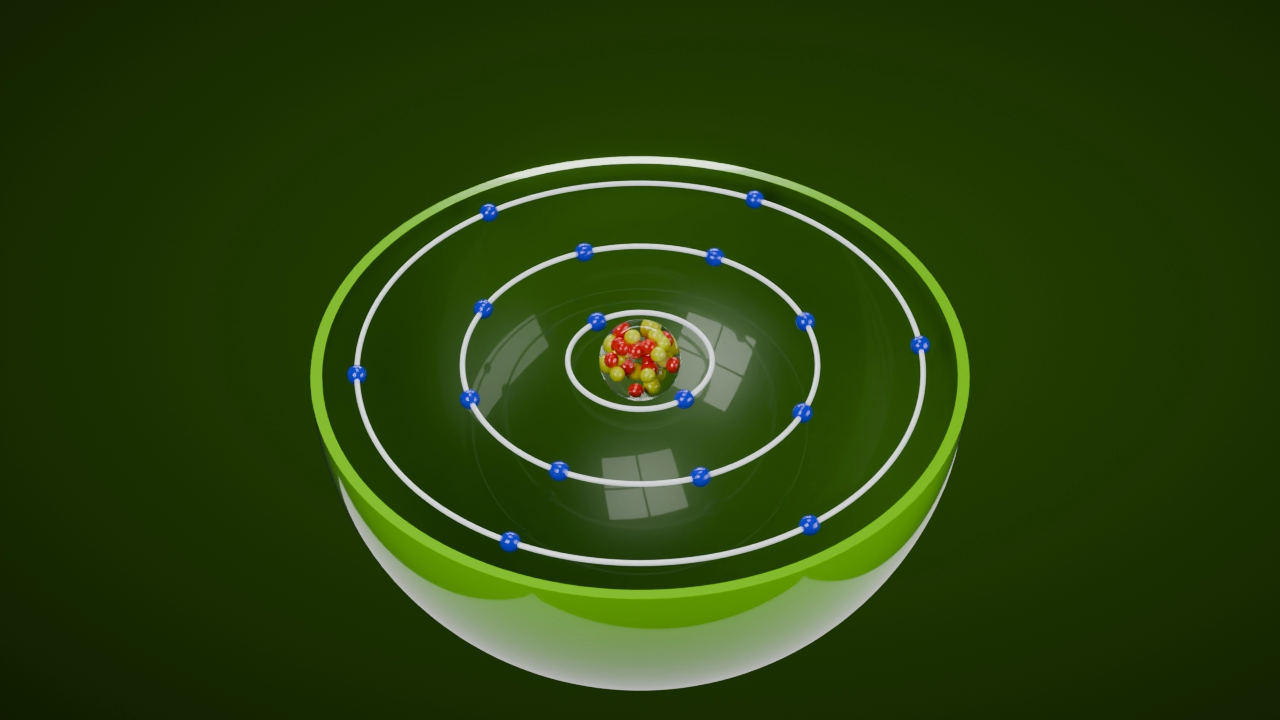
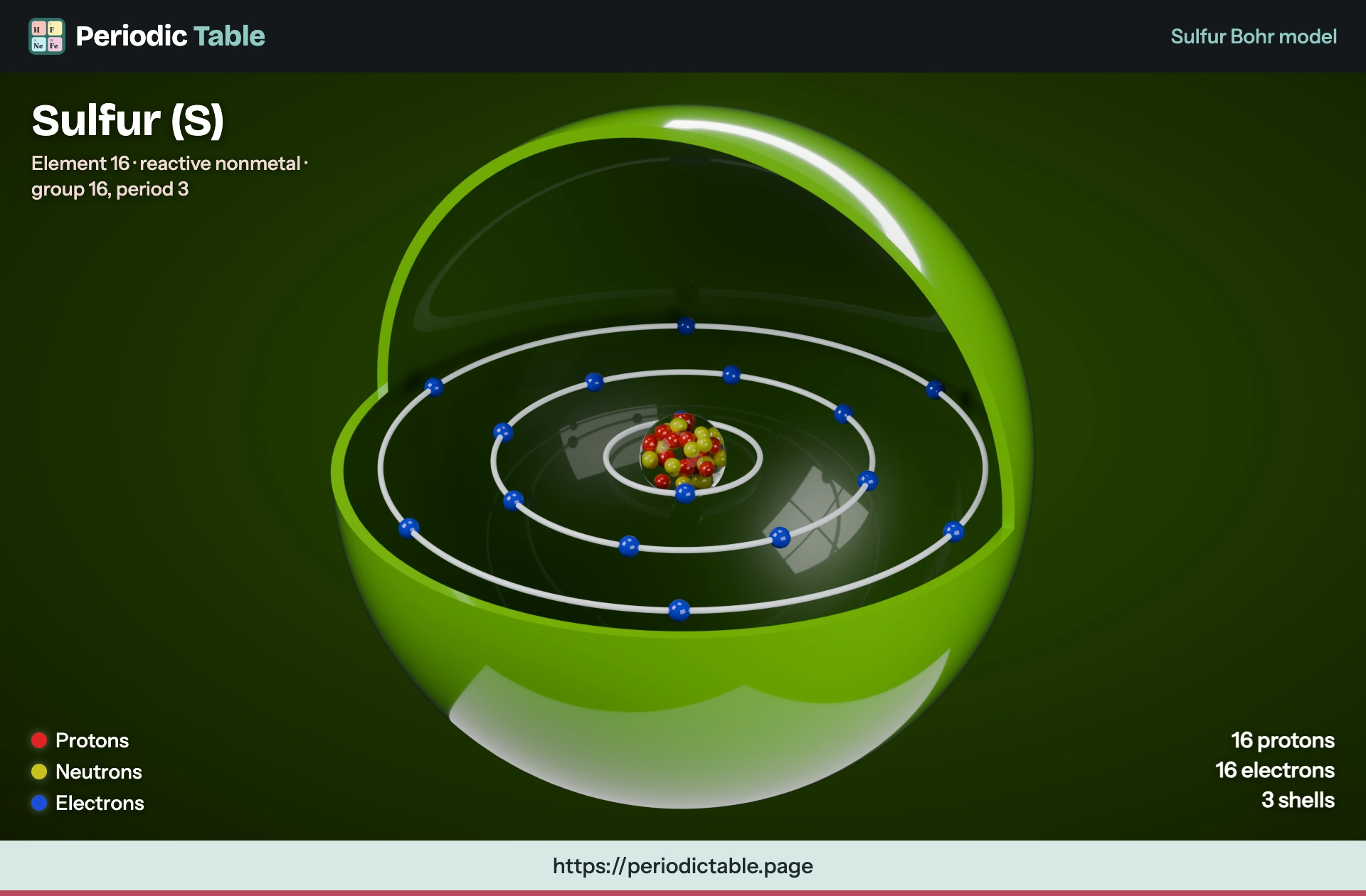
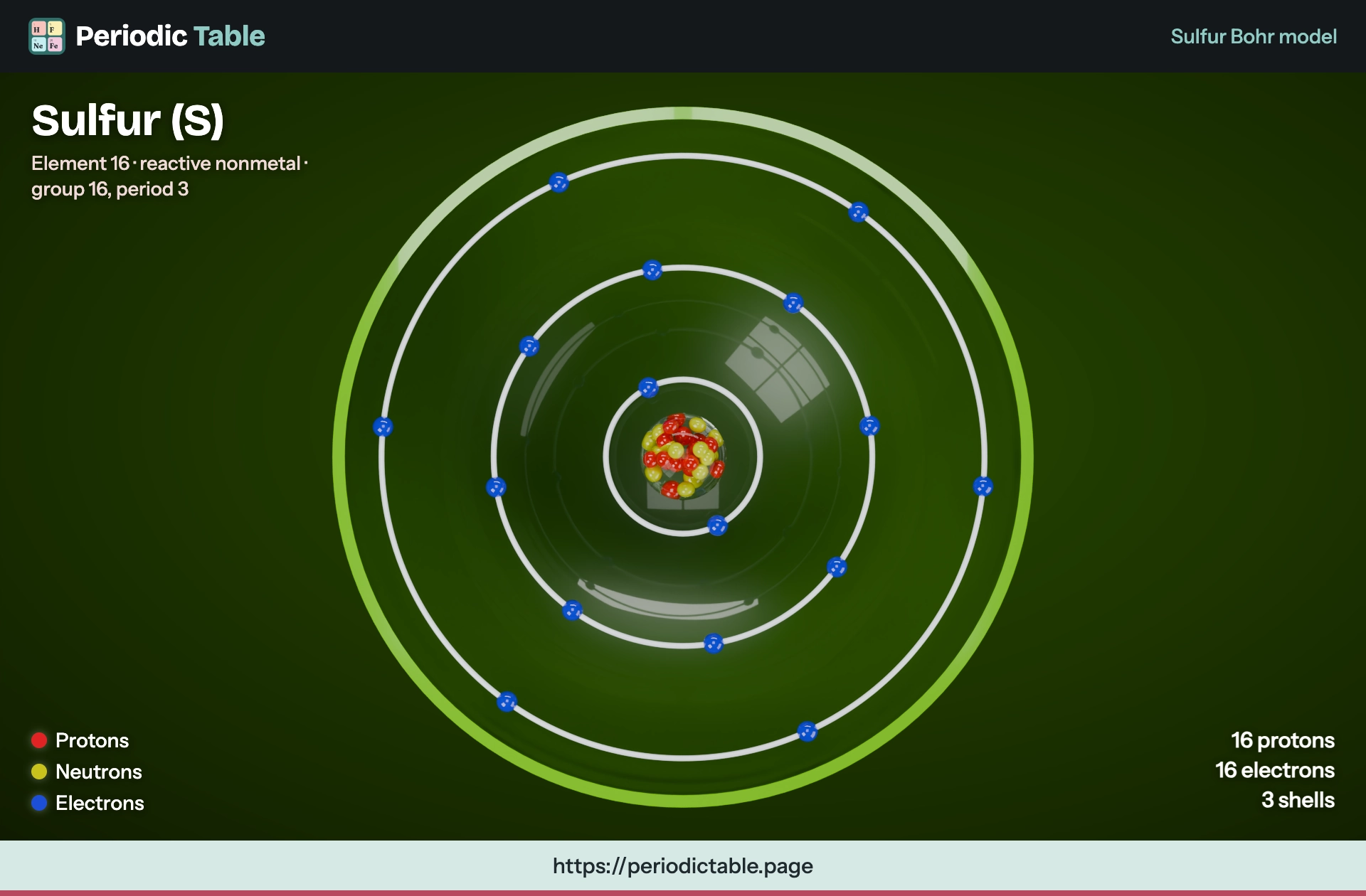
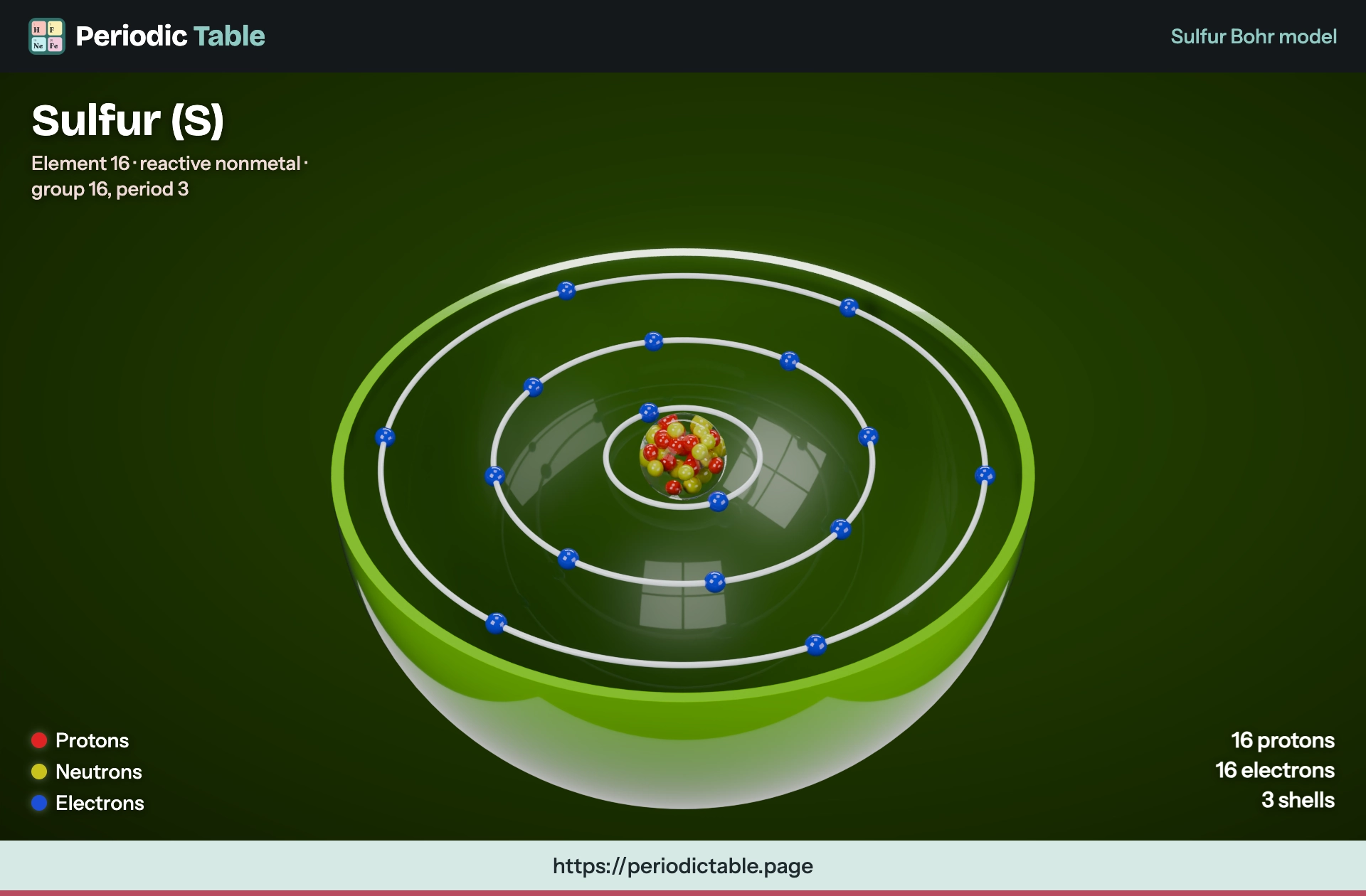
This is a Bohr model of sulfur (S), a simplified picture of a single sulfur atom. Its nucleus holds 16 protons, and a neutral sulfur atom has 16 electrons, arranged around it in 3 shells (2 in shell K, 8 in shell L and 6 in shell M).
Sulfur periodic table electron configuration
- Shorthand
- [Ne] 3s2 3p4
- Full
- 1s2 2s2 2p6 3s2 3p4
- Electrons per shell
- 2, 8, 6
Sulfur element properties and atomic data
- Atomic number
- 16
- Atomic mass
- 32.06 u
- Phase at STP
- Solid
- Melting point
- 115.21°C (388.36 K)
- Boiling point
- 444.65°C (717.8 K)
- Density
- 2.07 g/cm³
- Electronegativity (Pauling)
- 2.58
- Period
- 3
- Group
- 16
- Block
- p-block
- Appearance
- Lemon yellow sintered microcrystals
- Discovery date
- Ancient
- Discovered by
- Ancient china
- Named by
- —
Sulfur element facts at a glance
The sulfur element is a chemical element with the symbol S and atomic number 16, meaning every atom carries 16 protons. The table below gathers the reference values you will most often need, from its relative mass of 32.06 to its density of 2.07 g/cm³ for the common yellow crystals. Found in 1817 by Jöns Jacob Berzelius and named after the moon, this story is told in the black selenium entry in full.
| Property | Value |
|---|---|
| Symbol / atomic number | S / 16 |
| Relative atomic mass | 32.06 |
| Group, period, block | Group 16, period 3, p-block |
| Electron configuration | [Ne] 3s² 3p⁴ |
| Melting point (rhombic) | 115.21 °C (388.36 K) |
| Boiling point | 444.6 °C (717.8 K) |
| Density at 20 °C | 2.07 g/cm³ |
| Electronegativity | 2.58 (Pauling scale) |
| Covalent radius / Van der Waals radius | about 104 pm / 180 pm |
| Common oxidation states | −2, +2, +4, +6 |
| State at room temperature | Solid, pale to lemon yellow |
| CAS number | 7704-34-9 |
An electronegativity of 2.58 places the element between carbon and nitrogen, which is why it forms covalent bonds with most nonmetals and ionic compounds with reactive metals. Its covalent radius is noticeably larger than that of the element above it, and that size difference explains much of its unusual chemistry.
Where sulfur sits in the periodic table
On the periodic table, element 16 sits in group 16 and period 3, in the p-block. The members of this column are called the chalcogens, a name meaning "ore formers," because so many metal ores belong to this family.
Above it sits oxygen and below it sits selenium; to its left is phosphorus and to its right is chlorine. Compared with its lighter neighbor, it is less electronegative, forms long chains and rings, and can expand its valence shell to hold six bonds, as in SF₆, which gives it a very different chemistry.
Electron configuration and ionization energies
The ground-state arrangement is 1s² 2s² 2p⁶ 3s² 3p⁴, usually written in shorthand as [Ne] 3s² 3p⁴. With six valence electrons, sulfur atoms need two more to complete an octet, which explains the −2 charge in sulfide ions. The ionization energies climb steadily as each electron is removed:
- First: about 999.6 kJ/mol
- Second: about 2,252 kJ/mol
- Third: about 3,357 kJ/mol
- Sixth: about 8,496 kJ/mol, before a huge jump for the seventh, when core electrons are reached
That jump after the sixth electron is why +6 is the highest common oxidation state.
Physical properties of solid sulfur
Solid sulfur is a soft, brittle, lemon yellow solid. Pure crystals are odorless; the "sulfur smell" people describe really comes from hydrogen sulfide and other compounds. It is insoluble in water but dissolves readily in carbon disulfide, and it is an excellent electrical insulator. Students of transactinide chemistry will find darmstadtium (ds) explained alongside Sigurd Hofmann's discovery work.
Melting point, boiling point and color changes
The element melts at a low 115.21 °C and boils at 444.6 °C, so you can melt it over an ordinary laboratory burner. What happens next is unusual. Molten sulfur starts as a runny yellow liquid, then, above about 160 °C, its rings break open and link into long polymer chains.
The liquid becomes thick and dark, turning blood-red at higher temperatures, and finally thins out again at still higher temperatures as the chains break apart. When it burns, it gives a pale blue flame; at volcanoes such as Kawah Ijen, burning sulfur gas creates the famous "blue lava" seen at night.
Sulfur allotropes: rhombic, monoclinic and plastic
Sulfur forms more solid allotropes than any other element, over 30 in total. Almost all are built from rings of atoms, and the most important is octasulfur, a crown-shaped ring of eight atoms written as S8.
- Rhombic (α) sulfur: the orthorhombic crystal form, stable at room temperature.
- Monoclinic (β) sulfur: needle-like crystals, stable from about 95 °C up to the point where it melts.
- Plastic sulfur: an amorphous, rubbery form made by pouring the hot liquid into cold water. It slowly reverts to rhombic crystals over hours or days.
This wealth of forms comes from its ability to catenate, or bond to itself in rings and chains, more readily than almost any element except carbon.
Chemical properties and oxidation states of sulfur
Its chemistry is broad: the element combines with every element except the noble gases (and a few unreactive ones only with heat). Its charge in compounds ranges from −2 in metal compounds through 0 in the element to +4 and +6 in its oxides and acids.
When it is reduced with active metals, it forms chain-like polysulfides, such as the ones used in sodium–sulfur batteries. The strength of its bonds helps explain these preferences:
| Bond | Bond enthalpy (kJ/mol) | Example |
|---|---|---|
| S–S | 226 | Ring in S8 |
| S=S | 351 | S₂ gas |
| H–S | 347 | H₂S |
| O=S | 435 | SO₃ |
The fairly weak S–S single bond is why heat easily opens the rings, while the strong S=O bond is why burning releases so much energy.
How sulfur reacts with oxygen, hydrogen and metals
Burned in air, sulfur forms sulfur dioxide, which can be oxidized further over a catalyst to sulfur trioxide:
$$\mathrm{S + O_2 \rightarrow SO_2} \qquad \mathrm{2\,SO_2 + O_2 \rightarrow 2\,SO_3}$$
Heated with hydrogen, it gives H₂S. With metals it forms sulfides: iron filings and sulfur powder heated together glow and produce iron sulfide, and silver tarnishes because it reacts with traces of sulfur compounds in air. Fluorine pushes the element all the way to +6, giving the remarkably stable gas sulfur hexafluoride, used as an electrical insulator in high-voltage equipment, while chlorine gives lower chlorides such as S₂Cl₂.
Sulfur isotopes: stable and radioactive forms
Scientists know more than 20 sulfur isotopes, but only four are stable. Nearly 95% of natural sulfur is sulfur-32, the isotope made in massive stars by fusing silicon with helium.
| Isotope | Natural abundance | Stability |
|---|---|---|
| ³²S | 94.99% | Stable |
| ³³S | 0.75% | Stable |
| ³⁴S | 4.25% | Stable |
| ³⁶S | 0.01% | Stable |
| ³⁵S | Trace | Half-life about 87 days |
The longest-lived radioactive form is sulfur-35, with a half-life of about 87 days; it forms when cosmic rays strike argon in the air and is used as a tracer in biochemical research, most famously in the Hershey–Chase experiment that showed DNA carries genetic information. The ratio of sulfur-34 to sulfur-32 in rocks and sediments also lets geologists trace ancient ocean chemistry and pollution sources.
Where native sulfur and sulfur deposits are found
By mass, sulfur is the fifth most common element on Earth. Native sulfur, the pure element, forms around volcanoes and hot springs, where gases rising from below deposit yellow crusts; miners in Indonesia still carry blocks of it out of the crater at Kawah Ijen. Large underground sulfur deposits also formed in salt domes, where bacteria broke down calcium sulfate over millions of years.
Sulfur in minerals: sulfides and sulfates
Most sulfur in the crust is locked in minerals, which fall into two big families: sulfates (built around the SO₄ group) and compounds with metals. Many of them are the main ores of important metals, which is why the element matters so much in geology and mining.
| Mineral | Formula | Type |
|---|---|---|
| Pyrite ("fool's gold") | FeS₂ | Iron sulfide |
| Galena | PbS | Lead sulfide (main lead ore) |
| Cinnabar | HgS | Mercury sulfide |
| Sphalerite | ZnS | Zinc sulfide (main zinc ore) |
| Stibnite | Sb₂S₃ | Antimony sulfide |
| Gypsum | CaSO₄·2H₂O | Calcium sulfate |
| Barite | BaSO₄ | Barium sulfate |
Sulfur beyond Earth: Io, Mars and meteorites
Sulfur is the tenth most abundant element in the universe. It is forged by nuclear fusion deep inside massive stars and scattered when they explode as supernovae.
Jupiter's moon Io, the most volcanic body in the solar system, owes its yellow, orange and red patches to sulfur and its compounds. Many meteorites contain a few percent sulfur, mostly as the iron sulfide troilite, and in 2024 NASA's Curiosity rover cracked open a rock on Mars to reveal crystals of pure yellow sulfur.
Sulfur production: from the Frasch process to oil refining
For most of its history, sulfur came from volcanic deposits, above all in Sicily, where it was dug by hand and melted out in kilns under brutal working conditions. In the 1890s, Herman Frasch changed everything with the Frasch process: wells drilled into salt domes in Louisiana and Texas pumped superheated water at about 165 °C down to melt the buried deposits, and compressed air pushed the liquid back up at more than 99% purity. That made the United States the world's leading producer for most of the 20th century.
Underground mining of this kind has largely stopped. Today, almost all sulfur production is a byproduct of oil refining and gas processing, because fuels must be cleaned of sulfur before they are burned. China, the United States and Canada are among the largest producers, and Canada's oil sands produce so much that yellow stockpiles line Alberta's processing sites.
Recovering pure sulfur with the Claus process
Sour natural gas, petroleum and crude oil contain sulfur as H₂S and organic compounds. Refineries strip it out as hydrogen sulfide, then convert it into pure sulfur with the Claus process: one-third of the H₂S is burned to SO₂, which then reacts with the rest:
$$\mathrm{2\,H_2S + SO_2 \rightarrow 3\,S + 2\,H_2O}$$
The product ships as liquid, pellets or blocks.
Important sulfur compounds
Flexible bonding makes the compound chemistry of this element unusually rich. A few sulfur compounds matter far more than the rest, either because factories depend on them or because you can smell them from a long way off.
Sulfur dioxide, sulfuric acid and sulfites
Sulfur dioxide (SO₂) is a sharp-smelling gas formed when sulfur or sulfur-bearing fuels burn. Most of it is turned into sulfuric acid (H₂SO₄) through the contact process, in which SO₂ is oxidized over a vanadium catalyst and the trioxide is absorbed in acid. The acid is made in larger quantities than any other industrial chemical, so its output has long been used as a rough measure of a country's industrial strength.
Dissolved in water, SO₂ forms sulfites, which act as preservatives and antioxidants. They protect the color of dried fruit such as apricots and stop unwanted microbes in wine, which is why many wine labels carry a sulfite warning.
Hydrogen sulfide and organosulfur compounds
Hydrogen sulfide (H₂S) is the colorless gas behind the smell of rotten eggs, sewers and some hot springs. You can detect it at well under one part per million, which is lucky, because it is highly toxic.
Organosulfur compounds carry sulfur bonded to carbon, and many of them have powerful smells:
- Thiols, also called mercaptans, are added to odorless natural gas so you can smell a leak, and they form part of skunk spray.
- Garlic gets its bite from allicin, and cutting onions releases a sulfur compound that makes your eyes water.
- Cooked eggs give off a faint sulfur smell because heat breaks down sulfur-containing proteins in the white.
Uses of elemental sulfur in industry and agriculture
More than 80% of all sulfur ends up as sulfuric acid, which then feeds almost every corner of the chemical industry: metal processing, detergents, paper, dyes, explosives and battery acid. The rest is used directly as elemental sulfur or turned into other compounds.
Fertilizers and crop nutrition
The single biggest end use is in fertilizers. Sulfuric acid dissolves phosphate rock to make superphosphate and phosphoric acid, the base of most phosphate-based fertilizer.
Sulfur is also a plant nutrient in its own right: crops need it to grow, and as clean-air rules have cut the sulfur once deposited from smokestacks, farmers in many regions now add sulfate or elemental sulfur to their soil. In modern agriculture, sulfur is often counted as the fourth major nutrient after nitrogen, phosphorus and potassium.
Vulcanization of rubber and tires
Natural rubber is sticky when warm and brittle when cold. In 1839, Charles Goodyear found that heating it with sulfur made it strong and elastic.
This process, vulcanization, works because sulfur atoms form cross-links between the long polymer chains of rubber. Almost every car and bicycle tire is still vulcanized with sulfur today.
Fungicide, pesticides and gunpowder
Elemental sulfur is one of the oldest crop-protection chemicals. Dusted onto grapes, apples and vegetables, it works as a fungicide against powdery mildew, and it is one of the few fungicides allowed in organic farming.
It also serves among the gentler pesticides and insecticides, especially against mites and ticks. In a very different role, sulfur is one of the three ingredients of black powder, the original gunpowder (with charcoal and saltpeter), and it remains a component of fireworks and match heads.
- Safety matches use sulfur or antimony sulfide in the head to help it ignite.
- Sulfur concrete uses molten sulfur instead of cement in acid-resistant floors.
- Sodium thiosulfate was the "fixer" used to develop film photographs.
Sulfur in batteries and new materials
Because sulfur is cheap and can store a lot of charge, researchers are developing lithium–sulfur batteries that could hold more energy per kilogram than today's lithium-ion cells. Their main challenge so far is a short life, as sulfur compounds dissolve into the electrolyte during charging.
Sulfur in biology and the human body
Sulfur is essential for all life. It is about the eighth most abundant element in the human body, making up roughly 0.2% of your weight; a 70 kg adult carries around 140 g.
You get almost all of it from nutrition, mainly the protein in meat, fish, dairy, legumes and grains, so true deficiency is rare. In biology, its role centers on enzymes, vitamins and energy metabolism.
Amino acids, proteins and disulfide bridges
Two of the 20 standard amino acids, cysteine and methionine, contain sulfur. Methionine is the starting amino acid of nearly every protein your cells make, and your body can build cysteine from it.
When two cysteine units in a protein chain sit close together, their side chains link into disulfide bridges that lock the protein's shape in place. Those bridges make keratin in hair, nails and skin tough, and breaking and reforming them is exactly how a permanent wave curls straight hair.
Sulfur also appears in the vitamins biotin and thiamine (vitamin B1) and in glutathione, a small cysteine-based molecule that helps protect cells from oxidative damage.
Sulfur bacteria and the sulfur cycle
Microbes keep sulfur moving between rocks, water, air and living things. Sulfate-reducing bacteria in mud and swamps "breathe" sulfate instead of oxygen and release hydrogen sulfide, which is why black anoxic mud smells so foul.
Other sulfur bacteria do the reverse, oxidizing sulfide for energy. Around deep-sea hydrothermal vents, whole ecosystems of tube worms, clams and shrimp live on bacteria that use the chemical energy in H₂S instead of sunlight.
Sulfur in medicine and pharmaceuticals
Sulfur has been used in medicine throughout recorded history, mainly for skin conditions. It is mildly antibacterial and antifungal and loosens dead skin cells, so creams, soaps and lotions containing sulfur are still used to treat acne, rosacea, seborrheic dermatitis, dandruff and scabies.
The element also sits at the heart of many important drugs:
- Sulfa drugs (sulfonamides) were among the first antibiotics, used widely from the 1930s.
- Penicillin and related beta-lactam antibiotics contain a sulfur ring.
- The mucus thinner acetylcysteine is a modified form of cysteine.
History of sulfur from antiquity to Lavoisier
Because it occurs naturally in pure form, sulfur has been known since prehistoric times. Its history runs through medicine, religion, warfare and early science.
The ancient Egyptians used sulfur ointments, the Greeks and Romans burned it to fumigate and purify homes, the Romans mined it in Sicily, and Chinese texts describe it from at least the 6th century BCE. Chinese alchemists later mixed it with saltpeter and charcoal, creating black powder.
Brimstone in the Bible and alchemy
The old English name brimstone means "burning stone."
Fire and judgment in the Bible
In Genesis, fire and brimstone rain down on Sodom and Gomorrah, and in Revelation a fiery lake becomes an image of hell, which is why the smell of burning is linked with the devil in folklore.
Sulfur in alchemy
Alchemy was the forerunner of chemistry, and in it sulfur was one of the key principles of matter: medieval alchemists believed every metal was a blend of sulfur and mercury, and that the right balance could turn lead into gold. Paracelsus later added salt to make his three principles. The alchemical symbol for sulfur, a triangle above a cross, is still recognized today.
Lavoisier confirms a new element
For a long time, chemists thought sulfur hid a mysterious "fire principle," later called phlogiston. In 1777, Antoine Lavoisier used combustion experiments to argue that sulfur was a true element that combines with part of the air when it burns, and he listed it in his 1789 table of simple substances, helping found modern chemistry.
French chemists Gay-Lussac and Thénard confirmed it in 1809. Sicily remained the main source until American salt-dome wells took over.
Why the name is spelled sulfur or sulphur
The name comes from the Latin sulpur, which may trace back to the Sanskrit sulvere. Writers later added a Greek-looking "ph," giving sulphur, even though the word never came from Greek. Both spellings lived side by side for much of the word's history:
- "Sulphur" became the standard British spelling in the 19th century.
- American dictionaries switched to "sulfur" in the 20th century.
- The IUPAC adopted "sulfur" in 1990, and the Royal Society of Chemistry followed in 1992.
- Older British books, brand names and everyday UK writing still often use sulphur.
So if you see "sulphur dioxide" or "sulphur springs," it is exactly the same element; only the spelling differs.
Sulfur safety, toxicity and acid rain
The element itself has low toxicity, though its dust can irritate your eyes, skin and lungs, and fine sulfur powder can ignite or explode in air. Its compounds are another story. Hydrogen sulfide is about as poisonous as hydrogen cyanide, and above roughly 100 ppm it numbs your sense of smell, so you can stop noticing it just when it becomes most dangerous.
Burning sulfur-rich coal and oil in power plants releases SO₂ into the atmosphere, where it turns into acid droplets that fall as acid rain. This damaged forests, lakes and stone buildings across Europe and North America and caused deadly smog in industrial cities. Scrubbers in smokestacks and low-sulfur fuel standards have since cut this pollution sharply, an example of how controlling one element can protect the wider environment.