


Selenium element (Se): selenium periodic table facts
Selenium periodic table facts: selenium (Se) is element 34, a reactive nonmetal in group 16, period 4. Hold a piece of gray selenium under a lamp and its electrical resistance drops, which is the property that made this chemical element famous long before anyone knew your body needs it. When studying clean fuels, electrolysis, steam reforming and an energy carrier role for the lightest element are explained in the hydrogen electron affinity guide for curious readers.
Selenium, symbol Se, is a nonmetal (some textbooks call it a metalloid) that Berzelius identified in 1817, and it now sits at the crossroads of glassmaking, light and electricity, and human nutrition. Below you get its atomic data, the forms it takes, the compounds it builds, where it comes from, how factories use it, and why the gap between a healthy dose and a toxic one is so narrow.
Rotate the 3D Bohr model of selenium
Drag to orbit, scroll to zoom.
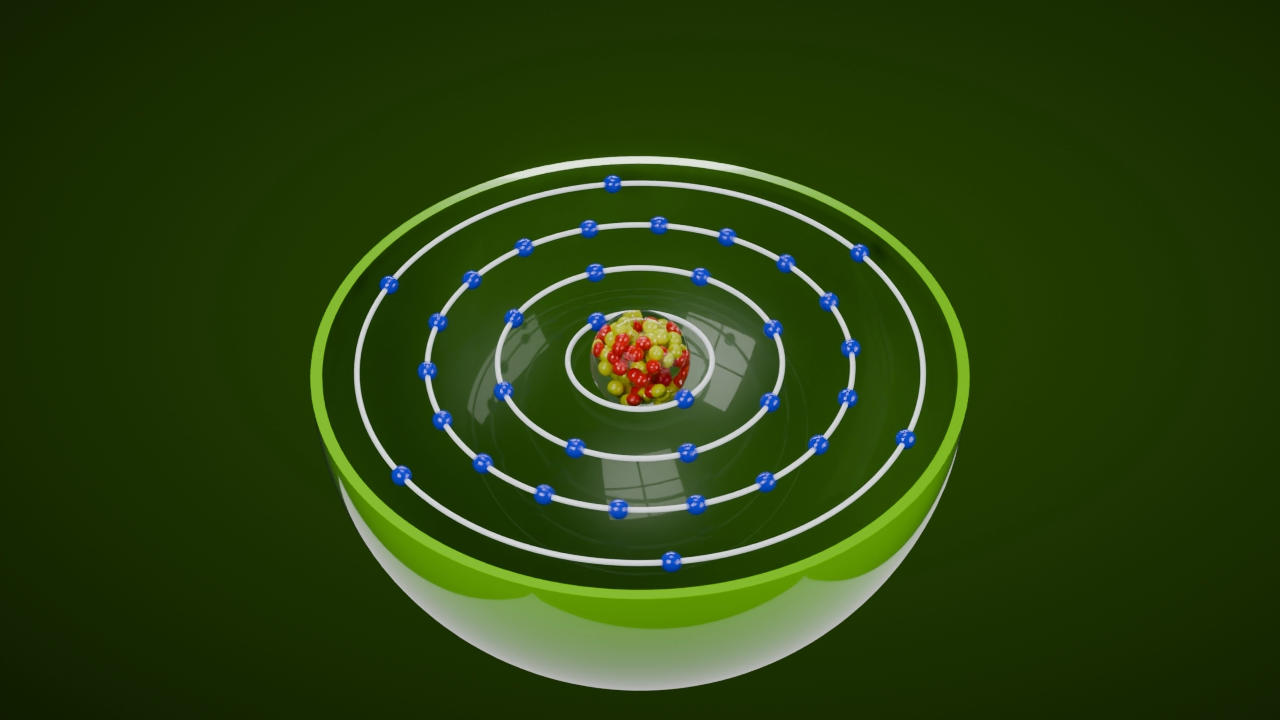
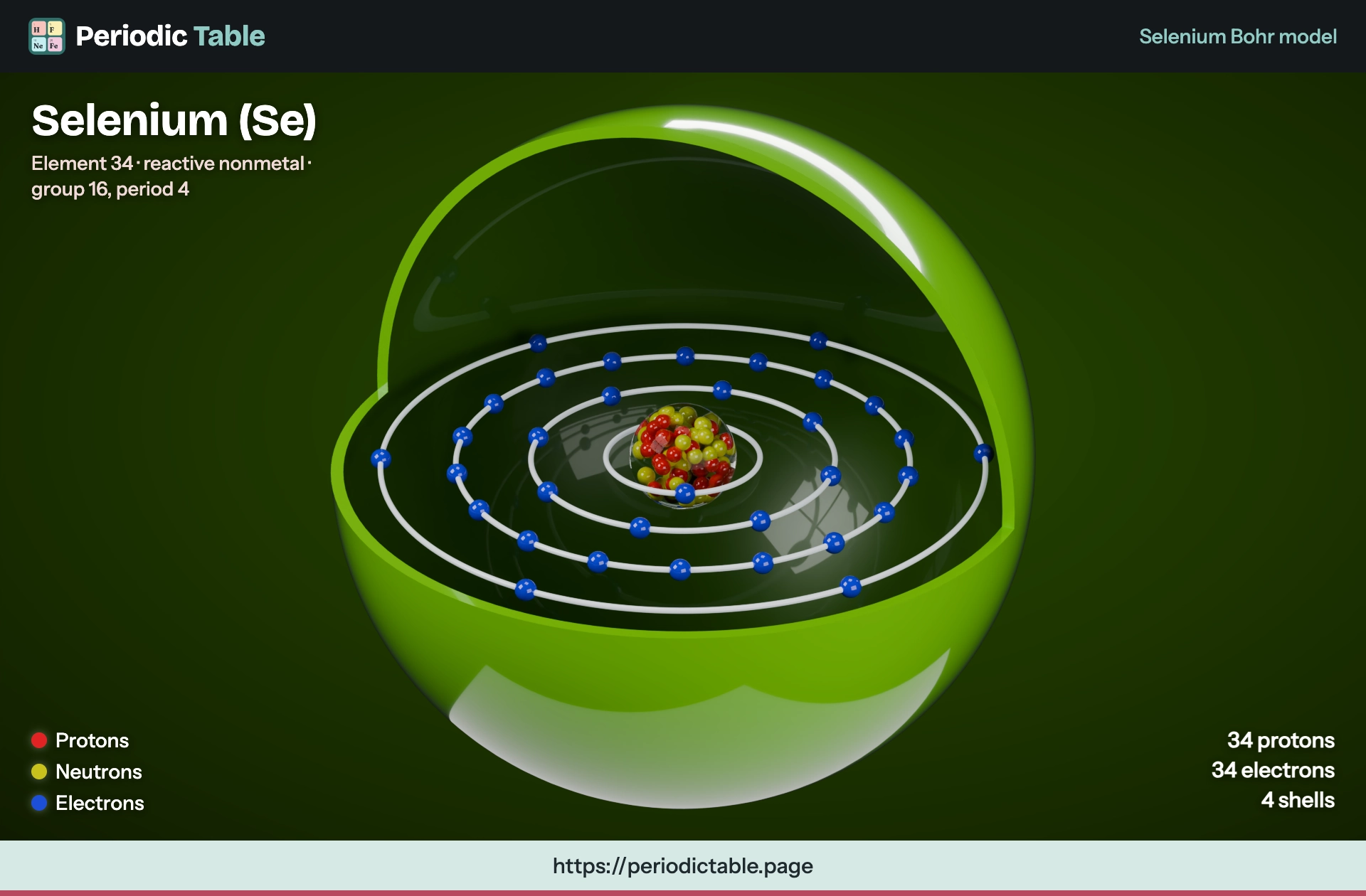
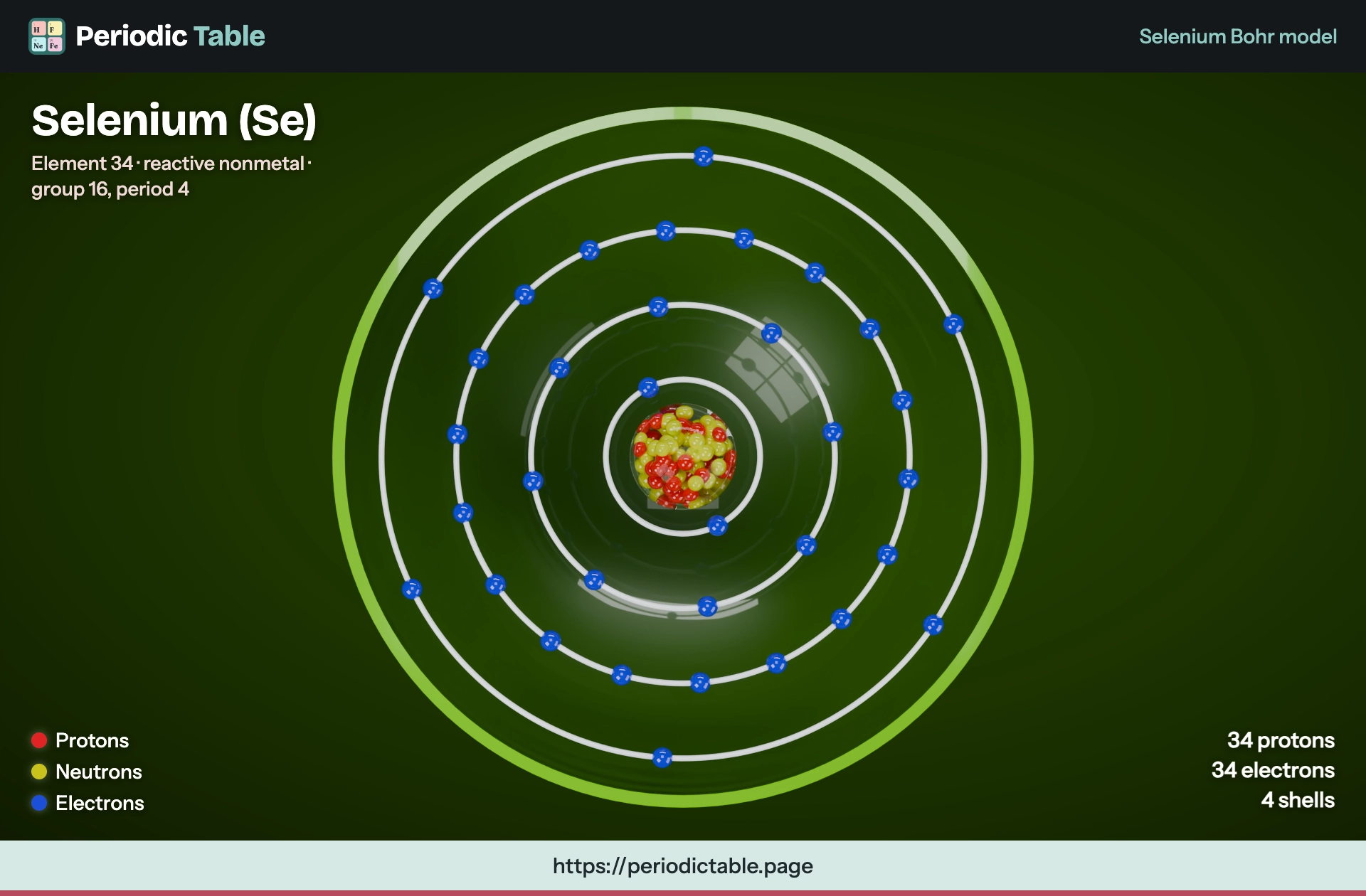
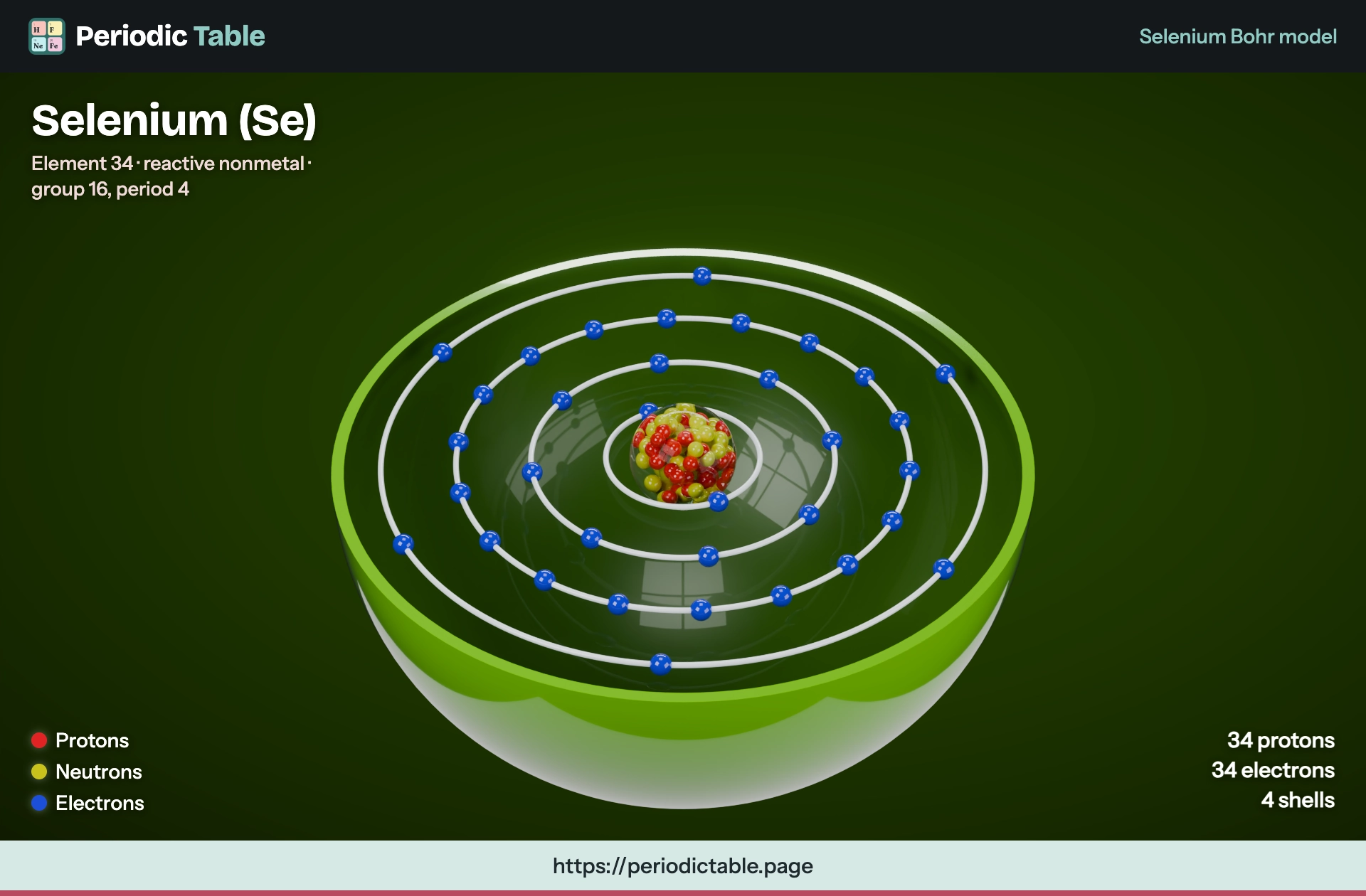
This is a Bohr model of selenium (Se), a simplified picture of a single selenium atom. Its nucleus holds 34 protons, and a neutral selenium atom has 34 electrons, arranged around it in 4 shells (2 in shell K, 8 in shell L, 18 in shell M and 6 in shell N).
Selenium periodic table electron configuration
- Shorthand
- [Ar] 3d10 4s2 4p4
- Full
- 1s2 2s2 2p6 3s2 3p6 4s2 3d10 4p4
- Electrons per shell
- 2, 8, 18, 6
Selenium element properties and atomic data
- Atomic number
- 34
- Atomic mass
- 78.9718 u
- Phase at STP
- Solid
- Melting point
- 220.85°C (494 K)
- Boiling point
- 684.85°C (958 K)
- Density
- 4.81 g/cm³
- Electronegativity (Pauling)
- 2.55
- Period
- 4
- Group
- 16
- Block
- p-block
- Appearance
- Black, red, and gray (not pictured) allotropes
- Discovery date
- 1817
- Discovered by
- Jöns Jakob Berzelius
- Named by
- —
Selenium element data at a glance
Every figure below is a published reference value, not an estimate, so you can use the table as a quick lookup before you read the details. Selenium carries atomic number 34, and its CAS number, 7782-49-2, is the identifier you will see on safety data sheets and supplier catalogues. Anyone comparing melting point, boiling point and density can open history of ruthenium for the full data table.
The numbers describe gray selenium, the stable form, unless a row says otherwise. Together they explain much of its chemistry: a mid-sized atom that holds its electrons fairly tightly but still conducts a little current.
| Property | Selenium value |
|---|---|
| Symbol and atomic number | Se, 34 |
| Standard atomic mass | 78.971 |
| Group, period, block | Group 16 (chalcogens), period 4, p-block |
| Electron configuration | [Ar] 3d10 4s2 4p4 (shells 2, 8, 18, 6) |
| Melting point | 221 °C (494 K) |
| Boiling point | 685 °C (958 K) |
| Density, gray Se | 4.81 g/cm³ |
| Electronegativity (Pauling) | 2.55 |
| First three ionization energies | 941, 2045, 2974 kJ/mol |
| Common oxidation states | −2, +2, +4, +6 |
| State at 20 °C | Solid |
| CAS number | 7782-49-2 |
Atomic number, atomic mass and electron configuration
The atomic number tells you a neutral Se atom has 34 protons and 34 electrons. Its standard atomic mass of 78.971 is a weighted average across six naturally occurring isotopes, which is why it is not a whole number.
The electron configuration, [Ar] 3d10 4s2 4p4, leaves the atom two electrons short of a filled outer shell, so selenium readily gains two to form the Se2− ion or shares electrons in covalent bonds. Size figures are consistent with that: the covalent radius is about 120 pm, the empirical atomic radius is also about 120 pm, and the van der Waals radius is about 190 pm.
Group 16, period 4 and the P-block of the periodic table
On the periodic table, selenium sits in group 16, period 4, inside the p-block. That makes it a chalcogen, the family headed by oxygen, with sulfur directly above it and tellurium directly below.
You can predict a lot from that position: selenium behaves like a heavier, less reactive sulfur and a lighter, less metallic tellurium. Across the row, arsenic lies to its left and bromine to its right, and selenium shares arsenic's tendency to replace sulfur in minerals and, in some compounds, its toxicity to living things.
Melting point, boiling point, density and electronegativity
Gray selenium has a low melting point of 221 °C and a boiling point of 685 °C, so it melts in an ordinary laboratory flame and vaporises well below the temperatures iron needs. Its density is 4.81 g/cm³, a little under half that of lead.
An electronegativity of 2.55 on the Pauling scale is the same as carbon's, which helps explain why Se–C bonds are so common in organic selenium chemistry. For anyone working with the physics of the solid, the specific heat capacity is about 321 J/(kg·K) and the bulk modulus is roughly 8.3 GPa, a soft, brittle material with a Mohs hardness of only 2.
Physical properties of selenium and its allotropes
The properties of selenium depend on which form you are holding, because the element has several allotropes, structurally different versions of the same atoms. Some are amorphous, with no long-range order; others are crystalline. If you smell rotten eggs near a lab, open the sulphur for hydrogen sulfide and the blue flame of burning sulphur.
They interconvert with heat, and the rate of heating or cooling decides which one you end up with. All of them burn in air, resist water, and dissolve in concentrated nitric acid.
Gray selenium, photoconductivity and semiconductor behaviour
Gray selenium is the most stable and densest allotrope. Its atoms form long helical chains packed side by side in a hexagonal crystal lattice, with each Se–Se bond about 237 pm long. This is the form that matters for devices.
It is a semiconductor: its conductivity is low in the dark but rises sharply when light falls on it, a behaviour called photoconductivity. The same photoconductive response is what lets a thin selenium film turn an image into a pattern of electric charge. Other allotropes convert to the gray form when you warm them gently or cool molten selenium slowly.
Red and black selenium as allotropic forms
When selenium is precipitated in a chemical reaction, it usually appears as a brick-red, amorphous powder. Dissolving that in carbon disulfide and evaporating the solvent at different speeds gives three red monoclinic crystals built from puckered eight-atom rings (Se8), like the eight-membered rings of the element above it. Melt selenium and cool it fast and you get black selenium, a brittle, glassy, vitreous solid made of huge irregular loops, which is the form usually sold as beads.
These allotropic forms soften around 50 °C and turn gray near 180 °C. Native elemental selenium does occur in nature, but only rarely.
Selenium isotopes, oxidation states and ionization energies
Natural selenium isotopes number six, five of them stable and one so long-lived that it counts as primordial. The table lists their natural abundance as reference values. Se-80 dominates, at roughly half of all selenium atoms.
| Isotope | Natural abundance | Stability |
|---|---|---|
| Se-74 | 0.86% | Stable |
| Se-76 | 9.23% | Stable |
| Se-77 | 7.60% | Stable |
| Se-78 | 23.69% | Stable |
| Se-80 | 49.80% | Stable |
| Se-82 | 8.82% | Half-life about 1020 years (double beta decay) |
Among the synthetic isotopes, Se-75 has a half-life of about 120 days and is used as a gamma source for industrial X-ray-style radiography of welds, while Se-79 forms in tiny amounts as a fission product. Chemically, selenium shows four main oxidation states: −2 in compounds with metals and hydrogen, +2 in a few halides, +4 in SeO2 and selenites, and +6 in selenic acid and its salts. The first three ionization energies (941, 2045 and 2974 kJ/mol) climb steadily, and removing all six valence electrons for the +6 state takes much more energy, which is why compounds in the +6 state are strong oxidants.
Selenium compounds and their chemistry
Selenium compounds mirror the chemistry of its lighter neighbour so closely that you can often guess a formula by swapping one element for the other. The differences are in stability and toxicity: selenium analogues tend to be less stable at high oxidation states and more harmful to living cells.
Selenium dioxide, selenous acid and selenates
Burning the element in oxygen gives selenium dioxide, a white polymeric solid:
$$\mathrm{Se + O_2 \rightarrow SeO_2}$$
Dissolved in water, it forms selenous acid, H2SeO3, which older sources spell selenious acid. Its salts are the selenites; sodium selenite is the form added to many animal feeds. Oxidising the dioxide further with hydrogen peroxide gives selenic acid, H2SeO4, whose salts are the selenates.
A selenate is the selenium version of a sulfate and moves easily through water. Treating selenous acid with hydrogen sulfide yields selenium disulfide, the yellow-orange solid in medicated scalp treatments.
Selenides, halides and organoselenium compounds
In the −2 state, selenium forms selenides. The simplest, hydrogen selenide (H2Se), is a colourless gas with a foul smell and is far more toxic than hydrogen sulfide. Metal compounds such as zinc selenide and cadmium selenide are semiconductors in their own right, and reactive metals like aluminium form a compound that releases H2Se on contact with water.
With halogens, selenium gives selenium hexafluoride (SeF6), a toxic gas, plus tetrachloride and monochloride, and selenium oxychloride (SeOCl2) has served as a specialty solvent. Organic chemists use Se–C compounds such as selenoxides in synthesis, and selenium even replaces sulfur in some amino acids, covered further down.
History and discovery of the element selenium
The discovery of the element selenium came by accident in 1817. Swedish chemist Jöns Jacob Berzelius and his partner Johan Gottlieb Gahn ran a plant making sulfuric acid from pyrite mined at Falun.
A red sludge kept settling in the lead chambers, and they first took it for an arsenic or tellurium compound because it smelled like horseradish when burned. When no tellurium turned up in the ore, Berzelius re-examined the deposit and concluded it was a new element.
Because tellurium had been named for the Earth, Berzelius named its lighter sibling after the Moon, from the Greek word selene. The pairing is still a handy memory aid: tellurium for the Earth, selenium for the moon above it.
The element's later history turned on illumination. In 1873 the English engineer Willoughby Smith, testing materials for undersea telegraph cables, noticed that selenium rods conducted better in sunlight than in the dark.
That observation led to the first light sensors, Alexander Graham Bell's photophone in 1880, and early solar cells. Biologists came much later: selenium was recognised as a poison for livestock first and only shown to be essential for mammals in 1957.
Selenium occurrence, production and crustal abundance
Selenium is scarce. Its crustal abundance is usually quoted at about 0.05 to 0.13 parts per million, which makes it rarer than silver. Its occurrence is spread thinly through rocks and the ground rather than concentrated in deposits worth mining for their own sake, so almost all output depends on other metals.
Selenium minerals and copper refining
True selenium minerals exist, including clausthalite (PbSe) and crooksite, but they are rare and seldom form good crystals. Most of the element hides as an impurity in sulfide ores, standing in for a small share of the sulfur in a metal sulfide, especially copper sulfides. When copper is purified by electrolytic refining, selenium collects in the anode mud at the bottom of the cells.
Refiners roast that residue with soda ash to make the dioxide, dissolve and acidify it, and reduce the acid with sulfur dioxide to recover the element. In other words, selenium is a byproduct of copper and, historically, a by-product of sulfuric acid plants. Note that the common mineral selenite is actually gypsum and contains no selenium at all; it was named for its pale lunar sheen before the element was found.
Supply risk and producing countries
Because supply follows copper, you cannot simply open a selenium mine when demand rises. World output is on the order of a few thousand tonnes a year, and less than 10% is recycled.
China is the largest consumer and a major producer, alongside Japan, Germany, Belgium and Russia, with Canada and the United States also refining it. The Royal Society of Chemistry rates selenium's relative supply risk as moderately high, mainly because production is concentrated in a few refining countries and few substitutes exist for some of its uses.
Uses of selenium and its applications in industry
The uses of selenium have shifted over a century from early electrical devices toward metallurgy, glassmaking and agriculture, but its applications still span most of modern industry. In manganese refining, adding selenium dioxide to the electrolysis cells cuts the power needed, and that alone consumes a large share of global supply.
Glass production and pigments
Glass production is the single largest use. Iron impurities give ordinary panes a green tint, and a small dose of selenium adds a pink, red colour that cancels it, leaving the pane looking neutral.
Add more, often with cadmium sulfide, and you get the deep red color of ruby glass and warning lenses. The same cadmium sulfoselenide chemistry has long supplied orange and red pigments for plastics, ceramics and enamels.
Solar cells, photovoltaic devices and electronics
Selenium's photosensitivity made it one of the first materials in electronics. It turned up in photocells, photographic light meters and, for decades, in photocopiers, where a charged selenium drum held the image as a pattern of static. Selenium rectifiers, which convert AC to DC, appeared in 1933 and were later replaced by silicon, though selenium surge suppressors are still made.
The first solid-state solar cells, built in 1876 and 1883, used selenium as the photoabsorber, and the element is again being studied as a wide-bandgap top layer for tandem cells. Its photovoltaic cousin, copper indium gallium diselenide (CIGS), is an established thin-film technology. Amorphous selenium films are the active layer in flat-panel X-ray detectors used for mammography, and cadmium selenide makes the fluorescent quantum dots found in some displays.
Alloys, rubber, shampoos and other uses
In alloys, about 0.15% selenium makes steel and copper easier to machine. Combined with bismuth, it replaces lead in plumbing brass, keeping lead out of drinking-water fittings. Small amounts improve the abrasion resistance of rubber during vulcanization.
Selenium disulfide is the active ingredient of many anti-dandruff products: if your shampoo lists it, you are using selenium chemistry, and medicated shampoos rely on it to slow flaking. In black-and-white photography, selenium toning deepens the tonal range of prints and helps them last.
Biological role of selenium as a trace element
Selenium's biological role is what makes it matter for human health, not just industry. It is a trace element and an essential micronutrient for humans and many animals, even though the pure element and its salts are poisonous in larger amounts. Your body holds only about 13 to 20 mg in total.
In biology, most of it sits in two amino acids. Selenocysteine, the "21st amino acid," is built into selenoproteins, while selenomethionine comes from food and can stand in for methionine. Selenoproteins include glutathione peroxidase, an antioxidant that breaks down hydrogen peroxide before it damages cells, and the deiodinase enzymes that activate and deactivate thyroid hormone.
That is why the thyroid holds more selenium per gram than any other organ. Selenium also works alongside vitamin E, and it binds mercury, which partly offsets mercury's harm. Claims that supplements prevent cancer have not held up in large trials.
Dietary sources and recommended intake
You get selenium mainly from food, and how much depends on the soil your food grew in. Brazil nuts are the richest source; a single nut can exceed a day's requirement, so a handful of these nuts daily is too many. Seafood such as tuna and lobster, organ meats like kidney, plus meat, eggs, cereals and grains supply the rest.
The US recommended allowance for adults is 55 micrograms a day. Multivitamins and dietary supplements commonly carry 55 to 200 µg per serving, regulators set minimum and maximum levels for infant formula, and selenium is added to animal feeds in low-selenium regions.
Selenium toxicity and health effects
Selenium toxicity begins not far above the amount you need. The tolerable upper intake level for adults is 400 micrograms a day, roughly seven times the recommended intake. Regularly going beyond that causes selenosis, whose health effects include garlic breath, hair loss, brittle hair, nausea, fatigue, irritability and nerve damage.
The nails may thicken, discolour or fall off. Severe selenium poisoning can damage the liver, fill the lungs with fluid and, rarely, kill.
Form matters for toxicity. Elemental selenium is poorly absorbed and relatively mild, whereas soluble selenites and selenates are highly toxic, and hydrogen selenide gas is among the most toxic selenium compounds. Workplace selenium exposure usually happens through dust or fumes in refining, smelting and paint work, and US agencies limit airborne selenium to 0.2 mg/m³ over an eight-hour shift.
Inhaled fumes irritate the eyes and airways, and the garlic odour on the breath is often the first sign. For your own health, the practical rule is to count supplement doses together with any Brazil-nut habit so your daily total stays under the upper limit.
Selenium deficiency and low-selenium soils
Selenium deficiency is uncommon in people with varied diets, but it does occur where soils are naturally poor in the element, as in parts of China, where it became a public health problem linked to Keshan disease, a heart muscle disorder. Low intake is associated with muscle weakness, weakened immunity and impaired thyroid function.
In agriculture, grazing animals in low-selenium regions develop white muscle disease, which is why selenium is added to fertilisers in Finland and to livestock rations elsewhere. Deficiency often appears together with low vitamin E or iodine, which makes the cause hard to separate.
Environmental effects and selenium pollution
The environmental effects of selenium come from how easily it moves and concentrates. Weathering rocks release it naturally, but most selenium pollution comes from human activity: coal burning and oil combustion, which release selenium dioxide to the air, plus smelting, fly-ash ponds and landfills. In the environment, oxygen-rich, acidic conditions turn selenium into mobile, dissolved forms that travel.
Irrigation makes the problem worse in dry regions. Water passing through selenium-rich soil leaches these salts, and drainage water collected in evaporation ponds concentrates them further.
It can also reach groundwater and wells, raising levels in local drinking water. Once in aquatic systems, selenium undergoes bioaccumulation: plankton concentrate it thousands of times above the water level, and it is magnified up the food chain to fish and wetland birds.
The damage shows up in the next generation. Selenium passes into eggs, causing birth defects such as deformed spines and fins and reproductive failure, even when adult fish look healthy.
Kesterson Reservoir in California and Belews Lake in North Carolina are the textbook cases: agricultural drainage at one and coal ash wastewater at the other wiped out much of the aquatic life. Because the same element that keeps you healthy can collapse a wetland ecosystem, regulators now set water limits for selenium measured in single-digit µg per litre.