


Ruthenium element (Ru): ruthenium periodic table facts
Ruthenium periodic table facts: ruthenium (Ru) is element 44, a transition metal in group 8, period 5. You probably rely on ruthenium (Ru) every day without knowing it, because this rare chemical element sits inside data-storage disks, switch contacts and the circuits of the phone in your pocket. Before you compare isotopes or boiling points, look up the reactive nonmetal hydrogen for the atomic number of the lightest element.
Karl Ernst Claus isolated it in 1844, and it belongs to the platinum group, a family of six scarce, tough metals. Its real talent is making other metals harder, longer-lasting and far more resistant to wear, which is why a few grams of it go a long way in industry.
Rotate the 3D Bohr model of ruthenium
Drag to orbit, scroll to zoom.
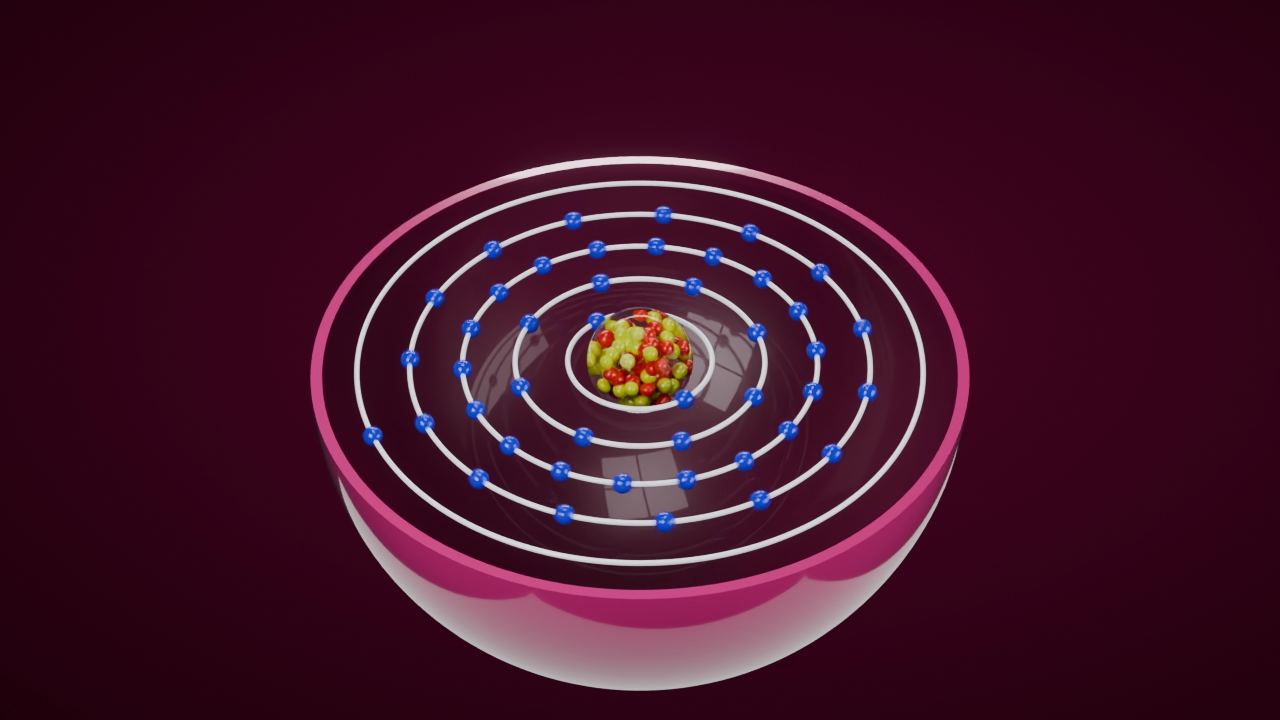
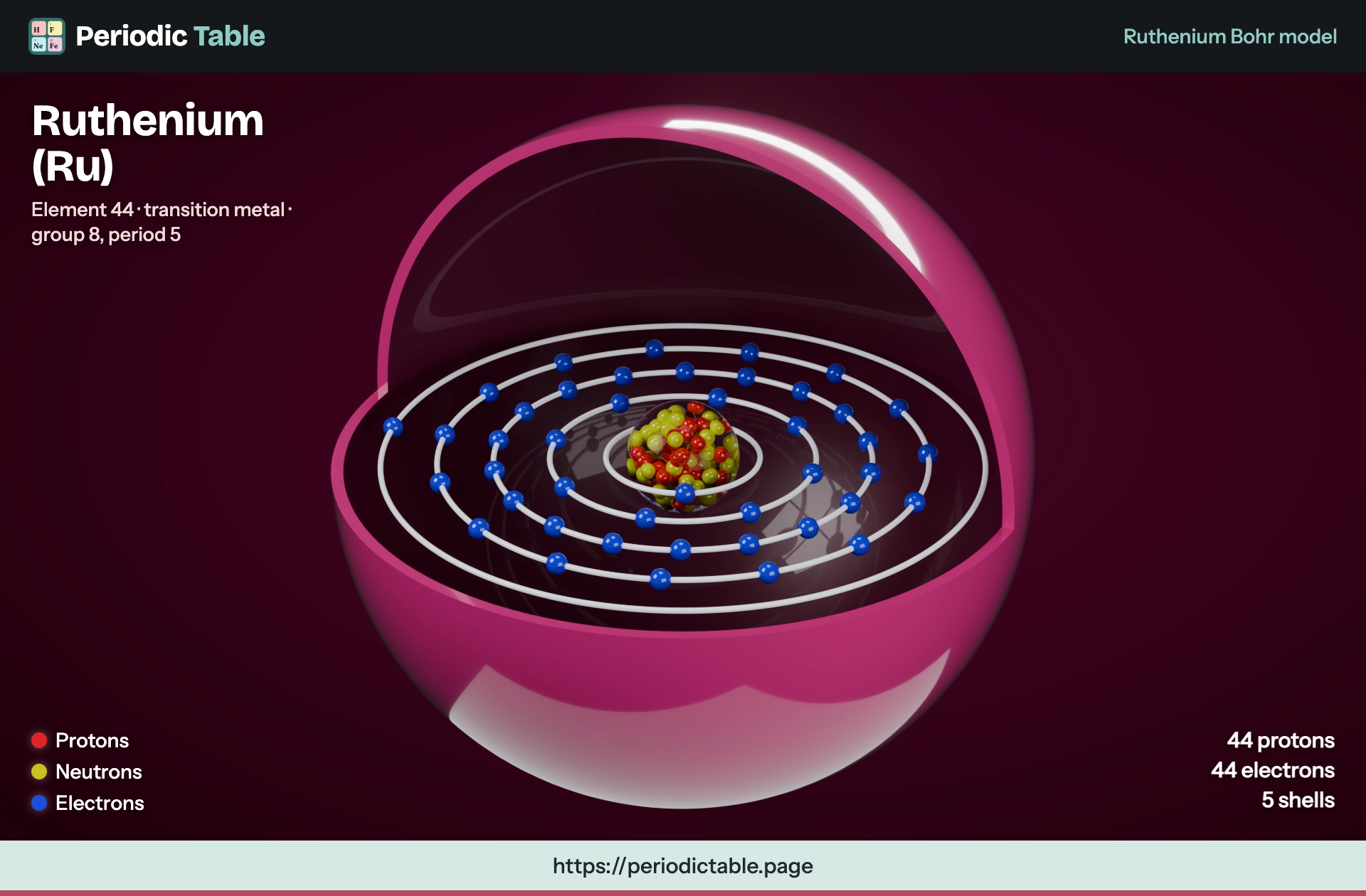
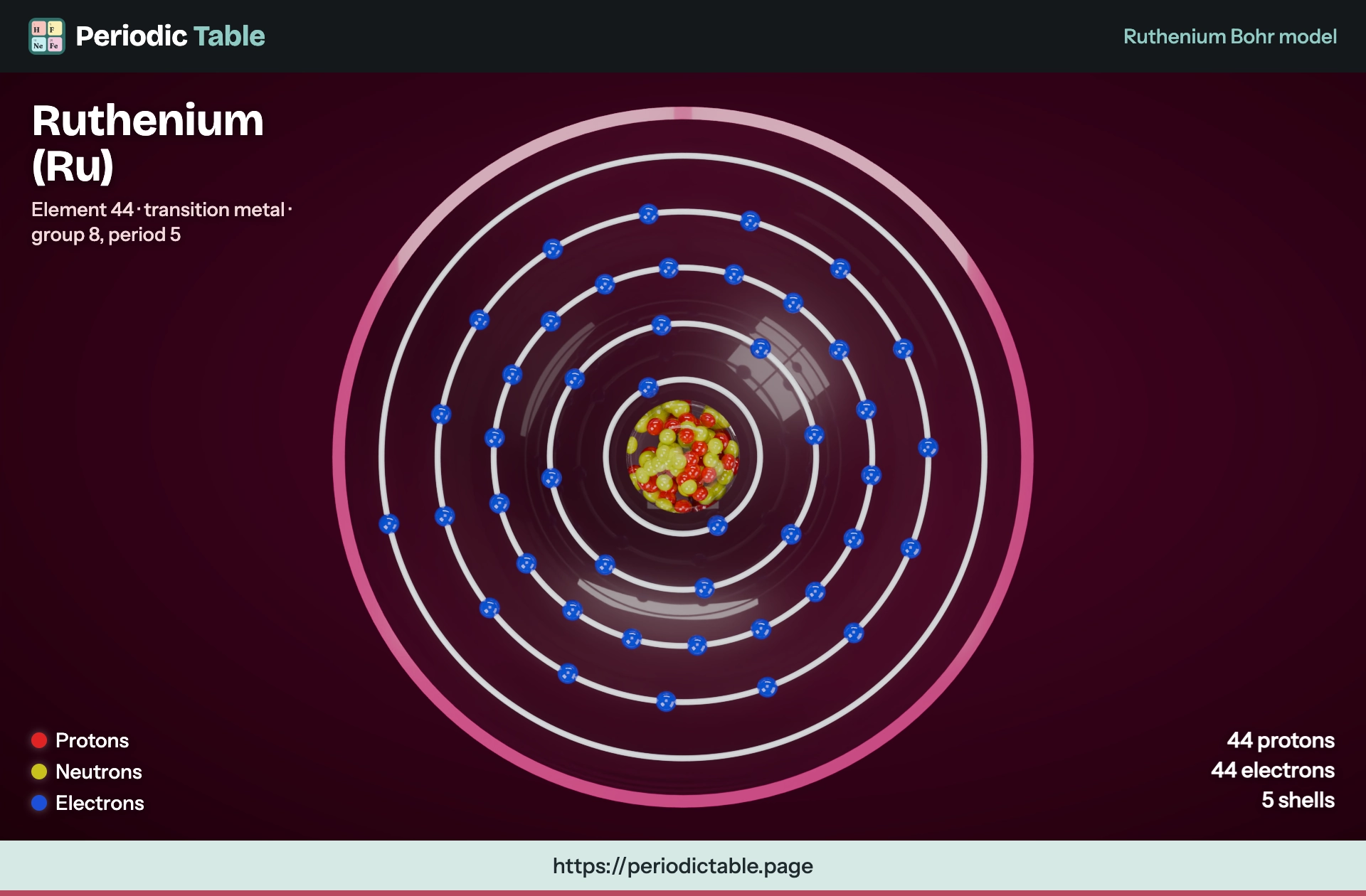
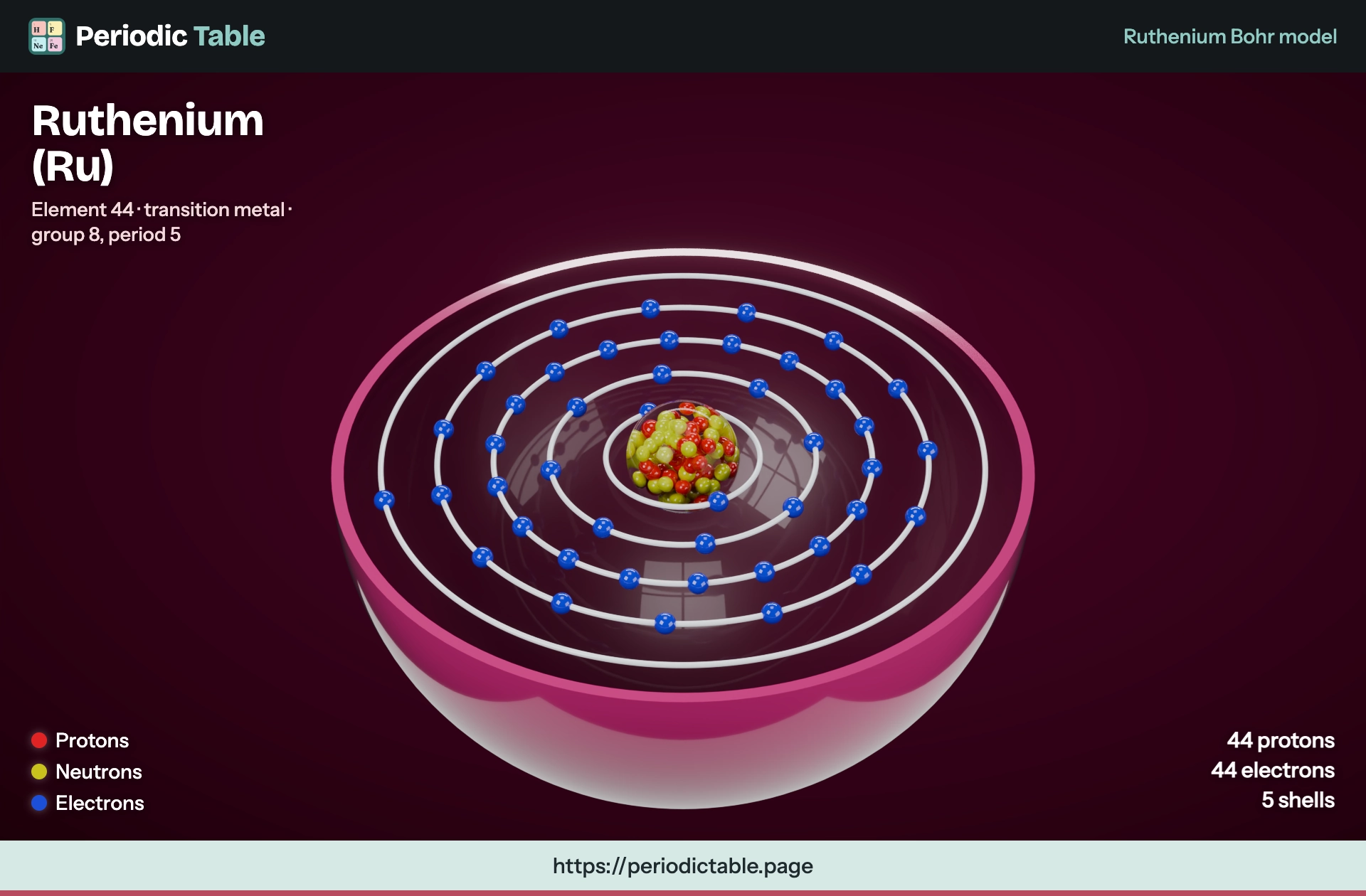
This is a Bohr model of ruthenium (Ru), a simplified picture of a single ruthenium atom. Its nucleus holds 44 protons, and a neutral ruthenium atom has 44 electrons, arranged around it in 5 shells (2 in shell K, 8 in shell L, 18 in shell M, 15 in shell N and 1 in shell O).
Ruthenium periodic table electron configuration
- Shorthand
- [Kr] 4d7 5s1
- Full
- 1s2 2s2 2p6 3s2 3p6 4s2 3d10 4p6 5s1 4d7
- Electrons per shell
- 2, 8, 18, 15, 1
Ruthenium element properties and atomic data
- Atomic number
- 44
- Atomic mass
- 101.072 u
- Phase at STP
- Solid
- Melting point
- 2333.85°C (2607 K)
- Boiling point
- 4149.85°C (4423 K)
- Density
- 12.45 g/cm³
- Electronegativity (Pauling)
- 2.2
- Period
- 5
- Group
- 8
- Block
- d-block
- Appearance
- Silvery white metallic
- Discovery date
- 1844
- Discovered by
- Karl Ernst Claus
- Named by
- —
What is ruthenium? element 44 at a glance
Ruthenium is a transition metal with atomic number 44, which means every atom carries 44 protons in its nucleus and, in the neutral state, 44 electrons around it. Its standard atomic weight is 101.07, and it stays solid well past any everyday temperature, with a bright, silvery shine that looks a lot like platinum. If you picture the middle of the table where cobalt lives, ruthenium sits two rows below iron, among the heavier and much scarcer precious metals. Anyone following Nobel Prize research on the elements will find mendelevium (Md) a compact account of the 1955 result.
The quick facts below are the numbers you will most often need when you look up this element.
| Property | Value |
|---|---|
| Symbol | Ru |
| Atomic number | 44 |
| Relative atomic mass | 101.07 |
| Group / period / block | Group 8, period 5, d-block |
| Electron configuration | [Kr] 4d7 5s1 |
| State at 20 °C | Solid |
| CAS number | 7440-18-8 |
The symbol for ruthenium and its Latin name
The symbol Ru comes straight from the name. Chemists took it from Ruthenia, the Latin word for the lands of Rus', a region that covered parts of modern Ukraine, Belarus and the Russian west. It was one of the first elements named after a country, a habit later copied by germanium, polonium and francium.
Where Ru sits on the periodic table
You will find Ru in period 5 (the fifth row) and in the eighth column of the periodic table, inside the d-block where the transition elements live. Its column is headed by the lightest member, followed by ruthenium, osmium and the short-lived synthetic element hassium. Members of a column usually share chemistry, and these four do have a lot in common, yet the lighter and heavier pairs split in ways that matter for how they are used. Between gray, red and black allotropic forms and their melting points, the selenium on the periodic table profile draws the comparison.
Its immediate neighbors along the row are technetium on the left and rhodium on the right. That puts ruthenium at the heart of the six-member platinum family, sharing its row with two other members.
Electron configuration and group 8 neighbors
Written out in shorthand, the arrangement is [Kr] 4d7 5s1, with shells filled as 2, 8, 18, 15 and 1. That single outer electron is an oddity: the other members of its column keep two electrons in the outermost shell, but here one has dropped into the 4d subshell instead.
Most 4d metals from niobium onward show the same quirk, and it barely changes how ruthenium reacts. Melting points across the row peak at molybdenum, and element 44 is the first step down from that maximum because its 4d subshell is more than half full.
Physical properties of this platinum group metal
The physical properties of ruthenium metal make it one of the toughest elements you can handle. It has a very high melting point and boiling point, a density a little above lead's, and it keeps its shape and shine under heat and stress. The values below are standard reference data.
| Property | Value |
|---|---|
| Melting point | 2334 °C (2607 K) |
| Boiling point | 4150 °C (4423 K) |
| Density at 20 °C | 12.364 g/cm3 |
| Mohs hardness | 6.5 |
| Thermal conductivity | 117 W/(m·K) |
| Electrical resistivity | 71 nΩ·m at 0 °C |
| Young's modulus | 447 GPa |
| Specific heat capacity | 238 J/(kg·K) |
| Heat of fusion | 38.59 kJ/mol |
In bulk form it is paramagnetic at room temperature, unlike iron. A strained tetragonal form grown as an ultrathin layer, though, turns ferromagnetic, which made it only the fourth element shown to do so under everyday conditions. A blend with molybdenum is also superconductive below about 10.6 K.
Color, hardness and crystal structure
Freshly polished, ruthenium is silvery white with a cool, slightly gray tint. It is hard but brittle, so you cannot easily roll or draw it into wire the way you can gold.
Its crystal structure is hexagonal close-packed, with atoms stacked as tightly as geometry allows. It does not tarnish in normal air and only starts to oxidize when heated to about 800 °C.
Is ruthenium a transition metal?
Yes. It conducts heat and electricity, has a lustrous surface, forms many colored complexes and shows a wide spread of charges, all hallmarks of a transition element.
It is also counted among the noble metals because it resists acids and air so well. That combination explains why it is rarely used alone but is valued as a small addition that strengthens other metals.
Chemical properties of Ru and its oxidation states
The chemical properties of Ru are dominated by how unreactive it is. Ruthenium is inert toward most chemicals and is not attacked by acids, not even aqua regia, the mix of nitric and hydrochloric acids that dissolves gold.
You need harsher conditions to make it react: fused alkalis turn it into ruthenates, sodium hypochlorite attacks it even when cold, and halogens react with it once it is hot. A strong oxidizing agent is the most reliable way to bring it into solution.
Its oxidation states run from −2 all the way to +8, and ruthenium is the only 4d element that can reach +8. The +2, +3 and +4 states are the ones you meet most often in everyday chemistry. Like its lighter column-mate, but unlike osmium, it forms stable water-soluble ions in the +2 and +3 states, which shapes its reactivity in solution.
Atomic data: electronegativity and ionization energies
Its electronegativity is 2.2 on the Pauling scale, close to that of hydrogen. The first three ionization energies are 710.2, 1620 and 2747 kJ/mol. The empirical atomic radius is 134 pm, and the covalent radius is about 146 pm.
Isotopes from Ru-96 to Ru-106
The natural isotopes of ruthenium form a fixed blend of seven stable isotopes. The heaviest-weighted share belongs to Ru-102, which makes up almost a third of every natural sample. These published natural abundances are fixed values, so the same blend shows up in ores from anywhere on Earth.
| Isotope | Natural abundance (%) |
|---|---|
| Ru-96 | 5.54 |
| Ru-98 | 1.87 |
| Ru-99 | 12.76 |
| Ru-100 | 12.60 |
| Ru-101 | 17.06 |
| Ru-102 | 31.55 |
| Ru-104 | 18.62 |
More than 30 radioactive versions have also been made. The longest-lived is mass 106, with a half-life of 371.8 days, followed by mass 103 at about 39 days. Lighter unstable forms decay mainly by electron capture into technetium, while heavier ones undergo beta decay into rhodium.
Mass 106 is a common fission product of uranium and plutonium, so it builds up in spent nuclear fuel. In 2017 a cloud of it drifted across Europe, and later analysis linked it to an undeclared nuclear accident at a reprocessing site in Russia.
Ru compounds and complexes
Most laboratory work starts with ruthenium trichloride, a dark powder that is loosely defined chemically but easy to convert into almost anything else. From it you can build simple salts, oxides and a huge range of ruthenium compounds, including the ruthenium complexes described below.
Oxides: ruthenium tetroxide and dioxide
The most common ruthenium oxide is ruthenium dioxide, RuO2, a dark blue-black crystal that conducts electricity almost as well as a pure conductor. Oxidize it further and you get ruthenium tetroxide, RuO4, a volatile yellow substance that is highly toxic and a fierce oxidant, strong enough to attack ethanol without heating. In nature the element shows up as laurite, a sulfide mineral with the formula RuS2.
Halides, coordination and organometallic chemistry
With fluorine it reaches as high as the hexafluoride, a dark brown crystal that melts at 54 °C and reacts violently with water. It also forms many coordination complexes. The best known is tris(bipyridine)ruthenium(II), a bipyridine compound that glows orange under light and is a workhorse in photochemistry.
Organometallic examples include ruthenocene, a sandwich molecule shaped like ferrocene. Ruthenium red, a three-center ammonia complex, is a stain biologists use to color pectin and nucleic acids for microscopy.
History and discovery of the Ru element
The history of ruthenium is unusual because it was claimed several times before anyone proved it existed. In 1807 the Polish chemist Jędrzej Sniadecki studied South American platinum ore and announced a new substance he called vestium, after the asteroid Vesta. Other chemists could not repeat his result, and he withdrew the claim.
In 1827, Jöns Jacob Berzelius and Gottfried Osann examined residues of platinum from the Ural Mountains. Osann thought he had found three new metals, which he named pluranium, polinium and ruthenium, but Berzelius saw nothing unusual and Osann could not reproduce his work.
The real discovery came in 1844. Working at Kazan University, Karl Claus processed the leftovers from making platinum coins, proved that the oxide held a new element and isolated about 6 grams of it. He kept Osann's name in honor of his homeland.
Where platinum-group metals like Ru are found
This is one of the scarcest elements around: the Earth's crust holds only about 100 parts per trillion, ranking it near 78th in abundance. It occurs with the other platinum-group metals in ores from the Ural Mountains and North and South America, and in pentlandite from Sudbury, Ontario. The largest deposits lie in South Africa, followed by Russia and Zimbabwe.
No mine digs for it alone. Ruthenium is recovered as a by-product of refining base and precious metals, so its supply depends on demand for those metals, and some sources describe it as a byproduct of nickel processing.
Mining, refining and supply risk
Mining yields only around 30 tonnes a year, and world reserves are estimated at roughly 5,000 tonnes. During base-metal refining, noble metals sink as anode mud, which becomes the raw feed. The mud is dissolved with chlorine and acid; osmium, iridium and our element resist aqua regia and are separated later, with palladium going off in solution.
Turning ruthenium into its volatile tetroxide lets refiners distill it away from the rest. Because a few countries supply almost all of it, analysts rate its supply risk as high.
Ru in electronics
Electronics is the single largest outlet for ruthenium, using roughly half of what is sold each year. Two jobs dominate, and a newer group of chip-making uses is growing fast.
Electrical contacts and chip resistors
Because it hardens platinum and palladium, a thin coat of ruthenium is enough to make electrical contacts that survive millions of open-close cycles. It costs less than its row neighbor and behaves much the same, so it is the usual choice.
The coating is laid down by electroplating or by sputtering. Ruthenium dioxide mixed with lead and bismuth ruthenates forms the conducting layer in thick-film resistors, the tiny surface-mount parts found on nearly every circuit board.
Thin films, interconnects and photomasks
In microelectronics a thin film of ruthenium works well because it hardly evaporates and copper plates onto it directly. That makes it useful for barrier layers, transistor gates and the fine interconnects that link components on a chip. The newest use is as the capping layer on extreme-ultraviolet photomasks in semiconductor lithography, where it protects the mask during exposure.
Ru in catalysis and industrial chemistry
The second biggest market is catalysis. Its complexes strike a useful balance between being reactive and being stable, which makes them easy to handle yet able to speed up a chemical reaction many times over without being used up.
Grubbs' catalyst and olefin metathesis
Grubbs' catalyst is a ruthenium carbene complex that swaps the pieces of carbon-carbon double bonds between molecules. This reaction, called metathesis, helped earn Yves Chauvin, Robert Grubbs and Richard Schrock the 2005 Nobel Prize in Chemistry, and today it is used to make drugs, plastics such as polynorbornene and advanced materials.
Hydrogenation and Fischer–Tropsch synthesis
Chiral complexes designed by Ryoji Noyori drive asymmetric hydrogenation, producing just one mirror-image form of a molecule, which is crucial for medicines. Noyori shared the 2001 chemistry Nobel for this work. Cobalt promoted with ruthenium is also used in Fischer–Tropsch synthesis, which turns gas mixtures into liquid fuels.
Ru alloy applications: jewelry, pens and superalloys
On its own the metal is too rare and too brittle for jewelry, but a ruthenium alloy made with a small addition behaves very differently from the base. A pinch mixed into platinum produces a harder, more scratch-resistant piece. Ruthenium plating also gives rings and watch cases a dark, gunmetal finish that resists wear and tarnish.
The same trick improves corrosion resistance in titanium alloys: just 0.1% of the additive markedly slows corrosion in harsh chemical plants. Nickel-based superalloys for jet engines and gas turbines also carry a few percent of it to stay strong at extreme temperatures, an area of materials science where every percentage point is tested.
Fountain pen fans may already own some. Since 1944 the Parker 51 used an "RU" nib, a 14K gold nib tipped with a blend of 96.2% Ru and 3.8% iridium.
Emerging Ru uses in solar cells and medicine
Ru-based dyes were key to early dye-sensitized solar cells, which soak up sunlight with a thin colored layer on titanium dioxide and promise cheaper panels than silicon. In industry, mixed oxide anodes containing ruthenium make chlorine from salt water and provide cathodic protection for pipelines and submerged structures.
In medicine, plaques loaded with ruthenium-106 isotope deliver radiotherapy to eye tumors, mainly melanomas of the uvea. Research into anticancer drugs is also active, since some Ru complexes may replace platinum drugs with fewer side effects. Forensic teams even use the tetroxide to reveal latent fingerprints on difficult surfaces.
Health effects of Ru and its compounds
Little is known about the health effects of the element, partly because most people never meet it outside a lab. Bulk ruthenium is inert and poses little risk. Some compounds are another matter: the volatile tetroxide is highly toxic, harms the eyes and lungs, and some oxides are suspected carcinogens.
Radioactive forms such as mass 106 add a radiation hazard and can raise cancer risk if inhaled. If you handle any of these substances, use a fume hood, gloves and eye protection.