


Mendelevium element (Md): mendelevium periodic table facts
Mendelevium periodic table facts: mendelevium (Md) is element 101, an actinide in period 7 of the f-block. If you have ever wondered what sits at the far end of the actinide row, meet mendelevium: a synthetic, radioactive element with the symbol Md and atomic number 101. A chemistry reader after uses of hydrogen will see how clean energy and fuel cells use the gas in industry.
You will never hold a sample of it, because no lab has made more than a few million atoms at once. What you get here is the full picture: its expected properties, the story of its discovery, why it carries Mendeleev's name, and what its short-lived forms tell scientists about the heaviest atoms.
Rotate the 3D Bohr model of mendelevium
Drag to orbit, scroll to zoom.
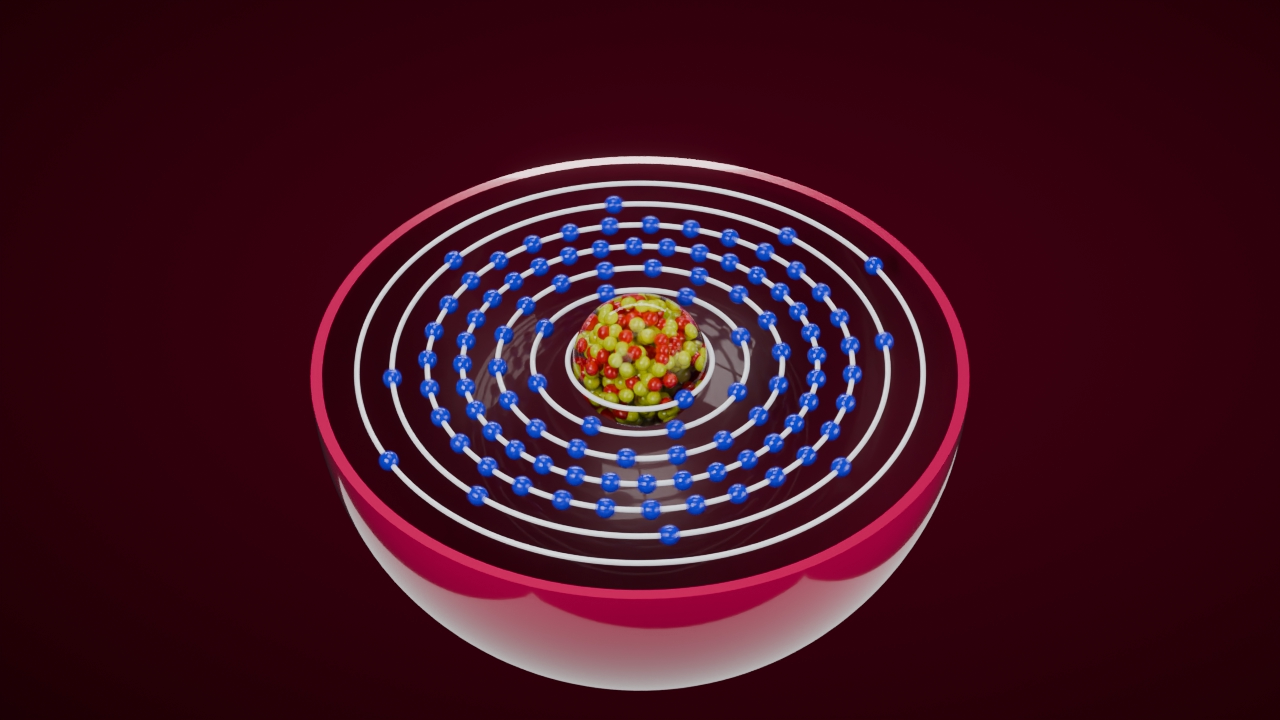
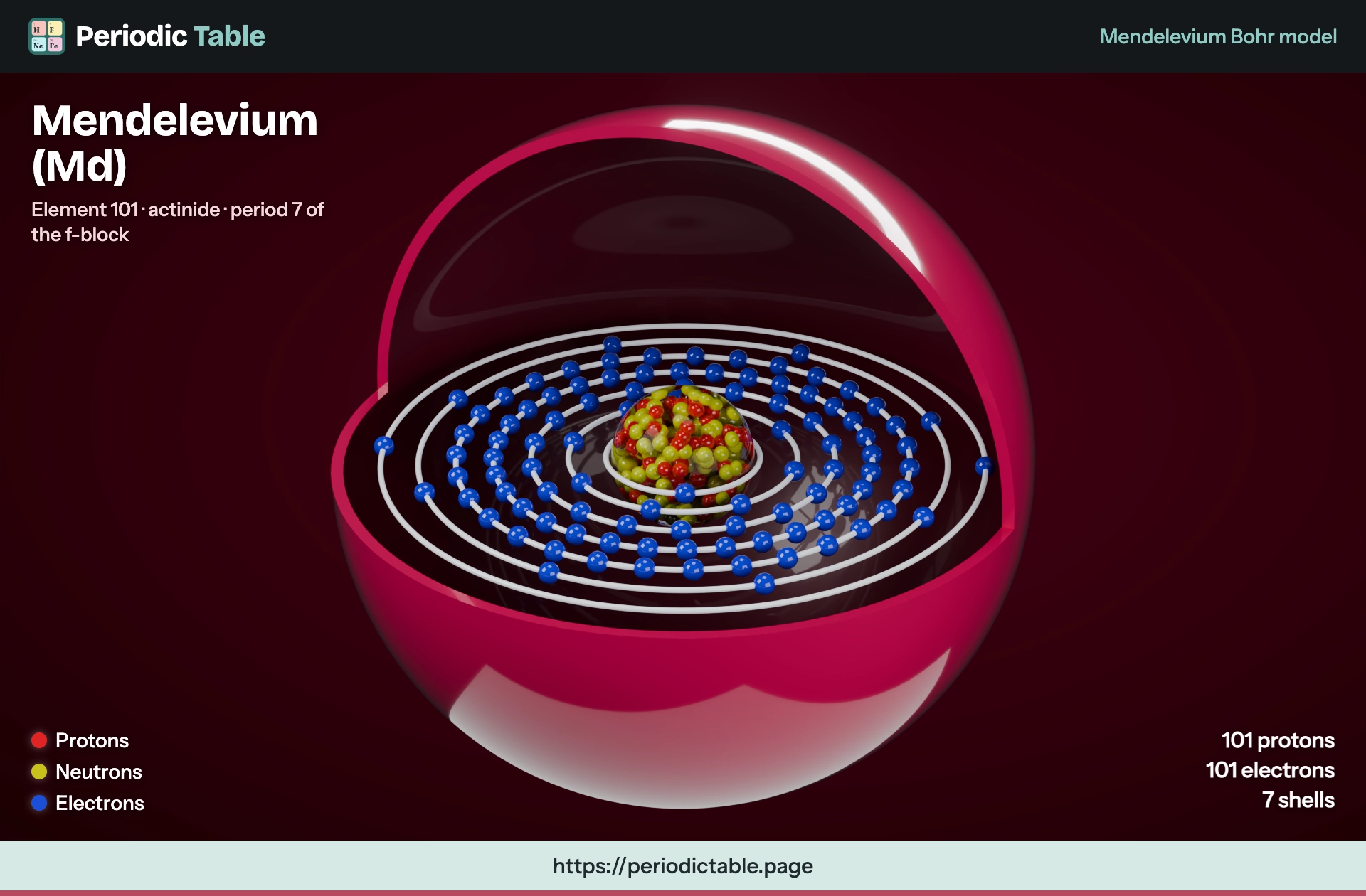
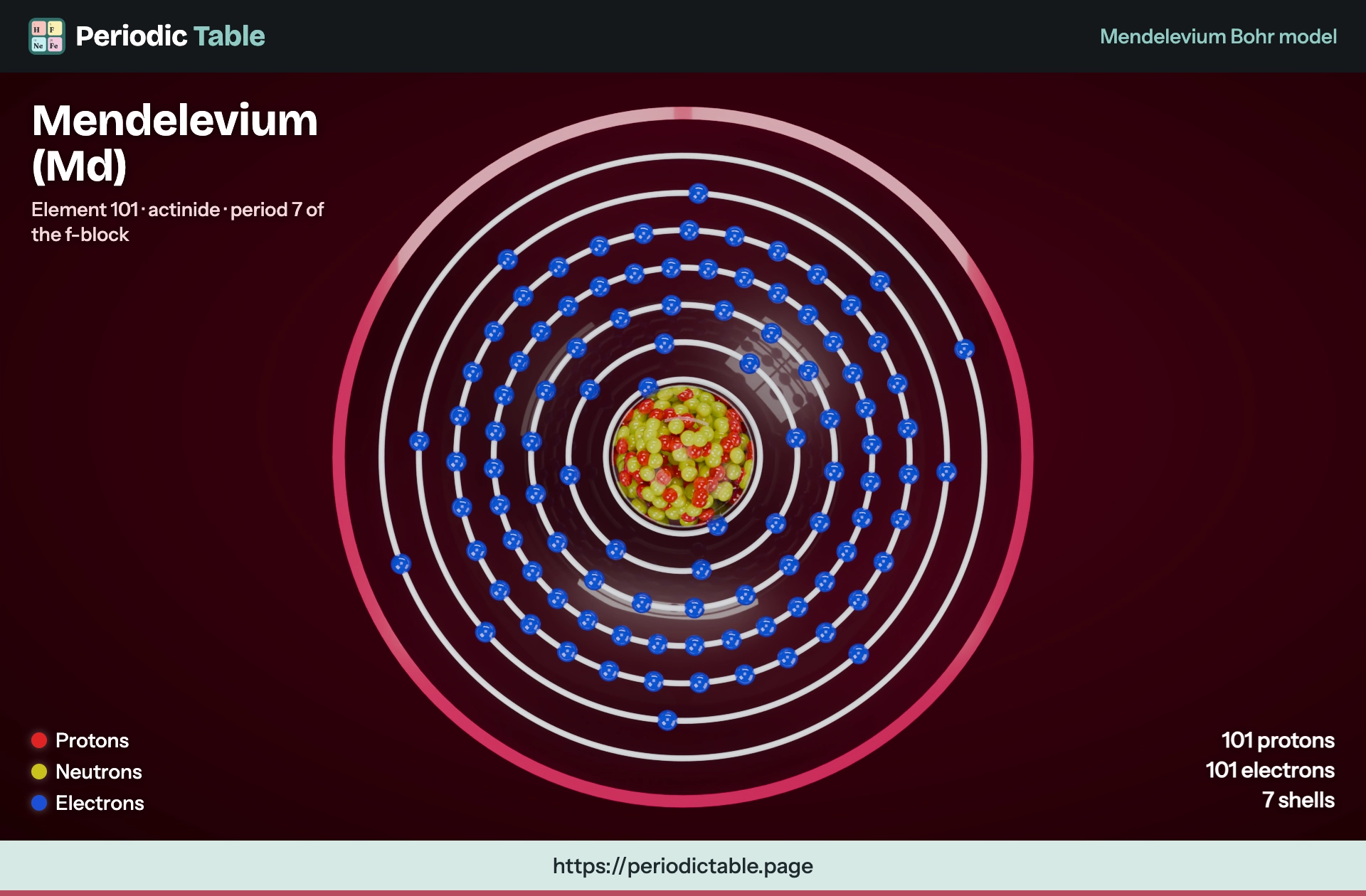
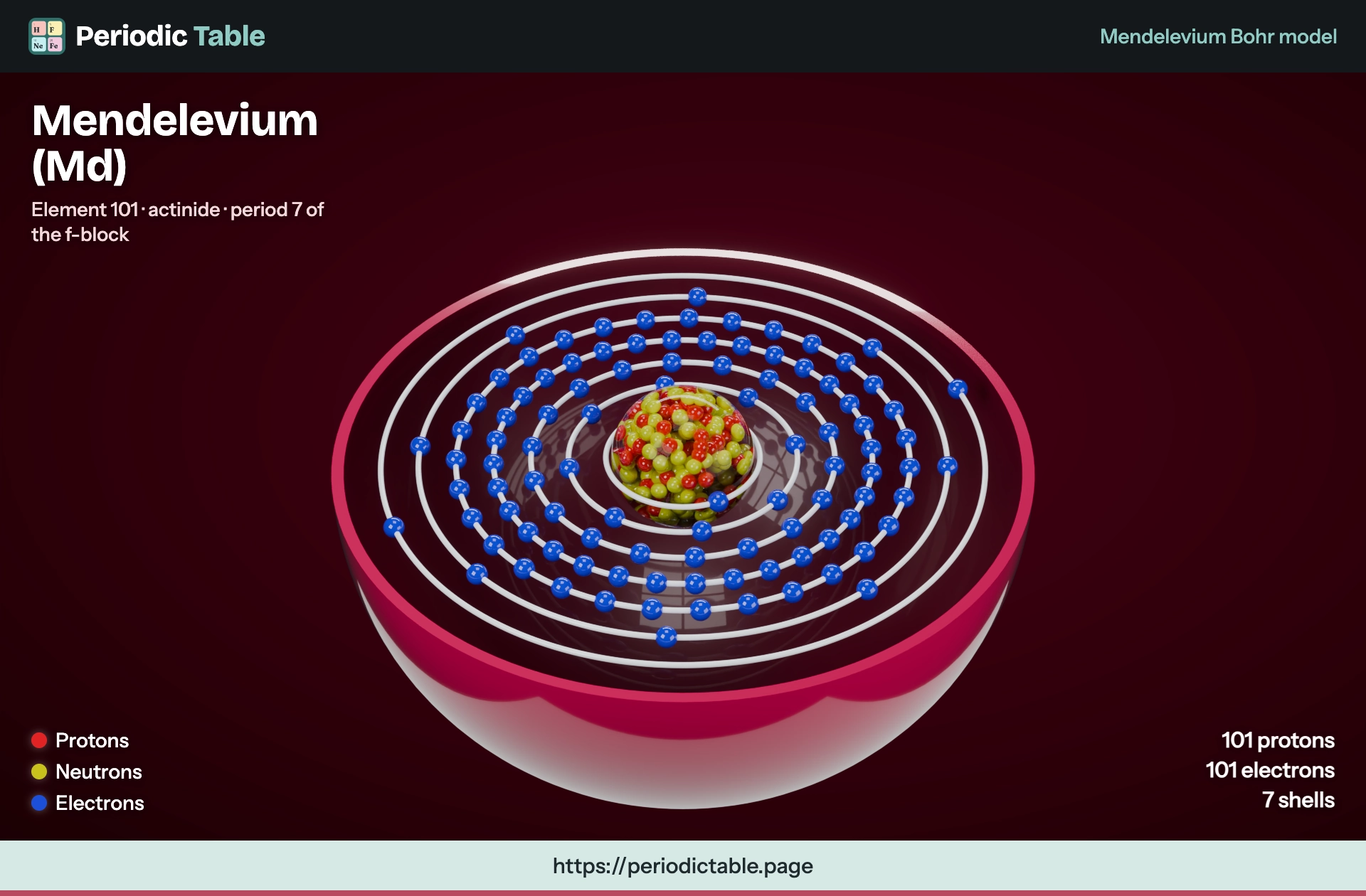
This is a Bohr model of mendelevium (Md), a simplified picture of a single mendelevium atom. Its nucleus holds 101 protons, and a neutral mendelevium atom has 101 electrons, arranged around it in 7 shells (2 in shell K, 8 in shell L, 18 in shell M, 32 in shell N, 31 in shell O, 8 in shell P and 2 in shell Q).
Mendelevium periodic table electron configuration
- Shorthand
- [Rn] 5f13 7s2
- Full
- 1s2 2s2 2p6 3s2 3p6 4s2 3d10 4p6 5s2 4d10 5p6 6s2 4f14 5d10 6p6 7s2 5f13
- Electrons per shell
- 2, 8, 18, 32, 31, 8, 2
Mendelevium element properties and atomic data
- Atomic number
- 101
- Atomic mass
- [258] u
- Phase at STP
- Solid
- Melting point
- 826.85°C (1100 K)
- Boiling point
- Unknown
- Density
- Unknown
- Electronegativity (Pauling)
- 1.3
- Period
- 7
- Group
- —
- Block
- f-block
- Appearance
- Unknown
- Discovery date
- 1955
- Discovered by
- Lawrence Berkeley National Laboratory
- Named by
- —
Mendelevium element facts: electron configuration, melting point and density
Almost every physical number for the mendelevium element is predicted from its neighbours rather than measured, since, unlike most lighter elements, bulk metal has never been prepared. The values below are the ones reference sources agree on, with the measured figures noted as such. On historical prediction, the germanium element write-up links Mendeleev's 1869 prediction of ekasilicon to the mining of ores and the question of toxicity.
| Property | Value |
|---|---|
| Symbol / proton count | Md / 101 |
| Mass number, most stable form | 258 |
| Group, period, block | Actinoid group, period 7, f-block |
| Electron configuration | [Rn] 5f13 7s2 |
| Shell filling | 2, 8, 18, 32, 31, 8, 2 |
| State at 20 °C | Solid (predicted) |
| Melting point | About 800-827 °C (1,100 K), estimated |
| Density | About 10.3 g/cm3, predicted |
| Crystal structure | Face-centered cubic (expected) |
| Electronegativity | 1.3 on the Pauling scale |
| First ionisation energy | About 635 kJ/mol (measured) |
| Covalent radius | 173 pm |
| CAS number | 7440-11-1 |
Read the table as a set of informed expectations. Its proton count and the arrangement of its 101 electrons are fixed by definition, while the bulk figures come from trends across the late actinide row and from trace-level experiments.
Element 101 in the actinide series of the periodic table
Element 101 is the thirteenth member of the actinide series. On the table it sits to the right of fermium (100), to the left of nobelium (102), and directly below the lanthanide thulium. Its nucleus holds 101 protons, and its outer chemistry is set by the 5f electrons, the same subshell that shapes every other actinide. Electronics and the chemical industry use the ruthenium alloy, and the page also covers refining from platinum ores.
Three labels place mendelevium more precisely:
- It is the ninth transuranic element, meaning it lies beyond uranium.
- It is the first transfermium, the first one that cannot be built up by neutron capture in a reactor.
- It is also the first one that cannot be made in weighable, macroscopic amounts at all.
Like other late actinides, it behaves much like its lanthanide partner in the row above, which is why chemists could predict its separation behaviour from the lanthanides long before anyone made it.
The discovery of mendelevium at Berkeley
The discovery of mendelevium came in early 1955 at the University of California, in the lab now known as Lawrence Berkeley National Laboratory. The team was Albert Ghiorso, Glenn Seaborg, Gregory Choppin, Bernard Harvey and team leader Stanley Thompson.
Before starting, the scientists ran a rough estimate of the yield: target atoms times cross section times beam intensity times bombardment time. It came out at roughly one new atom per run.
Alpha particles, einsteinium-253 and the 60-Inch cyclotron
The target was tiny: about 109 atoms of einsteinium-253, bred by irradiating plutonium in a reactor and electroplated onto a thin gold foil. Because einsteinium has a half-life of only about three weeks, the team had a narrow window to use it. They fired 41 MeV alpha particles (helium nuclei) at it in the 60-inch cyclotron, adding two protons to each target nucleus that fused.
Ghiorso's recoil technique did the separating. The target faced away from the beam, so each newly formed product recoiled out of the foil and was caught on a second gold catcher foil behind it, leaving the precious target material in place for the next run.
Seventeen atoms traced by spontaneous fission
On 19 February 1955 the catcher foils were dissolved, passed through ion-exchange columns, and driven up the hill to the Radiation Laboratory. A cation-exchange column with α-hydroxyisobutyric acid separated the mendelevium atoms from leftover target material.
The atoms were not seen directly. Mendelevium-256 turns into fermium-256 by electron capture, and that daughter splits by spontaneous fission, which the detectors recorded as large pen deflections.
It was the first time a new element had been identified one atom at a time. Over the whole campaign, seventeen atoms were detected. The discovery was announced at the end of April 1955, and the full result appeared in Physical Review that June.
Ghiorso and Seaborg's group went on to make more than a dozen new elements by similar methods. A press release at the time described those 17 atoms as perhaps the rarest units of matter on Earth.
Why the Md symbol honors Dmitri Mendeleev
As the first of the second hundred elements, the 101st element was named for Dmitri Mendeleev, the Russian chemist widely called the father of the periodic table. Seaborg's team had relied on Mendeleev's method of predicting an element's chemistry from its position in the periodic table throughout their transuranium work, so the choice felt natural to them.
It was also a bold one. Because the discovery fell in the middle of the Cold War, Seaborg had to ask the United States government for permission to propose a Russian name, and it was granted.
IUPAC accepted the name in 1955 with the symbol Mv, then changed it to Md at its 1957 General Assembly in Paris. The pairing has a neat symmetry: Mendeleev got his namesake, and Seaborg later got seaborgium, number 106.
Transuranium elements, the fermium gap and atomic number 101
The road to mendelevium ran through the transuranium elements. Uranium, at 92, is the heaviest element found in quantity on Earth; everything beyond it had to be made. Through the 1940s, Berkeley built neptunium, plutonium and their successors mostly by soaking targets in neutrons and waiting for beta emission to raise the proton count one step at a time.
In 1952 the Ivy Mike thermonuclear test produced elements 99 and 100 in its debris, showing how far heavy neutron capture can reach. It stops there. Fermium-258 splits almost instantly, and none of its neighbours beta-decays upward.
This barrier, the fermium gap, is why number 101 had to come from a charged-particle beam, and why everything heavier since has been made in an accelerator. The physics of that wall shaped how all heavy elements past number 100 are hunted today.
Physical and chemical properties of mendelevium
With so few atoms to work with, the chemistry of mendelevium is studied almost entirely in solution, and its chemical properties are inferred from how single atoms move through separation columns.
Predicted physical properties of mendelevium metal
The physical properties of mendelevium metal remain largely theoretical, because it cannot be produced in macroscopic quantities. Calculations from 1975 suggested that, like its two lighter neighbours, it should form a divalent metal, closer to europium and ytterbium than to most actinides.
Thermochromatography with trace amounts between 1976 and 1982 backed this up. In 1990 its enthalpy of sublimation was put at 134-142 kJ/mol, and its metallic radius should be about 194 pm.
Oxidation states in aqueous solution
In aqueous solution the +3 oxidation state dominates, so mendelevium(III) behaves like other trivalent actinides. It forms insoluble hydroxides and fluorides that coprecipitate with trivalent lanthanide salts, and it forms complexes with DCTA.
Under reducing conditions the +2 oxidation state becomes easy to reach, and mendelevium(II) stays stable in water. The Md3+/Md2+ reduction potential was measured in 2013 at -0.16 ± 0.05 V.
- +3
- Most stable in water; no pure solid compounds have been isolated.
- +2
- Reached with mild reducing agents; elutes like strontium(II) and europium(II).
- +1
- Reported by a Russian team in 1973, never confirmed.
Atomic structure and ionic radius
A neutral atom carries 15 valence electrons in the 5f and 7s subshells. Losing three leaves a [Rn] 5f12 core, matching the pattern of other tripositive actinides. The ionic radius of six-coordinate Md3+ is about 89.6 pm, a little smaller than fermium's, while Md2+ should be around 115 pm.
Isotopes of mendelevium by half-life
Seventeen isotopes of mendelevium are known, with mass numbers from 244 to 260, and every one is radioactive. The longest-lived isotope is mendelevium-258, with a half-life of 51.6 days. It is the last element with any isotope that survives longer than a day.
| Mass number | Half-life | Main mode |
|---|---|---|
| 256 | 77.7 minutes | Electron capture (about 90%), alpha decay (about 10%) |
| 257 | 5.52 hours | EC, alpha |
| 258 | 51.6 days | Alpha |
| 259 | 1.60 hours | Splits apart |
| 260 | 27.8 days | Fission |
Half-lives of the mendelevium isotopes rise with mass up to 258, then fall as fission takes over as the decay mode. Lab work still favours the 256 form despite its 77.7 minutes lifetime, because it can be made in larger amounts from common einsteinium targets. To put those clocks in perspective: after one day, only about 0.0003% of a 256Md sample is left, while a 258Md sample keeps about 0.74% after a full year.
How mendelevium is produced and isolated today
Mendelevium production still follows the 1955 route. The useful forms from 254 to 258 come from firing helium nuclei at einsteinium of mass 253, 254 or 255; the 254 form is preferred because it lasts longer as a target.
From microgram amounts of einsteinium, a lab can make over a million atoms an hour, which still adds up to femtograms. Lighter isotopes come from bombarding bismuth with argon ions, or plutonium and americium with carbon and nitrogen ions.
Separating Md from neighbouring actinides
Recoiling atoms are caught on a thin foil or swept away in a gas jet, then purified. Common steps include coprecipitation with lanthanum fluoride, dissolving a gold foil in aqua regia, and selective elution from a cation-exchange resin with ammonium α-HIB.
An alternative is solvent extraction chromatography with HDEHP and nitric acid. A cleaner trick reduces it to the +2 state so it stays in the hydrochloric acid while the trivalent actinides stick to the column.
Mendelevium in scientific research and safety
Mendelevium has no commercial or industrial uses. Its value lies entirely in scientific research: testing how relativistic effects bend periodic trends, refining models of nuclear structure, and improving predictions for still heavier elements. Reference pages from Los Alamos and other labs list it for exactly that reason.
Exposure limits for mendelevium-258
Few people ever come near it, but the ICRP still sets annual exposure limits for its most stable isotope. For the 258 form, the ingestion limit is 9 × 10⁵ becquerels, only about 2.48 ng, and the inhalation limit is 6,000 Bq, about 16.5 pg. By our own calculation, a single nanogram would emit roughly 363,000 alpha particles every second.