


Germanium element (Ge): germanium periodic table facts
Germanium periodic table facts: germanium (Ge) is element 32, a metalloid in group 14, period 4. If you have ever wondered why an element named after a country ended up inside the first transistors and today's thermal cameras, germanium is the place to start. Germanium (symbol Ge, atomic number 32) is a hard, lustrous, grayish-white metalloid that sits between metal and nonmetal, and it was the first chemical element to prove a periodic prediction right: Dmitri Mendeleev described it in 1869, years before anyone held a sample, and its discoverer later named it after Germany. Clean energy and industry both lean on the hydrogen atom, which sets out how the gas behaves in chemical reactions.
Rotate the 3D Bohr model of germanium
Drag to orbit, scroll to zoom.
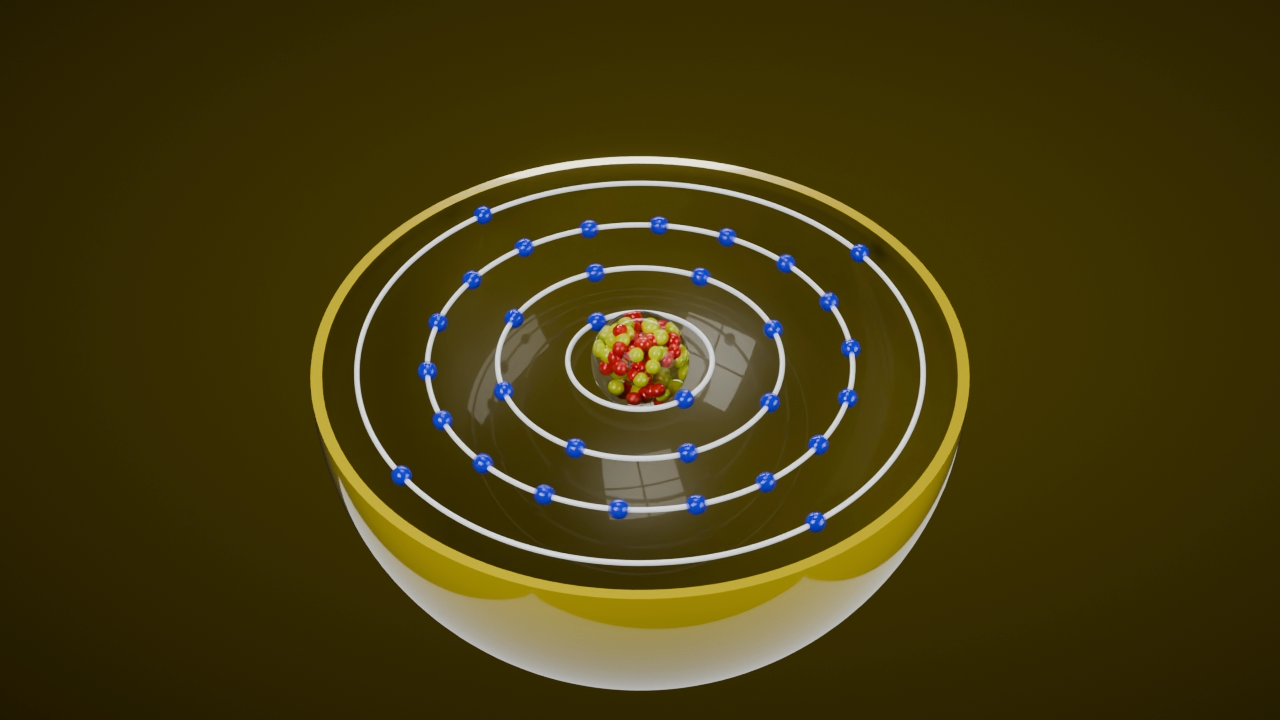
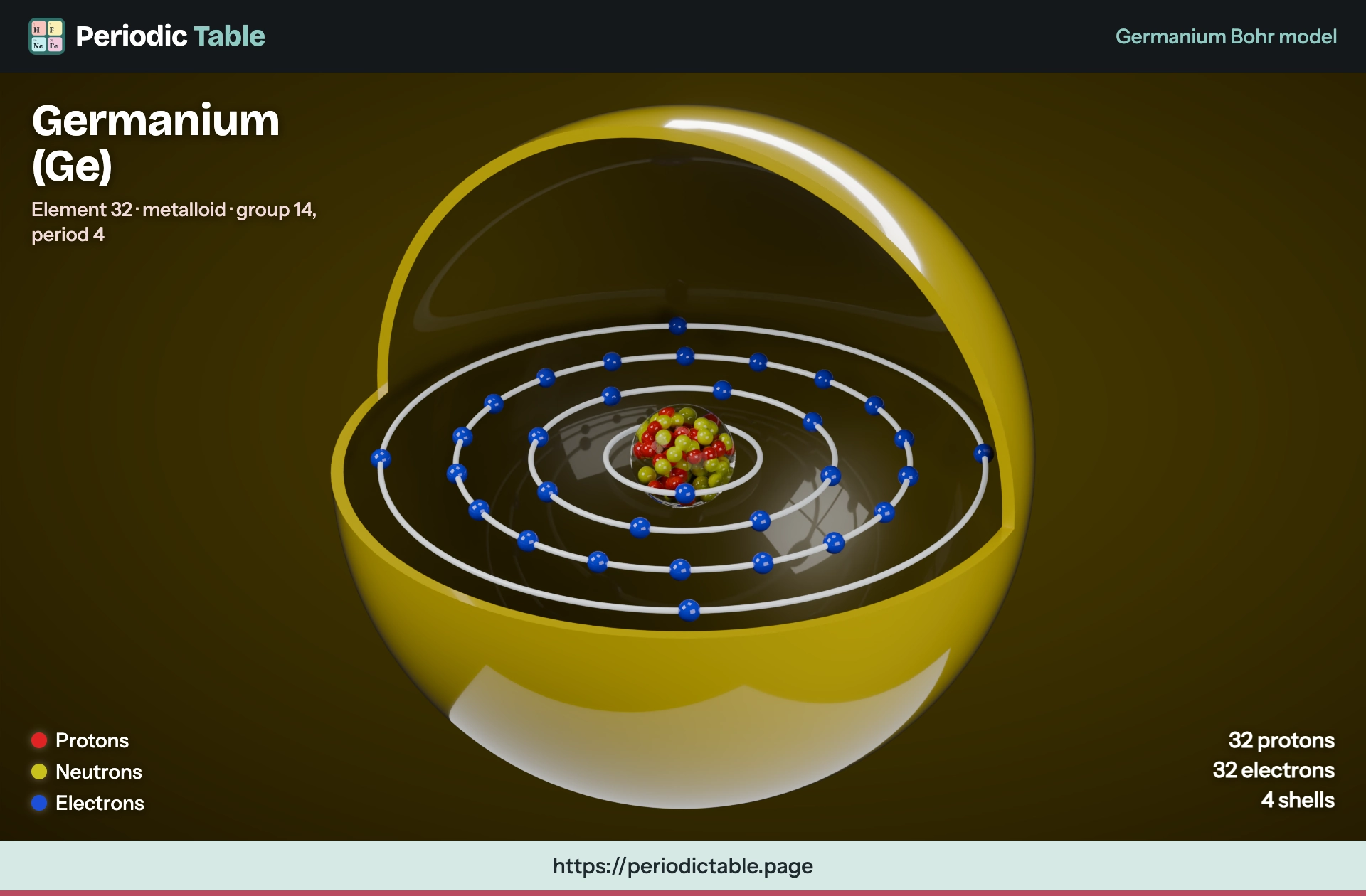
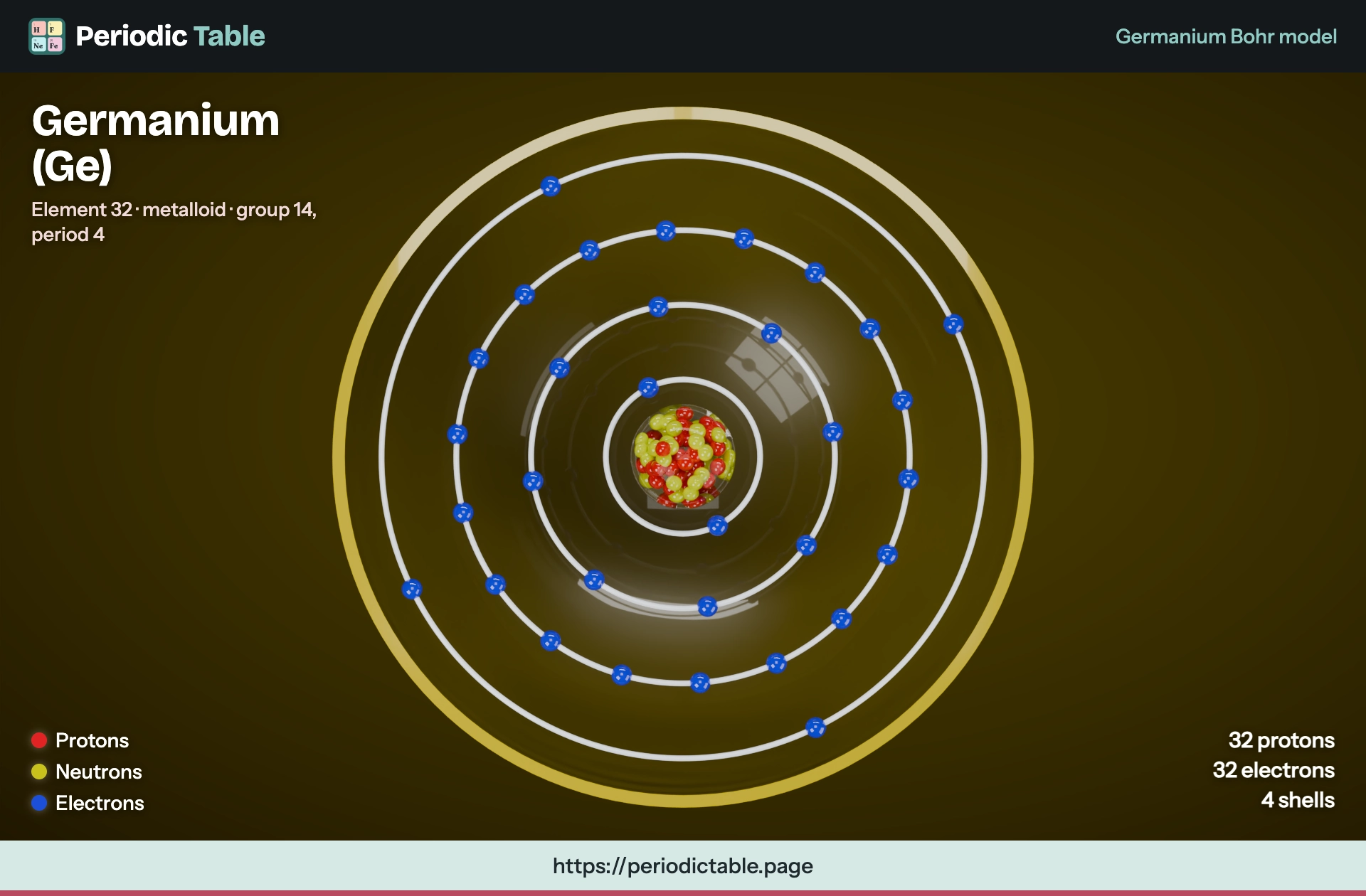
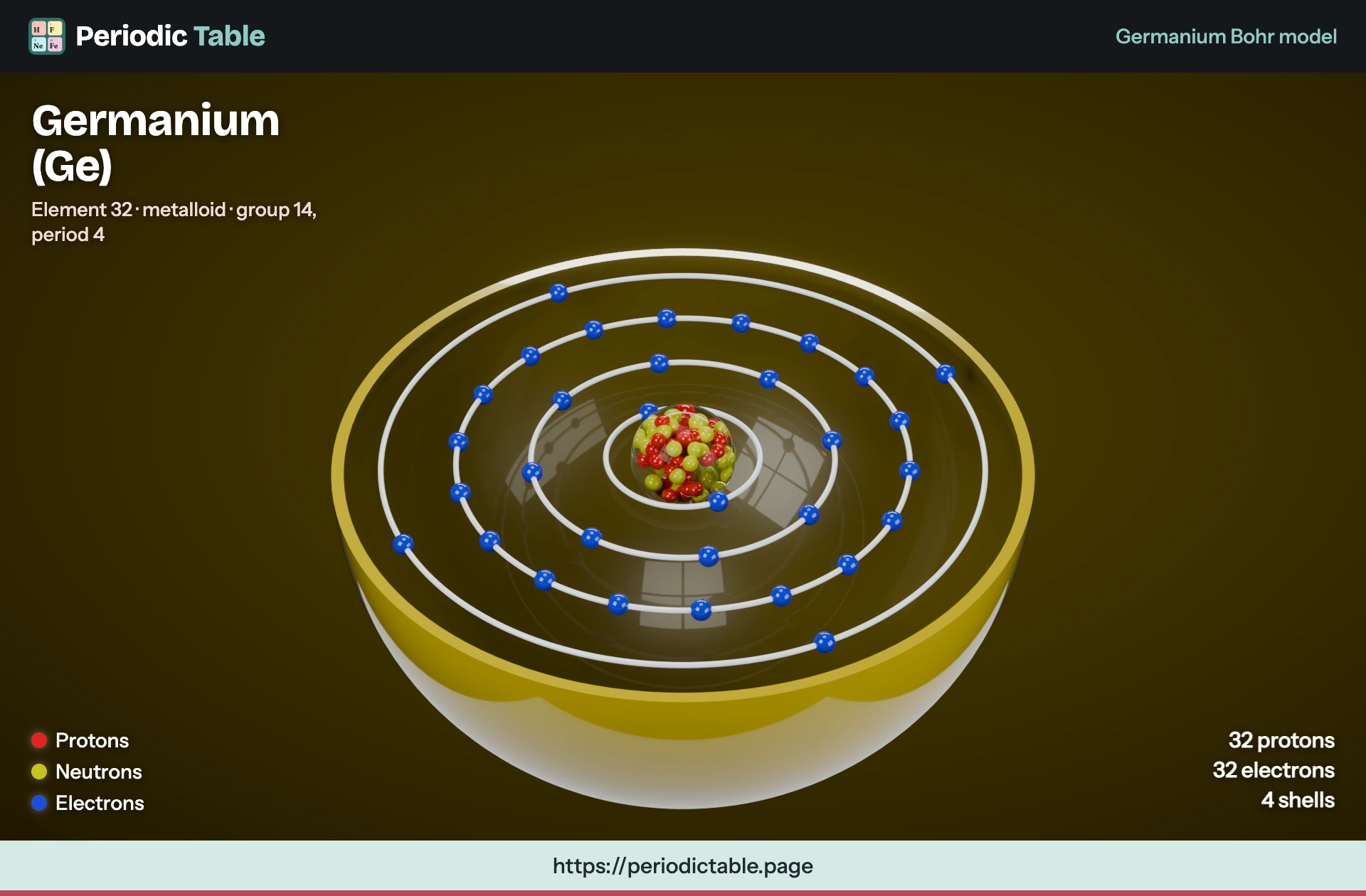
This is a Bohr model of germanium (Ge), a simplified picture of a single germanium atom. Its nucleus holds 32 protons, and a neutral germanium atom has 32 electrons, arranged around it in 4 shells (2 in shell K, 8 in shell L, 18 in shell M and 4 in shell N).
Germanium periodic table electron configuration
- Shorthand
- [Ar] 3d10 4s2 4p2
- Full
- 1s2 2s2 2p6 3s2 3p6 4s2 3d10 4p2
- Electrons per shell
- 2, 8, 18, 4
Germanium element properties and atomic data
- Atomic number
- 32
- Atomic mass
- 72.6308 u
- Phase at STP
- Solid
- Melting point
- 938.25°C (1211.4 K)
- Boiling point
- 2832.85°C (3106 K)
- Density
- 5.323 g/cm³
- Electronegativity (Pauling)
- 2.01
- Period
- 4
- Group
- 14
- Block
- p-block
- Appearance
- Grayish-white
- Discovery date
- 1886
- Discovered by
- Clemens Winkler
- Named by
- —
Germanium facts at a glance: atomic mass, density and melting point
The table below gathers the reference values you will most often need for the element germanium. Values are for the stable alpha form at room temperature unless stated, and they come from standard chemistry data tables rather than from any single measurement. In the discovery story, Bernard Courtois, Gay-Lussac and Humphry Davy each play a part, as told in the iodine atomic weight in plain words.
| Property | Value |
|---|---|
| Symbol and atomic number | Ge, 32 |
| Standard atomic mass | 72.630 ± 0.008 |
| Density (20 °C) | 5.327 g/cm3 |
| Melting point | 938.25 °C (1211.4 K) |
| Boiling point | 2833 °C (3106 K) |
| Electronegativity (Pauling scale) | 2.01 |
| Atomic radius (empirical) | 122 pm |
| Covalent radius | about 120-122 pm |
| Van der Waals radius | 211 pm |
| Specific heat capacity | about 320 J/(kg·K) |
| Thermal conductivity | 60.2 W/(m·K) |
| Electrical resistivity (20 °C) | roughly 1 Ω·m for intrinsic material |
| Magnetic behaviour | Diamagnetic |
| CAS number | 7440-56-4 |
Two numbers in that table explain most of how the element is handled in practice. Its melting temperature is modest for a hard solid, so it can be melted, cast and grown into single crystals in ordinary furnaces, and its resistivity sits millions of times above copper and millions of times below glass, which is the signature of a semiconducting material.
Element 32 in group 14, the carbon group of the periodic table
Element 32 lives in group 14, period 4 and the p-block of the periodic table. Above it sits silicon and above that carbon; below it come tin and then lead.
Its row neighbours are gallium on the left and arsenic on the right. That column runs from a nonmetal at the top to soft metal at the bottom, and germanium lands right at the turning point, which is why it shares the diamond-like crystal of the lighter members yet looks shiny like the heavier ones.
Electron configuration and ionization energies of Ge
The ground-state electron configuration is [Ar] 3d10 4s2 4p2, with 2, 8, 18 and 4 electrons per shell. The four outermost ones are what atoms of the element share in bonds, giving the familiar +4 state.
The first three ionization energies are about 762, 1537.5 and 3302.1 kJ/mol, and the electron affinity is close to 119 kJ/mol. The big jump after the fourth removal shows how firmly the filled 3d shell holds on.
Physical properties of germanium and its crystal structure
At room temperature the element is brittle, silvery-white and metallic-looking, with a Mohs hardness of about 6.0, so it shatters like glass rather than bending like a metal. Its normal form, α-germanium, is an allotrope with a diamond cubic crystal structure, the same arrangement found in diamond, with a lattice constant near 565.8 pm. Readers tracing the Manhattan Project and Los Alamos will find how this radioactive actinide fits that story in the isotopes of mendelevium and its background section.
Squeeze it above roughly 120 kbar and it converts to β-germanium, a metallic phase with a body-centred tetragonal lattice. It also belongs to a short list of substances, alongside water and bismuth, that expand when the liquid freezes. Crystalline germanium is stable in air and water at room temperature and is not attacked by dilute acids or alkalis, which makes polished optical parts long-lived.
Band gap: why germanium behaves as a semiconductor
A semiconductor is a material whose ability to carry current lies between a conductor and an insulator and can be changed by doping, heat or light. Germanium's band gap is an indirect 0.67 eV at 300 K, about 60% of silicon's, so less energy is needed to free charge carriers. That small gap gives fast carriers and a low turn-on voltage, but it also means more leakage current as the temperature climbs.
Purity matters enormously here. Zone refining can bring pure germanium to roughly one impurity atom in 1010, making it one of the purest materials ever produced. One quirk of the pure metal is germanium whiskers: thin filaments that grow out of the surface over years and once caused short circuits in old components.
Germanium chemistry and oxidation states
In its chemistry the element mostly takes the +4 oxidation state, with a smaller family of +2 compounds; rarer oxidation states run from −4 in germanides such as Mg2Ge up to +3 and +1 on oxide surfaces. Elemental germanium starts to oxidise slowly in air at about 250 °C. It ignores dilute acids, dissolves slowly in hot concentrated sulfuric acid and nitric acid, and reacts with molten alkalis to form germanates.
Two oxides exist: the dioxide GeO2 and germanium monoxide, GeO, made by heating the dioxide with the element. The white oxide powder is barely soluble in water. Germanium oxide glass combines a high refractive index in visible light with transparency in the infrared, which is the root of most optical uses described below.
Germanium dioxide, germanium tetrachloride and organogermanium compounds
Germanium dioxide is the hub compound: ore processing produces it and metal production starts from it. Germanium tetrachloride, GeCl4, is a colourless fuming liquid that boils at about 83 °C and is made by heating the metal with chlorine. Germanium disulfide, GeS2, drops out as a white precipitate when hydrogen sulfide is bubbled through strongly acidic solution, and that insolubility is exactly what let the element be isolated in the first place.
Germane, GeH4, is the methane analogue. Organogermanium compounds began with tetraethylgermane in 1887, and germanium compounds such as bismuth germanate (Bi4Ge3O12) now serve as a dense scintillator crystal that flashes when struck by gamma rays.
Natural isotopes of germanium
The natural element is a mix of five isotopes. Four are stable; the fifth, 76Ge, is very slightly radioactive and decays by double beta decay to selenium-76 with a half-life near 2 × 10²¹ years, over a hundred billion times the age of the universe.
| Isotope | Mass (u) | Natural abundance | Status |
|---|---|---|---|
| 70Ge | 69.924 | about 20.5% | Stable |
| 72Ge | 71.922 | about 27.4% | Stable |
| 73Ge | 72.923 | about 7.8% | Stable, the only one usable for NMR |
| 74Ge | 73.921 | about 36.5% | Stable, most common |
| 76Ge | 75.921 | about 7.75% | Double beta decay, ~2 × 10²¹ y |
Among the 27 or more synthetic radioisotopes, 68Ge lasts longest at about 271 days. It decays by electron capture to Ga-68, which is why hospitals use Ge-68 generators to make short-lived tracers on site. Physicists also grow detectors from enriched 76Ge to hunt for a still-unseen neutrinoless form of its decay.
History of Ge: from ekasilicon to Winkler's argyrodite
In 1869 Mendeleev left a gap in his periodic table between silicon and tin and called the missing element ekasilicon, predicting an atomic weight of about 72, a grey colour, a high melting temperature and a dense dioxide. In 1885 miners near Freiberg in Saxony found a silver-rich mineral, named argyrodite. The chemist Clemens Winkler found that about 7% of its mass belonged to no known element, and on 6 February 1886 he isolated it.
Winkler first wanted to call it neptunium, since Neptune had also been predicted before it was seen, but that name was already claimed. He chose germanium, from Germania, the Latin name for his homeland. The mineral turned out to be Ag8GeS6.
How well the eka-silicon prediction held up
Winkler at first suspected an eka-antimony, but the measured values matched eka-silicon closely: an atomic weight near 72.3 against the predicted 72, a measured 5.35 g/cm3 against the forecast 5.5, and an oxide and a volatile chloride with the predicted properties. The match turned periodicity from a clever arrangement into a working scientific tool.
Where germanium comes from: sphalerite, coal and other ores
The element averages about 1.3-1.6 ppm in the Earth's crust, more common than silver but scattered in trace amounts instead of forming its own deposits. Only a handful of minerals carry real concentrations, and none forms large deposits of its own:
- Zinc minerals: sphalerite can hold up to about 0.3% and supplies most of the world's metal as a by-product.
- Rare germanium minerals: germanite, renierite and briartite, plus Winkler's original silver mineral.
- Coal: some seams, especially lignite, concentrate it naturally, and the fly ash left after burning is a recovery source.
In the cosmos it is built by stellar nucleosynthesis, mainly the slow neutron-capture s-process in ageing giant stars, and it has been detected in Jupiter's atmosphere and distant stars.
Germanium production from ore to metal
Because it rides along with zinc, copper and silver ores, germanium production starts at zinc smelters rather than with dedicated mining. Sulfide concentrates are first oxidised by roasting:
$$\mathrm{GeS_2 + 3\,O_2 \rightarrow GeO_2 + 2\,SO_2}$$The oxide is leached, precipitated and treated with hydrochloric acid to give the volatile chloride, which is purified by fractional distillation and then hydrolysed back to a very clean dioxide. Reduction with hydrogen gives germanium metal, and zone refining follows for detector or optical grades:
$$\mathrm{GeO_2 + 4\,HCl \rightarrow GeCl_4 + 2\,H_2O \qquad GeO_2 + 2\,H_2 \rightarrow Ge + 2\,H_2O}$$The distillation step is the key separation, because the chloride boils far below most metal chlorides it is mixed with.
Who supplies the world's germanium
China refines the large majority of the world's supply, with Russia, Canada and a few others well behind, and about a third of demand is often met by recycled scrap from lens grinding and wafer manufacturing. Governments treat it as a strategic and critical material: the US once stockpiled it for defence, and China's 2023 export licensing rules for germanium sent prices up and pushed the thermal-imaging industry to secure other sources.
Uses of germanium in electronics, imaging and communications
The element's value comes from two traits: it is a high-mobility semiconducting crystal, and it lets long-wave infrared through while blocking visible light. Almost every application below uses one or the other.
Germanium transistors and diodes
The element sat unused for decades, then World War II made it valuable: point-contact detector diode crystals made from it were used in radar receivers. The first transistor, built at Bell Labs in late 1947, was a germanium transistor, and through the 1950s and 1960s germanium devices powered transistor radios, early computers and the first wave of consumer electronics, opening the solid state era.
Silicon took over once it could be purified well enough, thanks to lower leakage and a stable native oxide. Today the element returns in SiGe chips for fast radio-frequency circuits, and vintage germanium parts remain prized in guitar fuzz pedals for their soft clipping.
Infrared optics, night vision and fiber optics
For infrared work, Ge is close to ideal: it transmits from about 2 to 14 µm and has a refractive index near 4.0, so a thin element bends infrared light strongly. That is why camera lenses for thermal imaging and night vision are often dark, mirror-like germanium discs. One caveat: above roughly 100 °C the material absorbs more infrared radiation and can run away thermally, so hot-environment optics need cooling or a different material.
In fibre optics, a germanium-doped silica core traps light inside the fiber-optic cables that carry most long-distance internet and phone traffic. Cooled high-purity crystals also make gamma-ray spectroscopy detectors used in labs and at airport security for radiation screening.
Solar cells, polymerization catalysts and alloys
High-efficiency multi-junction solar cells for satellites and other space applications are grown on Ge wafers, whose lattice matches gallium arsenide layers. GeO2 is also a polymerization catalyst for making polyethylene terephthalate (PET), the polyester in bottles and fibres, mostly in Asia. Smaller uses include light-emitting diodes (LEDs), research nanowires, optical glass and alloys with gold, silver and other metals for dental, jewellery and solder work.
Germanium vs silicon: bandgap compared with other semiconductor materials
Comparing it with the common alternatives shows why germanium kept its niche in photovoltaics and fast circuits while its lighter neighbour won mainstream chips. The values below are typical room-temperature figures for pure crystals.
| Material | Bandgap (eV) | Electron mobility (cm²/V·s) | Melting temperature (°C) | Where it wins |
|---|---|---|---|---|
| Germanium | 0.67 | ~3,900 | 938 | Infrared detection, space solar substrates |
| Silicon | 1.12 | ~1,400 | 1,414 | Low cost, low leakage, mainstream chips |
| Gallium arsenide | 1.42 | ~8,500 | 1,238 | Microwave circuits, lasers |
| Gallium nitride | 3.4 | ~1,000 | decomposes | Power switching, blue LEDs |
Charge carriers in germanium move nearly three times faster than in Si, but its narrow gap means more leakage when hot, and the lighter element's native oxide makes chip fabrication far simpler.
Is germanium toxic? health and safety
Germanium is not an essential element for any known organism; the human body carries only a trace, and it is not among the minerals your diet needs. The metal and its natural compounds are poorly soluble, so ordinary handling of lenses or wafers poses little toxicity risk. Some reactive forms are hazardous: germane is a toxic gas, and the halides are corrosive irritants that need fume-hood handling.
The real health concern is supplements. Organic forms sold as a dietary supplement, promoted with unproven claims about boosting the immune system, have been linked to kidney failure and deaths, because soluble salts are nephrotoxic. Regulators in several countries restrict these products, and there is no recognised medical need to take germanium at all.