Iodine element (I): iodine periodic table facts
Iodine periodic table facts: iodine (I) is element 53, a halogen in group 17, period 5. Hold a few grey-black flakes of iodine in a warm flask and you will see them give off a violet haze without ever turning to liquid. When a class needs protium, deuterium, tritium and heavy water side by side, students checking hydrogen properties will find them together.
Iodine (I) is the chemical element with symbol I and atomic number 53, a lustrous, non-metallic halogen that your body treats as an essential nutrient for making thyroid hormones. Below you will find its core data, how it behaves, where it comes from, what it is used for and how much of it you actually need.
Rotate the 3D Bohr model of iodine
Drag to orbit, scroll to zoom.
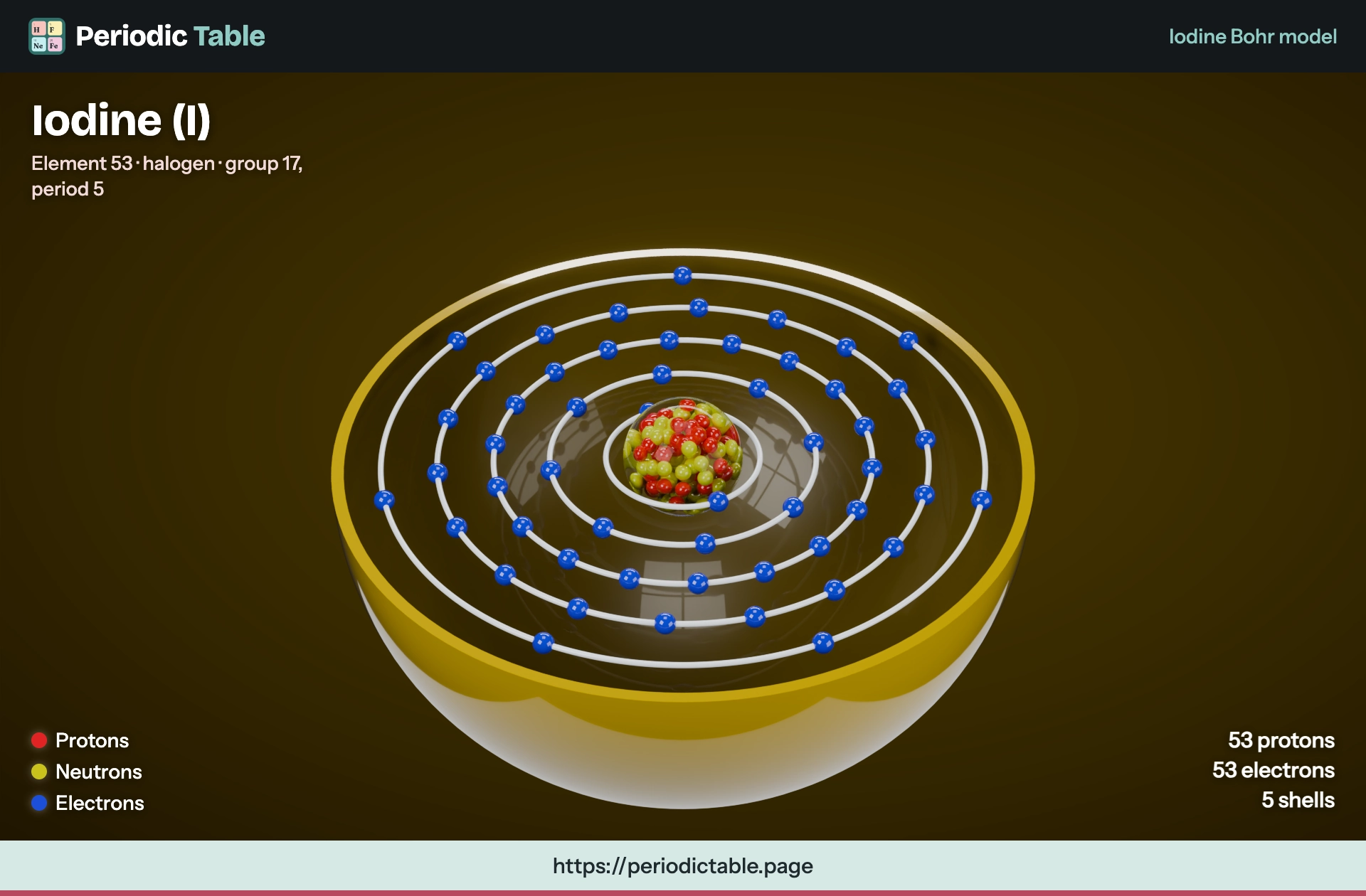
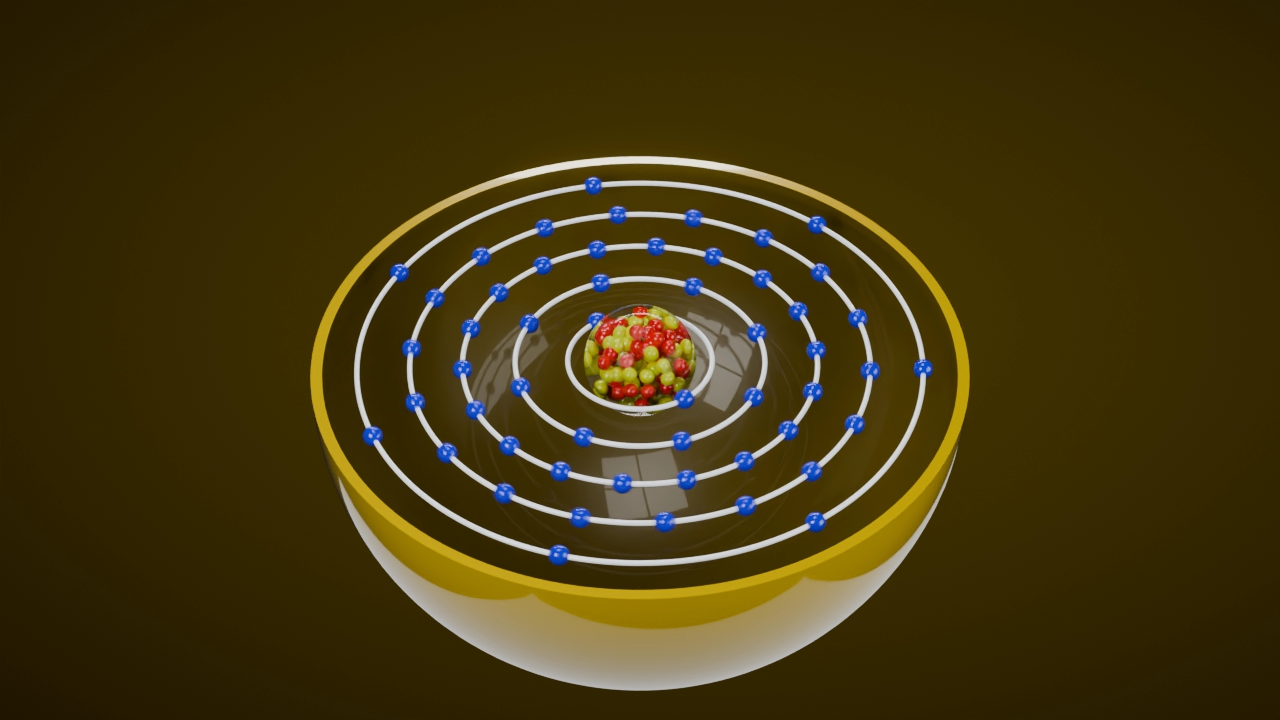
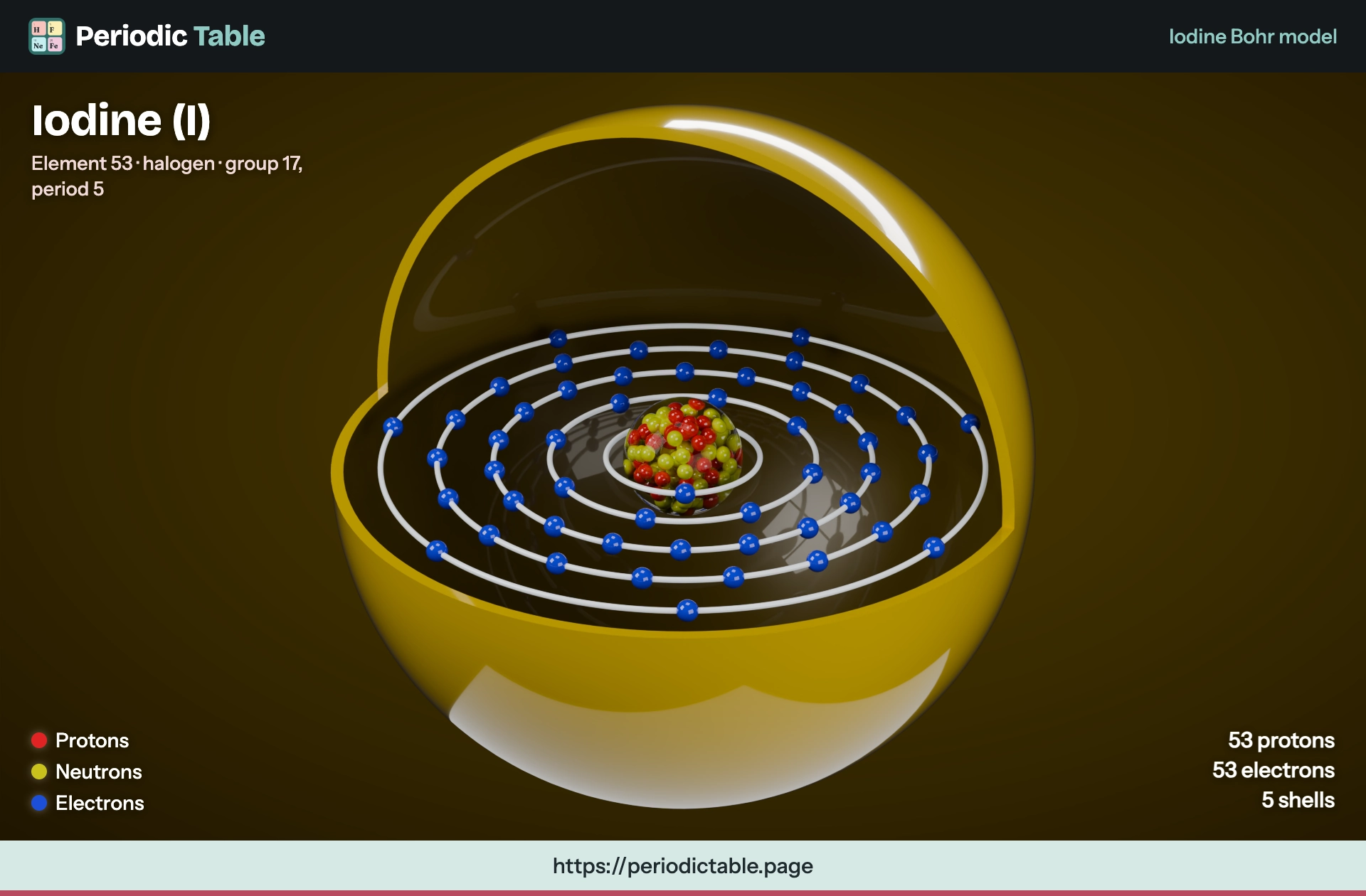
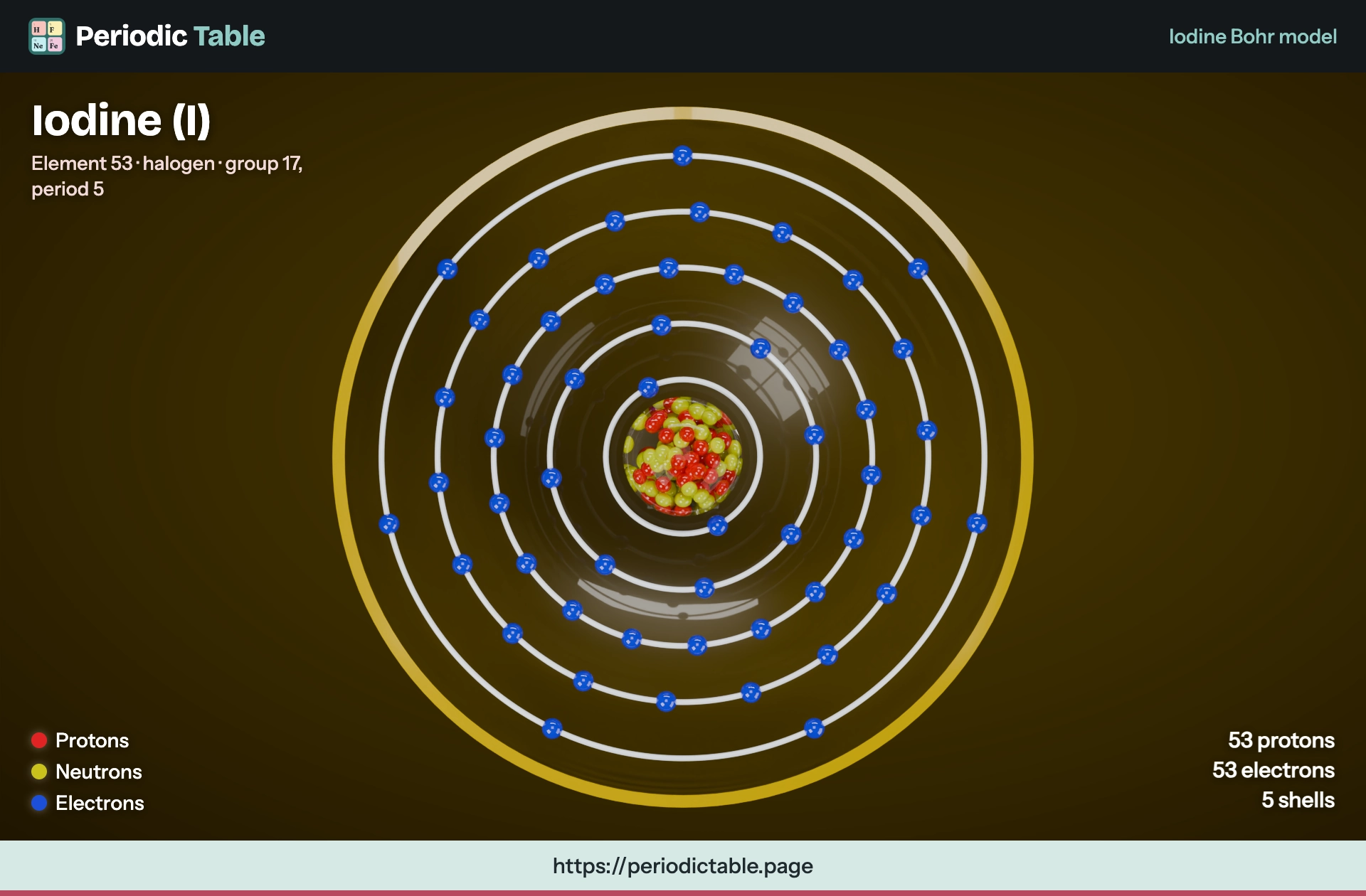
This is a Bohr model of iodine (I), a simplified picture of a single iodine atom. Its nucleus holds 53 protons, and a neutral iodine atom has 53 electrons, arranged around it in 5 shells (2 in shell K, 8 in shell L, 18 in shell M, 18 in shell N and 7 in shell O).
Iodine periodic table electron configuration
- Shorthand
- [Kr] 4d10 5s2 5p5
- Full
- 1s2 2s2 2p6 3s2 3p6 4s2 3d10 4p6 5s2 4d10 5p5
- Electrons per shell
- 2, 8, 18, 18, 7
Iodine element properties and atomic data
- Atomic number
- 53
- Atomic mass
- 126.9045 u
- Phase at STP
- Solid
- Melting point
- 113.7°C (386.85 K)
- Boiling point
- 184.25°C (457.4 K)
- Density
- 4.933 g/cm³
- Electronegativity (Pauling)
- 2.66
- Period
- 5
- Group
- 17
- Block
- p-block
- Appearance
- Lustrous metallic gray, violet as a gas
- Discovery date
- 1811
- Discovered by
- Bernard Courtois
- Named by
- —
Iodine element at a glance: key facts about element 53
Element 53 sits in group 17 of the periodic table, period 5, in the p-block, between tellurium on its left and xenon on its right. At STP the iodine element is a purple-black solid with a metallic sheen, built from diatomic I2 molecules rather than single atoms. To understand alpha emitter behavior and the half-life of Po-210, read the polonium element for a full explanation.
Like the other elements in its column, it is a reactive non-metal, and of all the stable members of its family it is the heaviest, the least reactive and the only one that is a solid at room temperature. The table collects the published reference values you are most likely to look up.
| Property | Value for iodine |
|---|---|
| Symbol and atomic number | I, 53 |
| Standard atomic weight | 126.904 47 |
| Group, period, block | Group 17 (halogens), period 5, p-block |
| Electron configuration | [Kr] 4d10 5s2 5p5 |
| Phase at room temperature | Solid, made of I2 molecules |
| Melting point of I2 | 113.7 °C (386.85 K) |
| Boiling point of I2 | 184.3 °C (457.4 K) |
| Density at 20 °C | 4.93 g/cm3 |
| Electronegativity (Pauling) | 2.66 |
| Common oxidation states | −1, +1, +3, +5, +7 |
| Stable isotopes | One: iodine-127 (100% of natural iodine) |
| Discovered | 1811, by Bernard Courtois |
Atomic number, atomic mass and electron configuration
The atomic number of 53 means every iodine atom carries 53 protons, with its electrons arranged in shells of 2, 8, 18, 18 and 7. Those seven valence electrons sit in the fifth shell, one short of a full octet, which is why iodine, like every halogen, tends to pick up one more electron and form the iodide ion, I−.
Because natural iodine is a single isotope, its atomic mass is unusually precise: the standard atomic weight of 126.904 47 is effectively a constant of nature. One mole of I2 therefore weighs 253.81 g. To put that into perspective, the 150 mcg an adult needs each day contains about 7.1 × 10¹⁷ iodine atoms, a figure you get by dividing 150 × 10−6 g by 126.904 g/mol and multiplying by Avogadro's number.
- First ionisation energy
- 1,008.4 kJ/mol, the lowest of the stable halogens
- Electron affinity
- About 295 kJ/mol, again the lowest in its family
- Covalent radius
- 139 pm, with a Van der Waals radius of 198 pm
Physical properties: melting point, boiling point and density
Solid iodine has a melting point of 113.7 °C and a boiling point of 184.3 °C, leaving a liquid range of only about 71 °C. Its density of 4.93 g/cm3 makes a small vial of iodine crystals feel surprisingly heavy. The crystals pack in a base-centred orthorhombic lattice, the same arrangement found in solid chlorine and bromine.
Within each layer of that lattice, neighbouring molecules interact strongly enough to give bulk iodine its shine and make it a two-dimensional semiconductor, with a band gap of about 1.3 eV in the plane of the layers and insulating behaviour across them. You can think of the physical properties of iodine as sitting halfway between a molecular solid and a metal.
History and discovery of iodine
The discovery of iodine came out of wartime chemistry. In 1811 the French chemist Bernard Courtois was producing saltpetre (also spelled saltpeter) for gunpowder during the Napoleonic Wars. Clemens Winkler isolated this metalloid at Freiberg in 1886, and the germanium production entry tells the full story.
His process needed sodium carbonate, which he extracted from the ash of seaweed collected on the coasts of Normandy and Brittany. While looking into why his copper vats were corroding, he added too much sulfuric acid to the seaweed waste and saw a cloud of violet vapour rise and settle as dark crystals on cold surfaces.
Courtois lacked the money to study the substance properly, so he handed samples to Charles Desormes and Nicolas Clément, who announced it at the Institut de France in November 1813. Joseph Louis Gay-Lussac showed it was a new element, not a compound of known elements, and proposed the name iode, from the Greek word for violet, which became "iodine" in English.
At almost the same moment the British chemist Humphry Davy, working from a sample passed on by André-Marie Ampère, reached the same conclusion and noted how closely it resembled chlorine. The two argued over priority, but both credited Courtois with the original find.
The history of iodine in medicine followed quickly. Doctors were treating goiter with iodine preparations by the 1820s, in 1873 Casimir Davaine described its antiseptic action, and in 1908 the surgeon Antonio Grossich introduced tincture of iodine for sterilising skin before operations. Older German periodic tables used the symbol J, for Jod, and you may still meet that letter in German texts.
- 1811: Courtois isolates iodine from seaweed ash
- 1813: Desormes, Clément, Gay-Lussac and Davy confirm it as an element
- 1873: the antiseptic power of iodine is described
- 1908: tincture of iodine enters surgical practice
- 1920s: iodized salt programmes begin in Switzerland and the United States
Chemical properties of iodine, the heaviest stable halogen
Iodine is the fourth member of the halogens, below fluorine, chlorine and bromine. Astatine and tennessine sit further down group 17, but both are radioactive and scarce, so iodine is the heaviest halogen you can keep in a jar. Its chemistry follows the family trends seen across these elements: reactivity drops as you go down the group, colour darkens and melting and boiling points rise.
| Halogen | State at 25 °C | Colour | Melting point | Electronegativity |
|---|---|---|---|---|
| Fluorine | Gas | Pale yellow | −219.6 °C | 3.98 |
| Chlorine | Gas | Yellow-green | −101.5 °C | 3.16 |
| Bromine | Liquid | Red-brown | −7.2 °C | 2.96 |
| Iodine | Solid | Violet-black | 113.7 °C | 2.66 |
Elemental iodine is still an oxidising agent, but it is the weakest one among the stable halogens, while the iodide ion is the strongest reducing agent in that set because it gives up its extra electron most easily. In practice this means chlorine and bromine will push iodine out of iodide solutions, a reaction used both in the laboratory and in commercial iodine production. Iodine forms compounds with nearly every group of elements in the periodic table; only the lighter noble gases refuse to combine with it.
Why iodine vapour forms: sublimation explained
Iodine is famous for sublimation: warm the solid gently and it sublimes, appearing to pass straight into a purple gas. The reason is its high vapour pressure.
At room temperature solid iodine already gives off enough iodine vapor to tint the air in a closed jar, and well below its melting point the vapour escapes faster than the solid can melt in an open dish. The classroom demonstration is so common that many people think iodine never melts, but in a sealed tube it does melt at 113.7 °C into a dark violet liquid.
The vapour is made of diiodine molecules (I–I bond length 266.6 pm, one of the longest single bonds known). That bond is also the weakest among the stable halogens, so at around 575 °C about 1% of the gas has already split into separate iodine atoms, a temperature far lower than chlorine or bromine need.
Solubility and charge-transfer colours
Iodine is only slightly soluble in water, roughly 0.3 g per litre at 20 °C. Its solubility rises sharply when you add potassium iodide, because I2 combines with iodide to form the brown triiodide ion, I3−, and longer polyiodide chains. This is how Lugol's solution and many antiseptic iodine solutions keep a useful amount of iodine dissolved.
The colour of a solution tells you what the solvent is doing. In carbon tetrachloride and hexane, which do not interact with the molecule, iodine stays violet, the same colour as its vapour. In water, alcohols and amines, the solvent donates electron density to I2 and forms a charge-transfer complex, and the solution turns brown.
Oxidation states and electronegativity
Iodine's electronegativity of 2.66 on the Pauling scale is the lowest of the stable halogens, and its large, easily distorted electron cloud lets it take positive oxidation states far more readily than its lighter relatives. The common values are −1 in iodide, +1 in hypoiodite and iodine monochloride, +3 in iodine trichloride, +5 in iodate (IO3−) and +7 in periodate (IO4−). Iodate is the main form in Chilean ores and in many iodized salt formulas, while periodate is a strong oxidant used in organic chemistry to split diols.
Isotopes of iodine and radioactive iodine
Natural iodine has just one stable isotope, iodine-127, which makes it both mononuclidic and monoisotopic. As with many heavy elements, more than 35 radioactive isotopes are known, from iodine-108 to iodine-147, and only one lives long enough to matter on geological timescales.
Iodine-129 has a half-life of about 16 million years and undergoes beta decay to stable xenon-129. A little forms naturally when cosmic rays strike xenon in the atmosphere and as a uranium fission product, but most of the iodine-129 on Earth today comes from nuclear fuel reprocessing and weapons testing.
Scientists use its ratio to iodine-127 to date old groundwater and to trace ocean currents. The heavier excited states of both isotopes are also used in Mössbauer spectroscopy.
| Isotope | Half-life | Decay product | Main use |
|---|---|---|---|
| Iodine-123 | 13.2 hours | Tellurium-123 | Thyroid imaging |
| Iodine-125 | 59.4 days | Tellurium-125 | Prostate seed implants, lab assays |
| Iodine-127 | Stable | None | All natural iodine |
| Iodine-129 | About 16 million years | Xenon-129 | Groundwater dating, nuclear tracer |
| Iodine-131 | 8.02 days | Xenon-131 | Thyroid therapy |
Medical radioisotopes: iodine-123 and iodine-131
Because the thyroid gland collects iodine from the blood, radioactive iodine goes straight to the one organ doctors want to see or treat. Iodine-123 decays by electron capture and gives off gamma rays that a scanner can pick up, so it is used in nuclear medicine imaging. After 48 hours only about 8% of a dose is left, which keeps the patient's radiation exposure low.
Iodine-131 emits beta particles that destroy the tissue that absorbs it, which is why it is used to treat an overactive thyroid and to remove leftover thyroid tissue after surgery for thyroid cancer. With an 8.02-day half-life, a quarter of a dose remains after about 16 days and less than 0.1% after 80 days. The same isotope is a major concern after nuclear accidents, a point covered in the health section below.
Iodine compounds and how iodide behaves
Iodine rarely occurs free in nature. You almost always meet it as iodide, the I− ion, or as iodate.
Iodide salts are colourless and soluble, but slowly oxidise in air and light to release brown iodine, which is why an old bottle of potassium iodide can turn yellow. The iodine compounds below are the ones most often found in labs, industry and medicine.
Hydrogen iodide and metal iodides
Hydrogen iodide (HI) is a colourless gas that dissolves in water to give hydroiodic acid, the strongest of the hydrohalic acids. It is a useful reducing agent and a reagent for breaking ether bonds in organic chemistry.
Most metals form iodide salts. Sodium iodide and potassium iodide are the main ways iodine is added to salt, supplements and animal feed, and thallium-doped sodium iodide crystals are used as radiation detectors. Silver iodide is light-sensitive and almost insoluble, which made it part of early photography and makes it useful today for cloud seeding.
Interhalogen, oxide and organoiodine compounds
Iodine bonds with the other halogens to make interhalogen compounds such as iodine monochloride (ICl), iodine trichloride and iodine heptafluoride (IF7), one of the few molecules with seven atoms bonded around a central one. With oxygen it forms iodine pentoxide, which is used to measure carbon monoxide, and the oxoacids iodic acid and periodic acid, the parent acids of iodate and periodate salts.
Organoiodine compounds contain a carbon–iodine bond. That bond is weak, so these molecules react easily, which is useful to chemists. Methyl iodide is the key intermediate in the industrial process that turns methanol into acetic acid, and the thyroid hormones themselves are organoiodine molecules.
Testing for elemental iodine with starch and spectroscopy
The classic test for elemental iodine is starch. When I2 and iodide are present together, the triiodide and longer polyiodide chains slip inside the coiled amylose molecules of starch and produce an intense blue-black colour. Iodometric titrations use this colour change as an end point to measure vitamin C, chlorine in water and many oxidising agents.
Iodine vapour also has a dense band spectrum in the visible range, rich enough that iodine cells are used as wavelength standards for stabilising lasers. Its emission lines sit mostly in the violet and blue, which is the source of the colour that gave the element its name.
Occurrence and production of iodine
Compared with most other elements, iodine is fairly rare: it ranks about sixtieth in abundance, at roughly 0.45 parts per million in the Earth's crust. It is spread thinly through rocks, soils and seawater, which holds only about 0.05 to 0.06 ppm, and it only becomes worth extracting where some natural process has concentrated it.
The oceans are the main reservoir. Seaweed and other marine organisms take up iodide and release volatile compounds such as methyl iodide into the air, which is how iodine reaches inland soils.
Iodine minerals are uncommon, and none of these minerals is mined for iodine alone. Lautarite (calcium iodate) and dietzeite occur in the Chilean nitrate deposits, and iodargyrite (silver iodide) turns up in a few silver mining districts.
Brines, caliche and the top producers
Almost all commercial iodine production comes from two sources. In northern Chile, iodate is leached from caliche, the same nitrate-rich ore once mined for fertiliser and saltpetre.
The leach is treated with sodium bisulfite to reduce iodate to iodide, and more iodate is then added so the two react and free iodine precipitates. In Japan and the United States, the source is underground brines from natural gas and oil fields, which can hold 30 to more than 100 ppm iodide.
From brines, chlorine is bubbled through to oxidise iodide to iodine, air is blown through to carry the iodine out, and the crude product is purified by subliming it again. Chile and Japan together supply most of the world's iodine, with smaller amounts from the United States, Turkmenistan, Russia and Azerbaijan. Seaweed, the original source, is now a minor part of global production, and some Chinese production still uses it.
Applications of the halogen in medicine and industry
Iodine has many uses, but each takes a relatively small share of the market. Medical uses, X-ray contrast and disinfection take a large part, and the rest goes to catalysts, animal feed, polarising films and specialty chemicals. Its high atomic number, its readiness to bond to carbon and its ability to kill microbes explain most of them.
Uses of iodine in X-ray imaging
Heavy iodine atoms absorb X-rays strongly, so organoiodine molecules make an excellent contrast agent. Injected iodinated contrast media make blood vessels, kidneys and soft tissue stand out on X-ray and CT scans. This is one of the largest uses of iodine in medicine, and it relies on the element's high atomic number rather than any chemical reaction in the body.
Antiseptics, disinfectants and water purification
Iodine kills bacteria, viruses, fungi and spores by oxidising their proteins. Tincture of iodine (iodine and sodium or potassium iodide dissolved in alcohol) was the original skin disinfectant.
Today povidone-iodine, which binds iodine to a polymer so it is released slowly and stings less, is the standard surgical scrub. Iodophor disinfectants are also used to sanitise dairy equipment, which is one reason milk carries iodine.
Iodine tablets are a lightweight option for water purification on hikes and in emergencies. They are effective against most pathogens, but they are meant for short-term use and are not a good choice during pregnancy or for anyone with a thyroid condition.
Catalyst, photography and other industrial roles
- Catalyst: iodide promoters with rhodium or iridium turn methanol into acetic acid on a huge industrial scale
- Animal feed: iodine compounds are added to livestock feed to prevent deficiency in herds
- Optics: iodine-doped polymer films polarise light in LCD screens
- Photography and cloud seeding: silver iodide served film photography and still seeds clouds today
- Energy: lithium-iodine batteries power many implanted pacemakers
- Pharmaceuticals, dyes and inks: iodine is a reagent and a building block for drugs and colourants
- Refrigerants: trifluoromethyl iodide has been studied as a replacement for gases that damage the ozone layer
Iodine nutrition and thyroid hormones
Iodine is a trace element that every vertebrate needs, and it is the heaviest element known to be essential for human life. Its only confirmed job in your body is to form the thyroid hormones thyroxine (T4), which carries four iodine atoms, and triiodothyronine (T3), which carries three.
That makes iodine nutrition a matter of whole-body health, not just thyroid health. These hormones control your metabolism, protein synthesis, body temperature and heart rate, and they guide skeletal and brain development before birth and in infancy.
A healthy adult body holds about 15 to 20 mg of iodine, and 70% to 80% of it is stored in the thyroid gland. The pituitary releases thyroid-stimulating hormone (TSH) to control how much iodide the thyroid takes up; when iodine runs short, TSH stays high and the thyroid gland enlarges to catch more. In terms of nutrition, the thyroid is the reason iodine matters, and almost every question about iodine and health comes back to it, from iodine deficiency at one end to excess intake at the other.
Recommended dietary allowance and iodine intake by age
In the United States, the Food and Nutrition Board sets a recommended dietary allowance (RDA) for iodine, with an adequate intake (AI) for infants. The tolerable upper intake level for adults is 1,100 mcg per day, a little more than seven times the adult RDA.
| Life stage | Daily iodine intake |
|---|---|
| Birth to 6 months | 110 mcg (AI) |
| 7 to 12 months | 130 mcg (AI) |
| 1 to 8 years | 90 mcg |
| 9 to 13 years | 120 mcg |
| 14 years and older | 150 mcg |
| Pregnancy | 220 mcg |
| Breastfeeding | 290 mcg |
The World Health Organization recommends 250 mcg per day in pregnancy, slightly above the US figure, because the mother has to supply thyroid hormone to the fetus in the first trimester before its own thyroid starts working. Public health nutrition programmes use these figures to judge whether a population is at risk of iodine deficiency.
Iodized salt and other sources of iodine in food
Seaweed such as kelp, nori, kombu and wakame is the richest natural source, but its iodine content varies enormously from batch to batch, and some dried products contain more than the daily upper limit in a single serving. Other reliable sources include sea fish and shellfish, dairy products, eggs and bread made with iodate dough conditioners. Fruit, vegetables and grains carry whatever iodine the soil they grew in can provide, which is often very little.
Iodized salt is the most important source worldwide. US iodized salt is labelled at 45 mcg of iodine per gram, so about 3.3 g of it, a little over half a teaspoon, would cover an adult's 150 mcg.
Salt iodization is the single most effective nutrition measure against iodine deficiency. A few points to keep in mind about salt and diet:
- Most salt in processed food is not iodized, so cutting back on table salt can lower your iodine intake
- Sea salt, kosher salt and Himalayan salt are usually not iodized
- Dairy iodine depends on the feed and sanitisers used on the farm
- A vegan diet without seaweed or iodized salt is often low in iodine
- Many multivitamins provide 150 mcg as potassium iodide, but some prenatal supplements contain none
Iodine deficiency and who is at risk
Iodine deficiency still affects about two billion people and is the leading preventable cause of intellectual disability in the world, which makes it one of the largest public health problems tied to a single nutrient. Without enough iodine the thyroid cannot make hormones, TSH rises and the gland swells into a goiter. Long-term iodine deficiency also causes hypothyroidism, with fatigue, weight gain, feeling cold and slowed thinking.
The damage from iodine deficiency is worst during development. Severe deficiency in pregnancy raises the risk of miscarriage and stillbirth and can cause cretinism, a combination of severe intellectual disability, stunted growth and deafness.
Even mild iodine deficiency in pregnancy and childhood is linked to lower cognitive scores. Salt iodization has sharply reduced these health problems, but the groups at highest risk of iodine deficiency are:
- People who do not use iodized salt, the most common cause of iodine deficiency in countries with salt programmes
- Pregnant and breastfeeding women, whose iodine needs rise by about half or more
- Vegans and people who eat little dairy, seafood or eggs
- People living in mountain and inland regions with iodine-poor soil, where iodine deficiency has always been most common
- People with low iodine status who eat large amounts of goitrogens such as raw cassava, soy or cruciferous vegetables
Measuring status with urinary iodine
More than 90% of the iodine you eat leaves in your urine, so urinary iodine is the standard measure of iodine status. A median concentration of 100 to 199 mcg/L in school-age children or adults means a population is getting enough; pregnant women need 150 to 249 mcg/L. A median urinary iodine level below 20 mcg/L marks severe iodine deficiency.
A single spot sample of urinary iodine varies too much from day to day to judge one person, so these thresholds describe groups, not individuals, and they are mostly used to diagnose iodine deficiency across a region. If you are worried about your own thyroid, a blood test for TSH and thyroid hormones is more useful than a one-off urine test.
Health effects of too much iodine
Most people tolerate large amounts of iodine, but too much can upset the thyroid in either direction, and the health effects can look surprisingly similar to those of iodine deficiency. Excess iodine can cause hyperthyroidism, especially in people whose diet was previously low in iodine or who have a history of iodine deficiency or who have nodular goiter, and it can also cause hypothyroidism, goiter and thyroid inflammation (thyroiditis). Sources of excess include kelp supplements, some seaweed dishes, amiodarone and iodinated contrast media; a small number of people react to contrast agents, though this is not a true iodine allergy.
Elemental iodine is toxic to handle. The vapour irritates the eyes and lungs, the solid stains and burns skin, and swallowing a few grams of iodine can be fatal. US workplace rules set an exposure ceiling of 0.1 ppm (about 1 mg/m3) in air.
Thyroid cancer, radiation emergencies and potassium iodide
After a nuclear accident, radioactive iodine-131 can enter the food chain, especially through milk, and collect in the thyroid. The rise in childhood thyroid cancer after the 1986 Chernobyl disaster is the clearest example, and the risk is higher in children who were already iodine deficient.
Taking potassium iodide before or soon after exposure fills the thyroid with stable iodine so it absorbs far less of the radioactive form. Potassium iodide only protects the thyroid, should be taken only when health authorities advise it, and is not a general radiation antidote.
People having radioactive iodine treatment for thyroid cancer are often asked to follow a low-iodine diet for one to two weeks beforehand, so their thyroid tissue takes up as much of the treatment dose as possible.
Medicines that interact with iodide
Iodine supplements can interact with antithyroid drugs such as methimazole, raising the risk of hypothyroidism. Potassium iodide taken with ACE inhibitors or potassium-sparing diuretics can push blood potassium too high. If you take any of these medicines, talk to your doctor before starting a high-dose iodine supplement.
Environmental effects of iodine
Iodine cycles continuously through the environment. Each year a large amount of iodine leaves the oceans as sea spray and as volatile compounds made by marine algae, and it is carried inland and washed down in rain.
In soil, iodine binds to organic matter and can stay put for a long time, so plants growing there take up only small amounts. Grazing animals eat those plants, and iodine moves up the food chain, completing a biocycle that links the sea, the air and the land.
Human activity adds a little iodine to the air through burning coal and fuel oil, but this is small compared with what the oceans release. The bigger environmental concern is radioactive iodine.
Short-lived isotopes such as iodine-131 decay within weeks, but iodine-129 from fuel reprocessing plants lasts for millions of years and moves easily through water, so its release is closely monitored. For the wider environment and for human health, the stable element is not considered a major pollutant; the radioactive isotopes are what matter.