


Polonium element (Po): polonium periodic table facts
Polonium periodic table facts: polonium (Po) is element 84, a post-transition metal in group 16, period 6. If you have only heard of polonium from news stories about poisoning, the rest of its story may surprise you. Beyond simple chemistry, molecules, atoms and the nucleus, from a single proton to astrophysics, are explored in the atomic hydrogen page for curious readers.
Polonium (Po) is a rare, silvery-gray chemical element that Marie Curie named after her homeland, Poland, and it is so radioactive that a speck you could not see would warm itself and glow. Below you will find its key properties, isotopes, uses and why it is so toxic, all in one place.
Rotate the 3D Bohr model of polonium
Drag to orbit, scroll to zoom.
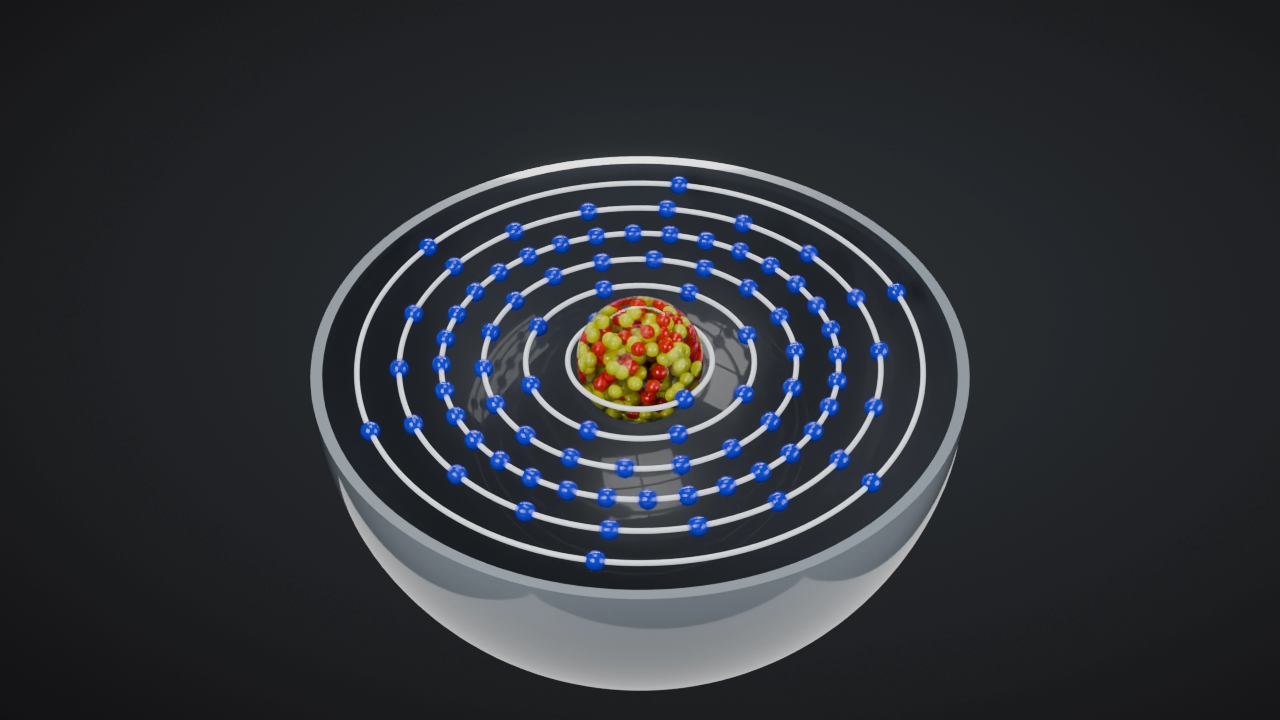
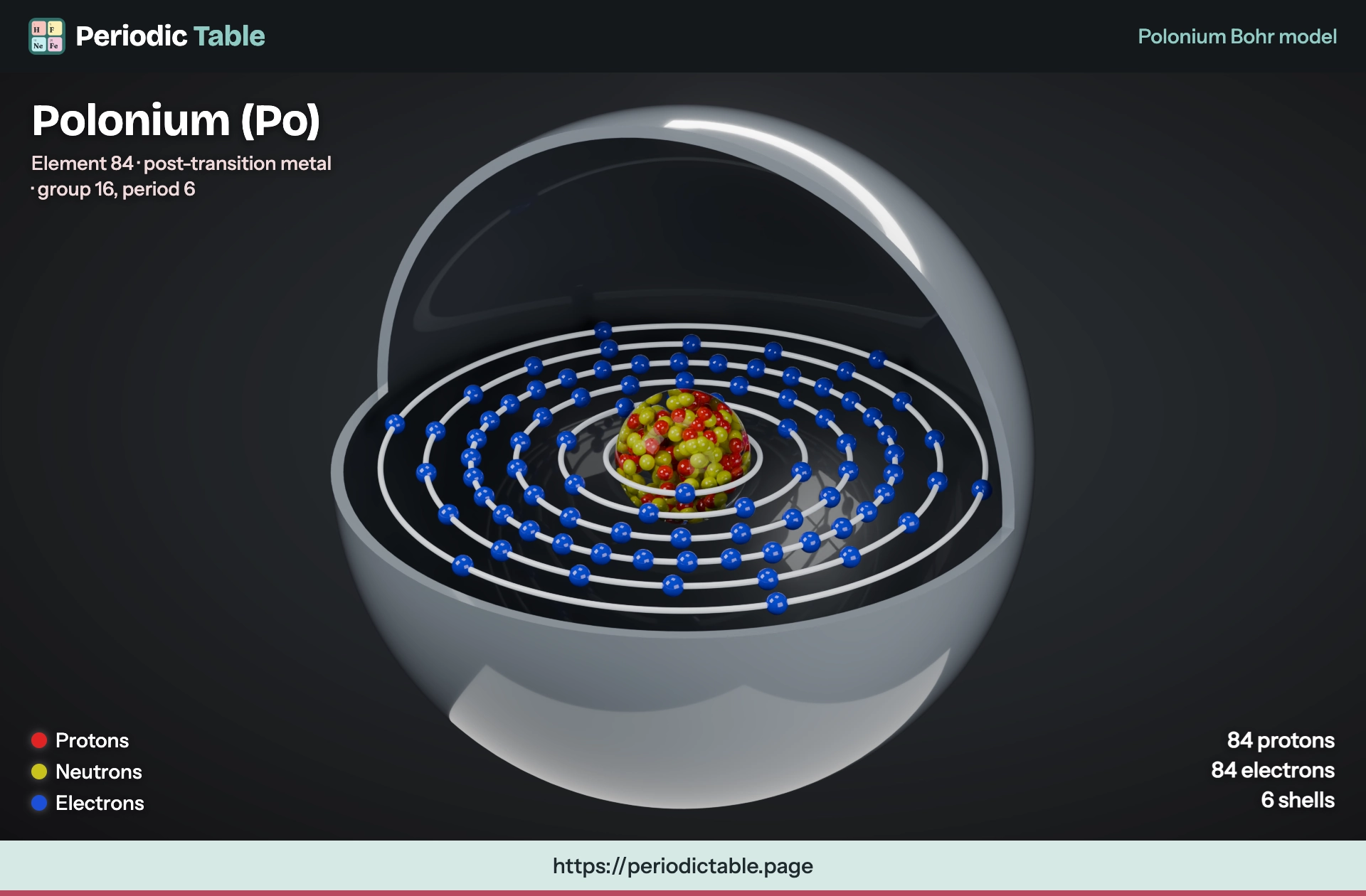
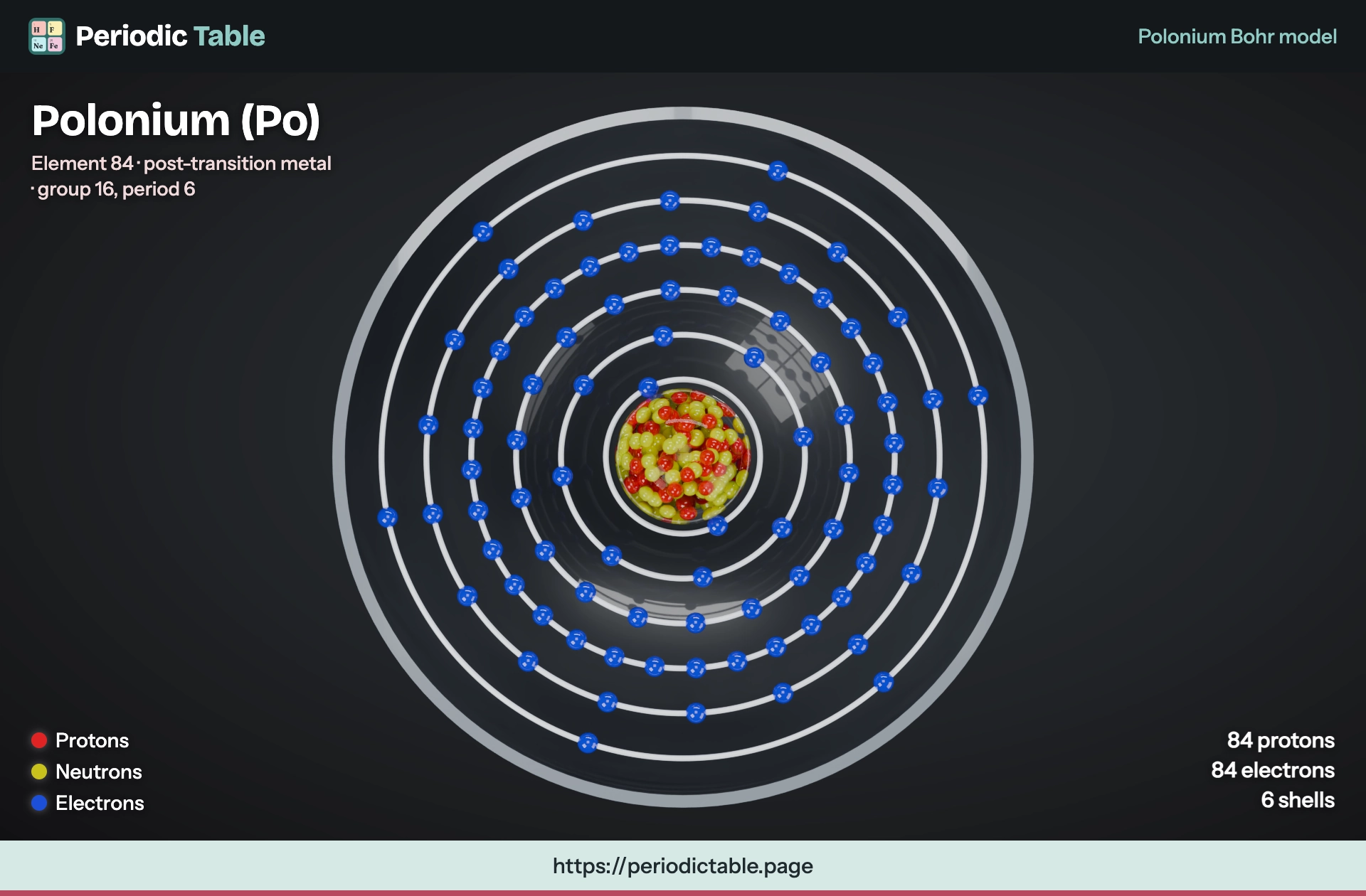
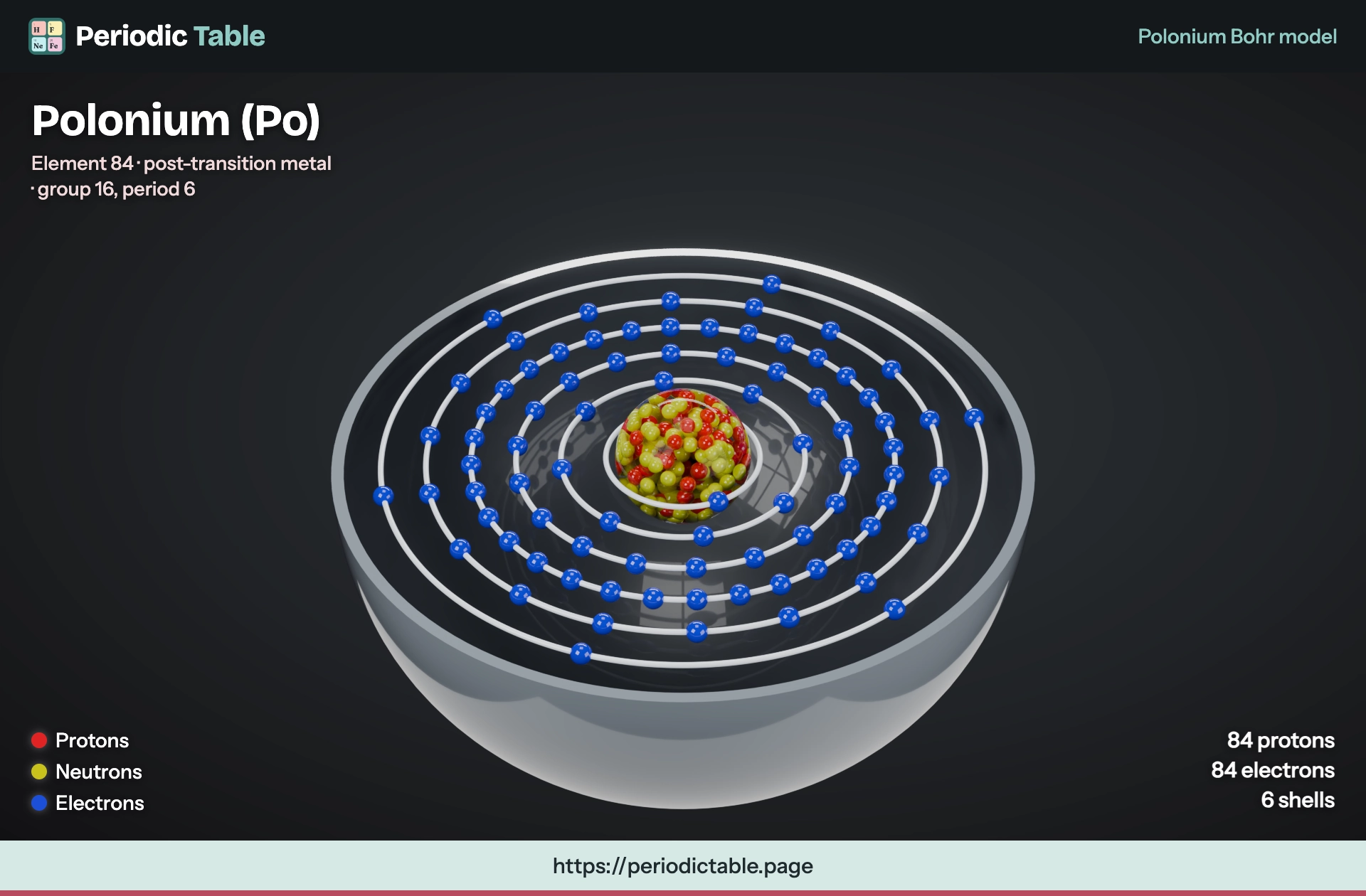
This is a Bohr model of polonium (Po), a simplified picture of a single polonium atom. Its nucleus holds 84 protons, and a neutral polonium atom has 84 electrons, arranged around it in 6 shells (2 in shell K, 8 in shell L, 18 in shell M, 32 in shell N, 18 in shell O and 6 in shell P).
Polonium periodic table electron configuration
- Shorthand
- [Xe] 4f14 5d10 6s2 6p4
- Full
- 1s2 2s2 2p6 3s2 3p6 4s2 3d10 4p6 5s2 4d10 5p6 6s2 4f14 5d10 6p4
- Electrons per shell
- 2, 8, 18, 32, 18, 6
Polonium element properties and atomic data
- Atomic number
- 84
- Atomic mass
- [209] u
- Phase at STP
- Solid
- Melting point
- 253.85°C (527 K)
- Boiling point
- 961.85°C (1235 K)
- Density
- 9.196 g/cm³
- Electronegativity (Pauling)
- 2
- Period
- 6
- Group
- 16
- Block
- p-block
- Appearance
- Silvery
- Discovery date
- 1898
- Discovered by
- Pierre Curie
- Named by
- —
Polonium at a glance: atomic number, density and electron configuration
Every atom of this element carries 84 protons and, when neutral, 84 electrons. It has no stable form, so its standard atomic mass is given as [209], the mass number of its longest-lived isotope rather than a weighted average. Readers new to chemistry and the transuranium elements will find bohrium (bh) an orderly guide to discovery.
Its crustal abundance is tiny: around 2 × 10⁻¹⁰ parts per million, which makes it one of the scarcest naturally occurring elements on Earth. The table below collects the numbers you are most likely to look up.
| Property | Value |
|---|---|
| Symbol | Po |
| Atomic number | 84 |
| Atomic mass | [209] |
| Group, period, block | Group 16, period 6, p-block |
| Electron configuration | [Xe] 4f14 5d10 6s2 6p4 |
| Density (α form) | 9.196 g/cm3 |
| Melting point | 254 °C (527 K) |
| Boiling point | 962 °C (1,235 K) |
| Electronegativity (Pauling scale) | 2.0 |
| Atomic radius / covalent radius / Van der Waals radius | 168 pm / 140 pm / 197 pm |
| CAS number | 7440-08-6 |
| Vapor pressure | about 1 Pa at 846 K |
Melting point, boiling point and allotropes
Polonium is a solid at room temperature that melts at a modest 254 °C and boils at 962 °C. It exists as two allotropes. The low-temperature α form has a simple cubic crystal structure, and it is the only known element that adopts this arrangement with one atom per lattice point under standard conditions.
Above about 36 °C it shifts to the denser rhombohedral beta form (9.398 g/cm3). Even well below 254 °C, a sample is surprisingly volatile: its own recoiling atoms knock tiny clusters loose, so it spreads through the air far more easily than you would expect from a solid.
Oxidation states, electronegativity and ionization energies
The common oxidation states are +2 and +4, with −2 in compounds with reactive metals and +6 in a few fluorine and oxygen compounds. Its Pauling value of 2.0 is typical of the heavy elements around it. Only the first of its ionization energies has been measured reliably, at 812.1 kJ/mol, because intense self-irradiation makes precise spectroscopy difficult.
Element 84 in the periodic table: group 16, period 6 and the p-block
On the periodic table, polonium sits at the bottom of the oxygen family, below selenium and tellurium. That makes it the heaviest naturally occurring chalcogen, and its chemistry echoes its lighter neighbor. Its physical behavior, though, looks much more like the post-transition metals beside it in the same row: thallium, lead and bismuth. A reader curious about sublimation, violet vapor and a purple-black metallic sheen will find it all in the iodine intake article for curious readers.
This middle position is why sources disagree on how to classify it. Some call it a metalloid, LANL describes it as a semi-metal, and most chemists class it as a metal because its electrical conductivity falls as temperature rises, the signature of metallic bonding.
It is clearly not a nonmetal. Its 6p4 outer shell explains its preference for +2 and +4 states: the 6s2 pair holds on tightly, an effect that grows stronger down every group of heavy elements.
Polonium compounds, polonides and polonium solutions
It has no everyday compounds, and almost all of the 50-plus known ones were made in a laboratory. The most stable family is the polonides, formed by heating it directly with sodium, calcium, mercury or a lanthanide.
The rare natural example is PbPo, which forms in ores as polonium decays. Other compounds include three oxides, a range of halides from dichlorides to the hexafluoride, and polonium hydride, a volatile liquid that falls apart soon after it forms.
The chemistry of polonium solutions is visibly strange. It dissolves readily in dilute acids, first giving pink Po ions in the +2 state; these quickly turn yellow as radiolysis of the water oxidizes them to +4.
The same radiolysis bubbles the liquid and its self-heating warms the glass, so unsealed samples evaporate within days. That is why most of what chemists know about polonium compounds comes from trace-scale experiments rather than weighable samples.
Polonium-210 radioactivity and alpha particles
Almost every fact that makes polonium notable traces back to the radioactivity of polonium-210, the form found in nature and made in reactors. It decays by firing out alpha particles, each a cluster of two protons and two neutrons, at very high energy. One gram of it has an activity of about 166 TBq, which is roughly 4,490 curies.
Why polonium-210 is an alpha emitter with a blue glow
As an almost pure emitter of these particles, it releases very little gamma radiation: only about one decay in 100,000 sends out a gamma ray, at 803 keV. Gram for gram it is about 5,000 times as active as radium. A sample of well under a milligram ionizes the air around it so strongly that it gives off a faint blue glow, and the absorbed energy keeps the sample hot without any outside power.
Radioactive decay to lead-206
Each Po atom decays in a single step straight to lead-206, a stable isotope. There is no long tail of radioactive daughters, so a sealed source simply fades. You can see how quickly with the exponential law:
$$N(t) = N_0 \times \left(\frac{1}{2}\right)^{t / T_{1/2}}$$
With \(T_{1/2} = 138.376\) days, a source keeps about 86% of its activity after 30 days, 64% after 90 days, 16% after one year and only about 2.6% after two years. That steep fall is the main reason polonium devices have to be replaced so often.
Polonium isotopes and their decay chain
Researchers have identified 42 isotopes of polonium, from mass 186 to 227, and none of them is stable. Nine of them, from mass 210 to 218, turn up in nature as short-lived decay products of the natural radioactive series. In the uranium-238 series, for example, radon-222 decays to Po-218, which later feeds Po-214 and finally the longest-lived natural form.
Only polonium-209 and polonium-208 outlive it, and both are made by bombarding bismuth with protons or deuterons in a cyclotron. Heavy, neutron-poor polonium isotopes also decay by electron capture, and none decays by spontaneous fission in measurable amounts. Every one listed below decays mainly by alpha emission.
| Isotope | Half-life | Where it comes from |
|---|---|---|
| Po-209 | about 124 years | Accelerator-made |
| Po-208 | 2.898 years | Accelerator-made |
| Po-210 | 138.376 days | Natural series; reactor-made |
| Po-218 | 3.1 minutes | Natural series |
| Po-216 | 0.145 seconds | Natural series |
| Po-214 | 164 microseconds | Natural series |
| Po-212 | 0.3 microseconds | Natural series |
Polonium discovery: Marie Curie, pitchblende and radium F
Back in 1891, Dmitri Mendeleev had already predicted this missing heavy chalcogen. In July 1898, Marie Curie and Pierre Curie found it while working through tons of pitchblende, an ore that stayed more radioactive than its uranium and thorium content could explain.
After removing those, they traced the extra activity to a new substance, the first element ever identified only by its radioactivity. Five months later they announced radium, from the same residue.
Marie named it after Poland, then split between Russia, Germany and Austria-Hungary, hoping the name would draw attention to her homeland's lack of independence. Rutherford's naming scheme later called it radium F, because it is the sixth member of the radium series.
The work fed into the 1903 Nobel Prize in Physics, and the 1911 Nobel Prize in Chemistry recognized the discovery of both elements. The family link continued: Irène Joliot-Curie, their daughter, later handled it herself.
Radio-tellurium, the Dayton project and the urchin initiator
In 1902 the German chemist Willy Marckwald isolated a few milligrams of what he called radio-tellurium, believing it was new; by 1905 it was shown to be polonium. The first visible weighable sample was isolated in 1946.
During World War II the Manhattan Project made it at its Dayton Project in Ohio, because a mixture with beryllium gave a reliable neutron burst. That pairing formed the Urchin initiator at the center of the earliest nuclear weapons, and its design stayed classified until the 1960s.
Where polonium comes from: uranium ore, bismuth and neutron irradiation
Natural polonium exists only in trace amounts, roughly 0.1 mg in every metric ton of uranium ore, because each Po atom formed is gone within months. Extracting it from uranium ores is slow and wasteful, so today almost all of it is made by neutron irradiation of bismuth in nuclear reactors. Each target nucleus that captures a neutron becomes unstable and turns, within about five days, into polonium-210, which is then separated chemically.
World output is only about 100 grams a year, nearly all of it from the Mayak complex near Ozersk in Russia, a production line that dates back to Soviet times. A whole year's supply would fit in a small jar, and each microgram of polonium-210 carries an activity of about 4.5 millicuries, so even tiny quantities are significant.
Po-210 uses: heat source, neutron source and antistatic devices
Because its emissions release so much energy, one gram of Po-210 produces about 140 watts and can climb above 500 °C on its own. That made it a compact heat source for space hardware.
The Soviet Union used it in the Kosmos 84 and 90 satellites and to keep the Lunokhod moon rovers warm through the two-week lunar night, and it was studied for radioisotope thermoelectric generators, which turn that warmth into electricity with no moving parts. Its short half-life meant longer-lived plutonium-238 later replaced it in space probes.
A Po-Be mixture works as a portable neutron source: alpha particles striking beryllium knock out neutrons, which were used to start weapons and to log oil wells. Smaller uses in industry include gauges that measure coating thickness and sealed needle sources for teaching labs and cloud chambers.
Static electricity, textile mills and spark plugs
Polonium's oldest commercial job is removing static electricity. Its emissions ionize the air, and those ions neutralize charge on paper rolls, film and fabric, which is why it was first used in textile mills.
Some anti-static brushes still hold up to 500 microcuries of sealed polonium-210, and you have to replace them about once a year as the source fades. Firestone even sold polonium spark plugs from 1940 to 1953, though any benefit to the engine vanished within weeks.
Polonium toxicity and lethal dose
Polonium has no biological role, and its danger is radiological, not chemical. Outside the body its radiation cannot get through skin, but once ingested or inhaled they deposit all their energy in a few cells' thickness of tissue.
By mass, polonium-210 is roughly 250,000 times more toxic than hydrogen cyanide. The estimated median lethal dose is about 0.89 micrograms, far smaller than a single grain of table salt.
Biological half-life and effective half-life in the body
After a single intake, most of the dose passes out through the gastrointestinal tract. The part that reaches the blood binds to hemoglobin and builds up in the spleen, kidneys and liver, with about a tenth reaching the bone marrow. The body clears it with a biological half-life of roughly 30 to 50 days, so the half-life that matters for dose combines both processes:
$$\frac{1}{T_{\text{eff}}} = \frac{1}{T_{\text{phys}}} + \frac{1}{T_{\text{bio}}}$$
Using 138.4 days for physical loss and 50 days for clearance gives an effective half-life of about 36.7 days; with 30 days of clearance it drops to about 24.7 days. Most of the absorbed dose is therefore delivered within the first few months.
Radiation sickness and treatment after polonium exposure
A large intake causes acute radiation sickness: vomiting, hair loss, collapsing blood counts and organ failure over days to weeks. Lower radiation exposure raises long-term cancer risk instead.
Treatment options are limited; chelating drugs such as dimercaprol can bind some of it if given early, and doctors confirm an intake by measuring activity in urine samples, because the isotope emits almost no gamma rays for a body scanner to pick up. These health effects are the reason handling rules are so strict.
Glove boxes, HEPA filters and exposure limits
Laboratories handle it only inside a sealed glove box kept under negative pressure and fitted with HEPA filters, so airborne particles cannot escape. Neoprene or butyl gloves are used because latex lets acid solutions seep through.
The maximum allowable body burden for swallowed polonium is only 1.1 kBq, about 6.8 picograms. Since 2007 the US Nuclear Regulatory Commission has tracked purchases above 16 curies, although small sealed devices remain exempt, and any spill is treated as serious contamination with radioactive material.
Polonium poisoning cases from 1954 to Litvinenko
Because it is so scarce, confirmed polonium poisoning is rare. The first documented death came in the Soviet Union in 1954, when a worker inhaled aerosol from a ruptured capsule and died 13 days later.
In 1946 a sealed capsule burst on Irène Joliot-Curie's bench, and her 1956 death from leukemia has been linked to that accident. The 1957 Windscale fire in England released polonium-210 into the countryside, which was found only when the land downwind was tested.
The best-known case is the 2006 death of Alexander Litvinenko, a former Russian security officer living in London, who drank tea laced with a few micrograms of polonium-210. His three-week decline was the first confirmed deliberate use of polonium as a weapon and the clearest record of radiation poisoning by this route. Tests on the remains of Palestinian leader Yasser Arafat in 2012 and 2013 also raised the question, but the investigating teams did not agree on whether polonium caused his death.
Polonium exposure in tobacco smoke, food and radon
You carry a small, measurable amount of polonium-210 in your body right now, taken in from food, water and air. Seafood tends to contain the most.
Tobacco is a bigger personal source: plants grown with phosphate fertilizers draw up polonium from the soil, and tobacco leaves trap airborne decay products on their sticky surfaces. Tobacco smoke then carries polonium-210 deep into the lungs, so tobacco users have measurably higher levels than non-smokers.
Indoor radon adds more. When the gas breaks down, it leaves Po-218 and Po-214, which cling to dust, settle in the airways and release alpha radiation there.
These two isotopes are thought to cause most of the lung cancer deaths linked to this gas in US homes. Testing your home for it is therefore one of the most practical ways to cut your own polonium intake.