Bohrium element (Bh): bohrium periodic table facts
Bohrium periodic table facts: bohrium (Bh) is element 107, a transition metal in group 7, period 7. You will probably never meet bohrium outside a periodic chart, and neither has anyone else: it is a synthetic element that has only ever existed as a few atoms at a time, each gone within minutes of being made. Cavendish and Lavoisier appear in the history told by the molecular hydrogen, from inflammable air to modern rocket fuel.
Everything you can learn about element 107 is a blend of a handful of real measurements and a much larger body of careful prediction. Named after Niels Bohr, this chemical element still tells physicists a great deal about how the heaviest nuclei hold together.
Rotate the 3D Bohr model of bohrium
Drag to orbit, scroll to zoom.
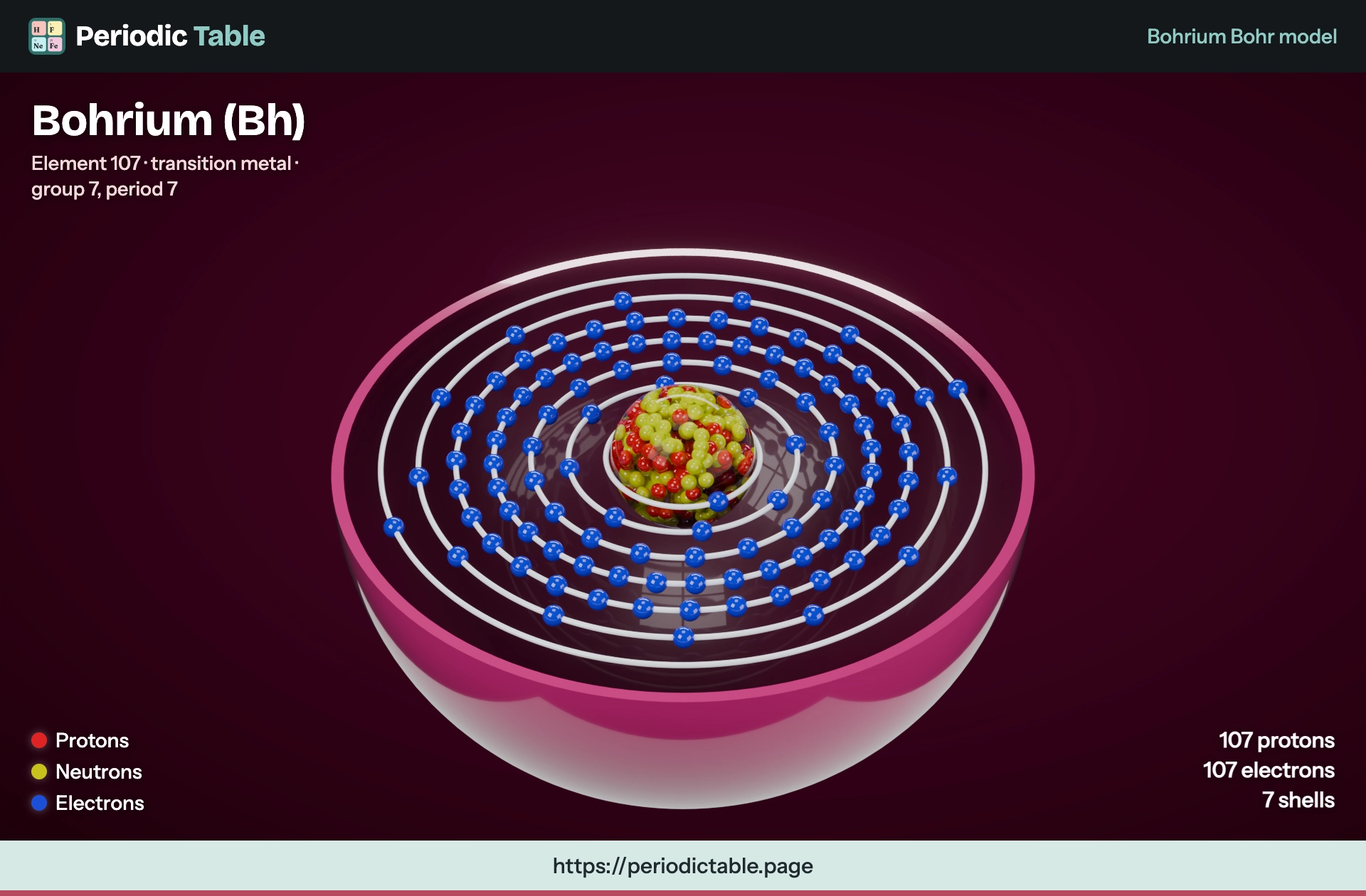
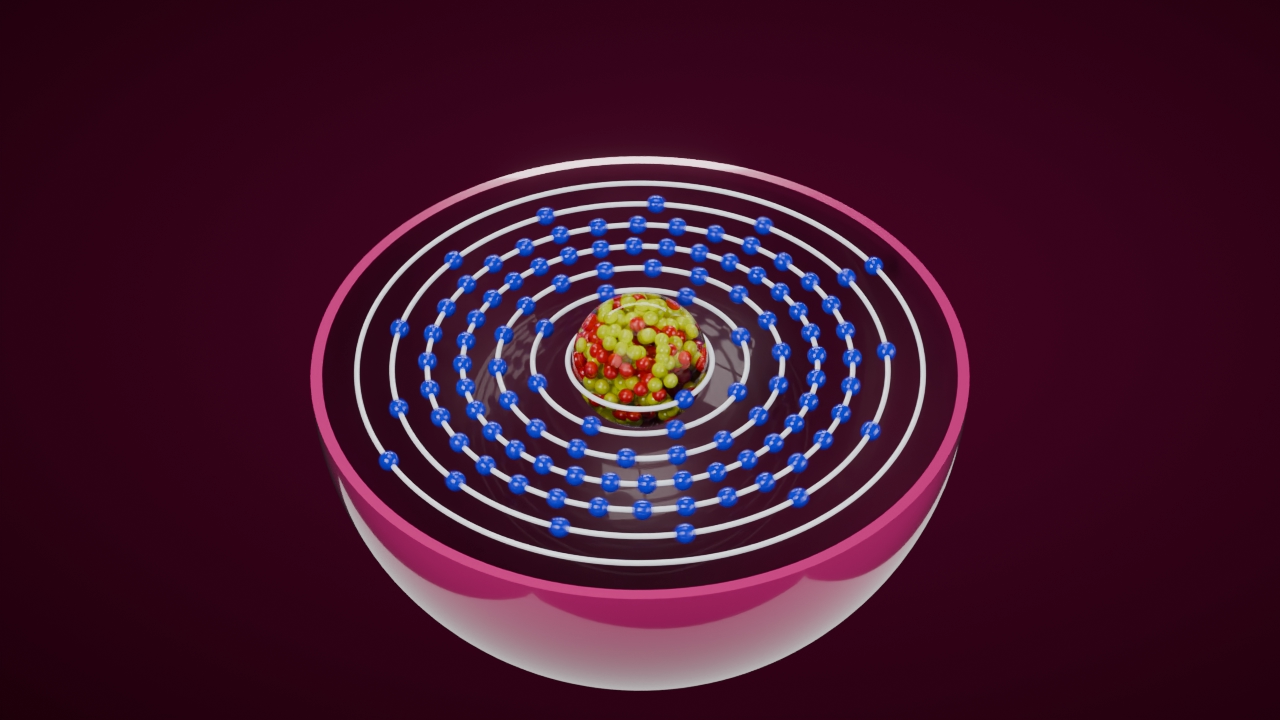
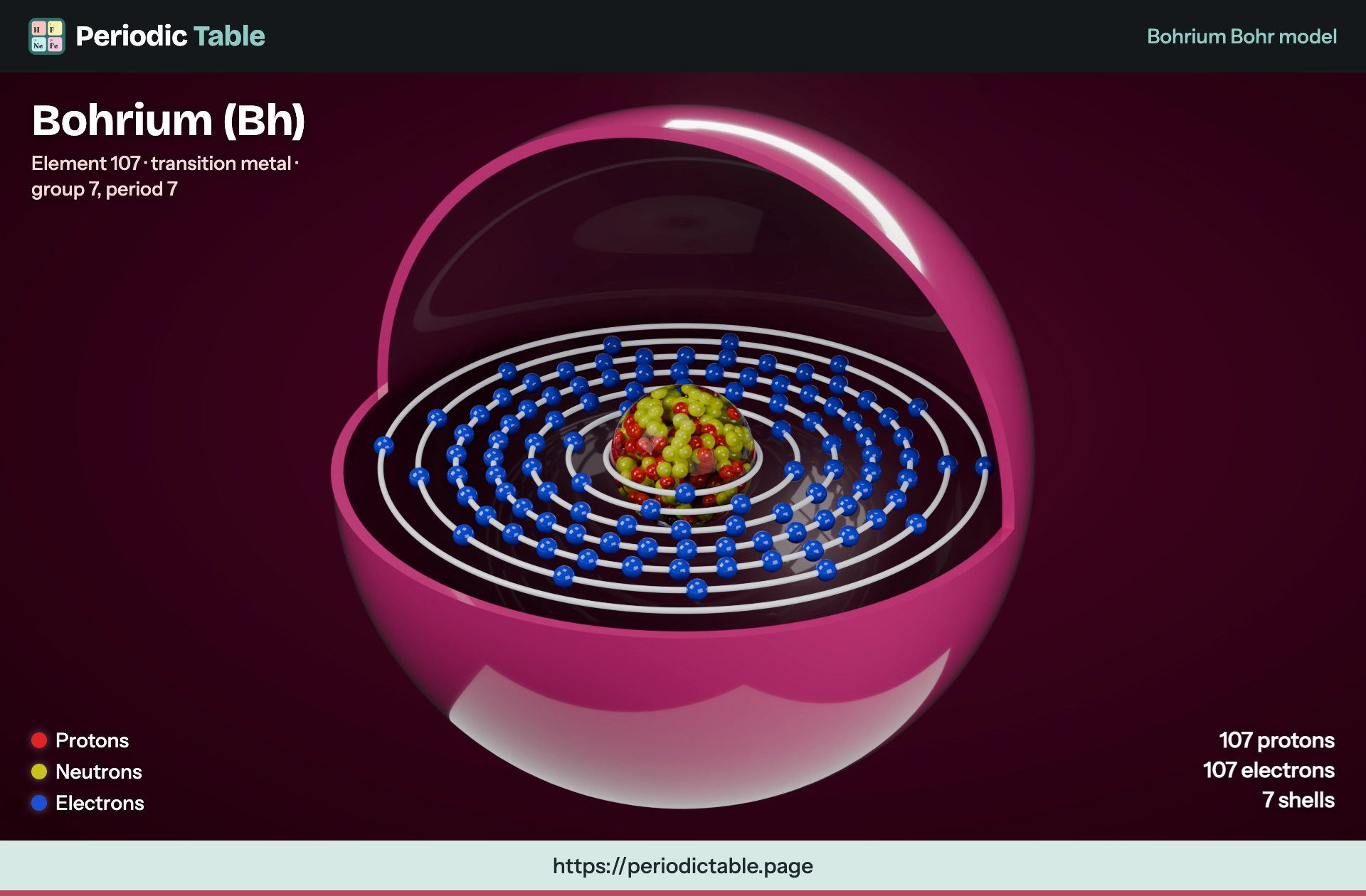
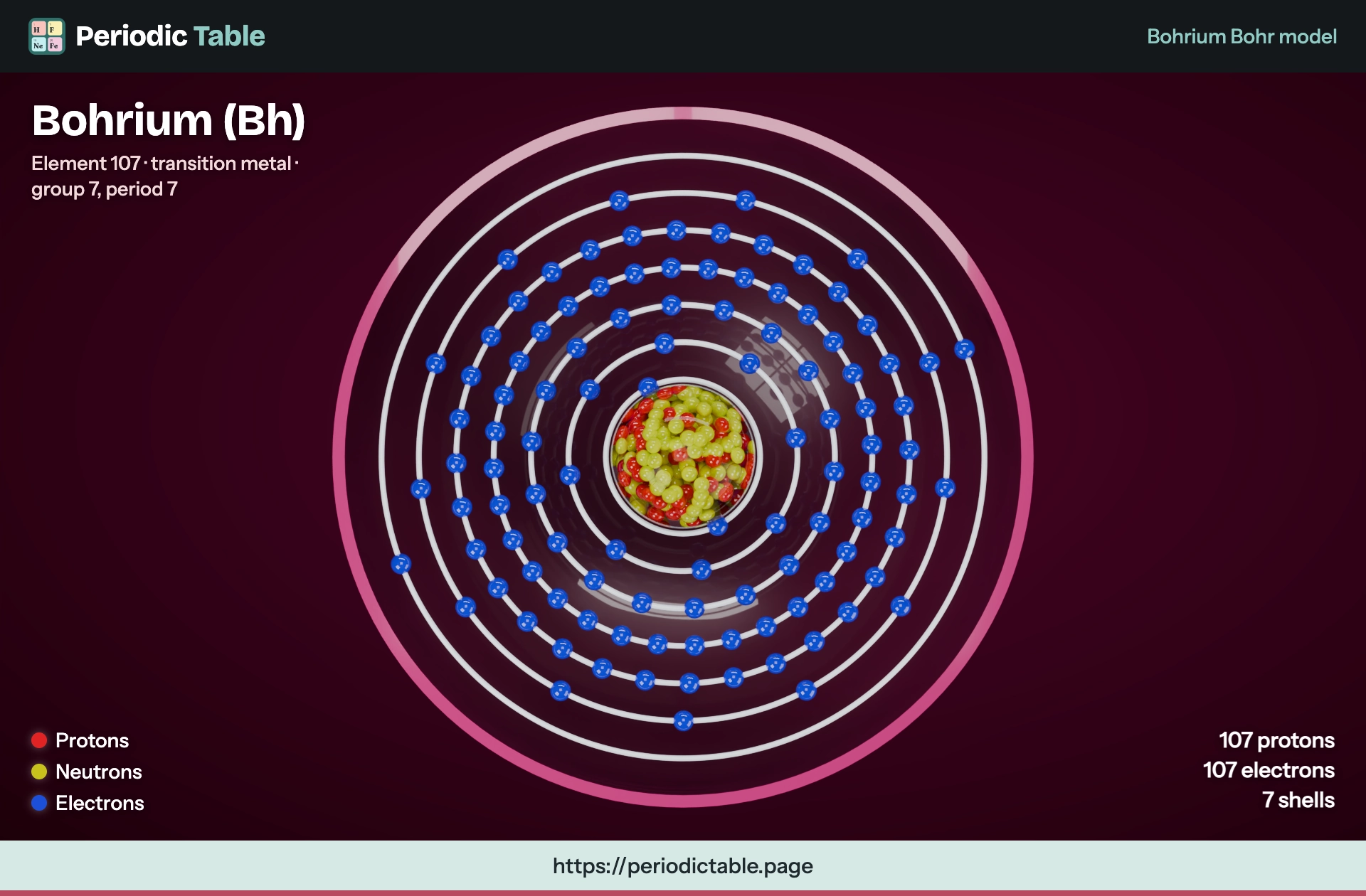
This is a Bohr model of bohrium (Bh), a simplified picture of a single bohrium atom. Its nucleus holds 107 protons, and a neutral bohrium atom has 107 electrons, arranged around it in 7 shells (2 in shell K, 8 in shell L, 18 in shell M, 32 in shell N, 32 in shell O, 13 in shell P and 2 in shell Q).
Bohrium periodic table electron configuration
- Shorthand
- *[Rn] 5f14 6d5 7s2
- Full
- 1s2 2s2 2p6 3s2 3p6 4s2 3d10 4p6 5s2 4d10 5p6 6s2 4f14 5d10 6p6 7s2 5f14 6d5
- Electrons per shell
- 2, 8, 18, 32, 32, 13, 2
Bohrium element properties and atomic data
- Atomic number
- 107
- Atomic mass
- [270] u
- Phase at STP
- Unknown
- Melting point
- Unknown
- Boiling point
- Unknown
- Density
- 37.1 g/cm³
- Electronegativity (Pauling)
- Unknown
- Period
- 7
- Group
- 7
- Block
- d-block
- Appearance
- Unknown
- Discovery date
- 1981
- Discovered by
- Gesellschaft für Schwerionenforschung
- Named by
- —
Bohrium (Bh) at a glance
The table collects the core data you would find on any element card. Anything marked predicted comes from calculation rather than measurement, because no sample of bohrium large enough to see, weigh or melt has ever been produced. If you need atomic radius and ionisation energies given as theory-based estimates, meitnerium isotopes is the place to look.
| Property | Value |
|---|---|
| Symbol | Bh |
| Atomic number | 107 |
| Relative atomic mass | [270] |
| Position | Group 7, period 7, d-block |
| Electron configuration | [Rn] 5f14 6d5 7s2 |
| State at 20 °C | Solid (predicted) |
| Appearance | Unknown; expected to be metallic |
| Natural occurrence | None, made only in accelerators |
| CAS number | 54037-14-8 |
| First confirmed | 1981, GSI, Darmstadt |
The square brackets around the mass are worth a second look. They mean there is no stable isotope to set a standard atomic weight, so the figure is simply the mass number of the longest-lived confirmed form. If a longer-lived form is confirmed later, that bracketed number can change.
A transactinide element in the D-block
Bh sits in the seventh row, at the foot of the column headed by manganese, with seaborgium (106) on its left and hassium (108) on its right. It is the fifth member of the 6d series of transition metals, and like every element after lawrencium it counts as a transactinide. In the periodic table, that position is a prediction in itself: the column tells chemists which compounds to look for, and the experiments described further down set out to test whether the heavy newcomer really behaves like the lighter members above it.
How bohrium atoms are made
Nothing in nature produces this metal. Every atom ever detected was synthesized one at a time in particle accelerators, through a nuclear reaction that fires a beam of lighter nuclei into a heavy target. No laboratory has ever gathered enough atoms to see, so all the data on bohrium comes from detectors that register single events. Nuclear research on decay chains in pitchblende is the focus of the polonium element, with its health and industry roles.
Fusing nuclei in a cold fusion reaction
The 1981 route is still the textbook case: a bismuth-209 target bombarded with chromium-54 ions.
$$^{209}_{83}\mathrm{Bi} + {}^{54}_{24}\mathrm{Cr} \rightarrow {}^{262}_{107}\mathrm{Bh} + n$$
For the two nuclei to merge, they must get close enough for the strong force to overcome their electrostatic repulsion. When they do, they form a compound nucleus that is still carrying excess energy. In a "cold" reaction that excess is low enough for the merger to shed a single neutron and survive, rather than splitting apart.
The odds of success are expressed as a cross section, an effective target area per beam-and-target pair, and for bohrium it is tiny. This is nuclear fusion in the nuclear physics sense, unrelated to the tabletop cold fusion claims of 1989.
Following the decay chain of a superheavy element
Once a new nucleus forms, a separator steers it out of the beam and into a silicon detector that records where and when it lands. You never see the atom itself; you see its decay. These nuclei shed alpha particles, and each one's energy and position link it to the next step, until the chain reaches well-known nuclei of fermium and californium that confirm what the parent was.
The weak point is spontaneous fission, which splits a nucleus into random fragments that say nothing about where they came from. As protons are added, electrostatic repulsion grows faster than the binding of the strong force, which is why superheavy elements are so short-lived.
Theory points to an island of stability near 300 nucleons where nuclei should last far longer; the heaviest known isotopes sit on the shore approaching it. Both ideas shape the data on element 107 directly: its heaviest forms outlive the light ones by more than a thousand times, and its mass-278 form is still unconfirmed because its chain ends in fission rather than a known daughter.
Discovery of bohrium: two rival claims
Two laboratories claimed it first. In 1976 a Soviet team led by Yuri Oganessian at the Joint Institute for Nuclear Research bombarded bismuth and lead targets with chromium and Mn-55 ions and reported activity they assigned to mass 261, decaying into dubnium. The IUPAC/IUPAP Transfermium Working Group later judged that the daughter was probably real but the evidence for its parent was not convincing.
In 1981 a German group led by Peter Armbruster and Gottfried Münzenberg at Darmstadt ran the reaction shown above and recorded five atoms of bohrium-262, following each alpha chain down to known isotopes. That chain-by-chain proof is what earned the German team official credit in the working group's 1992 report.
The nielsbohrium naming dispute
The discoverers proposed nielsbohrium, symbol Ns, to honour the Danish physicist and to acknowledge that the team in Dubna had pioneered this kind of reaction. Until a name was agreed, IUPAC used the systematic element name unnilseptium (Uns). In 1994 a committee recommended the shorter name because no element had ever carried a scientist's full name.
The discoverers objected that "bohrium" sounds like boron, and that an oxyanion called bohrate would be easy to confuse with borate. The shorter name won anyway and was recognised in 1997.
Bohrium isotopes and their half-lives
None of the isotopes of bohrium is stable and none occurs naturally. All are radioactive isotopes made either directly by fusion or as daughters in the decay of heavier atoms, and one form, mass 262, also has a metastable state.
| Isotope | Half-life | Decay mode | First reported |
|---|---|---|---|
| Bh-260 | 41 ms | α | 2008 |
| Bh-261 | 12.8 ms | α | 1989 |
| Bh-262 | 84 ms | α | 1981 |
| Bh-262m | 9.5 ms | α | 1981 |
| Bh-264 | 1.07 s | α | 1995 |
| Bh-265 | 1.19 s | α | 2004 |
| Bh-266 | 10.6 s | α | 2000 |
| Bh-267 | 22 s | α | 2000 |
| Bh-270 | 2.4 min | α | 2007 |
| Bh-271 | 2.9 s | α | 2013 |
| Bh-272 | 8.8 s | α | 2004 |
| Bh-274 | 57 s | α | 2010 |
| Bh-278 | about 11.5 min (unconfirmed) | SF | 2016 |
Read down the table and a pattern appears: a light, proton-rich nucleus made directly by fusion lasts only milliseconds, while a neutron-rich nucleus lasts seconds to minutes. The heavier forms turn up only as daughters in chains starting from nihonium, moscovium and tennessine, while masses 262 and 264 appeared in chains from meitnerium and roentgenium.
Mass 274 is the hardest to reach, because the tennessine that feeds it needs a rare berkelium target. Every confirmed form decays by alpha decay (α); only mass 278 is listed with spontaneous fission (SF).
Bh-270 and the most stable isotope debate
Most references name mass 270 as the most stable isotope, with a half-life of about 2.4 minutes, but that figure rests on very few atoms. Its two-standard-deviation range runs from roughly 0.6 to 11 minutes, which overlaps the range for mass 274, so neither can yet be called the winner.
If the unconfirmed mass 278 holds up, it would beat both. Older sources that quote about 61 seconds for mass 270 are citing an earlier measurement, not a typo.
Predicted properties of bohrium metal
With only a few atoms ever made, and each nucleus gone in minutes, the bulk metal has never existed. Almost every figure about bohrium in this section is therefore a calculation, cross-checked against the lighter elements in its column.
Physical properties and crystal structure
Calculations say it should be a solid at room temperature with a hexagonal close-packed lattice (c/a ≈ 1.62), the same arrangement as its lighter neighbour above. Its density was first estimated at 37.1 g/cm³; newer calculations bring that down to 26–27 g/cm³, which would still make it one of the heaviest solids known.
The melting point and boiling point are unknown, and so is the colour, although a silvery look like its neighbours is the usual guess. These physical properties are unlikely ever to be measured directly, since a visible lump would vaporise itself with its own decay heat long before anyone could study it.
Atomic radius, ionization energies and relativistic effects
The predicted atomic radius is about 128 pm and the covalent radius about 141 pm. Estimated ionization energies run to roughly 740, 1,690 and 2,570 kJ/mol for the first three electrons. The surprise is which electron leaves first.
Relativistic effects pull the 7s orbital inward and push the 6d orbital outward, so the Bh+ ion is predicted to lose a 6d electron and keep both 7s electrons, giving [Rn] 5f14 6d4 7s2. That is the opposite of what the lightest members of its column do, and it comes from the same physics that makes gold yellow.
Bh chemistry and oxidation states
The predicted chemistry follows the column. All the lighter members reach +7, and that top oxidation state becomes more stable the further down you go, so bohrium is expected to hold +7 comfortably. Technetium also shows a stable +4 state and rhenium +4 and +3, so lower states are likely here too.
Older texts call it eka-rhenium, Mendeleev-style shorthand for the heavier homologue of rhenium. Its closest congener is the obvious benchmark for its chemical properties, and every experiment so far has compared the two side by side.
The perbohrate ion and other oxyanions
The +7 state is most likely to survive in oxyanions such as perbohrate, BhO4−, the heavy cousin of permanganate, pertechnetate and perrhenate. The lighter members all form a heptoxide M2O7, so Bh2O7 is expected too, and it should dissolve in water to give perbohric acid, HBhO4. In water, though, the +7 form is probably unstable and would drop to the more stable +4 form.
The bohrium oxychloride experiment
The only real chemistry done on bohrium came in 2000 at the Paul Scherrer Institute. Researchers made six atoms of mass 267 from a berkelium-249 target hit with neon-22, then let them react with a mixture of hydrogen chloride and oxygen:
$$2\,\mathrm{Bh} + 3\,\mathrm{O_2} + 2\,\mathrm{HCl} \rightarrow 2\,\mathrm{BhO_3Cl} + \mathrm{H_2}$$
The product is a volatile oxychloride, so it could be carried as a gas along a temperature-controlled column. How strongly it stuck to the column wall, its adsorption enthalpy, came out at −77.8 kJ/mol, against a theoretical value of −78.5 kJ/mol.
The matching technetium and rhenium compounds, measured alongside, gave −51 and −61 kJ/mol, so volatility falls in the order TcO3Cl > ReO3Cl > BhO3Cl, exactly as the periodic table predicts. The result was so unremarkable that the coverage was headlined "Boring Bohrium", which is the point: radiochemistry done one atom at a time confirmed that relativity does not break the column's chemistry here.
Atomic number 107 beside its group 7 relatives
Line up the group 7 elements and you can see why chemists trusted the column. The top valence of +7 stays fixed while the metals get steadily heavier with every row.
| Element | Atomic number | Period | Highest oxidation state | Oxide | Density (g/cm³) | Melting point (°C) |
|---|---|---|---|---|---|---|
| Manganese | 25 | 4 | +7 | Mn2O7 | 7.21 | 1,246 |
| Technetium | 43 | 5 | +7 | Tc2O7 | 11.5 | 2,157 |
| Rhenium | 75 | 6 | +7 | Re2O7 | 21.0 | 3,186 |
| Bohrium (Bh) | 107 | 7 | +7 (seen in BhO3Cl) | Bh2O7 (predicted) | 26–27 (predicted) | Unknown |
The bottom row is the only one built mostly on calculation, but the one value that has been tested, +7 in the BhO3Cl gas experiment, landed where the rows above said it would. That is why the predicted figures for bohrium are taken seriously even without a sample.
Uses of element 107 beyond scientific research
There are none. Outside scientific research the element has no use: too few atoms exist at any moment, and each is too radioactive and too short-lived to be useful.
Its value is as a test case for the periodic table and for models of superheavy elements, and its isotopes help researchers piece together decay chains from heavier atoms. If you see a "bohrium" display cube for sale, it holds a printed label in acrylic, not a single atom of the element.