


Meitnerium element (Mt): meitnerium periodic table facts
Meitnerium periodic table facts: meitnerium (Mt) is element 109, a transition metal in group 9, period 7. Only a few dozen atoms of meitnerium have ever existed, and none of them lasted long enough for you to see. Before you compare isotopes or boiling points, look up hydrogen atoms for the atomic number of the lightest element.
Mt is a highly radioactive synthetic element with atomic number 109, a man-made chemical element whose longest-lived confirmed form, meitnerium-278, falls apart in about 4.5 seconds. Here you'll find what scientists have measured, what they can only predict, and why such a fleeting element still earns its place on the periodic table.
Rotate the 3D Bohr model of meitnerium
Drag to orbit, scroll to zoom.
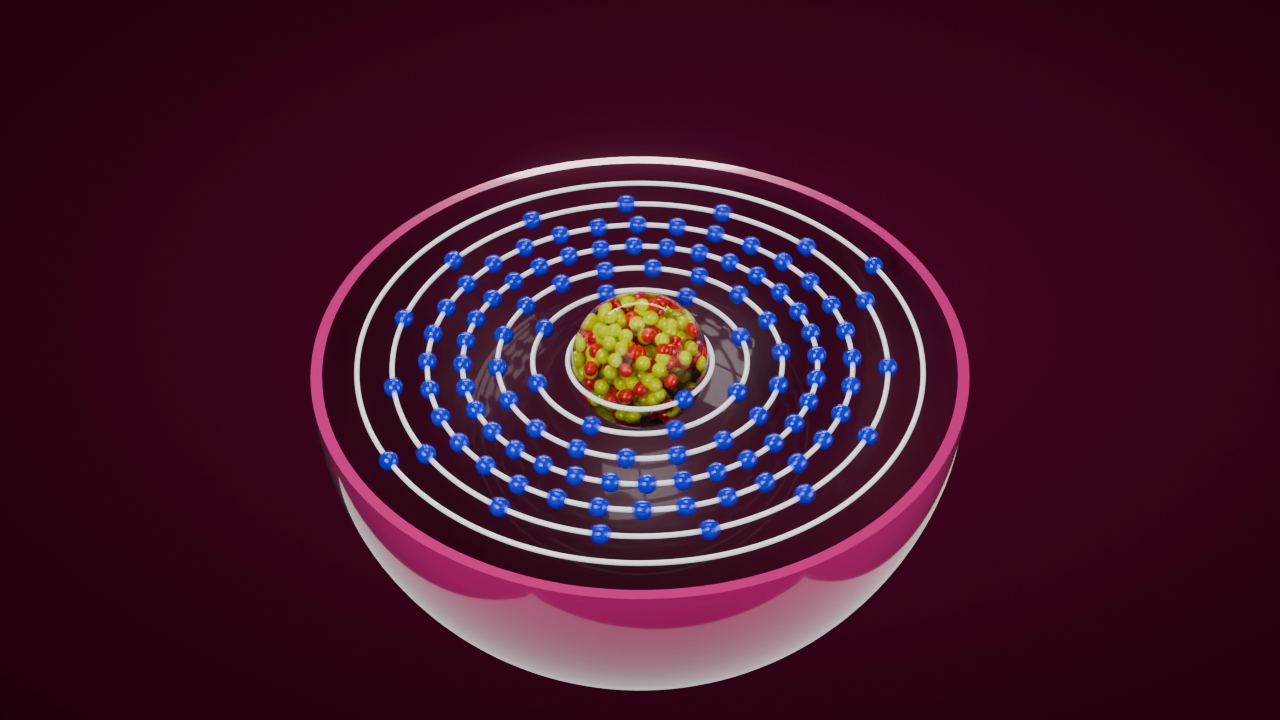
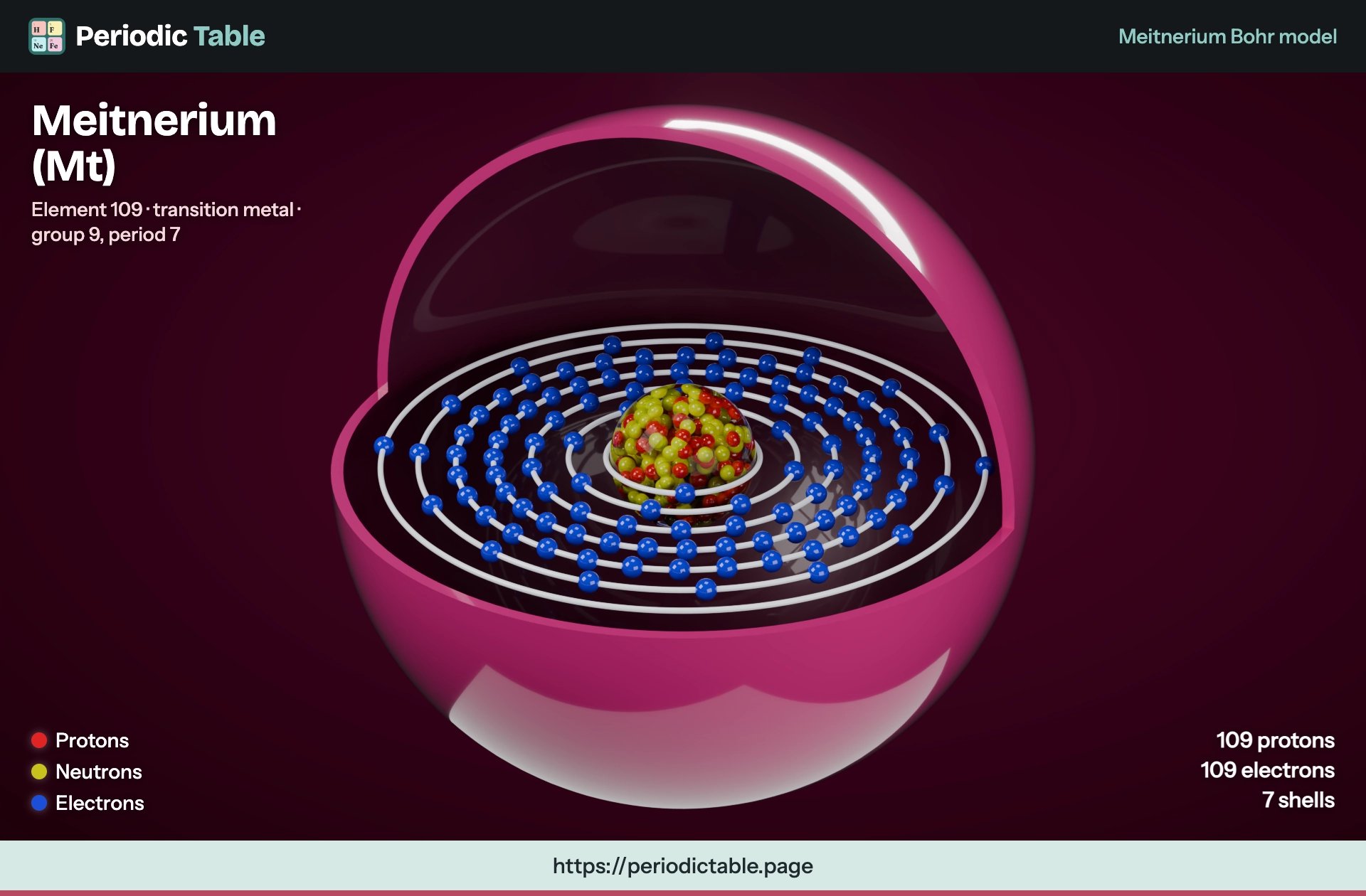
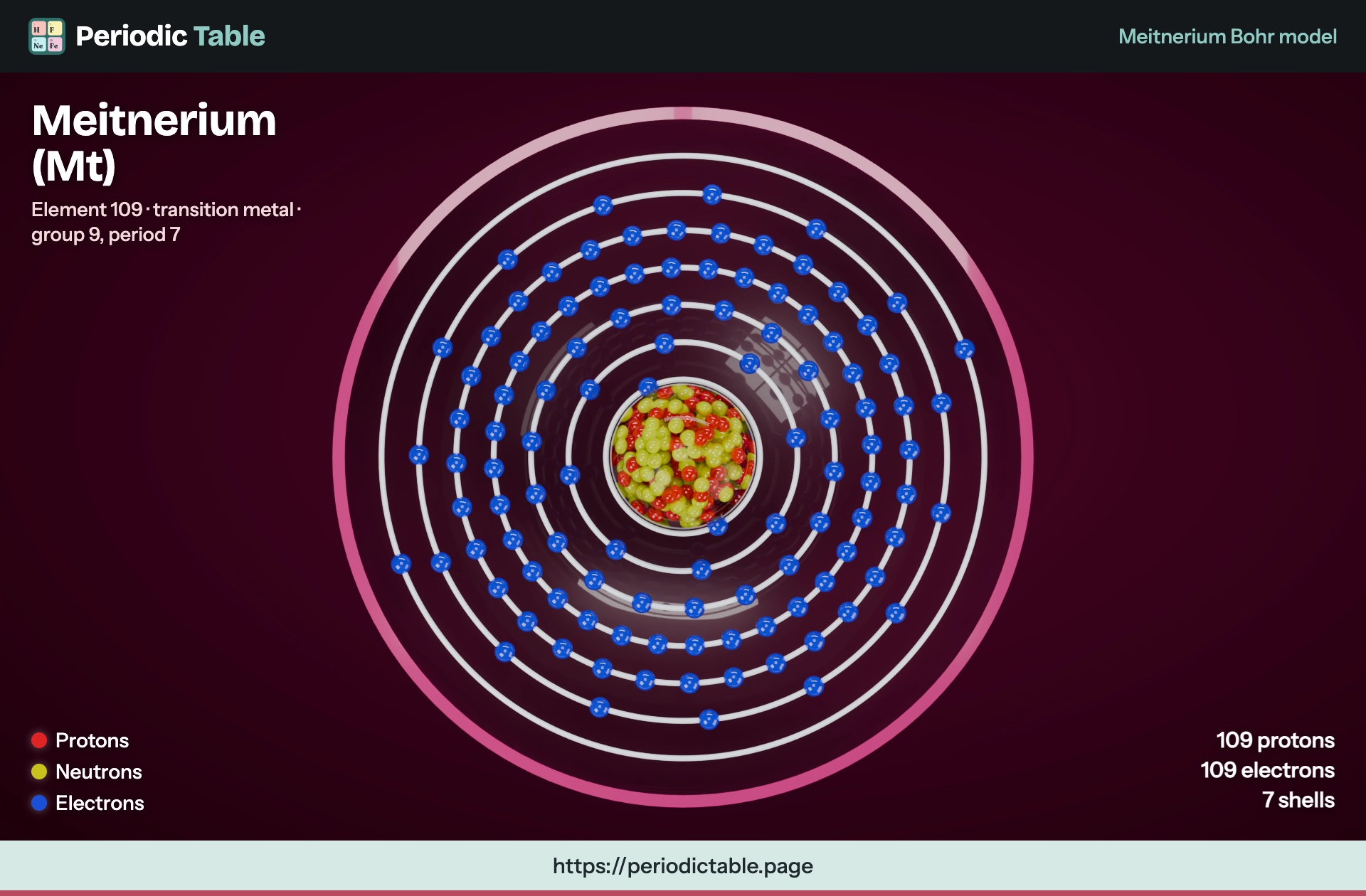
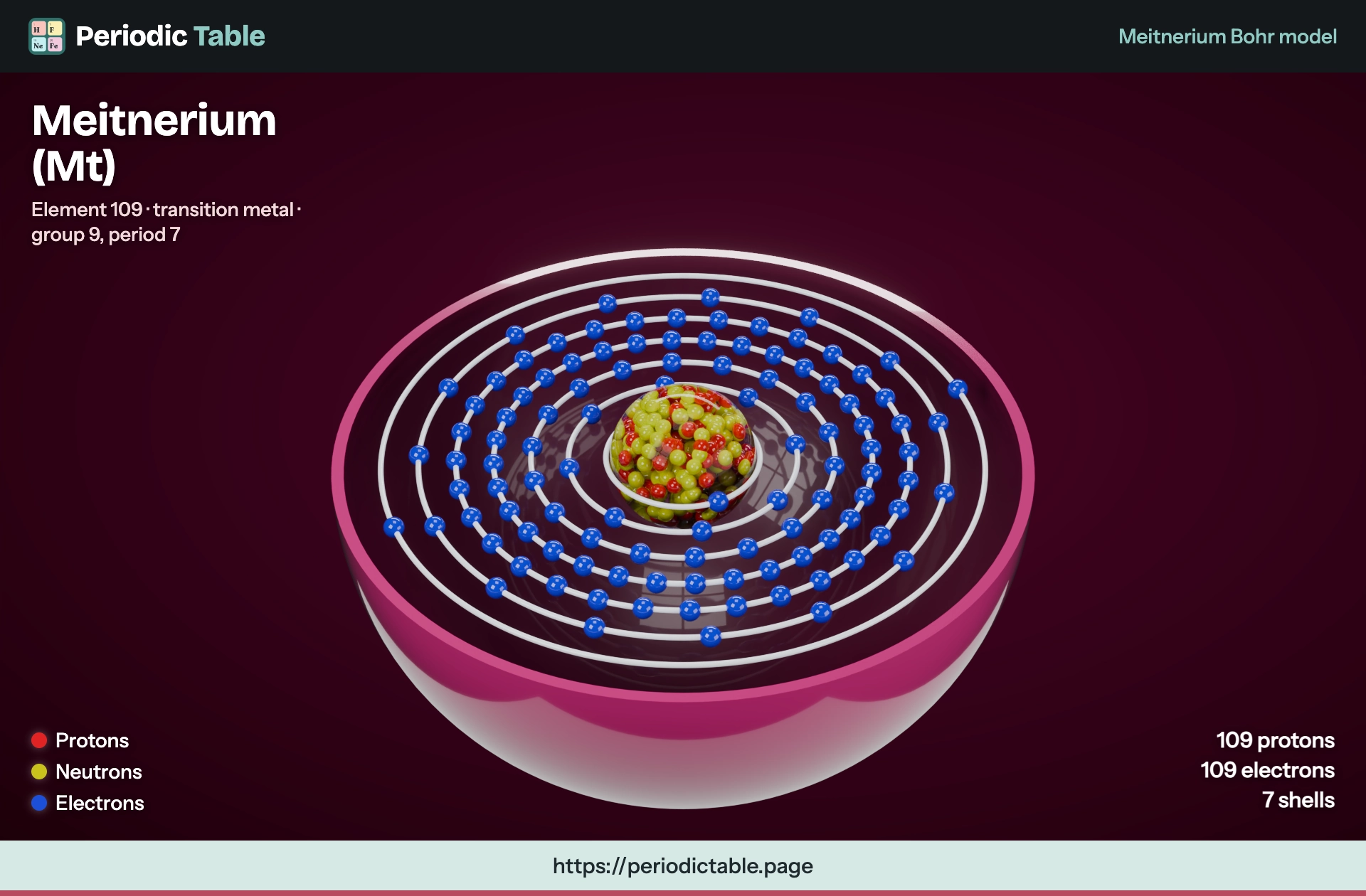
This is a Bohr model of meitnerium (Mt), a simplified picture of a single meitnerium atom. Its nucleus holds 109 protons, and a neutral meitnerium atom has 109 electrons, arranged around it in 7 shells (2 in shell K, 8 in shell L, 18 in shell M, 32 in shell N, 32 in shell O, 15 in shell P and 2 in shell Q).
Meitnerium periodic table electron configuration
- Shorthand
- *[Rn] 5f14 6d7 7s2
- Full
- 1s2 2s2 2p6 3s2 3p6 4s2 3d10 4p6 5s2 4d10 5p6 6s2 4f14 5d10 6p6 7s2 5f14 6d7
- Electrons per shell
- 2, 8, 18, 32, 32, 15, 2
Meitnerium element properties and atomic data
- Atomic number
- 109
- Atomic mass
- [278] u
- Phase at STP
- Unknown
- Melting point
- Unknown
- Boiling point
- Unknown
- Density
- 37.4 g/cm³
- Electronegativity (Pauling)
- Unknown
- Period
- 7
- Group
- 9
- Block
- d-block
- Appearance
- Unknown
- Discovery date
- 1982
- Discovered by
- Gesellschaft für Schwerionenforschung
- Named by
- —
Mt atomic number, density and electron configuration
Every value below comes from either a measurement on single atoms or a theoretical calculation, because no one has ever collected a weighable sample of the metal. Treat the bulk properties as predictions, and the nuclear figures as hard data. For quick reference, half-life, density and boiling point of this heaviest noble gas are tabulated in the radon gas page by page.
| Property | Value |
|---|---|
| Symbol | Mt |
| Atomic number | 109 |
| Relative atomic mass | [278], the mass number of the longest-lived confirmed isotope |
| Position | Period 7, d-block, ninth column |
| Electron configuration | [Rn] 5f14 6d7 7s2 (predicted) |
| Standard state | Solid at 298 K (predicted) |
| Phase at room temperature | Metallic (predicted) |
| Density | 27–28 g/cm3 (predicted) |
| Melting point | Unknown |
| Boiling point | Unknown |
| CAS number | 54038-01-6 |
You'll also see an atomic weight of 276 or 278 quoted on different reference sites. Neither is a true weighted average: with no stable isotope to average over, the bracketed figure simply points to the heaviest well-characterised nucleus at the time the source was written.
Element 109 in group 9, period 7 and the D-block
On the periodic table, Mt sits in group 9 directly below cobalt, rhodium and iridium, which makes it the seventh member of the 6d series of transition metals when that series is counted from lawrencium (103). The rest of the row runs from rutherfordium (104) through copernicium (112). In the story of superheavy synthesis, the bohrium element explains how a chromium-54 beam on bismuth-209 made the first atoms by cold fusion.
To the left lie bohrium (107) and hassium (108); to the right is darmstadtium (110). Chemists group all of them as transactinides, and nuclear physicists usually call the same stretch the superheavy elements.
The label matters because it tells you how the element is studied: not by the gram, but one atom at a time, with every result inferred from what that atom does before it decays. Its placement in this column is itself an assumption, since no experiment has yet tested whether it really behaves like its lighter neighbours.
Discovery and naming of meitnerium (Mt)
The element went from a single detected atom to an official name over fifteen years, a slow path that reflects how hard every early claim was to confirm.
Discovery at the GSI lab in Darmstadt
The discovery came on 29 August 1982 at the Gesellschaft für Schwerionenforschung, the Institute for Heavy Ion Research in Darmstadt, then part of West Germany. A team led by Peter Armbruster and Gottfried Münzenberg fired a beam of accelerated iron nuclei at a bismuth foil and recorded exactly one atom of meitnerium-266, which decayed within milliseconds.
A single event is thin evidence, so the claim needed outside support. The Joint Institute for Nuclear Research at Dubna, in the then Soviet Union, confirmed the result three years later. That independent check is why the discovery is credited to the German team even though the formal recognition and name arrived much later.
Naming after Lise Meitner, a pioneer of nuclear fission
Before it had a name, the element went by placeholders. Mendeleev's scheme would have called it eka-iridium, and in 1979 IUPAC assigned the systematic element name unnilennium, symbol Une. Researchers in the field mostly ignored that and simply wrote "element 109" or E109.
The discovery team proposed honouring Lise Meitner, the Austrian physicist who worked in early radiochemistry with Otto Hahn and co-discovered protactinium with him. In late 1938, after fleeing to Stockholm, she explained why bombarding uranium with neutrons produced barium: the nucleus was splitting in two, with krypton as the partner fragment.
That explanation gave the world nuclear fission. Hahn alone received the 1944 Nobel Prize in Chemistry, an omission many historians now treat as one of the prize's clearest oversights.
Unlike several of its neighbours, the name was never contested during the Transfermium Wars. IUPAC recommended it in 1994 and adopted it in 1997, making it the only element named solely after a real, non-mythical woman.
How a superheavy element is made
Every atom of this superheavy element comes from a nuclear reaction in which two lighter nuclei are forced to merge. The original 1982 route is called cold fusion (in the nuclear-physics sense, not the discredited tabletop claim): a bismuth-209 target is struck by an iron-58 beam from a linear accelerator.
$$^{209}_{83}\text{Bi} + ^{58}_{26}\text{Fe} \rightarrow ^{266}_{109}\text{Mt} + ^{1}_{0}\text{n}$$Read the equation as a balance sheet. The 83 protons of bismuth plus the 26 of iron give 109, the element's identity. The mass numbers add to 267, and one neutron carries away the excess energy, leaving a nucleus of mass 266.
Getting there is mostly failure. The two nuclei repel each other, so the projectile must be fast enough to overcome that push but not so fast that the projectile shatters. Even on contact, most pairs of nuclei separate again within about 10−20 seconds.
When fusion does happen, the result is a hot compound nucleus that must shed neutrons or gamma rays quickly or split apart. The cross section, a measure of how likely the merger is, is so tiny that weeks of running may yield a single atom, which is why the 1982 experiment logged just one atom of Mt.
Alpha decay and detection of single meitnerium atoms
Newly made meitnerium atoms ride along with the beam into a separator, which relies on electric and magnetic fields to pull them away from the unreacted beam nuclei. They then bury themselves in a silicon detector that logs the position, energy and arrival time of the impact.
When the nucleus later decays at that same spot, the detector logs a second event. Most decays here release an alpha particle, and each alpha step lands on a lighter, already-known nuclide.
Tracing that decay chain back to familiar territory is how researchers prove which element they made. It is the core logic of superheavy nuclear physics: identity is never seen directly, only reconstructed from a sequence of decays in one place.
Isotopes of meitnerium and their half-lives
The element has no stable form, so every isotope is one of a handful of short-lived radioisotopes. Eight are confirmed (mass numbers 266, 268, 270 and 274–278), two of them with unconfirmed metastable states, and a ninth, mass 282, still awaits confirmation. Several were first seen not by direct synthesis but as daughters of heavier elements such as nihonium, moscovium, tennessine and roentgenium.
| Mass number | Half-life | Decay mode | First reported | Parent nucleus |
|---|---|---|---|---|
| 266 | 2.0 ms | α, SF | 1982 | None (direct fusion of Bi-209 and Fe-58) |
| 268 | 23 ms | α | 1995 | Rg-272 |
| 270 | 800 ms | α | 2004 | Nh-278 |
| 274 | 640 ms | α | 2007 | Nh-282 |
| 275 | 20 ms | α | 2004 | Mc-287 |
| 276 | 620 ms | α | 2004 | Mc-288 |
| 277 | 5 ms | SF | 2013 | Ts-293 |
| 278 | 4.5 s | α | 2010 | Ts-294 |
| 282 (unconfirmed) | 67 s | α | 2016 | Fl-290 (proposed) |
Read "α" as alpha decay (also called alpha emission) and "SF" as spontaneous fission, where the nucleus splits into two large fragments. Times are in milliseconds (ms) unless marked s. Each half-life rests on very few events, so the published error bars are wide and the values shift as new atoms are counted.
Decay mode and stability of the heavier meitnerium isotopes
The table shows a clear trend: the heavier meitnerium isotopes generally survive longer. A higher neutron count dilutes the electrostatic repulsion between 109 protons, and nuclear shell effects add more stability as the count climbs toward the predicted island of stability, a region of superheavy nuclei expected to resist fission.
The exceptions are revealing. Mass 277 breaks down by spontaneous fission in about 5 ms, hinting at a pocket of instability around N = 168–170.
Researchers also hoped meitnerium-271 would be unusually long-lived because N = 162 is a deformed-shell magic number, but a 2002–2003 search at Berkeley found no atoms of it. For future chemistry experiments, meitnerium-276, reachable through moscovium decay, looks like the most practical half-life to work with.
Predicted properties of meitnerium
Apart from its nuclear behaviour, nothing about the element has been measured. The predicted properties below come from relativistic quantum calculations and from extrapolating the trend down the column, so treat each one as a well-argued forecast, not as a recorded fact.
Chemical behaviour and oxidation states
Calculated ionization potentials and ionic radii put Mt very close to its lighter homolog (Ir), so it is expected to behave as a noble metal like the platinum group metals. As the heavier homologue in the column, its most stable oxidation states are predicted to be +6, +3 and +1, with +3 favoured in aqueous solution.
The standard electrode potential for the Mt3+/Mt couple is estimated at about 0.8 V, positive enough to resist corrosion. Calculations also allow a +4 state through tetrahalides, and possibly +9 in an exotic nonafluoride, though that species would likely be less stable than IrO4+, the only +9 species known so far.
Physical and atomic traits of the meitnerium metal
The meitnerium metal should be a solid with a face-centered cubic crystal structure, matching its congener directly above it. At 27–28 g/cm3 it would rank among the densest of all 118 known elements, and it is predicted to be paramagnetic.
- Atomic radius: about 128 pm (predicted)
- Covalent radius: about 129 pm, roughly 6–10 pm larger than the metal above it
- Ionization energies: roughly 800, 1,820 and 2,900 kJ/mol for the first three (estimated)
- Electron affinity and electronegativity: unknown
Experimental chemistry of a transactinide element
Here is the oddity: Mt is the lightest transactinide element whose chemistry has never been tested. Experimental chemistry has reached seaborgium, bohrium and hassium, and even heavier elements, but the chemistry of meitnerium remains a blank page.
The likeliest first experiment would compare volatile meitnerium compounds with their lighter analogues, the same way HsO4 was compared with OsO4 for element 108. Iridium hexafluoride becomes volatile above about 60 °C, so meitnerium hexafluoride (MtF6) is the leading candidate, with a possible octafluoride, MtF8, as an alternative.
Any fluoride route has to stay below roughly 500 °C, since current methods for superheavy elements fail above that; GSI's trial runs with Rh2O3 and RhCl3 needed 1,000 °C and 780 °C, far too hot. Producing the isotopes is a second bottleneck: mass 278 needs a rare berkelium target, which is why the mass-276 route is preferred.
What a chemist needs before testing one meitnerium atom
Atom-at-a-time chemistry has a practical rule of thumb. To get a usable result, a laboratory needs:
- at least four atoms to study,
- an isotope with a half-life of one second or more, and
- a production rate of at least one atom per week.
A single meitnerium atom per week sounds modest, yet experiments must run for months with automated separation to collect enough events. Mass 278 meets the half-life bar; production speed is what keeps the field waiting.
Uses of meitnerium, a highly radioactive synthetic element
There are no commercial or industrial uses. The element is not found in nature and does not occur naturally anywhere on Earth; every atom is made in a laboratory, and each one costs a share of a research budget that runs into the millions. Its value is entirely in scientific research:
- testing models of shell structure and the limits of stability in heavy nuclei,
- checking how relativistic effects reshape chemistry at the bottom of the periodic table, and
- serving as a known waypoint when decay chains from heavier elements are traced.
The element itself has no role in energy, but its name links it to one: Meitner's fission work underpins nuclear power, which today supplies a large share of low-carbon electricity worldwide.
How Mt compares with its lighter neighbours
Placing Mt beside the three metals above it shows how much is known about them and how much is still forecast. The table below lists published reference values for the lighter three and predictions for the newcomer.
| Element | Z | Mass per cm3 (g) | Common oxidation state | Crystal structure |
|---|---|---|---|---|
| Cobalt (Co) | 27 | 8.90 | +2, +3 | Hexagonal close-packed |
| Rhodium (Rh) | 45 | 12.4 | +3 | Face-centred cubic |
| Iridium (Ir) | 77 | 22.6 | +3, +4 | Face-centred cubic |
| Meitnerium (Mt) | 109 | 27–28 (predicted) | +3 (predicted) | Face-centred cubic (predicted) |
The pattern is steady: each step down adds mass faster than size, so each metal packs more into every cubic centimetre. If the forecasts hold, Mt would be roughly three times as dense as the top member and around a fifth denser than the heaviest of the three, putting it among the densest of all elements, though no bulk sample will ever exist to test it.
Fun facts about the meitnerium element
- The meitnerium element is one of only two elements named after a woman, and the only one named for a single, real woman.
- Its first confirmed atom lived for only a few thousandths of a second before decaying.
- Its official symbol, Mt, replaced the temporary Une used in the 1980s.
- No chemical experiment has ever been carried out on it, even though heavier neighbours have been tested.
- If enough could be made, a 1 cm cube of it would weigh about 27–28 g, against under 8 g for the same cube of iron.