


Radon element (Rn): radon periodic table facts
Radon periodic table facts: radon (Rn) is element 86, a noble gas in group 18, period 6. You can't see, smell or taste it, yet radon is drifting up through the ground under almost every building on Earth. Cavendish and Lavoisier appear in the history told by the green hydrogen, from inflammable air to modern rocket fuel.
Radon (symbol Rn) is a colorless, odorless radioactive gas and the heaviest member of the noble gas family, born from the slow decay of uranium and radium in rocks and soil. Here you'll find what radon is, how it behaves, where it comes from and why it matters to your health, from its place on the periodic table to the radon test you can run at home.
Rotate the 3D Bohr model of radon
Drag to orbit, scroll to zoom.
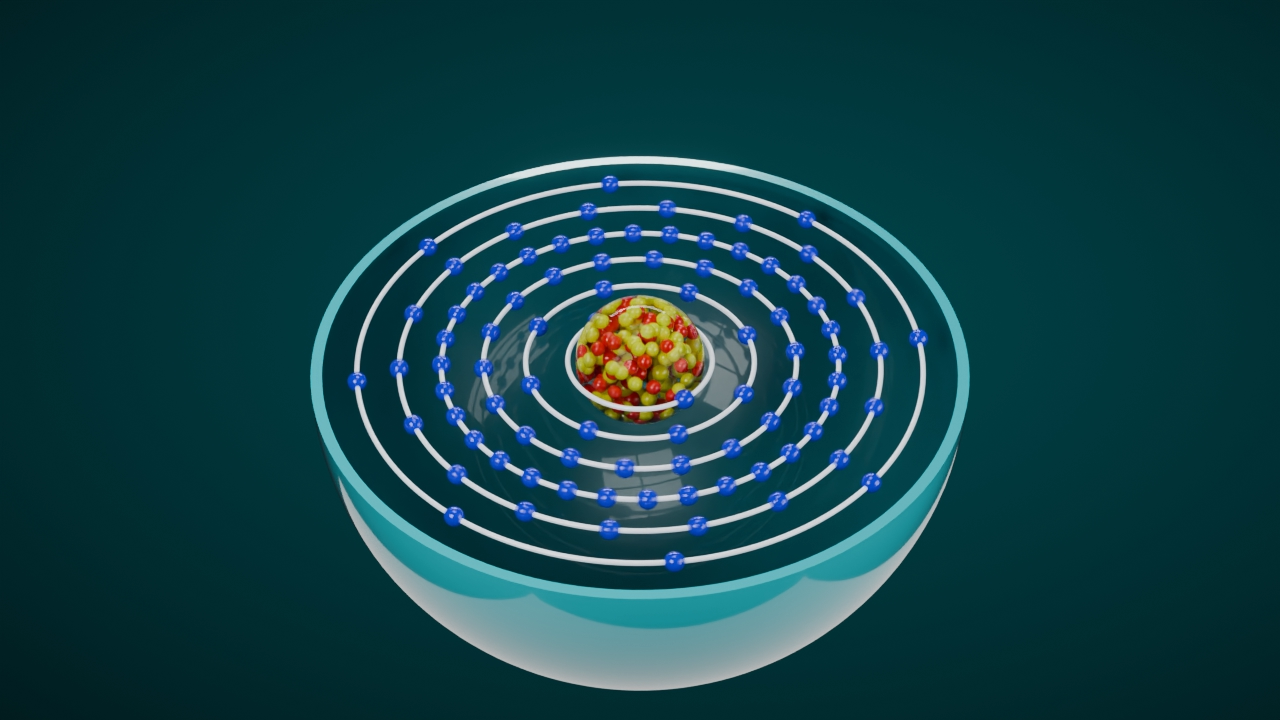
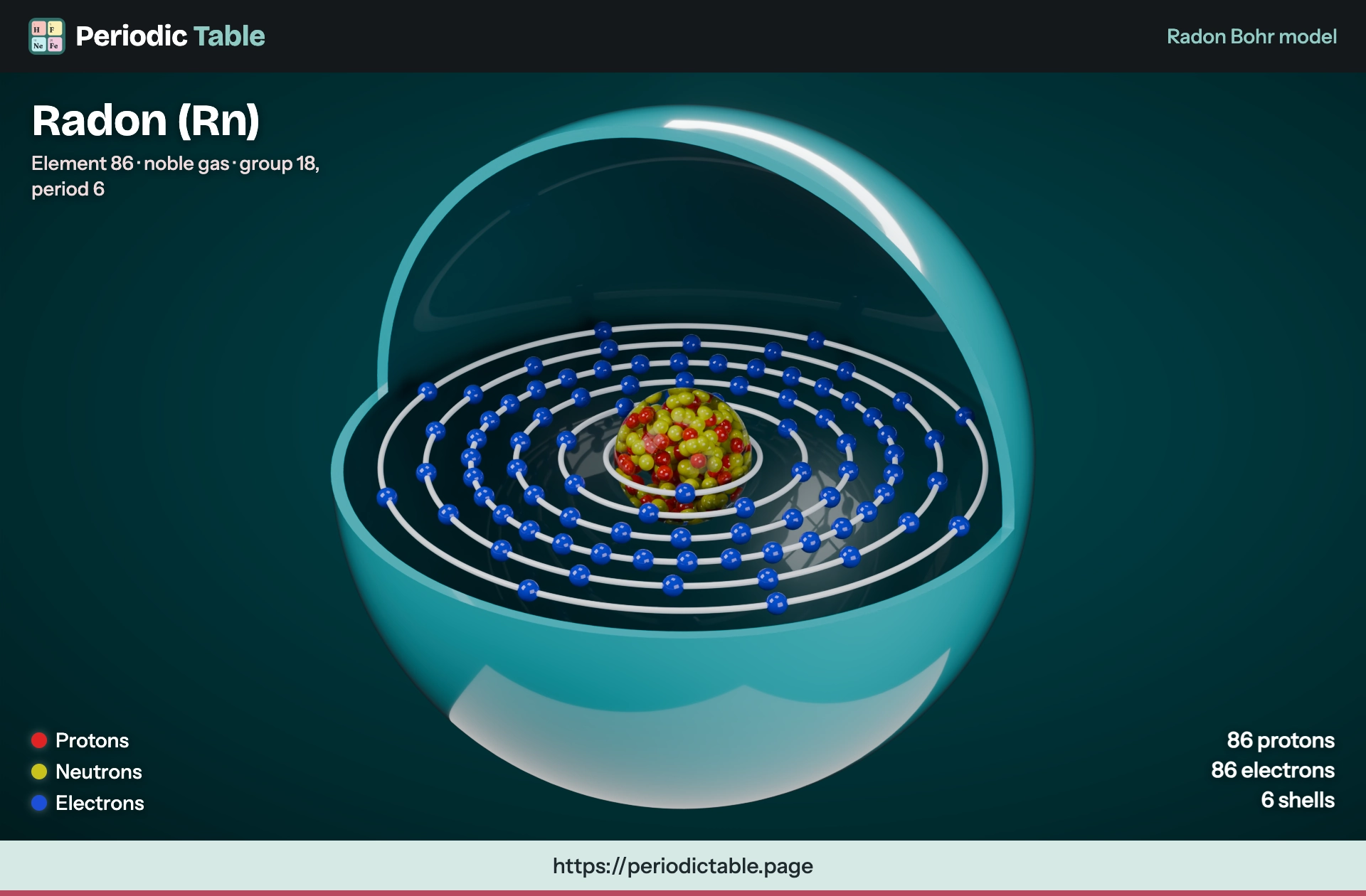
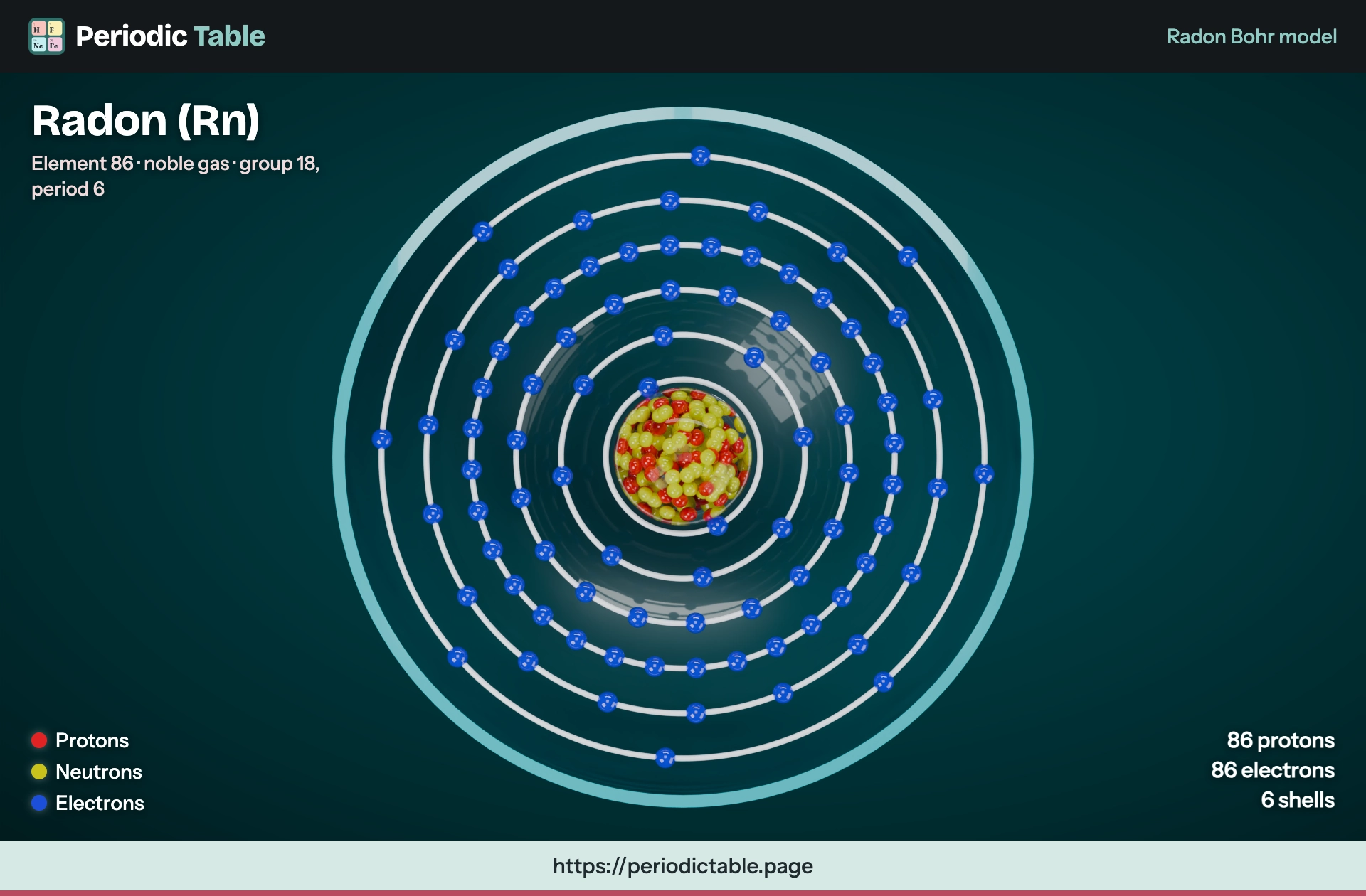
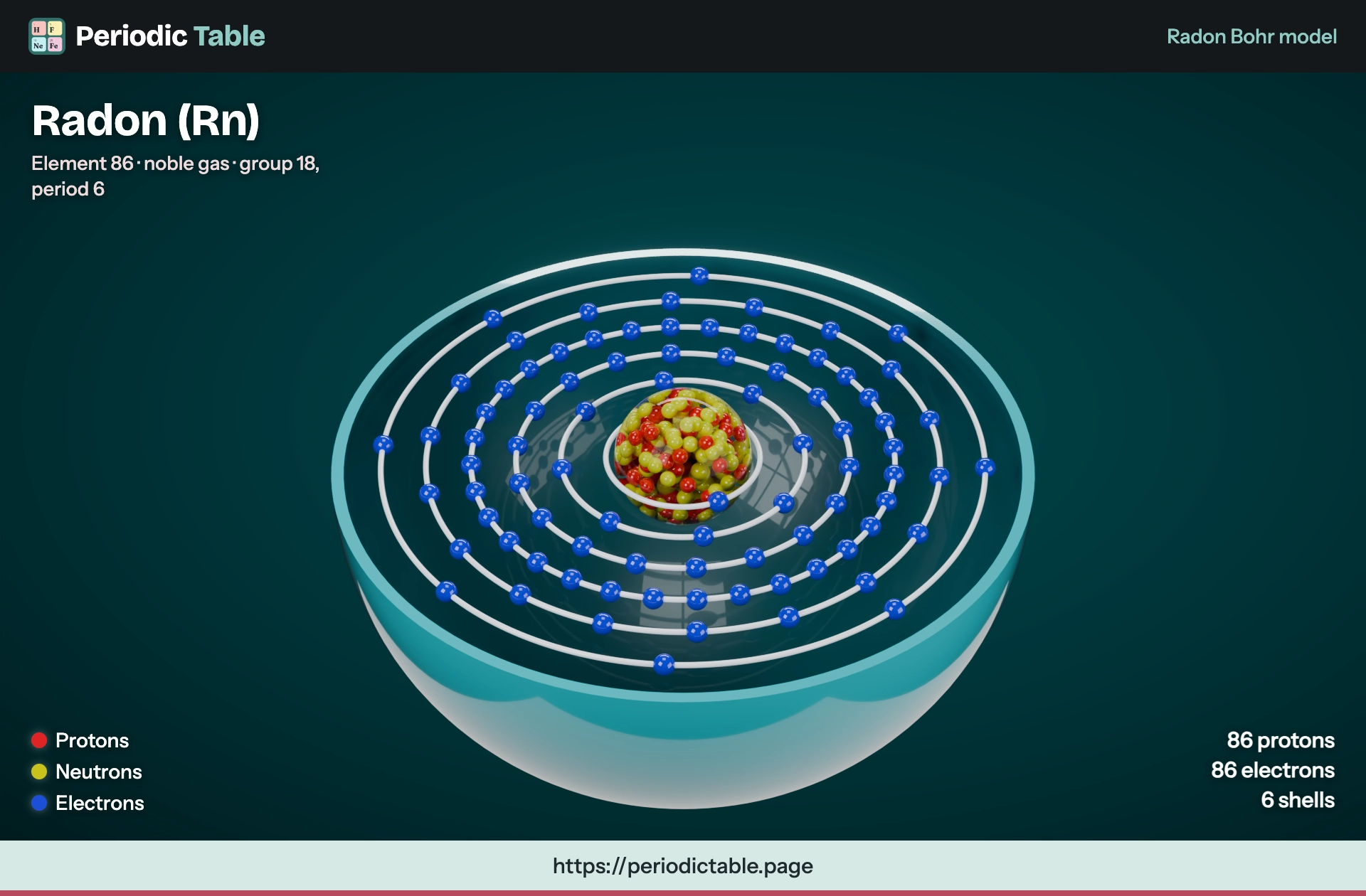
This is a Bohr model of radon (Rn), a simplified picture of a single radon atom. Its nucleus holds 86 protons, and a neutral radon atom has 86 electrons, arranged around it in 6 shells (2 in shell K, 8 in shell L, 18 in shell M, 32 in shell N, 18 in shell O and 8 in shell P).
Radon periodic table electron configuration
- Shorthand
- [Xe] 4f14 5d10 6s2 6p6
- Full
- 1s2 2s2 2p6 3s2 3p6 4s2 3d10 4p6 5s2 4d10 5p6 6s2 4f14 5d10 6p6
- Electrons per shell
- 2, 8, 18, 32, 18, 8
Radon element properties and atomic data
- Atomic number
- 86
- Atomic mass
- [222] u
- Phase at STP
- Gas
- Melting point
- -71.15°C (202 K)
- Boiling point
- -61.65°C (211.5 K)
- Density
- 0.00973 g/cm³
- Electronegativity (Pauling)
- 2.2
- Period
- 6
- Group
- 18
- Block
- p-block
- Appearance
- Colorless gas, occasionally glows green or red in discharge tubes
- Discovery date
- 1900
- Discovered by
- Friedrich Ernst Dorn
- Named by
- —
Radon element facts at a glance
The radon element sits at the bottom of group 18 on the periodic table, directly below xenon and above oganesson. It belongs to period 6 and the p-block, and because it has no stable isotopes, its relative atomic mass is quoted as [222], the mass number of its longest-lived isotope. Every value in the table below is a measured or standard reference figure for element 86. Readers asking about bananas can check potassium (K) for radioactivity and the potassium-40 in food.
| Property | Value for radon (Rn) |
|---|---|
| Atomic number | 86 |
| Atomic mass | [222] (most stable isotope) |
| Group / period / block | Group 18 (noble gases) / period 6 / p-block |
| State at 20 °C | Gas |
| Melting point | 202 K (−71 °C, −96 °F) |
| Boiling point | 211.5 K (−61.7 °C, −79.1 °F) |
| Density at STP | 9.73 g/L (about 8 times air) |
| Critical point | 377 K, 6.28 MPa |
| Heat of fusion | 3.247 kJ/mol |
| Heat of vaporization | 18.10 kJ/mol |
| Covalent radius | 150 pm |
| Van der Waals radius | 220 pm |
| Electronegativity (Pauling) | 2.2 |
| First ionization energy | 1037 kJ/mol |
| CAS number | 10043-92-2 |
Atomic number and electron configuration of Rn
With 86 protons, radon has the shell structure 2, 8, 18, 32, 18, 8. Its electron configuration is written in shorthand as [Xe] 4f14 5d10 6s2 6p6: everything xenon has, plus filled 4f, 5d, 6s and 6p subshells. That closed outer shell of eight electrons is what gives Rn its noble-gas character in chemistry terms.
The atom holds those outer electrons tightly, though not as tightly as lighter noble gases do, because the outermost shell sits farther from the nucleus and is screened by many inner electrons. This is why radon's first ionization energy (1037 kJ/mol) is the lowest in its group, and why it is the most reactive of the naturally occurring noble gases.
Why radon is the heaviest noble gas
Radon earns the title of heaviest noble gas found in nature simply by size: its nucleus carries more protons and neutrons than helium, neon, argon, krypton or xenon. Like the rest of the noble gas column, it is close to chemically inert, so it rarely bonds with anything. That combination of weight and low reactivity is exactly why radon gas drifts out of rock, slips through soil, and settles low in buildings rather than reacting along the way. A summary of the meitnerium atom suggests a noble metal like iridium, though no chemistry has yet been measured.
Physical properties: boiling point, melting point and density
At room temperature radon is a monatomic gas: single atoms, not molecules. It is colorless, odorless and tasteless, so none of your senses will ever detect it. Its density of 9.73 g/L makes it the densest of the noble gases and one of the densest gases of any kind at room temperature, roughly eight times heavier than the air you breathe.
Cool radon below its boiling point of 211.5 K and it condenses into a liquid; take it below its melting point of 202 K and it freezes solid. Both phases show a striking effect called radioluminescence: the radioactive decay inside the sample makes it glow, shifting from yellow toward orange-red as the temperature drops.
Because concentrated radon is so hazardous, liquid and solid radon are almost never seen outside specialist laboratories. In a cloud chamber, the ionizing tracks left by its decay appear as thin white trails, a classic way of showing that the gas is there even though it is invisible.
Chemical properties and radon compounds
Radon's chemical properties follow the noble-gas pattern with a twist. Its outer shell is full, so it resists combustion and most ordinary reactions.
But its electronegativity is lower than xenon's, so strong oxidizers can pull electrons away. Part of the reason is the inert pair effect, which stabilizes the 6s electrons; explaining it properly needs relativistic quantum chemistry, because electrons this close to a heavy nucleus move fast enough for relativity to matter.
The best-known of the few radon compounds is radon difluoride (RnF2), formed when radon meets fluorine or other powerful fluorinating agents. It was a landmark for noble-gas chemistry when it was first made, it breaks down above about 250 °C, and its short-lived radioactivity has kept anyone from studying it in detail. Radon trioxide (RnO3) is the only confirmed oxide, while higher fluorides such as RnF4 and RnF6 are predicted but not confirmed.
Early work also suggested that radon hydrate should be about as stable as the hydrates of chlorine and sulfur dioxide. In practice, the common oxidation states are 0 and +2, with +6 seen only in the trioxide. Because radon is expensive and intensely radioactive, very little experimental chemistry has ever been done with it.
Radon isotopes, half-life and the decay chain
Radon has no stable isotopes at all. Thirty-nine radioactive isotopes have been identified, with mass numbers from 193 to 231, and six of them (217 to 222) occur naturally.
Radon decay never pauses, so the radon on Earth today exists only because the radioactive decay chain of uranium and thorium keeps replacing it. Each isotope's half-life, the time it takes for half of a sample to decay, decides how far radon can travel before it disappears.

Radon-222, thoron and actinon
Three natural forms matter, one for each natural decay series:
- Radon-222 (Rn-222): half-life 3.8235 days, made by radium-226 in the uranium-238 series. It is the isotope people mean when they say "radon."
- Thoron (Rn-220): half-life 55.6 seconds, made in the thorium-232 series.
- Actinon (Rn-219): half-life 3.96 seconds, made in the actinium (uranium-235) series.
The difference in half-life is the whole story. Thoron and actinon usually decay within centimetres of where they form, so they rarely escape rock or soil.
Rn-222 lasts long enough to diffuse through the ground and into the air, which is why it dominates radon levels everywhere. Of the artificial isotopes, Rn-211 (about 15 hours) and Rn-210 (2.4 hours) live longest, but neither occurs naturally.
Radon daughters and radioactive decay to lead
When Rn-222 decays it doesn't simply vanish. It starts a fast sequence of short-lived radon daughters, also called radon progeny, before ending as stable lead. Here is the main branch of the chain:
- Radon-222 (3.82 days) emits alpha particles and becomes polonium-218
- Polonium-218 (3.10 minutes) emits an alpha particle and becomes lead-214
- Lead-214 (26.8 minutes) emits beta particles and becomes bismuth-214
- Bismuth-214 (19.9 minutes) emits beta particles and gamma radiation and becomes polonium-214
- Polonium-214 (0.164 milliseconds) emits an alpha particle and becomes lead-210
- Lead-210 (22.3 years) decays slowly through bismuth-210 and polonium-210 to stable lead-206
The four short-lived products between Rn-222 and lead-210 do most of the biological damage, because they are electrically charged solids that stick to dust and to the lining of your lungs. Scientists describe how far they've built up with the equilibrium factor: 1 means the daughters are as active as the radon itself, while a typical home sits nearer 0.4 because ventilation and surfaces remove some of them. The same predictable 3.8-day clock makes radon useful as a natural tracer in hydrology and atmospheric research.
History of radon: from radium emanation to element 86
Radon was the fifth radioactive element discovered, after uranium, thorium, radium and polonium. In 1899, Ernest Rutherford and Robert B. Owens at McGill University in Montreal noticed that thorium compounds gave off a radioactive gas, which Rutherford called an "emanation."
The same year, Pierre Curie and Marie Curie saw that gas released by radium stayed radioactive for about a month. In 1900, the German physicist Friedrich Ernst Dorn described the gas coming from radium compounds and named it "radium emanation", and in 1903 André-Louis Debierne found a third emanation from actinium.
In 1901, Rutherford and Harriet Brooks showed the emanations were themselves radioactive. In 1904, William Ramsay pointed out that their spectra resembled those of argon, krypton and xenon and suggested a new noble gas.
Ramsay and Robert Whytlaw-Gray then isolated it around 1909-1910, measured its melting point and showed it was the heaviest gas known. They proposed the name niton, from the Latin for "shining," after its glow.

The naming took decades to settle. The three emanations were briefly called radon, thoron and actinon in 1920, and in 1923 IUPAC chose radon, after the most stable isotope, as the name of the whole element. Even so, chemists still called it emanation into the 1960s.
The first radon compound, a radon fluoride, was made in 1962. Radon also shaped how radioactivity is measured: the curie, named for the Curies, was first defined in 1910 as the amount of radon emanation in equilibrium with one gram of radium, about 37 billion decays per second.
Where radon gas comes from in nature
Natural radon starts deep in the decay chain of uranium-238, a nuclide with a half-life of about 4.5 billion years. Uranium decays slowly into radium-226, and radium-226 decays into radon gas.
Because the parents are so long-lived, the supply never runs out. Radon will be present for billions of years even though each atom lasts only days.
How much radon you meet depends on where you are. In the open atmosphere, radon concentration over land is typically 10 to 30 Bq/m³, and above the open ocean it can fall below 1 Bq/m³ because there is almost no soil to feed it.
The whole Earth's atmosphere holds only a few tens of grams of radon at any moment, constantly topped up as older atoms decay. Outdoor air is the baseline that indoor radon is always compared against.
Rocks and minerals rich in uranium release the most: granite, shale, phosphate rock, gneiss and schist, and to a lesser degree limestone. Every few square kilometres of topsoil holds about a gram of radium, which leaks radon into the atmosphere, and local geology decides how much reaches the surface. Radon also dissolves in groundwater, so spring waters and hot springs in places like Bad Gastein in Austria and Misasa in Japan can carry high levels.
Even so, its crustal abundance is tiny, about 0.0000000000004 parts per million. Radon trapped in permafrost can be released as it thaws, and radon readings are often higher over geological faults, where cracks give the gas an easy path upward.
How indoor radon builds up in basements
Outdoors, radon mixes into open air and stays dilute. Indoors it can't escape so easily.
Indoor radon mostly enters from the soil through the lowest part of a building: cracks in foundations, construction joints, gaps around service pipes, sumps and drains, and sometimes the water supply or building materials such as certain granites. Because the gas is heavy and a warm house draws air up from the ground like a chimney, radon levels are usually highest in basements and crawlspaces, and poor ventilation lets them climb further.
The problem became famous in 1984. Stanley Watras, an engineer at the Limerick Generating Station in Pennsylvania, kept setting off radiation alarms on his way into the plant before it had ever been fuelled.
The source turned out to be his own home, where the basement measured about 100,000 Bq/m³, thousands of times the typical level. Since then, millions of homes have been tested for indoor radon, and regions with uranium-rich ground, such as Iowa in the United States and Cornwall in the United Kingdom, show some of the highest averages.
Radon concentration units and the working level
Radon concentration is measured by its radioactivity, not by weight, because the amounts involved are far too small to weigh. Three units are in common use:
| Unit | What it measures | Conversion |
|---|---|---|
| Becquerel per cubic metre (Bq/m³) | Decays per second in a cubic metre of air (SI unit) | 1 Bq = one decay per second |
| Picocuries per liter (pCi/L) | Activity in a litre of air (common in the US) | 1 pCi/L = 37 Bq/m³ |
| Working level (WL) | Potential alpha energy from short-lived daughters in a litre of air | 1 WL = 1.3 × 10⁵ MeV per litre |
One becquerel is a single atom decaying each second. Miners' cumulative exposure is tracked in the working level month (WLM), equal to one WL breathed for 170 working hours. To convert a home reading, multiply picocuries per liter by 37: a basement reading of 6.2, for example, works out to a radon concentration of 229.4 Bq/m³.
Uses of radon in medicine and science
Radon has few commercial uses, but its radioactivity has been put to work. In early radiation therapy, gold or glass "seeds" filled with radon were implanted directly into tumours, a form of brachytherapy. The gold shell held the gas and blocked its alpha and beta particles while letting gamma rays through to destroy diseased tissue.
After 11 half-lives, about 42 days, a seed's radon activity falls to 1/2,048 of its starting level. Accelerator- and reactor-made isotopes have since replaced radon in cancer treatment and nuclear medicine, although Rn-211 is still used to make astatine-211 for targeted alpha therapy.
In science, radon's predictable decay makes it a useful tracer. Hydrologists use it to find where groundwater feeds a river, geologists map buried faults with it, and meteorologists use outdoor readings to track air masses.
Researchers have studied rising groundwater radon as a possible earthquake prediction signal, though the results have been inconsistent. In the 1940s and 1950s, radon from radium sources was also used as a gamma radiation source for industrial radiography, until cobalt-60 and iridium-192 took over.
The less flattering history involves radon spas and "health mines," where visitors breathe radon-rich air or bathe in radioactive water in the hope of relieving arthritis. Supporters cite radiation hormesis, the idea that small doses stimulate the body's repair systems, but the claim remains contested, and health agencies discourage the practice because of the well-documented harm from radiation.
Radon health risks and lung cancer
Radon has no biological role in plants or animals. Its health risks come almost entirely from breathing in its short-lived daughters.
They lodge in the airways and fire alpha radiation into the cells lining your lungs. That ionizing radiation can break DNA directly or create free radicals that cause further cell damage, and over years, that damage can turn into lung cancer.
According to the US Environmental Protection Agency (EPA), radon is the second biggest cause of lung cancer after smoking, linked to about 21,000 deaths a year in the United States, and the top cause among non-smokers. The two risks multiply: in EPA estimates, roughly 62 in every 1,000 smokers with prolonged high exposure would die of lung cancer, against about 7 in 1,000 people who have never smoked. Epidemiology from pooled North American and European studies supports a raised risk after years of home exposure, which is why radon is treated as a public health issue rather than a niche one.
For many people, radon is also the largest single source of natural radiation they receive; in the UK it accounts for around half of the average annual radiation dose. Swallowing radon in drinking water carries far less risk than breathing it.
Radon exposure in uranium mines and homes
The first clear evidence came from uranium mines. In the 1940s and 1950s, before good ventilation was required, miners in central Europe, the southwestern US and South Australia developed lung cancer at high rates, even among non-smokers.
The International Agency for Research on Cancer now classes radon's decay products as carcinogenic to humans. Ventilation has since brought most miners' radon exposure down to levels similar to some homes, but it remains a recognised occupational hazard, and old unventilated workings can still hold extreme concentrations.
Today, most people's dose comes from their own homes, where they spend most of their time and the air is exchanged far less than outdoors. The greatest risk is in airtight, poorly ventilated buildings with leaky foundations.
If you smoke, lowering radon exposure at home matters even more, because smoking and radon multiply each other's effect on the lungs. Outdoor radon in the wider environment is rarely a significant risk, because it disperses quickly into the atmosphere.
EPA action level and WHO reference level
Different agencies draw the line at different points. A national reference level is meant as the maximum acceptable annual average in a home, not a safe limit, and the right answer to a high reading is to reduce it rather than live with it.
| Organization | Guideline for homes | In Bq/m³ |
|---|---|---|
| World Health Organization | Reference level (300 Bq/m³ upper limit where 100 isn't practical) | 100 |
| EPA (United States) | Action level 4 pCi/L; consider fixing from 2 pCi/L | 148 (74) |
| European Union | 200 for new homes, 400 for older homes | 200-400 |
| UK Health Protection Agency | Target 100, action level 200 | 100-200 |
Measured against these, the 229.4 Bq/m³ basement from the unit example above sits over the EPA action level, the WHO reference level and the EU new-home figure all at once. Lowering it is one of the most effective steps you can take for indoor air quality.

How to run a radon test and lower levels
Because nothing about radon can be sensed, testing is the only way to know your level, and mitigation is usually simple once you do. In the US, the EPA advises buyers to delay or decline a home purchase if the seller hasn't reduced radon to the action level or below.
Short-term and long-term radon detectors
A short-term radon test is cheap, sometimes free: you hang a collector in the lowest lived-in floor for two to seven days, then post it to a lab. Long-term kits sample for 90 days to a year and give a truer average, since radon levels swing with weather, season and time of day.
Digital radon detectors show continuous daily and weekly readings. A first result above the 4 pCi/L action level should be confirmed: for readings up to 10, follow up with a longer test; above that, repeat a quick test so a fix isn't delayed.
Sub-slab depressurization and other fixes
The preferred fixes stop radon getting in rather than diluting it afterwards. The main options are:
- Sub-slab depressurization (soil suction): a vent pipe and fan draw radon from under the floor slab and exhaust it above the roofline.
- A radon sump: a small pit under the basement floor connected to the same pipe-and-fan system.
- Better ventilation: more under-floor and room airflow so radon can't build up in living spaces.
- Positive pressurization: a supply-ventilation unit that keeps indoor air pressure slightly higher than the soil.
- Sealing cracks and openings, which helps the systems above but rarely works alone.
Because radon-222's half-life is only 3.8 days, cutting off the source works fast: once entry stops, the gas already inside decays away within weeks. Retest after any fix to confirm the new level.