


Potassium element (K): potassium periodic table facts
Potassium periodic table facts: potassium (K) is element 19, an alkali metal in group 1, period 4. Drop a pea-sized lump of potassium into water and it skates across the surface, fizzing and bursting into a lilac flame within a second. That violent streak is the clue to everything else about element 19, symbol K: you are looking at a soft, silvery white alkali metal you can cut with a knife, so eager to give away one electron that potassium metal never survives in nature, yet its ions run your nerves and feed the world's crops. Clean energy and industry both lean on the hydrogen atomic number, which sets out how the gas behaves in chemical reactions.
Rotate the 3D Bohr model of potassium
Drag to orbit, scroll to zoom.
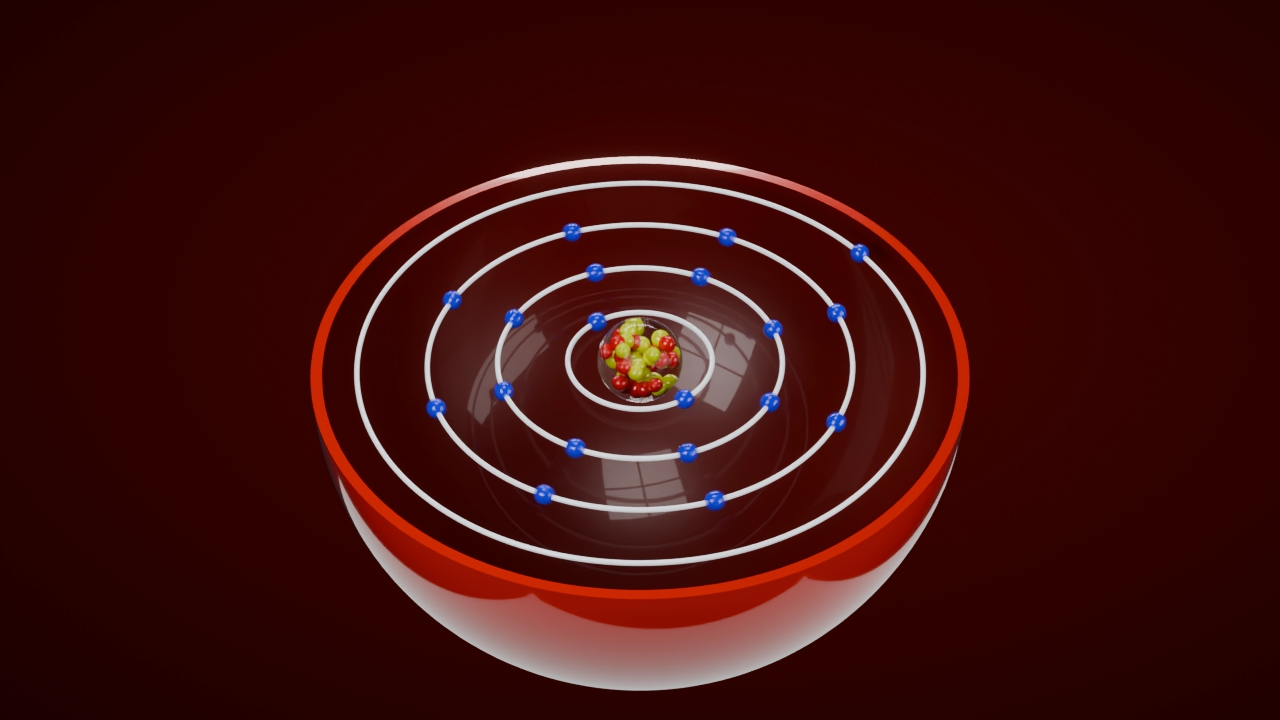
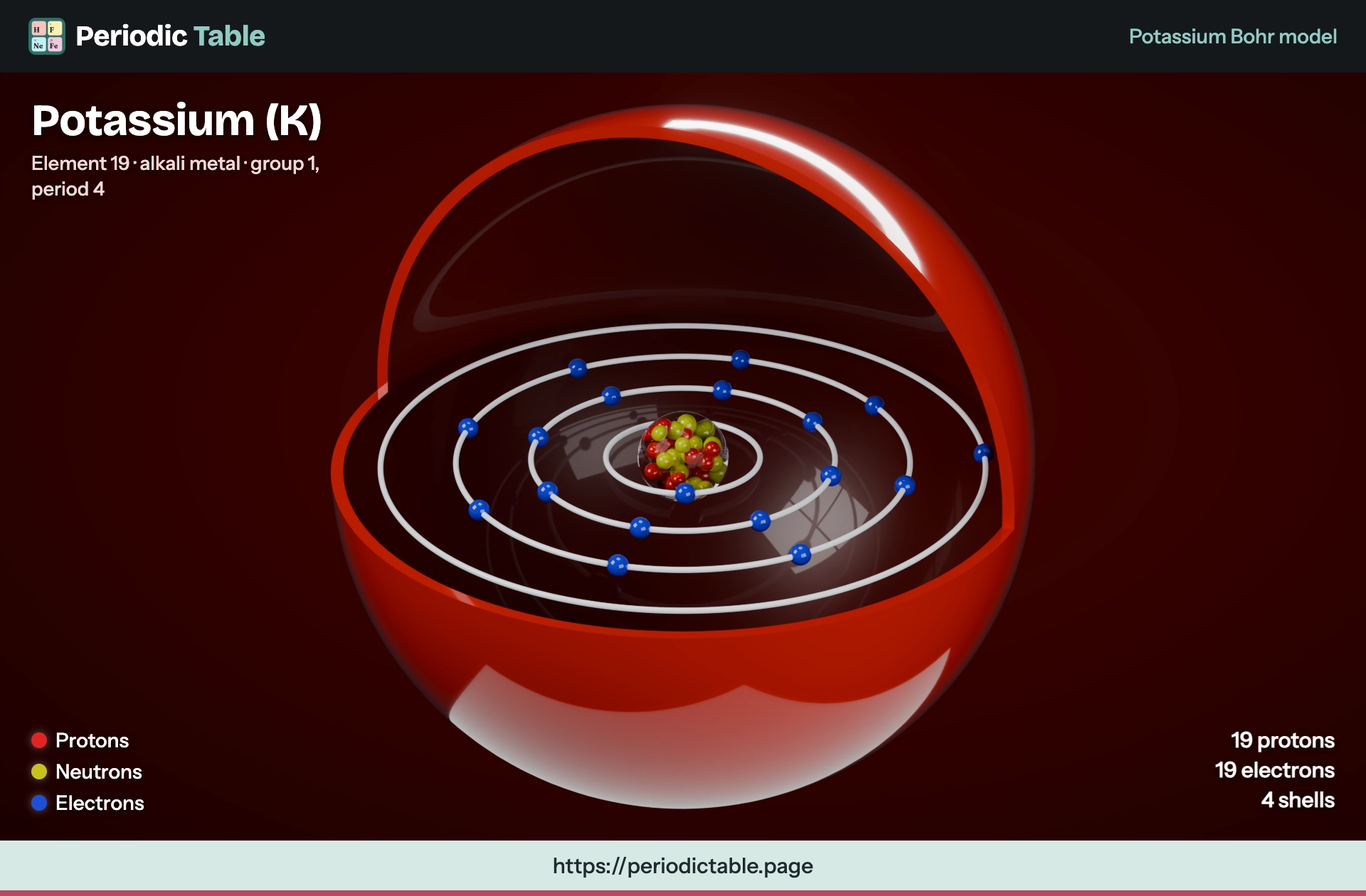
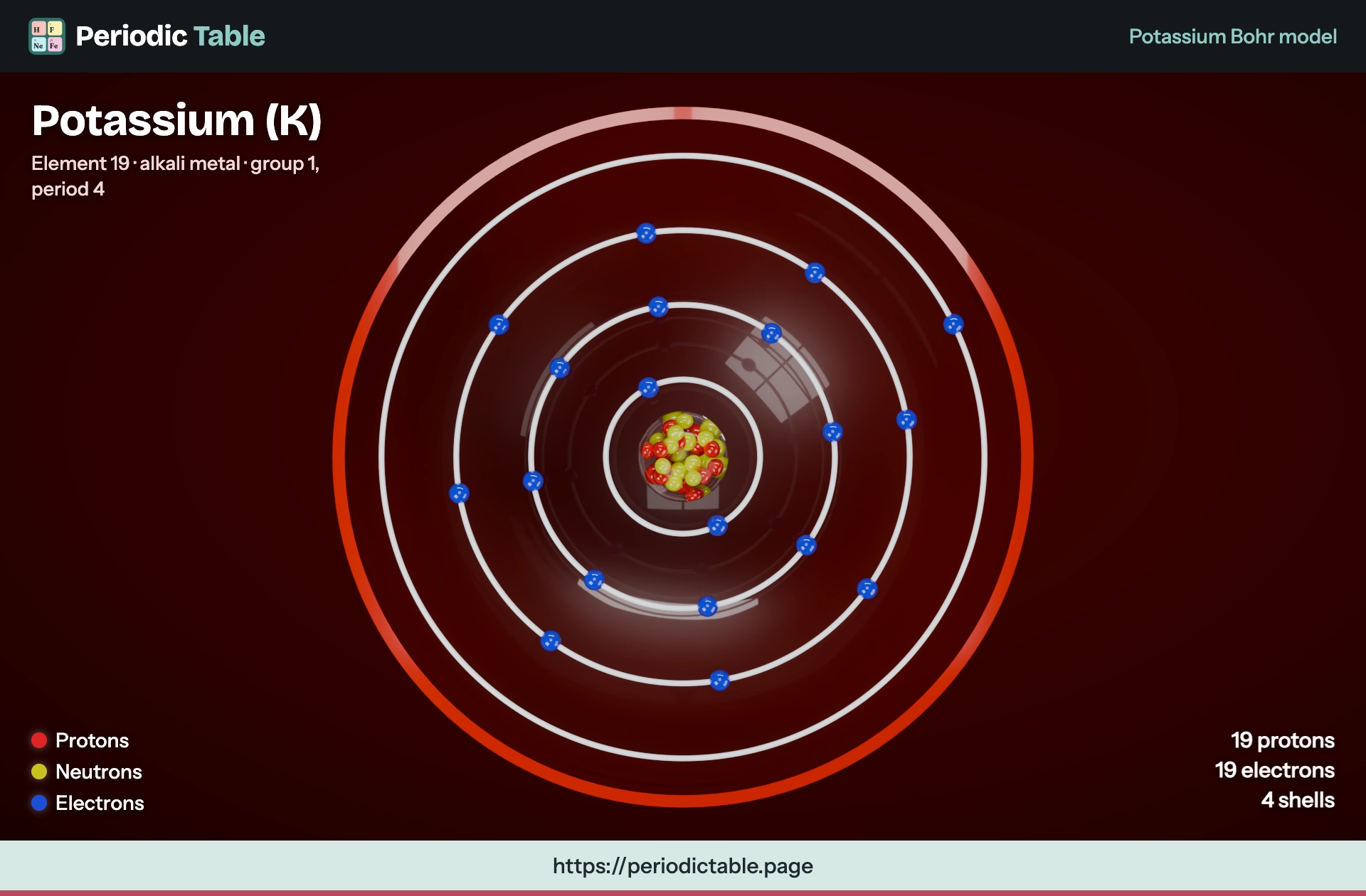
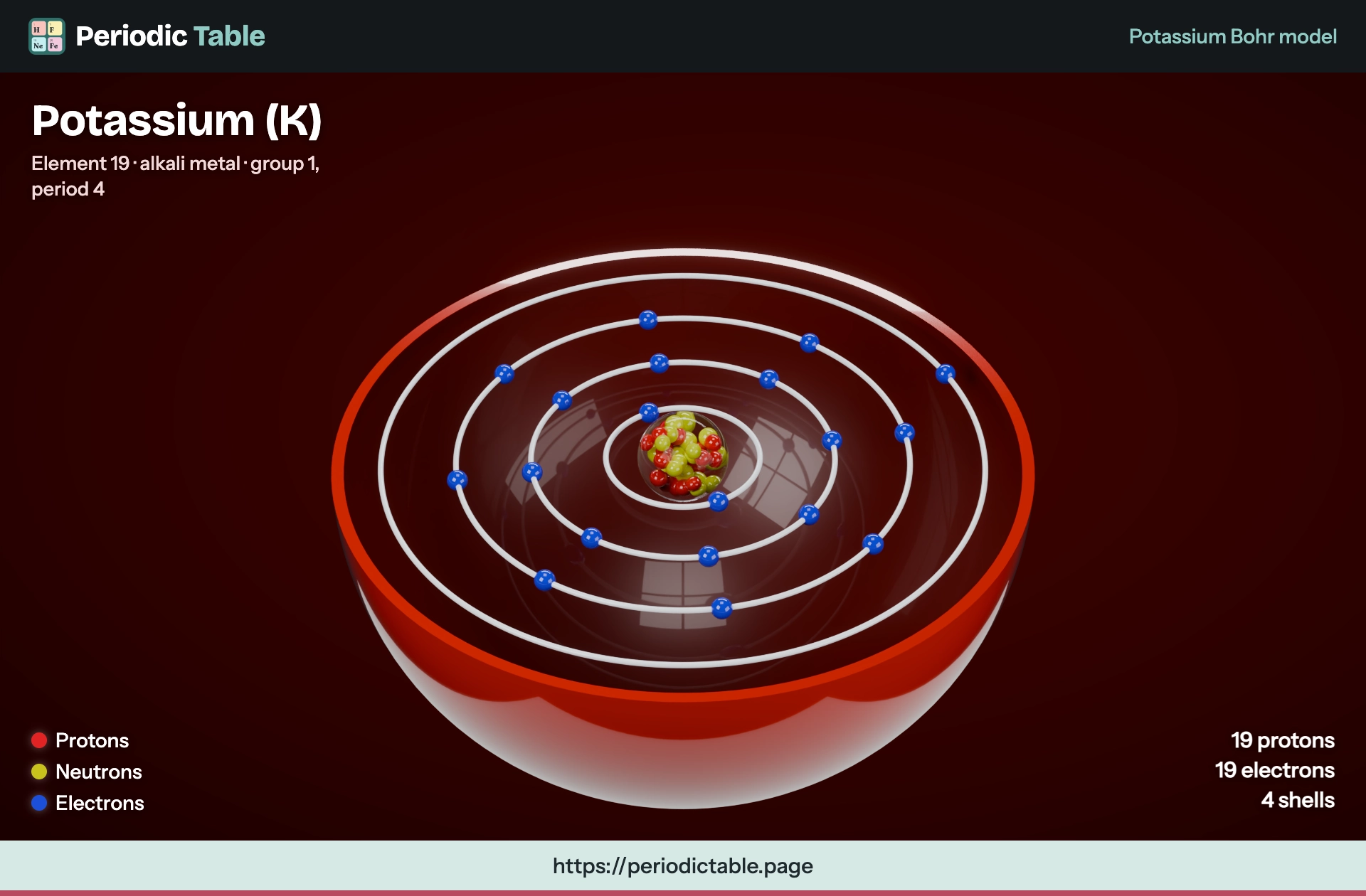
This is a Bohr model of potassium (K), a simplified picture of a single potassium atom. Its nucleus holds 19 protons, and a neutral potassium atom has 19 electrons, arranged around it in 4 shells (2 in shell K, 8 in shell L, 8 in shell M and 1 in shell N).
Potassium periodic table electron configuration
- Shorthand
- [Ar] 4s1
- Full
- 1s2 2s2 2p6 3s2 3p6 4s1
- Electrons per shell
- 2, 8, 8, 1
Potassium element properties and atomic data
- Atomic number
- 19
- Atomic mass
- 39.0983 u
- Phase at STP
- Solid
- Melting point
- 63.55°C (336.7 K)
- Boiling point
- 758.85°C (1032 K)
- Density
- 0.862 g/cm³
- Electronegativity (Pauling)
- 0.82
- Period
- 4
- Group
- 1
- Block
- s-block
- Appearance
- Silvery gray
- Discovery date
- 1807
- Discovered by
- Humphry Davy
- Named by
- —
Potassium element facts: atomic number, mass and density
The potassium element is a chemical element with atomic number 19, which means every one of its atoms carries 19 protons in the nucleus and, when neutral, 19 electrons around it. Its standard atomic weight is 39.098, and a solid block is light enough to float on water. The table below gathers the reference values you will want most often for K. Thermal conductivity and oxygen reactions are compared in silver uses, with notes on industry uses.
| Property | Value for potassium (K) |
|---|---|
| Symbol | K (from kalium) |
| Atomic number | 19 |
| Standard atomic weight | 39.098 |
| Group / period / block | Group 1, period 4, s-block |
| Electron configuration | [Ar] 4s1 (2, 8, 8, 1) |
| Melting point | 63.5 °C (336.7 K) |
| Boiling point | 759 °C (1032 K) |
| Density at 20 °C | 0.86 g/cm3 |
| Electronegativity | 0.82 (Pauling scale) |
| First ionization energy | 418.8 kJ/mol |
| Atomic radius (empirical) | 227 pm |
| Crystal structure | Body-centered cubic |
| Common oxidation state | +1 |
| CAS number | 7440-09-7 |
A density below 1 g/cm3 is unusual for a metal: only lithium and sodium join it in that club, and K is the second-lightest metal after lithium.
Electron configuration, electronegativity and ionization energy
Write out the electron configuration in full and you get 1s2 2s2 2p6 3s2 3p6 4s1: an argon core plus one lonely valence electron in the fourth shell. That single electron sits far from the nucleus and is well shielded, so removing it is cheap.
The first ionization energy is just 418.8 kJ/mol, while the second jumps to about 3052 kJ/mol because it would break into the stable argon core. That gap is why the element almost always appears as the K+ cation.
The same story shows up in its electronegativity of 0.82 on the Pauling scale, one of the lowest values of any element, and in a modest electron affinity of about 48.4 kJ/mol. Put simply, K wants to lose an electron, not gain one.
$$\text{K} \rightarrow \text{K}^{+} + e^{-} \qquad \Delta H = +418.8\ \text{kJ/mol}$$
Where potassium sits in the periodic table
On the periodic table, element 19 sits in group 1, period 4, at the start of the s-block. Its left-hand neighbour in atomic number is the noble gas argon (element 18), and the next element along is calcium (element 20). Because every group 1 member ends its configuration with a single s electron, they share a family resemblance: soft, low-melting, strongly reducing and quick to form +1 ions. Geology of rocks and minerals that release this colorless gas is the subject of the radon element, plus air quality advice.
How K compares with the other alkali metals
Reading down the alkali metals, atoms get bigger, the outer electron is held more loosely and reactivity climbs. K is noticeably more reactive than sodium and lithium, but tamer than rubidium and caesium. Melting points fall steadily down the group, while density does not rise neatly: K is actually less dense than sodium above it.
| Alkali metal | Symbol | Melting point (°C) | Density (g/cm3) | Reaction with water |
|---|---|---|---|---|
| Lithium | Li | 180.5 | 0.53 | Steady fizzing |
| Sodium | Na | 97.8 | 0.97 | Melts into a ball, rushes about |
| Potassium | K | 63.5 | 0.86 | Ignites hydrogen, lilac flame |
| Rubidium | Rb | 39.3 | 1.53 | Explosive |
| Caesium | Cs | 28.5 | 1.93 | Violently explosive |
Sodium and K are the pair you will meet most in everyday metals chemistry and in biology, and their salts behave almost identically in solution, which is why it took chemists until the 1700s to accept they were different substances.
Physical properties of potassium metal
The physical properties of potassium metal make it look almost harmless. A freshly cut surface is bright and silvery, the metal is a soft metal with a Mohs hardness of about 0.4, and it can be sliced like cold butter. Its melting point of 63.5 °C means a sample would melt in a cup of hot tea, if it did not set the tea on fire first.
That bright lustre does not last. Exposed to air, it tarnishes to a dull grey or bluish-purple skin within seconds to minutes as oxides form, so laboratories keep it under paraffin or another dry hydrocarbon. It conducts heat and electricity well, as you would expect from a free valence electron.
Boiling point, atomic radius and crystal structure
The liquid range is wide: the solid melts at 63.5 °C and only reaches its boiling point at about 759 °C. Its empirical atomic radius of 227 pm is far larger than sodium's, which explains the weaker metallic bonding and the low melting point. In the solid, the atoms pack in a body-centered cubic lattice, a fairly open arrangement that suits big, loosely bonded atoms and adds to the low density.
Chemical properties of elemental potassium
The chemical properties of elemental potassium all come back to that easily lost 4s electron. It is one of the most electropositive metals known and a powerful reducing agent: it can strip chlorine from magnesium chloride to leave magnesium metal behind. Its reactivity is high enough that chemists handle it with air-free techniques, under argon or nitrogen.
It dissolves in liquid ammonia to give a deep blue solution of solvated electrons, and it slips between the layers of graphite to form a golden compound, KC8. Crown ethers can wrap around the K+ ion and drag its salts into organic solvents.
Reaction with water and oxygen
The metal reacts with water to form potassium hydroxide and hydrogen gas, and it reacts vigorously enough that the heat released ignites the hydrogen:
$$2\,\text{K} + 2\,\text{H}_2\text{O} \rightarrow 2\,\text{KOH} + \text{H}_2$$
Here is what that means in numbers. One gram of K is \(1 \div 39.098 = 0.0256\) mol, which releases \(0.0128\) mol of H2, roughly 0.31 litres of hydrogen at 25 °C, and leaves about 1.43 g of KOH in solution. The burning hydrogen takes on the lilac flame colour of excited potassium atoms.
In air, it burns mainly to the orange superoxide KO2, with potassium peroxide (K2O2) forming under limited oxygen. That is why the metal is stored under mineral oil or kerosene and never in contact with moist air.
Flame test for potassium ions
A classic flame test identifies potassium ions by colour: a wire dipped in a potassium salt turns a gas flame lilac, sometimes described as a pale purple flame, with its strongest emission at about 766.5 nm. Traces of sodium swamp it with yellow, so analysts view it through blue cobalt glass. For accurate numbers, labs use flame photometry, and the fertilizer trade still relies on gravimetric analysis, weighing insoluble potassium salts such as the tetraphenylborate.
Potassium compounds and oxidation states
Nearly all potassium compounds are ionic. The oxidation states are +1 in essentially everything you will handle, and −1 only in exotic alkalide salts where the element becomes the K− anion. Because the K+ ion attracts water strongly, its salts usually show high water solubility; in solution it exists as aquo complexes such as [K(H2O)6]+.
- Oxides: potassium oxide (K2O), the peroxide, the superoxide and the ozonide.
- Halides: potassium fluoride (KF), potassium chloride (KCl), potassium bromide (KBr) and potassium iodide (KI).
- Hydride: potassium hydride (KH), a strong base made directly from the elements.
- Oxidisers: potassium dichromate and permanganate, both standard laboratory reagents.
Small differences in solubility between sodium and K salts matter in practice, for example in separating tantalum from niobium. Notably, no stable nitride of K is known.
Potassium hydroxide, carbonate and nitrate
Potassium hydroxide (KOH, caustic potash) is the commercial workhorse: a strong, corrosive base that dissolves in water with great heat. It turns fats into soft soaps, and it pulls CO2 from air to make potassium carbonate (K2CO3), the original "potash".
Potassium nitrate (KNO3) is the oxidising salt behind black powder and also a fertilizer. Together these three account for much of the tonnage of potassium salts traded, alongside the chloride and sulfate.
Isotopes of potassium and potassium-40
Natural K is a mix of three isotopes: two stable ones and one long-lived radioactive one.
| Isotope | Natural abundance | Half-life | Decay |
|---|---|---|---|
| Potassium-39 | 93.26% | Stable | None |
| Potassium-40 | 0.0117% | 1.25 billion years | Beta decay to calcium-40 (about 89%), electron capture to argon-40 (about 11%) |
| Potassium-41 | 6.73% | Stable | None |
Potassium-40 is the reason every sample of the element is faintly radioactive. Using the constants above, one gram of natural K holds about 1.8 × 10¹⁸ atoms of K-40, giving an activity near 31.7 becquerels per gram.
Scale that up and a 1 kg tub of potassium chloride salt substitute, which is 52.4% K by mass, gives off roughly 16,600 decays every second, harmless but easy to pick up on a Geiger counter. The same isotope is the largest natural source of radioactivity in the human body, and it is why bananas are often joked about as "radioactive fruit".
The slow decay of K-40 to argon-40 underpins potassium–argon radiometric dating. Because argon is a gas, it escapes molten rock; once the rock solidifies, the argon builds up again, and the argon-to-K ratio dates the moment the rock cooled, across millions to billions of years.
History of the element potassium and Humphry Davy
People used potassium salts long before anyone knew the element potassium existed. Alum (potassium aluminium sulfate) was used for dyeing in antiquity, and saltpeter became the oxidiser in gunpowder in China during the first millennium CE.
In October 1807, Humphry Davy passed current from a large voltaic pile through molten caustic potash at the Royal Institution in London. Tiny metallic globules burst through the crust and caught fire: it was the first metal ever isolated by electrolysis, and Davy produced sodium the same way a few days later.
Demand soared after Justus von Liebig showed around 1840 that the element is essential for plant growth, turning potash into a strategic resource.
From potash to kalium: why the symbol is K
The English name comes from potash, the white residue made by soaking wood ash or plant ashes in water and boiling the liquid down in iron pots. Potash was used for soap, glass and bleach for centuries. The symbol K comes from a different root: kalium, the Neo-Latin name proposed in German chemistry and championed by Berzelius in 1814, which traces back to kali and the Arabic al-qali, meaning "plant ashes" and the source of the word alkali.
Klaproth had already recognised in 1797 that potash contained an unknown element. English and French adopted Davy's "potassium", while German and Scandinavian languages kept kalium, which is why the symbol and name do not match.
Where potassium salts occur in nature
Element 19 is forged in massive stars and scattered by supernovae through nucleosynthesis. On Earth it never occurs as a free metal; it is locked in potassium salts and silicate minerals. It makes up about 2.6% of the Earth's crust by weight, roughly the seventh most abundant element there, and seawater carries about 0.39 g of it per litre, far less than its sodium content.
Much of the crustal supply sits in feldspar, especially orthoclase, a common component of granite, but that rock-bound reserve is hard to extract. The economically useful supply comes from evaporite beds: layers of salt left behind when ancient seas and lakes dried out.
Potash mining and supply risk
Mining targets minerals such as sylvite (KCl), carnallite, langbeinite and polyhalite. Canada leads world output, much of it from deep beds about 1,000 metres below Saskatchewan, followed by Russia and Belarus, while Israel and Jordan recover potash from Dead Sea brines. Because a few countries hold most reserves, supply is politically concentrated, even though the element itself is far from scarce.
How pure potassium is produced by electrolysis
Most mined ore is refined to potassium chloride, sold as muriate of potash. Separation from sodium and magnesium salts uses fractional precipitation, flotation or electrostatic methods.
Making pure potassium metal is a much smaller industry. Electrolysis of the molten hydroxide works, just as it did for Davy, but most metal today comes from a thermal route in which sodium vapour reduces molten potassium chloride:
$$\text{Na} + \text{KCl} \rightarrow \text{NaCl} + \text{K}$$
Because K is more volatile, it is drawn off as vapour, pushing the equilibrium forward; adjusting the conditions gives sodium–potassium alloys instead.
Uses of potassium in fertilizer, industry and medicine
The uses of potassium are overwhelmingly about its compounds rather than the metal. Roughly 95% of production goes to agriculture, with the rest split between chemicals, food, glassmaking and medicine. The common potassium uses below follow that order of importance.
Potassium chloride and potassium sulfate in fertilizer
Element 19 is the "K" in NPK fertilizer labels, and harvesting removes it from the soil every season, so crops need it replaced. Potassium chloride supplies about 90% of it, while potassium sulfate serves chloride-sensitive crops such as tobacco and some fruit. Labels state it as K2O, so convert with the factor 0.830: a 50 kg bag of 0-0-60 muriate of potash carries 30 kg of K2O, which is about 24.9 kg of actual K.
Food additives and medical uses
- Potassium chloride tablets and drips treat low blood potassium in medicine.
- Potassium citrate helps prevent certain kidney stones.
- Potassium sodium tartrate (Rochelle salt) appears in baking powder; potassium bromate was used to strengthen dough.
- Potassium bisulfite and sorbate act as a food preservative in wine and baked goods; salt substitutes swap some sodium chloride for KCl.
Many of these food additives carry E-numbers, and the bromate is now banned in many countries.
Potassium superoxide and other industrial uses
Potassium superoxide is a breathing aid in a can: in rebreathers for mines, submarines and spacecraft it absorbs exhaled CO2 and releases oxygen.
$$4\,\text{KO}_2 + 2\,\text{CO}_2 \rightarrow 2\,\text{K}_2\text{CO}_3 + 3\,\text{O}_2$$
Other industrial uses include soap and liquid detergents from KOH, potassium carbonate for specialist glass, potassium cyanide in gold extraction and electroplating, potassium permanganate as an oxidiser and disinfectant, and potassium chlorate in matches and fireworks. KOH is also the electrolyte in alkaline batteries. The liquid alloy NaK serves as a heat-transfer medium in some reactors (engineers also write heat transfer medium) and as a drying agent for solvents.
Biological role of potassium ions in the body
K+ is the main positive ion inside your cells; about 98% of the body's supply sits inside them. Each potassium ion is pumped in by the sodium-potassium pump, which uses ATP to move three sodium ions out and two potassium ions in, creating a voltage across the cell membrane.
That resting membrane potential is what lets nerve impulses travel, so nerve transmission depends on it: during an action potential, K channels open to reset the cell. The same gradient controls muscle contraction, including the heartbeat.
It also helps regulate blood pressure and fluid balance, and as an electrolyte it works alongside sodium and chloride; doctors check these electrolytes together in routine blood tests. Your kidneys fine-tune it hour by hour, excreting more when intake is high and conserving it when intake falls. Inside cells, it activates many enzymes, which makes it an essential nutrient for every animal.
Potassium in plants
For plants, K is a major nutrient, and its plant chemistry is well studied. It controls the opening of leaf pores, keeps cells firm, drives sugar transport and supports photosynthesis. A shortage shows up as scorched leaf edges and lower crop yields, which is exactly why fertilizer demand is so large.
Nutrition and dietary sources
Good dietary sources are fresh fruits and vegetables, beans, potatoes, dairy and fish, and most adults are advised to aim for several grams a day. Too little leads to hypokalemia (also spelled hypokalaemia), with weakness, cramps and an irregular heart rhythm; too much, usually from kidney problems or supplements, causes hyperkalaemia, which can be just as dangerous for the heart. Supplements should follow medical advice.
Potassium safety: handling the alkali metal
Potassium (K) as a metal is a fire hazard. It reacts with water, sweat and humid air, so handle it with tongs under dry conditions and store it under oil. Old samples can grow a crust of superoxide that may explode when cut, so aged stock is destroyed rather than used.
Alkali metal fires need dry sand or a Class D extinguisher, never water or CO2. Its everyday compounds, by contrast, are mostly safe in normal amounts, and the chemistry that makes the metal dangerous is the same chemistry that makes its ions so useful.