


Silver element (Ag): silver periodic table facts
Silver periodic table facts: silver (Ag) is element 47, a transition metal in group 11, period 5. If you have ever wondered why a mirror, a solar cell and a wedding ring might all share one ingredient, the answer is silver, the chemical element with the symbol Ag. After reading about Boyle and Cavendish, anyone studying hydrogen isotopes can follow the story through to the Hindenburg and airships.
It is a soft, lustrous white metal and a transition metal that carries the highest electrical conductivity of any element, which is why it turns up far beyond the jewelry box. Here you will find its key numbers, how its atoms behave, where it is mined and what silver is used for today.
Rotate the 3D Bohr model of silver
Drag to orbit, scroll to zoom.
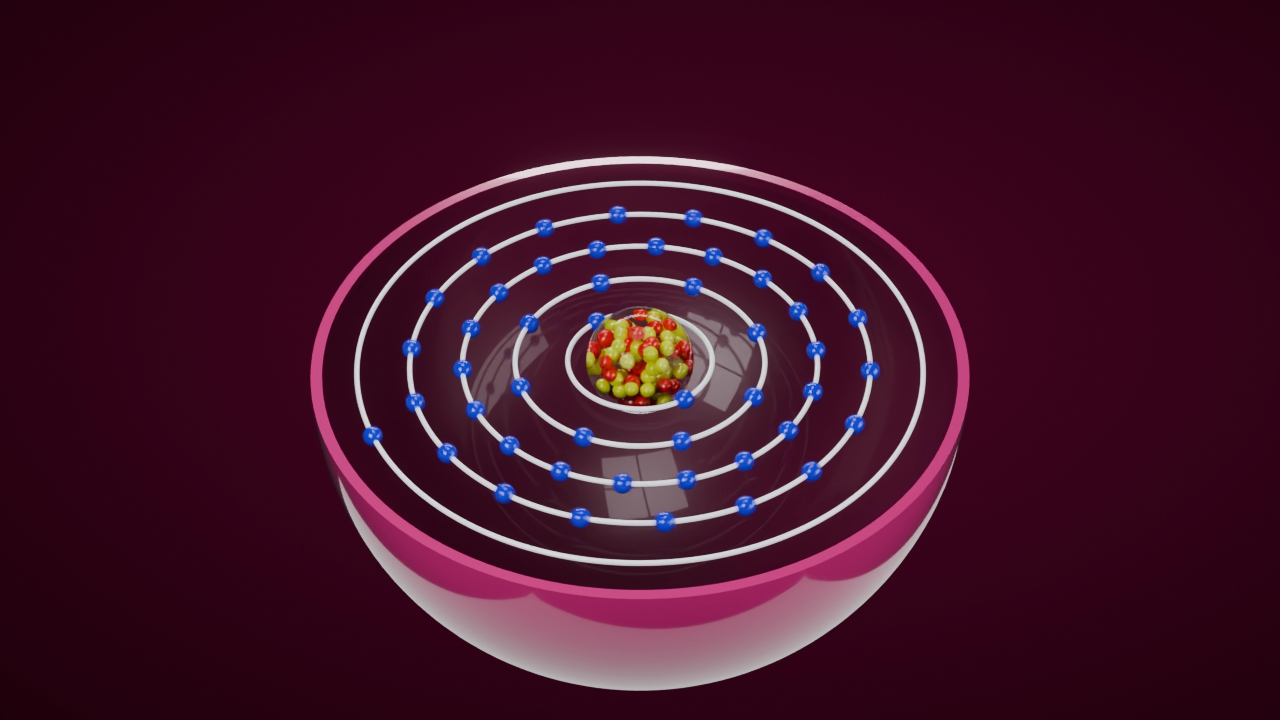
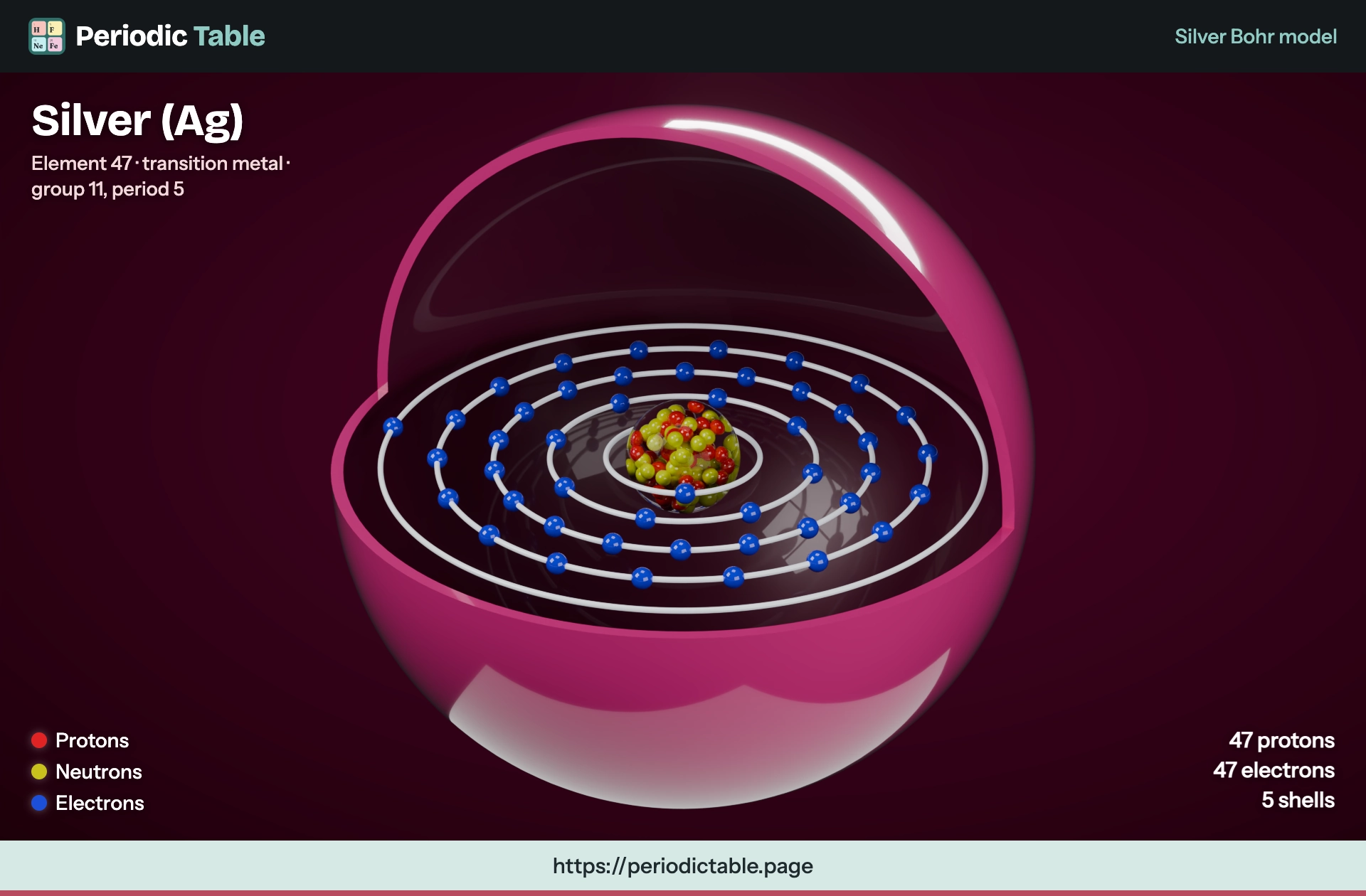
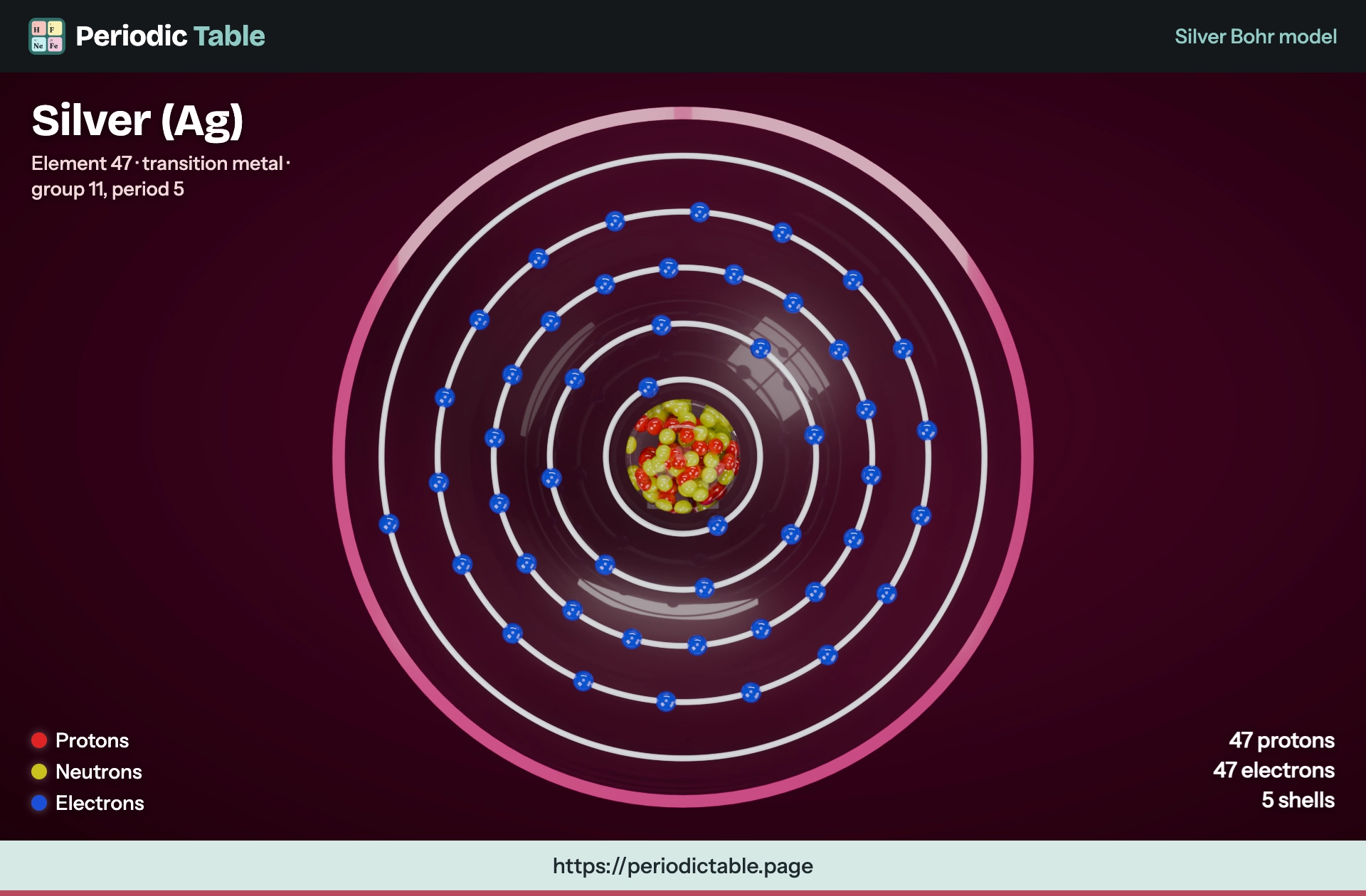
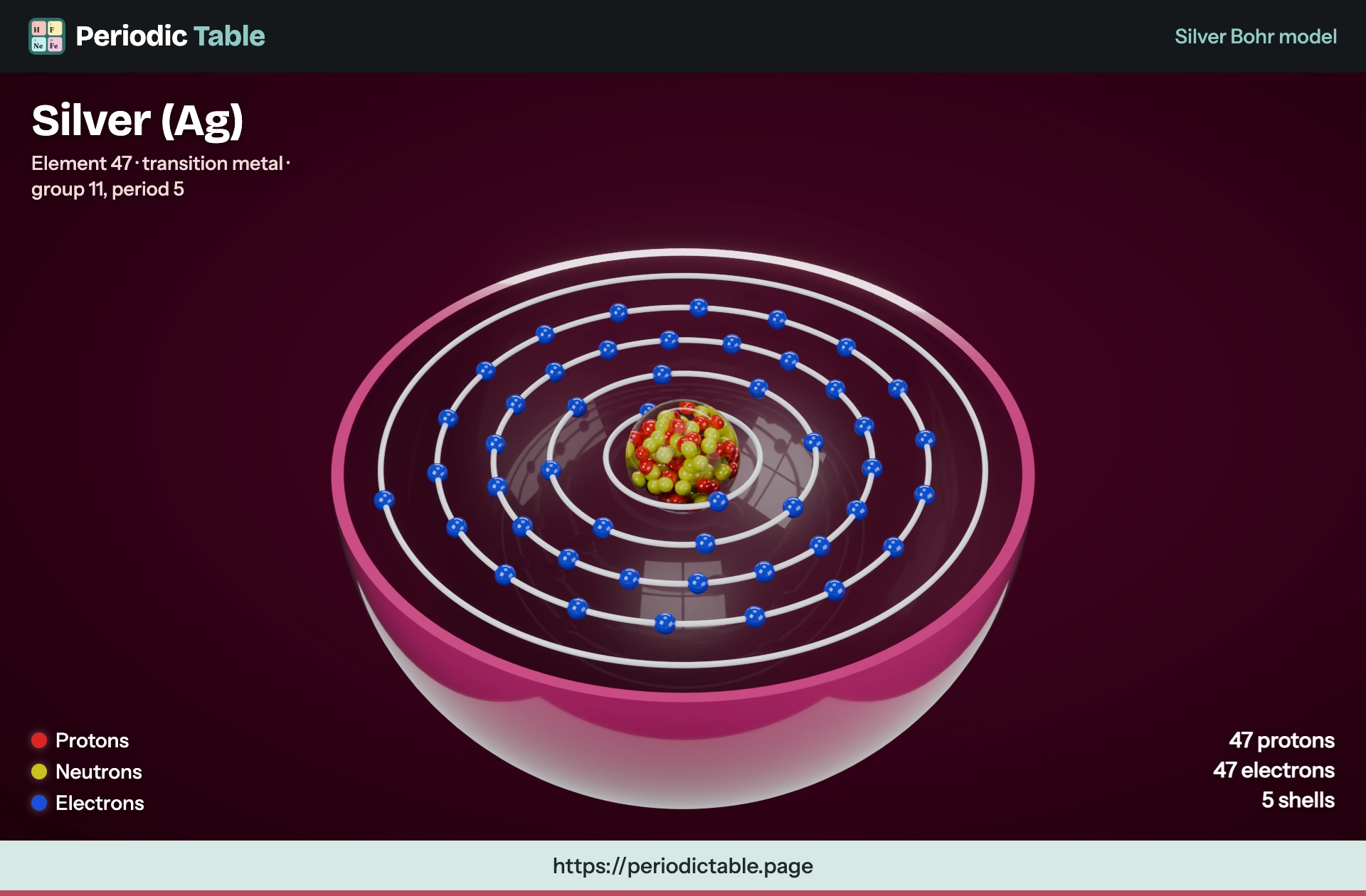
This is a Bohr model of silver (Ag), a simplified picture of a single silver atom. Its nucleus holds 47 protons, and a neutral silver atom has 47 electrons, arranged around it in 5 shells (2 in shell K, 8 in shell L, 18 in shell M, 18 in shell N and 1 in shell O).
Silver periodic table electron configuration
- Shorthand
- [Kr] 4d10 5s1
- Full
- 1s2 2s2 2p6 3s2 3p6 4s2 3d10 4p6 5s1 4d10
- Electrons per shell
- 2, 8, 18, 18, 1
Silver element properties and atomic data
- Atomic number
- 47
- Atomic mass
- 107.8682 u
- Phase at STP
- Solid
- Melting point
- 961.78°C (1234.93 K)
- Boiling point
- 2161.85°C (2435 K)
- Density
- 10.49 g/cm³
- Electronegativity (Pauling)
- 1.93
- Period
- 5
- Group
- 11
- Block
- d-block
- Appearance
- Lustrous white metal
- Discovery date
- Ancient
- Discovered by
- Unknown
- Named by
- —
Silver element facts: atomic number 47 at a glance
Silver sits in the fifth row of the periodic table, between palladium (element 46) and cadmium (element 48), in the same column as copper and gold. It belongs to the d-block, it is a solid at room temperature, and it has been known since prehistoric times, so no one person is credited with its discovery. The table below gathers the values you are most likely to need for a chemistry class, a lab report or a quick comparison with other elements. When science compares air and space, details on neon (ne) show how the gas appears near the sun, the moon and Jupiter.
| Property | Value for Ag |
|---|---|
| Symbol | Ag |
| Atomic number | 47 |
| Group / period / block | Group 11, period 5, d-block |
| Standard atomic mass | 107.8682 u |
| Melting point | 961.78 °C (1234.93 K) |
| Boiling point | 2162 °C (2435 K) |
| Density at 20 °C | 10.50 g/cm³ |
| Lattice | Face-centred cubic |
| Mohs scale | 2.5 |
| Heat of fusion | 11.28 kJ/mol |
| Heat of vaporization | 254 kJ/mol |
| Appearance | Lustrous, white and highly polishable |
A quick way to read these numbers: at about 10.5 g/cm³ it is roughly four times as heavy as aluminium for the same volume, yet its melting point is low enough that ancient smiths could cast it in simple clay furnaces.
Silver properties: lustre, ductility and conductivity
Freshly polished silver has a brilliant white shine so distinctive that its name became a colour. It is soft and extremely ductile, meaning you can draw it into very fine wire, and malleable, so it can be hammered into thin leaf without cracking. Pure silver is only slightly harder than gold, which is why it is usually alloyed before it becomes a fork or a coin. Agriculture readers can use the potassium atomic number to see why crops and soil need a steady supply of this nutrient.
Why silver leads all metals in electrical conductivity
Of every element, silver conducts electric current best. Its single outer 5s electron moves freely over a filled 4d shell, so little gets in the way of the charge.
That makes it the benchmark for carrying current, ahead of copper. The catch is price: its cheaper neighbour conducts nearly as well for a small fraction of the cost, so household wiring skips it, and silver is reserved for conductors where a few percent of extra performance matters, such as high-frequency radio parts where current travels along a conductor's surface.
Thermal conductivity and reflectivity
Silver also moves heat extremely well; its thermal conductivity of about 429 W/(m·K) is beaten only by a few materials such as diamond. Polished silver reflects more of the visible spectrum than any other element at most wavelengths, and this high reflectivity is why it was once the standard backing for mirrors and telescope optics. In the ultraviolet below about 450 nm, aluminium becomes the better reflector.
Crystal structure, hardness and mechanical data
Silver atoms pack into a face-centered cubic lattice, the same arrangement as its two column neighbours, in which each atom touches twelve neighbours. The metallic bonds are fairly weak, which explains the low hardness and the easy shaping. A few more values describe how the solid responds to force and heat:
- Young's modulus: about 83 GPa
- Bulk modulus: about 100 GPa
- Shear modulus: about 30 GPa
- Specific heat capacity: 0.235 J/(g·K)
- Vapour pressure: still only about 1 Pa at 1283 K
- Magnetism: diamagnetic, so it is weakly repelled by a magnet
The diamagnetic behaviour is a handy test: a real silver coin slides slowly down a strong magnet held at an angle, while a fake made of steel sticks to it.
Inside the silver atom: electron configuration and atomic data
A neutral silver atom has 47 protons, 47 electrons and, in its most common form, 60 neutrons. The electrons fill shells of 2, 8, 18, 18 and 1, written in shorthand as the electron configuration [Kr] 4d10 5s1. That lone 5s electron over a complete d subshell is the feature silver shares with copper and gold, and it explains much of its character, from its conductivity to its preference for the +1 state.
| Atomic data | Value |
|---|---|
| Atomic radius (empirical) | 144 pm |
| Covalent radius | 145 pm |
| Van der Waals radius | 172 pm |
| Electron affinity | 125.6 kJ/mol |
Ionisation energies and electronegativity
Removing the first electron from Ag takes 731 kJ/mol, the second 2070 kJ/mol and the third 3361 kJ/mol. The jump between the first two ionisation energies shows how much more stable the filled 4d shell is than the single 5s electron. On the Pauling scale, its electronegativity is 1.93, higher than copper's, so its bonds are more covalent than you might expect.
Ag chemistry: oxidation states and isotopes
Silver is a fairly unreactive element. It sits low in the electrochemical series (standard potential +0.799 V for Ag+/Ag), so it does not react with oxygen in normal air, does not dissolve in dilute hydrochloric acid, and only dissolves readily in oxidising acids such as nitric acid. This low chemical reactivity is why it can be found uncombined in nature.
The +1 state dominates its chemistry: Ag+ is the stable ion in water and in almost every common compound. It can reach +2 and +3 with very strong oxidisers such as fluorine or peroxodisulfate, but those compounds are rare and powerful oxidising agents in their own right. Its oxidation states range from −2 in a few unusual metal-rich compounds up to +3, with +1 by far the most important.
Silver-107, silver-109 and radioactive forms
Natural silver is a near-even mix of two stable isotopes: silver-107 with a natural abundance of 51.839% and silver-109 with 48.161%. Few elements split this evenly. You can check the standard atomic mass from those two numbers:
Beyond these, scientists have characterised around 28 radioisotopes. The longest-lived is silver-105, with a half-life of 41.29 days, and several nuclear isomers last much longer, such as silver-108m at over 400 years. Isotopes lighter than silver-107 decay mainly by electron capture into palladium, and heavier ones by beta decay into cadmium.
Why silver tarnish forms in air
Silver does not rust, but it does darken. Traces of hydrogen sulfide and other sulfur gases in the air react with the surface to form a thin black film of silver sulfide, Ag2S:
$$4\,\text{Ag} + 2\,\text{H}_2\text{S} + \text{O}_2 \rightarrow 2\,\text{Ag}_2\text{S} + 2\,\text{H}_2\text{O}$$This tarnish is only a few atoms to a few micrometres thick. Polishing pastes rub it away, while a dip in a reducing bath converts the sulfide back without removing any of the underlying surface.
Silver compounds: halides, nitrate, oxide and sulfide
Most silver compounds contain Ag+, and many are insoluble or darken in sunlight, which shapes how they are used. Adding alkali to a dissolved salt gives dark brown silver oxide, Ag2O, which breaks down back into the metal and oxygen when heated above about 160 °C.
Some are dangerous: silver fulminate is a touch-sensitive explosive once used in percussion caps. When any of these compounds is reduced, the product is metallic silver, the reaction behind both photographic development and silver mirror coatings.
Silver halides in film and photochromic glass
The four silver halides are the fluoride, the white silver chloride (AgCl), the pale yellow silver bromide (AgBr) and the yellow silver iodide (AgI). All except the fluoride are almost insoluble in water, which makes them useful in gravimetric analysis, where a chemist weighs the precipitate to work out how much chloride a sample held.
They are also photosensitive: light frees an electron that reduces Ag+ to a speck of metal. Photochromic lenses use this reversibly, darkening in sunlight and clearing indoors.
Silver nitrate, the lunar caustic
White, crystalline silver nitrate, AgNO3, is the usual starting point for making other silver chemicals. Alchemists linked the element with the Moon, so they called it lunar caustic, and it still burns skin, which is why it was once used to remove warts. It is far less light-sensitive than the halides, it dissolves easily in water, and reducing it with sugars or formaldehyde deposits a bright mirror film on glass.
Where native silver comes from: ores, minerals and mining
Silver is rare: the Earth's crust holds only about 0.08 parts per million, about the same as mercury. Some of it occurs as native silver, the uncombined element in wires and nuggets, and some as electrum, a natural alloy with gold. Most of it, though, is locked in compounds such as acanthite and argentite (both Ag2S) and chlorargyrite, the silver chloride mineral miners call horn silver.
Today only a minority of silver comes from mines worked mainly for silver. Most is a byproduct of refining lead-zinc, copper and gold ores, where it rides along in sulfides like argentiferous galena, a lead sulfide. Because so much output depends on demand for other metals, silver mining cannot simply ramp up when the price rises.
Top producers, supply risk and recycling
Mexico is the world's largest producer, followed by China and Peru, with Peru also holding the largest reserves. Because it is hard to replace in many uses, secondary supply matters: roughly one-fifth of the annual supply is recycled from old ornaments, scrap circuit boards and spent photographic chemicals. Recycling rates above 30% help offset how concentrated mine output is in a handful of countries.
A history of silver the element, from cupellation to coinage
Silver was among the first metals people worked, alongside gold and copper, and it is one of the seven metals of antiquity. The uncombined element was scarce, so in early Egypt it was valued even above gold, and the Egyptians imported much of what they used.
Everything changed with cupellation: heating silver-bearing lead in air turns the lead into a molten oxide that soaks away, leaving a bright bead of silver behind. Slag heaps show the method in use in Asia Minor by the 4th millennium BC.
The Greeks built an economy on the mines of Laurion, and the Romans struck huge numbers of denarii. After the fall of Rome, output collapsed for centuries.
It rebounded in the 1500s when Spain opened vast mines in the Americas, and the Spanish dollar, the famous piece of eight, became the first truly global coin, shaping trade from Europe to China and later the design of the US dollar and the Chinese yuan. The history of silver the element is in large part a history of money.
Argentum and the origin of the symbol Ag
The symbol Ag comes from argentum, the Latin word for silver, which traces back to a root meaning "white" or "shining". The English name grew from Old English seolfor, linked to German Silber. Argentina takes its name from the same Latin root, after early explorers hoped to find the metal there.
The silver bullet and other symbolism
Folklore gave the metal a protective power: a silver bullet was said to be the only sure way to kill a werewolf or witch, and the phrase now means a single, simple fix for a hard problem. Silver also stands for second place, from the "silver age" of Greek myth to the silver medal.
Silver as a precious metal: coins, money and price
For about 2,500 years silver was money. The first coins, from Lydia around 600 BC, were made of electrum, and silver standards set the value of a currency in much of the world until the 20th century. Today silver coins are made for collectors and investors rather than for daily spending, and silver bullion even has its own ISO currency code, XAG.
As a precious metal, silver is priced by weight in troy units: one troy ounce equals 31.1035 grams, slightly heavier than the ordinary ounce. A daily benchmark price set in London guides the global market, and people buy bars and rounds as an investment or a hedge. Silver prices tend to swing more than gold because about half of demand is industrial.
Sterling silver, fineness and common alloys
Purity is stated as fineness in parts per thousand. Sterling silver is 925 fine, so it holds 92.5% of the pure element and 7.5% of another, usually copper, which hardens it for daily wear. To see what that means, take a 186 g sterling bowl: it contains 0.925 × 186 = 172.05 g of silver, or about 5.53 troy ounces.
Other common alloys include 900 "coin silver", 800 fine in older European cutlery, and Britannia silver at 958. Pure 999 fine bars are too soft to keep a crisp edge as a coin, which is why the alloy has been the standard for centuries.
Uses of silver in industry, health and everyday life
About half of the silver used each year now goes into industry rather than money or ornaments. The same properties covered above, top conductivity, strong reflection, photosensitivity and toxicity to microbes, explain almost every application. Even the weather benefits: silver iodide crystals are used for cloud seeding to encourage rain or snow.
Electronics, solar panels and brazing alloys
Silver paste prints the fine lines that collect current from solar cells, making photovoltaics one of the fastest-growing sources of demand. It is also used in electrical contacts for switches and relays, membrane keyboards, RFID antennas and the conductive inks used in printed electronics. In metalwork, silver-copper brazing alloys join steel, copper and nickel parts at lower temperatures than welding, and zinc and oxide button batteries based on the element power watches and hearing aids.
Photography and silver-plated mirrors
For more than 150 years, photography depended on silver halide crystals spread in gelatin; exposure created a hidden image that developer chemicals turned into black grains of metal. Digital cameras cut that demand sharply, but film is still made.
Glass reflectors use a reduced coating as their reflective layer, and electroplating puts a thin coat on cutlery, musical instruments and electrical connectors. Much of what is sold as tableware is silver-plated base metal rather than solid silver.
Medicine and antimicrobial silver nanoparticles
Silver ions disrupt the enzymes and cell walls of bacteria, so silver has long been used as an antibacterial agent. In medicine, burn creams with silver sulfadiazine and wound dressings containing it help prevent infection, and silver-coated catheters and breathing tubes reduce hospital infections.
Nanosilver particles 10-100 nanometres across give clothing and surfaces an antimicrobial finish, and dental amalgams have used silver-tin-mercury fillings for over a century. Bacteria can develop resistance, so these uses are now more targeted than they once were.
Jewellery, silverware and catalysis
Rings, chains and other jewelry remain one of the largest uses, along with candlesticks, trays and silverware. Out of view, silver is also a catalyst: silver spread on alumina turns ethylene into ethylene oxide, a building block for antifreeze and plastics, and hot gauze turns methanol into formaldehyde. Chemists also prize silver crucibles because the metal resists molten alkalis.
Silver metal beside copper and gold in group 11
Silver, copper and gold are called the coinage metals because all three have been struck as money for millennia. They share the same outer-electron pattern, the same cubic lattice and an unusual softness and conductivity, but they differ in reactivity and price.
Copper oxidises in air to a green patina, the middle element darkens only with sulfur, and gold barely reacts at all. It forms useful alloys with both neighbours, plus zinc: most minted pieces and ornaments are really silver-copper mixtures, while silver-gold blends tint many yellow alloys.
| Coinage metal | Symbol | Z | g/cm³ at 20 °C | Air reaction |
|---|---|---|---|---|
| Copper | Cu | 29 | 8.96 | Slow oxide and green patina |
| Silver | Ag | 47 | 10.50 | Black sulfide film |
| Gold | Au | 79 | 19.30 | Essentially none |
Read across the table and heaviness climbs steeply with proton count, while reactivity falls, which is why the heaviest of the three survives untouched for thousands of years.
Is pure silver toxic? safety and argyria
Solid silver is safe to handle, eat from and wear. Silver compounds have low toxic effects compared with most heavy metals because the body absorbs little of them, although soluble salts such as silver nitrate are caustic and can damage tissue in large amounts. The best-known risk is argyria, a permanent blue-grey discolouration of the skin caused by long-term intake of silver, usually from drinking homemade colloidal silver.
It is not otherwise known to harm health, but it does not fade. Its salts are more harmful to fish and other water life, so silver waste from labs and photo processing is collected and treated.