


Neon element (Ne): neon periodic table facts
Neon periodic table facts: neon (Ne) is element 10, a noble gas in group 18, period 2. If you have ever stopped to look at a glowing red shop sign, you have already seen neon at work. When studying clean fuels, electrolysis, steam reforming and an energy carrier role for the lightest element are explained in the hydrogen production guide for curious readers.
This colorless, odorless element is the second of the noble gases on the periodic table, it is lighter than the air around it, and two London chemists, William Ramsay and Morris Travers, pulled it out of chilled air in 1898. Below you get its atomic data, physical properties, isotopes, history and uses in one place.
Rotate the 3D Bohr model of neon
Drag to orbit, scroll to zoom.
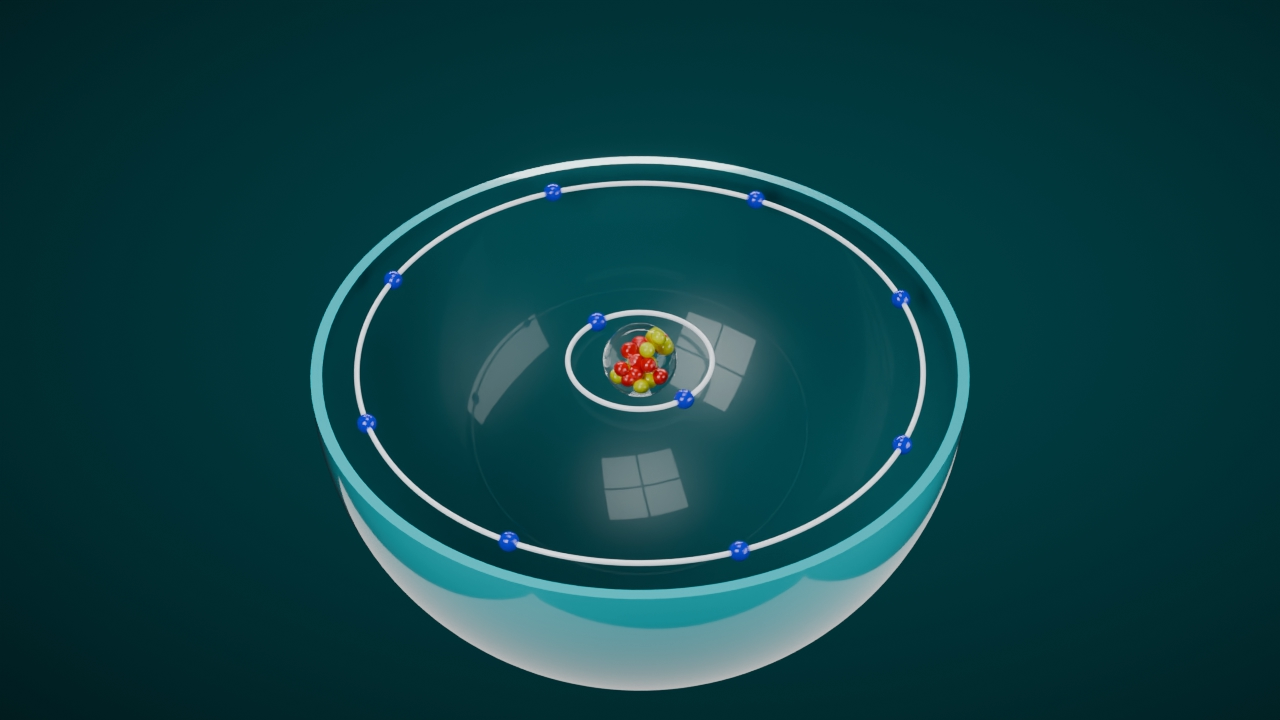
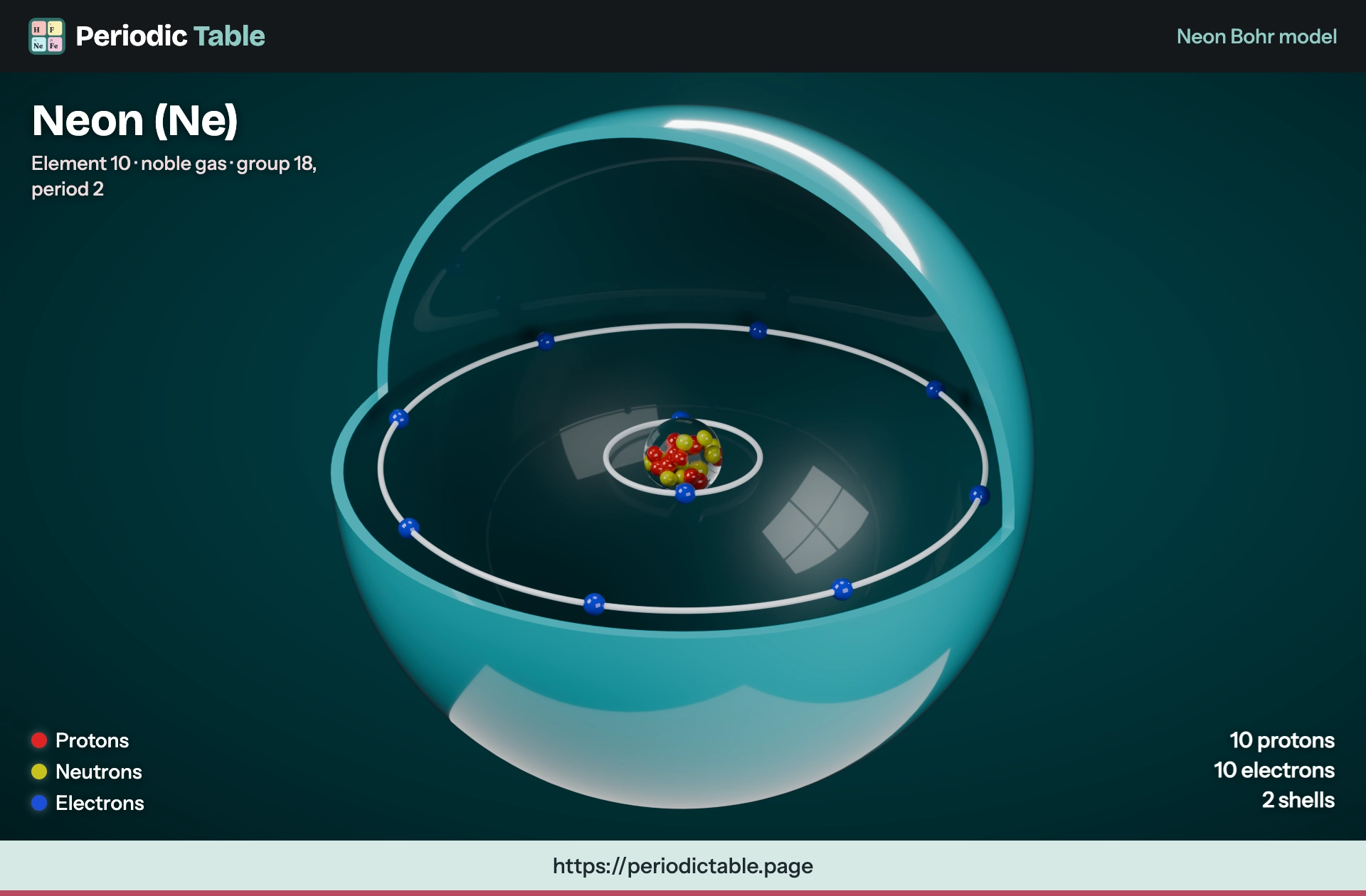
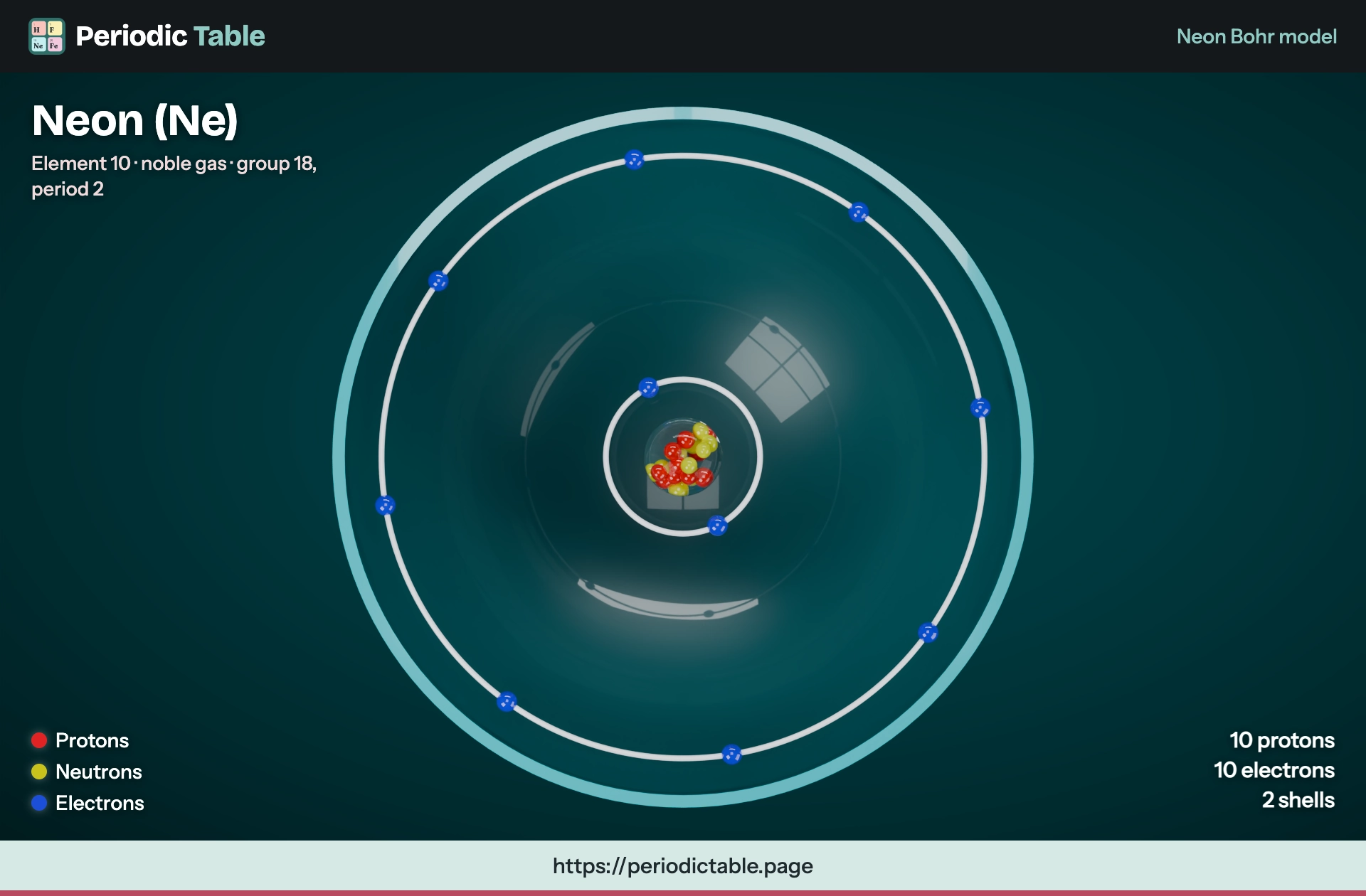
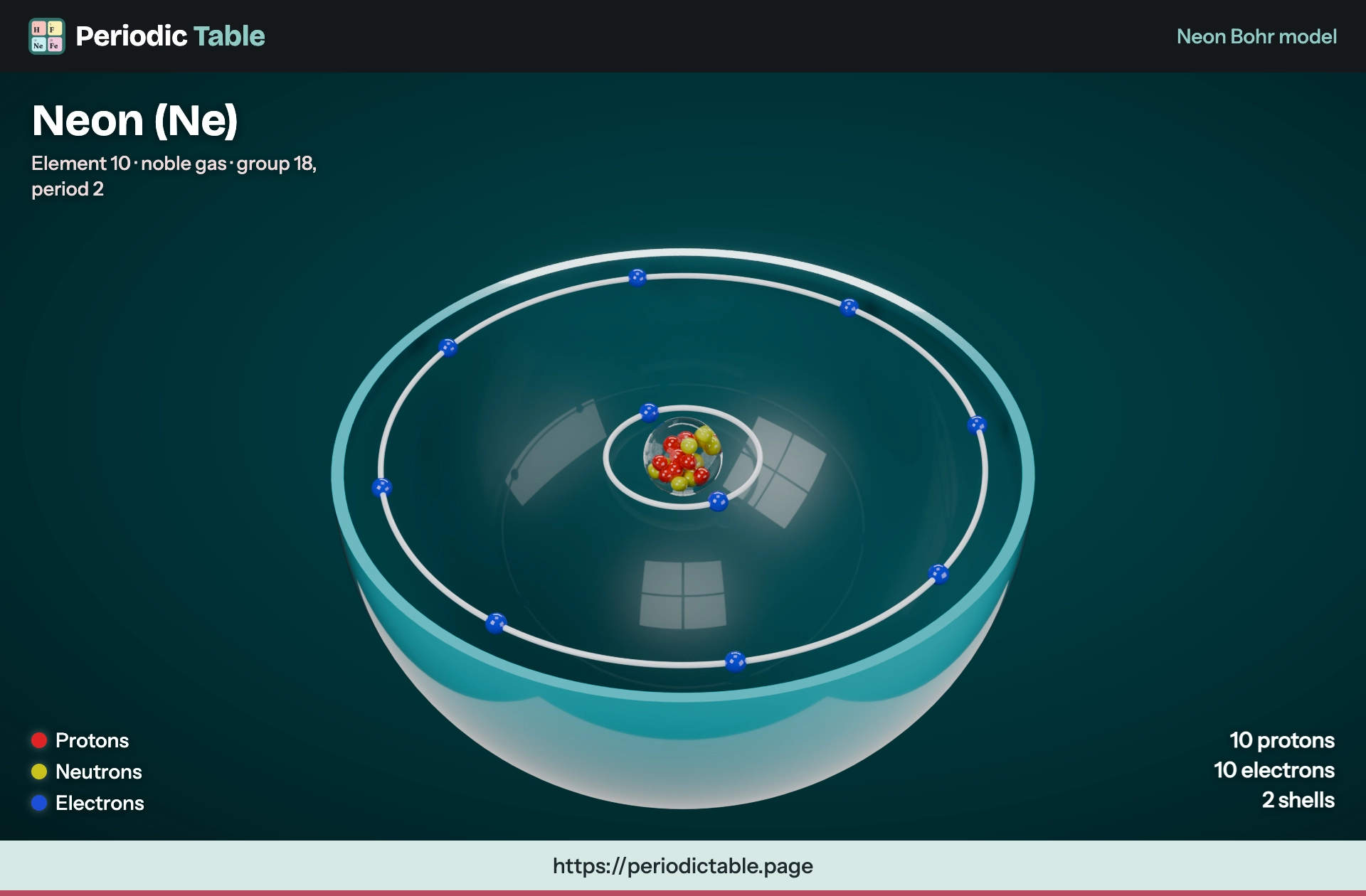
This is a Bohr model of neon (Ne), a simplified picture of a single neon atom. Its nucleus holds 10 protons, and a neutral neon atom has 10 electrons, arranged around it in 2 shells (2 in shell K and 8 in shell L).
Neon periodic table electron configuration
- Shorthand
- [He] 2s2 2p6
- Full
- 1s2 2s2 2p6
- Electrons per shell
- 2, 8
Neon element properties and atomic data
- Atomic number
- 10
- Atomic mass
- 20.1798 u
- Phase at STP
- Gas
- Melting point
- -248.59°C (24.56 K)
- Boiling point
- -246.05°C (27.104 K)
- Density
- 0.0009002 g/cm³
- Electronegativity (Pauling)
- Unknown
- Period
- 2
- Group
- 18
- Block
- p-block
- Appearance
- Colorless gas exhibiting an orange-red glow when placed in a high voltage electric field
- Discovery date
- 1898
- Discovered by
- Morris Travers
- Named by
- —
Key facts for atomic number 10: group 18 and period 2
Element cards usually print the essentials as Neon Ne 10: the name, the two-letter symbol and the atomic number. Atomic number 10 means every nucleus carries ten protons, which puts this chemical element at the far right of the second row, in the p-block. The table collects the reference values you are most likely to look up. A summary of element 102 covers cation-exchange chromatography, elution behaviour and ionic radius.
| Property | Value |
|---|---|
| Symbol | Ne |
| Atomic number | 10 |
| Standard atomic weight | 20.180 (20.1797 ± 0.0006) |
| Group / period / block | Group 18, period 2, p-block |
| Electron configuration | [He] 2s2 2p6 |
| State at 20 °C | Gas |
| Melting point | 24.56 K (−248.59 °C) |
| Boiling point | 27.104 K (−246.046 °C) |
| Density at STP | 0.9002 g/L |
| CAS number | 7440-01-9 |
Neon compared with the other noble gases
The group holds seven members: helium, neon, argon, krypton, xenon, radon and oganesson. Each noble gas has a filled valence shell, yet the temperature at which they boil climbs steeply as the atoms get heavier, because larger electron clouds produce stronger van der Waals attraction between atoms. Chemistry of halides in photography is a theme of the transition metal silver, with metals and light explained step by step.
| Element | Symbol | Boils at (K) | Discharge glow | Typical use |
|---|---|---|---|---|
| Helium | He | 4.22 | Pale pink-peach | Balloons, MRI magnet cooling |
| Neon | Ne | 27.10 | Orange-red | Signs, cryogenics |
| Argon | Ar | 87.30 | Lavender to violet | Welding shield gas, light bulbs |
| Krypton | Kr | 119.93 | Whitish violet | High-performance lighting |
| Xenon | Xe | 165.03 | Blue-white | Car headlamps, ion thrusters |
| Radon | Rn | 211.3 | Not used (radioactive) | Little practical use |
| Oganesson | Og | Unknown | Not observed | Research only, a few atoms made |
Neon is the second-lightest member, light enough that a balloon filled with it rises in air, though more slowly than a helium one. It stays liquid about 23 K above helium, which is exactly the gap that makes it useful as a coolant.
Inside the Ne atom: structure and electron configuration
A neutral neon atom holds 10 electrons arranged 2, 8: two in the first shell and eight in the second, written 1s2 2s2 2p6. That full outer shell is a complete octet, and this is the first element in the table to reach a true octet.
It explains almost everything about how the gas behaves. The atom is also small: its van der Waals radius is 154 pm, and its covalent atomic radius is quoted at 58 to 62 pm.
Ionization energy, electron affinity and electronegativity
Pulling the first electron off takes 2,080.7 kJ/mol, the highest first ionization energy of any element but one. The second and third steps need 3,952.3 and 6,122 kJ/mol.
No stable negative ion exists, so electron affinity is listed as "not stable". On the Pauling scale electronegativity is undefined here, since there are no bonds to measure, but the Allen scale, built from measured atomic orbital levels, ranks neon as the most electronegative element of all, just ahead of fluorine.
Physical properties of neon gas
Under everyday conditions neon gas is monatomic, colorless and about two-thirds as heavy as air. It is diamagnetic, its thermal conductivity is low at 49.1 mW/(m·K), and its speed of sound is 435 m/s at 0 °C. Frozen solid, it packs into a face-centered cubic crystal structure.
Melting point, boiling point and triple point
The liquid exists only across a narrow 2.5-kelvin window. The melting point is 24.56 K (−248.59 °C, −415.46 °F), and the boiling point is 27.104 K (−246.046 °C, −410.883 °F).
Its triple point, 24.5561 K at 43.37 kPa, is the temperature and pressure where solid, liquid and gas coexist, and it is reproducible enough that the International Temperature Scale of 1990 uses it as a defining fixed point for calibrating thermometers. Above the critical point (44.49 K, 2.77 MPa) no amount of pressure will liquefy it.
Density, heat of vaporization and heat of fusion
At STP the gas weighs 0.9002 g/L, about 70% of air's 1.293 g/L. To picture that, take a 5-liter flask: filled at STP it holds 4.50 g of neon, while the same flask of air holds 6.46 g.
As a liquid at its boiling temperature it reaches 1.207 g/cm3. The heat of vaporization is 1.71 kJ/mol and the heat of fusion only 0.335 kJ/mol, while the specific heat capacity of the gas is 1,030 J/(kg·K).
Chemical behavior of an inert gas
In chemistry terms, neon is the most stubborn element known. It is chemically inert and in practice more unreactive than helium: helium forms the HeH+ ion and the high-pressure solid Na2He, but no neutral neon compound has ever been confirmed.
What does exist is a handful of weakly bound species seen in the lab, such as the ions [NeAr]+, [NeH]+ and [HeNe]+ and the fragile complex Cr(CO)5Ne, held together by a very weak Ne–Cr bond. Atoms can also be caged without bonding inside a clathrate hydrate made from water ice at 350–480 MPa; pump the cage empty and you are left with ice XVI.
Oxidation states and known compounds
The only oxidation state listed for the element is 0, because it never gives up or shares electrons in a stable bond. Reference tables of common oxidation states therefore show zero or leave the entry blank. An anion carrying a bound atom, [B12(CN)11Ne]−, has been predicted and probed in the gas phase, but it is still unconfirmed, and no bulk compounds you could bottle exist.
Neon isotopes and natural abundance
Natural neon is a mix of three stable isotopes. Neon-20 dominates, neon-22 is a distant second, and Ne-21 is a trace.
| Isotope | Mass (u) | Natural abundance (%) | Origin |
|---|---|---|---|
| Ne-20 | 19.9924 | 90.48 | Primordial, made by stellar carbon burning |
| Ne-21 | 20.9938 | 0.27 | Partly nucleogenic and cosmogenic |
| Ne-22 | 21.9914 | 9.25 | Partly nucleogenic |
The standard atomic weight is the abundance-weighted average of those masses:
$$A_r = (19.9924 \times 0.9048) + (20.9938 \times 0.0027) + (21.9914 \times 0.0925) \approx 20.180$$
These variants also made history. In 1913, J. J. Thomson sent ions from canal rays through magnetic and electric fields and saw two separate parabolas on a photographic plate, one for mass 20 and one for mass 22.
It was the first evidence that a stable element could have isotopes, and Thomson's apparatus was an early mass spectrometer. Today geologists use the cosmogenic isotope Ne-21, made when cosmic rays hit magnesium, sodium, silicon and aluminium in surface rocks, to date how long a rock has been exposed.
Discovery of neon in liquid air
The discovery came in June 1898 at University College London. Ramsay and Travers had just found krypton by letting liquid air evaporate. They then let solid argon evaporate slowly under reduced pressure and collected the first fraction that boiled off.
Inside a spectroscope tube it lit up a brilliant crimson that, as Travers later recalled, needed no further proof that something new had been found. Ramsay's 13-year-old son suggested novum, Latin for new; his father preferred the Greek neos, and the name neon (pronounced NEE-on) stuck. Xenon followed from the same work that September, completing a remarkable year for the two scientists.
Practical use took another decade. Georges Claude, whose air-liquefaction firm produced the gas as a byproduct, showed the first sealed tube lamp in Paris in December 1910. Homeowners disliked red light indoors, so Claude bent the tubes into letters instead, and in 1923 his company sold two signs to a Packard car dealership in Los Angeles, the start of neon advertising in the United States.
Why the noble gas glows red-orange
Put a little neon at low pressure in a sealed glass tube, apply a high voltage, and an electric current turns the gas into a glowing plasma. Electrons knocked into higher energy levels fall back and release light at fixed wavelengths. The emission spectrum is crowded with lines in the yellow-to-red range, so your eye averages them into the familiar red-orange, which some sources call reddish-orange.
A spectroscope also shows a strong green line that the red light hides. Within its group, this element gives the brightest discharge at ordinary voltages and currents, which is why its spectral lines are a staple of physics teaching labs. The other colors in so-called neon tubes come from argon with a little mercury vapor and a fluorescent phosphor coating on the glass.
Neon in the universe and Earth's atmosphere
By mass, neon is the fifth most abundant element in the universe, behind hydrogen, helium, oxygen and carbon, at roughly 1 part in 750, and about 1 part in 600 in the Sun. Most of it forms in stars of more than about 8 solar masses through the carbon-burning process, a stage of stellar nucleosynthesis that runs above 500 million kelvin.
For all that, it is rare at home. Because the atoms are light, volatile and form no compounds, the warm young inner planets could not hold on to them, so the element is comparatively scarce on Earth. Earth's atmosphere contains only 18.2 ppm by volume, about 1 part in 55,000, and the crust far less.
Elsewhere, the solar wind carries gas enriched in Ne-20, the Galileo probe found Jupiter's upper atmosphere depleted about tenfold, and NASA's LADEE spacecraft detected it in the thin exosphere of the Moon in 2015. Primordial traces even turn up in volcanic gases and diamonds, despite the element being so abundant in space.
How pure neon is produced by fractional distillation
Air is the only commercial source, so pure neon comes from the cryogenic fractional distillation of liquefied air in large air-separation plants built mainly to make liquid oxygen and nitrogen for industry. The steps run in this order:
- A light fraction of nitrogen, neon and other light gases is drawn from the top of the high-pressure column.
- A side column concentrates the crude neon.
- Activated charcoal removes the remaining helium.
- Added oxygen turns any hydrogen into water, which condenses out.
Yields are tiny, roughly one part of finished gas from 88,000 parts of that crude mixture by mass, which is why it is more expensive than helium.
Supply risk and the 2022 shortage
Much of the world's crude supply is a byproduct of steel production, since steel mills run big air-separation units for oxygen. Before 2022, plants in Ukraine purified roughly half of the world's semiconductor-grade gas, much of it from crude neon shipped out of Russian steelworks.
When fighting shut the Odesa and Mariupol producers, chip manufacturers, which depend on it for lithography lasers, faced sharp price spikes, after an earlier jump of about 600% following 2014. Many have since added suppliers in China, the US and Europe and started recycling the gas.
Uses of the element neon
Almost every application of the element neon relies on two traits: it never reacts, and it glows brightly at low voltage. That makes it valuable across lighting, optics, cryogenics, electronics and laboratory science.
Neon signs and glow lamps
- Neon signs: hand-bent glass tubing, often meters long, filled at low pressure and run at 2–15 kilovolts. Pure gas gives red; other colors use argon and phosphors. These advertising signs still define the look of city streets and remain popular in architectural and artistic neon lighting.
- Glow lamps: small neon lamps running at 100–250 volts, long used as power-on indicators and in circuit testers, now mostly replaced by LEDs.
- Plasma displays: plasma display panels and plasma TVs descend directly from the simple glass discharge tube.
- Gas discharge tubes: voltage regulators and wavemeter tubes use the same steady discharge.
Lasers, cryogenic refrigerant and electronics
- Lasers: helium–neon lasers emit the classic 632.8 nm red beam for alignment, barcode reading and optics labs, and high-purity gas is the buffer in the excimer lasers used for photolithography in chip fabs.
- Cryogenic refrigerant: the liquid has over 40 times the refrigerating capacity per unit volume of liquid helium and three times that of liquid hydrogen, so it serves as a cryogenic coolant wherever the 25–40 K range is cold enough.
- Electronics: vacuum tubes, high-voltage indicators, lightning arresters and older television tubes.