


Nobelium element (No): nobelium periodic table facts
Nobelium periodic table facts: nobelium (No) is element 102, an actinide in period 7 of the f-block. You will never hold a piece of nobelium: only a few thousand atoms of this chemical element have ever existed at once, and most vanish within minutes. Beyond simple chemistry, molecules, atoms and the nucleus, from a single proton to astrophysics, are explored in the atomic hydrogen page for curious readers.
Yet nobelium taught chemists something unique among heavy elements, because it prefers a +2 charge where its neighbours prefer +3. Its story also includes one of the longest naming fights in science, as physicists in Sweden, the United States and the Soviet Union all claimed it before IUPAC finally ruled.
Rotate the 3D Bohr model of nobelium
Drag to orbit, scroll to zoom.
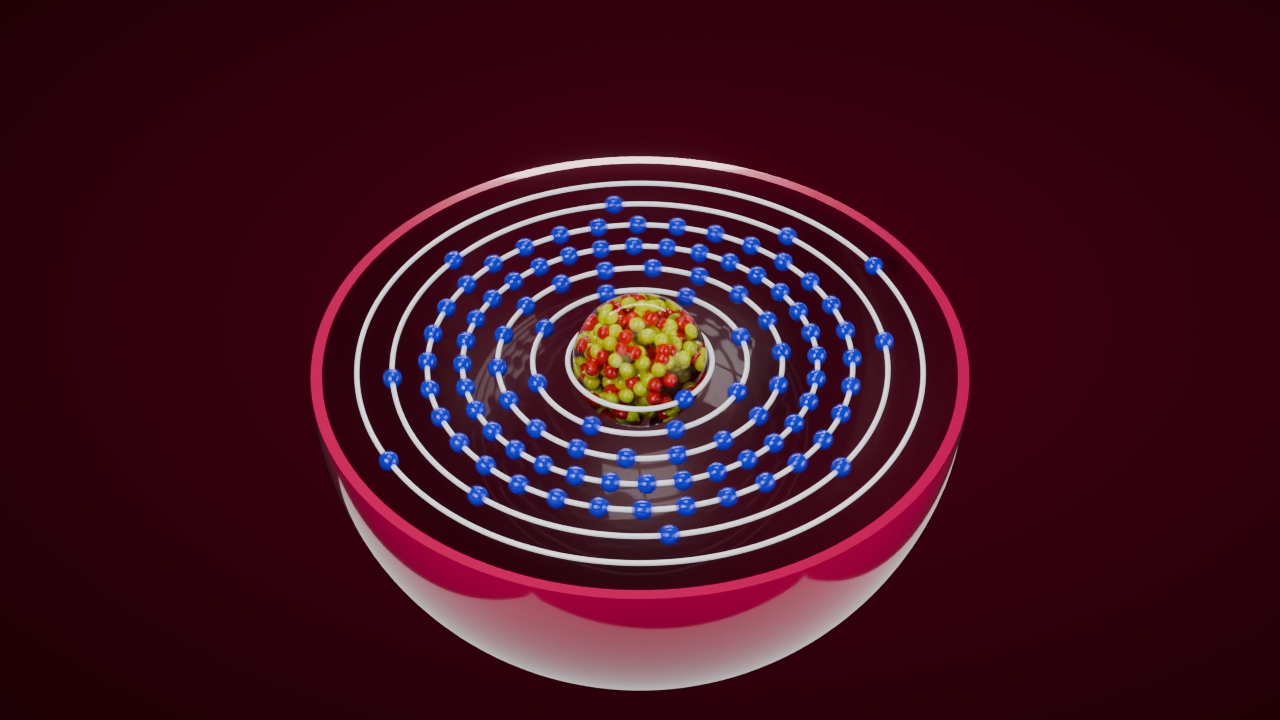
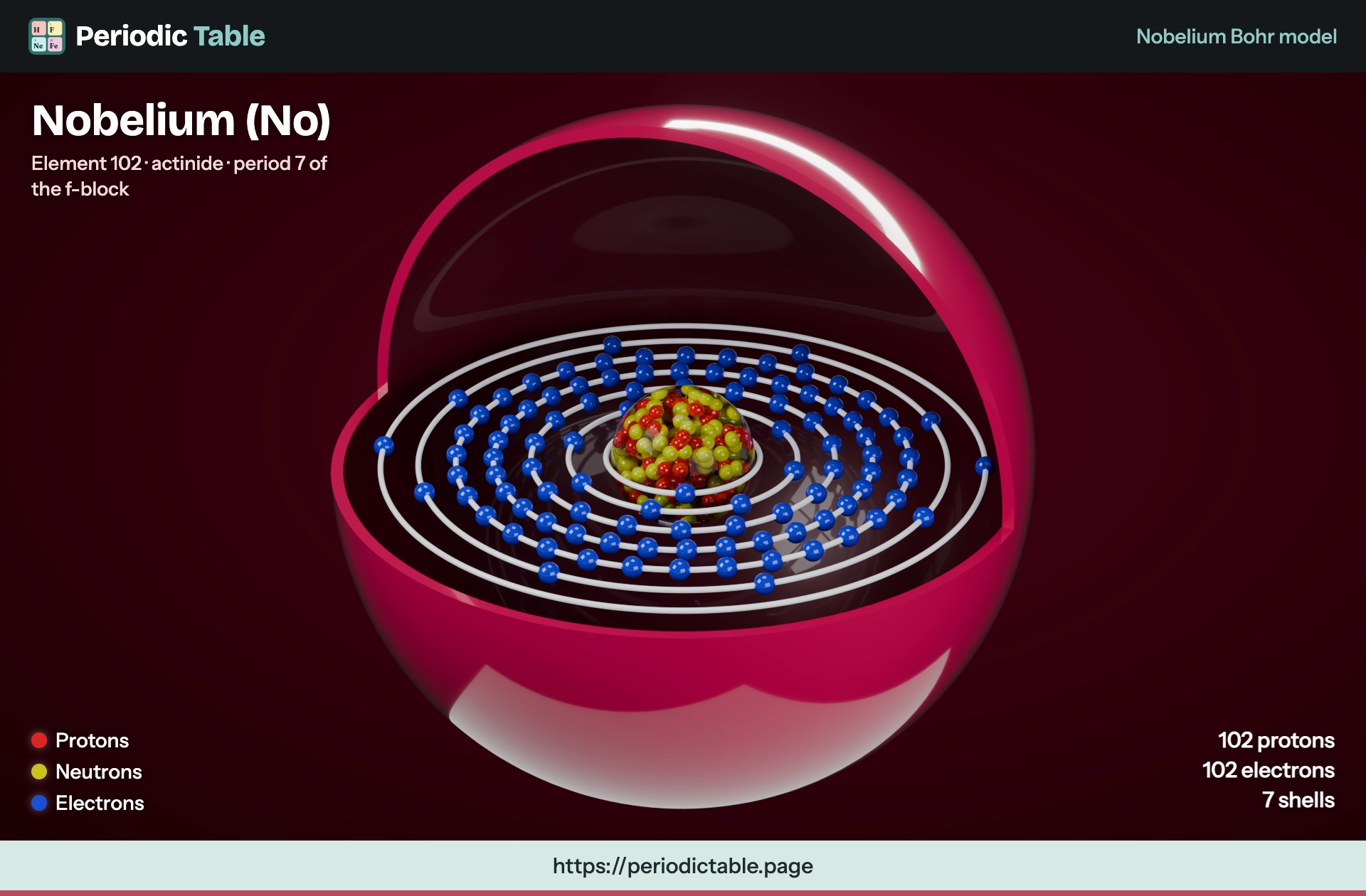
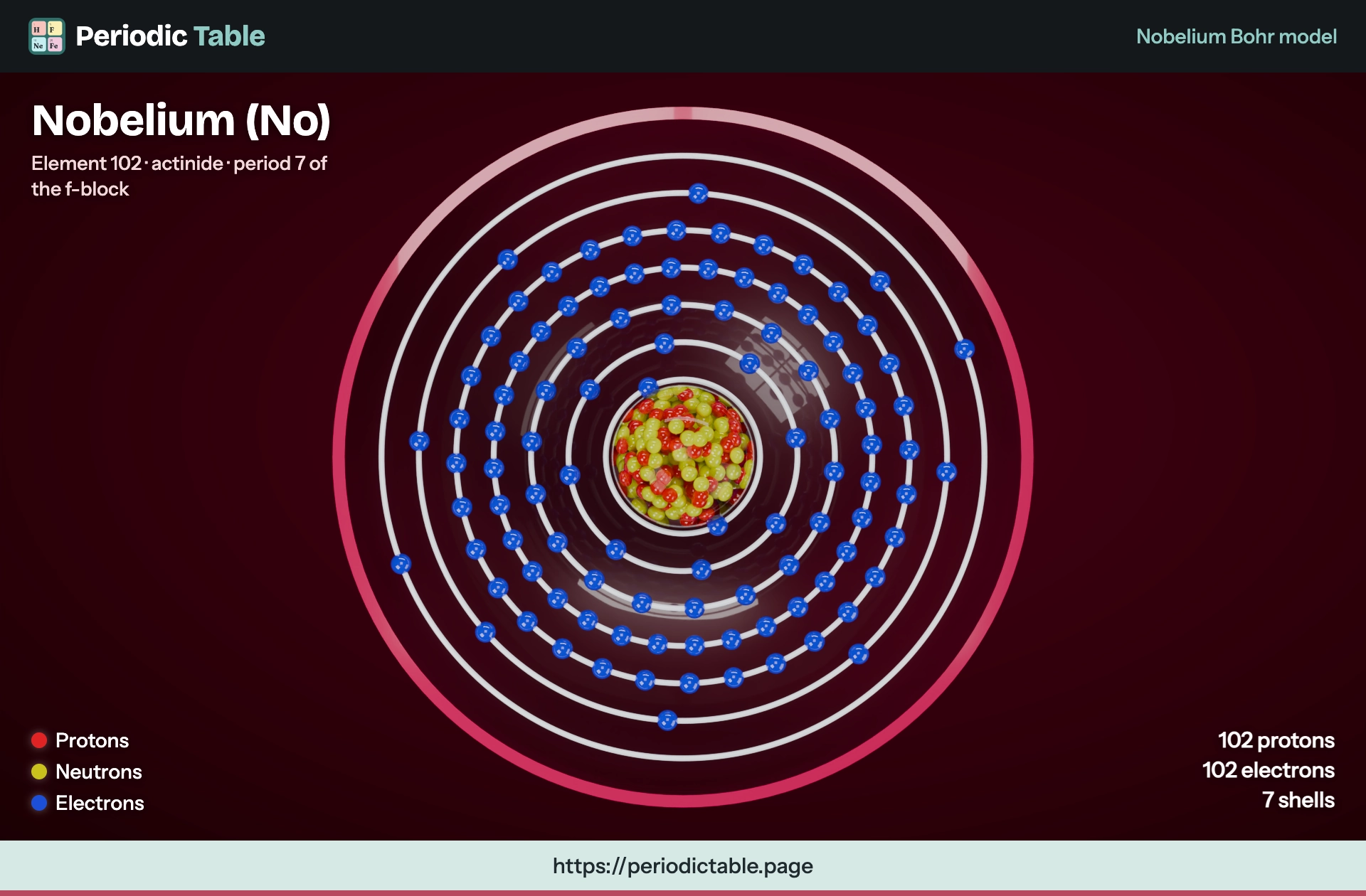
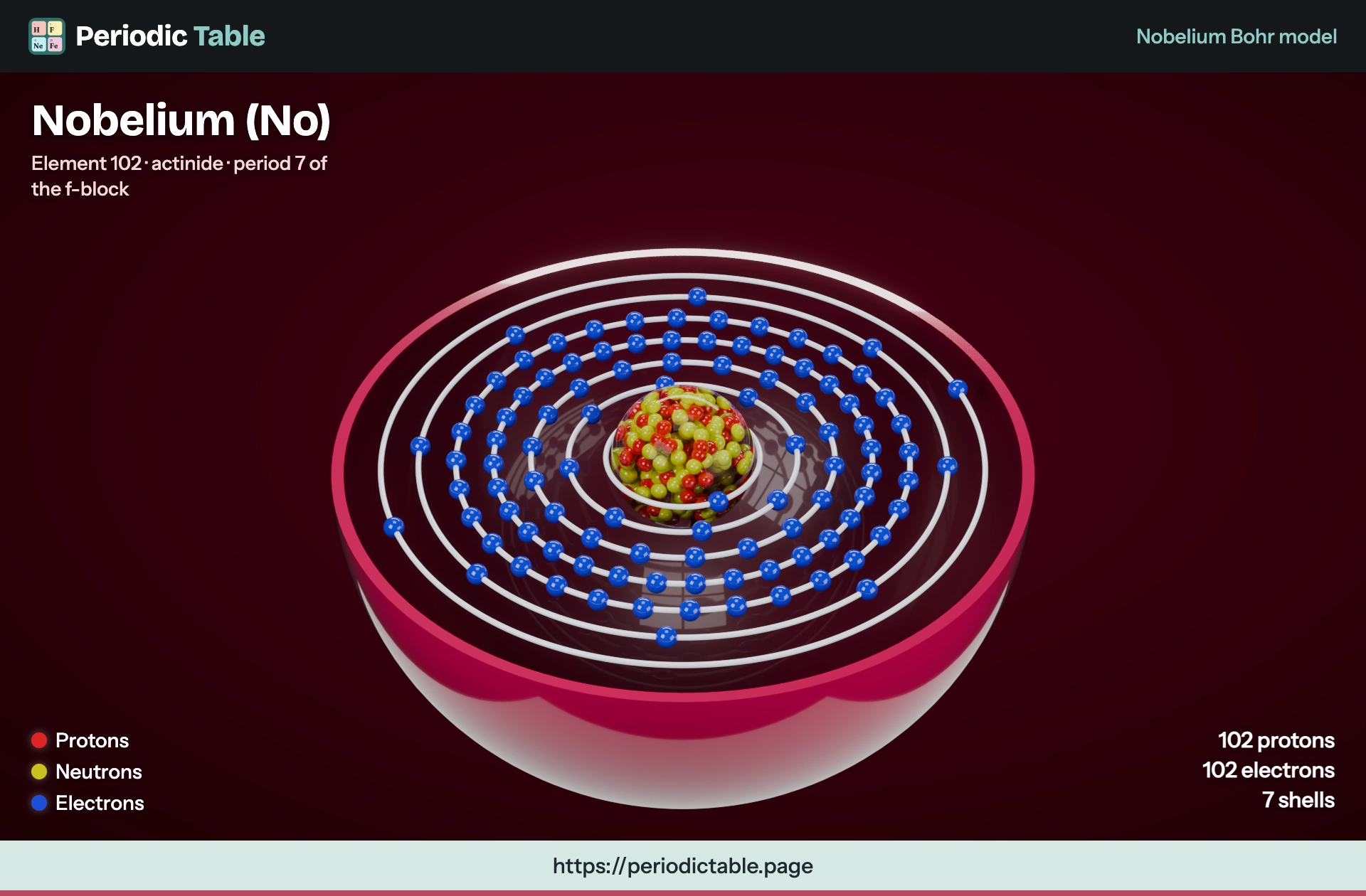
This is a Bohr model of nobelium (No), a simplified picture of a single nobelium atom. Its nucleus holds 102 protons, and a neutral nobelium atom has 102 electrons, arranged around it in 7 shells (2 in shell K, 8 in shell L, 18 in shell M, 32 in shell N, 32 in shell O, 8 in shell P and 2 in shell Q).
Nobelium periodic table electron configuration
- Shorthand
- [Rn] 5f14 7s2
- Full
- 1s2 2s2 2p6 3s2 3p6 4s2 3d10 4p6 5s2 4d10 5p6 6s2 4f14 5d10 6p6 7s2 5f14
- Electrons per shell
- 2, 8, 18, 32, 32, 8, 2
Nobelium element properties and atomic data
- Atomic number
- 102
- Atomic mass
- [259] u
- Phase at STP
- Solid
- Melting point
- 826.85°C (1100 K)
- Boiling point
- Unknown
- Density
- Unknown
- Electronegativity (Pauling)
- 1.3
- Period
- 7
- Group
- —
- Block
- f-block
- Appearance
- Unknown
- Discovery date
- 1966
- Discovered by
- Joint Institute for Nuclear Research
- Named by
- —
What is nobelium? a radioactive transuranium element
Nobelium carries the symbol No and sits near the end of the actinide series. It is a transuranium element (heavier than atomic number 92) and also a transfermium one, meaning it lies beyond fermium's 100. Like everything past 100, it is synthetic: it does not occur in nature, there is no ore to mine, and every atom on Earth was built one at a time by smashing lighter nuclei together. Made with calcium-48 beams and plutonium-244 targets in Dubna, the flerovium periodic table lasts only seconds.
That rarity shapes everything you can learn about the nobelium element. Nothing large enough to see has been made, so most bulk figures are calculated rather than measured. What has been measured, from experiments on single atoms, is its chemistry in water and a handful of atomic values.
Key facts: atomic number, density and melting point
The table below collects the accepted values. Anything marked as estimated comes from theory and from trends among the neighbouring actinides, not from a weighed sample.
| Property | Value |
|---|---|
| Symbol | No |
| Atomic number | 102 |
| Mass number of most stable isotope | [259] |
| Series | Actinide |
| Period | 7 |
| Electron configuration | [Rn] 5f14 7s2 |
| State at 20 °C | Solid (predicted) |
| Melting point | About 800-827 °C (1,100 K), estimated |
| Boiling point | Unknown |
| Density | About 9.9 g/cm3, estimated |
| Common oxidation states | +2 (most stable), +3 |
| Electronegativity (Pauling scale) | About 1.3, estimated |
| CAS number | 10028-14-5 |
| Discovery credited | 1966, Soviet team (first claims 1957) |
Nobelium element on the periodic table: period 7, f-block actinides
Element 102 sits in period 7 of the f-block, the two detached rows usually printed below the main grid. The top row holds the lanthanides (atomic numbers 57-71) and the bottom row the actinides (89-103). Together these are the inner transition metals, and the actinide row includes familiar heavy elements such as uranium and plutonium. When science compares air and space, details on element 10, neon show how the gas appears near the sun, the moon and Jupiter.
Its immediate neighbours are mendelevium (101) to the left and lawrencium (103) to the right. Directly above it, in the lanthanide row, is ytterbium (70), and that vertical link matters: both fill their f subshell completely, and both show an unusually stable +2 charge. Chemists call it the heavier homolog of its lanthanide twin for this reason.
- Left neighbour: element 101, also made only in accelerators
- Right neighbour: lawrencium, the last actinide
- Above: element 70, its lighter chemical twin
- Row: the seventh period of the periodic table of elements
Discovery of nobelium: three countries, one element
Few elements had a messier birth. Teams in three countries reported a discovery between 1957 and 1966, several of them were wrong about what they had seen, and the arguments over discovery credit and naming ran for four decades. The naming controversy only closed in 1997.
The 1957 Stockholm claim
The first announcement came from the Nobel Institute of Physics in Stockholm, working with British and American collaborators. They bombarded a curium target with carbon-13 and reported alpha particles of about 8.5 MeV with a ten-minute lifetime. They proposed a name straight away, and it was accepted quickly.
Nobody else could reproduce the result. Later work showed no isotope that long-lived could have formed, and the signal was most likely background effects from a thorium contaminant. The Swedish team withdrew the claim.
Berkeley and Dubna experiments
In 1958, Albert Ghiorso, Glenn T. Seaborg and colleagues at what is now Lawrence Berkeley National Laboratory repeated the attempt with a new heavy-ion linear accelerator and a carbon beam. They reported a three-second activity, but that too was later traced to an isomer of element 100 rather than a new discovery.
Meanwhile, the group led by Georgy Flerov at the Joint Institute for Nuclear Research in Dubna, then in the Soviet Union, ran its own series. Its 1966 papers, using uranium-238 struck by neon-22 and americium-243 struck by nitrogen-15, measured a lifetime of about 50 seconds for the 254 isotope, with alpha energies near 8.1 MeV pointing back through known daughter nuclei.
That value held up. Berkeley confirmed the Soviet results in late 1966, and work at Oak Ridge National Laboratory in 1971 cleared up the earlier confusion.
The nuclear reaction behind that decisive result can be written as:
$$^{238}_{92}\text{U} + {}^{22}_{10}\text{Ne} \rightarrow {}^{254}_{102}\text{No} + 6\,{}^{1}_{0}n$$
How IUPAC settled the credit
In 1992 the IUPAC-IUPAP Transfermium Working Group reviewed every claim and concluded that only the 1966 Soviet work had correctly identified the new nuclei, so credit for the discovery went to the scientists in Russia. The name was a separate fight: IUPAC kept the Swedish name in 1994 because it had been in the literature for 30 years, briefly proposed flerovium for element 102 in 1995, and restored the original name in 1997. Flerovium was later given to element 114.
How element 102 got its name: Alfred Nobel and joliotium
The name honours Alfred Nobel (1833-1896), the Swedish chemist and engineer who invented dynamite and left his fortune to fund the Nobel Prize. The irony is that the element was named for the institute whose discovery claim failed, not for any work Nobel did on atoms.
The Soviet team had a different name in mind. In 1969, after their chemistry experiments showed the newcomer behaving like a heavier lanthanide, they proposed joliotium (symbol Jo), after Irène Joliot-Curie, the French physicist and daughter of Marie and Pierre Curie, who had died in 1956.
Each side used its own name for years. In the end the Swedish proposal stuck because of long use, while the Soviet lab kept the credit.
Even the pronunciation splits people: some say "no-BEE-lee-um", rhyming with helium, while others say "no-BEL-ee-um", closer to how you say Nobel.
How nobelium atoms are made in particle accelerators
Nobelium can only be produced in particle accelerators, by bombarding a target of a lighter actinide with a beam of charged ions. The most common modern route aims carbon-12 at a thin target of californium-249; curium-248 and plutonium targets have also been used. A single run yields atoms in the hundreds or low thousands, which is why output is counted in atoms rather than grams.
Fusion, the compound nucleus and superheavy nuclei
To make a heavier atom, two nuclei must fuse. Both are positively charged and repel each other, so the beam has to be accelerated to around a tenth of the speed of light before the strong force can take over at very short range. Most close encounters still fail: the pair sticks together for roughly 10-20 seconds and flies apart.
When the two do merge, the result is an excited compound nucleus. It sheds that extra energy by emitting a few neutrons or a gamma ray, leaving a new, cooler nucleus. In nuclear physics, a new element only counts as made if that nucleus survives at least 10-14 seconds, long enough to gather its electron cloud.
The same physics governs the hunt for superheavy elements beyond 103, which is why this work doubles as a test bench for that field. For element 102 the usual case is 249Cf + 12C: the merged nucleus throws off an alpha particle and a neutron pair, leaving the 255 isotope.
How a new chemical element is detected: alpha decay and spontaneous fission
After the target, a separator pulls the rare new nuclei away from the beam and lodges them in a detector that records where and when each one lands. The detector then waits for it to decay. Heavy nuclei mainly do this in two ways, both driven by the repulsion between their many protons:
- Alpha decay: the nucleus throws out an alpha particle (two protons and two neutrons) with a characteristic energy, becoming a known daughter. A run of these steps forms a decay chain that leads back to familiar nuclides, which identifies the parent.
- Spontaneous fission: the nucleus splits into two fragments of varying size. Because the fragments differ every time, fission alone cannot prove which nuclide you started with.
Fission becomes much faster as atomic number rises: spontaneous fission partial half-lives fall by about 23 orders of magnitude from element 92 up to this one, so decay by splitting starts to compete with alpha emission. The old liquid drop model predicted that nuclei near 280 nucleons would fission almost instantly.
The later shell model added shell effects, extra stability at certain proton and neutron numbers, and predicted an island of stability farther out. Here that tension is plain to see: the 258 isotope splits within about a millisecond, which makes element 102 a stepping stone toward superheavy elements.
Separating and purifying nobelium-255
Once the atoms form, they recoil out of the target. In a typical setup they are caught in a stream of helium carrying salt aerosols and blown through a thin capillary by a gas jet, sometimes over tens of metres, to a collection point. Other setups stop them on a thin metal catcher foil of beryllium, aluminium, platinum or gold, from which dilute acid lifts the deposit.
Purification exploits its odd chemistry. Almost every other actinide is trivalent in solution, but this one is divalent, so in cation-exchange or extraction chromatography (for example with HDEHP as the stationary phase and dilute hydrochloric acid as the eluent) it washes straight through during elution while the +3 actinides stay on the column.
If a gold foil was used, the gold has to be stripped first with anion exchange. The whole sequence has to finish in a few minutes, before the sample is gone.
Physical properties of nobelium
Because there has never been a visible sample, the physical properties of nobelium are almost all predictions. Nobelium metal is expected to be divalent, like europium and ytterbium among the lanthanides and like einsteinium, fermium and mendelevium among the late actinides, whose decay-limited samples were also tiny. Theory says it would adopt a face-centered cubic crystal structure, with a metallic radius near 197 pm, and that it would be a solid at room temperature with a silvery or grey appearance, much like its neighbours.
- Appearance: not observed; expected to be silver or grey
- Crystal lattice: face-centered cubic, by calculation
- Enthalpy of sublimation: about 126 kJ/mol, close to the values for its late-actinide neighbours
- Hardness, conductivity and boiling point: never measured
One source lists a hexagonal close-packed lattice instead, which shows how much of the data is still model-dependent. Treat any physical number for this metal as a best estimate, not a lab measurement.
Nobelium chemistry: why the +2 state wins
Everything known about its chemistry comes from aqueous solution and from gas-phase tests on a few atoms at a time. The headline result is that it favours a 2+ charge, which no other actinide does in water. The reason is its full f subshell: across the series those orbitals are held more and more tightly as nuclear charge rises, with relativistic effects adding to the pull, so removing a third electron costs a lot of energy.
Oxidation states of divalent nobelium
Before any atoms were made, most chemists expected the usual actinide +3 state. Glenn Seaborg predicted in 1949 that the +2 oxidation state would also be stable, because the No2+ ion would have a completely filled 5f14 shell.
Experiments in 1967 and 1968 on around fifty thousand atoms confirmed it: divalent nobelium behaved like the alkaline earth metals, not like its actinide neighbours. A 1974 study found it eluting between calcium and strontium.
It also forms chloride complexes about as weakly as barium does, and its binding to citrate, oxalate and acetate falls between calcium and strontium. The +3 state does exist, but only when strong oxidisers are present.
Chemical properties in aqueous solution
The key chemical properties come down to how readily No3+ gains an electron. A 2009 measurement put the standard reduction potential for the No3+/No2+ couple at about +0.75 V. A positive value means the 3+ ion is eager to be reduced, making it a good oxidizing agent and leaving 2+ as the resting state.
Compounds are almost unexplored. A 1967 gas-chromatography study reacted the element with chlorine and found that nobelium chloride stuck strongly to surfaces, so it is not very volatile.
Theory also expects a dihydride, NoH2, in which the atom behaves like a main-group metal such as barium. Beyond these, no compound has been confirmed.
Atomic properties and electron configuration of a nobelium atom
A nobelium atom holds 102 electrons, arranged (as far as theory and indirect evidence show) with a full 5f subshell and two 7s electrons outside it. Sixteen of these, in the 5f and outer s subshells, are valence electrons. Losing the outer pair leaves a stable filled core, which is the atomic root of the +2 chemistry above.
| Atomic property | Value | Status |
|---|---|---|
| First ionization energy | 6.626 eV (about 639 kJ/mol) | Measured by laser spectroscopy |
| Ionic radius, No2+ | About 100 pm | Measured |
| Covalent radius | About 176 pm | Estimated |
| Van der Waals radius | About 246 pm | Estimated |
| Electronegativity | About 1.3 on the Pauling scale | Estimated |
| Enthalpy of hydration, No2+ | About 1,486 kJ/mol | Calculated |
The first ionization energy is one of the few precise values on record. It was refined in 2018 with resonance ionization laser spectroscopy on atoms held in buffer gas, a few at a time.
Nobelium isotopes and their half-life values
Fourteen nobelium isotopes are known, with mass numbers 248 to 260 plus 262, and every one is unstable. Seventeen excited nuclear states (each an isomer of its isotope) are known as well. The longest-lived is 259No, with a half-life of about 58 minutes; an undiscovered 261No is expected to last around three hours.
| Isotope | Half-life | Main way it breaks down |
|---|---|---|
| 259No | About 58 min | Alpha emission, some electron capture |
| 255No | About 3.5 min | Alpha emission, electron capture |
| 253No | About 1.6 min | Alpha emission |
| 254No | About 51 s | Alpha emission |
| 257No | About 25 s | Alpha emission |
| 256No | About 2.9 s | Alpha emission |
| 258No | About 1.2 ms | Spontaneous fission |
The short-lived pattern has a clear shape, and it shows how nuclei lose stability. Half-lives rise from 250 to 253, dip at 254, then drop sharply for the even-even isotopes as fission takes over: 256 lasts almost three seconds, 258 barely a millisecond. You can see how fast a sample disappears from the standard formula, where \(N_0\) is the starting count and \(T_{1/2}\) the half-life:
$$N(t) = N_0 \times \left(\tfrac{1}{2}\right)^{t / T_{1/2}}$$
Working it through ourselves: after one hour, about 49% of a 259No sample remains (\(0.5^{60/58}\)), but only about 1.7% of a 254No sample survives five minutes (\(0.5^{300/51.2}\)).
Why the 255 isotope is the lab workhorse
The 255 isotope does not last as long as 259, but it can be made in much larger numbers from californium-249 and carbon-12, so it is the standard choice for nuclear chemistry. The trade-off is time: with a 3.52-minute half-life, about 14% of a batch is left after a ten-minute transfer and separation (\(0.5^{10/3.52}\)), which is why every step is automated.
Uses of nobelium in nuclear research
Nobelium has no commercial use and never will in any industry: too few atoms exist, and they vanish too fast. Its value is entirely scientific, where it serves as a reference point in several ways:
- Testing how relativity reshapes chemistry at the bottom of the chart
- Calibrating models of fission barriers, decay energies and nuclear shell structure
- Training the fast separation and single-atom detection methods later used on heavier elements
- Providing a measured anchor for predicting how elements beyond 103 will behave
Any atoms made are dangerously radioactive, but there are far too few to pose a risk to anyone outside the beamline.