


Flerovium element (Fl): flerovium periodic table facts
Flerovium periodic table facts: flerovium (Fl) is element 114, a post-transition metal in group 14, period 7. If you have ever wondered what sits one row below lead in the periodic table, the answer is flerovium, symbol Fl, a synthetic element that no one has ever seen in bulk. Clean energy and industry both lean on the hydrogen electronegativity, which sets out how the gas behaves in chemical reactions.
Every atom of the superheavy element flerovium has been built in a particle accelerator, and each one is radioactive enough to vanish within seconds. What makes it worth your attention is the surprise its few atoms delivered: it evaporates more readily than any other metal ever tested, sitting somewhere between a heavy metal and the noble gases.
Rotate the 3D Bohr model of flerovium
Drag to orbit, scroll to zoom.
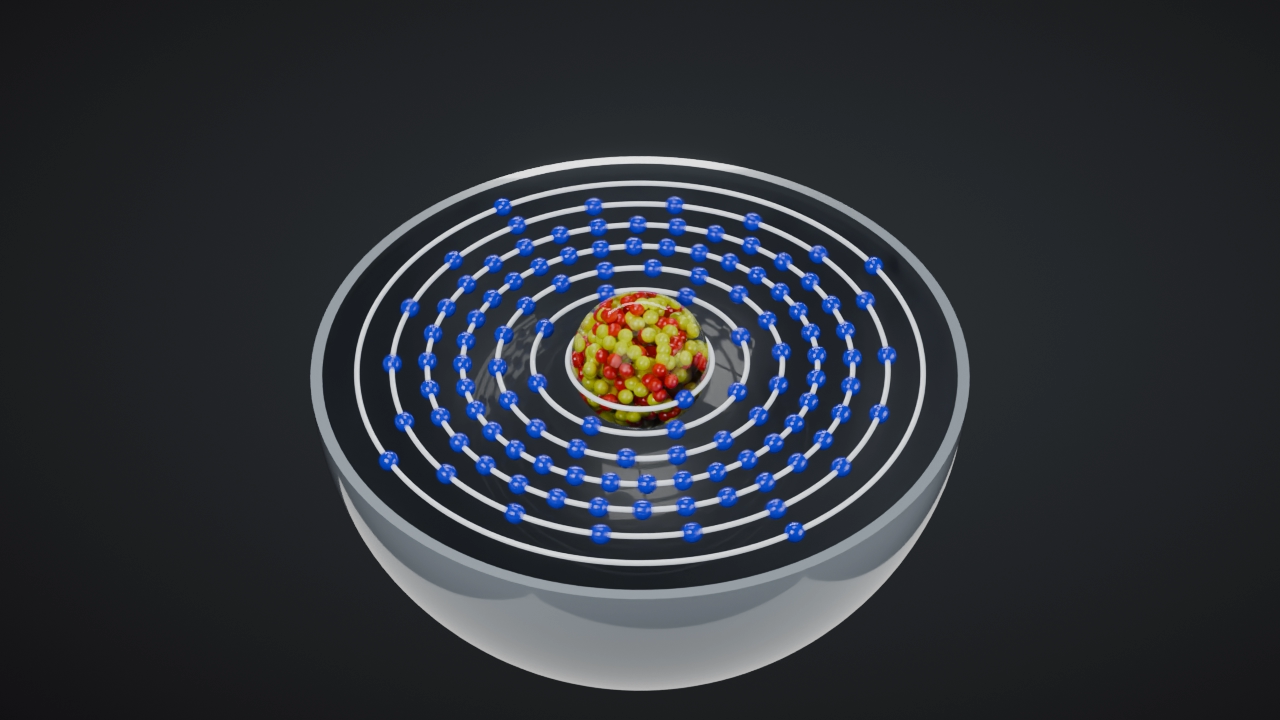
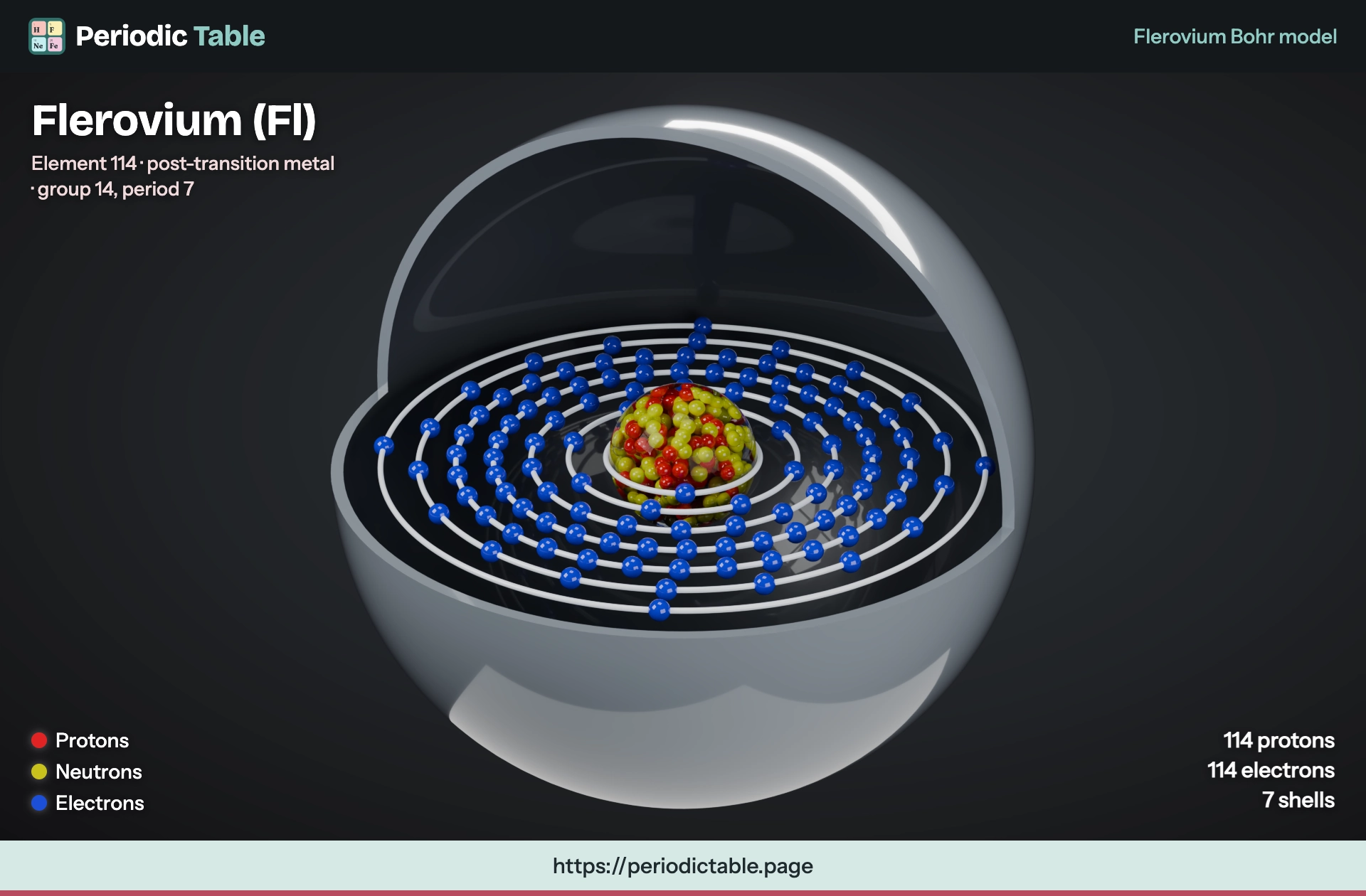
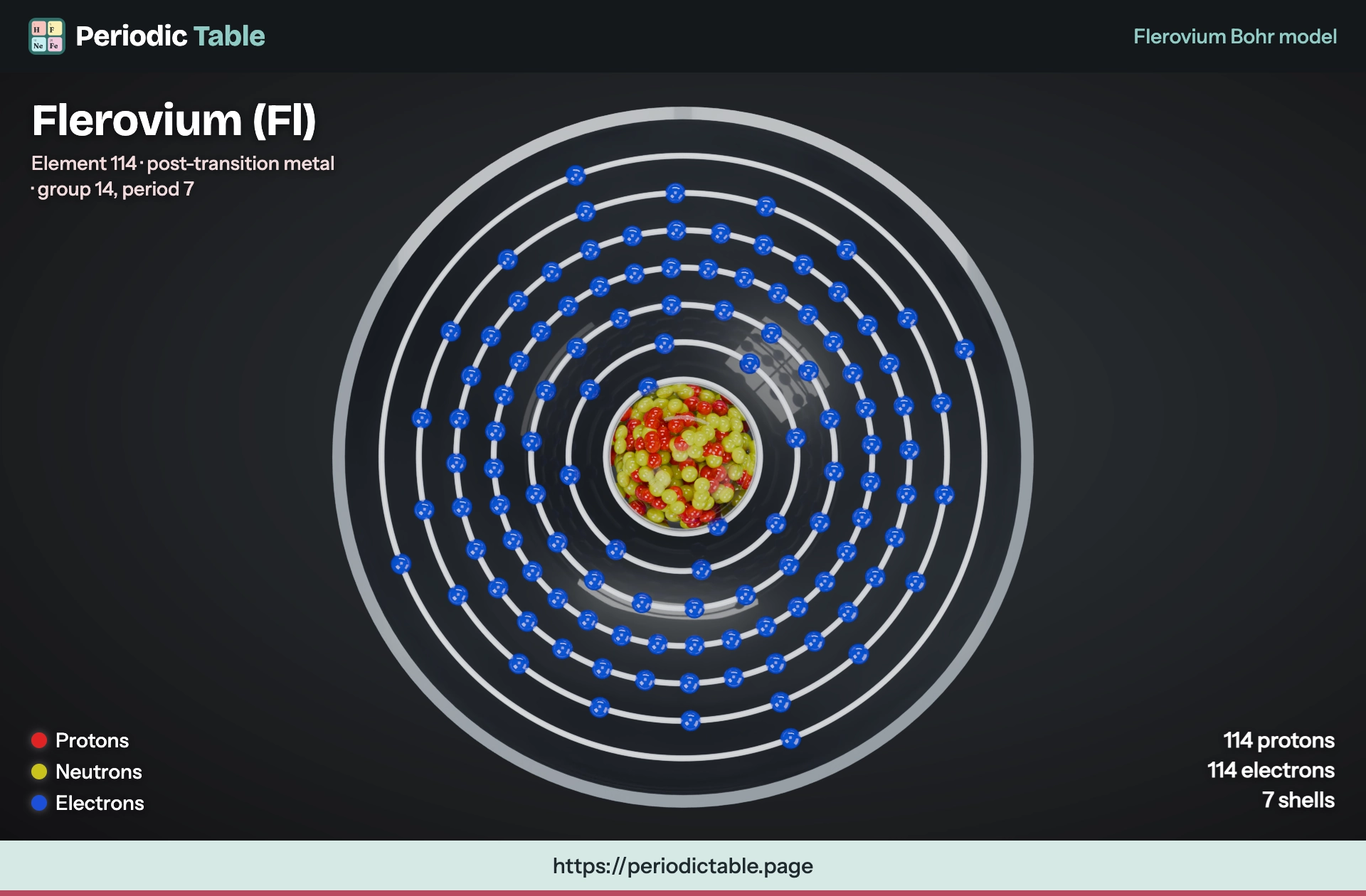
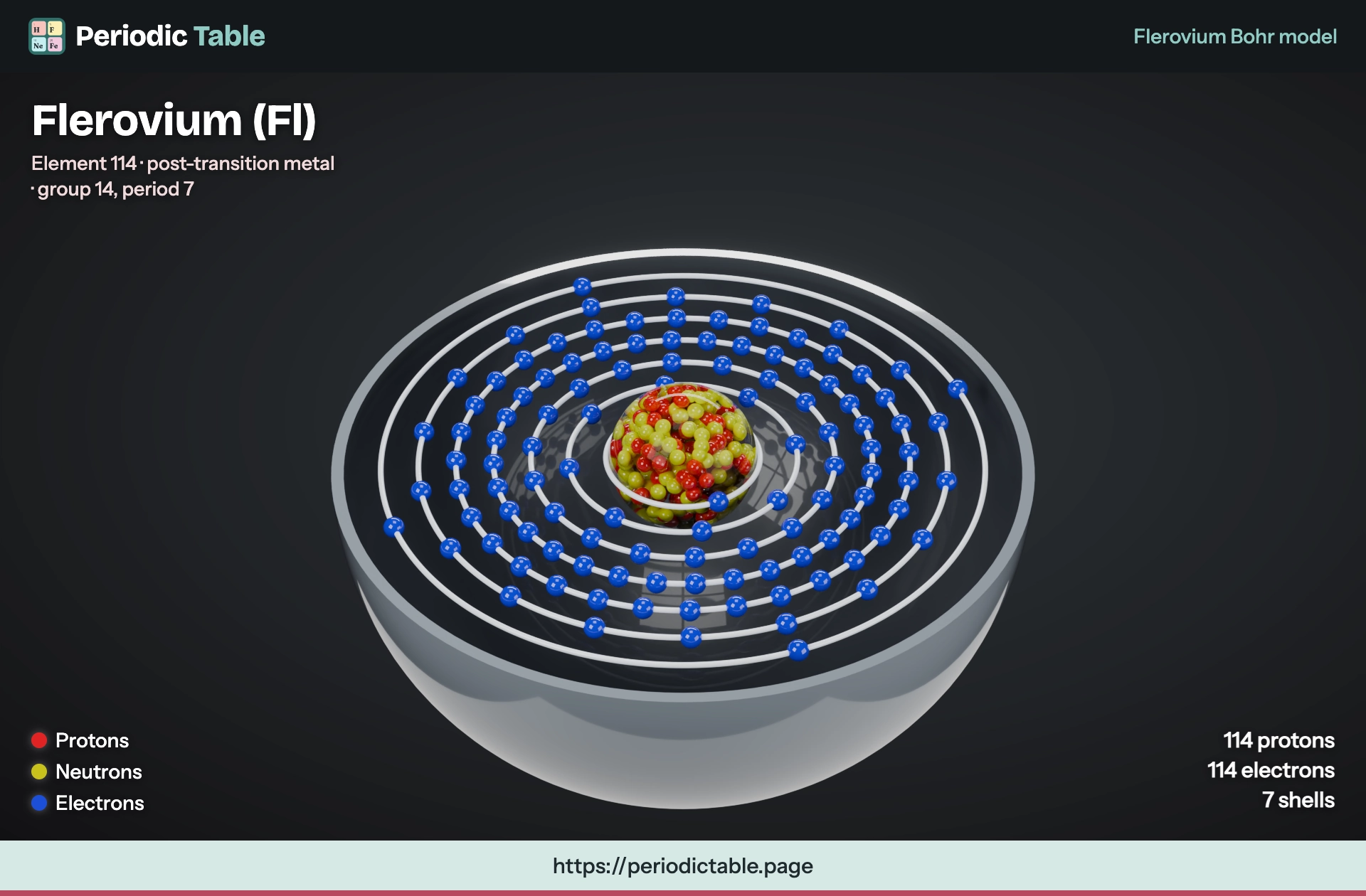
This is a Bohr model of flerovium (Fl), a simplified picture of a single flerovium atom. Its nucleus holds 114 protons, and a neutral flerovium atom has 114 electrons, arranged around it in 7 shells (2 in shell K, 8 in shell L, 18 in shell M, 32 in shell N, 32 in shell O, 18 in shell P and 4 in shell Q).
Flerovium periodic table electron configuration
- Shorthand
- *[Rn] 5f14 6d10 7s2 7p2
- Full
- 1s2 2s2 2p6 3s2 3p6 4s2 3d10 4p6 5s2 4d10 5p6 6s2 4f14 5d10 6p6 7s2 5f14 6d10 7p2
- Electrons per shell
- 2, 8, 18, 32, 32, 18, 4
Flerovium element properties and atomic data
- Atomic number
- 114
- Atomic mass
- [289] u
- Phase at STP
- Unknown
- Melting point
- 66.85°C (340 K)
- Boiling point
- 146.85°C (420 K)
- Density
- 14 g/cm³
- Electronegativity (Pauling)
- Unknown
- Period
- 7
- Group
- 14
- Block
- p-block
- Appearance
- Unknown
- Discovery date
- 1999
- Discovered by
- Joint Institute for Nuclear Research
- Named by
- —
Flerovium at a glance: element 114 in the periodic table
Element 114 is a transactinide, one of the superheavy elements that come after lawrencium, and it belongs to the wider family of transuranium elements, all with atomic numbers above 92. Because only a handful of atoms have ever existed at one time, almost everything you read about its bulk behaviour is a prediction, not a measurement. Values that are measured come from single-atom chemistry and from the decay data of its isotopes. For anyone tracing the metal in seawater, soil and the Earth's crust, the thulium element guide keeps recycling and production in focus.
| Property | Flerovium value |
|---|---|
| Symbol | Fl |
| Atomic number | 114 |
| Group, period, block | Group 14 (carbon group), period 7, p-block |
| Mass (most stable confirmed isotope) | [289] |
| Electron configuration | [Rn] 5f14 6d10 7s2 7p2 (predicted) |
| State at 20°C | Predicted solid or liquid; measured volatility suggests it may even be gaseous |
| Natural occurrence | None, made only in the laboratory |
| Discovered | 1998 to 1999, Joint Institute for Nuclear Research, Russia |
| CAS number | 54085-16-4 |
Fact sheets such as the one published by the Royal Society of Chemistry list many fields for this element as unknown, including its density, electronegativity and Young's modulus. That gap is not neglect: you cannot measure bulk properties on one superheavy atom that lives about two seconds.
Where it sits: group 14, period 7 and the p-block
Flerovium shares a column with carbon, silicon, germanium, tin and lead, flanked by nihonium (113) on the left and moscovium (115) on the right. As the heaviest known member of that column, it is the test case for whether the trend from non-metal at the top to metal at the bottom keeps going, or whether physics at very high nuclear charge changes the rules of the periodic table.
Atomic number, atomic mass and electron configuration
An atomic number of 114 means 114 protons in every nucleus. The atomic mass is written in brackets, [289], because there is no stable isotope and no natural mix to average: the value is simply the mass number of Fl-289.
Its predicted electron configuration ends in two electrons in the 7p subshell, matching the ns2 np2 pattern of the rest of group 14. Calculated ionization energies start at about 832 kJ/mol for the first electron, higher than any lighter member of the column, a hint that this atom holds on to its outer electrons unusually tightly. Its electron affinity is expected to be below zero, and no reliable electronegativity value exists.
Discovery of the flerovium element at Dubna
The discovery of the flerovium element came from the Joint Institute for Nuclear Research (JINR) in Dubna, Russia, where a team of scientists led by Yuri Oganessian spent months firing ion beams at heavy plutonium samples. The story behind that discovery starts decades earlier, though, with a theory that said element 114 might be unusually long-lived. Chemists and physicists will find in the nobelium element a study of experiments done atom by atom in a laboratory.
Island of stability predictions before 1998
In the 1960s, the nuclear shell model suggested that nucleons fill shells inside the nucleus, much as electrons fill shells around it. A nucleus with a full shell, a so-called magic number of nucleons, resists decay.
One with full shells of both protons and neutrons is doubly magic. Calculations at the time pointed to 114 protons and 184 neutrons, the isotope Fl-298, as the centre of an island of stability in a sea of very short-lived superheavy nuclei.
The idea was championed by Glenn T. Seaborg and caught the imagination of nuclear physics. Early estimates even gave some flerovium isotopes half-lives of millions of years.
A first attempt in 1968 found nothing. Later work showed the picture is more subtle: deformed nuclei near hassium (108) gain extra stability too, and the true centre of the island may sit at a different proton number.
The first flerovium atoms, 1998 to 1999
In December 1998 the Dubna team bombarded a plutonium-244 target with calcium ions and recorded a single event that pointed to element 114, with a decay time of roughly 30 seconds. That first atom has never been reproduced, so its exact identity is still debated. In 1999 the same group, working with scientists from the Lawrence Livermore National Laboratory in California, switched to plutonium-242 and recorded more atoms with consistent decay chains.
Repeat runs at the Joint Institute for Nuclear Research and later at other laboratories between 2002 and 2009 produced matching results, and those independent checks are what turned a claim into a confirmed discovery.
Confirmation and naming: from ununquadium to flerovium
Until a permanent name was agreed, the element went by the IUPAC systematic placeholder ununquadium, symbol Uuq, built from Latin roots for "one, one, four". Older texts also call it eka-lead, using Mendeleev's convention for the unknown element one place below a known one.
In 2011 a joint working party of IUPAC and IUPAP credited the Dubna and Livermore collaboration with the discovery. On 30 May 2012, IUPAC approved the name flerovium and the symbol Fl.
The name honours the Flerov Laboratory of Nuclear Reactions at JINR and its founder, the physicist Georgy Flerov, who co-discovered the spontaneous fission of uranium. Curiously, the same name had been proposed decades earlier for element 102, which IUPAC instead named nobelium.
How the superheavy element flerovium is made
You cannot dig a superheavy element out of the ground, so every flerovium nucleus is built in a nuclear reaction. A particle accelerator speeds up a beam of calcium-48 ions to around a tenth of the speed of light and fires it at a thin plutonium target. That calcium isotope is prized because it carries an unusually high share of neutrons, which helps the product land closer to the stable region.
Two positively charged nuclei repel each other strongly, so fusion only happens when the beam nucleus gets close enough for the strong interaction to overcome electrostatic repulsion. Most collisions fail.
When fusion succeeds, it forms an excited compound nucleus that sheds a few neutrons and settles into a flerovium isotope. The success rate is tiny: trillions of ions hit the plutonium every second for only a few superheavy atoms per day, which is why researchers describe the element as made one atom at a time.
Reading the decay chain to prove a new atom
A separator steers each new flerovium atom out of the beam and into a silicon detector, which logs where and when it lands. Seconds later the same spot records the atom's decay. Flerovium nuclei mostly undergo alpha decay, ejecting a helium nucleus and turning into copernicium (element 112), which decays again.
This decay chain of linked events, each with a known energy, lets physicists trace the decay products back to the parent. A chain that ends in spontaneous fission, where the nucleus splits into two large fragments, is harder to read because fission fragments vary from atom to atom.
Flerovium isotopes and their half-life values
Seven flerovium isotopes have been reported, with mass numbers from 284 to 290. All of these isotopes are radioactive and short-lived, and the table below gives their commonly cited half-lives. Some heavier ones are produced directly from plutonium, while the lighter isotopes also turn up as daughters when livermorium (116) decays.
| Isotope | Half-life | Main decay mode |
|---|---|---|
| Fl-284 | 2.5 ms | Spontaneous fission |
| Fl-285 | 100 ms | Alpha decay |
| Fl-286 | 105 ms | Alpha (55%) or fission (45%) |
| Fl-287 | 360 ms | Alpha |
| Fl-288 | 653 ms | Alpha |
| Fl-289 | 1.9 s (about 2.1 s in older data) | Alpha |
| Fl-290 | 19 s (unconfirmed) | Electron capture or alpha |
The longest-lived isotope confirmed so far is flerovium-289. To see what a half-life near two seconds means in practice, you can apply the decay law yourself:
$$\frac{N}{N_0} = \left(\frac{1}{2}\right)^{t / t_{1/2}}$$
Using \(t_{1/2} = 1.9\) s for Fl-289, the share of atoms still intact after a given wait works out as follows:
- After 1 s: about 69.4% remain
- After 5 s: about 16.1% remain
- After 10 s: about 2.6% remain
- After 20 s: about 0.07% remain
The same arithmetic shows that only 1% of a sample survives past roughly 12.6 seconds. For Fl-288, with a 653 ms half-life, under 0.5% is left after just 5 seconds. Superheavy chemistry therefore has to finish its work in the first few seconds after an atom is made, which shapes every experiment design you will read about below.
These half-lives are still far longer than those of neighbouring nuclei that carry fewer neutrons, which is why most physicists read them as the shore of the island of stability rather than its centre. Reaching Fl-298 would need 14 more of them than any known flerovium isotope carries.
Predicted physical properties of flerovium
Because no one has ever held a visible amount of it, the physical properties of flerovium come from relativistic quantum calculations. The figures below are the ones most often cited, set beside its lighter neighbour so you can see how the trend down group 14 is expected to bend.
| Property | Flerovium (predicted) | Lead (measured) |
|---|---|---|
| Density | 11.4 ± 0.3 g/cm3 | 11.34 g/cm3 |
| Melting point | 284 ± 50 K (about 11 °C) | 600.6 K (327.5 °C) |
| Boiling point | Not established; very low expected | 2022 K (1749 °C) |
| Atomic radius | About 180 pm | 175 pm |
| Covalent radius | 171 to 177 pm (extrapolated) | 146 pm |
| Heat of vaporization | About 38 kJ/mol | 179.5 kJ/mol |
The striking row is the melting point. If the calculations hold, flerovium would be a liquid close to room temperature, much like mercury, and some models even allow it to be a gas at standard temperature and pressure.
The tiny heat of vaporization, about a fifth of the value in the right-hand column, points the same way: its atoms barely hold on to each other. Different sources disagree on whether it is a solid at 298 K, and that disagreement is honest uncertainty, not error.
Flerovium chemical properties: the most volatile metal
Flerovium is the heaviest element that has been chemically studied, and its chemical properties are where the real surprises lie. Rather than acting as a plain heavier copy of its neighbour, it sits on a borderline between the metals and the noble gases. This corner of superheavy chemistry has driven most of the research on element 114 since 2007.
Relativistic effects on the 7p electrons
Around a nucleus this heavy, the innermost electrons move at a large fraction of the speed of light. These relativistic effects, combined with strong spin-orbit coupling, split the 7p subshell and pull its first two places in close to the nucleus.
Flerovium's two valence electrons fill exactly that inner pair, giving it something close to a closed shell. That is why theorists in the 1970s predicted it could be as inert as a noble gas, while others still expected a weakly bonding metal.
Oxidation state and bonding predictions
For carbon and silicon, +4 is common, but the trend down the column favours +2, and flerovium pushes it further. Its main oxidation state is expected to be +2, with 0 also likely, while +4 compounds would be very unstable.
Calculations suggest two atoms can join as a diatomic molecule, Fl2, held more strongly than a pair of noble gas atoms. Early runs also showed that flerovium interacts with platinum, gold and silver surfaces, consistent with a weak metallic bond.
Gold surface experiments at GSI
The decisive experiments used a gas stream to carry single atoms past a gold detector cooled along its length. The first run, in 2007 to 2008, saw three atoms and hinted at gas-like behaviour.
A 2009 run at GSI in Darmstadt, Germany, saw two atoms deposit on gold at room temperature, suggesting a metal. To settle it, scientists compared flerovium with lead, mercury and radon run through the same setup: lead stuck to the silicon oxide in the first section, mercury reached the gold, and the noble gas slipped past most of it.
Results published in Frontiers in Chemistry in 2022 found that flerovium binds to the gold surface more weakly than mercury but more strongly than radon. That volatility makes it the most volatile metal in the periodic table and the least reactive member of its group, a result that rewrote textbook chemistry for element 114.
Element Fl compared with lead and the carbon group
On paper, element Fl is the heavier homologue of lead, and a few basic features follow the group trend: two outer p-electrons, a preference for the lower oxidation state, and metallic bonding at heart. The differences are bigger than the likenesses, though.
- Reactivity: lead is a fairly ordinary heavy metal that forms oxides and salts easily; flerovium barely bonds at all.
- Boiling behaviour: lead boils above 1,700 °C, while flerovium atoms drift through a detector without sticking.
- Stability: lead has four stable isotopes; flerovium has none that last more than seconds.
- Neighbours: flerovium behaves more like its row-mate copernicium than like tin, a quirk shared by the heaviest metals.
It is not alone in breaking the pattern. Oganesson, the last element in its row, is predicted to act less like a noble gas than its place suggests. Together, these superheavy elements show that the periodic table's tidy columns start to bend once relativity takes over, and flerovium is the clearest measured example so far in modern chemistry.
Uses of flerovium and why research continues
Flerovium has no practical applications, and given how it is made, it never will in the everyday sense. A whole year of beam time yields a few dozen atoms at best. Outside of basic research, the only places you will find flerovium Fl named are periodic tables, chemistry textbooks and physics papers.
Its value is scientific. Each new atom tests models of superheavy nuclear structure, helps map how far the island of stability extends, and checks how well relativistic quantum chemistry predicts the behaviour of the heaviest elements. Newer accelerator facilities in Dubna aim to raise production rates, which could let scientists run longer chemistry sequences on element 114 and possibly measure the first compounds of flerovium.