


Thulium element (Tm): thulium periodic table facts
Thulium periodic table facts: thulium (Tm) is element 69, a lanthanide in period 6 of the f-block. Ask a chemist to name the rarest stable lanthanide and you will probably hear thulium, a soft, silvery-gray rare earth with the symbol Tm. When studying clean fuels, electrolysis, steam reforming and an energy carrier role for the lightest element are explained in the hydrogen element guide for curious readers.
Only promethium, which is radioactive, is scarcer in Earth's crust, and that scarcity explains the high price you pay for even a few grams of the metal. Below you will find its key data, chemistry, isotopes and the medical and industrial jobs that make it worth the cost.
Rotate the 3D Bohr model of thulium
Drag to orbit, scroll to zoom.
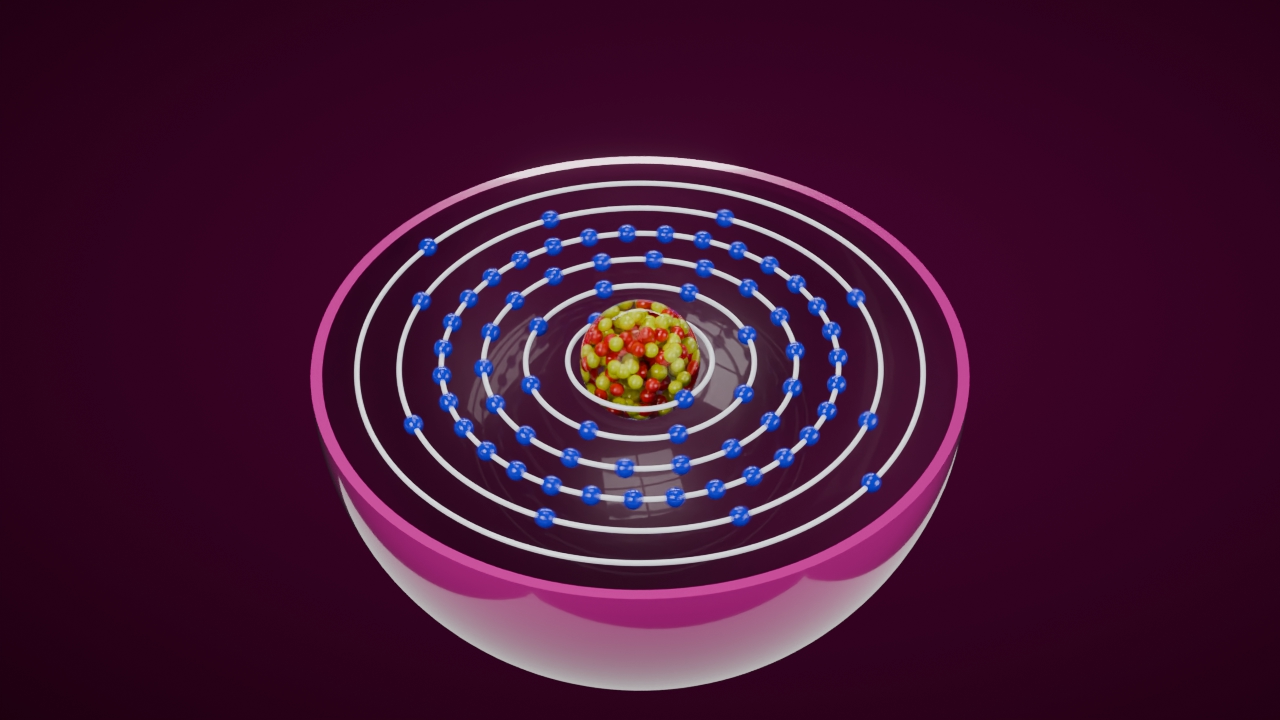
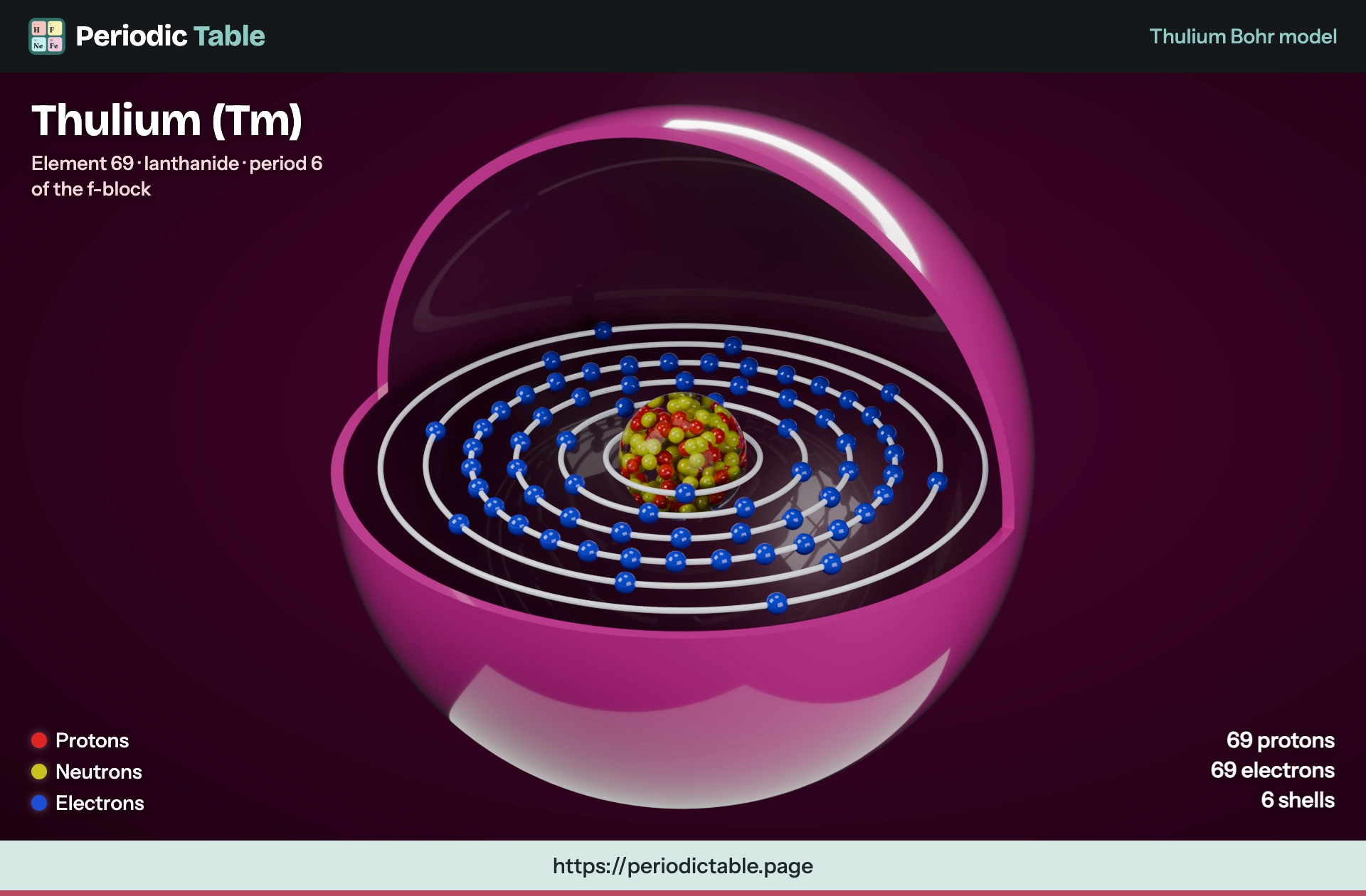
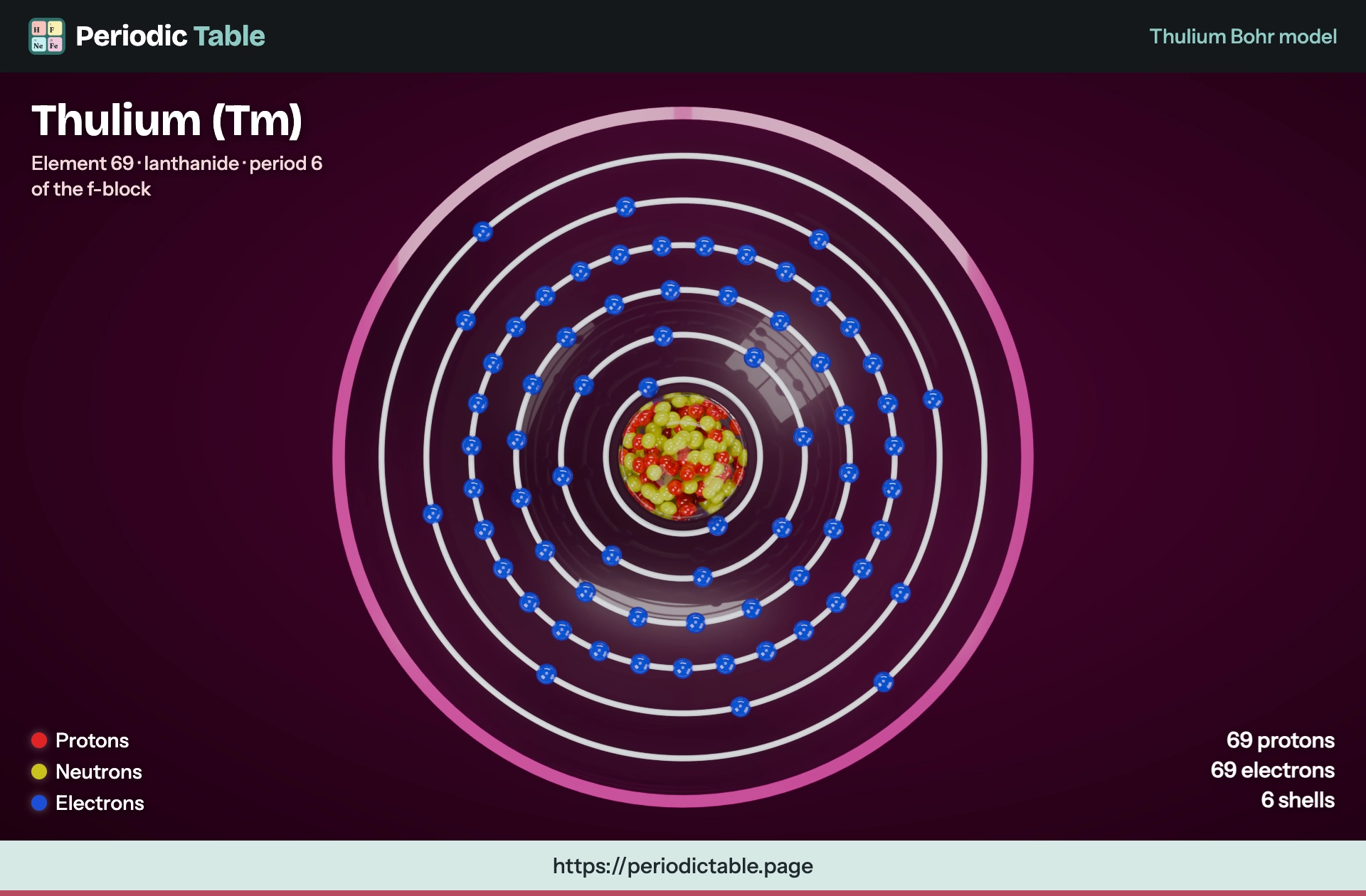
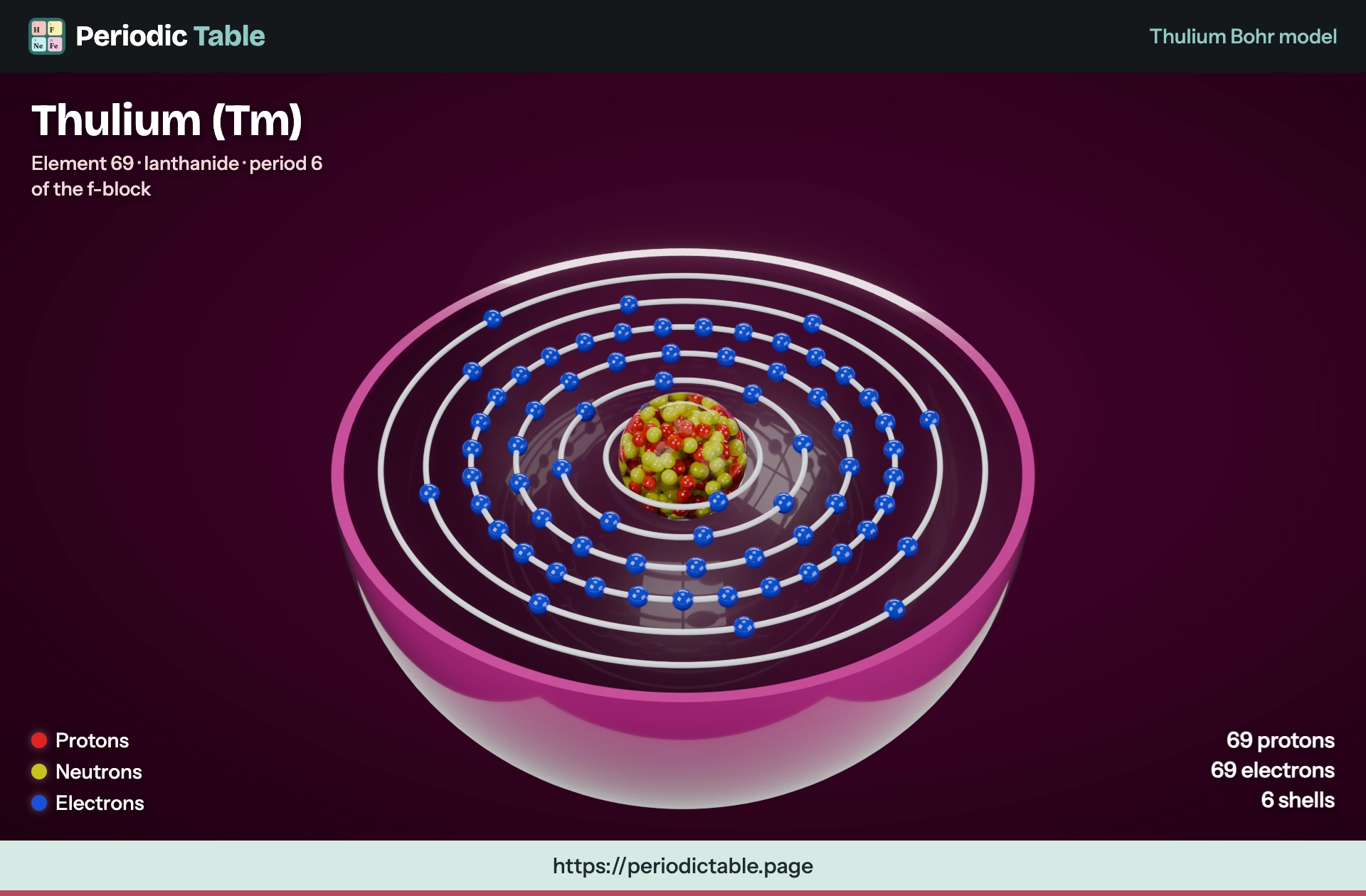
This is a Bohr model of thulium (Tm), a simplified picture of a single thulium atom. Its nucleus holds 69 protons, and a neutral thulium atom has 69 electrons, arranged around it in 6 shells (2 in shell K, 8 in shell L, 18 in shell M, 31 in shell N, 8 in shell O and 2 in shell P).
Thulium periodic table electron configuration
- Shorthand
- [Xe] 4f13 6s2
- Full
- 1s2 2s2 2p6 3s2 3p6 4s2 3d10 4p6 5s2 4d10 5p6 6s2 4f13
- Electrons per shell
- 2, 8, 18, 31, 8, 2
Thulium element properties and atomic data
- Atomic number
- 69
- Atomic mass
- 168.9342 u
- Phase at STP
- Solid
- Melting point
- 1544.85°C (1818 K)
- Boiling point
- 1949.85°C (2223 K)
- Density
- 9.32 g/cm³
- Electronegativity (Pauling)
- 1.25
- Period
- 6
- Group
- —
- Block
- f-block
- Appearance
- Silvery gray
- Discovery date
- 1879
- Discovered by
- Per Teodor Cleve
- Named by
- —
Thulium element facts and the lanthanide series
Element thulium is a chemical element in the lanthanide series, the run of fifteen f-block elements at the foot of the table. It sits in period 6, thirteenth along the series. To see how soft metals react with water to form a hydroxide and release hydrogen, read about the alkali metal reactivity in more detail than a summary.
Like every rare-earth element, it shares almost all of its chemistry with its neighbours, which is why separating it took decades. The table gives you the core figures at a glance.
| Property | Value |
|---|---|
| Symbol | Tm |
| Proton number (Z) | 69 |
| Relative atomic mass | 168.934 |
| Series and block | Lanthanides, f-block |
| State at 20 °C | Solid |
| Only natural nuclide | 169Tm (100%) |
| CAS number | 7440-30-4 |
| Discovered | 1879 by Per Teodor Cleve |
| Name origin | Thule, a classical name for the far north linked with Scandinavia |
Atomic number, atomic weight and electron configuration
With atomic number 69, every atom of the element carries 69 protons in its nucleus and, when neutral, 69 electrons around it. The standard atomic weight of 168.934 is unusually precise because nature supplies just one nuclide, which has 100 neutrons. The ground-state arrangement is [Xe] 4f13 6s2: the 4f subshell is one electron short of full, a detail that explains several of its chemical quirks.
Where Tm sits in the periodic table
Look at the two detached rows below the main grid of the periodic table. The upper row holds the lanthanides, running from lanthanum (57) to lutetium (71). Element 69 lies between erbium (68) and Yb (70), close enough to the end of the row that its atoms are among the smallest of the series, a trend chemists call the lanthanide contraction.
Physical properties of thulium metal
A freshly cut surface shows a bright silver lustre. The element is malleable and ductile, so you can roll it into foil or draw it into wire, and with a Mohs hardness of only 2 to 3 it can be cut with a knife. Mechanically it is stiffer than that suggests: its Young's modulus is about 74 GPa, close to that of aluminium. For eka-lead, look up flerovium chemical properties and how a plutonium target and calcium beam made it.
Its specific heat capacity is 160 J/(kg·K), so it warms quickly for its mass. These numbers are typical of the late lanthanides, and most of the useful properties of thulium come from its partly filled inner shell rather than its bulk mechanics.
Melting point, boiling point and density
- Melts at: 1545 °C (1818 K)
- Boiling point: 1950 °C (2223 K)
- Mass per volume: 9.32 g/cm3 at 20 °C, falling to about 8.56 g/cm3 as a liquid
The liquid range is narrow, just 405 °C between melting and boiling. That short window, together with a fairly high vapour pressure just below its melt, is why refiners often purify the solid by distillation instead of handling large pools of liquid.
Crystal structure and magnetic behaviour
At room temperature the atoms pack in a hexagonal close-packed lattice, the more stable of its two allotropes (a tetragonal form also exists). Its magnetism changes as you cool it: the element is paramagnetic above 56 K, antiferromagnetic between 32 and 56 K, and ferromagnetic below 32 K. Those transitions make it a useful test case for physicists studying how localised spins order.
Chemical properties and thulium compounds
In air the surface tarnishes slowly, and above about 150 °C the element burns readily to thulium(III) oxide:
$$4\,\text{Tm} + 3\,\text{O}_2 \rightarrow 2\,\text{Tm}_2\text{O}_3$$
That white-to-greenish powder is its only known oxide, traditionally called thulia, and commercial thulium oxide is the starting point for almost every other salt. Thulium reacts slowly with cold water and quickly with hot water to give thulium hydroxide and hydrogen gas.
It combines with all the halogens, gently at room temperature and vigorously above 200 °C, and it dissolves in dilute sulfuric acid to give pale green solutions in which each Tm(III) ion is surrounded by nine water molecules. Under the right excitation those ions show a bright blue luminescence, the property behind several of its modern uses.
Oxidation states and electronegativity
The +3 oxidation state dominates, and it is the only one seen in solution. Because the inner shell is nearly full, a +2 state can also be stabilised, but only in solids such as reddish-purple dihalides that react violently with water.
The ionisation pattern shows why: the first three ionization energies are about 597, 1160 and 2285 kJ/mol, but the fourth jumps to roughly 4120 kJ/mol, so removing a fourth electron is never worth it chemically. With an electronegativity of 1.25 on the Pauling scale, the element is easily oxidised and forms mainly ionic compounds.
Isotopes of thulium and their half-life values
Natural samples contain a single nuclide, thulium-169, which is stable for every practical purpose; theory predicts an alpha decay to holmium-165 that has never been observed. Known nuclides run from mass 144 to 183.
Lighter isotopes decay mainly by electron capture to Er nuclides, heavier ones by beta emission toward ytterbium. The longest-lived synthetic nuclide is thulium-171.
| Nuclide | Abundance | Half-life | Main decay |
|---|---|---|---|
| 167Tm | Synthetic | 9.25 days | Electron capture to 167Er |
| 168Tm | Synthetic | 93.1 days | EC (with minor β+) to 168Er |
| 169Tm | 100% | Stable | None observed |
| 170Tm | Synthetic | 128.6 days | β− to 170Yb |
| 171Tm | Synthetic | 1.92 years | β− to 171Yb |
History of element 69 from Thule to a pure sample
The story begins with yttrium, found in a Swedish mineral in 1794, which later turned out to hide several more elements. In 1879 the Swedish chemist Per Teodor Cleve took erbia (erbium oxide), stripped out the known impurities and found two new oxides: a brown one he called holmia and a green one he called thulia.
He named the new element thulium after the most northerly land known to ancient geographers. Its first symbol was Tu, later changed to avoid confusion with tungsten.
Getting a clean sample was brutal work. In 1911 Charles James, a British chemist at New Hampshire College, reported nearly pure material after about 15,000 fractional crystallisations of thulium bromate.
Theodore William Richards, whose precise atomic-weight measurements won him the 1914 Nobel Prize in Chemistry, refined the figure for thulium the same patient way. Metallic thulium was first isolated in 1936, and high-purity material reached the market only in the late 1950s once ion-exchange separation became practical.
Where Tm occurs in nature
You will never find thulium native. It turns up at trace level in monazite, xenotime, euxenite, gadolinite and bastnasite, always mixed with the other rare earth elements, and no minerals yet found contain more of it than of its relatives.
Its average abundance is about 0.5 parts per million in Earth's crust and in soil, and only around 250 parts per quadrillion in seawater. That makes it the least abundant lanthanide apart from promethium.
Because no ore is mined for thulium alone, supply follows the wider rare-earth trade. China holds the largest share by far, with Russia, Australia, Brazil, India and the United States holding most of the remaining reserves, and global output is measured in tens of tonnes per year.
How pure thulium is produced
Most material comes from monazite sands and the ion-adsorption clays of southern China, where it is roughly 0.5% of the rare-earth content. Refiners dissolve the concentrate and separate the near-identical lanthanides by ion exchange and solvent extraction, steps that have to be repeated many times because neighbours differ so little.
The metallic form is then made by reducing the oxide with lanthanum or calcium in a sealed vessel. Annual production was estimated at around 50 tonnes of oxide in the early 2000s, a tiny figure next to cerium or neodymium, and recycling recovers very little of what is used.
Thulium uses in medicine, science and industry
Scarcity keeps the list short, and cheaper rare earths can stand in for it in many jobs. Where it does earn its price, it is because of a specific laser wavelength, a convenient radioisotope or that blue glow.
Thulium lasers and laser surgery
Doped into yttrium aluminium garnet, the element forms Tm:YAG crystals that lase near 2010 nm, and a triple-doped Ho:Cr:Tm:YAG medium lases at 2080 nm for military, meteorological and medical work. Water absorbs this infrared light strongly, so the beam cuts and vaporises soft tissue with very shallow heat damage. Surgeons use thulium fibre and crystal laser systems for urology, especially for benign prostatic hyperplasia, where precise cutting with little bleeding matters.
Thulium-170 as a portable X-ray source
Bombard stable thulium-169 with neutrons in a nuclear reactor and you get Tm-170, which emits low-energy gamma rays and X-rays (main lines between about 7 and 84 keV) and stays useful for about a year. Sealed in a small lead cup, it powers portable X-ray units that need no mains electricity, handy for imaging bones in the field and for dental work. The same sources serve industrial radiography, checking welds and hidden components for cracks, and the isotope is being studied for brachytherapy, a cancer treatment that places a sealed radiation source next to a tumour.
Banknotes, superconductors and other applications
- Euro banknotes: the element fluoresces blue under ultraviolet light, so it is built into the notes as a check against counterfeiting.
- Dosimeters: doped calcium sulfate glows blue in proportion to absorbed dose, giving a visual radiation monitor.
- Advanced materials: it has been tested in high-temperature superconductors and in ferrites, the magnetic ceramics used in microwave equipment.
- Arc lighting: its green emission lines fill a gap in the spectrum of halide arc lamps.
Thulium compared with erbium and ytterbium
Comparing thulium with its two neighbours shows how much one extra inner electron can change. The middle column is the one this page covers.
| Property | Er | Tm | Yb |
|---|---|---|---|
| Z | 68 | 69 | 70 |
| f-shell occupancy | 12 | 13 | 14 (full) |
| Melting point (°C) | 1529 | 1545 | 824 |
| Density (g/cm3) | 9.07 | 9.32 | 6.90 |
| Colour of the 3+ ion in water | Pink | Pale green | Colourless |
The sharp drop in Yb's figures comes from its full f shell, which lets it behave as a divalent element in the solid. Thulium sits just short of that point, which is why it can be pushed into a +2 state but prefers +3.
Is Tm toxic? health and environment facts
The element has no known biological role. Insoluble salts are essentially non-toxic and soluble ones are only mildly so, so its toxicity is rated low. In animal studies, injected compounds damaged the liver and spleen and caused haemoglobin levels to swing.
In people it collects mainly in the liver, kidneys and bones, but you take in only a few micrograms a year, and plant roots barely absorb it. Some sources note a mild stimulating effect on metabolism, without any proven benefit. The main practical hazard is fine thulium dust, which can ignite, so store and handle the powder as a fire risk.