


Darmstadtium element (Ds): darmstadtium periodic table facts
Darmstadtium periodic table facts: darmstadtium (Ds) is element 110, a transition metal in group 10, period 7. Only a few dozen nuclei of darmstadtium have ever existed, and most vanished in less than a thousandth of a second. Protium, deuterium and tritium are compared in the atomic hydrogen, along with its atomic mass and electron configuration.
Darmstadtium (Ds) is a synthetic element with atomic number 110: it is intensely radioactive, never found in nature, and made one atom at a time in a particle laboratory. Here you get the facts you need about it, from its place in the periodic table and its isotopes to the properties scientists predict but cannot yet measure.
Rotate the 3D Bohr model of darmstadtium
Drag to orbit, scroll to zoom.
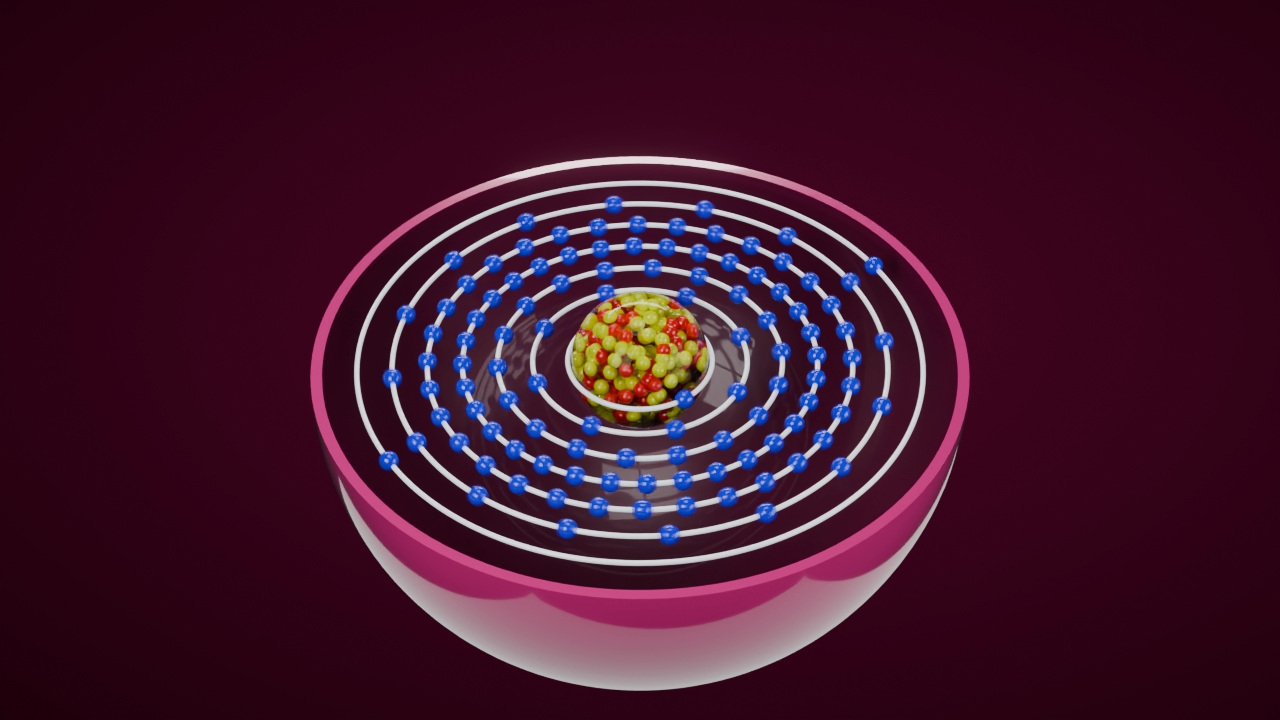
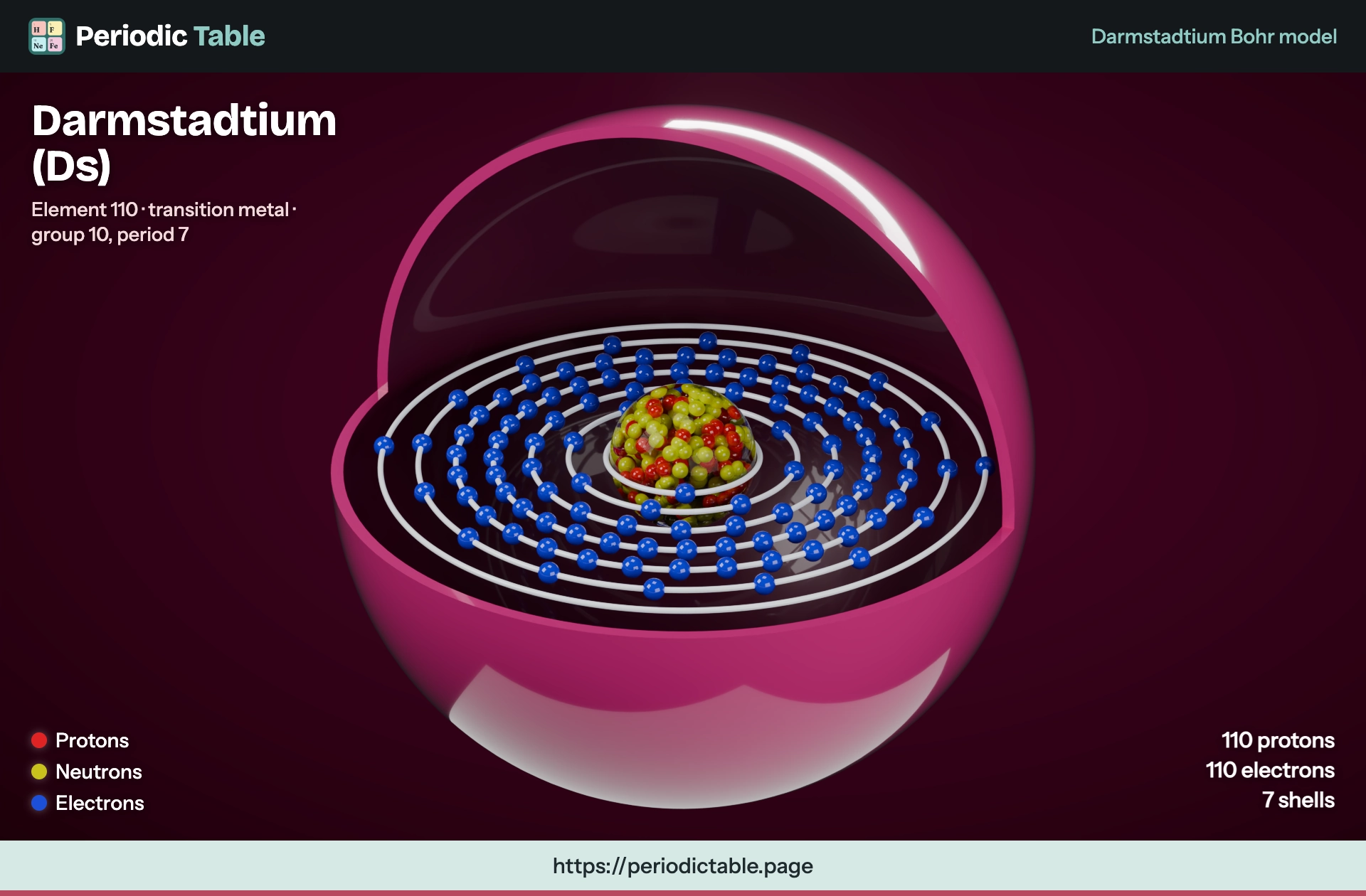
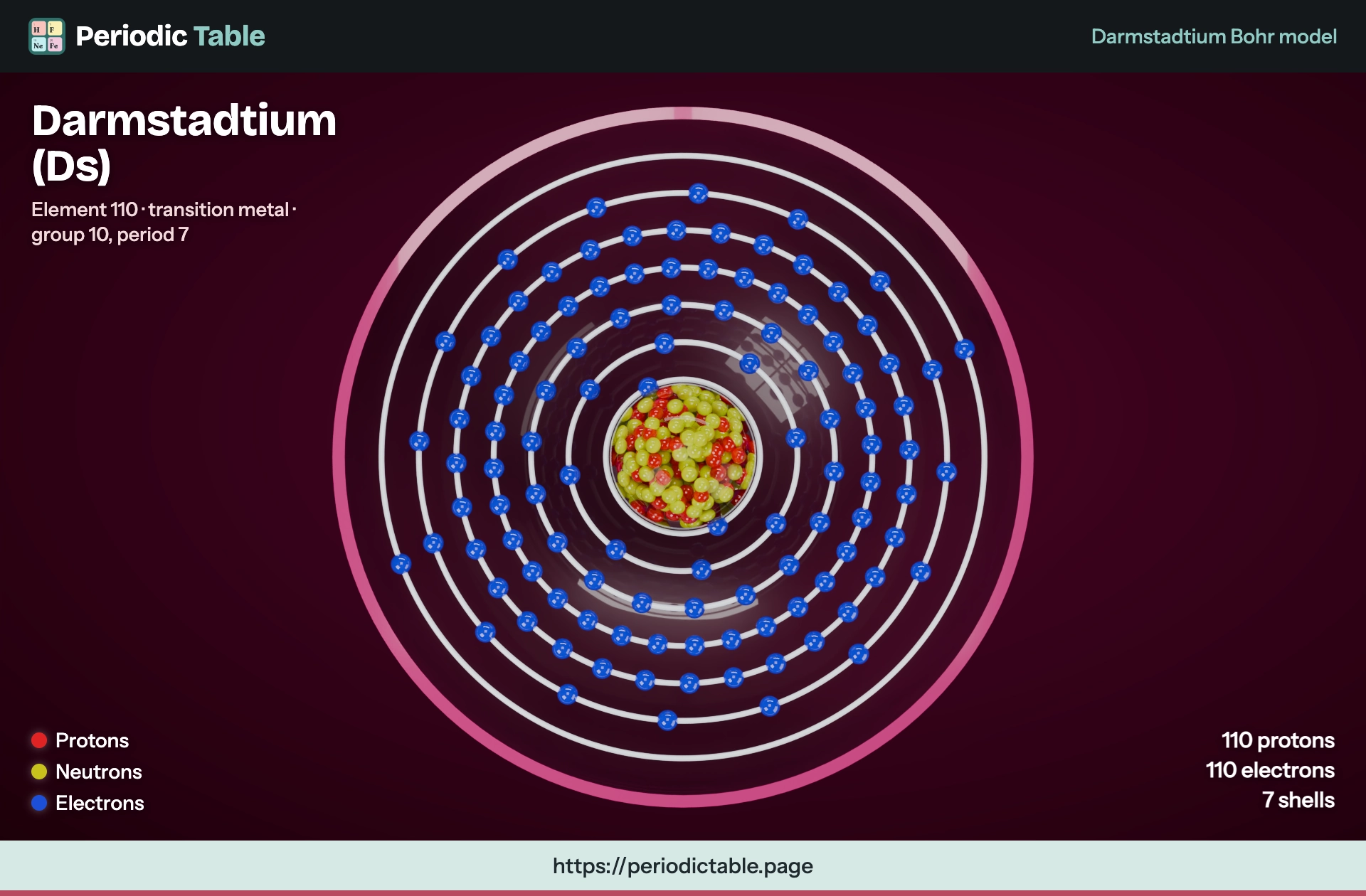
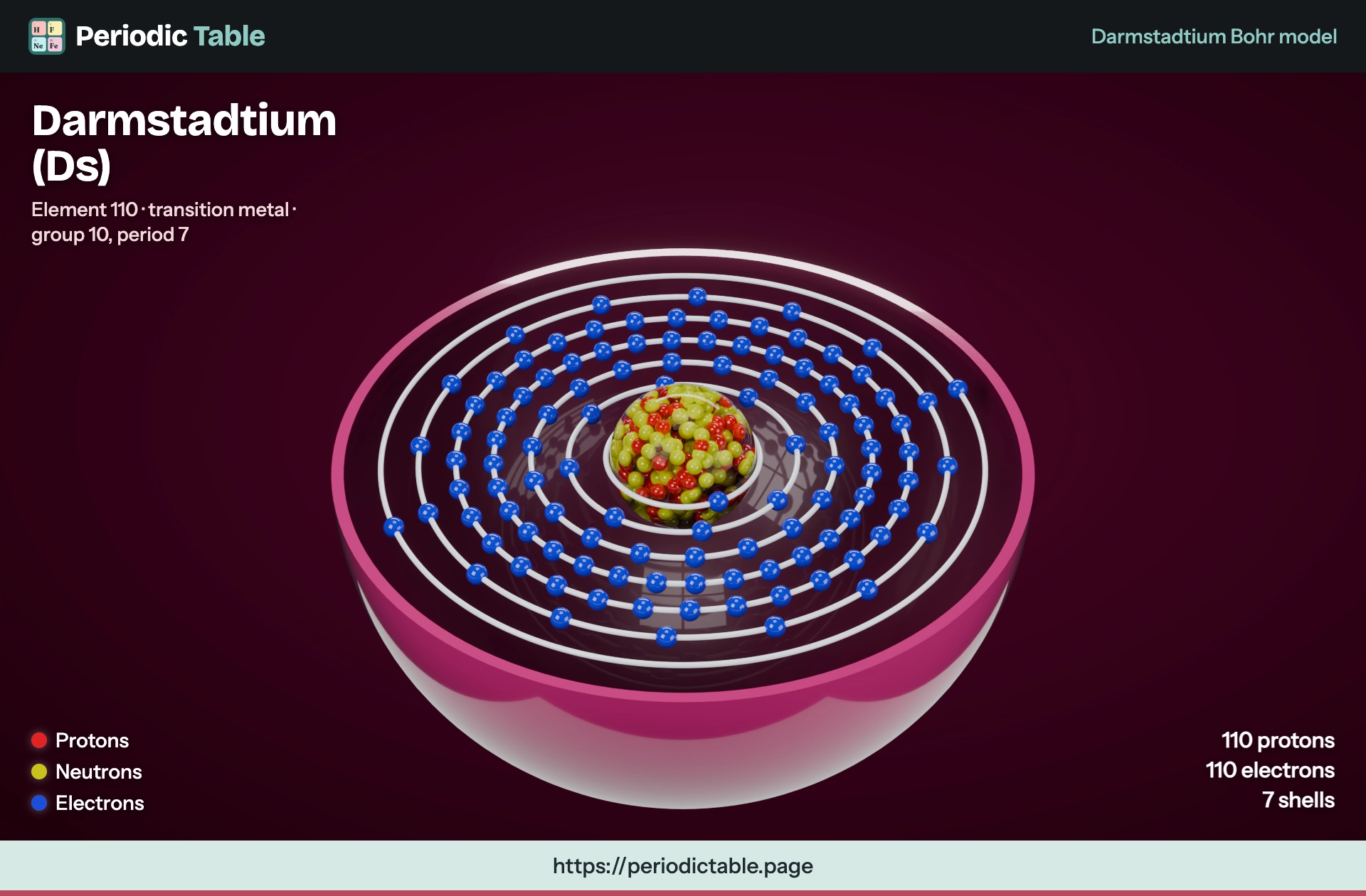
This is a Bohr model of darmstadtium (Ds), a simplified picture of a single darmstadtium atom. Its nucleus holds 110 protons, and a neutral darmstadtium atom has 110 electrons, arranged around it in 7 shells (2 in shell K, 8 in shell L, 18 in shell M, 32 in shell N, 32 in shell O, 16 in shell P and 2 in shell Q).
Darmstadtium periodic table electron configuration
- Shorthand
- *[Rn] 5f14 6d9 7s1
- Full
- 1s2 2s2 2p6 3s2 3p6 4s2 3d10 4p6 5s2 4d10 5p6 6s2 4f14 5d10 6p6 7s2 5f14 6d8
- Electrons per shell
- 2, 8, 18, 32, 32, 16, 2
Darmstadtium element properties and atomic data
- Atomic number
- 110
- Atomic mass
- [281] u
- Phase at STP
- Unknown
- Melting point
- Unknown
- Boiling point
- Unknown
- Density
- 34.8 g/cm³
- Electronegativity (Pauling)
- Unknown
- Period
- 7
- Group
- 10
- Block
- d-block
- Appearance
- Unknown
- Discovery date
- 1994
- Discovered by
- Gesellschaft für Schwerionenforschung
- Named by
- —
Darmstadtium element facts at a glance
Most of what you can say about this element comes from nuclear measurements and theoretical calculation rather than from a sample in a jar. The table below gathers the core identifiers. Values marked "predicted" come from relativistic models, because no one has ever held enough of it to weigh, melt or photograph. For plastic sulfur, amorphous forms and sulfur trioxide on the way to acid, look up element 16, sulfur and its allotropes.
| Property | Value |
|---|---|
| Symbol | Ds |
| Atomic number (Z) | 110 protons |
| Atomic mass | [281] (mass number of the longest-lived isotope) |
| Electron configuration | [Rn] 5f14 6d8 7s2 (predicted) |
| Electrons per shell | 2, 8, 18, 32, 32, 16, 2 (predicted) |
| Atomic radius | about 132 pm (predicted) |
| Covalent radius | about 128 pm (estimated) |
| State at room temperature | solid (predicted) |
| Melting and boiling points | unknown |
| CAS number | 54083-77-1 |
| First made | 9 November 1994, GSI, Darmstadt |
The radius figures are tiny on any scale: 132 picometers is about 0.13 billionths of a metre. Some references list the outer shell as 6d9 7s1 instead, copying the pattern of its lighter neighbour; the calculations discussed further down favour 6d8 7s2. As a chemical element, it is defined by its proton count alone, so every isotope you meet below is still darmstadtium.
Position in period 7 and the D-block
Darmstadtium sits in period 7 and the d-block of the periodic table, directly below the element that gives it its old nickname. It is a transactinide element, one of the elements beyond lawrencium, and the eighth member of the 6d series of transition metals. That placement makes it, on paper, a transition metal in group 10.
Its neighbours in the row are meitnerium (109) on the left and roentgenium (111) on the right, both equally short-lived and equally man-made. Whether it really behaves like the rest of its column has never been tested, because no chemistry experiment has yet been run on it.
History of darmstadtium (Ds)
The story of this element is a race between laboratories on three continents, a long naming dispute, and one scientific fraud case. Research on it still centres on the same German institute that won that race. In industrial testing, the californium element guide covers neutron radiography, activation analysis and start-up rods for nuclear reactors.
Discovery at the GSI in 1994
The confirmed discovery came on 9 November 1994 at the GSI Helmholtz Centre for Heavy Ion Research in Darmstadt, Germany. A team led by Sigurd Hofmann, with Peter Armbruster and Gottfried Münzenberg, fired accelerated nickel-62 ions at a lead-208 target in a heavy ion accelerator and caught a single nucleus of Ds-269:
$$^{208}_{82}\text{Pb} + ^{62}_{28}\text{Ni} \rightarrow ^{269}_{110}\text{Ds} + ^{1}_{0}\text{n}$$Two more events followed on 12 and 17 November. A further event once claimed for 11 November was later retracted after investigators found that Victor Ninov had fabricated the data. Switching the beam to nickel-64 produced nine nuclei of Ds-271 over two runs, each identified by the known decay of its daughters.
GSI was not the first to try. Earlier attempts at the Joint Institute for Nuclear Research in Dubna (1986–87), at GSI itself in 1990, and at the Lawrence Berkeley National Laboratory in 1995 produced hints but no convincing proof of the new darmstadtium element.
The German team had also worked with colleagues at Lawrence Livermore National Laboratory. In 2001 the IUPAC/IUPAP Joint Working Party credited GSI with the discovery, which gave the team the right to propose a name.
Naming: why ununnilium became darmstadtium
Before anyone made it, Mendeleev's convention called the empty slot under platinum in the periodic table eka-platinum. In 1979 IUPAC introduced the systematic element name ununnilium (symbol Uun, "one-one-nil"), a placeholder meant to last only until a discovery was confirmed. Many researchers ignored it and simply wrote element 110, E110 or (110).
Each rival lab had its own candidate:
- Becquerelium, proposed by the Russian team in 1996 after Henri Becquerel.
- Hahnium, proposed by the American team in 1997 after Otto Hahn.
- Wixhausium, briefly considered at GSI after the Darmstadt suburb of Wixhausen where the lab stands.
- "Policium", a joke suggestion, because 110 is the German police emergency number.
GSI settled on darmstadtium to honour its home city, and IUPAC officially recommended the name and the symbol Ds on 16 August 2003. It was the fourth element GSI had discovered.
How Ds is made as a superheavy element
Like every superheavy element, this one exists only when two lighter nuclei are forced to merge. Its synthesis relies on fusion: a beam of medium-mass ions travels at up to about a tenth of the speed of light into a thin target of heavy nuclei. Every nucleus carries positive charge, so electrostatic repulsion pushes the two apart; the strong interaction can only bind them if they get close enough, briefly enough, for it to take over.
When fusion succeeds, the result is an excited compound nucleus that must shed energy, usually by boiling off a neutron or two, within roughly 10-16 seconds. Most such mergers simply fly apart instead. Two families of nuclear reaction are used:
- Cold fusion pairs a lead or bismuth target with a beam such as nickel. The compound nucleus is less excited and loses only one neutron, as in the 1994 discovery.
- Hot fusion pairs an actinide target, such as thorium-232 or plutonium-244, with a lighter beam such as calcium-48 or sulfur-34. It gives more neutron-rich products but at higher excitation.
At GSI, the velocity filter SHIP (Separator for Heavy Ion reaction Products) steers each new nucleus away from the unreacted beam and buries it in a silicon detector, a journey of about a microsecond. Its arrival, position and energy are logged, then each alpha decay that follows is matched to a known daughter until the chain reaches well-studied nuclei; that chain is what proves the parent was darmstadtium.
Researchers in nuclear physics also find it indirectly, at the end of decay chains that start with heavier elements. These experiments run for weeks to yield a handful of events, which is why the total number ever detected stays so small.
Darmstadtium isotopes and half-life
It has no stable isotope. Eleven isotopes have been reported, with mass numbers 267, 269–271, 273, 275–277 and 279–281 (267 is unconfirmed), and three of them have metastable states.
Heavier generally means longer-lived. The selection below shows how wide the range of half-lives is:
| Mass number | Half-life | Main decay mode | How it was first made |
|---|---|---|---|
| 269 | 230 µs | α | Pb-208 + Ni-62 (1994) |
| 271 | 90 ms | α | Pb-208 + Ni-64 (1994) |
| 273 | 240 µs | α | Pu-244 + S-34 (1996) |
| 276 | 150 µs | SF, α | Th-232 + Ca-48 (2023) |
| 277 | 3.5 ms | α | Decay of Fl-285 (2010) |
| 279 | 186 ms | SF, α | Decay of Fl-287 (2004) |
| 281 | about 14 s | SF, α | Decay of Fl-289 (2004) |
Darmstadtium-281: the most stable isotope
Darmstadtium-281 is both the heaviest and the most stable isotope known. It cannot be made directly: it appears as a decay product of flerovium-289, which itself descends from heavier parents, and some chains reach it through copernicium. Every other isotope lasts between about one microsecond and a few hundred milliseconds.
Its quoted half-life drifts between sources, from about 11 to 20 seconds, because each figure rests on only a few observed decays. The currently evaluated value is about 14 s. The half-life formula shows what that means in practice:
$$N(t) = N_0 \left(\tfrac{1}{2}\right)^{t / t_{1/2}}$$With a 14-second half-life, the share of a sample left after one minute is \( (1/2)^{60/14} \approx 0.051 \), so about 5.1% survives; after two minutes, only about 0.26% remains. For mass 269, with its 230 µs half-life, roughly 4.9% is left after a single millisecond.
Alpha decay and spontaneous fission
Superheavy nuclei mostly break down in two ways, both driven by the repulsion between their 110 positive charges. In alpha decay, the nucleus throws out two protons and two neutrons together, becoming hassium four mass units lighter; that daughter nucleus then decays in turn, and the chain is what identifies the parent. In spontaneous fission, the whole nucleus splits into two medium-sized fragments, which leaves no chain to follow and makes the parent harder to prove.
Ds-281 mostly fissions: the evaluated split is roughly 94% fission and 6% alpha, although older work gave a larger alpha share. No form of darmstadtium has been seen to undergo beta decay. For a radioactive element this short-lived, the decay mode matters as much as the lifetime, because only an alpha chain gives a clean signature.
Isotopes of darmstadtium and the island of stability
The known isotopes of darmstadtium are all neutron-poor compared with what theory says would be most stable. Models predict an island of stability near 184 neutrons, a magic number that closes a nuclear shell. The undiscovered Ds-294 has exactly that count, and a quantum-tunnelling model that matches the measured half-lives of known darmstadtium isotopes estimates an alpha-decay lifetime of around 300 years for it.
The same model gives a similar figure for Ds-293, so the magic number may not be the whole story. No current beam and target pair can reach those masses, which is why the longest half-lives still sit in seconds.
Predicted properties of darmstadtium
Apart from its nuclear behaviour, nothing about it has been measured. Every figure in this section comes from calculation, and it describes what a bulk piece of the material would be like if one could ever exist.
Physical properties: density and crystal structure
It should be a solid, presumably silvery and very heavy, at about 26–27 g/cm3. For comparison, osmium, the heaviest element whose mass per volume has actually been measured, comes in at about 22.6 g/cm³. Calculations also predict a body-centered cubic lattice, unlike the face-centered cubic packing of its lighter group-mates, because its electrons are distributed differently.
That difference comes from relativistic effects: in heavy atoms, inner electrons move fast enough that relativity contracts and stabilises the 7s orbital. The result is an outer configuration of 6d8 7s2, which follows the Aufbau principle, rather than the 5d9 6s1 pattern seen directly above it.
Chemical properties and oxidation states
In terms of chemistry, darmstadtium's predicted chemical properties track the platinum group metals, and it is usually described as the heavier homologue of platinum. Calculated ionization energies are roughly 960, 1,890 and 3,030 kJ/mol for the first three electrons, close to its lighter neighbour's.
- It should be a very noble metal, with a standard reduction potential of about +1.7 V for reducing its 2+ ion to the neutral element.
- Its most stable oxidation states are predicted to be +6, +4 and +2.
- In aqueous solution, though, the neutral (0) state is expected to be the most stable.
- It is expected to bind cyanide as Ds(CN)22−, staying neutral where its lighter relative prefers +2.
Darmstadtium compounds chemists expect
Theoretical chemistry proposes a short list of compounds. Darmstadtium hexafluoride (DsF6) should closely resemble platinum hexafluoride (PtF6), with a similar electronic structure and the same octahedral shape.
Darmstadtium carbide (DsC) and darmstadtium tetrachloride (DsCl4) are expected to behave like their lighter homologues, and a chloride (DsCl) and an octafluoride (DsF8) have also been suggested. None has been made.
Experimental chemistry on element 110
For a transactinide to be studied by chemistry at all, a lab generally needs at least four atoms, an isotope lasting at least one second, and a production rate of at least one atom per week. Ds-281's 14 seconds clear the second test, but it arrives only as the granddaughter of Fl-289, at rates far too low for the weeks-long experiments that statistically useful results need.
The best candidate compound is DsF6, because the platinum analogue is volatile above about 60 °C and a volatile molecule can be separated and studied in the gas phase, the method used for bohrium and hassium. Direct routes to neutron-rich darmstadtium are slow: Ds-276 was finally made from thorium-232 and calcium-48 in 2022, lasting under a millisecond, and Ds-277 lasts only 3.5 ms. As a result, darmstadtium chemistry remains entirely theoretical, and the field's attention has moved to copernicium and the heavier elements, where longer-lived isotopes are easier to produce.
Why atomic number 110 has no commercial uses
Darmstadtium has no commercial uses, no biological role and no natural occurrence; it is not present anywhere in the Earth's crust, oceans or atmosphere. A substance that disappears within seconds cannot be stored, sold or built into anything, and the cost of making a single nucleus runs to weeks of accelerator time. Its value is purely scientific: each newly made nuclide tests models of nuclear structure and helps map the route towards longer-lived superheavy nuclei.
Health effects have never been studied, because no one could ever be exposed to a measurable amount. Even the darmstadtium "samples" sold as display cubes contain no darmstadtium at all.
Group 10 comparison: darmstadtium vs platinum, palladium and nickel
The quickest way to place it is to compare it with the measured members of group 10 of the periodic table. The table puts the real values for the lighter three next to the predictions for darmstadtium.
| Element | Atomic number | Density (g/cm³) | Crystal structure | Most stable state |
|---|---|---|---|---|
| Nickel (Ni) | 28 | 8.91 | fcc | +2 |
| Palladium (Pd) | 46 | 12.02 | fcc | +2 |
| Platinum (Pt) | 78 | 21.45 | fcc | +2 (reaches +6) |
| Darmstadtium | 110 | 26–27 (predicted) | bcc (predicted) | 0 in water; +6, +4, +2 predicted |
Two patterns stand out. Mass per volume climbs steeply down the column, and the newcomer would top it by a wide margin.
And the trend towards higher charge states continues: Ni and Pd favour +2, while Pt is the only measured member to reach +6, the state predicted to be stable for darmstadtium. Its spot on the periodic table under Pt is a prediction until someone runs a real experiment.