


Californium element (Cf): californium periodic table facts
Californium periodic table facts: californium (Cf) is element 98, an actinide in period 7 of the f-block. You will not find californium in any rock, river or mine, because every atom of this radioactive chemical element (symbol Cf) was made by people, starting with a few thousand atoms in 1950. What makes it worth knowing is one isotope: a single microgram of californium-252 throws off millions of neutrons every second, and that output starts nuclear reactors, finds oil, scans aircraft parts and helped build the heaviest element ever made. When studying clean fuels, electrolysis, steam reforming and an energy carrier role for the lightest element are explained in the hydrogen boiling point guide for curious readers.
Rotate the 3D Bohr model of californium
Drag to orbit, scroll to zoom.
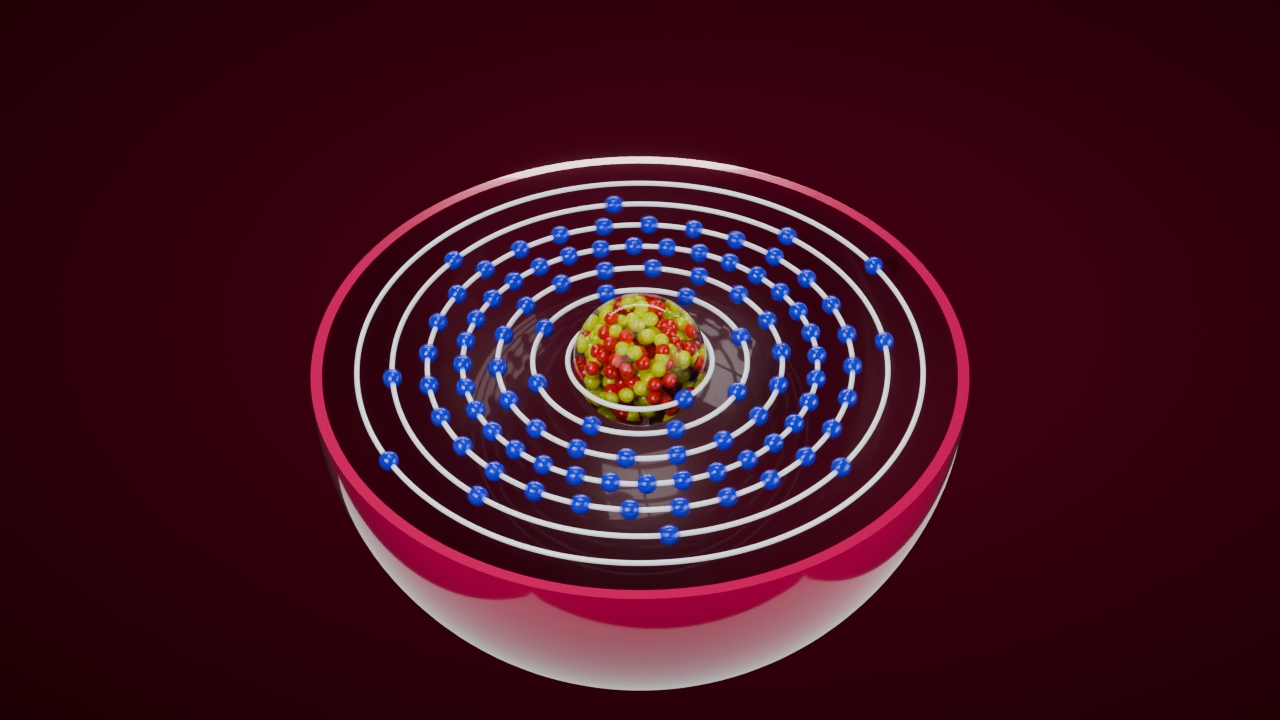
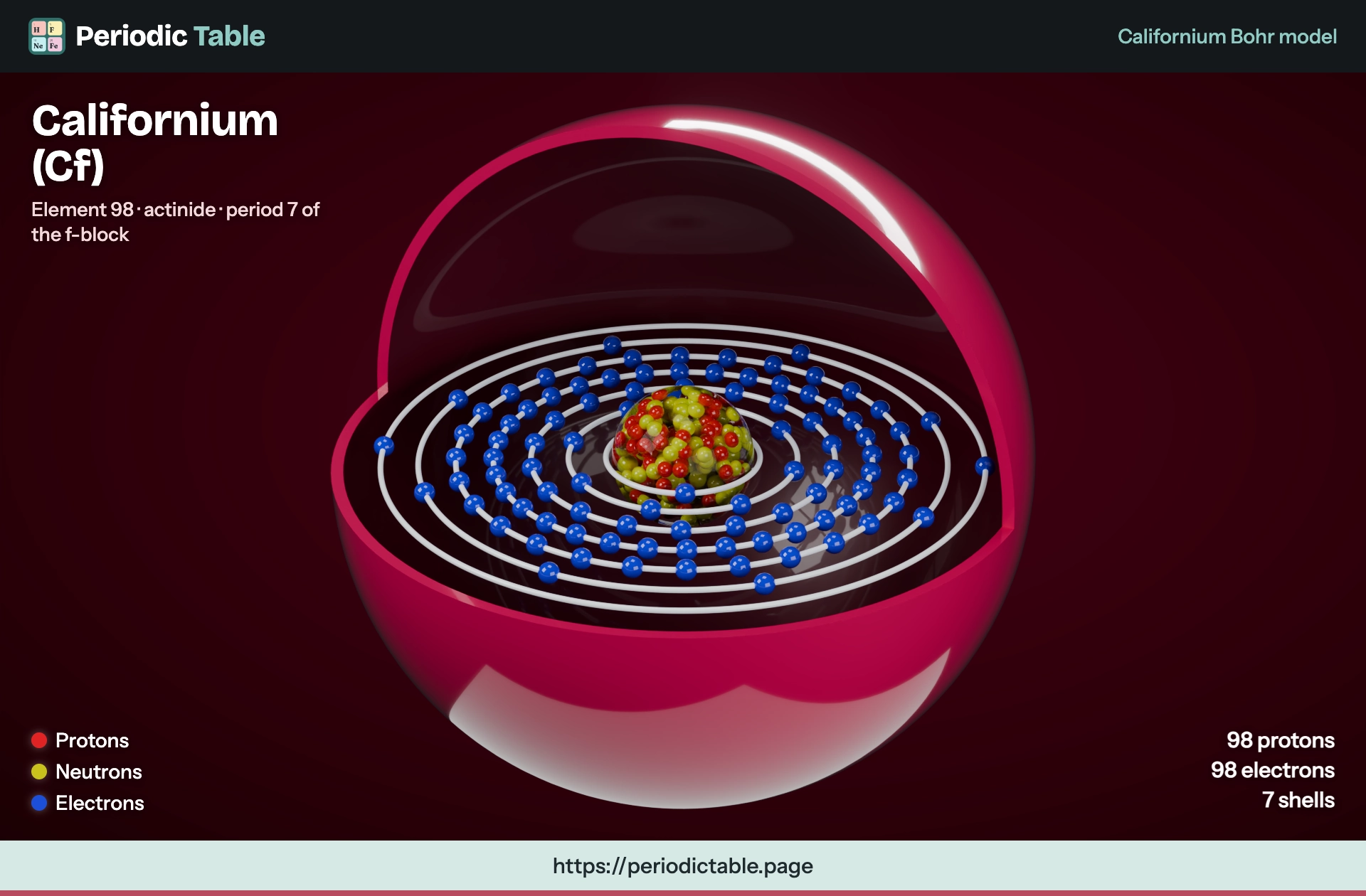
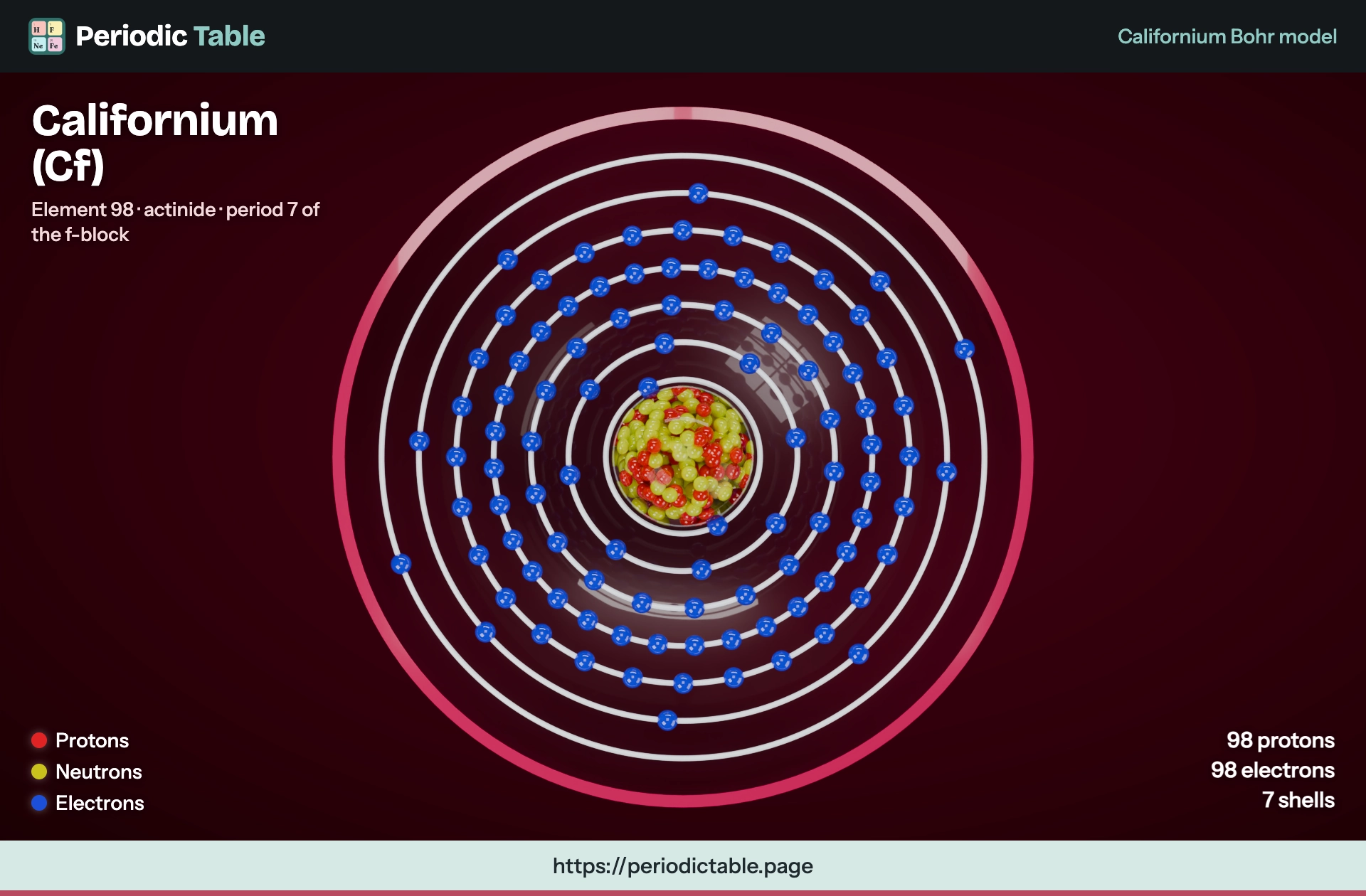
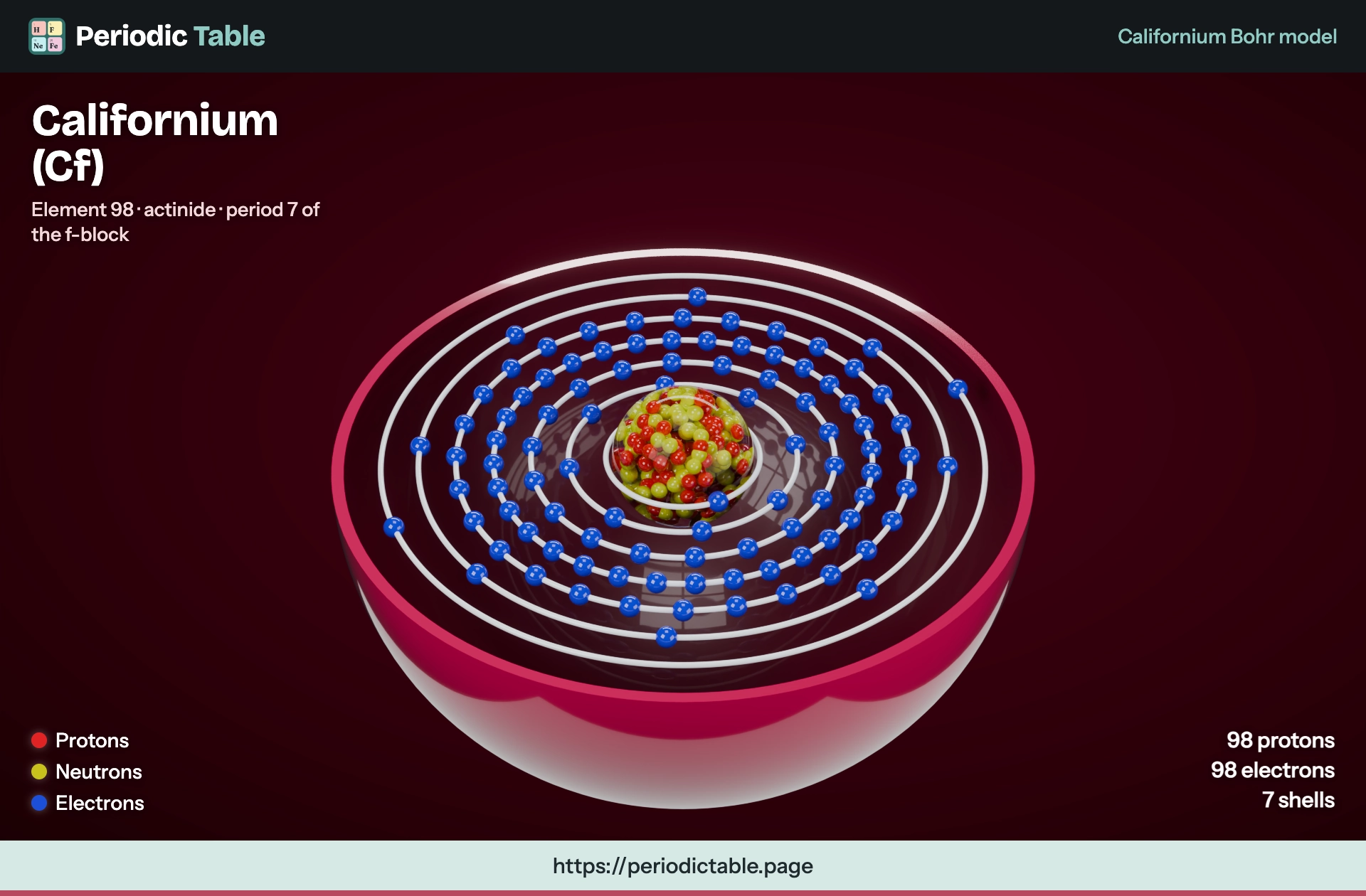
This is a Bohr model of californium (Cf), a simplified picture of a single californium atom. Its nucleus holds 98 protons, and a neutral californium atom has 98 electrons, arranged around it in 7 shells (2 in shell K, 8 in shell L, 18 in shell M, 32 in shell N, 28 in shell O, 8 in shell P and 2 in shell Q).
Californium periodic table electron configuration
- Shorthand
- [Rn] 5f10 7s2
- Full
- 1s2 2s2 2p6 3s2 3p6 4s2 3d10 4p6 5s2 4d10 5p6 6s2 4f14 5d10 6p6 7s2 5f10
- Electrons per shell
- 2, 8, 18, 32, 28, 8, 2
Californium element properties and atomic data
- Atomic number
- 98
- Atomic mass
- [251] u
- Phase at STP
- Solid
- Melting point
- 899.85°C (1173 K)
- Boiling point
- 1469.85°C (1743 K)
- Density
- 15.1 g/cm³
- Electronegativity (Pauling)
- 1.3
- Period
- 7
- Group
- —
- Block
- f-block
- Appearance
- Silvery
- Discovery date
- 1950
- Discovered by
- Lawrence Berkeley National Laboratory
- Named by
- —
What is the californium element?
The californium element is a silvery, soft actinide metal with atomic number 98, which means each atom carries 98 protons and, as a neutral atom, 98 electrons. It is a man-made element: no natural process on Earth has produced it in amounts anyone could measure, so all of it comes from accelerators and high-flux reactors. Scientists in a laboratory used fusion of lead-208 targets to make the darmstadtium periodic table, studied through decay chains.
Chemists group it with the actinides rather than with the lanthanide row printed above it, although the two families behave in similar ways. The table below collects the key data for element californium in one place.
| Property | Value |
|---|---|
| Symbol | Cf |
| Atomic number | 98 (element californium sits between berkelium and einsteinium) |
| Atomic mass | [251], the mass number of its most stable isotope |
| Group, period, block | Actinide series, period 7, f-block |
| Electron configuration | [Rn] 5f10 7s2 |
| Melting point | about 900 °C (1173 K) |
| Boiling point | about 1470 °C (1743 K), estimated |
| Density | 15.1 g/cm3 (alpha form) |
| State at room temperature | Solid, silvery-white metal |
| Common oxidation states | +3 (most stable), +2, +4 |
| CAS number | 7440-71-3 |
Where element 98 sits among the actinides
On the periodic table, element 98 lives in the f-block, in the actinide row usually printed below the main grid. It falls in period 7, after berkelium (97) and before einsteinium (99). Directly above it in the lanthanide row is dysprosium, and the two share a lot of their chemistry: both prefer the +3 state and form similar salts.
Californium is the sixth of the transuranic elements to be synthesized, and it is one of the heaviest elements ever produced in a quantity large enough to see. Because no isotope is stable, the atomic mass on most charts is given in brackets as [251] rather than as a weighted average.
Physical and chemical properties of californium
Very few labs have ever held a visible piece of the metal, so the properties of californium come from microgram and milligram samples studied in shielded hot cells. Even at that scale, the californium properties that have been measured fall into a clear pattern: a soft, dense metal with mostly trivalent chemistry. Questions on environment and atmosphere effects are handled in the halogen bromine, including ozone chemistry.
Atomic mass, density and melting point
Pure californium metal is silvery-white, malleable and soft enough to cut with a razor blade. Its melting point is close to 900 °C, and its boiling point has never been measured directly; the accepted figure of roughly 1470 °C is an estimate. In a vacuum the metal starts to vaporize above about 300 °C, which is far below its melting point.
The metal has two crystal forms at normal pressure. Below about 600-800 °C it takes a double hexagonal close-packed (dhcp) crystal structure with a density of 15.1 g/cm3; above that range it switches to a face-centered cubic form that is much lighter, near 8.7 g/cm3.
Its bulk modulus of about 50 GPa makes it easier to compress than aluminium. Magnetism changes with temperature too: the metal is ferromagnetic or ferrimagnetic at very low temperatures and paramagnetic above about 160 K.
Californium electron configuration and oxidation state
The electron configuration of californium is [Rn] 5f10 7s2: ten electrons in the 5f subshell and two in the 7s. Those 5f electrons are held tightly enough that the usual oxidation state is +3, which is the only form that dissolves in water as a simple ion. A +2 state (a strong reducing agent) and a +4 state (a strong oxidizer) also exist in solids, and a +5 state has been seen in gas-phase nitrate complexes.
Electronegativity is about 1.3 on the Pauling scale. Exposed to air, the metal slowly tarnishes, and moisture speeds that up.
Californium compounds and reactivity
Most californium compounds contain Cf3+, and many of them are brightly colored, which helped early chemists track tiny samples. The metal reacts readily with hydrogen, nitrogen, oxygen and mineral acids when warmed, and the +3 ion forms soluble chloride, nitrate and sulfate salts while the fluoride, oxalate and hydroxide precipitate out.
- Californium oxide (Cf2O3): a yellow-green solid and the usual starting point for making the metal.
- Californium trichloride (CfCl3): an emerald-green salt, among the first compounds made in 1960.
- Halides in other states: CfBr2 and CfI2 for +2, CfF4 and CfO2 for +4.
- Californium borate: a 2014 crystal that showed covalent bonding, making californium the heaviest actinide known to do so.
Those colors and solubility rules matter in practice, because separating californium from curium and berkelium after reactor irradiation relies on exactly these differences.
Isotopes of californium and their half-life
Twenty isotopes of californium are known, with mass numbers from 237 to 256, and every one is radioactive. Most last less than 20 minutes. Only a handful survive long enough to collect and use, and the table compares the half-life and main decay route of each.
| Isotope | Half-life | Main decay | Why it matters |
|---|---|---|---|
| Cf-249 | 351 years | Alpha | Target material for superheavy element work |
| Cf-250 | 13.08 years | Alpha | Intermediate in the production chain |
| Cf-251 | 898 years | Alpha | Longest-lived isotope, made in low yield |
| Cf-252 | 2.645 years | Alpha, plus spontaneous fission | The isotope sold as a neutron source |
| Cf-253 | 17.81 days | Beta minus | Decays to einsteinium-253 |
| Cf-254 | 60.5 days | Spontaneous fission | Once linked to supernova light curves |
The other californium isotopes are rarely mentioned outside nuclear data tables. Cf-251 has the longest life, yet it is hard to stockpile because it captures another neutron so easily inside the reactor. In the literature you will also see 252Cf written with the mass number as a superscript in front of the symbol; it means the same isotope.
Why Cf-252 is the strongest neutron emitter
Cf-252 is the isotope that gives the element its value. It is one of very few nuclides that splits on its own, and each split releases about 3.7 neutrons.
One microgram of it gives off about 2.3 million neutrons per second, which works out to roughly 138 million per microgram per minute. That neutron emission needs no power supply, no accelerator and no reactor, so a source the size of a pencil eraser can deliver a steady neutron flux in the field.
The trade-off is decay. Using the 2.645-year half-life, a source keeps about 77% of its output after one year, 27% after five years and only 7.3% after ten. Users of californium-252 therefore plan on replacing a source every few years, and output drops about 10% in under five months.
Spontaneous fission, alpha decay and gamma rays
About 96.9% of Cf-252 nuclei undergo alpha decay to curium-248, and the remaining 3.1% split by spontaneous fission. That small fission share is what produces almost all of the neutrons, so the isotope behaves as a portable fission source as well as an alpha emitter.
Both processes are accompanied by gamma radiation, which is why handling the isotope calls for dense shielding as well as neutron moderators. For nuclear physics labs, the well-known neutron energy spectrum also makes it a standard reference for calibrating detectors.
History of californium and its discovery
The history of californium begins at the University of California Radiation Laboratory in Berkeley, the site now called Lawrence Berkeley National Laboratory. There, a team of Stanley Thompson, Kenneth Street Jr., Albert Ghiorso and Glenn Seaborg made the element around February 9, 1950, and announced it on March 17 of that year.
The team named it after both the university and the state, breaking the habit of naming elements 95 to 97 after the lanthanides above them. Dysprosium, the element above 98, means "hard to get at", and the discoverers joked that searchers a century earlier had also found California hard to get to.
Making californium from curium in a cyclotron
The first synthesis aimed a beam of helium ions (alpha particles) at a microgram-scale target of curium-242 in the 60-inch cyclotron. Each successful hit fused the two nuclei into californium-245 and released a single neutron:
$$^{242}_{96}\text{Cm} + ^{4}_{2}\text{He} \rightarrow ^{245}_{98}\text{Cf} + ^{1}_{0}\text{n}$$
Only about 5,000 atoms formed, with a half-life of 44 minutes, and the team picked them out using ion exchange chromatography. The first weighable amounts came in 1954 from plutonium irradiated in an Idaho test reactor, and in 1974 R.
G. Haire and R. D. Baybarz made the first metal films. Each step was a milestone in nuclear chemistry, showing that ever heavier elements could be built and studied.
How californium-252 is produced today
Almost all californium-252 comes from two places: the High Flux Isotope Reactor at Oak Ridge National Laboratory in Tennessee, and the Research Institute of Atomic Reactors in Dimitrovgrad, Russia. Early-2000s figures put their output near 0.25 grams and 0.025 grams a year respectively, so world supply is measured in fractions of a gram, often a single milligram batch at a time. Starting from uranium-238, reaching a long-lived californium isotope takes about 15 neutron captures without the nucleus splitting along the way, which is why a production campaign can run close to two years from target to shipped source.
Berkelium targets and neutron capture in nuclear reactors
Modern production loads curium isotopes 244-248 into high-flux nuclear reactors. Each neutron capture adds one mass unit, and every so often a beta decay turns a neutron into a proton and moves the nucleus up one element. Curium becomes berkelium, and berkelium-250 decays to californium-250, which then captures more neutrons to reach Cf-251 and Cf-252.
Long irradiation of plutonium and americium feeds the same chain from further down. The hard part is chemical: technicians must strip the californium from curium, berkelium and fission products in remotely handled cells before anyone can use it.
Uses of californium as a neutron source
It is one of the few elements beyond uranium that has everyday jobs, and nearly all uses of californium come from Cf-252 working as a compact neutron source. Alternatives exist, such as americium-beryllium or plutonium-238 sources, but they are larger and weaker for the same output. That is why the nuclear industry, oil companies and security agencies keep coming back to the main californium uses below.
Start-up rods for research and power reactors
A new or refuelled reactor core needs a steady supply of neutrons so operators can watch the chain reaction build safely. Cf-252 sealed in start-up rods, often paired with antimony-beryllium pellets, supplies that signal next to the nuclear fuel.
The same rods serve research reactors at universities and are being specified for small modular reactors, compact designs of up to about 300 MW each. Detectors read the steady neutron count from the start-up source as a baseline, so operators can watch the core approach criticality and confirm each fuel rod is behaving before power goes up.
Neutron activation analysis in oil wells and mines
In neutron activation analysis, neutrons make atoms in a sample briefly radioactive, and the gamma rays they emit reveal which elements are present, even in trace amounts. Logging tools lowered into oil wells use this to read rock layers during oil exploration, and neutron moisture gauges find water and petroleum layers.
Online coal analyzers in power and cement plants check every load on the conveyor, and prospectors use portable units to test for gold and silver on the spot. The same portable sources let plant inspectors look for metal fatigue in critical parts.
Neutron radiography of aircraft and welds
Neutron radiography works like an X-ray but sees different things: neutrons pass through dense metals and light up hydrogen-rich materials such as water, glue and explosives. Inspectors use it to find corrosion, trapped moisture, cracks and bad welds in aircraft and weapons parts.
By 1994 this was the largest single use of Cf-252, ahead of fuel rod scanning and reactor start-up. Smaller capsules of the same kind also sit inside some portable metal detectors.
Homeland security, cancer treatment and space
For homeland security, portable neutron spectroscopy tools bombard a suspect package and read the returning gamma rays to tell explosives or chemical agents from harmless cargo, without opening it. In medicine, Cf-252 has been used for cancer treatment of some cervical and brain tumors that resist other radiation therapy, placed inside the body as a form of brachytherapy. NASA has used californium in scientific research on how radiation in space differs from radiation on Earth, and the element has also been used to simulate fission fragments when testing equipment for spacecraft.
Element 98 in superheavy element research
Because Cf-249 lasts for centuries and has many neutrons, it makes an ideal target for building heavy elements. In 2006, researchers at Dubna, Russia, announced three atoms of oganesson, element 118, made by bombarding Cf-249 with calcium-48 ions, which closes the seventh row of the periodic table and remains the heaviest superheavy element ever confirmed. Decades earlier, in 1961, lawrencium was first made by hitting a californium target with boron nuclei.
Californium also comes up in talk of nuclear weapons. Cf-251 has a calculated critical mass of only about 5 kg, which led a 1961 magazine to claim a californium bomb could fit in a pistol bullet. In practice the world makes well under a gram a year, so no weapon has ever been built from it.
Is californium a synthetic transuranium element?
Yes. Californium is a synthetic element and the sixth transuranium element ever made, part of the run of new actinides that Glenn T. Seaborg and his colleagues added between 1940 and 1955, so any natural supply from the early Earth has long since decayed.
Traces show up only where people put them: near sites that use it for prospecting or medicine, and in nuclear fallout from atmospheric bomb tests before 1980, which spread small amounts of Cf-249, -252, -253 and -254. It sticks to soil far more than it dissolves in water, with soil concentrations up to 500 times those of the surrounding water.
Astronomers once thought a supernova made californium, since some light curves faded with a 60-day half-life matching Cf-254. Later work found no californium spectra, and those curves are now credited to nickel-56. The natural fission reactor at Oklo in Gabon would have made some too, but it has long since decayed away.
Handling radioactive Cf-252 safely
Cf-252 is intensely radioactive, and its neutrons go straight through the lead that stops gamma rays. Safe handling therefore combines three tools: time, distance and layered shielding, usually hydrogen-rich materials such as water-extended polyethylene to slow neutrons, plus dense metal for the gamma rays.
Sources are sealed in double welded capsules and shipped in certified Type A shipping containers, and spent sources go back to suppliers or approved high-level waste sites. Personal dosimeters track each worker's radiation exposure, since radioactivity from a neutron source cannot be seen or felt.
How californium affects bone and blood
The biggest health risk comes from taking californium into the body by swallowing or breathing it. Only about 0.05% reaches the bloodstream, but of that, roughly 65% settles in the skeleton and 25% in the liver.
Because it bioaccumulates on bone surfaces, its radiation damages the marrow that makes red blood cells and can cause cancer over time. Half of the amount deposited leaves the skeleton in about 50 years and the liver in about 20, so a single intake keeps irradiating tissue for decades.
Californium price and annual supply
This element is among the most expensive materials on Earth. In the early 1970s the U.S. Atomic Energy Commission sold Cf-252 for $10 per microgram, and by 1999 the price had risen to $60 per microgram before encapsulation and shipping. At that rate a single gram would run to tens of millions of dollars, which is why buyers order micrograms or a few milligrams at most.
The californium price reflects three facts: only two reactors in the world make it, each production run takes close to two years, and every gram has to travel in heavy shielded casks. Commercial californium neutron sources are sold as small capsules holding Cf-252 wire, and because output halves every 2.645 years, a buyer is effectively paying for a few years of neutrons rather than a permanent asset.