


Bromine element (Br): bromine periodic table facts
Bromine periodic table facts: bromine (Br) is element 35, a halogen in group 17, period 4. Open a sealed ampoule of bromine and you meet the only nonmetal that stays liquid at room temperature: a heavy, volatile fluid that gives off a pungent orange-brown vapour within seconds. Clean energy and industry both lean on the molecular hydrogen, which sets out how the gas behaves in chemical reactions.
Its name comes from the Greek word bromos, meaning "stench", and the smell earns it. This guide gives you the element's key data, atomic structure, compounds, uses and hazards in one place, with the important numbers worked through rather than just listed.
Rotate the 3D Bohr model of bromine
Drag to orbit, scroll to zoom.
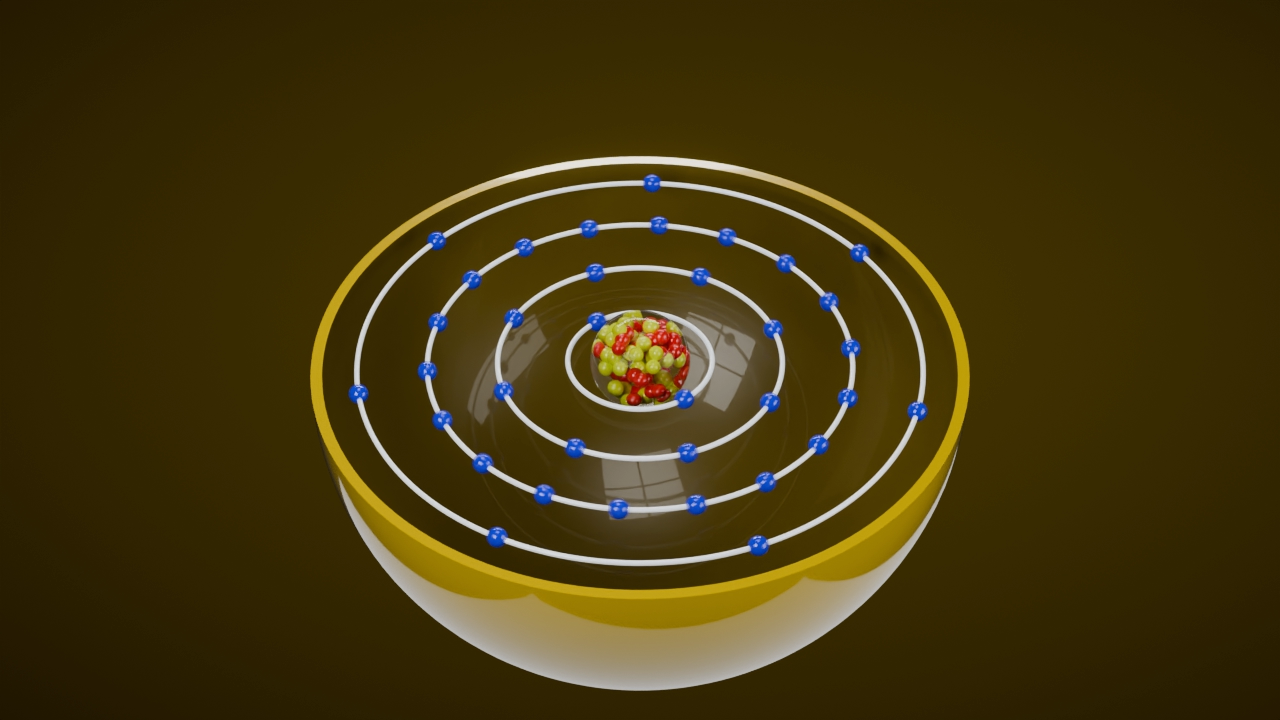
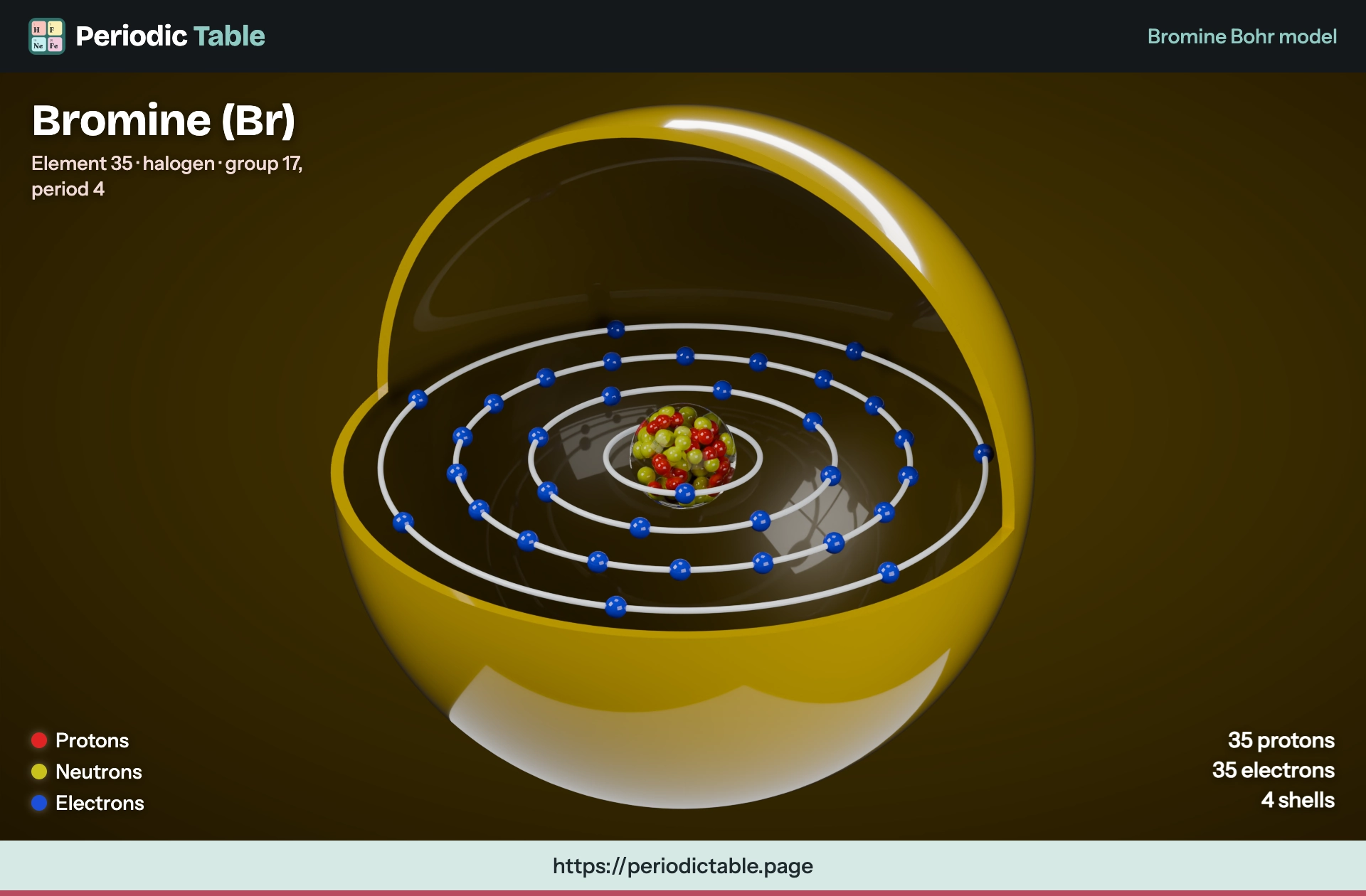
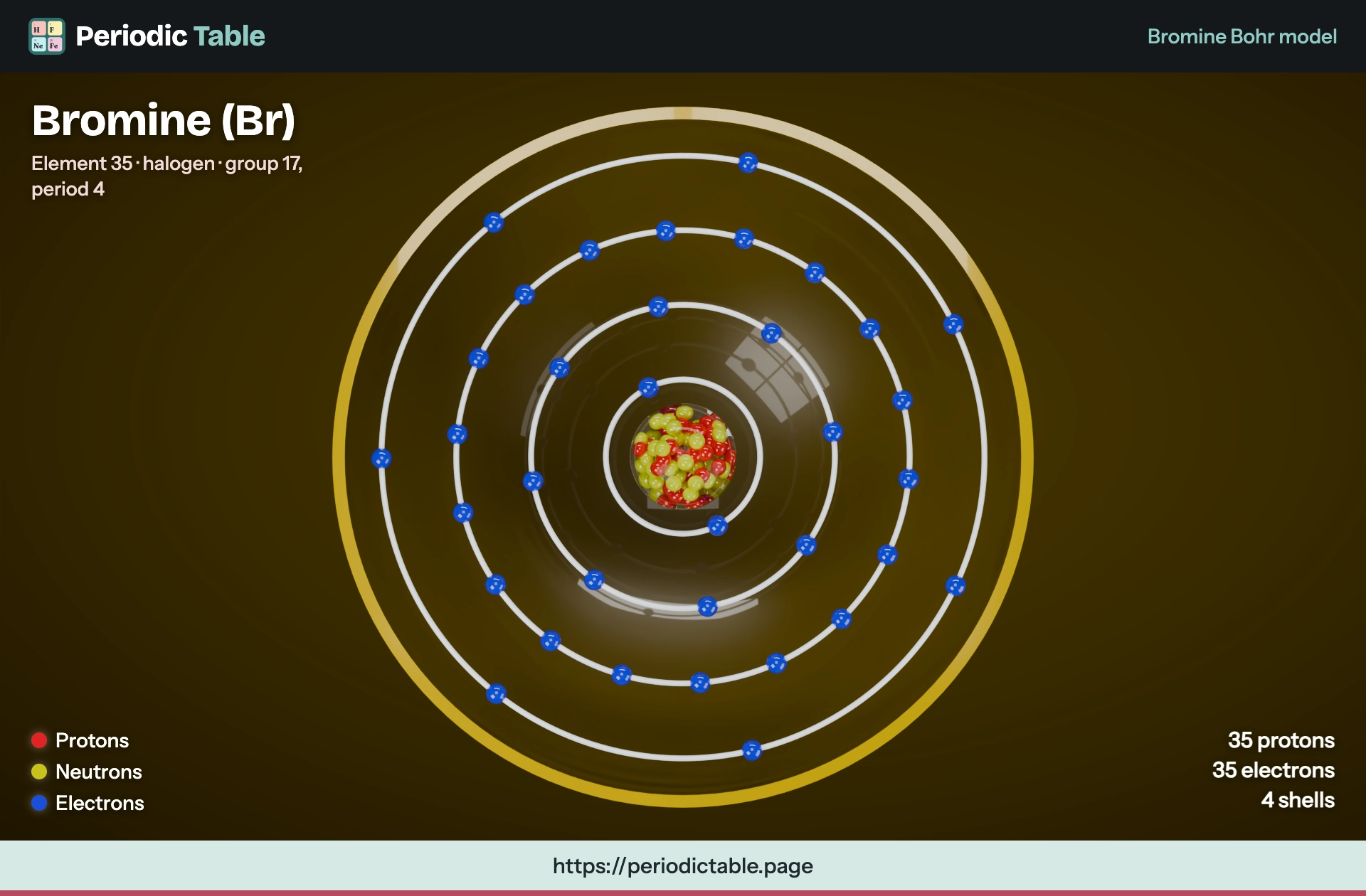
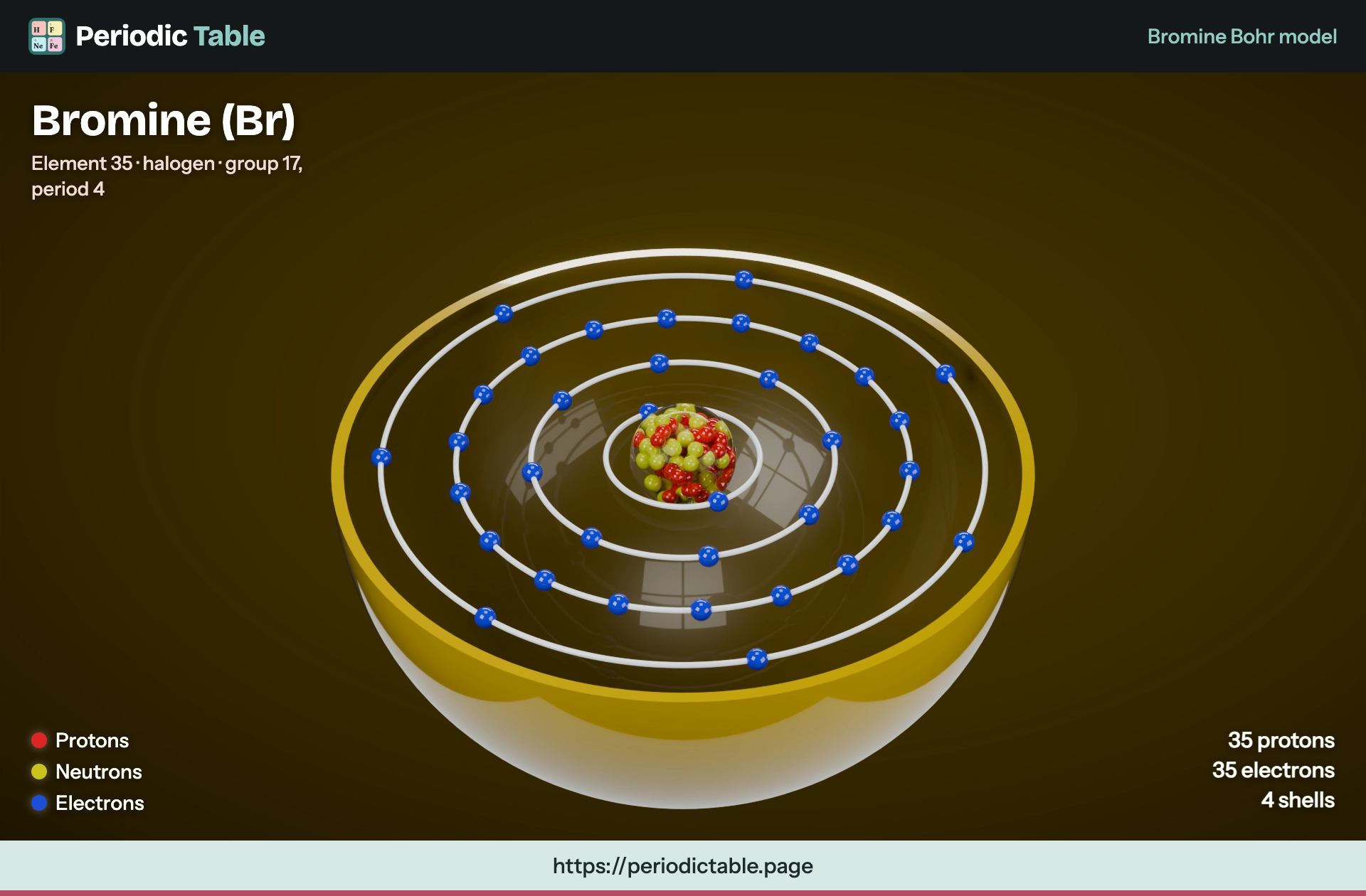
This is a Bohr model of bromine (Br), a simplified picture of a single bromine atom. Its nucleus holds 35 protons, and a neutral bromine atom has 35 electrons, arranged around it in 4 shells (2 in shell K, 8 in shell L, 18 in shell M and 7 in shell N).
Bromine periodic table electron configuration
- Shorthand
- [Ar] 3d10 4s2 4p5
- Full
- 1s2 2s2 2p6 3s2 3p6 4s2 3d10 4p5
- Electrons per shell
- 2, 8, 18, 7
Bromine element properties and atomic data
- Atomic number
- 35
- Atomic mass
- 79.904 u
- Phase at STP
- Liquid
- Melting point
- -7.35°C (265.8 K)
- Boiling point
- 58.85°C (332 K)
- Density
- 3.1028 g/cm³
- Electronegativity (Pauling)
- 2.96
- Period
- 4
- Group
- 17
- Block
- p-block
- Appearance
- Unknown
- Discovery date
- 1826
- Discovered by
- Antoine Jérôme Balard
- Named by
- —
What is bromine? the liquid halogen explained
Element bromine is a chemical element with the symbol Br and atomic number 35. In everyday handling, liquid bromine is a reddish-brown liquid about three times as dense as water, and it evaporates fast enough that an open bottle quickly fills with brown fumes. Among all 118 known elements, only mercury shares that state at 25 °C, and mercury is a metal. For engineers weighing radioactivity and radiation risks, a practical summary of the High Flux Isotope Reactor program is at element 98, californium for further reading.
You will never find free samples in nature, because the atom is far too reactive. Instead it sits in rocks and the sea as dissolved bromide, so every gram used in chemistry and industry first has to be released from salty water. That single fact explains most of its story: where it is produced, how it is extracted and why its compounds are everywhere while the pure substance is a hazard.
Br on the periodic table: group 17 and the halogens
You find bromine in period 4 of group 17. Its column-mates are fluorine, chlorine, iodine and astatine, and all of them share an outer shell that holds seven, one short of a full octet, which is why the whole family grabs a partner so readily. Following the usual periodic trends, almost every property of bromine sits between the values for its neighbours directly above and below: it reacts less vigorously than the lighter gas but more vigorously than the heavier solid, and its colour is darker than one and lighter than the other.
Br element data at a glance
The table collects the values you will most often look up for element 35. Values for the molecule are marked Br2; everything else refers to the single atom. In nuclear materials work with uranium or thorium, neutron data is often needed and is listed in hafnium compounds for engineers and other specialists.
| Property | Value |
|---|---|
| Symbol | Br |
| Atomic number | 35 |
| Atomic weight | 79.904 |
| Group / period / block | 17 (halogens) / 4 / p-block |
| State at 25 °C | liquid (Br2) |
| Appearance | reddish-brown, fuming |
| Melting point | −7.2 °C (265.8 K) |
| Boiling point | 58.8 °C (332.0 K) |
| Density (Br2, near 20 °C) | 3.1028 g/cm3 |
| Electron configuration | [Ar] 3d10 4s2 4p5 |
| Oxidation states | −1, +1, +3, +5, +7 (rarely +4) |
| Electronegativity (Pauling) | 2.96 |
| Electron affinity | 324.5 kJ/mol |
| First ionisation energy | 1,139.9 kJ/mol |
| Atomic radius (empirical) | 120 pm |
| Van der Waals radius | 185 pm |
| Crystal structure (solid) | orthorhombic |
| Common ion | Br− (bromide) |
| Natural isotopes | Br-79 (50.69%), Br-81 (49.31%) |
| CAS number | 7726-95-6 |
One practical consequence of these numbers: a 1-litre bottle of bromine weighs about 3.1 kg, so a reagent bottle that looks half full is far heavier than it seems. The narrow 66-degree window between freezing and boiling also means it vaporises readily on a warm bench.
Structure of bromine: isotopes and the Br2 molecule
The structure of bromine starts with the nucleus: 35 protons and, in the most common isotope, 44 neutrons, while the heavier natural form carries 46. Around that nucleus, 35 negative charges fill four shells in a 2, 8, 18, 7 pattern. A bromine atom therefore sits in size between its lighter and heavier neighbours, which is the root of its in-between behaviour.
Electron configuration and valence electrons
Written out in full, the arrangement is 1s2 2s2 2p6 3s2 3p6 4s2 3d10 4p5, or [Ar] 3d10 4s2 4p5 in shorthand. The seven in the fourth shell (4s2 4p5) are the ones that take part in bonding.
Gaining one more gives the bromide ion, Br−, with the same closed-shell arrangement as krypton; that is the most common fate of the atom in nature. Sharing one with a partner instead gives a covalent bond such as the Br–Br link.
Bromine isotopes: two stable isotopes in almost equal shares
Natural samples contain just two forms, Br-79 and Br-81, each with nuclear spin 3/2. Because they occur in close to a 1:1 ratio, any molecule carrying one Br atom shows a mass-spectrum doublet two units apart with nearly equal peak heights, a fingerprint chemists use to spot organobromine compounds at a glance. You can recover the standard atomic weight yourself from the two isotope masses and their abundances:
$$A_r(\text{Br}) = (78.9183 \times 0.5069) + (80.9163 \times 0.4931) \approx 79.904$$
The result, 79.904, is the value printed on every periodic table, and it lands so close to 80 because the two masses are averaged in almost equal parts. Every other form is radioactive. The longest-lived, Br-77, has a half-life of about 57 hours, and Br-82 (35.3 hours) is used as a tracer in industrial leak and flow studies.
The diatomic molecule Br2 and dibromine
Pure bromine never exists as loose atoms under ordinary conditions. Two atoms pair up through a single covalent bond, about 228 pm long in the gas, to form the diatomic molecule Br2, which chemists sometimes call dibromine to separate it from the atom.
When a lab manual says "bromine", it almost always means this molecule. Its bond is fairly weak (about 193 kJ/mol, against 243 kJ/mol for the Cl–Cl bond), so light or heat splits it into two free atoms, the first step of many bromination reactions.
How the halogen behaves: physical and chemical traits
The properties of bromine fall into two groups worth separating: how the substance looks and moves as a material, and how its atoms react. Most bromine properties make sense once you remember that it sits halfway down its column.
Physical properties: a dense fluid that fumes
At 20 °C bromine is a heavy, red-brown fluid with a density of 3.10 g/cm3, and its vapour pressure is high enough that the space above it is always tinted orange. The vapor is roughly 5.5 times heavier than air, so it pools in sinks and low corners instead of rising.
It freezes at −7.2 °C into dark crystals and boils at 58.8 °C. The colour comes from visible light being absorbed as the molecule shifts between orbitals, and it fades on cooling: the solid at −195 °C is pale yellow.
Like other physical properties of the halogens, the freezing and boiling temperatures rise down the group, because larger molecules attract each other more strongly through van der Waals forces. Fluorine and chlorine are gases, bromine is a fluid and iodine is a solid. It dissolves moderately in water (about 3.4 g per 100 mL at 20 °C) to give orange bromine water, and far more readily in organic solvents such as hexane or carbon disulfide.
Chemical properties, reactivity and oxidising power
Chemically, Br2 is a strong oxidising agent: each atom readily accepts one electron to become Br−. Its electronegativity of 2.96 on the Pauling scale sits between chlorine (3.16) and iodine (2.66), and the standard electrode potentials follow the same order (Cl2 +1.36 V, Br2 +1.09 V, I2 +0.54 V). That ordering drives a classic displacement test: bubble chlorine through a colourless bromide solution and it turns orange as bromine is released.
$$\text{Cl}_2 + 2\,\text{Br}^- \longrightarrow 2\,\text{Cl}^- + \text{Br}_2$$
The same reaction is how producers extract bromine, as you will see below; iodine cannot do the reverse, because it is the weaker oxidiser. Common oxidation states run from −1 in bromides through +1, +3 and +5 up to +7 in perbromate, which was not made until 1968. Toward organic molecules, it behaves as an electrophile: it adds across carbon–carbon double bonds, which is why orange bromine water turning colourless is still taught as the test for an alkene.
Bromine compounds: bromides, oxoacids and organobromines
Bromine compounds span simple ionic solids, strong acids, unstable oxides and thousands of carbon-based molecules studied in organic chemistry. Nearly every element forms a binary bromide; the exceptions are most noble gases and the few elements more electronegative than the halogen itself (oxygen, nitrogen, fluorine and chlorine). In nature, dissolved bromide salts are what seawater actually holds.
Hydrogen bromide and hydrobromic acid
Hydrogen bromide (HBr) is a colourless, choking gas, made industrially by burning hydrogen in bromine vapor at 200-400 °C over a platinum catalyst. Dissolved in water it becomes hydrobromic acid, one of the strongest common acids (pKa about −9), which forms a constant-boiling mixture at 47.6% HBr. Both are workhorse reagents for making inorganic bromides and alkyl bromides.
Metal bromides and interhalogens
Metals with low charges give ionic bromides: sodium bromide and potassium bromide are white crystalline solids that dissolve easily. Silver bromide is so insoluble that its pale-cream precipitate is the standard laboratory test for bromide, and in the ground the same compound occurs as the rare mineral bromargyrite. Bromine also combines with its lighter group-mates to give interhalogens such as BrF3, BrF5 and BrCl; bromine trifluoride is aggressive enough to convert uranium into uranium hexafluoride during nuclear fuel processing.
Oxides, hypobromous acid and bromate
The oxides are all unstable, and most decompose well below 0 °C. The oxoacids behave better in solution: hypobromous acid (HOBr) forms when the element dissolves in water and is the active sanitiser in bromine-treated pools. Oxidising bromide further gives bromate (BrO3−), a strong oxidiser that is regulated in drinking water because it can form when ozone is used to treat bromide-rich supplies.
Organobromine compounds in nature and synthesis
A carbon–bromine bond is a common functional group in synthesis, intermediate in reactivity between C–Cl and C–I bonds and often the best compromise between cost and reactivity. Nature makes more of these molecules than any lab: more than 1,600 natural organobromine compounds had been catalogued by 1999, mostly from marine organisms such as sponges and red algae using bromoperoxidase enzymes. The sea releases an estimated 56,000 tonnes of methyl bromide (bromomethane) and one to two million tonnes of bromoform every year, largely from seaweeds.
Discovery of Br: Balard, Löwig and the name brome
Two young chemists found bromine independently. Carl Jacob Löwig isolated it in 1825 from the water of a mineral spring in his hometown of Bad Kreuznach, Germany, by saturating it with chlorine and shaking out the brown product with ether. His paper was delayed, so Antoine Balard, a pharmacy student in Montpellier, published first in 1826.
Balard found it in the ash of seaweed from the nearby salt marshes, again by treating the extract the same way. He first suspected iodine chloride, then concluded he had a new element and called it muride, from the Latin for brine.
Reviewers at the French Académie des Sciences renamed it brome for its smell. Justus von Liebig had actually held a sample earlier but mislabelled the sample as a known compound, a mistake he reportedly never forgot.
Production stayed tiny until 1858, when the potash mines at Stassfurt in Germany began yielding it as a by-product. Early demand came from photography: in 1840 it was found to make daguerreotype plates far more light-sensitive than iodine alone.
During the American Civil War, a bromine solution was used to treat gangrene in field hospitals, and in the First World War compounds such as xylyl bromide served as poison gas. It is one of the few elements whose discovery story runs straight from seaweed ash to a battlefield within a century.
Where Br comes from and how it is extracted
Bromine is fairly rare in rock, about 2.5 parts per million of the Earth's crust, because its compounds dissolve so easily. Rain has leached it into the oceans for billions of years, so seawater now carries about 65 mg per kg, roughly one Br atom for every 660 chlorine atoms.
Very few minerals contain it, but it does turn up in evaporite deposits and in the salt deposits left by ancient seas. The Dead Sea, with roughly 0.4% bromide, is the richest commercial source.
Concentration decides where production happens. Take one cubic metre of ordinary ocean water, which weighs about 1,025 kg:
$$m_{\text{Br}} = 1025\ \text{kg} \times 65\ \tfrac{\text{mg}}{\text{kg}} \approx 66.6\ \text{g}$$
So a single tonne of elemental bromine would mean processing roughly 15,000 m3 of ocean water in full. Dead Sea water, at about 4.96 g of bromide per litre, needs only about 202 m3 for the same tonne, roughly 74 times less volume to pump, oxidise and strip. That gap is why the leading producers are Israel and Jordan, followed by China and the brine wells of Arkansas in the United States.
The extraction itself uses the displacement reaction shown earlier. Chlorine gas oxidises the dissolved bromide to Br2, a blast of steam or air strips the volatile product out of solution, and it is then condensed, dried and purified.
Some plants first concentrate the solution in evaporation ponds; electrolysis is a less common alternative. The finished product ships in lead-lined steel tanks or heavy drums.
Bromine uses in industry, water treatment and medicine
The main bromine uses have shifted sharply over the past 60 years as regulators phased out its biggest old markets. World output now runs to several hundred thousand tonnes a year, spread across these applications:
- Fire-retardant additives for electronics, insulation foams and textiles, the largest single market
- Heavy clear drilling fluids for oil and gas wells
- Sanitisers for pools, spas and cooling towers
- Intermediates for pharmaceuticals, dyes and crop-protection chemicals
- Zinc-bromine flow batteries for stationary power storage
- Specialty reagents for research labs
Flame retardants and fire suppression
Roughly half of all bromine production goes into brominated flame retardants. When a treated material heats up, it releases HBr, which mops up the energetic hydrogen and hydroxyl radicals that keep a fire's chain reaction going.
Tetrabromobisphenol A, built into the epoxy of FR-4 circuit boards, is the best-known example in plastics. Brominated halons such as Halon 1301 once filled fire extinguishers for aircraft and computer rooms, but their production is now heavily restricted because they destroy ozone.
Water treatment, swimming pools and hot tubs
Bromine sanitisers release the same HOBr described above, much as chlorine products release hypochlorous acid. They stay effective across a wider pH range and hold up better in hot water, so they are the usual choice for a hot tub or spa and for indoor pools.
Outdoors they lose out: sunlight's UV breaks them down quickly, and no cheap stabiliser protects them. The same tolerance for heat makes them popular in cooling towers, where they control algae, bacteria and zebra mussels.
Photography, medicine, farming and other uses
Silver bromide is still the light-sensitive compound in black-and-white photographic film and paper, and bromides run through darkroom photographic chemicals in general. In the clinic, potassium bromide was one of the first effective anticonvulsants (1857), and both it and sodium bromide were sold as household sedatives until barbiturates replaced them around 1930. Simple bromides still serve as antiepileptics for dogs and, in some countries, people, and modern pharmaceuticals such as the sedative brotizolam carry a bromine atom.
On farms, methyl bromide was one of the most widely used soil and quarantine fumigants until the ozone rules ended most of its uses, and other brominated pesticides have followed it out. Ethylene bromide, added to leaded petrol to carry lead out of the engine, took 77% of American output in 1966. Dyes such as the indicator bromothymol blue and the ancient Tyrian purple contain bromine too.
Is Br dangerous? toxicity, safety and environmental impact
The answer depends on the form. Free bromine is toxic and corrosive, while dissolved bromide is mild at normal intakes; a typical diet supplies about 2 to 8 mg a day. Most real-world harm comes from fumes in a workspace or from long-term overuse of bromide drugs.
Biological role: a trace element for some organisms
A 2014 study found that bromide is a required cofactor for assembling collagen IV, the scaffold of basement membranes in animal tissue, which would make it an essential trace element. White blood cells called eosinophils also prefer bromide when they make the hypobromite they use to kill parasites.
Even so, no deficiency disease has been documented in mammals, and many references still rate it as not necessary for life. Your body holds about 0.0004% bromine by mass.
Health effects, bromism and bromine poisoning
Splashes of bromine cause deep, slow-healing chemical burns, and breathing the fumes causes irritation of the eyes, nose and respiratory tract, coughing and, in heavy exposures, fluid in the lungs. OSHA's permissible exposure limit is 0.1 ppm averaged over a shift, NIOSH's short-term limit is 0.3 ppm, and 3 ppm is rated immediately dangerous to life and health.
Chronic overuse of bromide drugs causes bromism. Because the body clears bromide with a half-life of 9 to 12 days, doses of 0.5 to 1 g a day build up into drowsiness, confusion, psychosis and skin rashes. There is no antidote, so treatment is supportive: fresh air or oxygen, flushing exposed skin or eyes with running water for at least 15 minutes, and intravenous saline to speed bromide excretion.
Handling precautions in the laboratory
Standard safety precautions for the free element are short but strict:
- Work only in a fume hood, wearing splash goggles, a face shield, a lab coat and heavy fluoroelastomer or neoprene gloves
- Keep a sodium thiosulfate solution within reach to neutralise spills and splashes
- Never work alone, and label every container as hazardous and corrosive
- Store it away from aluminium, ammonia and organic solvents, which can react violently
Ozone depletion and other environmental hazards
In the stratosphere, bromine atoms destroy ozone roughly 60 times more efficiently than chlorine atoms, atom for atom. That is why bromomethane and the halons fall under the Montreal Protocol, and why brominated gases still account for a large share of the damage to the ozone layer over Antarctica even though emissions have dropped.
Released into the atmosphere, they last for years. Some older fire retardants, such as the PBDEs, also persist and build up in the environment and in wildlife, which is why several have been banned.