


Hafnium element (Hf): hafnium periodic table facts
Hafnium periodic table facts: hafnium (Hf) is element 72, a transition metal in group 4, period 6. If you have ever wondered why one obscure grey chemical element sits inside both naval reactor cores and the chip in your laptop, the element hafnium is the answer. When studying clean fuels, electrolysis, steam reforming and an energy carrier role for the lightest element are explained in the hydrogen fuel guide for curious readers.
Hafnium (Hf) is a lustrous, silvery, ductile transition metal with a rare talent: it swallows stray reactor particles while shrugging off heat and corrosion. Below you will find its key data, how it is mined and purified, where it is used, and how a missing slot in the table of elements finally got filled.
Rotate the 3D Bohr model of hafnium
Drag to orbit, scroll to zoom.
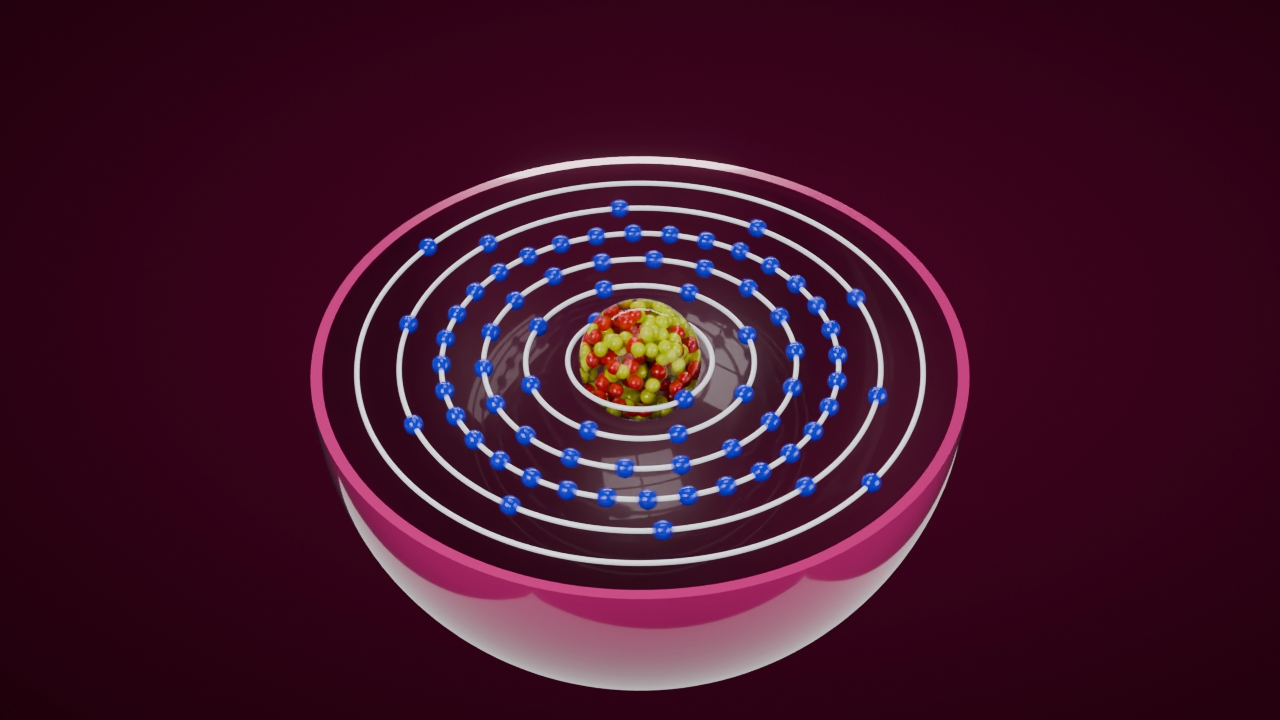
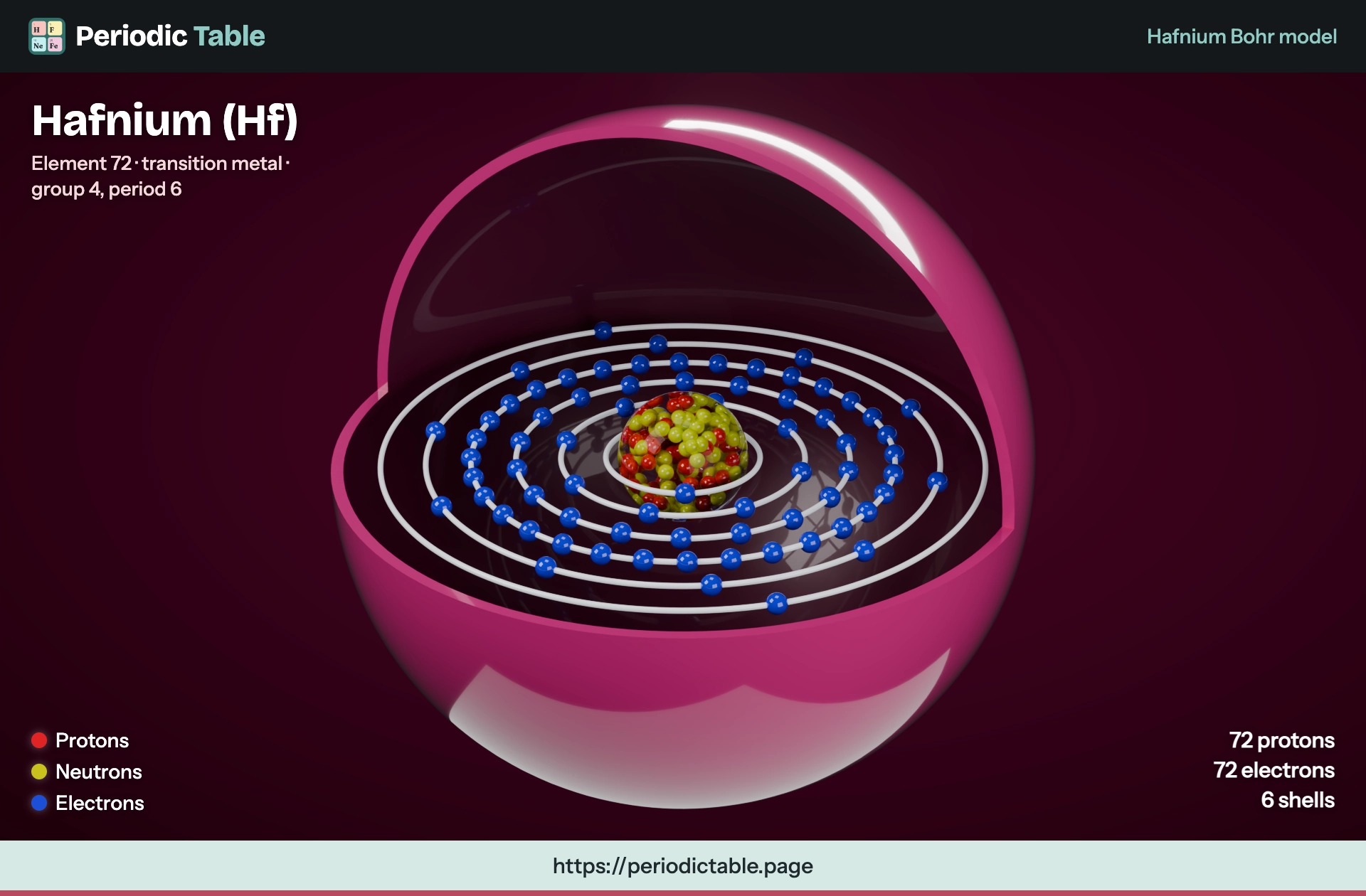
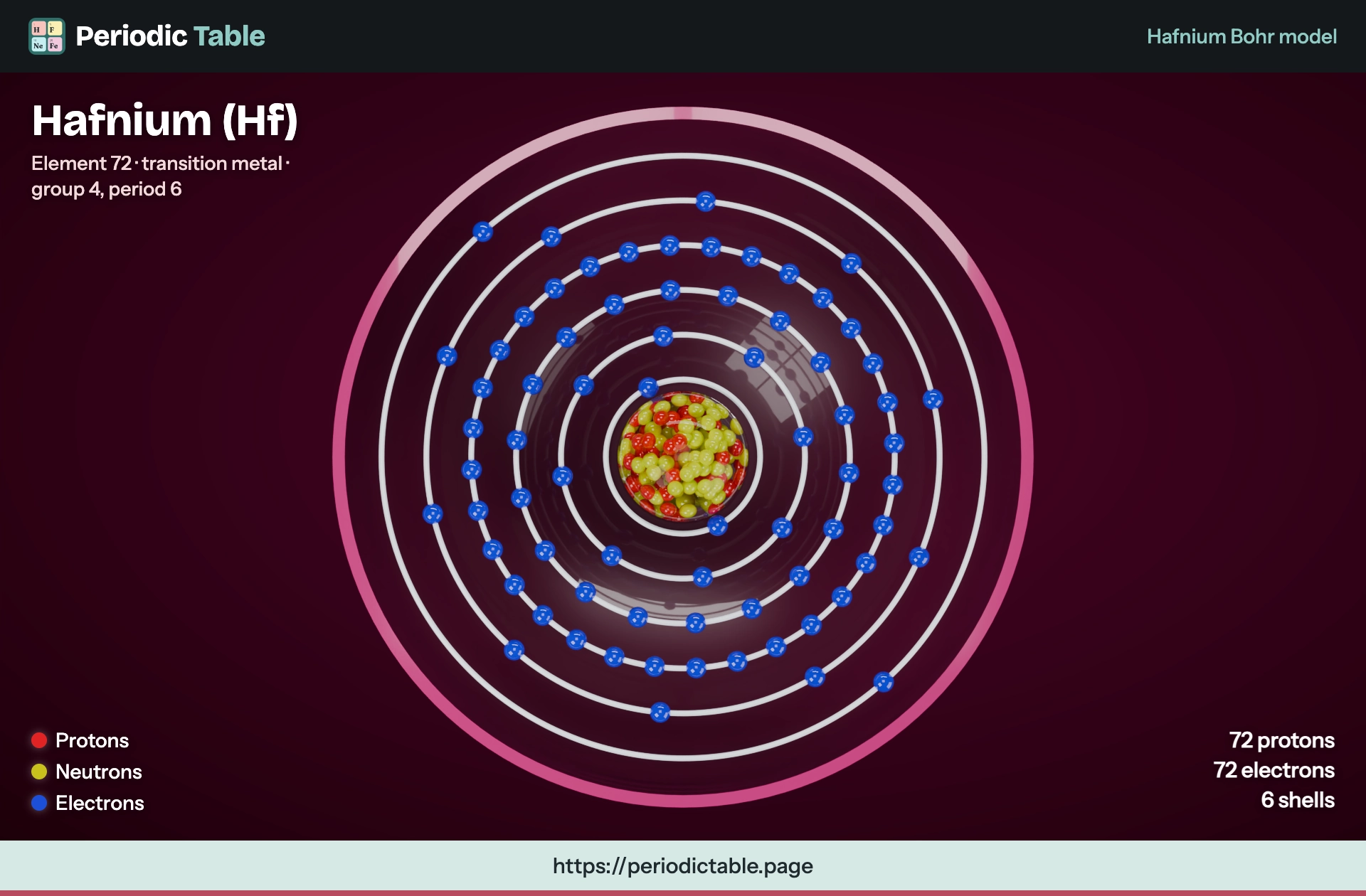
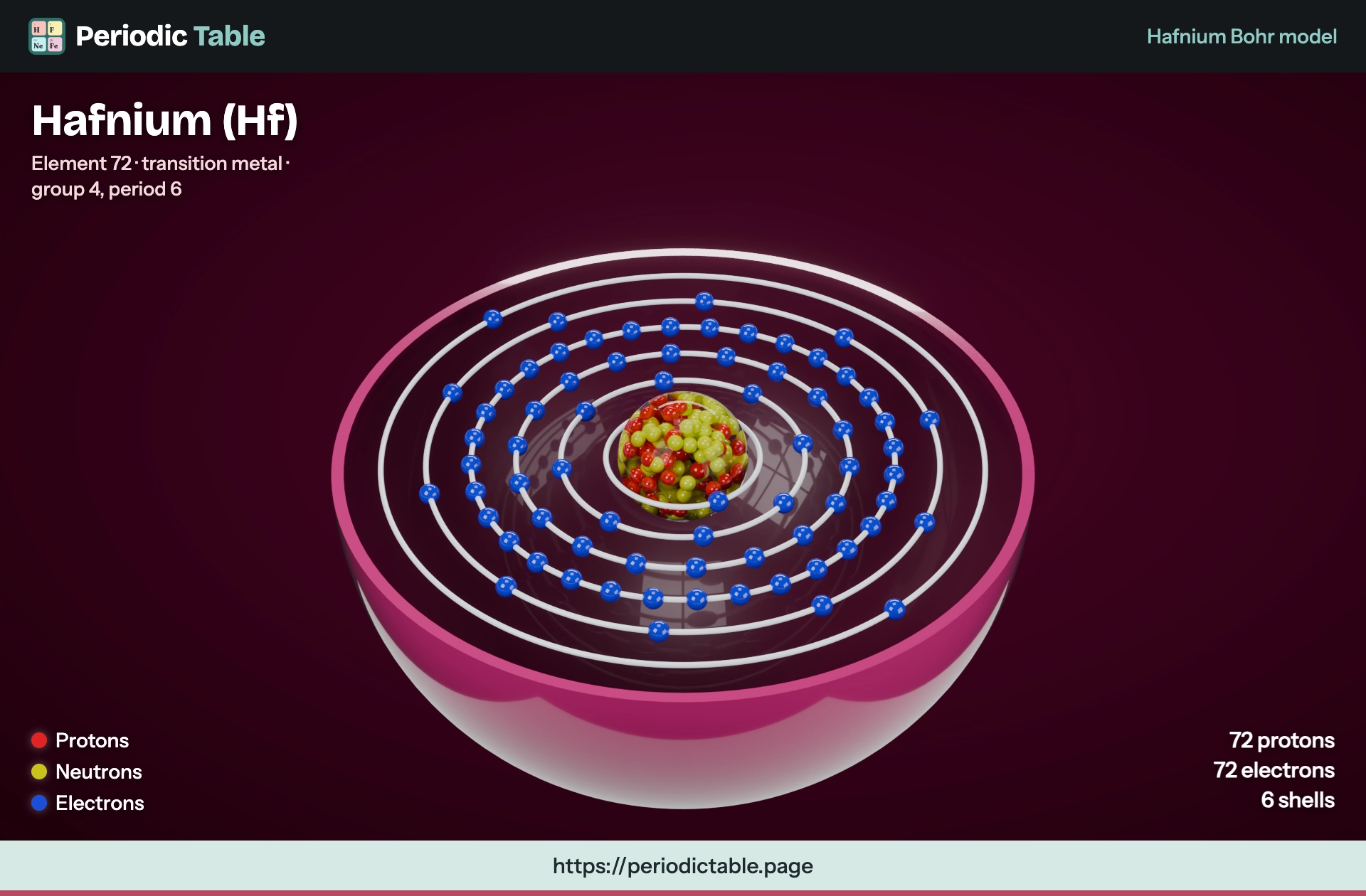
This is a Bohr model of hafnium (Hf), a simplified picture of a single hafnium atom. Its nucleus holds 72 protons, and a neutral hafnium atom has 72 electrons, arranged around it in 6 shells (2 in shell K, 8 in shell L, 18 in shell M, 32 in shell N, 10 in shell O and 2 in shell P).
Hafnium periodic table electron configuration
- Shorthand
- [Xe] 4f14 5d2 6s2
- Full
- 1s2 2s2 2p6 3s2 3p6 4s2 3d10 4p6 5s2 4d10 5p6 6s2 4f14 5d2
- Electrons per shell
- 2, 8, 18, 32, 10, 2
Hafnium element properties and atomic data
- Atomic number
- 72
- Atomic mass
- 178.492 u
- Phase at STP
- Solid
- Melting point
- 2232.85°C (2506 K)
- Boiling point
- 4602.85°C (4876 K)
- Density
- 13.31 g/cm³
- Electronegativity (Pauling)
- 1.3
- Period
- 6
- Group
- 4
- Block
- d-block
- Appearance
- Steel gray
- Discovery date
- 1923
- Discovered by
- Dirk Coster
- Named by
- —
Hafnium element facts: group 4, period 6 and the D-block
With atomic number 72, the element sits directly below titanium and zirconium in the periodic table, which is why its chemistry tracks theirs so closely. The table below collects the reference values you are most likely to need. Every figure is a published constant, not an estimate. For a path from sea brine to products, the bromine element overview follows oceans and salt as sources, then moves on to photography, plastics and medicine.
Hafnium at a glance
| Property | Value |
|---|---|
| Symbol | Hf |
| Atomic number | 72 |
| Atomic weight | 178.49 |
| Group / period / block | Group 4, period 6, d-block |
| Electron configuration | [Xe] 4f14 5d2 6s2 |
| Density at 20 °C | 13.28 g/cm3 |
| Melting point | 2,233 °C (2,506 K) |
| Boiling point | about 4,603 °C (4,876 K) |
| Electronegativity | 1.3 (Pauling scale) |
| Appearance at room conditions | Steel-grey solid |
Atomic weight, electron configuration and electronegativity
The standard weight of 178.49 is an average across six naturally occurring nuclides, weighted by how common each one is. The outer shell holds four valence electrons (two 5d and two 6s), so the atom gives up four electrons in nearly all of its chemistry. A value of 1.3 on the Pauling scale puts it among the more electropositive transition elements, which explains its eagerness to form oxides and halides.
Atomic radius and ionization energies
The empirical atomic radius is about 159 pm, almost identical to its lighter twin's despite carrying 32 more electrons. The first four ionization energies rise steeply, from roughly 659 to 3,216 kJ/mol, and stripping all four is what produces the stable Hf4+ ion. Its neighbours on either side, element 71 and tantalum (73), behave quite differently, which shows how much a single proton matters here.
Physical characteristics of hafnium and its crystal structure
The physical characteristics of hafnium make it a heavy, tough, corrosion-resistant metal. A bar of pure hafnium is roughly twice as heavy as the same bar of zirconium. Its density of about 13.3 g/cm3 is higher than that of lead, and it has a Mohs hardness of about 5.5. When tracing the main ore, molybdenite, and the route to pure metal, the molybdenum element guide describes each step.
- At ordinary conditions the atoms pack in a hexagonal close-packed lattice (the alpha form).
- Near 2,388 K the lattice rearranges into a body-centered cubic beta form, a phase change point well above where most structural metals have already melted.
- The specific heat capacity is low, about 144 J/(kg·K), so a given mass warms quickly as heat flows in.
- Thermal conductivity is modest, about 23 W/(m·K), and the element is paramagnetic.
Commercial samples are rarely perfectly pure. Even a few percent of its sister element shifts the mechanical and especially the nuclear behaviour, so grade certificates always list zirconium content.
Lanthanide contraction and its zirconium twin
You would normally expect an element one row lower to have bigger atoms. Hafnium does not, because of the lanthanide contraction: the fourteen 4f electrons added across the lanthanides shield the nucleus poorly, pulling the outer shells inward.
Relativistic effects in the heavy nucleus add a smaller extra squeeze. The physics leaves hafnium and zirconium with near-identical radii and the same outer electrons, and that chemical similarity is the single fact that shapes how the element is found, refined and priced.
Chemical properties of hafnium: oxidation states and corrosion resistance
The chemical properties of hafnium are dominated by the +4 state. It is tetravalent in almost every compound, although rare complexes show lower oxidation states (+3, +2, +1, 0 and even −2). In air it instantly grows a thin, adherent oxide film of HfO2, and that oxide layer is what gives it outstanding corrosion resistance in water, steam and most acids.
The protection has limits you should know about:
- Hydrofluoric acid and hot concentrated sulfuric acid attack it.
- The halogens react on heating to give volatile tetrahalides.
- It holds up well against concentrated alkalis.
- At high heat it combines directly with oxygen, nitrogen, carbon, boron, silicon and sulfur.
For practical chemistry the main differences from its twin are physical, not chemical: compounds of the two melt, boil and dissolve at slightly different points, and refiners exploit exactly those small gaps.
Hafnium isotopes, half-life and the 178m2 nuclear isomer
More than 40 hafnium isotopes have been observed, spanning mass numbers 153 to 192. Natural hafnium is a mixture of five stable isotopes plus one primordial nuclide that decays so slowly it barely counts as radioactive.
| Nuclide | Natural abundance | Status |
|---|---|---|
| Hf-174 | 0.16% | Alpha decay, over about 3.8 × 10¹⁶ years |
| Hf-176 | 5.26% | Stable |
| Hf-177 | 18.6% | Stable |
| Hf-178 | 27.3% | Stable |
| Hf-179 | 13.6% | Stable |
| Hf-180 | 35.1% | Stable |
Of the other nuclides, Hf-182 (which decays over about 8.9 million years) is now extinct in nature but left traces that help date the formation of planetary cores. The best-known oddity is Hf-178m2, a long-lived nuclear isomer with a 31-year half-life that stores a large amount of excitation energy.
Around 2000 it drew attention, and US defence funding, as a possible trigger for induced gamma emission. The idea collapsed: nobody could produce the isomer in useful quantities, and later experiments did not confirm the claimed effect.
Where hafnium is found: zircon, hafnon and heavy mineral sands
The element makes up roughly 3 to 5 ppm of Earth's crust, more than tin or silver, yet it never occurs in native form. Instead it hides inside zirconium-bearing minerals, substituting for zirconium atoms because the two are the same size.
- Zircon (ZrSiO4) is the main host, typically with 1-4% of its zirconium replaced. Ratios of about 50 zirconium atoms per hafnium atom are common.
- Baddeleyite (ZrO2) carries hafnium at somewhat lower ratios.
- Hafnon (HfSiO4) is the rare end member in which hafnium outnumbers zirconium.
In terms of geology, the element starts in magma: zircon crystallises in igneous rocks and in pegmatites, and survives metamorphic reworking almost untouched. Because zircon resists weathering, it erodes out of its parent rock and collects with rutile and ilmenite in beach and dune placer deposits.
These heavy mineral sands in Australia, South Africa, China and the south-eastern United States supply nearly all of the mined mineral. Hafnium is a by-product: no ore is worked for it alone, so mining output follows demand for zirconium and for the pigment feedstocks made from those minerals.
Why hafnium is a critical mineral
The US government lists hafnium as a critical mineral for defense, aerospace and energy technology. Supply is tied to a few refiners, it cannot be mined on its own, and it is expensive: the price roughly doubled in the mid-2010s when demand for reactor-grade zirconium dropped after Fukushima, and so did the by-product flow.
Hafnium production and separation from zirconium
Hafnium production exists because the nuclear industry needs zirconium almost free of hafnium (more on why below). Every tonne of reactor-grade zirconium therefore yields a small stream of hafnium, and that stream is most of the world's supply. The hard step is the separation itself.
Early chemists relied on slow fractional crystallization of fluoride salts, which never scaled. Modern plants use:
- Liquid-liquid extraction, in which the two metals partition differently between an aqueous phase and an organic solvent across dozens of stages.
- Extractive distillation of the chlorides, which exploits their slightly different volatility.
- Conversion of the purified hafnium fraction into hafnium tetrachloride, HfCl4.
The chloride is then reduced with molten magnesium in the Kroll process, a high-temperature reduction run in sealed steel retorts:
$$\mathrm{HfCl_4 + 2\,Mg \;\xrightarrow{\;1100\,^{\circ}C\;}\; Hf + 2\,MgCl_2}$$For the highest purity, the sponge goes through the van Arkel-de Boer method: iodine carries it as a vapour of HfI4, which decomposes on a white-hot tungsten filament and deposits pure crystals. Zirconium ores are, in effect, the only feedstock for this whole metal chain.
Uses of hafnium across modern industry
The main uses of hafnium follow directly from its properties. The nuclear industry takes a large share, followed by high-temperature alloys and electronics.
Control rods and neutron absorption in nuclear reactors
The standout trait is neutron absorption. Its neutron capture cross section for thermal neutrons is hundreds of times larger than zirconium's, and several of its nuclides can absorb a neutron, become the next heavier one, and absorb again, so a rod keeps its stopping power for years. Combined with its durability in hot pressurised water, that makes it an ideal material for control rods in nuclear reactors.
Most hafnium absorber rods go into compact military cores, especially submarine and aircraft-carrier plants, where refuelling is rare and space is tight. Civilian pressurized water reactors usually choose cheaper silver-indium-cadmium or boron carbide. The irony is that the same property forces zirconium refiners to remove hafnium: zirconium cladding around fuel rods must let those particles pass almost freely, or nuclear power plants would waste them.
Hafnium alloys and superalloys for extreme heat
Hafnium alloys are prized where things get very hot. In nickel-based superalloys for jet-engine turbine blades, an addition of around 1-2% strengthens grain boundaries and helps the protective oxide scale cling during thermal cycling, raising heat resistance.
The niobium alloy C103 (89% niobium, 10% hafnium, 1% titanium) was used for liquid-fuel rocket thruster nozzles on the Apollo Lunar Module. Nickel, iron and tantalum grades also take small doses.
Microprocessors and semiconductor gates
In 2007, Intel introduced hafnium oxide based insulators in its 45 nm microprocessors, replacing silicon dioxide in the transistor gate. A thin layer of hafnium dioxide is a high-permittivity dielectric, so it blocks leakage current that would otherwise flow through ultra-thin oxides.
Today the semiconductor industry deposits these films one atomic layer at a time by atomic layer deposition, using hafnium chloride or metal-organic precursors. Ferroelectric forms of the oxide are also being studied for new memory in integrated circuits and microelectronics, as transistors keep shrinking.
Isotope geochemistry and lutetium-hafnium dating
Geologists use isotope geochemistry to read the history of rocks, and lutetium-hafnium dating is one of its sharpest tools. Lu-176 decays to Hf-176 so slowly that half of it takes about 37 billion years to go, so the Hf-176/Hf-177 ratio in a crystal records how much Lu it has had time to decay. Zircon locks in hafnium at concentrations above 10,000 ppm while holding almost no Lu, which makes it an ideal tracer of how Earth's mantle and continents separated.
Garnet, which concentrates Lu instead, is used to date metamorphic events. Together these methods are a mainstay of modern geochronology.
Plasma cutting, lamps and catalysts
- Plasma cutting torches use hafnium inserts in their electrodes because it emits electrons readily and survives the arc.
- Gas-filled and incandescent lamps use it as a scavenger for traces of oxygen and nitrogen, and its ductility lets it be drawn into fine wire and filaments.
- Hafnium metallocene catalysts help make polyethylene and polypropylene with tightly controlled chain structures.
Hafnium compounds: carbide, nitride and oxide
Most hafnium compounds are hard, high-melting ceramics, and several hold records:
- Hafnium carbide (HfC) is the most refractory binary compound known, with a melting point close to 3,900 °C. It is studied for hypersonic vehicle leading edges.
- Hafnium nitride (HfN) is the most refractory metal nitride, melting at about 3,310 °C, and is used as a hard, gold-coloured coating.
- The carbonitride Hf(C,N) has the highest melting value measured for any material, above 4,000 °C.
- HfO2, also called hafnia, is a white ceramic that melts near 2,800 °C and serves in thermal barrier coatings and optics.
Unlike these ceramics, hafnium metal itself is rarely used bare. Its halides, chiefly the tetrachloride and tetraiodide, are mostly intermediates in refining and in organometallic chemistry.
Discovery of hafnium and the search for element 72
The discovery story is a contest between chemistry and physics. In 1869, Dmitri Mendeleev left room for a heavier sibling of titanium and zirconium. In 1914, Henry Moseley used X-ray spectroscopy to show that each element's place is fixed by its nuclear charge, which revealed a gap at element 72.
The question was what kind of element would fill it. In 1911, French chemist Georges Urbain had claimed it among the rare earth elements and named it celtium, but his spectra did not match. Theory pointed elsewhere: Niels Bohr, working from his quantum theory of electron shells, predicted that element 72 would resemble zirconium rather than any rare earth.
In late 1922 and early 1923, Dirk Coster and George de Hevesy, working at Bohr's institute in Copenhagen, examined Norwegian zircon by X-ray spectroscopy and found the missing lines within weeks. They named the element after Hafnia, the Latin name of the city.
It was the second-to-last stable element to be found; only rhenium, recognised in 1925, came later. In 1924, van Arkel and de Boer produced the first ductile metal by the iodide route.
Hafnium toxicity, pyrophoric powder and safe handling
The solid is inert and shows low toxicity, but finely divided hafnium powder is pyrophoric: it can catch fire through spontaneous combustion on contact with air. Suppliers ship it wetted with at least 25% water, and machining chips and dust are a real fire risk, so treat them as highly flammable.
- OSHA sets a workplace exposure limit of 0.5 mg/m3 as an 8-hour average, and NIOSH recommends the same value.
- Animal studies show the tetrachloride can damage the liver at high doses, so treat soluble compounds as toxic.
- Zircon processing can release traces of uranium and thorium, so refinery waste is managed for radiation as well as chemical hazards.